

Poor performance on the Iowa gambling task in children with obsessive-compulsive disorder
Open accessThe DOI matches its Crossref record; 45 of the 45 references it cites were found in a registry or an index.
Abstract
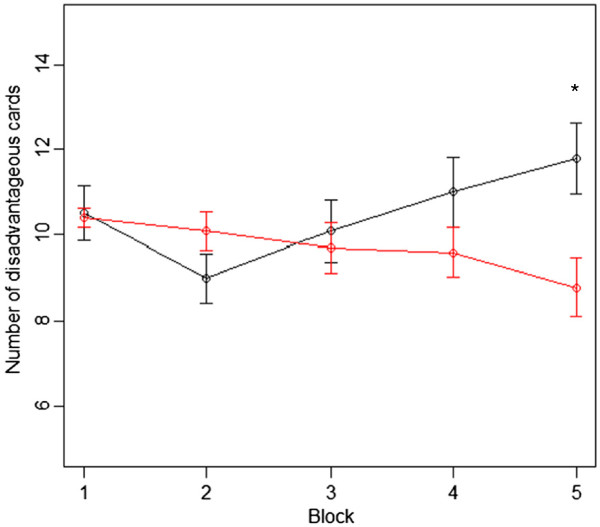
BACKGROUND: Several lines of evidence implicate orbitofrontal cortex dysfunction in the pathophysiology of obsessive-compulsive disorder (OCD). The purpose of this study was to investigate neuropsychological dysfunction of the orbitofrontal cortex in children with OCD. METHODS: The Iowa Gambling Task (IGT), which reflects orbitofrontal cortex function, and the Wisconsin Card Sorting Test (WCST), which is associated with functioning of the dorsolateral prefrontal cortex, were administered to 22 children with OCD and 22 healthy controls matched for gender, age, and intelligence. RESULTS: OCD patients displayed poor performance on the IGT. In contrast, performance on the WCST was not impaired in OCD patients compared to controls. CONCLUSIONS: These findings are in line with previous studies demonstrating that OCD in childhood is associated with a dysfunction of orbitofrontal-striatal-thalamic circuitry.
Overview
The claims and statistics of this paper haven’t been checked yet.
Free: it reads the open-access text and checks the first 5 claims that cite a source we can check. Create a free account to check every claim.
Integrity signals
Registry
Cites
Statistics
Figures
Verification
Claims the paper makes
The claims and statistics of this paper haven’t been checked yet.
Free: it reads the open-access text and checks the first 5 claims that cite a source we can check. Create a free account to check every claim.
Claims other papers make about this one
Each is checked against this paper’s own text: does it say what the citing paper says it does?
The source backs part of the claim, not all of it — or backs it for a different population, condition or comparison.
In the citing paper
“IGT scores in OCD patients under the age of 18 were still significantly lower than in HC.”
From Obsessive-Compulsive Disorder and Decision Making under Ambiguity: A Systematic Review with Meta-Analysis (2021) · cites this paper as [39]
Experimental — accuracy not yet measuredThe cited source says what the claim attributes to it.
In the citing paper
“However three studies found a correlation between symptoms severity as per Y-BOCS and IGT scores [18,39,45].”
From Obsessive-Compulsive Disorder and Decision Making under Ambiguity: A Systematic Review with Meta-Analysis (2021) · cites this paper as [39]
The cited source says what the claim attributes to it.
In the citing paper
“To the best of our knowledge, only two studies evaluated IGT performance in adolescents with OCD: Kodaira and colleagues [39] found that children with OCD performed similar to controls in the early stages of the IGT, but selected more disadvantageous cards at the very last block; this behaviour has been observed in patients with a deficit of the orbitofrontal cortex.”
From Obsessive-Compulsive Disorder and Decision Making under Ambiguity: A Systematic Review with Meta-Analysis (2021) · cites this paper as [39]
In the citing paper
“However, a recent study based on large groups indicates that impaired decision-making might be a key feature in OCD (da Rocha et al. 2011) and already present in childhood (Kodaira et al. 2012).”
From The neurobiological link between OCD and ADHD (2014) · cites this paper as Kodaira et al. 2012
Self-check
Percentages, sums and reported differences re-computed from the paper’s own numbers.
The self-check needs the paper’s full text.
Citations
Cites
Diagnostic and Statistical Manual of Mental Disorders
Williams, J. B. W., & First, M. (2013) · Encyclopedia of Social Work · doi:10.1093/acrefore/9780199975839.013.104 · Cited by 109,519
Faul, F., Erdfelder, E., Lang, A.-G., & Buchner, A. (2007) · Behavior Research Methods · doi:10.3758/bf03193146 · Cited by 65,971
Insensitivity to future consequences following damage to human prefrontal cortex
Bechara, A., Damasio, A. R., Damasio, H., & Anderson, S. W. (1994) · Cognition · doi:10.1016/0010-0277(94)90018-3 · Cited by 6,128 · cited 11×
“Performance on the Iowa Gambling Task (IGT), which evaluates real-life decision-making abilities under conditions of ambiguity, is particularly sensitive to alterations in OFC function [4,5].”
BackgroundMethodInfluentialDiagnostic and Statistical Manual of Mental Disorders ( DSM ‐ IV ‐ TR )
Segal, D. L. (2010) · The Corsini Encyclopedia of Psychology · doi:10.1002/9780470479216.corpsy0271 · Cited by 4,666
A Modified Card Sorting Test Sensitive to Frontal Lobe Defects
Nelson, H. E. (1976) · Cortex · doi:10.1016/s0010-9452(76)80035-4 · Cited by 2,454 · cited 1×
“It is also a sensitive test of dorsolateral prefrontal cortex function [26].”
BackgroundChildren's Yale-Brown Obsessive Compulsive Scale: Reliability and Validity
SCAHILL, L., RIDDLE, M. A., McSWIGGIN-HARDIN, M., ORT, S. I., KING, R. A., GOODMAN, W. K., CICCHETTI, D., & LECKMAN, J. F. (1997) · Journal of the American Academy of Child & Adolescent Psychiatry · doi:10.1097/00004583-199706000-00023 · Cited by 2,045 · cited 6×
“The present findings that IGT performance correlated significantly with the CY-BOCS score during the period with the most severe symptoms but not with the CYBOCS score at the time of the assessment suggest that IGT performance may be associated with the potential severity of OCD rather than the state of present sympto…”
MethodInfluentialRelative reward preference in primate orbitofrontal cortex
Tremblay, L., & Schultz, W. (1999) · Nature · doi:10.1038/19525 · Cited by 1,314 · cited 1×
“Electrophysiological recordings of the OFC have revealed that orbitofrontal neurons play an important role in processing the motivational value of rewarding outcomes [30-32].”
BackgroundDissociation Of Working Memory from Decision Making within the Human Prefrontal Cortex
Bechara, A., Damasio, H., Tranel, D., & Anderson, S. W. (1998) · The Journal of Neuroscience · doi:10.1523/jneurosci.18-01-00428.1998 · Cited by 1,059 · cited 1×
“Performance on the Iowa Gambling Task (IGT), which evaluates real-life decision-making abilities under conditions of ambiguity, is particularly sensitive to alterations in OFC function [4,5].”
BackgroundAbramowitz, J. S., Taylor, S., & McKay, D. (2009) · The Lancet · doi:10.1016/s0140-6736(09)60240-3 · Cited by 1,002
Toward a neurobiology of obsessive-compulsive disorder
Graybiel, A. M., & Rauch, S. L. (2000) · Neuron · doi:10.1016/s0896-6273(00)00113-6 · Cited by 864 · cited 1×
“The current dominant model of obsessive-compulsive disorder (OCD) focuses on abnormalities in corticostriatal circuitry, with particular emphasis on the orbitofrontal-striatal-thalamic circuit [1,2].”
Background
Research works printed but not linked: 1
- 27. Lezak MD. Neuropsychological Assessment. 3. New York: Oxford University Press, USA; 1995.
Cited by
Think twice: Impulsivity and decision making in obsessive–compulsive disorder
Grassi, G., Pallanti, S., Righi, L., Figee, M., Mantione, M., Denys, D., Piccagliani, D., Rossi, A., & Stratta, P. (2015) · Journal of Behavioral Addictions · doi:10.1556/2006.4.2015.039 · Cited by 137
“…al., 2006; Cavedini, Riboldi, D’Annucci et al., 2002; Cavedini, Riboldi, Keller et al., 2002; Cavedini et al., 2012, Cavedini et al., 2010; da Rocha, Alvarenga et al., 2011; da Rocha, Malloy-Diniz et al., 2011; da Rocha et al. 2008; Kashyap et al., 2013; Kodaira et al., 2012; Starcke et al., 2010).”
BackgroundResultInfluentialReward-based decision making in pathological gambling: The roles of risk and delay
Wiehler, A., & Peters, J. (2014) · Neuroscience Research · doi:10.1016/j.neures.2014.09.008 · Cited by 123
The neurobiological link between OCD and ADHD
Brem, S., Grünblatt, E., Drechsler, R., Riederer, P., & Walitza, S. (2014) · ADHD Attention Deficit and Hyperactivity Disorders · doi:10.1007/s12402-014-0146-x · Cited by 109
Abramovitch, A., Abramowitz, J. S., Mittelman, A., Stark, A., Ramsey, K., & Geller, D. A. (2015) · Journal of Child Psychology and Psychiatry · doi:10.1111/jcpp.12414 · Cited by 88
“…Emel, & Oner, 2011; Beers et al., 1999; Behar et al., 1984; Chang, Mccracken, & Piacentini, 2007; Gruner et al., 2012; Huyser, Veltman, Wolters, De Haan, & Boer, 2010; Kodaira et al., 2012; Ornstein et al., 2010; Zandt, Prior, & Kyrios, 2009), the year of publication ranging from 1984 to 2012.”
Impaired cognitive plasticity and goal-directed control in adolescent obsessive–compulsive disorder
Gottwald, J., de Wit, S., Apergis-Schoute, A. M., Morein-Zamir, S., Kaser, M., Cormack, F., Sule, A., Limmer, W., Morris, A. C., Robbins, T. W., et al. (2018) · Psychological Medicine · doi:10.1017/s0033291717003464 · Cited by 64
“For cognitive flexibility and set shifting, some studies have shown impairments in youths with OCD (Andrés et al. 2007; Shin et al. 2008; Isik Taner et al. 2011; Gruner et al. 2012), while others found no deficits (Beers et al. 1999; Ornstein et al. 2010; Kodaira et al. 2012; Hybel et al. 2017).”
InfluentialNorman, L. J., Carlisi, C. O., Christakou, A., Murphy, C. M., Chantiluke, K., Giampietro, V., Simmons, A., Brammer, M., Mataix-Cols, D., & Rubia, K. (2018) · Biological Psychiatry: Cognitive Neuroscience and Neuroimaging · doi:10.1016/j.bpsc.2018.03.009 · Cited by 55
“Indeed, the previous report of performance differences on the IGT in adolescents with OCD found significant differences only on the final 20 trials (63).”
Unpacking the role of self-reported compulsivity and impulsivity in obsessive-compulsive disorder
Prochazkova, L., Parkes, L., Dawson, A., Youssef, G., Ferreira, G. M., Lorenzetti, V., Segrave, R. A., Fontenelle, L. F., & Yücel, M. (2018) · CNS Spectrums · doi:10.1017/s1092852917000244 · Cited by 40
Carlisi, C. O., Norman, L., Murphy, C. M., Christakou, A., Chantiluke, K., Giampietro, V., Simmons, A., Brammer, M., Murphy, D. G., Mataix-Cols, D., et al. (2017) · Cerebral Cortex · doi:10.1093/cercor/bhx265 · Cited by 40
“Only one study was conducted in children with OCD using the IGT which found that patients performed worse relative to controls and that this was related to symptom severity during the most severe period of illness (Kodaira et al. 2012).”
Marzuki, A. A., Pereira de Souza, A. M. F. L., Sahakian, B. J., & Robbins, T. W. (2020) · Neuroscience & Biobehavioral Reviews · doi:10.1016/j.neubiorev.2019.12.010 · Cited by 39
Cool and Hot Aspects of Executive Function in Childhood Obsessive-Compulsive Disorder
Hybel, K. A., Mortensen, E. L., Lambek, R., Thastum, M., & Thomsen, P. H. (2017) · Journal of Abnormal Child Psychology · doi:10.1007/s10802-016-0229-6 · Cited by 34
“To our knowledge only one study has investigated decision making in a pediatric sample and found OCD children to perform inferior to nonpsychiatric controls on the Iowa gambling task, an ambiguous paradigm task (Kodaira et al. 2012).”
BackgroundResultZhang, L., Dong, Y., Ji, Y., Tao, R., Chen, X., Ye, J., Zhang, L., Yu, F., Zhu, C., & Wang, K. (2015) · Scientific Reports · doi:10.1038/srep17312 · Cited by 26
Disrupted latent decision processes in medication-free pediatric OCD patients
Erhan, C., Bulut, G. Ç., Gökçe, S., Ozbas, D., Türkakın, E., Dursun, O. B., Yazgan, Y., & Balcı, F. (2016) · Journal of Affective Disorders · doi:10.1016/j.jad.2016.09.011 · Cited by 27
Zhu, C., Yu, F., Ye, R., Chen, X., Dong, Y., Li, D., Zhang, L., Li, D., & Wang, K. (2014) · PLoS ONE · doi:10.1371/journal.pone.0090874 · Cited by 22
“Some neuropsychological research in OCD patients has found impaired decision-making behavior on the Iowa Gambling Task (IGT) [42,43].”
BackgroundResultInfluentialNisticò, V., De Angelis, A., Erro, R., Demartini, B., & Ricciardi, L. (2021) · Brain Sciences · doi:10.3390/brainsci11020143 · Cited by 20
“To explain heterogeneity among studies, we attempted to evaluate the influence of age on IGT performance by pooling studies considering subjects under the age of 18 [31,39] and studies evaluating subjects above the age of 18.”
BackgroundMethodResultInfluentialUhre, C. F., Ritter, M., Jepsen, J. R. M., Uhre, V., Lønfeldt, N. N., Müller, A. D., Plessen, K. J., Vangkilde, S., Blair, J., & Pagsberg, A. K. (2023) · European Child & Adolescent Psychiatry · doi:10.1007/s00787-023-02301-w · Cited by 20
“…with OCD, relative to comparison participants, were slower to learn response–outcome relationships and worse at adapting response strategy when previously rewarded actions were devalued compared to non-psychiatric control children [47, 48] and show poorer decision-making ability [49, 50].”
ResultCiano, P. D., Manvich, D. F., Pushparaj, A. P., Gappasov, A., Hess, E. J., Weinshenker, D., & Foll, B. L. (2017) · Psychopharmacology · doi:10.1007/s00213-017-4744-0 · Cited by 17
“…A uthor M anuscript disorder (Biernacki et al. 2016; Stephan et al. 2017), Parkinson’s disease (Evens et al. 2016), obsessive-compulsive disorder (Kodaira et al. 2012), and eating disorders (Garrido and Subira 2013), which poses the question as to whether the present findings with disulfiram…”
Becker, H. C., Norman, L., Yang, H., Monk, C. S., Phan, K., Taylor, S., Liu, Y.-N., Mannella, K. A., & Fitzgerald, K. (2021) · Psychological Medicine · doi:10.1017/s0033291721003044 · Cited by 14
Sawa, T., Kodaira, M., Oiji, A., Sasayama, D., Iwadare, Y., Ushijima, H., Usami, M., Watanabe, K., & Saito, K. (2013) · Annals of General Psychiatry · doi:10.1186/1744-859x-12-31 · Cited by 18
“In the present study, subjects were informed that they would get a special gift if they earned at least 300,000 yen at the end of the task [16].”
BackgroundSelf-citationGüngör, B. B., Budak, E., Taymur, İ., Zorlu, N., Ucgun, B., Akgul, A. I., & Demirci, H. (2018) · Archives of Clinical Psychiatry (São Paulo) · doi:10.1590/0101-60830000000170 · Cited by 8
“The first 20 cards (0-20) represent pre-punishment (baseline), the second 20 cards (21-40) a pre-hunch, the third 20 cards (41-60) a hunch and the fourth (61-80) and fifth (81-100) blocks show conceptual knowledge.”
Behavioral domains in compulsive rats: implications for understanding compulsive spectrum disorders
Martín-González, E., Olmedo-Córdoba, M., Prados-Pardo, Á., Cruz-Garzón, D. J., Flores, P., Mora, S., & Moreno, M. (2023) · Frontiers in Behavioral Neuroscience · doi:10.3389/fnbeh.2023.1175137 · Cited by 6
Intelligence quotient (IQ) in pediatric patients with obsessive-compulsive disorder
Batistuzzo, M. C., Souza, M. D. M. E., Bernardes, E. T., Requena, G. D. L., Miguel, E. C., & Shavitt, R. G. (2020) · Journal of Obsessive-Compulsive and Related Disorders · doi:10.1016/j.jocrd.2020.100548 · Cited by 6
Lochman, J. E., Vernberg, E. M., Glenn, A. L., Jarrett, M. A., McDonald, K. L., Powell, N. P., Abel, M. R., Boxmeyer, C. L., Kassing, F., Qu, L., et al. (2021) · Research on Child and Adolescent Psychopathology · doi:10.1007/s10802-020-00753-1 · Cited by 53
Neuropsychological performance in youth with obsessive-compulsive disorder
Deepthi, K., Roopesh, B. N., Balachander, S., Sagar, J. V., Thennarasu, K., & Reddy, Y. C. J. (2021) · Journal of Psychiatric Research · doi:10.1016/j.jpsychires.2021.03.066 · Cited by 5
Carlisi, C. O. (2017) · Research Portal (King's College London) · Cited by 1
Marzuki, A. A. (2021) · Apollo (University of Cambridge) · doi:10.17863/cam.70408
(2020) · Elsevier eBooks · doi:10.1016/b978-0-12-815002-3.00020-6
Ho, Y.-C., Tsai, S., & Chen, M. (2023) · Taiwanese Journal of Psychiatry · doi:10.4103/tpsy.tpsy_20_23
Zevedei, D. (2023) · Tesis Doctorals en Xarxa (Consorci de Serveis Universitaris de Catalunya)
González, E. M. (2022) · Repositorio de Patentes de la Universidad de Almería (Universidad de Almería) · Cited by 2
Prados-Pardo, Á. (2023) · Repositorio de Patentes de la Universidad de Almería (Universidad de Almería)
Košíková, E., Turoňová, D., Konrádová, Ľ., & Mesárošová, B. (2026) · Children · doi:10.3390/children13081109
“Similarly, a clinical study by Kodaira et al. [83] reported that children with OCD had significantly worse IGT performance, while their WCST performance was not significantly different compared to the control group.”
Metadata
- Authors
- Kodaira, M., Iwadare, Y., Ushijima, H., Oiji, A., Kato, M., Sugiyama, N., Sasayama, D., Usami, M., Watanabe, K., & Saito, K.
- Affiliations
- National Center for Global Health and Medicine (JP)
- Kumamoto University (JP)
- Kitasato University (JP)
- Keio University (JP)
- Shinshu University (JP)
- Corresponding author
- Kodaira, Masaki
- Venue
- Annals of General Psychiatry
- Published
- 2012
- Volume
- 11
- Issue
- 1
- Pages
- 25
- ISSN
- 1744-859X (ISSN-L)
- PMC
- PMC3508952
- OpenAlex
- W2112869130
- Semantic Scholar
- db218d0bca5c418504ee113ca968bc062b05efd2
- Cited by
- 28
- References
- 45
- Citations by year
- 2026: 1 · 2023: 3 · 2021: 4 · 2020: 2 · 2019: 1 · 2018: 4 · 2017: 4 · 2016: 2 · 2015: 3 · 2014: 3 · 2013: 1
- FWCI
- 2.55
- Type
- journal article
- Language
- en
- Open access
- gold
- doi.org
- Licence
- cc-by
- Locations
- Annals of General Psychiatry (publishedVersion, cc-by)
- PubMed Central (publishedVersion, cc-by)
- PubMed (publishedVersion)
- Institutional Repositories DataBase (IRDB) (publishedVersion, cc-by)
- DOAJ (DOAJ: Directory of Open Access Journals) (submittedVersion)
- SOAR (Shinshu University) (submittedVersion, cc-by-nc-nd)
- Topics
- Social Sciences › Psychology › Clinical Psychology › Obsessive-Compulsive Spectrum Disorders
- Life Sciences › Neuroscience › Cognitive Neuroscience › Neural and Behavioral Psychology Studies
- Social Sciences › Psychology › Clinical Psychology › Psychoanalysis and Psychopathology Research
- Keywords
- obsessive-compulsive disorder, childhood OCD, Iowa Gambling Task, Wisconsin Card Sorting Test, dorsolateral prefrontal cortex, neuropsychological dysfunction
About these checks
Registry, retraction, Cites and statistics results are computed, not judged, with one exception: a printed reference that no index lists is read once by a model before it counts as a citation error. Claims are extracted by a model and kept only when their quote appears verbatim in the text; each cited source is then checked, with a model’s help, for whether it says what the claim relies on. Those verdicts can be wrong — read the claim’s quote and the cited source before relying on one.
Statistics and arithmetic are recomputed, not judged.
Confidence bands are shown only for fields calibrated on our annotated test set. None is calibrated yet, so no band is shown.
What counts as a claim ›How we measure confidence ›How we check this ›
Are you an author, or do you see a problem with this page? Request a review
Data sources
Bibliographic data: Semantic Scholar, OpenAlex, Crossref.
Contains information from the Semantic Scholar Academic Graph Datasets, made available under the ODC Attribution License (ODC-BY 1.0).
Semantic Scholar’s data is described in: Kinney, R., et al. (2023). The Semantic Scholar Open Data Platform. arXiv:2301.10140.
