

Evolution of the genetic code: partial optimization of a random code for robustness to translation error in a rugged fitness landscape
Open accessThe DOI matches its Crossref record; 67 of the 67 references it cites were found in a registry or an index.
Abstract
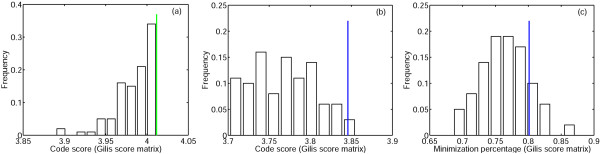
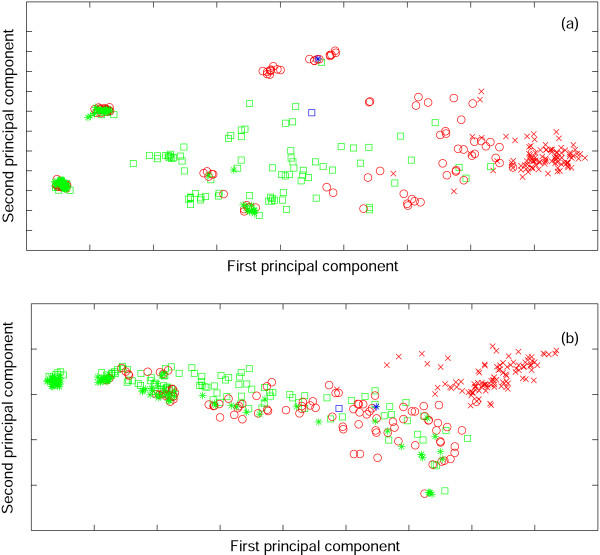
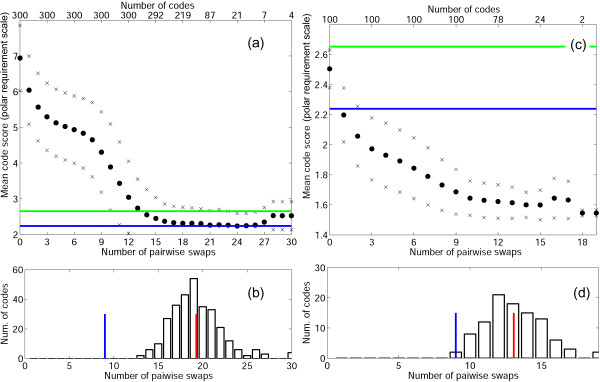
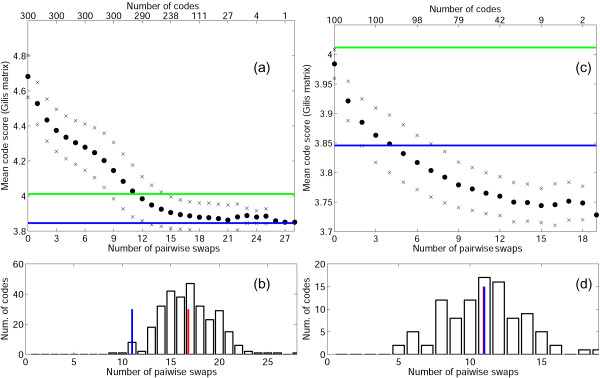
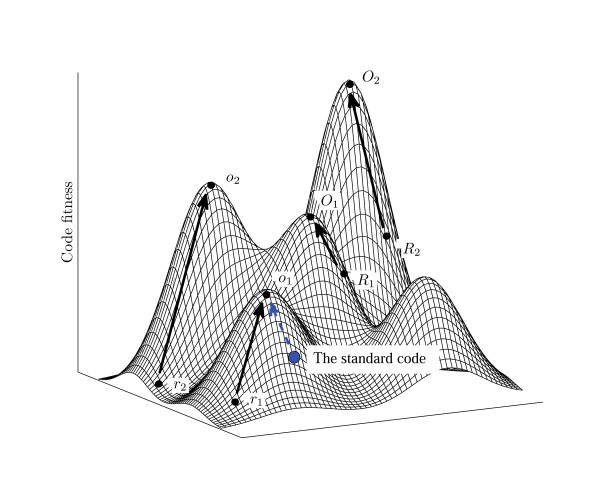
Background: The standard genetic code table has a distinctly non-random structure, with similar amino acids often encoded by codons series that differ by a single nucleotide substitution, typically, in the third or the first position of the codon. It has been repeatedly argued that this structure of the code results from selective optimization for robustness to translation errors such that translational misreading has the minimal adverse effect. Indeed, it has been shown in several studies that the standard code is more robust than a substantial majority of random codes. However, it remains unclear how much evolution the standard code underwent, what is the level of optimization, and what is the likely starting point. Results: We explored possible evolutionary trajectories of the genetic code within a limited domain of the vast space of possible codes. Only those codes were analyzed for robustness to translation error that possess the same block structure and the same degree of degeneracy as the standard code. This choice of a small part of the vast space of possible codes is based on the notion that the block structure of the standard code is a consequence of the structure of the complex between the cognate tRNA and the codon in mRNA where the third base of the codon plays a minimum role as a specificity determinant. Within this part of the fitness landscape, a simple evolutionary algorithm, with elementary evolutionary steps comprising swaps of four-codon or two-codon series, was employed to investigate the optimization of codes for the maximum attainable robustness. The properties of the standard code were compared to the properties of four sets of codes, namely, purely random codes, random codes that are more robust than the standard code, and two sets of codes that resulted from optimization of the first two sets. The comparison of these sets of codes with the standard code and its locally optimized version showed that, on average, optimization of random codes yielded evolutionary trajectories that converged at the same level of robustness to translation errors as the optimization path of the standard code; however, the standard code required considerably fewer steps to reach that level than an average random code. When evolution starts from random codes whose fitness is comparable to that of the standard code, they typically reach much higher level of optimization than the standard code, i.e., the standard code is much closer to its local minimum (fitness peak) than most of the random codes with similar levels of robustness. Thus, the standard genetic code appears to be a point on an evolutionary trajectory from a random point (code) about half the way to the summit of the local peak. The fitness landscape of code evolution appears to be extremely rugged, containing numerous peaks with a broad distribution of heights, and the standard code is relatively unremarkable, being located on the slope of a moderate-height peak. Conclusion: The standard code appears to be the result of partial optimization of a random code for robustness to errors of translation. The reason the code is not fully optimized could be the trade-off between the beneficial effect of increasing robustness to translation errors and the deleterious effect of codon series reassignment that becomes increasingly severe with growing complexity of the evolving system. Thus, evolution of the code can be represented as a combination of adaptation and frozen accident. Reviewers: This article was reviewed by David Ardell, Allan Drummond (nominated by Laura Landweber), and Rob Knight. Open Peer Review: This article was reviewed by David Ardell, Allan Drummond (nominated by Laura Landweber), and Rob Knight.
Overview
The claims and statistics of this paper haven’t been checked yet.
Free: it reads the open-access text and checks the first 5 claims that cite a source we can check. Create a free account to check every claim.
Integrity signals
Registry
Cites
Statistics
Figures
Verification
Claims the paper makes
The claims and statistics of this paper haven’t been checked yet.
Free: it reads the open-access text and checks the first 5 claims that cite a source we can check. Create a free account to check every claim.
Claims other papers make about this one
Each is checked against this paper’s own text: does it say what the citing paper says it does?
The source backs part of the claim, not all of it — or backs it for a different population, condition or comparison.
In the citing paper
“Using the language of fitness landscapes, the frozen accident perspective implies that there can be many different codes occupying fitness peaks, but these are separated by deep valleys of low fitness (60).”
From Origin and Evolution of the Universal Genetic Code (2017) · cites this paper as [60]
Experimental — accuracy not yet measuredThe source backs part of the claim, not all of it — or backs it for a different population, condition or comparison.
In the citing paper
“Using the language of fitness landscapes, the frozen accident perspective implies that there can be many different codes occupying fitness peaks, but they are separated by deep valleys of low fitness [15] (Figure 1).”
From Frozen Accident Pushing 50: Stereochemistry, Expansion, and Chance in the Evolution of the Genetic Code (2017) · cites this paper as [15]
Experimental — accuracy not yet measuredThe source backs part of the claim, not all of it — or backs it for a different population, condition or comparison.
In the citing paper
“Quantitative analyses of the code using cost functions derived from physico-chemical properties of amino acids or their evolutionary exchangeability have confirmed the exceptional robustness of the standard genetic code (SGC): the probability to reach the same level of error minimization as in the SGC by random permutation of codons is below 10−6 [10,13,14,15].”
From Frozen Accident Pushing 50: Stereochemistry, Expansion, and Chance in the Evolution of the Genetic Code (2017) · cites this paper as [15]
Experimental — accuracy not yet measuredThe cited source says what the claim attributes to it.
In the citing paper
“a quantitative estimate has shown that the SGC is positioned roughly halfway from an average random code to the summit of the corresponding local peak (60).”
From Origin and Evolution of the Universal Genetic Code (2017) · cites this paper as [60]
The cited source says what the claim attributes to it.
In the citing paper
“Obviously, however, among the ~1084 possible random codes, there is a huge number with a higher degree of error minimization than the SGC.”
From Frozen Accident Pushing 50: Stereochemistry, Expansion, and Chance in the Evolution of the Genetic Code (2017) · cites this paper as [15]
2 more claims about this paper
Create a free account to see every claim other papers make about this one.
Self-check
Percentages, sums and reported differences re-computed from the paper’s own numbers.
The self-check needs the paper’s full text.
Citations
Cites
The origin of the genetic code
Crick, F. H. C. (1968) · Journal of Molecular Biology · doi:10.1016/0022-2836(68)90392-6 · Cited by 2,320
Codon—anticodon pairing: The wobble hypothesis
Crick, F. H. C. (1966) · Journal of Molecular Biology · doi:10.1016/s0022-2836(66)80022-0 · Cited by 2,029
King, J. L., & Jukes, T. H. (1969) · Science · doi:10.1126/science.164.3881.788 · Cited by 1,768
MICROBIOLOGY AND MOLECULAR BIOLOGY REVIEWS: 2011 INSTRUCTIONS TO AUTHORS
(2011) · Microbiology and Molecular Biology Reviews · doi:10.1128/mmbr.00038-10 · Cited by 1,313
Recognition of Cognate Transfer RNA by the 30 S Ribosomal Subunit
Ogle, J. M., Brodersen, D. E., Clemons, W. M., Tarry, M. J., Carter, A. P., & Ramakrishnan, V. (2001) · Science · doi:10.1126/science.1060612 · Cited by 1,162
A co-evolution theory of the genetic code
Wong, J. T.-F. (1975) · Proceedings of the National Academy of Sciences · doi:10.1073/pnas.72.5.1909 · Cited by 649 · cited 1×
“The coevolution hypothesis [34-38] posits that the structure of the standard code reflects the biosynthetic pathways of amino acid formation.”
BackgroundSTRUCTURAL INSIGHTS INTO TRANSLATIONAL FIDELITY
Ogle, J. M., & Ramakrishnan, V. (2005) · Annual Review of Biochemistry · doi:10.1146/annurev.biochem.74.061903.155440 · Cited by 588
The genetic code is one in a million
Freeland, S. J., & Hurst, L. D. (1998) · Journal of Molecular Evolution · doi:10.1007/pl00006381 · Cited by 563 · cited 11×
“Haig and Hurst [12] let p ( c '| c ) = 1 for any two codons that differ by one base and p ( c '| c ) = 0 otherwise, not taking into account that transitions (i.e., translational misreading between two purines or two pyrimidines) might occur more often than transversions (interchange between purines and pyrimidines) [4…”
BackgroundMethodInfluentialOn the evolution of the genetic code.
Woese, C. R. (1965) · Proceedings of the National Academy of Sciences · doi:10.1073/pnas.54.6.1546 · Cited by 487
STREPTOMYCIN, SUPPRESSION, AND THE CODE
Davies, J., Gilbert, W., & Gorini, L. (1964) · Proceedings of the National Academy of Sciences · doi:10.1073/pnas.51.5.883 · Cited by 474 · cited 1×
“The initial evidence for the translation-error hypothesis consists of the aforementioned fact that related codons (codons that differ by one base only), typically, code for related amino acids (amino acids with similar physicochemical properties) and the experimental observations that translational errors occur more f…”
BackgroundErrors and alternatives in reading the universal genetic code
Parker, J. (1989) · Microbiological Reviews · doi:10.1128/mmbr.53.3.273-298.1989 · Cited by 460
Kramer, E. B., & Farabaugh, P. J. (2007) · RNA · doi:10.1261/rna.294907 · Cited by 443 · cited 1×
“…p ( c '| c ) = 1 for any two codons that differ by one base and p ( c '| c ) = 0 otherwise, not taking into account that transitions (i.e., translational misreading between two purines or two pyrimidines) might occur more often than transversions (interchange between purines and pyrimidines) [43].”
BackgroundMICROBIOLOGY AND MOLECULAR BIOLOGY REVIEWS: 2007 INSTRUCTIONS TO AUTHORS
(2007) · Microbiology and Molecular Biology Reviews · doi:10.1128/mmbr.00038-06 · Cited by 420
Possible Relation between Deoxyribonucleic Acid and Protein Structures
GAMOW, G. (1954) · Nature · doi:10.1038/173318a0 · Cited by 377 · cited 1×
“The stereochemical hypothesis that can be traced back to the early work of Gamow [3,25-31] postulates that codon assignments for particular amino acids are determined by a physicochemical affinity that exists between the amino acids and the cognate nucleotide triplets (codons or anticodons).”
BackgroundInsights into the decoding mechanism from recent ribosome structures
Ogle, J. M., Carter, A. P., & Ramakrishnan, V. (2003) · Trends in Biochemical Sciences · doi:10.1016/s0968-0004(03)00066-5 · Cited by 371 · cited 4×
“I was unable to connect the contents of [50] (Spirin, RNA Biol.”
BackgroundInfluentialJournal of Molecular Evolution
(2013) · Journal of Molecular Evolution · doi:10.1007/239.1432-1432 · Cited by 367
Natural expansion of the genetic code
Ambrogelly, A., Palioura, S., & Söll, D. (2007) · Nature Chemical Biology · doi:10.1038/nchembio847 · Cited by 361 · cited 1×
“The main general features that do not depend upon details of the code are: (i) there are four distinct bases in mRNA – two pyrimidines (U, C) and two purines (A, G), (ii) each codon is a triplet of bases, thus forming 64 (43) codons, and (iii) 20 standard protein amino acids are encoded (with the notable exception of…”
BackgroundA quantitative measure of error minimization in the genetic code
Haig, D., & Hurst, L. D. (1991) · Journal of Molecular Evolution · doi:10.1007/bf02103132 · Cited by 337
The genetic code : the molecular basis for genetic expression
Woese, C. R. (1967) · Harper & Row eBooks · Cited by 298
On the fundamental nature and evolution of the genetic code
Woese, C. R., Dugre, D. H., Dugre, S. A., Kondo, M., & Saxinger, W. C. (1966) · Cold Spring Harbor Symposia on Quantitative Biology · doi:10.1101/sqb.1966.031.01.093 · Cited by 274 · cited 1×
“, translation, replication, and transcription, must have been error-ridden' [8], so the subsequent evolution is thought to have been driven by selection for an arrangement of the code table that would be increasingly robust to translational misreading – the translationerror hypothesis of code evolution [8,10-15].”
BackgroundThe molecular basis for the genetic code.
Woese, C. R., Dugre, D. H., Saxinger, W. C., & Dugre, S. A. (1966) · Proceedings of the National Academy of Sciences · doi:10.1073/pnas.55.4.966 · Cited by 270 · cited 2×
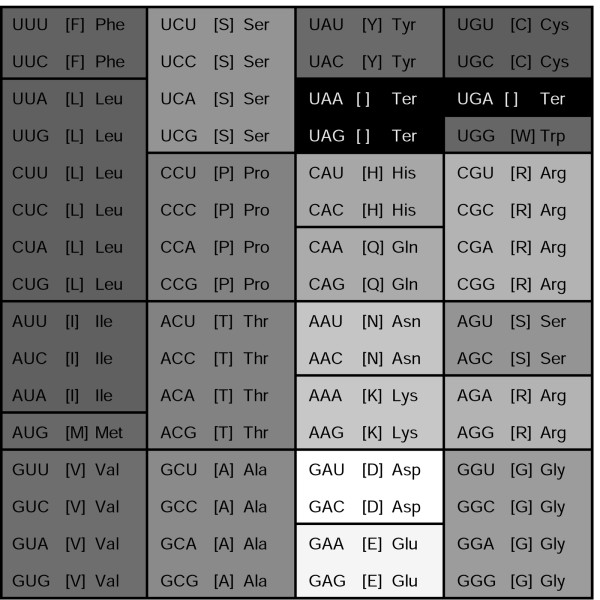
“1 where the blocks of synonymous codons are colored with respect to the polar requirement scale [6] (PRS), which is a measure of hydrophobicity).”
BackgroundMethodThe Genetic Code. The Molecular Basis for Genetic Expression
Woolf, L. I. (1968) · Journal of Medical Genetics · doi:10.1136/jmg.5.2.159 · Cited by 266
Early Fixation of an Optimal Genetic Code
Freeland, S. J., Knight, R. D., Landweber, L. F., & Hurst, L. D. (2000) · Molecular Biology and Evolution · doi:10.1093/oxfordjournals.molbev.a026331 · Cited by 241 · cited 4×
“The criticisms of Freeland et al. 2000 addressed the conclusion that, considering the low MP value of the standard code, the code could not evolve under selective pressure to reduce the effect of translation errors.”
BackgroundInfluentialWolf, Y. I., & Koonin, E. V. (2007) · Biology Direct · doi:10.1186/1745-6150-2-14 · Cited by 235 · cited 1×
“However, despite extensive experimentation in this area [32], the reality and relevance of any affinities between amino acid and cognate triplets, codons or anticodons, remain questionable (see [33] for a recent discussion).”
BackgroundSelf-citationSelection, history and chemistry: The three faces of the genetic code
Knight, R. D., Freeland, S. J., & Landweber, L. F. (1999) · Trends in Biochemical Sciences · doi:10.1016/s0968-0004(99)01392-4 · Cited by 227 · cited 3×
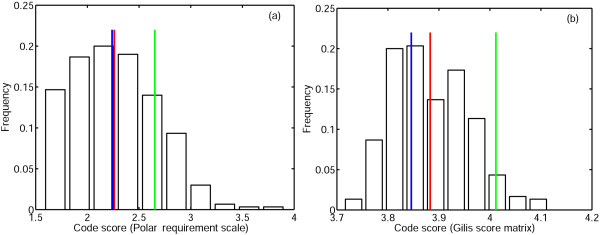
“The proponents of the translation-error hypothesis reasonably counter the above objections by showing that the distribution of the code error scores (fitness values) has a Gaussian-like shape where the better, more robust codes form a long tail such that the process of adaptation is non-linear, so approaching the abso…”
BackgroundOptimality of the genetic code with respect to protein stability and amino-acid frequencies
Gilis, D., Massar, S., Cerf, N. J., & Rooman, M. (2001) · Genome Biology · doi:10.1186/gb-2001-2-11-research0049 · Cited by 216 · cited 9×
“[22] argued that it is natural to expect that a codon misreading event that results in a substitution of a frequent amino acid for another frequent one leads to a greater absolute number of errors and thus has greater consequences for code robustness.”
BackgroundMethodResultInfluentialA Specific Amino Acid Binding Site Composed of RNA
Yarus, M. (1988) · Science · doi:10.1126/science.3381099 · Cited by 201
A unifying concept for the amino acid code
Swanson, R. (1984) · Bulletin of Mathematical Biology · doi:10.1007/bf02460068 · Cited by 172
THE GENETIC CODE AND ERROR TRANSMISSION
Alff-Steinberger, C. (1969) · Proceedings of the National Academy of Sciences · doi:10.1073/pnas.64.2.584 · Cited by 167 · cited 2×
“, translation, replication, and transcription, must have been error-ridden' [8], so the subsequent evolution is thought to have been driven by selection for an arrangement of the code table that would be increasingly robust to translational misreading – the translationerror hypothesis of code evolution [8,10-15].”
BackgroundMethodORIGINS OF THE GENETIC CODE: The Escaped Triplet Theory
Yarus, M., Caporaso, J. G., & Knight, R. (2005) · Annual Review of Biochemistry · doi:10.1146/annurev.biochem.74.082803.133119 · Cited by 166 · cited 1×
“However, despite extensive experimentation in this area [32], the reality and relevance of any affinities between amino acid and cognate triplets, codons or anticodons, remain questionable (see [33] for a recent discussion).”
BackgroundAmino acid substitution during functionally constrained divergent evolution of protein sequences
Bennet, S. A., Cohen, M. A., & Gonnet, G. H. (1994) · "Protein Engineering, Design and Selection" · doi:10.1093/protein/7.11.1323 · Cited by 165 · cited 1×
“Another prominent choice of the distance function is PAM74-100 [47].”
BackgroundThe Case for an Error Minimizing Standard Genetic Code
Freeland, S. J., Wu, T., & Keulmann, N. (2003) · Origins of life and evolution of the biosphere · doi:10.1023/a:1025771327614 · Cited by 164 · cited 3×
“The proponents of the translation-error hypothesis reasonably counter the above objections by showing that the distribution of the code error scores (fitness values) has a Gaussian-like shape where the better, more robust codes form a long tail such that the process of adaptation is non-linear, so approaching the abso…”
BackgroundThe origin of the genetic code: Theories and their relationships, a review
Giulio, M. D. (2005) · Biosystems · doi:10.1016/j.biosystems.2004.11.005 · Cited by 157
Amino Acids as RNA Ligands: A Direct-RNA-Template Theory for the Code's Origin
Yarus, M. (1998) · Journal of Molecular Evolution · doi:10.1007/pl00006357 · Cited by 138
Possibilities for the Evolution of the Genetic Code from a Preceding Form
Jukes, T. H. (1973) · Nature · doi:10.1038/246022a0 · Cited by 128 · cited 1×
“Indeed, the suboptimal encoding of arginine in the standard code has been noticed previously, leading to the suggestion that arginine was a late addition to the code [58-61].”
BackgroundOn the Coding of Genetic Information
Nirenberg, M. W., Jones, O. W., Leder, P., Clark, B. F. C., Sly, W. S., & Pestka, S. (1963) · Cold Spring Harbor Symposia on Quantitative Biology · doi:10.1101/sqb.1963.028.01.074 · Cited by 118 · cited 1×
“Ever since the standard code was deciphered [1-3], the interplay of the evolutionary forces that shaped the structure of the code has been a subject of debate [3,4].”
BackgroundOn Error Minimization in a Sequential Origin of the Standard Genetic Code
Ardell, D. H. (1998) · Journal of Molecular Evolution · doi:10.1007/pl00006356 · Cited by 117 · cited 5×
“This matrix has been first proposed for quantification of code robustness by Ardell [46].”
BackgroundMethodInfluentialRNA–ligand chemistry: A testable source for the genetic code
YARUS, M. (2000) · RNA · doi:10.1017/s1355838200002569 · Cited by 113 · cited 1×
“The stereochemical hypothesis that can be traced back to the early work of Gamow [3,25-31] postulates that codon assignments for particular amino acids are determined by a physicochemical affinity that exists between the amino acids and the cognate nucleotide triplets (codons or anticodons).”
BackgroundLACK OF FIDELITY IN THE TRANSLATION OF SYNTHETIC POLYRIBONUCLEOTIDES
Friedman, S. M., & Weinstein, I. B. (1964) · Proceedings of the National Academy of Sciences · doi:10.1073/pnas.52.4.988 · Cited by 105
Role of minimization of chemical distances between amino acids in the evolution of the genetic code.
Wong, J. T. (1980) · Proceedings of the National Academy of Sciences · doi:10.1073/pnas.77.2.1083 · Cited by 99
The Coevolution of Genes and Genetic Codes: Crick’s Frozen Accident Revisited
Sella, G., & Ardell, D. H. (2006) · Journal of Molecular Evolution · doi:10.1007/s00239-004-0176-7 · Cited by 86 · cited 2×
“, translation, replication, and transcription, must have been error-ridden' [8], so the subsequent evolution is thought to have been driven by selection for an arrangement of the code table that would be increasingly robust to translational misreading – the translationerror hypothesis of code evolution [8,10-15].”
BackgroundCorrelation between Coding-Triplets and Amino-Acids
Pelc, S. R. (1965) · Nature · doi:10.1038/207597a0 · Cited by 82 · cited 1×
“The stereochemical hypothesis that can be traced back to the early work of Gamow [3,25-31] postulates that codon assignments for particular amino acids are determined by a physicochemical affinity that exists between the amino acids and the cognate nucleotide triplets (codons or anticodons).”
BackgroundOn the Evolution of Redundancy in Genetic Codes
Ardell, D. H., & Sella, G. (2001) · Journal of Molecular Evolution · doi:10.1007/s002390010217 · Cited by 75 · cited 3×
“Our own earlier claim (Ardell and Sella, 2001) not withstanding, there is clear evidence in extant life that certain amino acids have most likely inherited or invaded codons from others, thus neither the block structure of the genetic code nor its amino acid expressivity has been invariant…”
BackgroundGiulio, M. D., Capobianco, M. R., & Medugno, M. (1994) · Journal of Theoretical Biology · doi:10.1006/jtbi.1994.1086 · Cited by 70 · cited 1×
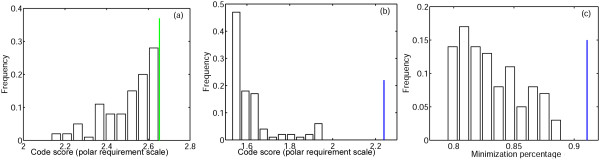
“…is still huge, (ii) the minimization percentage (the relative optimization level reached during genetic code evolution) for the standard code would have been higher (62% for the standard code according to Di Giulio's calculations [42]) if the selection on amino acid distances were the main force.”
Arginine as an evolutionary intruder into protein synthesis
Jukes, T. H. (1973) · Biochemical and Biophysical Research Communications · doi:10.1016/0006-291x(73)90151-4 · Cited by 69 · cited 1×
“Indeed, the suboptimal encoding of arginine in the standard code has been noticed previously, leading to the suggestion that arginine was a late addition to the code [58-61].”
BackgroundCodon Usage Bias and Mutation Constraints Reduce the Level of ErrorMinimization of the Genetic Code
Archetti, M. (2004) · Journal of Molecular Evolution · doi:10.1007/s00239-004-2620-0 · Cited by 68 · cited 4×
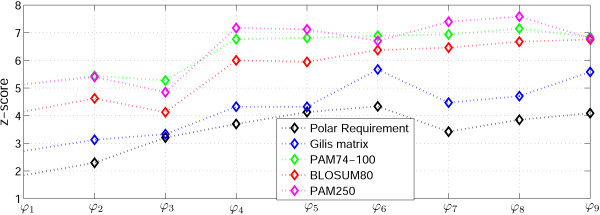
“2, cost functions φ1, φ 2, φ 3); similar observations have been reported previously [44,45,56]; (ii) for the PRS and the Gilis matrix cost measures, the inclusion of the inferred translation bias [i.”
BackgroundMethodResultInfluentialOuyang, L., Chen, X., & Bieker, J. J. (1998) · Journal of Biological Chemistry · doi:10.1074/jbc.273.36.23019 · Cited by 64
Load minimization of the genetic code: history does not explain the pattern
Freeland, S. J., & Hurst, L. D. (1998) · Proceedings of the Royal Society of London. Series B: Biological Sciences · doi:10.1098/rspb.1998.0547 · Cited by 59 · cited 1×
“However, it has been shown that the coevolution scenario alone does not account for the observed degree of translational error-minimization of the standard code [21,39].”
BackgroundFurther results on error minimization in the genetic code
Goldman, N. (1993) · Journal of Molecular Evolution · doi:10.1007/bf00182752 · Cited by 57 · cited 2×
“, translation, replication, and transcription, must have been error-ridden' [8], so the subsequent evolution is thought to have been driven by selection for an arrangement of the code table that would be increasingly robust to translational misreading – the translationerror hypothesis of code evolution [8,10-15].”
BackgroundMethodNo accident: genetic codes freeze in error–correcting patterns of the standard genetic code
Ardell, D. H., & Sella, G. (2002) · Philosophical Transactions of the Royal Society of London. Series B: Biological Sciences · doi:10.1098/rstb.2002.1071 · Cited by 56 · cited 3×
“The finer structure of the code comes into view if synonymous codon series that differ by purines or pyrimidines are compared [7].”
BackgroundGiulio, M. D. (2001) · Journal of Theoretical Biology · doi:10.1006/jtbi.2000.2206 · Cited by 55 · cited 4×
“…250 or BLOSUM 80, suggesting that it is equally inadequate as a measure for the cost of amino acid substitutions, as previously proposed by others [48,57]; (v) inclusion of amino acid frequencies, according to [22], had no effect on the genetic code optimality, in contrast to the results of Gilis…”
BackgroundResultInfluentialOn the optimality of the genetic code, with the consideration of termination codons
Goodarzi, H., Nejad, H. A., & Torabi, N. (2004) · Biosystems · doi:10.1016/j.biosystems.2004.05.031 · Cited by 55 · cited 3×
“The matrix (2) has been used in numerous studies on the evolution of the code [22-24,44,45].”
BackgroundMethodOn the antisymmetry of the amino acid code table
Hasegawa, M., & Miyata, T. (1980) · Origins of Life and Evolution of Biospheres · doi:10.1007/bf00928404 · Cited by 53 · cited 1×
“, small amino acids typically have four-codon series whereas larger amino acids tend to have two-codon series [29,54].”
BackgroundThe Impact of Message Mutation on the Fitness of a Genetic Code
Sella, G., & Ardell, D. H. (2002) · Journal of Molecular Evolution · doi:10.1007/s00239-001-0060-7 · Cited by 51 · cited 1×
“the evolution of the structure of the code than minimization of the effect of translation errors [7,19,20].”
BackgroundGiulio, M. D., & Medugno, M. (1998) · Journal of Molecular Evolution · doi:10.1007/pl00006341 · Cited by 51 · cited 1×
“In the original studies, this factor was not considered, i.e., f ( c ) = 1 was assumed for any c [12,24,37,46].”
BackgroundThe origin of the genetic code
Giulio, M. D. (2000) · Trends in Biochemical Sciences · doi:10.1016/s0968-0004(99)01522-4 · Cited by 43
The coevolution theory of the origin of the genetic code
Giulio, M. D. (2004) · Physics of Life Reviews · doi:10.1016/j.plrev.2004.05.001 · Cited by 41
Codon Usage Decreases the Error Minimization Within the Genetic Code
Zhu, C.-T., Zeng, X., & Huang, W. (2003) · Journal of Molecular Evolution · doi:10.1007/s00239-003-2505-7 · Cited by 41 · cited 4×
“2, cost functions φ1, φ 2, φ 3); similar observations have been reported previously [44,45,56]; (ii) for the PRS and the Gilis matrix cost measures, the inclusion of the inferred translation bias [i.”
BackgroundMethodResultInfluentialMeasuring adaptation within the genetic code
Freeland, S. J., Knight, R. D., & Landweber, L. F. (2000) · Trends in Biochemical Sciences · doi:10.1016/s0968-0004(99)01531-5 · Cited by 40 · cited 3×
“The proponents of the translation-error hypothesis reasonably counter the above objections by showing that the distribution of the code error scores (fitness values) has a Gaussian-like shape where the better, more robust codes form a long tail such that the process of adaptation is non-linear, so approaching the abso…”
BackgroundCaporaso, J. G., Yarus, M., & Knight, R. D. (2005) · Journal of Molecular Evolution · doi:10.1007/s00239-004-0314-2 · Cited by 38 · cited 3×
“The Caporaso et al. 2005 JME paper shows that there is plenty of "room" for adaptation even if substantial parts of the code were fixed by stereochemistry, for example.”
BackgroundMethodTolstrup, N., Toftgård, J., Engelbrecht, J., & Brunak, S. (1994) · Journal of Molecular Biology · doi:10.1006/jmbi.1994.1683 · Cited by 35 · cited 1×
“Indeed, the suboptimal encoding of arginine in the standard code has been noticed previously, leading to the suggestion that arginine was a late addition to the code [58-61].”
BackgroundBlock structure and stability of the genetic code
Chechetkin, V. R. (2003) · Journal of Theoretical Biology · doi:10.1016/s0022-5193(03)00025-0 · Cited by 34 · cited 1×
“The block structure of the code is considered to be a necessary condition of this robustness [9].”
BackgroundDo universal codon-usage patterns minimize the effects of mutation and translation error?
Marquez, R., Smit, S., & Knight, R. D. (2005) · Genome biology · doi:10.1186/gb-2005-6-11-r91 · Cited by 29 · cited 1×
“2, cost functions φ1, φ 2, φ 3); similar observations have been reported previously [44,45,56]; (ii) for the PRS and the Gilis matrix cost measures, the inclusion of the inferred translation bias [i.”
ResultGenetic Code Origin and the Strength of Natural Selection
Giulio, M. D. (2000) · Journal of Theoretical Biology · doi:10.1006/jtbi.2000.2115 · Cited by 27
Goodarzi, H., Najafabadi, H. S., Hassani, K., Nejad, H. A., & Torabi, N. (2005) · Journal of Theoretical Biology · doi:10.1016/j.jtbi.2005.01.012 · Cited by 23 · cited 1×
“2)); (iii) the PAM and BLOSUM matrices show a higher level of robustness for the standard code when compared to the PRS and the Gilis score matrix; (iv) the PAM 74-100 matrix showed results very similar to those obtained with PAM 250 or BLOSUM 80, suggesting that it is equally inadequate as a measure for the cost of a…”
ResultOn the optimality of the genetic code
Milanov, P., Kenderov, P. S., & Ivanov, O. C. (1986) · Origins of Life and Evolution of Biospheres · doi:10.1007/bf02422181 · Cited by 10
On the coevolution of genes and genetic code
Goodarzi, H., Najafabadi, H. S., & Torabi, N. (2005) · Gene · doi:10.1016/j.gene.2005.08.005 · Cited by 8 · cited 1×
“In most of the previous studies on the robustness of the standard code [12,22-24,44,45], this algorithm was used to generate random alternative codes, sometimes, with modifications to prohibit particular permutations; however, analyses of random code generated with more general algorithms, without the constraint on th…”
Method
Cited by
Origin and evolution of the genetic code: The universal enigma
Koonin, E. V., & Novozhilov, A. S. (2009) · IUBMB Life · doi:10.1002/iub.146 · Cited by 392
“Recently, we explored possible evolutionary trajectories of the genetic code within a limited domain of the vast space of possible codes (only codes that possess the same block structure and the same level of degeneracy as the standard code were analyzed) (86).”
BackgroundSelf-citationOrigin and Evolution of the Universal Genetic Code
Koonin, E. V., & Novozhilov, A. S. (2017) · Annual Review of Genetics · doi:10.1146/annurev-genet-120116-024713 · Cited by 200
Self-citationHiggs, P. G. (2009) · Biology Direct · doi:10.1186/1745-6150-4-16 · Cited by 137
“Dynamical models have also been studied [12,13] in which the code changes by swapping the amino acids assigned to two codon blocks.”
BackgroundMethodKoonin, E. (2017) · Life · doi:10.3390/life7020022 · Cited by 85
“Usi g the language of fitness landscapes, the frozen accident perspective implie that there can b many different codes occupying fitness peaks, but they are separated by deep valleys of low fitness [15] (Figure 1).”
BackgroundInfluentialSelf-citationKoonin, E. (2017) · doi:10.20944/preprints201705.0121.v1 · Cited by 85
Self-citation
Metadata
- Authors
- Novozhilov, A. S., Wolf, Y. I., & Koonin, E. V.
- Affiliations
- National Institutes of Health (US)
- Corresponding author
- Koonin, Eugene V
- Venue
- Biology Direct
- Published
- 2007-10-23
- Volume
- 2
- Issue
- 1
- Pages
- 24-24
- ISSN
- 1745-6150 (ISSN-L)
- PMC
- PMC2211284
- OpenAlex
- W2163198599
- Cited by
- 122
- References
- 67
- Citations by year
- 2026: 13 · 2025: 3 · 2024: 1 · 2023: 7 · 2022: 10 · 2021: 8 · 2020: 5 · 2019: 7 · 2018: 13 · 2017: 9 · 2016: 7 · 2015: 4 · 2014: 6 · 2013: 6 · 2012: 2
- FWCI
- 2.39
- Type
- journal article
- Language
- en
- Open access
- gold
- doi.org
- Licence
- cc-by
- Locations
- Biology Direct (publishedVersion, cc-by)
- PubMed Central (publishedVersion, cc-by)
- PubMed (publishedVersion)
- DOAJ (DOAJ: Directory of Open Access Journals) (submittedVersion, cc-by-sa)
- Funders
- U.S. Department of Health and Human Services
- National Institutes of Health
- U.S. National Library of Medicine
- Topics
- Life Sciences › Biochemistry, Genetics and Molecular Biology › Molecular Biology › RNA and protein synthesis mechanisms
- Life Sciences › Biochemistry, Genetics and Molecular Biology › Genetics › Evolution and Genetic Dynamics
- Physical Sciences › Physics and Astronomy › Astronomy and Astrophysics › Origins and Evolution of Life
- Keywords
- genetic code evolution, codon degeneracy, fitness landscape ruggedness, evolutionary trajectories, evolutionary algorithms, origin of the genetic code, codon usage bias
- MeSH terms
- Algorithms, Codon, Genetic Code, RNA, Messenger, RNA, Transfer, Selection, Genetic, Protein Biosynthesis, Evolution, Molecular
About these checks
Registry, retraction, Cites and statistics results are computed, not judged, with one exception: a printed reference that no index lists is read once by a model before it counts as a citation error. Claims are extracted by a model and kept only when their quote appears verbatim in the text; each cited source is then checked, with a model’s help, for whether it says what the claim relies on. Those verdicts can be wrong — read the claim’s quote and the cited source before relying on one.
Statistics and arithmetic are recomputed, not judged.
Confidence bands are shown only for fields calibrated on our annotated test set. None is calibrated yet, so no band is shown.
What counts as a claim ›How we measure confidence ›How we check this ›
Are you an author, or do you see a problem with this page? Request a review
Data sources
Bibliographic data: Semantic Scholar, OpenAlex, Crossref.
Contains information from the Semantic Scholar Academic Graph Datasets, made available under the ODC Attribution License (ODC-BY 1.0).
Semantic Scholar’s data is described in: Kinney, R., et al. (2023). The Semantic Scholar Open Data Platform. arXiv:2301.10140.
