

The look-ahead effect of phenotypic mutations
Open accessThe DOI matches its Crossref record; 56 of the 56 references it cites were found in a registry or an index.
Abstract
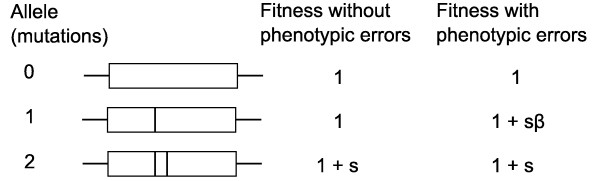
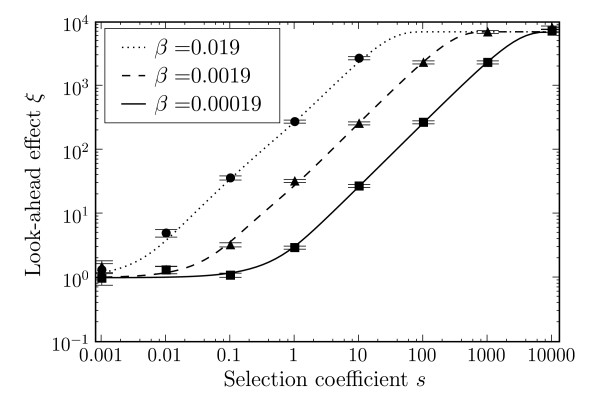
BACKGROUND: The evolution of complex molecular traits such as disulphide bridges often requires multiple mutations. The intermediate steps in such evolutionary trajectories are likely to be selectively neutral or deleterious. Therefore, large populations and long times may be required to evolve such traits. RESULTS: We propose that errors in transcription and translation may allow selection for the intermediate mutations, if the final trait provides a large enough selective advantage. We test this hypothesis using a population based model of protein evolution. CONCLUSION: If an individual acquires one of two mutations needed for a novel trait, the second mutation can be introduced into the phenotype due to transcription and translation errors. If the novel trait is advantageous enough, the allele with only one mutation will spread through the population, even though the gene sequence does not yet code for the complettrait. Thus, errors allow protein sequences to "look-ahead" for a more direct path to a complex trait.
Overview
The claims and statistics of this paper haven’t been checked yet.
Free: it reads the open-access text and checks the first 5 claims that cite a source we can check. Create a free account to check every claim.
Integrity signals
Registry
Cites
Statistics
Figures
Verification
Claims the paper makes
The claims and statistics of this paper haven’t been checked yet.
Free: it reads the open-access text and checks the first 5 claims that cite a source we can check. Create a free account to check every claim.
Claims other papers make about this one
Each is checked against this paper’s own text: does it say what the citing paper says it does?
In the citing paper
“Therefore, phenotypic variability could lead to an evolutionary ‘look-ahead’ effect (58): while each genotype specifies a particular ribozyme sequence, it also leads to a cloud of transcripts nearby in RNA sequence space.”
From The prebiotic evolutionary advantage of transferring genetic information from RNA to DNA (2011) · cites this paper as [58]
Self-check
Percentages, sums and reported differences re-computed from the paper’s own numbers.
The self-check needs the paper’s full text.
Citations
Cites
Handbook of Mathematical Functions with Formulas, Graphs, and Mathematical Tables
W., J. W., Abramowitz, M., & Stegun, I. A. (1965) · Mathematics of Computation · doi:10.2307/2004114 · Cited by 18,663
Handbook of Mathematical Functions with Formulas, Graphs, and Mathematical Tables
Owen, D. B., Abramowitz, M., & Stegun, I. A. (1965) · Technometrics · doi:10.2307/1266136 · Cited by 16,138
Handbook of Mathematical Functions with Formulas
Owen, D. B. (1965) · Technometrics · doi:10.1080/00401706.1965.10490234 · Cited by 4,021
Handbook of Mathematical Functions with Formulas, Graphs and Mathematical Tables.
Barton, D. E., Abramovitz, M., & Stegun, I. A. (1965) · Journal of the Royal Statistical Society. Series A (General) · doi:10.2307/2343473 · Cited by 3,705
Handbook of Mathematical Functions with Formulas, Graphs, and Mathematical Tables.
H., C., Abramowitz, M., & Stegun, I. A. (1964) · Journal of the American Statistical Association · doi:10.2307/2282672 · Cited by 3,073
The relation between the divergence of sequence and structure in proteins.
Chothia, C., & Lesk, A. M. (1986) · The EMBO Journal · doi:10.1002/j.1460-2075.1986.tb04288.x · Cited by 2,458 · cited 1×
“A modification of only two residues can result in large structural changes [15].”
BackgroundDrake, J. W., Charlesworth, B., Charlesworth, D., & Crow, J. F. (1998) · Genetics · doi:10.1093/genetics/148.4.1667 · Cited by 1,932
Baldwin, J. M. (1896) · The American Naturalist · doi:10.1086/276408 · Cited by 1,781
ON THE PROBABILITY OF FIXATION OF MUTANT GENES IN A POPULATION
Kimura, M. (1962) · Genetics · doi:10.1093/genetics/47.6.713 · Cited by 1,208
How Learning Can Guide Evolution.
Hinton, G. E., & Nowlan, S. J. (1987) · Addison-Wesley Longman Publishing Co., Inc. eBooks · Cited by 1,115
Cited by
The evolutionary consequences of erroneous protein synthesis
Allan Drummond, D., & Wilke, C. O. (2009) · Nature Reviews Genetics · doi:10.1038/nrg2662 · Cited by 515
“Synthesis errors can reveal cryptic genetic variation or produce novel phenotypes and thus allow an organism to either switch epigenetically between different phenotypes or pre-screen potentially beneficial mutation”
Self-citationThe causes of evolvability and their evolution
Payne, J. L., & Wagner, A. (2019) · Nature Reviews Genetics · doi:10.1038/s41576-018-0069-z · Cited by 385
Determinants of the rate of protein sequence evolution
Zhang, J., & Yang, J.-R. (2015) · Nature Reviews Genetics · doi:10.1038/nrg3950 · Cited by 364
Robustness: mechanisms and consequences
Masel, J., & Siegal, M. L. (2009) · Trends in Genetics · doi:10.1016/j.tig.2009.07.005 · Cited by 348
“This is especially true for adaptations that involve more than a single mutation [72,76,77] (Box 4).”
BackgroundMasel, J., & Trotter, M. V. (2010) · Trends in Genetics · doi:10.1016/j.tig.2010.06.002 · Cited by 291
Conformational dynamics and enzyme evolution
Petrović, D., Risso, V. A., Kamerlin, S. C. L., & Sanchez-Ruiz, J. M. (2018) · Journal of The Royal Society Interface · doi:10.1098/rsif.2018.0330 · Cited by 211
Somatic mosaicism in healthy human tissues
De, S. (2011) · Trends in Genetics · doi:10.1016/j.tig.2011.03.002 · Cited by 180
Random sequences rapidly evolve into de novo promoters
Yona, A. H., Alm, E. J., & Gore, J. (2018) · Nature Communications · doi:10.1038/s41467-018-04026-w · Cited by 179
Young genes are highly disordered as predicted by the preadaptation hypothesis of de novo gene birth
Wilson, B. A., Foy, S. G., Neme, R., & Masel, J. (2017) · Nature Ecology & Evolution · doi:10.1038/s41559-017-0146 · Cited by 171
Constraints and plasticity in genome and molecular-phenome evolution
Koonin, E. V., & Wolf, Y. I. (2010) · Nature Reviews Genetics · doi:10.1038/nrg2810 · Cited by 161
Ryall, B., Eydallin, G., & Ferenci, T. (2012) · Microbiology and Molecular Biology Reviews · doi:10.1128/mmbr.05028-11 · Cited by 160
“beneficial phenotypes generated by error (209, 360).”
Mordret, E., Dahan, O., Asraf, O., Rak, R., Yehonadav, A., Barnabas, G. D., Cox, J., Geiger, T., Lindner, A. B., & Pilpel, Y. (2019) · Molecular Cell · doi:10.1016/j.molcel.2019.06.041 · Cited by 154
On the Potential Origins of the High Stability of Reconstructed Ancestral Proteins
Trudeau, D. L., Kaltenbach, M., & Tawfik, D. S. (2016) · Molecular Biology and Evolution · doi:10.1093/molbev/msw138 · Cited by 131
Putatively Noncoding Transcripts Show Extensive Association with Ribosomes
Wilson, B. A., & Masel, J. (2011) · Genome Biology and Evolution · doi:10.1093/gbe/evr099 · Cited by 131
Intercellular competition and the inevitability of multicellular aging
Nelson, P., & Masel, J. (2017) · Proceedings of the National Academy of Sciences · doi:10.1073/pnas.1618854114 · Cited by 109
The prebiotic evolutionary advantage of transferring genetic information from RNA to DNA
Leu, K., Obermayer, B., Rajamani, S., Gerland, U., & Chen, I. A. (2011) · Nucleic Acids Research · doi:10.1093/nar/gkr525 · Cited by 85
Mechanisms of protein evolution
Jayaraman, V., Toledo‐Patiño, S., Noda‐García, L., & Laurino, P. (2022) · Protein Science · doi:10.1002/pro.4362 · Cited by 89
Evolution of molecular error rates and the consequences for evolvability
Rajon, É., & Masel, J. (2011) · Proceedings of the National Academy of Sciences · doi:10.1073/pnas.1012918108 · Cited by 89
Visualizing high error levels during gene expression in living bacterial cells
Meyerovich, M., Mamou, G., & Ben‐Yehuda, S. (2010) · Proceedings of the National Academy of Sciences · doi:10.1073/pnas.0912989107 · Cited by 94
A Relay Race on the Evolutionary Adaptation Spectrum
Yona, A. H., Frumkin, I., & Pilpel, Y. (2015) · Cell · doi:10.1016/j.cell.2015.10.005 · Cited by 84
Potential role of phenotypic mutations in the evolution of protein expression and stability
Goldsmith, M., & Tawfik, D. S. (2009) · Proceedings of the National Academy of Sciences · doi:10.1073/pnas.0809506106 · Cited by 81
Does the central dogma still stand?
Koonin, E. V. (2012) · Biology Direct · doi:10.1186/1745-6150-7-27 · Cited by 109
Nonessential tRNA and rRNA modifications impact the bacterial response to sub-MIC antibiotic stress
Babosan, A., Fruchard, L., Krin, E., Carvalho, A. F. P., Mazel, D., & Baharoglu, Z. (2022) · microLife · doi:10.1093/femsml/uqac019 · Cited by 60
Selection on protein structure, interaction, and sequence
Chi, P. B., & Liberles, D. A. (2016) · Protein Science · doi:10.1002/pro.2886 · Cited by 63
The Evolutionary Potential of Phenotypic Mutations
Yanagida, H., Gispan, A., Kadouri, N., Rozen, S., Sharon, M., Barkai, N., & Tawfik, D. S. (2015) · PLoS Genetics · doi:10.1371/journal.pgen.1005445 · Cited by 55
Rockah-Shmuel, L., Tóth-Petróczy, Á., Sela, A., Wurtzel, O., Sorek, R., & Tawfik, D. S. (2013) · PLoS Genetics · doi:10.1371/journal.pgen.1003882 · Cited by 50
Preventing Dangerous Nonsense: Selection for Robustness to Transcriptional Error in Human Genes
Cusack, B. P., Arndt, P. F., Duret, L., & Crollius, H. R. (2011) · PLoS Genetics · doi:10.1371/journal.pgen.1002276 · Cited by 46
“may play a much more prominent role in molecular evolution than is currently recognized”
BackgroundOn the networked architecture of genotype spaces and its critical effects on molecular evolution
Aguirre, J., Catalán, P., Cuesta, J. A., & Manrubia, S. (2018) · Open Biology · doi:10.1098/rsob.180069 · Cited by 44
Genome-wide impact of codon usage bias on translation optimization in Drosophila melanogaster
Wu, X., Xu, M., Yang, J., & Lü, J. (2024) · Nature Communications · doi:10.1038/s41467-024-52660-4 · Cited by 53
Adaptive multiscapes: an up-to-date metaphor to visualize molecular adaptation
Catalán, P., Arias, C. F., Cuesta, J. A., & Manrubia, S. (2017) · Biology Direct · doi:10.1186/s13062-017-0178-1 · Cited by 36
“Other mechanisms could affect specific quantities in adaptive multiscapes, the look-ahead effect being a prominent example: It has been put forward [68] that errors in transcription and translation that affect the phenotype, but do not modify the genotype, might constitute an important mechanism to promote the fixatio…”
BackgroundEvolution of complex adaptations in molecular systems
Pál, C., & Papp, B. (2017) · Nature Ecology & Evolution · doi:10.1038/s41559-017-0228-1 · Cited by 48
Mistranslation can enhance fitness through purging of deleterious mutations
Bratulić, S., Toll‐Riera, M., & Wagner, A. (2017) · Nature Communications · doi:10.1038/ncomms15410 · Cited by 34
Compensatory Evolution and the Origins of Innovations
Rajon, É., & Masel, J. (2013) · Genetics · doi:10.1534/genetics.112.148627 · Cited by 34
Robustness by intrinsically disordered C-termini and translational readthrough
Kleppe, A. S., & Bornberg‐Bauer, E. (2018) · Nucleic Acids Research · doi:10.1093/nar/gky778 · Cited by 32
Self-citationGallet, R., Lenormand, T., & Wang, I. (2012) · Evolution · doi:10.1111/j.1558-5646.2012.01690.x · Cited by 28
Phenotypic mutations contribute to protein diversity and shape protein evolution
Romero, M. L. R., Landerer, C., Poehls, J., & Tóth-Petróczy, Á. (2022) · Protein Science · doi:10.1002/pro.4397 · Cited by 25
Fitness Effects of Phenotypic Mutations at Proteome-Scale Reveal Optimality of Translation Machinery
Landerer, C., Poehls, J., & Tóth-Petróczy, Á. (2024) · Molecular Biology and Evolution · doi:10.1093/molbev/msae048 · Cited by 20
Evidence That the Heterogeneity of a T4 Population Is the Result of Heritable Traits
Storms, Z. J., & Sauvageau, D. (2014) · PLoS ONE · doi:10.1371/journal.pone.0116235 · Cited by 16
Readthrough Errors Purge Deleterious Cryptic Sequences, Facilitating the Birth of Coding Sequences
Kosinski, L., & Masel, J. (2020) · Molecular Biology and Evolution · doi:10.1093/molbev/msaa046 · Cited by 15
The Boggarts of biology: how non-genetic changes influence the genotype
Samhita, L. (2020) · Current Genetics · doi:10.1007/s00294-020-01108-5 · Cited by 13
The impact of mistranslation on phenotypic variability and fitness
Samhita, L., Raval, P. K., Stephenson, G., Thutupalli, S., & Agashe, D. (2021) · Evolution · doi:10.1111/evo.14179 · Cited by 16
Alternative Reading Frames are an Underappreciated Source of Protein Sequence Novelty
Ardern, Z. (2023) · Journal of Molecular Evolution · doi:10.1007/s00239-023-10122-3 · Cited by 17
Zheng, J., Guo, N., & Wagner, A. (2021) · Molecular Biology and Evolution · doi:10.1093/molbev/msab206 · Cited by 12
Theodorakos, K., Agudelo, O. M., Schreurs, J., Suykens, J. A. K., & Moor, B. D. (2022) · IEEE Transactions on Evolutionary Computation · doi:10.1109/tevc.2022.3189500 · Cited by 11
Evolutionary Capacitance Emerges Spontaneously during Adaptation to Environmental Changes
Nelson, P., & Masel, J. (2018) · Cell Reports · doi:10.1016/j.celrep.2018.09.008 · Cited by 12
Draghi, J. A., & Ogbunugafor, C. B. (2022) · Journal of Experimental Zoology Part B Molecular and Developmental Evolution · doi:10.1002/jez.b.23134 · Cited by 11
Schmutzer, M., & Wagner, A. (2023) · Molecular Biology and Evolution · doi:10.1093/molbev/msad136 · Cited by 12
The Adaptive Potential of Nonheritable Somatic Mutations
Majic, P., Erten, E. Y., & Payne, J. L. (2022) · The American Naturalist · doi:10.1086/721766 · Cited by 14
Translational fidelity and longevity are genetically linked
Zheng, B., Zhang, W., Yu, G., Shi, W., Deng, S., Zhang, X., Chen, J., Zhou, Z., Shan, Y., Wu, W., et al. (2025) · Nature Communications · doi:10.1038/s41467-025-62944-y · Cited by 11
Phenotype switching of the mutation rate facilitates adaptive evolution
Lobinska, G., Pilpel, Y., & Ram, Y. (2023) · Genetics · doi:10.1093/genetics/iyad111 · Cited by 9
Evolutionary paths of least resistance
Wilke, C. O. (2015) · Proceedings of the National Academy of Sciences · doi:10.1073/pnas.1517390112 · Cited by 9
Self-citationFrail Hypotheses in Evolutionary Biology
Ninio, J. (2010) · PLoS Genetics · doi:10.1371/journal.pgen.1001067 · Cited by 7
Evolution After and Before Gene Duplication?
Sikosek, T., & Bornberg‐Bauer, E. (2010) · Wiley eBooks · doi:10.1002/9780470619902.ch6 · Cited by 7
Self-citationTranscriptional errors and the drift barrier
McCandlish, D. M., & Plotkin, J. B. (2016) · Proceedings of the National Academy of Sciences · doi:10.1073/pnas.1601785113 · Cited by 7
Competition for nutritional resources masks the true frequency of bacterial mutants
Neves, H., Machado, G. T., Ramos, T. C. D. S., Yang, H. M., Yagil, E., & Spira, B. (2020) · BMC Biology · doi:10.1186/s12915-020-00913-1 · Cited by 5
Protein Products of Tandem Gene Duplication: A Structural View
Taylor, W. R., & Sadowski, M. I. (2010) · Wiley eBooks · doi:10.1002/9780470619902.ch7 · Cited by 6
Evidence for a role of phenotypic mutations in virus adaptation
Luzón–Hidalgo, R., Risso, V. A., Delgado, A., Andrés‐León, E., Ibarra‐Molero, B., & Sánchez‐Ruiz, J. M. (2021) · iScience · doi:10.1016/j.isci.2021.102257 · Cited by 5
Encoded and non-genetic alternative protein variants expand human functional proteomePreprint
Tretyachenko, V., Leiman, T., Morgenstern, D., Levin, Y., Asraf, O., Dahan, O., Dahary, D., & Pilpel, Y. (2025) · bioRxiv (Cold Spring Harbor Laboratory) · doi:10.1101/2025.02.17.638604 · Cited by 3
The Genomic Kaleidoscope: On the Hidden Dimensions of Within-Species Genomic Diversity
Brasó‐Vives, M., Hartasánchez, D. A., Ayroles, J. F., Bucao, C. F., Furlan-Magaril, M., Majic, P., Pallares, L. F., Phipps-Tan, J., Rogers, T. F., Ruiz‐Herrera, A., et al. (2025) · Genome Biology and Evolution · doi:10.1093/gbe/evaf204 · Cited by 3
Kusumi, J., Ichinose, M., & Iizuka, M. (2019) · Journal of Theoretical Biology · doi:10.1016/j.jtbi.2019.02.001 · Cited by 2
Stearns, F. W., Zhou, J., & Fenster, C. B. (2025) · Evolution · doi:10.1093/evolut/qpaf029 · Cited by 2
Revisiting Crick?s Dogma and the Impossibility of Reverse Translation
Biro, J. C. (2014) · Journal of Theoretical and Computational Science · doi:10.4172/2376-130x.1000110 · Cited by 2
The adaptive potential of non-heritable somatic mutationsPreprint
Majic, P., Erten, E. Y., & Payne, J. L. (2021) · bioRxiv (Cold Spring Harbor Laboratory) · doi:10.1101/2021.04.30.442123 · Cited by 2
Encoded and non-genetic protein variants expand the human functional proteome
Tretyachenko, V., Leiman, T., Morgenstern, D., Levin, Y., Asraf, O., Dahan, O., Dahary, D., & Pilpel, Y. (2026) · Nature · doi:10.1038/s41586-026-11124-z · Cited by 8
Reba, A., Meyer, A. G., & Barrick, J. E. (2012) · Conference on Artificial Life (ALIFE) · doi:10.7551/978-0-262-31050-5-ch062 · Cited by 1
Epigenetic variation can promote adaptation by smoothing rugged fitness landscapes
Mall, A., Marx, C. J., & Draghi, J. A. (2026) · Proceedings of the Royal Society B Biological Sciences · doi:10.1098/rspb.2025.2619 · Cited by 3
The Argument from Biological Complexity
Behe, M. J. (2021) · Bloomsbury Academic eBooks · doi:10.5040/9781350093881.ch-005 · Cited by 1
Evolutionary Genetics, History of
Travis, J., & Baer, C. F. (2016) · Elsevier eBooks · doi:10.1016/b978-0-12-800049-6.00011-1 · Cited by 1
Amino acid and codon usage explain amino acid misincorporation rates across the tree of lifePreprint
Poehls, J., Landerer, C., Daniels, K. G., & Tóth-Petróczy, Á. (2026) · bioRxiv (Cold Spring Harbor Laboratory) · doi:10.64898/2026.02.19.706746 · Cited by 1
Translational readthrough goes unseen by natural selectionPreprint
Kleppe, A. S., & Bornberg‐Bauer, E. (2019) · bioRxiv (Cold Spring Harbor Laboratory) · doi:10.1101/844621
Self-citationA bacterial tragedy of the commons that masks the actual frequency of mutantsPreprint
Neves, H., Machado, G. T., Ramos, T. C. D. S., Yang, H. M., Yagil, E., & Spira, B. (2020) · bioRxiv (Cold Spring Harbor Laboratory) · doi:10.1101/2020.04.02.022889
Faculty Opinions recommendation of Random sequences rapidly evolve into de novo promoters.
Mazel, D. (2018) · Faculty Opinions – Post-Publication Peer Review of the Biomedical Literature · doi:10.3410/f.733066720.793545543
Sánchez‐Ruiz, J. M. (2019) · Wiley eBooks · doi:10.1002/9780470015902.a0028797
Why Do Academics Not Seriously Consider Intelligent Design?
Behe, M. J. (2023) · Filozoficzne Aspekty Genezy · doi:10.53763/fag.2023.20.1.219
Genome-wide impact of codon usage bias on translation optimization in Drosophila melanogasterPreprint
Wu, X., Yang, J., & Lü, J. (2023) · bioRxiv (Cold Spring Harbor Laboratory) · doi:10.1101/2023.10.05.561139
Labadie, T., & Cambray, G. (2024) · bioRxiv (Cold Spring Harbor Laboratory) · doi:10.1101/2024.01.15.575645
Virus propagation linked to exceedingly rare gene-expression errorsPreprint
Luzón–Hidalgo, R., D’Agostino, G., Risso, V. A., Delgado, A., Ibarra‐Molero, B., Campos, L. A., Requejo‐Isidro, J., & Sánchez‐Ruiz, J. M. (2024) · bioRxiv (Cold Spring Harbor Laboratory) · doi:10.1101/2024.05.21.595180
Luzón–Hidalgo, R., D’Agostino, G., Risso, V. A., Delgado, A., Ibarra‐Molero, B., Campos, L. A., Requejo‐Isidro, J., & Sánchez‐Ruiz, J. M. (2025) · ACS Chemical Biology · doi:10.1021/acschembio.5c00638 · Cited by 2
Mutations in ribosomal protein uS5 alter translation fidelity and mutagenesis in Pseudomonas putida
Jürgenstein, K., Ilves, H., Luhaäär, C., Brauer, A., Rèmme, J., & Kivisaar, M. (2025) · Journal of Bacteriology · doi:10.1128/jb.00334-25 · Cited by 1
Neves, H., Machado, G. T., Ramos, T. C. D. S., Yang, H. M., Yagil, E., & Spira, B. (2020) · Figshare · doi:10.6084/m9.figshare.13466859
Neves, H., Machado, G. T., Ramos, T. C. D. S., Yang, H. M., Yagil, E., & Spira, B. (2020) · Figshare · doi:10.6084/m9.figshare.13466863
Mistranslation suppresses mistranscription in eukaryotes
Zhang, X., Yu, G., Guo, Z., Liao, J., Li, W., Zhang, W., Zheng, B., Wu, Z., Peng, S., Tan, D., et al. (2026) · Nature Communications · doi:10.1038/s41467-026-69969-x
Sholeh, M., Beig, M., Kiani, N., & Badmasti, F. (2026) · Infection Genetics and Evolution · doi:10.1016/j.meegid.2026.105998
Metadata
- Authors
- Whitehead, D. J., Wilke, C. O., Vernazobres, D., & Bornberg-Bauer, E.
- Affiliations
- University of Münster (DE)
- The University of Texas at Austin (US)
- Corresponding author
- Whitehead, Dion J
- Wilke, Claus O
- ORCID
- Wilke, Claus O
- Venue
- Biology Direct
- Published
- 2008
- Volume
- 3
- Issue
- 1
- Pages
- 18
- ISSN
- 1745-6150 (ISSN-L)
- PMC
- PMC2423361
- OpenAlex
- W1973231206
- Cited by
- 84
- References
- 56
- Citations by year
- 2026: 5 · 2025: 6 · 2024: 5 · 2023: 5 · 2022: 6 · 2021: 5 · 2020: 6 · 2019: 4 · 2018: 7 · 2017: 5 · 2016: 4 · 2015: 4 · 2014: 2 · 2013: 2 · 2012: 4
- FWCI
- 2.67
- Type
- journal article
- Language
- en
- Open access
- gold
- doi.org
- Licence
- cc-by
- Locations
- Biology Direct (publishedVersion, cc-by)
- PubMed Central (publishedVersion, cc-by)
- PubMed (publishedVersion)
- arXiv (Cornell University) (submittedVersion)
- DOAJ (DOAJ: Directory of Open Access Journals) (submittedVersion)
- Texas ScholarWorks (Texas Digital Library) (submittedVersion, other-oa)
- arXiv (Cornell University)
- Texas Digital Library (University of Texas)
- Funders
- National Institutes of Health
- National Institute of Allergy and Infectious Diseases (R01AI065960, AI 065960)
- Topics
- Life Sciences › Biochemistry, Genetics and Molecular Biology › Genetics › Evolution and Genetic Dynamics
- Life Sciences › Biochemistry, Genetics and Molecular Biology › Molecular Biology › RNA and protein synthesis mechanisms
- Social Sciences › Cultural Studies › Language and cultural evolution
- Keywords
- protein evolution, transcription errors, translation errors, disulfide bonds, population genetic models, molecular evolution
- MeSH terms
- Alleles, Computer Simulation, Genetics, Population, Models, Genetic, Mutation, Phenotype, Selection, Genetic, Transcription, Genetic, Protein Biosynthesis, Evolution, Molecular, Quantitative Trait, Heritable
About these checks
Registry, retraction, Cites and statistics results are computed, not judged, with one exception: a printed reference that no index lists is read once by a model before it counts as a citation error. Claims are extracted by a model and kept only when their quote appears verbatim in the text; each cited source is then checked, with a model’s help, for whether it says what the claim relies on. Those verdicts can be wrong — read the claim’s quote and the cited source before relying on one.
Statistics and arithmetic are recomputed, not judged.
Confidence bands are shown only for fields calibrated on our annotated test set. None is calibrated yet, so no band is shown.
What counts as a claim ›How we measure confidence ›How we check this ›
Are you an author, or do you see a problem with this page? Request a review
Data sources
Bibliographic data: Semantic Scholar, OpenAlex, Crossref.
Contains information from the Semantic Scholar Academic Graph Datasets, made available under the ODC Attribution License (ODC-BY 1.0).
Semantic Scholar’s data is described in: Kinney, R., et al. (2023). The Semantic Scholar Open Data Platform. arXiv:2301.10140.
