

The look-ahead effect of phenotypic mutations
Open accessThe DOI matches its Crossref record; 56 of the 56 references it cites were found in a registry or an index.
Abstract
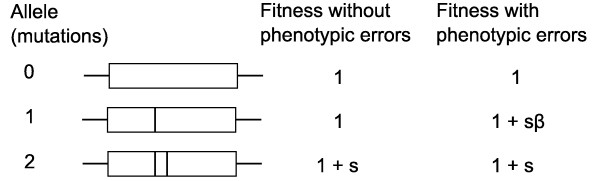
BACKGROUND: The evolution of complex molecular traits such as disulphide bridges often requires multiple mutations. The intermediate steps in such evolutionary trajectories are likely to be selectively neutral or deleterious. Therefore, large populations and long times may be required to evolve such traits. RESULTS: We propose that errors in transcription and translation may allow selection for the intermediate mutations, if the final trait provides a large enough selective advantage. We test this hypothesis using a population based model of protein evolution. CONCLUSION: If an individual acquires one of two mutations needed for a novel trait, the second mutation can be introduced into the phenotype due to transcription and translation errors. If the novel trait is advantageous enough, the allele with only one mutation will spread through the population, even though the gene sequence does not yet code for the complettrait. Thus, errors allow protein sequences to "look-ahead" for a more direct path to a complex trait.
Overview
The claims and statistics of this paper haven’t been checked yet.
Free: it reads the open-access text and checks the first 5 claims that cite a source we can check. Create a free account to check every claim.
Integrity signals
Registry
Cites
Statistics
Figures
Verification
Claims the paper makes
The claims and statistics of this paper haven’t been checked yet.
Free: it reads the open-access text and checks the first 5 claims that cite a source we can check. Create a free account to check every claim.
Claims other papers make about this one
Each is checked against this paper’s own text: does it say what the citing paper says it does?
In the citing paper
“Therefore, phenotypic variability could lead to an evolutionary ‘look-ahead’ effect (58): while each genotype specifies a particular ribozyme sequence, it also leads to a cloud of transcripts nearby in RNA sequence space.”
From The prebiotic evolutionary advantage of transferring genetic information from RNA to DNA (2011) · cites this paper as [58]
Self-check
Percentages, sums and reported differences re-computed from the paper’s own numbers.
The self-check needs the paper’s full text.
Citations
Cites
Handbook of Mathematical Functions with Formulas, Graphs, and Mathematical Tables
W., J. W., Abramowitz, M., & Stegun, I. A. (1965) · Mathematics of Computation · doi:10.2307/2004114 · Cited by 18,663
Handbook of Mathematical Functions with Formulas, Graphs, and Mathematical Tables
Owen, D. B., Abramowitz, M., & Stegun, I. A. (1965) · Technometrics · doi:10.2307/1266136 · Cited by 16,138
Handbook of Mathematical Functions with Formulas
Owen, D. B. (1965) · Technometrics · doi:10.1080/00401706.1965.10490234 · Cited by 4,021
Handbook of Mathematical Functions with Formulas, Graphs and Mathematical Tables.
Barton, D. E., Abramovitz, M., & Stegun, I. A. (1965) · Journal of the Royal Statistical Society. Series A (General) · doi:10.2307/2343473 · Cited by 3,705
Handbook of Mathematical Functions with Formulas, Graphs, and Mathematical Tables.
H., C., Abramowitz, M., & Stegun, I. A. (1964) · Journal of the American Statistical Association · doi:10.2307/2282672 · Cited by 3,073
The relation between the divergence of sequence and structure in proteins.
Chothia, C., & Lesk, A. M. (1986) · The EMBO Journal · doi:10.1002/j.1460-2075.1986.tb04288.x · Cited by 2,458 · cited 1×
“A modification of only two residues can result in large structural changes [15].”
BackgroundDrake, J. W., Charlesworth, B., Charlesworth, D., & Crow, J. F. (1998) · Genetics · doi:10.1093/genetics/148.4.1667 · Cited by 1,932
Baldwin, J. M. (1896) · The American Naturalist · doi:10.1086/276408 · Cited by 1,781
ON THE PROBABILITY OF FIXATION OF MUTANT GENES IN A POPULATION
Kimura, M. (1962) · Genetics · doi:10.1093/genetics/47.6.713 · Cited by 1,208
How Learning Can Guide Evolution.
Hinton, G. E., & Nowlan, S. J. (1987) · Addison-Wesley Longman Publishing Co., Inc. eBooks · Cited by 1,115
Cairns, J., Overbaugh, J., & Miller, S. (1988) · Nature · doi:10.1038/335142a0 · Cited by 1,025 · cited 2×
“While the notion that cells can directly decide in which genomic regions to increase their mutation rate has been mostly abandoned [4,7], the original observations by [1] have been corroborated (see above reviews).”
BackgroundResultWhy highly expressed proteins evolve slowly
Drummond, D. A., Bloom, J. D., Adami, C., Wilke, C. O., & Arnold, F. H. (2005) · Proceedings of the National Academy of Sciences · doi:10.1073/pnas.0504070102 · Cited by 815
Self-citationSmit, E., Leeflang, P., Gommans, S., van den Broek, J., van Mil, S., & Wernars, K. (2001) · Applied and Environmental Microbiology · doi:10.1128/aem.67.5.2284-2291.2001 · Cited by 631
Editing-defective tRNA synthetase causes protein misfolding and neurodegeneration
Lee, J. W., Beebe, K., Nangle, L. A., Jang, J., Longo-Guess, C. M., Cook, S. A., Davisson, M. T., Sundberg, J. P., Schimmel, P., & Ackerman, S. L. (2006) · Nature · doi:10.1038/nature05096 · Cited by 592
STRUCTURAL INSIGHTS INTO TRANSLATIONAL FIDELITY
Ogle, J. M., & Ramakrishnan, V. (2005) · Annual Review of Biochemistry · doi:10.1146/annurev.biochem.74.061903.155440 · Cited by 588
Plasticity, evolvability, and modularity in RNA
Ancel, L. W., & Fontana, W. (2000) · Journal of Experimental Zoology · doi:10.1002/1097-010x(20001015)288:3<242::aid-jez5>3.0.co;2-o · Cited by 458
Kramer, E. B., & Farabaugh, P. J. (2007) · RNA · doi:10.1261/rna.294907 · Cited by 443
Evolving responsively: adaptive mutation
Rosenberg, S. M. (2001) · Nature Reviews Genetics · doi:10.1038/35080556 · Cited by 417
The Stability Effects of Protein Mutations Appear to be Universally Distributed
Tokuriki, N., Stricher, F., Schymkowitz, J., Serrano, L., & Tawfik, D. S. (2007) · Journal of Molecular Biology · doi:10.1016/j.jmb.2007.03.069 · Cited by 414
Weissmann, C. (2004) · Nature Reviews Microbiology · doi:10.1038/nrmicro1025 · Cited by 346
Edelmann, P., & Gallant, J. (1977) · Cell · doi:10.1016/0092-8674(77)90147-7 · Cited by 287
Using information theory to search for co-evolving residues in proteins
Martin, L. C., Gloor, G. B., Dunn, S. D., & Wahl, L. M. (2005) · Bioinformatics · doi:10.1093/bioinformatics/bti671 · Cited by 259
Experimental evolution of learning ability in fruit flies
Mery, F., & Kawecki, T. J. (2002) · Proceedings of the National Academy of Sciences · doi:10.1073/pnas.222371199 · Cited by 255
RAPID EVOLUTIONARY ESCAPE BY LARGE POPULATIONS FROM LOCAL FITNESS PEAKS IS LIKELY IN NATURE
Weinreich, D. M., & Chao, L. (2005) · Evolution · doi:10.1111/j.0014-3820.2005.tb01769.x · Cited by 252
Mechanisms of Stationary Phase Mutation: A Decade of Adaptive Mutation
Foster, P. L. (1999) · Annual Review of Genetics · doi:10.1146/annurev.genet.33.1.57 · Cited by 182
Structural Determinants of the Rate of Protein Evolution in Yeast
Bloom, J. D., Drummond, D. A., Arnold, F. H., & Wilke, C. O. (2006) · Molecular Biology and Evolution · doi:10.1093/molbev/msl040 · Cited by 166
Self-citationBig-Benefit Mutations in a Bacteriophage Inhibited with Heat
Bull, J. J., Badgett, M. R., & Wichman, H. A. (2000) · Molecular Biology and Evolution · doi:10.1093/oxfordjournals.molbev.a026375 · Cited by 161
Optimization of Ribosome Structure and Function by rRNA Base Modification
Baxter-Roshek, J. L., Petrov, A. N., & Dinman, J. D. (2007) · PLoS ONE · doi:10.1371/journal.pone.0000174 · Cited by 137
O'Connor, M. (1997) · Nucleic Acids Research · doi:10.1093/nar/25.6.1185 · Cited by 127
Challenges: Selective compartments for resistant microorganisms in antibiotic gradients
Baquero, F., & Negri, M. (1997) · BioEssays · doi:10.1002/bies.950190814 · Cited by 116
An estimate of the global error frequency in translation
Ellis, N. A., & Gallant, J. (1982) · Molecular and General Genetics MGG · doi:10.1007/bf00332670 · Cited by 113
X-ray crystal structures of the WT and a hyper-accurate ribosome from Escherichia coli
Vila‐Sanjurjo, A., Ridgeway, W. K., Seymaner, V., Zhang, W., Santoso, S., Yu, K., & Cate, J. H. D. (2003) · Proceedings of the National Academy of Sciences · doi:10.1073/pnas.1133380100 · Cited by 109
Mutation and Cancer: The Antecedents to Our Studies of Adaptive Mutation
Cairns, J. (1998) · Genetics · doi:10.1093/genetics/148.4.1433 · Cited by 99
Palzkill, T. G., Le, Q., Venkatachalam, K. V., LaRocco, M., & Ocera, H. (1994) · Molecular Microbiology · doi:10.1111/j.1365-2958.1994.tb01011.x · Cited by 89
The effect of phenotypic plasticity on evolution in multipeaked fitness landscapes
Borenstein, E., Meilijson, I., & Ruppin, E. (2006) · Journal of Evolutionary Biology · doi:10.1111/j.1420-9101.2006.01125.x · Cited by 88
Adaptive Mutation: Has the Unicorn Landed?
Foster, P. L. (1998) · Genetics · doi:10.1093/genetics/148.4.1453 · Cited by 87
On the fidelity of transcription by Escherichia coli ribonucleic acid polymerase
Springgate, C. F., & Loeb, L. A. (1975) · Journal of Molecular Biology · doi:10.1016/s0022-2836(75)80060-x · Cited by 78
Fredriksson, Å., Ballesteros, M., Peterson, C. N., Persson, Ö., Silhavy, T. J., & Nyström, T. (2007) · Genes & Development · doi:10.1101/gad.409407 · Cited by 64
Use of an in Vivo Reporter Assay to Test for Transcriptional and Translational Fidelity in Yeast
Shaw, R. J., Bonawitz, N. D., & Reines, D. (2002) · Journal of Biological Chemistry · doi:10.1074/jbc.m202059200 · Cited by 63
RAPID EVOLUTIONARY ESCAPE BY LARGE POPULATIONS FROM LOCAL FITNESS PEAKS IS LIKELY IN NATURE
Weinreich, D. M., & Chao, L. (2005) · Evolution · doi:10.1554/04-392 · Cited by 62
Baquero, F., Negri, M. C., Morosini, M.-I., & Blázquez, J. (2007) · Novartis Foundation symposium · doi:10.1002/9780470515358.ch7 · Cited by 60
Adaptive mutagenesis: a process that generates almost exclusively beneficial mutations
Hall, B. G. (1998) · Contemporary issues in genetics and evolution · doi:10.1007/978-94-011-5210-5_11 · Cited by 57
Adaptive mutagenesis: a process that generates almost exclusively beneficial mutations
Hall, B. G. (2004) · Genetica · doi:10.1023/a:1017015815643 · Cited by 57
Behe, M. J., & Snoke, D. W. (2004) · Protein Science · doi:10.1110/ps.04802904 · Cited by 55
Population Genetics of Translational Robustness
Wilke, C. O., & Drummond, D. A. (2006) · Genetics · doi:10.1534/genetics.105.051300 · Cited by 53
Self-citationThe role of DNA damage in stationary phase (`adaptive') mutation
Bridges, B. A. (1998) · Mutation Research/DNA Repair · doi:10.1016/s0921-8777(98)00008-1 · Cited by 52
Conditional diffusion processes in population genetics
Ewens, W. J. (1973) · Theoretical Population Biology · doi:10.1016/0040-5809(73)90003-8 · Cited by 49
Why Are Phenotypic Mutation Rates Much Higher Than Genotypic Mutation Rates?
Bürger, R., Willensdorfer, M., & Nowak, M. A. (2006) · Genetics · doi:10.1534/genetics.105.046599 · Cited by 49
Myths and Legends of the Baldwin Effect
Turney, P. D. (2002) · CogPrints (University of Southampton) · doi:10.48550/arxiv.cs/0212036 · Cited by 48
Kirthi, N., Roy-Chaudhuri, B., Kelley, T., & Culver, G. M. (2006) · RNA · doi:10.1261/rna.302006 · Cited by 46 · cited 1×
“coli increases frameshifting and nonsense mutations [38].”
Friedman, S. M., Berezney, R., & Weinstein, I. B. (1968) · Journal of Biological Chemistry · doi:10.1016/s0021-9258(18)91989-7 · Cited by 36
Simple evolutionary pathways to complex proteins
Lynch, M. (2005) · Protein Science · doi:10.1110/ps.041171805 · Cited by 36
The Moments of Stochastic Integrals and the Distribution of Sojourn Times
Nagylaki, T. (1974) · Proceedings of the National Academy of Sciences · doi:10.1073/pnas.71.3.746 · Cited by 29
Selection of very small differences in bacterial evolution.
Baquero, F., Negri, M.-C., Morosini, M.-I., & Blázquez, J. (1998) · PubMed · Cited by 24
Noisy clues to the origin of life
Krakauer, D. C., & Sasaki, A. (2002) · Proceedings of the Royal Society B Biological Sciences · doi:10.1098/rspb.2002.2127 · Cited by 16
Konstantinidis, T. C., Patsoukis, N., Georgiou, C. D., & Synetos, D. (2006) · Biochemistry · doi:10.1021/bi052505d · Cited by 15
Cited by
The evolutionary consequences of erroneous protein synthesis
Allan Drummond, D., & Wilke, C. O. (2009) · Nature Reviews Genetics · doi:10.1038/nrg2662 · Cited by 515
“Synthesis errors can reveal cryptic genetic variation or produce novel phenotypes and thus allow an organism to either switch epigenetically between different phenotypes or pre-screen potentially beneficial mutation”
Self-citationThe causes of evolvability and their evolution
Payne, J. L., & Wagner, A. (2019) · Nature Reviews Genetics · doi:10.1038/s41576-018-0069-z · Cited by 385
Determinants of the rate of protein sequence evolution
Zhang, J., & Yang, J.-R. (2015) · Nature Reviews Genetics · doi:10.1038/nrg3950 · Cited by 364
Robustness: mechanisms and consequences
Masel, J., & Siegal, M. L. (2009) · Trends in Genetics · doi:10.1016/j.tig.2009.07.005 · Cited by 348
“This is especially true for adaptations that involve more than a single mutation [72,76,77] (Box 4).”
BackgroundMasel, J., & Trotter, M. V. (2010) · Trends in Genetics · doi:10.1016/j.tig.2010.06.002 · Cited by 291
Metadata
- Authors
- Whitehead, D. J., Wilke, C. O., Vernazobres, D., & Bornberg-Bauer, E.
- Affiliations
- University of Münster (DE)
- The University of Texas at Austin (US)
- Corresponding author
- Whitehead, Dion J
- Wilke, Claus O
- ORCID
- Wilke, Claus O
- Venue
- Biology Direct
- Published
- 2008
- Volume
- 3
- Issue
- 1
- Pages
- 18
- ISSN
- 1745-6150 (ISSN-L)
- PMC
- PMC2423361
- OpenAlex
- W1973231206
- Cited by
- 84
- References
- 56
- Citations by year
- 2026: 5 · 2025: 6 · 2024: 5 · 2023: 5 · 2022: 6 · 2021: 5 · 2020: 6 · 2019: 4 · 2018: 7 · 2017: 5 · 2016: 4 · 2015: 4 · 2014: 2 · 2013: 2 · 2012: 4
- FWCI
- 2.67
- Type
- journal article
- Language
- en
- Open access
- gold
- doi.org
- Licence
- cc-by
- Locations
- Biology Direct (publishedVersion, cc-by)
- PubMed Central (publishedVersion, cc-by)
- PubMed (publishedVersion)
- arXiv (Cornell University) (submittedVersion)
- DOAJ (DOAJ: Directory of Open Access Journals) (submittedVersion)
- Texas ScholarWorks (Texas Digital Library) (submittedVersion, other-oa)
- arXiv (Cornell University)
- Texas Digital Library (University of Texas)
- Funders
- National Institutes of Health
- National Institute of Allergy and Infectious Diseases (R01AI065960, AI 065960)
- Topics
- Life Sciences › Biochemistry, Genetics and Molecular Biology › Genetics › Evolution and Genetic Dynamics
- Life Sciences › Biochemistry, Genetics and Molecular Biology › Molecular Biology › RNA and protein synthesis mechanisms
- Social Sciences › Cultural Studies › Language and cultural evolution
- Keywords
- protein evolution, transcription errors, translation errors, disulfide bonds, population genetic models, molecular evolution
- MeSH terms
- Alleles, Computer Simulation, Genetics, Population, Models, Genetic, Mutation, Phenotype, Selection, Genetic, Transcription, Genetic, Protein Biosynthesis, Evolution, Molecular, Quantitative Trait, Heritable
About these checks
Registry, retraction, Cites and statistics results are computed, not judged, with one exception: a printed reference that no index lists is read once by a model before it counts as a citation error. Claims are extracted by a model and kept only when their quote appears verbatim in the text; each cited source is then checked, with a model’s help, for whether it says what the claim relies on. Those verdicts can be wrong — read the claim’s quote and the cited source before relying on one.
Statistics and arithmetic are recomputed, not judged.
Confidence bands are shown only for fields calibrated on our annotated test set. None is calibrated yet, so no band is shown.
What counts as a claim ›How we measure confidence ›How we check this ›
Are you an author, or do you see a problem with this page? Request a review
Data sources
Bibliographic data: Semantic Scholar, OpenAlex, Crossref.
Contains information from the Semantic Scholar Academic Graph Datasets, made available under the ODC Attribution License (ODC-BY 1.0).
Semantic Scholar’s data is described in: Kinney, R., et al. (2023). The Semantic Scholar Open Data Platform. arXiv:2301.10140.
