

The DOI matches its Crossref record; 63 of the 65 references it cites were found in a registry or an index.
The role of psychosocial working conditions on burnout and its core component emotional exhaustion – a systematic review
Open accessAbstract
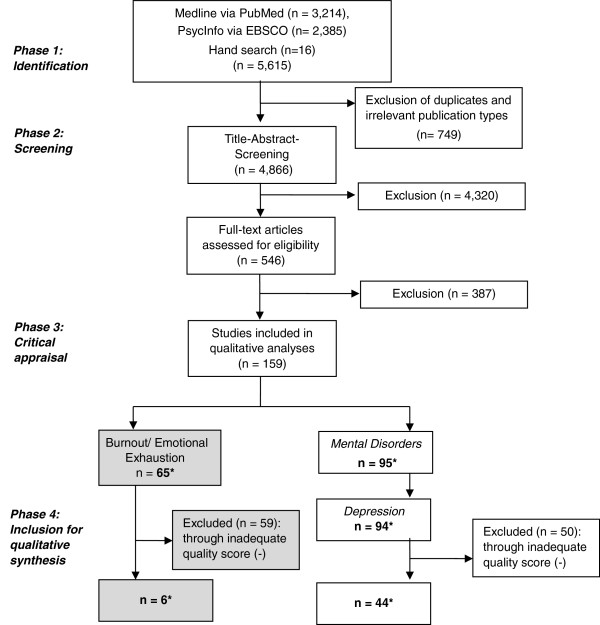
AIMS: To analyze the association between psychosocial working conditions and burnout and its core component emotional exhaustion, a systematic literature review was undertaken including cohort studies, case-control studies, and randomized controlled trials. METHODS: The literature search in Medline and PsycInfo was based on a defined search string and strict exclusion and inclusion criteria. Evaluation of the 5,599 initially identified search hits by two independent reviewers and a detailed quality assessment resulted in six methodologically adequate cohort studies considering the relationship between psychosocial working conditions and burnout (one study) as well as the burnout core component emotional exhaustion (five studies). RESULTS: The results of our systematic review point to a relationship between psychosocial working conditions and the development of emotional exhaustion/burnout. Particularly high job demands seem to play a role in the development of emotional exhaustion. However, strong intercorrelations between workplace factors, as a matter of principle, make the identification of a single psychosocial workplace factor (being associated with an especially high or low risk of burnout) difficult. CONCLUSIONS: Multidimensional approaches including reduction of work demands, enhancement of decision latitude and improving the social climate might be promising for preventing burnout and emotional exhaustion. However, methodologically adequate intervention studies are urgently needed to prove the effectiveness of workplace interventions.
Overview
The claims and statistics of this paper haven’t been checked yet.
Run the check — free, no account needed. It reads the open-access text and checks the sources it cites.
Integrity signals
Registry
Cites
Statistics
Figures
Verification
Claims the paper makes
The claims and statistics of this paper haven’t been checked yet.
Run the check — free, no account needed. It reads the open-access text and checks the sources it cites.
Claims other papers make about this one
Each is checked against this paper’s own text: does it say what the citing paper says it does?
In the citing paper
“The influence of low job control on burnout dimensions was inconsistent.”
From A systematic review including meta-analysis of work environment and burnout symptoms (2017) · cites this paper as [15]
Self-check
Percentages, sums and reported differences re-computed from the paper’s own numbers.
The self-check needs the paper’s full text.
Citations
Cites
Preferred Reporting Items for Systematic Reviews and Meta-Analyses: the PRISMA statement
Moher, D., Liberati, A., Tetzlaff, J., Altman, D. G., & for the PRISMA Group (2009) · BMJ · doi:10.1136/bmj.b2535 · Cited by 83,823
Preferred reporting items for systematic reviews and meta-analyses: the PRISMA Statement.
(2009) · PubMed Central · Cited by 44,859
Preferred Reporting Items for Systematic Reviews and Meta-Analyses: The PRISMA Statement
Moher, D., Liberati, A., Tetzlaff, J., & Altman, D. G. (2009) · Journal of Clinical Epidemiology · doi:10.1016/j.jclinepi.2009.06.005 · Cited by 19,575
The measurement of experienced burnout
Maslach, C., & Jackson, S. E. (1981) · Journal of Organizational Behavior · doi:10.1002/job.4030020205 · Cited by 14,496
Maslach, C., Schaufeli, W. B., & Leiter, M. P. (2001) · Annual Review of Psychology · doi:10.1146/annurev.psych.52.1.397 · Cited by 12,852
Bundesgesundheitsblatt - Gesundheitsforschung - Gesundheitsschutz
(2013) · Bundesgesundheitsblatt - Gesundheitsforschung - Gesundheitsschutz · doi:10.1007/103.1437-1588 · Cited by 11,769
Freudenberger, H. J. (1974) · Journal of Social Issues · doi:10.1111/j.1540-4560.1974.tb00706.x · Cited by 5,463
The Copenhagen Burnout Inventory: A new tool for the assessment of burnout
Kristensen, T. S., Borritz, M., Villadsen, E., & Christensen, K. B. (2005) · Work & Stress · doi:10.1080/02678370500297720 · Cited by 3,136 · cited 1×
“lished burnout questionnaires are the Copenhagen Burnout Inventory (CBI [26]), the Oldenburg Burnout”
MethodProfessional Burnout: Recent Developments in Theory and Research
Schaufeli, W. B., Maslach, C., & Marek, T. (2017) · Jagiellonian University Repository (Jagiellonian University) · Cited by 1,908
Psychosocial work environment and mental health—a meta-analytic review
Stansfeld, S., & Candy, B. (2006) · Scandinavian Journal of Work, Environment & Health · doi:10.5271/sjweh.1050 · Cited by 1,875 · cited 1×
“Existing systematic reviews on the psychologic effects of psychosocial working conditions mainly focused on depression [31,32], mental disorders in all [33], and stress-related disorders [34].”
BackgroundHandbook of Occupational Health Psychology
Quick, J. C., & American Psychological Association (2010) · American Psychological Association eBooks · doi:10.2307/j.ctv1chs29w · Cited by 1,364
The Convergent Validity of Two Burnout Instruments
Demerouti, E., Demerouti, E., Bakker, A. B., Vardakou, I., & Κάντας, Α. (2003) · European Journal of Psychological Assessment · doi:10.1027//1015-5759.19.1.12 · Cited by 1,066
Bonde, J. P. E. (2008) · Occupational and Environmental Medicine · doi:10.1136/oem.2007.038430 · Cited by 919
Maslach C, Schaufeli W, Leiter M. Job burnout. Annu Rev Psychol 2001; 52: 397-422.
Dedić, G. (2002) · Vojnosanitetski pregled · Cited by 855
Burnout: From tedium to personal growth
(1983) · Children and Youth Services Review · doi:10.1016/0190-7409(83)90036-1 · Cited by 790
Historical and Conceptual Development of Burnout
Maslach, C., & Schaufeli, W. B. (2017) · Routledge eBooks · doi:10.4324/9781315227979-1 · Cited by 789
A comparison of the construct validity of two burnout measures in two groups of professionals.
Shirom, A., & Melamed, S. (2006) · International Journal of Stress Management · doi:10.1037/1072-5245.13.2.176 · Cited by 763 · cited 2×
“In fact there is increasing consensus in the scientific community that burnout and depression have to be considered as two separate phenomena, albeit sharing a range of common characteristics [10,11,28,57].”
BackgroundMethodBurnout syndrome in critical care nursing staff
Poncet, M. C., Toullic, P., Papazian, L., Kentish-Barnes, N., Timsit, J.-F., Pochard, F., Chevret, S., Schlemmer, B., & Azoulay, É. (2007) · American Journal of Respiratory and Critical Care Medicine · doi:10.1164/rccm.200606-806oc · Cited by 750
Thomas, N. K. (2004) · JAMA · doi:10.1001/jama.292.23.2880 · Cited by 750
Psychosocial work environment and stress-related disorders, a systematic review
Nieuwenhuijsen, K., Bruinvels, D., & Frings-Dresen, M. (2010) · Occupational Medicine · doi:10.1093/occmed/kqq081 · Cited by 696
Self-citationJob-related burnout: A review.
Shirom, A. (2003) · Handbook of occupational health psychology. · doi:10.1037/10474-012 · Cited by 583
Burnout syndrome among critical care healthcare workers.
Embriaco, N., Papazian, L., Kentish-Barnes, N., Pochard, F., & Azoulay, E. (2007) · Current Opinion in Critical Care · doi:10.1097/mcc.0b013e3282efd28a · Cited by 569
The relationship between job stress, burnout and clinical depression
Iacovides, A., Fountoulakis, K. Ν., Kaprinis, S., & Kaprinis, G. S. (2002) · Journal of Affective Disorders · doi:10.1016/s0165-0327(02)00101-5 · Cited by 559
Kuper, H., & Marmot, M. G. (2003) · Journal of Epidemiology & Community Health · doi:10.1136/jech.57.2.147 · Cited by 557
Backé, E.-M., Seidler, A., Latza, U., Rossnagel, K., & Schumann, B. (2011) · International Archives of Occupational and Environmental Health · doi:10.1007/s00420-011-0643-6 · Cited by 483
Self-citationJob stress and burnout among correctional officers: A literature review study
Schaufeli, W. B., & Peeters, M. C. W. (2000) · International Journal of Stress Management · doi:10.1023/a:1009514731657 · Cited by 474
The Relation between Work-related Psychosocial Factors and the Development of Depression
Netterstrom, B., Conrad, N., Bech, P., Fink, P., Olsen, O., Rugulies, R., & Stansfeld, S. (2008) · Epidemiologic Reviews · doi:10.1093/epirev/mxn004 · Cited by 467 · cited 1×
“Existing systematic reviews on the psychologic effects of psychosocial working conditions mainly focused on depression [31,32], mental disorders in all [33], and stress-related disorders [34].”
BackgroundJob strain, burnout, and depressive symptoms: A prospective study among dentists
Ahola, K., & Hakanen, J. (2007) · Journal of Affective Disorders · doi:10.1016/j.jad.2007.03.004 · Cited by 461
Finney, C., Stergiopoulos, E., Hensel, J., Bonato, S., & Dewa, C. S. (2013) · BMC Public Health · doi:10.1186/1471-2458-13-82 · Cited by 429
Burnout in medical residents: a review
Prins, J. T., Gazendam‐Donofrio, S. M., Tubben, B. J., Van Der Heijden, F. M. M. A., Van De Wiel, H. B. M., & Hoekstra‐Weebers, J. E. H. M. (2007) · Medical Education · doi:10.1111/j.1365-2923.2007.02797.x · Cited by 383 · cited 4×
“However, the mentioned systematic reviews on burnout address very specific occupational groups: medical residents [36,37], pediatric oncology staff [38], correctional officers [35,40], elderly care staff [39], or nurses [41].”
BackgroundInfluentialKhamisa, N., Peltzer, K., & Oldenburg, B. (2013) · International Journal of Environmental Research and Public Health · doi:10.3390/ijerph10062214 · Cited by 338
Perceived control, depressive symptomatology, and professional burnout: A review of the evidence
Glass, D. C., & McKnight, J. (1996) · Psychology and Health · doi:10.1080/08870449608401975 · Cited by 310
Salanova, M., Martínez, I. M., Schaufeli, W. B., & Prieto, L. L. (2015) · Cited by 256
Kaschka, W. P., Korczak, D., & Broich, K. (2011) · Deutsches Ärzteblatt international · doi:10.3238/arztebl.2011.0781 · Cited by 229
Injustice at work and incidence of psychiatric morbidity: the Whitehall II study
Ferrie, J. E., Head, J. A., Shipley, M. J., Vahtera, J., Marmot, M. G., & Mika Kivimaki, B. (2006) · Occupational and Environmental Medicine · doi:10.1136/oem.2005.022269 · Cited by 225
Goehring, C., Gallacchi, M. B., Künzi, B., & BOVIER, P. A. (2005) · Swiss Medical Weekly · doi:10.4414/smw.2005.10841 · Cited by 219
Nübling, M., Stößel, U., Hasselhorn, H. M., Michaelis, M., & Hofmann, F. (2006) · PubMed Central · Cited by 218
Organizational Culture: The Focus Questionnaire
van Muijen, J. J., & al, E. (1999) · European Journal of Work and Organizational Psychology · doi:10.1080/135943299398168 · Cited by 216
Psychopathology and pathophysiology of the self in depression-Neuropsychiatric hypothesis
Northoff, G. (2007) · Journal of Affective Disorders · doi:10.1016/j.jad.2007.02.012 · Cited by 209
van Vegchel, N., JONGE, J. D., Söderfeldt, M., Dormann, C., & Schaufeli, W. B. (2004) · International Journal of Stress Management · doi:10.1037/1072-5245.11.1.21 · Cited by 178
Langballe, E., Innstrand, S. T., Aasland, O., & Falkum, E. (2011) · Stress and Health · doi:10.1002/smi.1321 · Cited by 169
Burnout and depression are not identical twins: is decline of superiority a distinguishing feature?
Brenninkmeyer, V., Van Yperen, N. W., & Buunk, B. P. (2001) · Personality and Individual Differences · doi:10.1016/s0191-8869(00)00079-9 · Cited by 130
Burnout in orthopaedic surgeons: a review
Arora, M., Diwan, A. D., & Harris, I. A. (2013) · ANZ Journal of Surgery · doi:10.1111/ans.12292 · Cited by 106
Andrea, H., Bültmann, U., van Amelsvoort, L. G. P. M., & Kant, Y. (2009) · Depression and Anxiety · doi:10.1002/da.20516 · Cited by 104
Indicators of Job Strain at Midlife and Cognitive Functioning in Advanced Old Age
Andel, R., Crowe, M. G., Kåreholt, I., Wastesson, J. W., & Parker, M. G. (2011) · The Journals of Gerontology Series B · doi:10.1093/geronb/gbq105 · Cited by 86
Nuebling, M., Seidler, A., Garthus‐Niegel, S., Latza, U., Wagner, M., Hegewald, J., Liebers, F., Jankowiak, S., Zwiener, I., Wild, P. S., et al. (2013) · BMC Public Health · doi:10.1186/1471-2458-13-538 · Cited by 85
Self-citationMukherjee, S., Beresford, B., Glaser, A., & Sloper, P. (2009) · Psycho-Oncology · doi:10.1002/pon.1534 · Cited by 78
Pinto‐Meza, A., Moneta, M. V., Alonso, J., Angermeyer, M. C., Bruffaerts, R., Caldas‐de‐Almeida, J. M., de Girolamo, G., de Graaf, R., Florescu, S., Kovess–Masféty, V., et al. (2012) · Social Psychiatry and Psychiatric Epidemiology · doi:10.1007/s00127-012-0536-3 · Cited by 78
Taris, T. W., Kompier, M. A. J., Geurts, S. A. E., Houtman, I. L. D., & Heuvel, F. F. M. V. D. (2009) · Journal of Occupational and Organizational Psychology · doi:10.1348/096317909x424583 · Cited by 76
Search strings for the study of putative occupational determinants of disease
Mattioli, S., Zanardi, F., Baldasseroni, A., Schaafsma, F. G., Cooke, R. M. T., Mancini, G., Fierro, M., Santangelo, C., Farioli, A., Fucksia, S., et al. (2009) · Occupational and Environmental Medicine · doi:10.1136/oem.2008.044727 · Cited by 70
Differential diagnostic of the burnout syndrome
Korczak, D., Huber, B., & Kister, C. (2010) · PubMed Central · doi:10.3205/hta000087 · Cited by 69
Lindeberg, S. I., Rosvall, M., Choi, B., Canivet, C. A., Isacsson, S., Karasek, R. A., & Östergren, P. ‐. (2010) · European Journal of Public Health · doi:10.1093/eurpub/ckq039 · Cited by 65
Driessen, M. T., Proper, K. I., Anema, J. R., Knol, D. L., Bongers, P. M., & van der Beek, A. J. (2010) · Occupational and Environmental Medicine · doi:10.1136/oem.2010.056739 · Cited by 49
Associations Between Positive Changes in Perceived Work Characteristics and Changes in Fatigue
Janssen, N., & Nijhuis, F. J. N. (2004) · Journal of Occupational and Environmental Medicine · doi:10.1097/01.jom.0000135608.82039.fa · Cited by 45
Haukka, E., Pehkonen, I., Leino‐Arjas, P., Viikari-Juntura, E. R. A., Takala, E., Malmivaara, A. V., Hopsu, L., Mutanen, P., Ketola, R. L., Virtanen, T., et al. (2009) · Occupational and Environmental Medicine · doi:10.1136/oem.2008.043786 · Cited by 42
Does psychological distress influence reporting of demands and control at work?
Waldenström, K., Lundberg, I. E., Waldenström, M., & Härenstam, A. (2003) · Occupational and Environmental Medicine · doi:10.1136/oem.60.11.887 · Cited by 38
Arbeit und Gesundheit: Konzepte und Ergebnisse der arbeitspsychologischen Streßforschung
Semmer, N. K., & Mohr, G. (2001) · Psychologische Rundschau · doi:10.1026//0033-3042.52.3.150 · Cited by 34
Gülalp, B., Karcıoğlu, Ö., Sarı, A., & Köseoğlu, Z. (2008) · Journal of Occupational Medicine and Toxicology · doi:10.1186/1745-6673-3-32 · Cited by 33
Ätiopathogenese der unipolaren Depression
Brakemeier, E., Normann, C., & Berger, T. (2008) · Bundesgesundheitsblatt - Gesundheitsforschung - Gesundheitsschutz · doi:10.1007/s00103-008-0505-x · Cited by 22
Prävention von Low-Back-Pain im beruflichen Kontext
Seidler, A., Liebers, F., & Latza, U. (2008) · Bundesgesundheitsblatt - Gesundheitsforschung - Gesundheitsschutz · doi:10.1007/s00103-008-0463-3 · Cited by 18
Self-citationKorczak, D., & Huber, B. (2012) · Bundesgesundheitsblatt - Gesundheitsforschung - Gesundheitsschutz · doi:10.1007/s00103-011-1404-0 · Cited by 17
Burn-out bei Beschäftigten in der stationären Altenpflege und in der Geriatrie
Nienhaus, A., Westermann, C., & Kühnert, S. (2012) · Bundesgesundheitsblatt - Gesundheitsforschung - Gesundheitsschutz · doi:10.1007/s00103-011-1407-x · Cited by 12
Bo, B. (2000) · Cited by 2
Cited by
Sorted by citations
Salvagioni, D. A. J., Melanda, F. N., Mesas, A. E., González, A. D., Gabani, F. L., & Andrade, S. M. D. (2017) · PLOS ONE · doi:10.1371/journal.pone.0185781 · Cited by 1,508
Moreno, L., Talavera‐Velasco, B., García-Albuerne, Y., & Martín‐García, J. (2020) · International Journal of Environmental Research and Public Health · doi:10.3390/ijerph17155514 · Cited by 834
A systematic review including meta-analysis of work environment and burnout symptoms
Aronsson, G., Theorell, T., Grape, T., Hammarström, A., Hogstedt, C., Marteinsdottir, I., Skoog, I., Träskman-Bendz, L., & Hall, C. (2017) · BMC Public Health · doi:10.1186/s12889-017-4153-7 · Cited by 789
Ahola, K., Toppinen‐Tanner, S., & Seppänen, J. (2017) · Burnout Research · doi:10.1016/j.burn.2017.02.001 · Cited by 276
Berg-Beckhoff, G., Nielsen, G., & Ladekjær Larsen, E. (2017) · International Journal of Occupational and Environmental Health · doi:10.1080/10773525.2018.1436015 · Cited by 197
Metadata
- Authors
- Seidler, A., Thinschmidt, M., Deckert, S., Then, F., Hegewald, J., Nieuwenhuijsen, K., & Riedel-Heller, S. G.
- Affiliations
- Technische Universität Dresden (DE)
- Leipzig University (DE)
- Amsterdam UMC Location University of Amsterdam (NL)
- Corresponding author
- Seidler, Andreas
- Venue
- Journal of Occupational Medicine and Toxicology
- Published
- 2014
- Volume
- 9
- Issue
- 1
- Pages
- 10
- ISSN
- 1745-6673 (ISSN-L)
- PMC
- PMC4233644
- OpenAlex
- W2118575037
- Cited by
- 326
- References
- 65
- Citations by year
- 2026: 29 · 2025: 37 · 2024: 58 · 2023: 28 · 2022: 52 · 2021: 25 · 2020: 19 · 2019: 18 · 2018: 16 · 2017: 25 · 2016: 12 · 2015: 6 · 2014: 1
- FWCI
- 2.09
- Type
- journal article
- Language
- en
- Open access
- gold
- doi.org
- Licence
- cc-by
- Locations
- Journal of Occupational Medicine and Toxicology (publishedVersion, cc-by)
- Europe PMC (PubMed Central) (publishedVersion, cc-by)
- PubMed Central (publishedVersion, cc-by)
- PubMed (publishedVersion)
- Pure Amsterdam UMC (publishedVersion)
- Data Archiving and Networked Services (DANS) (submittedVersion)
- Qucosa (Saxon State and University Library Dresden) (submittedVersion, cc-by)
- Funders
- Bundesanstalt für Arbeitsschutz und Arbeitsmedizin
- Topics
- Social Sciences › Psychology › Social Psychology › Stress and Burnout Research
- Health Sciences › Medicine › Public Health, Environmental and Occupational Health › Occupational Health and Burnout
- Health Sciences › Medicine › Public Health, Environmental and Occupational Health › Workplace Health and Well-being
- Keywords
- burnout, emotional exhaustion, psychosocial work environment, job demands, job control, social climate, burnout prevention, workplace interventions, occupational stress
About these checks
Registry, retraction, Cites and statistics results are computed, not judged, with one exception: a printed reference that no index lists is read once by a model before it counts as a citation error. Claims are extracted by a model and kept only when their quote appears verbatim in the text; each cited source is then checked, with a model’s help, for whether it says what the claim relies on. Those verdicts can be wrong — read the claim’s quote and the cited source before relying on one.
Statistics and arithmetic are recomputed, not judged.
Confidence bands are shown only for fields calibrated on our annotated test set. None is calibrated yet, so no band is shown.
What counts as a claim ›How we measure confidence ›How we check this ›
Are you an author, or do you see a problem with this page? Request a review
