

Towards a general theory of implementation
Open accessThe DOI matches its Crossref record; 97 of the 98 references it cites were found in a registry or an index.
Abstract
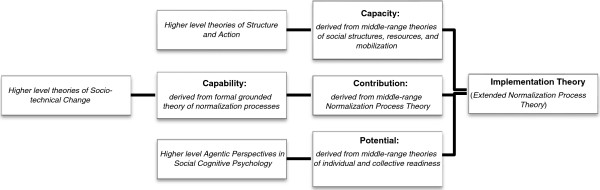
Understanding and evaluating the implementation of complex interventions in practice is an important problem for healthcare managers and policy makers, and for patients and others who must operationalize them beyond formal clinical settings. It has been argued that this work should be founded on theory that provides a foundation for understanding, designing, predicting, and evaluating dynamic implementation processes. This paper sets out core constituents of a general theory of implementation, building on Normalization Process Theory and linking it to key constructs from recent work in sociology and psychology. These are informed by ideas about agency and its expression within social systems and fields, social and cognitive mechanisms, and collective action. This approach unites a number of contending perspectives in a way that makes possible a more comprehensive explanation of the implementation and embedding of new ways of thinking, enacting and organizing practice.
Overview
The claims and statistics of this paper haven’t been checked yet.
Free: it reads the open-access text and checks the first 5 claims that cite a source we can check. Create a free account to check every claim.
Integrity signals
Registry
Cites
Statistics
Figures
Verification
Claims the paper makes
The claims and statistics of this paper haven’t been checked yet.
Free: it reads the open-access text and checks the first 5 claims that cite a source we can check. Create a free account to check every claim.
Claims other papers make about this one
Each is checked against this paper’s own text: does it say what the citing paper says it does?
The source backs part of the claim, not all of it — or backs it for a different population, condition or comparison.
In the citing paper
“The development of NPT first involved the iterative development of a robust generic theory of implementation [5–9, 11, 12].”
From Using Normalization Process Theory in feasibility studies and process evaluations of complex healthcare interventions: a systematic review (2018) · cites this paper as [9]
Experimental — accuracy not yet measuredThe source backs part of the claim, not all of it — or backs it for a different population, condition or comparison.
In the citing paper
“NPT is a theory of implementation that focuses on what people—both individuals and groups—do rather than what they believe or intend, and it has been built up from studies of practice in many different healthcare systems.”
From Using Normalization Process Theory in feasibility studies and process evaluations of complex healthcare interventions: a systematic review (2018) · cites this paper as [9]
Experimental — accuracy not yet measuredThe cited source says what the claim attributes to it.
In the citing paper
“For example, eight frameworks did not explicitly mention stages [13,15,42,44,46,49,50,64,74]”
From A systematic review of implementation frameworks of innovations in healthcare and resulting generic implementation framework (2015) · cites this paper as [49]
The cited source says what the claim attributes to it.
In the citing paper
“May’s [49] framework described only two domains (agency and context)”
From A systematic review of implementation frameworks of innovations in healthcare and resulting generic implementation framework (2015) · cites this paper as [49]
10 more claims about this paper
Create a free account to see every claim other papers make about this one.
Self-check
Percentages, sums and reported differences re-computed from the paper’s own numbers.
The self-check needs the paper’s full text.
Citations
Cites
The theory of planned behavior
Ajzen, I. (1991) · Organizational Behavior and Human Decision Processes · doi:10.1016/0749-5978(91)90020-t · Cited by 90,587
User Acceptance of Information Technology: Toward A Unified View1
Venkatesh, V., Morris, M. G., Davis, G. B., & Davis, F. D. (2003) · MIS Quarterly · doi:10.2307/30036540 · Cited by 45,035 · cited 1×
“[22] also added a group of ‘diffusion’ constructs to those proposed by the Theory of Planned Behavior [23].”
BackgroundSelf-efficacy: Toward a unifying theory of behavioral change
Bandura, A. (1977) · Psychological Review · doi:10.1037/0033-295x.84.2.191 · Cited by 43,925
Reassembling the Social: An Introduction to Actor-Network-Theory
Latour, B. (2005) · doi:10.1093/oso/9780199256044.001.0001 · Cited by 16,778
(1990) · Choice Reviews Online · doi:10.5860/choice.27-6637 · Cited by 16,594
Social Cognitive Theory: An Agentic Perspective
Bandura, A. (2001) · Annual Review of Psychology · doi:10.1146/annurev.psych.52.1.1 · Cited by 15,510
Damschroder, L. J., Aron, D. C., Keith, R. E., Kirsh, S. R., Alexander, J. A., & Lowery, J. C. (2009) · Implementation Science · doi:10.1186/1748-5908-4-50 · Cited by 14,496 · cited 2×
“Some existing frameworks have uti lized workability constructs from diffusion of innovations theory [20,24,53], setting out, for exa mple, ideas about ‘trialability’ and ‘ease of use’ as being important component s of such models.”
BackgroundSelf-efficacy: Toward a unifying theory of behavioral change
Bandura, A. (1978) · Advances in Behaviour Research and Therapy · doi:10.1016/0146-6402(78)90002-4 · Cited by 10,586
Reassembling the social: An introduction to actor‐network‐theory
Turnbull, J. (2008) · New Zealand Geographer · doi:10.1111/j.1745-7939.2008.00151_4.x · Cited by 7,617
Motivational beliefs, values, and goals
Eccles, J. S., & Wigfield, A. (2002) · Annual Review of Psychology · doi:10.1146/annurev.psych.53.100901.135153 · Cited by 7,587 · cited 1×
“Here, potential agency [14] and motivation [68] are themselves necessary antecedents for the dynamic and emergent conditions that follow.”
Background
Research works printed but not linked: 5
- Mingers J Explanatory Mechanisms: The contribution of Critical Realism and Systems Thinking/Cybernetics 2011 Working paper. University of Kent: Canterbury
- Smith A Pope C Goodwin D Mort M 'Contested conversations': an observational study of patient handovers in the recovery room Acta Anaesth Scand 2007 51 18 19
- Winner L Autonomous technologies 1977 Cambridge: MIT Press
- Fishbein M Bandura A Triandis H Kanfer F Becker M Middlestadt S Eichler A Factors influencing behavior and behavior change: Final report-Theorist's Workshop 1992 Rockville (MD): National Institute of Mental Health
- Bandura A Marsh H, Craven RG, McInerney DM Toward an Agentic Theory of the Self., Advances in Self Research, Vol. 3: Self-processes, learning, and enabling human potential (pp. 15-49) 2008 Charlotte, NC: Information Age Publishing
Cited by
Items 401–500 of 723
Langendoen‐Gort, M., Al‐Jabr, H., Hugtenburg, J. G., Rutters, F., de Wit, M., Bhattacharya, D., Abu–Hanna, A., Farmer, A. A., & Elders, P. J. M. (2022) · Trials · doi:10.1186/s13063-022-06491-7 · Cited by 7
“Table 3 provides an overview of the components of the MRC process evaluation framework of complex interventions and the Extended Normalisation Process Theory.”
InfluentialWilderink, L., Visscher, A., Bakker, I. M. C., Schuit, A. J., Seidell, J. C., & Renders, C. M. (2023) · PLoS ONE · doi:10.1371/journal.pone.0284903 · Cited by 6
Bø, K.-E., Halvorsen, K. H., Le, A. Y.-N., & Lehnbom, E. C. (2024) · BMC Health Services Research · doi:10.1186/s12913-024-11014-y · Cited by 7
“The interview questions were developed and inspired by the theoretical constructs in an extended version of the NPT [23].”
BackgroundMethodMbah, M. F., & Ezegwu, C. (2024) · Sustainability · doi:10.3390/su17010052 · Cited by 6
Vanhamel, J., Reyniers, T., Vuylsteke, B., Callens, S. F. J., Nöstlinger, C., Veld, D. H. I. ‘., Kenyon, C. R., Praet, J. T. V., Libois, A., Vincent, A., et al. (2024) · Journal of the International AIDS Society · doi:10.1002/jia2.26260 · Cited by 6
Leresche, E., Hossain, M., Rossi, R., Truppa, C. T., Barth, C. A., Mactaggart, I., Leaning, J., & Singh, N. (2022) · Disasters · doi:10.1111/disa.12549 · Cited by 6
Bonell, C. P., Ponsford, R., Meiksin, R., & Meléndez‐Torres, G. J. (2023) · Journal of Epidemiology & Community Health · doi:10.1136/jech-2022-219776 · Cited by 6
Furler, J., Blackberry, I., Manski-Nankervis, J.-A. E., Oâ€TMNeal, D., Best, J. D., & Young, D. Y. L. (2015) · Frontiers in Medicine · doi:10.3389/fmed.2014.00060 · Cited by 7
“If a research team is open and able to accommodate learnings from the field in iterative cycles of design, implementation, and evaluation, this can mean an intervention can evolve, approaching greater coherence and fit (9) with routine practice in the field.”
BackgroundMethodImplementing an integrated pathway to care for the dying: is your organisation ready?
Sharpe, K., Noble, C., Hiremagular, B., & Grealish, L. A. (2018) · International Journal of Palliative Nursing · doi:10.12968/ijpn.2018.24.2.70 · Cited by 6
Rapin, J., D’Amour, D., Penseyres, T., Santos, G., Adatte, V., Lehn, I., & Mabire, C. (2018) · Recherche en soins infirmiers · doi:10.3917/rsi.131.0061 · Cited by 6
Shaw, A. (2018) · Social Marketing Quarterly · doi:10.1177/1524500418810713 · Cited by 7
“…of interventions” (Manzano & Pawson, 2014, p.367), whereas implementation theory is “the production of a robust set of conceptual tools that enable researchers and practitioners to identify, describe and explain important elements of implementation processes and their outcomes” (May, 2013, p.2).”
BackgroundBello, A. K., Zaidi, D., Braam, B. G., Courtney, M. J., Glassford, J., Jindal, K. K., Klarenbach, S. W., Kurzawa, J., Osman, M. S., Scott‐Douglas, N., et al. (2019) · Canadian Journal of Kidney Health and Disease · doi:10.1177/2054358119878715 · Cited by 7
“Practice facilitation is a widely implemented tool in clinical practice that supports primary care practices to help overcome challenges and improve patient care and health outcomes.(18) In this study, practice facilitation will entail academic detailing visits by the University of Alberta’s Nephrology Team and the AH…”
Conner, M. T., Williams, D. M., & Rhodes, R. E. (2020) · Cambridge University Press eBooks · doi:10.1017/9781108677318.034 · Cited by 8
Duke, S., Richardson, A. M., May, C. R., Lund, S., Lunt, N. T., & Campling, N. C. (2021) · International Journal of Nursing Studies Advances · doi:10.1016/j.ijnsa.2021.100022 · Cited by 7
“These constructs provide a means of analysing implementation work to illuminate the organisational and relational factors that promote and inhibit implementation ( Murray et al., 2010 ; May, 2013 , May et al., 2018 ).”
Self-citationLim, S. E. R., Meredith, S. J., Agnew, S., Clift, E., Ibrahim, K., & Roberts, H. C. (2022) · BMJ Open · doi:10.1136/bmjopen-2021-052631 · Cited by 8
“39 NPT was chosen as the framework that under-pinned this study as it was systematic in its approach, easy to understand and provided a structured framework to evaluate the implementation process of this study.”
Bayisenge, J. (2015) · Gothenburg University Publications Electronic Archive (Gothenburg University) · Cited by 11
Delivering remote pulmonary rehabilitation in Bangladesh: a mixed-method feasibility study
Habib, G. M., Uzzaman, N., Rabinovich, R., Akhter, S., Sultana, M., Ali, M., & Pinnock, H. (2025) · Journal of Global Health · doi:10.7189/jogh.15.04002 · Cited by 5
O'Reilly, S. L. (2016) · Nutrition & Dietetics · doi:10.1111/1747-0080.12308 · Cited by 5
Baldwin, S., Insan, N., Beauchamp, H., Gilroy, V., Morton, A., & Barlow, J. (2023) · BMJ Open · doi:10.1136/bmjopen-2023-078579 · Cited by 5
Walangare, R. A. C., & Sujatmiko, B. (2022) · IT-Edu : jurnal information technology & education · doi:10.26740/it-edu.v7i3.50086 · Cited by 13
“Secara garis beras penerepan dapat diartikan sebagai proses atau merealisasikan. membuat suatu hal terjadi atau suatu tindakan seseorang untuk membuat sesuatu terjadi melalui tindakan seseorang tersebut (May, 2018).”
BackgroundProximity to Practice: The Role of Technology in the Next Era of Assessment
Krumm, A. E., Lai, H., Marcotte, K. M., Ark, T. K., Yaneva, V., & Chahine, S. (2024) · Perspectives on Medical Education · doi:10.5334/pme.1272 · Cited by 5
Walker, A., Boaz, A., & Hurley, M. (2020) · Disability and Rehabilitation · doi:10.1080/09638288.2020.1803997 · Cited by 6
Pearson, M., Jackson, G., Jackson, C., Boland, J. W., Featherstone, I., Huang, C., Ogden, M., Sartain, K., Siddiqi, N., Twiddy, M., et al. (2022) · BMJ Open · doi:10.1136/bmjopen-2021-060450 · Cited by 5
Fox, C., Hammond, S. P., Backhouse, T., Poland, F. M., Waring, J. J., Penhale, B., & Cross, J. (2023) · PLoS ONE · doi:10.1371/journal.pone.0279651 · Cited by 5
“Developing and testing interventions for efficacy is important, but so is knowledge of appropriate robust, theory-based implementation to normalize changes [9].”
BackgroundMoghtadai, M., Boroujeni, F. Z., & Soltanaghaei, M. (2023) · Applied Intelligence · doi:10.1007/s10489-023-04817-9 · Cited by 5
Holdsworth, L. M., Stedman, M. R., Saliba‐Gustafsson, E. A., Han, J., Asch, S. M., Harbert, G., Lorenz, K., Lupu, D., Malcolm, E. J., Moss, A. H., et al. (2023) · BMC Health Services Research · doi:10.1186/s12913-023-10360-7 · Cited by 5
“Efforts to extend NPT have attempted to account for the real-world context in which work takes place and is an essential improvement to NPT, as is the development of an NPT codebook to help researchers conceptualize context as part of the analytic process [38–40].”
BackgroundTowards implementing coordinated healthy lifestyle promotion in primary care: a mixed method study
Thomas, K., Bendtsen, P., & Krevers, B. (2015) · International Journal of Integrated Care · doi:10.5334/ijic.1741 · Cited by 8
Ehrlich, C., Kisely, S. R., Kendall, E., Crompton, D., Crowe, E., & Liddy, A. M. (2013) · Australian Health Review · doi:10.1071/ah13062 · Cited by 6
Whittle, J. (2013) · American Journal of Hypertension · doi:10.1093/ajh/hpt237 · Cited by 5
Nursing Theories: Foundation Of Nursing Profession
(2020) · i-manager’s Journal on Nursing · doi:10.26634/jnur.9.4.16643 · Cited by 5
Addressing Underserved Populations and Disparities in Behavior Change
Schüz, B., & Hooper, M. W. (2020) · Cambridge University Press eBooks · doi:10.1017/9781108677318.027 · Cited by 8
Professional Values: The Use of Technology and the New Generation of Clinicians
Wouters, E., Weijers, T. C. M., & Nieboer, M. E. (2016) · Springer eBooks · doi:10.1007/978-3-319-01583-5_51 · Cited by 6
Realist inquiry into Maternity care @ a Distance (ARM@DA): realist review protocol
Evans, C., Evans, K., Booth, A., Timmons, S., Jones, N. W., Nazmeen, B., Sunney, C., Clowes, M., Clancy, G., & Spiby, H. (2022) · BMJ Open · doi:10.1136/bmjopen-2022-062106 · Cited by 5
Slowther, A., Bernstein, C. J., Huxley, C., Harlock, J., Eli, K., Mann, C., Spencer, R. A., Dale, J. R., Gill, P. S., Blanchard, H., et al. (2024) · British Journal of General Practice · doi:10.3399/bjgp.2024.0248 · Cited by 6
“10 We found consensus among general practice and care home staff, patients, and their relatives that ReSPECT was a valuable tool for involving and empowering patients to express their views and influence future treatment decisions.”
Goodwin, V. A., Day, J., Byng, R., McArdle, P., & Kieft, E. (2017) · European Journal for Person Centered Healthcare · doi:10.5750/ejpch.v5i1.1248 · Cited by 6
“The PARiHS element of contextual readiness is also recognised in the Normalization Process Theory [38] and the Behaviour Change Wheel [33].”
MethodUnderstanding Innovation and the Problem of Technology Adoption
Gardner, J. (2017) · Springer eBooks · doi:10.1007/978-3-319-53270-7_2 · Cited by 6
Lessons for GIS Implementation in Zimbabwe from the South African Experiences
Tarisayi, K. S. (2018) · Alternation Interdisciplinary Journal for the Study of the Arts and Humanities in Southern Africa · doi:10.29086/2519-5476/2018/sp21a9 · Cited by 8
Flowers, P., Lasoye, S., McQueen, J., Owusu, M. W., Symonds, M., & Estcourt, C. S. (2021) · medRxiv · doi:10.1101/2021.07.07.21260064 · Cited by 6
Barriers and Facilitators to the Implementation of a Peer Support Intervention in Universities
Maillé, S., Beaulieu, F., Lachance, L., & Grégoire, S. (2025) · Journal of College Student Mental Health · doi:10.1080/28367138.2024.2325437 · Cited by 4
“But as May (2013) points out, such programs cannot become properly embedded in mental health services departments if stakeholders are unwilling to integrate them into existing practice, or are unable to make sense of the information required to operationalize them effectively.”
Armitt, H. A., Bottomley-Wise, R. M., Pervin, J., Blower, S. L., Booth-Card, S., Dubicka, B., Foers, M., Griffin, S. C., Hewitt, C. E., Baird, K., et al. (2025) · NIHR Open Research · doi:10.3310/nihropenres.14053.1 · Cited by 4
Potential Applications of Realist Methodologies to Implementation Science Research
Mukumbang, F. C., Bullon, A. A., McClelland, R. S., Potthoff, S., Weiner, B. J., & Dalkin, S. M. (2026) · International Journal of Qualitative Methods · doi:10.1177/16094069261432357 · Cited by 5
2 Theorieën over implementatie
Grol, R. P. T. M., Wensing, M., Bosch, M., Hulscher, M., & Eccles, M. (2015) · Bohn Stafleu van Loghum eBooks · doi:10.1007/978-90-368-1077-7_2 · Cited by 4
Backman, R., Weber, P., Turner, A. M., Lee, M. G., & Litchfield, I. J. (2017) · BMJ Open · doi:10.1136/bmjopen-2017-016713 · Cited by 4
Carter, H. M., Beard, D. J., Leighton, P. A., Moffatt, F., Smith, B. E., Webster, K. E., & Logan, P. (2024) · BMJ Open · doi:10.1136/bmjopen-2023-082387 · Cited by 4
Cunningham, A., Golden, D. D. L. H., Pink, M., Truszkowska, E., Byrne, T., Murphy, C., Strahann, A., Doyle, C., Kasemiire, A., & Frawley, T. (2024) · Journal of Advanced Nursing · doi:10.1111/jan.16498 · Cited by 6
“Therefore, the intervention becomes a ‘complex intervention’ which is adapted to fit the labyrinthine and dynamic healthcare setting (May 2013, 2).”
Sigvardsson, D., MacLean, A., Hoonk, A., Ali, T., & Makenzius, M. (2025) · BMC Family Practice · doi:10.1186/s12875-025-03038-y · Cited by 4
“The analysis began with an initial reading of the transcripts to familiarize them with the data, after which meaning units were identified and coded according to the NPT constructs [23, 24].”
Patientinvolvering og institutionelle logikker– implementerings-processer i praksis
Beedholm, K., Andersen, L. M., & Lomborg, K. E. (2017) · Klinisk Sygepleje · doi:10.18261/issn.1903-2285-2017-03-03 · Cited by 4
Changing Behavior in the Digital Age
Kavanagh, D. J. (2020) · Cambridge University Press eBooks · doi:10.1017/9781108677318.029 · Cited by 20
Clark, D., Inbadas, H., & Seymour, J. E. (2020) · Wellcome Open Research · doi:10.12688/wellcomeopenres.16321.1 · Cited by 4
Payne, V., Johnson, M. J., Hunt, K. J., & Prieto, J. A. (2024) · Journal of Neonatal Nursing · doi:10.1016/j.jnn.2024.07.026 · Cited by 4
Wicaksono, A., Wahyono, E. B., Wijaya, G., Prayoga, R. A., Prihatin, S. M., Purbawa, Y., Sidipurwanty, E., Juniati, H., Sakti, T., & Humaedi, M. A. (2024) · Journal of Infrastructure Policy and Development · doi:10.24294/jipd.v8i7.5246 · Cited by 5
“Consequently, each participant in the implementation chain is tasked with grasping, designing, forecasting, and critically assessing the nuanced intricacies of the process (Deleon and Deleon, 2002; May, 2013).”
MethodBeasant, L., Chakkarapani, E., Horwood, J. P., Odd, D., Stocks, S., Parker, D., & Ingram, J. C. (2024) · BMJ Open · doi:10.1136/bmjopen-2024-088228 · Cited by 6
The Challenges of Improving Statistical Practice in Alcohol Treatment Research
Harris, A. H. S., Boden, M. T., Finlay, A. K., & Rubinsky, A. D. (2013) · Alcoholism Clinical and Experimental Research · doi:10.1111/acer.12316 · Cited by 4
Shahrasbi, N., & Paré, G. (2015) · doi:10.13140/rg.2.1.2684.4247 · Cited by 13
Generating and using evidence: reflections from the perspective of implementation
Sales, A. E. (2016) · Journal of Clinical Epidemiology · doi:10.1016/j.jclinepi.2015.12.012 · Cited by 4
Pontin, D., Kenny, G., Bray, I., & Albarran, J. W. (2016) · BMJ Simulation & Technology Enhanced Learning · doi:10.1136/bmjstel-2016-000115 · Cited by 4
Bennett, S. H., Travers, C., Liddle, J., Smith, S. J., Clemson, L. M., OʼReilly, M., Allen, M. J., Laver, K., Beattie, E., Low, L., et al. (2020) · Brain Impairment · doi:10.1017/brimp.2020.15 · Cited by 5
“Although educational approaches are often utilised to develop stakeholder’s knowledge, implementation theories such as NPT (May et al., 2018), also highlights the power of strengthening professional relationships by relational integration (i.e. developing and maintaining knowledge and confidence in each other’s roles…”
BackgroundMethodInfluentialFeather, J., Kaehne, A., & Kiernan, J. (2023) · Journal of Health Organization and Management · doi:10.1108/jhom-03-2023-0095 · Cited by 5
Smith, M. C., O’May, F., Tropea, S., & Berg, J. (2016) · Journal of Clinical Nursing · doi:10.1111/jocn.13344 · Cited by 4
“Participants in our study were not in favour of generating more condition-specific guidelines as they considered their ‘ease of use’ important (May 2013).”
BackgroundInfluentialTowards general theories of software engineering
Johnson, P., Ekstedt, M., Goedicke, M., & Jacobson, I. (2014) · Science of Computer Programming · doi:10.1016/j.scico.2014.11.005 · Cited by 4
Quao, K. H. (2017) · DUT Open Scholar (Durban University of Technology) · doi:10.51415/10321/2563 · Cited by 5
“The evaluation of existing policies’ impact on MFI activities is necessary to identify gaps in the prevailing regulations/policies and also to review or reformulate (May 2013: 7) aspects of current policies.”
BackgroundInfluentialPReCePT Devolved Nations Evaluation ReportPreprint
Edwards, H. B., Rejon, C. S., Pithara, C., de Vocht, F., McLeod, H., Redwood, S., Hill, L., Opmeer, B. C., Odd, D., & Luyt, K. (2024) · medRxiv · doi:10.1101/2024.07.30.24311213 · Cited by 4
Förster, A., Godfrey, M., Green, J. R., McMaster, N., Airlie, J., Cundill, B., Lawton, R., Hawkins, R., Hulme, C. T., Birch, K. M., et al. (2021) · Programme Grants for Applied Research · doi:10.3310/pgfar09090 · Cited by 5
Ball, H., Eisner, E., Nicholas, J., Wilson, P. M., & Bucci, S. (2025) · International Journal of Medical Informatics · doi:10.1016/j.ijmedinf.2025.106040 · Cited by 3
Mountifield, C. (2025) · International Journal of Sport Policy and Politics · doi:10.1080/19406940.2025.2583979 · Cited by 3
“2012, May 2013, Skille and Stenling 2018).”
Ponsford, R., Meiksin, R., Muraleetharan, V., McAllister, J., Tilouche, N., Meléndez‐Torres, G. J., Sturgess, J., Opondo, C., Morris, S., Hadley, A., et al. (2026) · Sex Education · doi:10.1080/14681811.2026.2620092 · Cited by 3
Nilsen, P., & Kirk, J. W. (2026) · Implementation Science Communications · doi:10.1186/s43058-026-00940-z · Cited by 5
“Within this framework, social structure refers to the relational and material conditions that shape and constrain action in practice, including formal roles, distributions of expertise, access to organizational and technological resources, and regulatory or managerial constraints [104, 105].”
UK maternity inquiries: 25 years of the same diagnosis
Edwards, N., Vaughan, L., Barach, P. R., & Robson, S. (2026) · BMJ · doi:10.1136/bmj-2026-100383 · Cited by 3
Exploring Implementation Barriers of Elite Parasport Programs in National Parasport Organizations
Filho, C. E. Z. (2024) · Journal of Global Sport Management · doi:10.1080/24704067.2024.2329221 · Cited by 3
“Overall, several definitions of policy implementation can be found in the literature (Jann & Wegrich, 2006; May, 2013; Setegn, 2018; Vimarlund & Keller, 2014).”
InfluentialSepsis screening protocol implementation: a clinician-validated rapid realist review
Melville, J., Carr, T., Goodridge, D. M., Muhajarine, N., & Groot, G. (2024) · BMJ Open Quality · doi:10.1136/bmjoq-2023-002593 · Cited by 3
Implementation Science: Strategies to Improve Adoption and Adherence to Clinical Practice Guidelines
Jones, L. K., Sarkies, M., Gionfriddo, M. R., Gidding, S. S., & Watts, G. F. (2024) · Contemporary cardiology · doi:10.1007/978-3-031-54960-1_6 · Cited by 5
Hamilton, C., Lewis, R., Blake, C., Purvis, A., Vaczy, C., Deidda, M., Kerr, N., Waiting, L., Dawson, K., Willis, M., et al. (2025) · BMJ Open · doi:10.1136/bmjopen-2024-096596 · Cited by 6
Park, S., Bakko, M., & Pinto, R. M. (2025) · Human Services Organizations Management Leadership & Governance · doi:10.1080/23303131.2025.2471533 · Cited by 3
Line manager perspectives on workplace-based efforts to reduce sickness absence: a qualitative study
Rasmussen, L., Nielsen, M. B. D., Garde, A. H., & Kristiansen, J. (2025) · International Journal of Qualitative Studies on Health and Well-Being · doi:10.1080/17482631.2025.2510560 · Cited by 3
“Furthermore, the need for theory to explain social processes during implementation has been highlighted in previous papers (May, 2013).”
Pearson, M., Mohamed, A., Bajwah, S., Fallon, M., Date, K. L., Williams, B., Currow, D. C., & Johnson, M. (2026) · BMC Palliative Care · doi:10.1101/2025.06.12.25329502 · Cited by 3
Rose‐Clarke, K., Sönmez, C. C., Shrestha, S., Lamichhane, B., Pradhan, I., Pandey, P., Kandel, P., Hodsoll, J. P., Yan, L., Patenaude, B., et al. (2025) · BMC Psychiatry · doi:10.1186/s12888-025-07302-4 · Cited by 3
“The process evaluation design is informed by frameworks and theory including the general theory of implementation and Medical Research Council guidance [60, 61].”
Morton, A., & Wigley, W. (2014) · Journal of Health Visiting · doi:10.12968/johv.2014.2.12.670 · Cited by 3
Kuchenbaur, M., & Peter, R. (2021) · Frontiers in Public Health · doi:10.3389/fpubh.2021.797838 · Cited by 5
“Furthermore, a general and comprehensive attempt to theoretically underpin implementation processes has already been made by May (10).”
BackgroundLaing, L., Salema, N.-E., Jeffries, M., Shamsuddin, A., Sheikh, A., Chuter, A., Waring, J. J., Avery, A. J., & Keers, R. N. (2022) · PLoS ONE · doi:10.1371/journal.pone.0274560 · Cited by 3
Sundaram, N., Tilouche, N., Cullen, L., Hosseini, P., Nguipdop‐Djomo, P., Langan, S., Hargreaves, J., & Bonell, C. P. (2023) · SSM - Qualitative Research in Health · doi:10.1016/j.ssmqr.2023.100257 · Cited by 6
“Finally, in terms of GTI's concept of ‘reflexive monitoring’, schools undertook regular formal risk-assessments as well as informal reflections on implementation.”
MethodInfluentialTarp, K., Nielsen, S. L., Holmberg, T. T., Dalsgaard, C., Borkner, S., Skaarnes, H., Jensen, E. S., Piera-Jiménez, J., Vis, C., & Mathiasen, K. (2023) · Frontiers in Psychiatry · doi:10.3389/fpsyt.2023.1104301 · Cited by 4
“Frontiers in Psychiatry 12 frontiersin.org Even though the toolkit and the surveys were NPT based, it may be a strength that we chose the CFIR framework for qualitative data collection and analysis.”
BackgroundMethodInfluentialFORMATIVE ASSESSMENT IN ENGLISH LEARNING OF JUNIOR HIGH SCHOOL
Fitriani, D., Loeneto, B. A., & Inderawati, R. (2021) · English Review Journal of English Education · doi:10.25134/erjee.v9i2.4982 · Cited by 3
“The principles of implementing an assessment is also related to these three dimensions; input, process and output(May,2013).”
BackgroundMethodMilton, R., Channon, S., Sanders, J., Kenyon, S. L., Middlemiss, A. L., Strange, H., Davies, K., Choudary-Salter, L., Barry, S., Prendeville, T., et al. (2025) · NIHR Open Research · doi:10.3310/nihropenres.13745.2 · Cited by 3
“NPT and CFIR constructs will iteratively inform each step of the analysis to provide rich understanding of the operational context and implementation of MCoC.”
InfluentialCare planning for long term conditions in primary care: indicators of embeddedness
Lhussier, M., Forster, N., Eaton, S., & Carr, S. M. (2015) · European Journal for Person Centered Healthcare · doi:10.5750/ejpch.v3i1.869 · Cited by 3
Pries‐Heje, J., Commisso, T. H., & Nørbjerg, J. (2014) · Lecture notes in business information processing · doi:10.1007/978-3-319-09546-2 · Cited by 3
Innovating the practice of medical speciality training
Fokkema, J. P. I. (2016) · Perspectives on Medical Education · doi:10.1007/s40037-015-0245-1 · Cited by 3
“Using a theory-driven methodology based on a general theory of implementation [6], proceedings of project meetings were thematically analyzed to identify choices and developments regarding the implementation approach and to assess the effects of various approaches.”
MethodAn investigation of the financial monitoring policies for microfinance institutions in Ghana
Quao, K. H., Lekhanya, L. M., & Dorasamy, N. (2017) · Investment Management and Financial Innovations · doi:10.21511/imfi.14(4).2017.09 · Cited by 3
“This ‘3-Pillar FMPO model’ is developed on the premise that participation in decision-making integrates the views of all interest groups (Hill & Hupe, 2015; May, 2013).”
BackgroundMethodInfluentialIngredients of Successful Emerging Business Ecosystems: Case of Industrial IoT Adoption
Gupta, R., Miyazaki, K., & Kajikawa, Y. (2018) · Portland International Conference on Management of Engineering and Technology (PICMET) · doi:10.23919/picmet.2018.8481854 · Cited by 4
“The concept of the focal firm is discussed in context of its importance in co-innovation stabilization and eventually institutionalization [19].”
BackgroundWilson, P. M., Farley, K., Bickerdike, L., Booth, A., Chambers, D., Lambert, M. F., Thompson, C. A., Turner, R. N., & Watt, I. S. (2017) · Health Services and Delivery Research · doi:10.3310/hsdr05050 · Cited by 6
“The notion of ‘normalisation’, in which practices become routinely embedded into the organisational context, requires participants to have a shared understanding of the purpose and value of the information acquired.(65) CASE STUDIES EXPLORING UPTAKE AND USE OF EVIDENCE IN CCGS’ DECISION-MAKING”
BackgroundAnnesley, S. H. (2015) · Stirling Online Research Repository (University of Stirling) · Cited by 3
Addressing the Practice Context in Evidence-Based Practice Implementation: Leadership and Climate
Shuman, C. J. (2017) · Deep Blue (University of Michigan) · Cited by 8
Porter, A. M., Kingston, M. R., Evans, B. A., Hutchings, H. A., Whitman, S., & Snooks, H. A. (2016) · BMC Family Practice · doi:10.1186/s12875-016-0416-0 · Cited by 4
Comparison communities in a cluster randomised trial innovate in response to ‘being controlled’
Hawe, P., Riley, T., Gartrell, A., Turner, K., Canales, C., & Omstead, D. (2015) · Social Science & Medicine · doi:10.1016/j.socscimed.2015.03.033 · Cited by 3
Pithara, C., Stone, T. J., Treloar, E., Donovan, J., Luyt, K., & Redwood, S. (2025) · Implementation Science Communications · doi:10.1186/s43058-025-00758-1 · Cited by 2
“Contextual and intervention enablers and challenges reflected social-cognitive, and social-structural resources as captured by the Capacity and Potential components of the NPT [27].”
Andriessen, C., Blom, M. T., van Hoek, B. A. C. E., de Boer, A. W., Denig, P., Herings, R. M. C., de Rooij-Peek, A., van Marum, R. J., Hugtenburg, J. G., van Raalte, D. H., et al. (2025) · Family Practice · doi:10.1093/fampra/cmaf064 · Cited by 2
“The list entailed themes of the extended normalization process theory (ENPT), which is a commonly used framework to evaluate the implementation of innovations [20].”
Visser, E., Allers, S., van Linschoten, R. C. A., Bodelier, A. G. L., Fitzpatrick, C., de Jonge, V., Vermeulen, H. G., Verweij, K. E., van der Wiel, S. K., van der Horst, D., et al. (2025) · BMJ Open Quality · doi:10.1136/bmjoq-2025-003583 · Cited by 2
Halford, E. (2026) · The Police Journal Theory Practice and Principles · doi:10.1177/0032258x261430216 · Cited by 2
Hennus, M. P., Ladenheim, R. I., Chen, H. C., Chou, F. C., Hamstra, S. J., Hennel, E. K., Marty, A., Romão, G. S., Yap, M., & ten Cate, O. (2026) · Perspectives on Medical Education · doi:10.5334/pme.2440 · Cited by 2
“NPT is an implementation theory developed by May [23, 25], offering a framework for understanding how complex interventions become embedded (“normalized”) in everyday practice.”
Ankersen, P. V., Steffensen, R. G., Blæhr, E. E., & Beedholm, K. (2021) · Journal of Integrated Care · doi:10.1108/jica-07-2020-0047 · Cited by 4
Al-Shammari, M. A., Yasir, A. A., Aldoori, N. M., & Mohammad, H. (2021) · JMIR Research Protocols · doi:10.2196/23783 · Cited by 2
“Previous studies [30,31] specified 4 key analytical domains as nonlinear and mentioned that they cooperate energetically to afford broad enlightenment of implementation processes, which anticipate if participants do not understand, sustain, or consider an intervention valuable or compatible with their current work.”
Background
Metadata
- Authors
- May, C.
- Affiliations
- University of Southampton (GB)
- Corresponding author
- May, Carl
- ORCID
- May, Carl
- Venue
- Implementation Science
- Published
- 2013-02-13
- Volume
- 8
- Issue
- 1
- Pages
- 18-18
- ISSN
- 1748-5908 (ISSN-L)
- PMC
- PMC3602092
- OpenAlex
- W2152345693
- Cited by
- 656
- References
- 98
- Citations by year
- 2026: 28 · 2025: 36 · 2024: 39 · 2023: 57 · 2022: 72 · 2021: 60 · 2020: 105 · 2019: 54 · 2018: 45 · 2017: 47 · 2016: 42 · 2015: 43 · 2014: 20 · 2013: 8
- FWCI
- 68.22
- Type
- journal article
- Language
- en
- Open access
- gold
- doi.org
- Licence
- Locations
- Implementation Science (publishedVersion, cc-by)
- Europe PMC (PubMed Central) (publishedVersion, cc-by)
- PubMed Central (publishedVersion, cc-by)
- PubMed (publishedVersion)
- ePrints Soton (University of Southampton) (acceptedVersion)
- LSHTM Research Online (London School of Hygiene and Tropical Medicine) (acceptedVersion)
- Funders
- National Institute for Health and Care Research (NF-SI-0509-10017)
- Economic and Social Research Council (ES/I037342/1, ES-062-23-3274)
- Topics
- Health Sciences › Health Professions › General Health Professions › Health Policy Implementation Science
- Health Sciences › Medicine › Public Health, Environmental and Occupational Health › Clinical practice guidelines implementation
- Health Sciences › Health Professions › General Health Professions › Health Sciences Research and Education
- Keywords
- implementation theory, complex interventions, Normalization Process Theory, agency, social mechanisms, cognitive mechanisms, collective action, healthcare implementation, organizational change
- MeSH terms
- Delivery of Health Care, Diffusion of Innovation, United Kingdom, Health Policy, Humans, Organizational Innovation, State Medicine, Process Assessment, Health Care, Qualitative Research
About these checks
Registry, retraction, Cites and statistics results are computed, not judged, with one exception: a printed reference that no index lists is read once by a model before it counts as a citation error. Claims are extracted by a model and kept only when their quote appears verbatim in the text; each cited source is then checked, with a model’s help, for whether it says what the claim relies on. Those verdicts can be wrong — read the claim’s quote and the cited source before relying on one.
Statistics and arithmetic are recomputed, not judged.
Confidence bands are shown only for fields calibrated on our annotated test set. None is calibrated yet, so no band is shown.
What counts as a claim ›How we measure confidence ›How we check this ›
Are you an author, or do you see a problem with this page? Request a review
Data sources
Bibliographic data: Semantic Scholar, OpenAlex, Crossref.
Contains information from the Semantic Scholar Academic Graph Datasets, made available under the ODC Attribution License (ODC-BY 1.0).
Semantic Scholar’s data is described in: Kinney, R., et al. (2023). The Semantic Scholar Open Data Platform. arXiv:2301.10140.
