

Towards a general theory of implementation
Open accessThe DOI matches its Crossref record; 97 of the 98 references it cites were found in a registry or an index.
Abstract
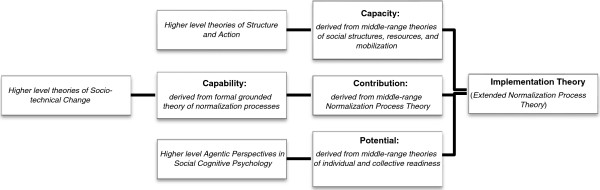
Understanding and evaluating the implementation of complex interventions in practice is an important problem for healthcare managers and policy makers, and for patients and others who must operationalize them beyond formal clinical settings. It has been argued that this work should be founded on theory that provides a foundation for understanding, designing, predicting, and evaluating dynamic implementation processes. This paper sets out core constituents of a general theory of implementation, building on Normalization Process Theory and linking it to key constructs from recent work in sociology and psychology. These are informed by ideas about agency and its expression within social systems and fields, social and cognitive mechanisms, and collective action. This approach unites a number of contending perspectives in a way that makes possible a more comprehensive explanation of the implementation and embedding of new ways of thinking, enacting and organizing practice.
Overview
The claims and statistics of this paper haven’t been checked yet.
Free: it reads the open-access text and checks the first 5 claims that cite a source we can check. Create a free account to check every claim.
Integrity signals
Registry
Cites
Statistics
Figures
Verification
Claims the paper makes
The claims and statistics of this paper haven’t been checked yet.
Free: it reads the open-access text and checks the first 5 claims that cite a source we can check. Create a free account to check every claim.
Claims other papers make about this one
Each is checked against this paper’s own text: does it say what the citing paper says it does?
The source backs part of the claim, not all of it — or backs it for a different population, condition or comparison.
In the citing paper
“The development of NPT first involved the iterative development of a robust generic theory of implementation [5–9, 11, 12].”
From Using Normalization Process Theory in feasibility studies and process evaluations of complex healthcare interventions: a systematic review (2018) · cites this paper as [9]
Experimental — accuracy not yet measuredThe source backs part of the claim, not all of it — or backs it for a different population, condition or comparison.
In the citing paper
“NPT is a theory of implementation that focuses on what people—both individuals and groups—do rather than what they believe or intend, and it has been built up from studies of practice in many different healthcare systems.”
From Using Normalization Process Theory in feasibility studies and process evaluations of complex healthcare interventions: a systematic review (2018) · cites this paper as [9]
Experimental — accuracy not yet measuredThe cited source says what the claim attributes to it.
In the citing paper
“For example, eight frameworks did not explicitly mention stages [13,15,42,44,46,49,50,64,74]”
From A systematic review of implementation frameworks of innovations in healthcare and resulting generic implementation framework (2015) · cites this paper as [49]
The cited source says what the claim attributes to it.
In the citing paper
“May’s [49] framework described only two domains (agency and context)”
From A systematic review of implementation frameworks of innovations in healthcare and resulting generic implementation framework (2015) · cites this paper as [49]
10 more claims about this paper
Create a free account to see every claim other papers make about this one.
Self-check
Percentages, sums and reported differences re-computed from the paper’s own numbers.
The self-check needs the paper’s full text.
Citations
Cites
The theory of planned behavior
Ajzen, I. (1991) · Organizational Behavior and Human Decision Processes · doi:10.1016/0749-5978(91)90020-t · Cited by 90,587
User Acceptance of Information Technology: Toward A Unified View1
Venkatesh, V., Morris, M. G., Davis, G. B., & Davis, F. D. (2003) · MIS Quarterly · doi:10.2307/30036540 · Cited by 45,035 · cited 1×
“[22] also added a group of ‘diffusion’ constructs to those proposed by the Theory of Planned Behavior [23].”
BackgroundSelf-efficacy: Toward a unifying theory of behavioral change
Bandura, A. (1977) · Psychological Review · doi:10.1037/0033-295x.84.2.191 · Cited by 43,925
Reassembling the Social: An Introduction to Actor-Network-Theory
Latour, B. (2005) · doi:10.1093/oso/9780199256044.001.0001 · Cited by 16,778
(1990) · Choice Reviews Online · doi:10.5860/choice.27-6637 · Cited by 16,594
Social Cognitive Theory: An Agentic Perspective
Bandura, A. (2001) · Annual Review of Psychology · doi:10.1146/annurev.psych.52.1.1 · Cited by 15,510
Damschroder, L. J., Aron, D. C., Keith, R. E., Kirsh, S. R., Alexander, J. A., & Lowery, J. C. (2009) · Implementation Science · doi:10.1186/1748-5908-4-50 · Cited by 14,496 · cited 2×
“Some existing frameworks have uti lized workability constructs from diffusion of innovations theory [20,24,53], setting out, for exa mple, ideas about ‘trialability’ and ‘ease of use’ as being important component s of such models.”
BackgroundSelf-efficacy: Toward a unifying theory of behavioral change
Bandura, A. (1978) · Advances in Behaviour Research and Therapy · doi:10.1016/0146-6402(78)90002-4 · Cited by 10,586
Reassembling the social: An introduction to actor‐network‐theory
Turnbull, J. (2008) · New Zealand Geographer · doi:10.1111/j.1745-7939.2008.00151_4.x · Cited by 7,617
Motivational beliefs, values, and goals
Eccles, J. S., & Wigfield, A. (2002) · Annual Review of Psychology · doi:10.1146/annurev.psych.53.100901.135153 · Cited by 7,587 · cited 1×
“Here, potential agency [14] and motivation [68] are themselves necessary antecedents for the dynamic and emergent conditions that follow.”
Background
Research works printed but not linked: 5
- Mingers J Explanatory Mechanisms: The contribution of Critical Realism and Systems Thinking/Cybernetics 2011 Working paper. University of Kent: Canterbury
- Smith A Pope C Goodwin D Mort M 'Contested conversations': an observational study of patient handovers in the recovery room Acta Anaesth Scand 2007 51 18 19
- Winner L Autonomous technologies 1977 Cambridge: MIT Press
- Fishbein M Bandura A Triandis H Kanfer F Becker M Middlestadt S Eichler A Factors influencing behavior and behavior change: Final report-Theorist's Workshop 1992 Rockville (MD): National Institute of Mental Health
- Bandura A Marsh H, Craven RG, McInerney DM Toward an Agentic Theory of the Self., Advances in Self Research, Vol. 3: Self-processes, learning, and enabling human potential (pp. 15-49) 2008 Charlotte, NC: Information Age Publishing
Cited by
Process evaluation of complex interventions: Medical Research Council guidance
Moore, G. F., Audrey, S., Barker, M., Bond, L., Bonell, C., Hardeman, W., Moore, L., O'Cathain, A., Tinati, T., Wight, D., et al. (2015) · BMJ · doi:10.1136/bmj.h1258 · Cited by 6,204
Making sense of implementation theories, models and frameworks
Nilsen, P. (2015) · Implementation Science · doi:10.1186/s13012-015-0242-0 · Cited by 4,447
“May [141] has discussed how a “general theory of implementation” might be constructed by linking the four constructs of Normalization Process Theory with constructs from relevant sociology and psychology theories to provide a more comprehensive explanation of the constituents of implementation processes.”
Implementation strategies: recommendations for specifying and reporting
Proctor, E. K., Powell, B. J., & McMillen, J. C. (2013) · Implementation Science · doi:10.1186/1748-5908-8-139 · Cited by 2,585
“Implementation strategies are inherently complex social interventions, as they address multifaceted and complicated processes within interpersonal, organizational, and community contexts [12,56-58].”
BackgroundPfadenhauer, L. M., Gerhardus, A., Mozygemba, K., Lysdahl, K. B., Booth, A., Hofmann, B., Wahlster, P., Polus, S., Burns, J., Brereton, L., et al. (2017) · Implementation Science · doi:10.1186/s13012-017-0552-5 · Cited by 1,016
“At specific points, corrections, refinements or expansions [14, 82] are undertaken by implementation agents [85] in order to successfully implement an intervention.”
BackgroundImplementation, context and complexity
May, C. R., Johnson, M., & Finch, T. (2016) · Implementation Science · doi:10.1186/s13012-016-0506-3 · Cited by 978
“2 Agency within implementation processes (2009) Analysis of mechanisms of agents’ contributions to implementation processes (sense-making, cognitive participation, collective action, reflexive monitoring) [24, 25].”
BackgroundInfluentialSelf-citationDemystifying theory and its use in improvement
Davidoff, F., Dixon-Woods, M., Leviton, L., & Michie, S. (2015) · BMJ Quality & Safety · doi:10.1136/bmjqs-2014-003627 · Cited by 714
“Similarly, Normalisation Process Theory, 23 Programme theories, on the other hand, provide what Lipsey 24 terms a ‘ small theory ’ for each intervention.”
BackgroundMay, C. R., Cummings, A., Girling, M., Bracher, M., Mair, F. S., May, C. M., Murray, E., Myall, M., Rapley, T., & Finch, T. (2018) · Implementation Science · doi:10.1186/s13012-018-0758-1 · Cited by 683
“Contexts: How are structural and cognitive resources for implementation mobilised and what mechanisms lead to variations in implementation processes over time and between settings? In the most recent iteration of the theory—Extended Normalization Process Theory (ENPT) [9, 10]—we pointed to the dynamic role of implemen…”
BackgroundInfluentialSelf-citationLessons from Complex Interventions to Improve Health
Hawe, P. (2015) · Annual Review of Public Health · doi:10.1146/annurev-publhealth-031912-114421 · Cited by 607
Johnson, M. J., & May, C. R. (2015) · BMJ Open · doi:10.1136/bmjopen-2015-008592 · Cited by 513
Self-citationThe sustainability of public health interventions in schools: a systematic review
Herlitz, L., MacIntyre, H., Osborn, T., & Bonell, C. (2020) · Implementation Science · doi:10.1186/s13012-019-0961-8 · Cited by 434
“We used the General Theory of Implementation (GTI [38]) as a sensitising lens; it explains how implementation proceeds over time, building on normalization process theory [21, 39] (Fig.”
MethodClarity out of chaos: Use of theory in implementation research
Damschroder, L. J. (2020) · Psychiatry Research · doi:10.1016/j.psychres.2019.06.036 · Cited by 422
“Implementation scientists seek to understand the role and impact of each of these dimensions.”
BackgroundInfluentialMcEvoy, R., Ballini, L., Maltoni, S., O’Donnell, C. A., Mair, F. S., & MacFarlane, A. (2014) · Implementation Science · doi:10.1186/1748-5908-9-2 · Cited by 413
“, health services research, health technology assessment, and improvement science), needs comprehensive, robust, and rigorous theories that explain the social processes that lead from inception to practice [55].”
The Handbook of Behavior Change
(2020) · Cambridge University Press eBooks · doi:10.1017/9781108677318 · Cited by 407
Moullin, J. C., Sabater-Hernández, D., Fernandez-Llimos, F., & Benrimoj, S. I. (2015) · Health Research Policy and Systems · doi:10.1186/s12961-015-0005-z · Cited by 392
“For example, May’s [49] framework described only two domains (agency and context), and Aaron et al.”
InfluentialFinch, T. L., Girling, M., May, C. R., Mair, F. S., Murray, E., Treweek, S., McColl, E., Steen, I. N., Cook, C., Vernazza, C. R., et al. (2018) · BMC Medical Research Methodology · doi:10.1186/s12874-018-0591-x · Cited by 337
Self-citationBleijenberg, N., de Man-van Ginkel, J. M., Trappenburg, J. C. A., Ettema, R. G. A., Sino, C. G., Heim, N., Hafsteindóttir, T. B., Richards, D. A., & Schuurmans, M. J. (2018) · International Journal of Nursing Studies · doi:10.1016/j.ijnurstu.2017.12.001 · Cited by 334
“Understanding the dynamics of the implementation context and gaining insight into how the intervention will be operationalized in practice is needed, (May, 2013), especially when developing the intervention.”
BackgroundOram, S., Fisher, H. L., Minnis, H., Seedat, S., Walby, S., Hegarty, K., Rouf, K., Angénieux, C., Callard, F., Chandra, P. S., et al. (2022) · The Lancet Psychiatry · doi:10.1016/s2215-0366(22)00008-6 · Cited by 331
on behalf of the CONSORT-SPI Group, Montgomery, P., Grant, S., Mayo-Wilson, E., Macdonald, G., Michie, S., Hopewell, S., & Moher, D. (2018) · Trials · doi:10.1186/s13063-018-2733-1 · Cited by 327
Lund, S., Richardson, A., & May, C. (2015) · PLOS ONE · doi:10.1371/journal.pone.0116629 · Cited by 325
“NPT proposes that four key mechanisms (coherence, cognitive participation, collective action, and reflexive monitoring) are associated with the investments that people make in meaning, commitment, enacting, and appraising new or modified ways of conceptualizing, enacting, and organizing practice.”
BackgroundMethodInfluentialSelf-citationMaking Sense of Implementation Theories, Models, and Frameworks
Nilsen, P. (2020) · Implementation Science 3.0 · doi:10.1007/978-3-030-03874-8_3 · Cited by 322
Translating research findings to clinical nursing practice
Curtis, K., Fry, M., Shaban, R. Z., & Considine, J. (2017) · Journal of Clinical Nursing · doi:10.1111/jocn.13586 · Cited by 318
“Implementation is a science and can be encompassed within the normalisation process theory, which characterises implementation as a social process of collective action (May 2013).”
BackgroundHow to study improvement interventions: a brief overview of possible study types
Portela, M. C., Pronovost, P. J., Woodcock, T., Carter, P., & Dixon-Woods, M. (2015) · BMJ Quality & Safety · doi:10.1136/bmjqs-2014-003620 · Cited by 315
Ibrahim, N., Thompson, D., Nixdorf, R., Kalha, J., Mpango, R., Moran, G., Mueller-Stierlin, A., Ryan, G., Mahlke, C., Shamba, D., et al. (2020) · Social Psychiatry and Psychiatric Epidemiology · doi:10.1007/s00127-019-01739-1 · Cited by 251
Changing Behavior Using the Theory of Planned Behavior
Ajzen, I., & Schmidt, P. (2020) · The Handbook of Behavior Change · doi:10.1017/9781108677318.002 · Cited by 266
Instrumentation issues in implementation science
Martinez, R. G., Lewis, C. C., & Weiner, B. J. (2014) · Implementation Science · doi:10.1186/s13012-014-0118-8 · Cited by 243
“For a comprehensive theory of implementation, readers may wish to consider the general theory of implementation proposed by May [21].”
BackgroundMay, C. R., Albers, B., Bracher, M., Finch, T. L., Gilbert, A., Girling, M., Greenwood, K., MacFarlane, A., Mair, F. S., May, C. M., et al. (2022) · Implementation Science · doi:10.1186/s13012-022-01191-x · Cited by 234
“As the theory was developed and applied, further consideration was given to the problem of contexts [9, 13, 16] and to the question of how mechanisms interact with contexts to produce specific outcomes [11, 24, 25, 55].”
Self-citationTheory and practice of social norms interventions: eight common pitfalls
Cislaghi, B., & Heise, L. (2018) · Globalization and Health · doi:10.1186/s12992-018-0398-x · Cited by 228
Shoesmith, A., Hall, A., Wolfenden, L., Shelton, R. C., Powell, B. J., Brown, H., McCrabb, S., Sutherland, R., Yoong, S., Lane, C., et al. (2021) · Implementation Science · doi:10.1186/s13012-021-01134-y · Cited by 209
“This review included 24 empirical studies of 18 interventions, and mapped barriers and facilitators to three of the four main constructs of the General Theory of Implementation framework [23, 24]: capacity (i.”
BackgroundRevisiting concepts of evidence in implementation science
Brownson, R. C., Shelton, R. C., Geng, E. H., & Glasgow, R. E. (2022) · Implementation Science · doi:10.1186/s13012-022-01201-y · Cited by 201
“Type 3 evidence is also highly context-dependent—the context for implementation involves complex adaptive systems that form the dynamic environment(s) in which discrete interventions and interconnected implementation processes are situated [29].”
BackgroundRapley, T., Girling, M., Mair, F. S., Murray, E., Treweek, S., McColl, E., Steen, I. N., May, C. R., & Finch, T. L. (2018) · BMC Medical Research Methodology · doi:10.1186/s12874-018-0590-y · Cited by 193
Self-citationPorter, A., Kingston, M. R., Evans, B. A., Hutchings, H., Whitman, S., & Snooks, H. (2016) · BMC Family Practice · doi:10.1186/s12875-015-0398-3 · Cited by 193
“There is an increasing acknowledgement of the complexities of the process of bringing new technology into routine use: what is implemented is a package of behaviour change, not just a piece of equipment or protocol [16]; it is a process over time [16, 17] and it involves a complex social system, in which multiple part…”
BackgroundContext and implementation: A concept analysis towards conceptual maturity
Pfadenhauer, L. M., Mozygemba, K., Gerhardus, A., Hofmann, B., Booth, A., Lysdahl, K. B., Tummers, M., Burns, J., & Rehfuess, E. A. (2015) · Zeitschrift für Evidenz, Fortbildung und Qualität im Gesundheitswesen · doi:10.1016/j.zefq.2015.01.004 · Cited by 189
Raine, R., Fitzpatrick, R., Barratt, H., Bevan, G., Black, N., Boaden, R., Bower, P., Campbell, M., Denis, J.-L., Devers, K., et al. (2016) · Health Services and Delivery Research · doi:10.3310/hsdr04160 · Cited by 186
Reviewing the current state of virtual reality integration in medical education - a scoping review
Mergen, M., Graf, N., & Meyerheim, M. (2024) · BMC Medical Education · doi:10.1186/s12909-024-05777-5 · Cited by 177
“Still, they presented valuable recommendations regarding the integration of VR into health professions education while referring to Carl May’s general theory of implementation [21].”
BackgroundEvidence-making interventions in health: A conceptual framing
Rhodes, T., & Lancaster, K. (2019) · Social Science & Medicine · doi:10.1016/j.socscimed.2019.112488 · Cited by 172
Implementation of Clinical Practice Guidelines in the Health Care Setting: A Concept Analysis
Beauchemin, M., Cohn, E. G., & Shelton, R. C. (2019) · Advances in Nursing Science · doi:10.1097/ans.0000000000000263 · Cited by 173
Wang, D. Y., Wong, E. L., Nilsén, P., Chung, V. C., Tian, Y., & Yeoh, E. (2023) · Implementation Science · doi:10.1186/s13012-023-01296-x · Cited by 173
“Most of the TMFs were identified as mid-range theories ( n = 103) (e.g., general theory of implementation) [36], 17 were defined as high-order program theories (e.g., QUERI Impact Framework) [37], and three grand theories were identified in this review [38–40].”
BackgroundImplementation of Virtual Reality in Health Professions Education: Scoping Review
Lie, S. S., Helle, N., Sletteland, N. V., Vikman, M. D., & Bonsaksen, T. (2023) · JMIR Medical Education · doi:10.2196/41589 · Cited by 172
“The purpose of Carl May’s general theory of implementation “is to help facilitate both prospective understanding of implementation processes and evaluation of their outcomes” [20].”
BackgroundMethodInfluentialThe Strategic Action Field Framework for Policy Implementation Research
Moulton, S., & Sandfort, J. R. (2016) · Policy Studies Journal · doi:10.1111/psj.12147 · Cited by 167
Beckett, K., Farr, M., Kothari, A., Wye, L., & le May, A. (2018) · Health Research Policy and Systems · doi:10.1186/s12961-018-0375-0 · Cited by 139
Changing Behavior Using the Model of Action Phases
Keller, L., Gollwitzer, P. M., & Sheeran, P. (2020) · The Handbook of Behavior Change · doi:10.1017/9781108677318.006 · Cited by 147
Birken, S. A., Haines, E. R., Hwang, S., Chambers, D. A., Bunger, A. C., & Nilsen, P. (2020) · Implementation Science · doi:10.1186/s13012-020-01040-9 · Cited by 122
Messiha, K., Chinapaw, M. J. M., Ket, J. C. F., An, Q., Anand-Kumar, V., Longworth, G. R., CHASTIN, S. F. M., & Altenburg, T. M. (2023) · Journal of Public Health · doi:10.1093/pubmed/fdad046 · Cited by 133
“For instance, Empowerment Theory was used as a method to understand the concept of customer empowerment and thereby inform about knowledge value co-creation 60 ; the Theoretical Framework of Symbolic Interactionism was used to analyse the social interactions between stakeholders involved in a forest management conflict…”
Coles, E., Wells, M., Maxwell, M., Harris, F., Anderson, J. M., Gray, N. M., Milner, G., & MacGillivray, S. A. (2017) · Systematic Reviews · doi:10.1186/s13643-017-0566-8 · Cited by 138
“May also highlights the dynamic nature of context, defining context as ‘complex adaptive systems that form the dynamic environment(s) in which implementation processes are situated’ [19]; additionally, contextual ‘confounders’ that act as a barrier in one setting may facilitate implementation in another [20].”
BackgroundHall, A., Wilson, C. B., Stanmore, E., & Todd, C. (2017) · International Journal of Nursing Studies · doi:10.1016/j.ijnurstu.2017.04.008 · Cited by 103
Changing Behavior Using the Health Action Process Approach
Schwarzer, R., & Hamilton, K. (2020) · The Handbook of Behavior Change · doi:10.1017/9781108677318.007 · Cited by 102
Berry, N., Bucci, S., & Lobban, F. (2017) · JMIR Mental Health · doi:10.2196/mental.8311 · Cited by 112
“Staff views align with the general theory of implementation, which details the key constructs that influence the implementation of complex interventions in health care settings [56].”
BackgroundSeven Propositions of the Science of Improvement: Exploring Foundations
Perla, R. J., Provost, L. P., & Parry, G. J. (2013) · Quality Management in Health Care · doi:10.1097/qmh.0b013e31829a6a15 · Cited by 107
COVID-19 and the health of people who use drugs: What is and what could be?
Grebely, J., Cerdá, M., & Rhodes, T. (2020) · International Journal of Drug Policy · doi:10.1016/j.drugpo.2020.102958 · Cited by 104
“Accordingly, research, intervention, and policy responses are also adaptive; that is, they are situated as emergent responses in relation to localised practices in unfolding situations (Greenhalgh, 2020; May, 2013; Rhodes & Lancaster, 2019).”
BackgroundPenno, L. N., Davies, B., Graham, I. D., Backman, C., MacDonald, I., Bain, J., Johnson, A. M., Moore, J. E., & Squires, J. E. (2019) · Implementation Science · doi:10.1186/s13012-019-0952-9 · Cited by 108
May, C., Sibley, A., & Hunt, K. (2014) · International Journal of Nursing Studies · doi:10.1016/j.ijnurstu.2013.06.019 · Cited by 93
“The third iteration of the theory (May, 2013) builds on the analysis of agents’ contributions by offering an account of centrally important structural and cognitive resources on which agents draw as they take action.”
BackgroundMethodInfluentialSelf-citationHadjistavropoulos, H. D., Nugent, M. M., Dirkse, D., & Pugh, N. (2017) · BMC Psychiatry · doi:10.1186/s12888-017-1496-7 · Cited by 94
“It is possible that findings may have varied if we used a different framework [19], formulated different questions, or utilized a different method of study (e.”
MethodBridges, J., May, C., Fuller, A., Griffiths, P., Wigley, W., Gould, L., Barker, H., & Libberton, P. (2017) · BMJ Quality & Safety · doi:10.1136/bmjqs-2017-006702 · Cited by 87
Self-citationPatient and Physician Perceptions of Virtual Visits for Parkinson's Disease: A Qualitative Study
Mammen, J. R., Elson, M. J., Java, J., Beck, C. A., Beran, D. B., Biglan, K., Boyd, C. M., Schmidt, P. N., Simone, R. B., Willis, A. W., et al. (2017) · Telemedicine Journal and e-Health · doi:10.1089/tmj.2017.0119 · Cited by 94
“9,10 Thus, understanding how patients and providers perceive virtual visits is critical to wide-spread implementation.”
Tarzia, L., Cameron, J., Watson, J., Fiolet, R., Baloch, S., Robertson, R., Kyei-Nimakoh, M., McKibbin, G., & Hegarty, K. L. (2021) · BMC Health Services Research · doi:10.1186/s12913-021-06582-2 · Cited by 91
“In order for behaviours to become normalised into practice, particular criteria need to be met across a number of levels [18, 19], both personal and structural.”
BackgroundChanging Behavior Using Social Cognitive Theory
Łuszczyńska, A., & Schwarzer, R. (2020) · Cambridge University Press eBooks · doi:10.1017/9781108677318.003 · Cited by 104
Breimaier, H. E., Halfens, R. J. G., & Lohrmann, C. (2015) · BMC Nursing · doi:10.1186/s12912-015-0064-z · Cited by 87
“It should also be considered that the implementation of nursing guidelines in a hospital setting can be arduous [22] and presents a considerable challenge [23].”
BackgroundStudying Scale-Up and Spread as Social Practice: Theoretical Introduction and Empirical Case Study
Shaw, J., Shaw, S., Wherton, J., Hughes, G., & Greenhalgh, T. (2017) · Journal of Medical Internet Research · doi:10.2196/jmir.7482 · Cited by 68
Naldemirci, Ö., Wolf, A., Elam, M. J., Lydahl, D., Moore, L., & Britten, N. (2017) · BMC Health Services Research · doi:10.1186/s12913-017-2470-2 · Cited by 90
“It is crucial to see how a set of practices are locally interpreted and modified in practice [12], which is often possible due to emergent strategies.”
BackgroundAllen, D. A. (2017) · International Journal of Nursing Studies · doi:10.1016/j.ijnurstu.2017.10.010 · Cited by 80
“Everyday service provision is characterised by action and knowledge that is distributed across time and space, fragmented and multiple understandings of the patient (Mol, 2002), and staff that make largely independent contributions to care (Allen, 2015).”
BackgroundKilbourne, A. M., Geng, E., Eshun-Wilson, I., Sweeney, S., Shelley, D., Cohen, D. J., Kirchner, J. E., Fernandez, M. E., & Parchman, M. L. (2023) · Implementation Science Communications · doi:10.1186/s43058-023-00435-1 · Cited by 75
Implementation of sustainable complex interventions in health care services: the triple C model
Khalil, H., & Kynoch, K. (2021) · BMC Health Services Research · doi:10.1186/s12913-021-06115-x · Cited by 79
Fulop, N., Ramsay, A. I. G., Perry, C., Boaden, R., McKevitt, C., Rudd, A. G., Turner, S., Tyrrell, P. J., Wolfe, C. D. A., & Morris, S. (2015) · Implementation Science · doi:10.1186/s13012-016-0445-z · Cited by 81
“Such frameworks provide, firstly, an analysis of how contextual factors, such as national policy or a ‘burning platform’, can influence the decision to change, and the type of intervention that is implemented [8, 11, 13].”
BackgroundA synthesis of implementation science frameworks and application to global health gaps
Dintrans, P. V., Bossert, T. J., Sherry, J., & Kruk, M. E. (2019) · Global Health Research and Policy · doi:10.1186/s41256-019-0115-1 · Cited by 82
Gardner, B., Rebar, A. L., & Lally, P. J. (2020) · Cambridge University Press eBooks · doi:10.1017/9781108677318.041 · Cited by 85
Montgomery, P., Movsisyan, A., Grant, S. P., Macdonald, G., & Rehfuess, E. A. (2019) · BMJ Global Health · doi:10.1136/bmjgh-2018-000848 · Cited by 68
“45 A common source of complexity is the contingency of intervention effects on recipients’ and providers’ agency.(46) The challenge therefore is to assess if the lack of blinding introduces a risk of bias that implies reduced confidence in the effect estimates.”
BackgroundChandler, J., Rycroft‐Malone, J., Hawkes, C., & Noyes, J. (2016) · Journal of Advanced Nursing · doi:10.1111/jan.12815 · Cited by 70
“May (2013) illustrates the potential utility of moving towards an explanatory theory in the healthcare context in his paper, ‘Towards a general theory of implementation’ (May 2013).”
BackgroundBradshaw, A., Santarelli, M., Mulderrig, M., Khamis, A. M., Sartain, K., Boland, J. W., Bennett, M., Johnson, M. J., Pearson, M., & Murtagh, F. E. (2020) · Palliative Medicine · doi:10.1177/0269216320972049 · Cited by 69
“Derived from May (2013).22 Normalisation Process Theory construct Description Coherence Sense making work: How individuals and groups understand what outcome measures are and how/when to use them Cognitive participation Relational work: What people do to engage in using outcome measures in order to…”
MethodIbrahim, K., May, C. R., Patel, H. P., Baxter, M. A., Sayer, A. A., & Roberts, H. C. (2018) · BMC Geriatrics · doi:10.1186/s12877-018-0768-5 · Cited by 74
“motivate and shape implementation processes in a busy healthcare setting [27, 28], and which focuses attention on the work that professionals and patients need to do”
BackgroundSelf-citationChanging Behavior Using Self-Determination Theory
Hagger, M. S., Hankonen, N. E., Chatzisarantis, N. L. D., & Ryan, R. M. (2020) · Cambridge University Press eBooks · doi:10.1017/9781108677318.008 · Cited by 86
Fleiszer, A. R., Semenic, S. E., Ritchie, J. A., Richer, M., & Denis, J. (2015) · International Journal of Nursing Studies · doi:10.1016/j.ijnurstu.2015.09.004 · Cited by 72
Jeffries, M., Keers, R. N., Phipps, D. L., Williams, R., Brown, B. C., Avery, A. J., Peek, N. B., & Ashcroft, D. M. (2018) · PLoS ONE · doi:10.1371/journal.pone.0205419 · Cited by 66
Theoretical frameworks in telemedicine research
Wade, V., Gray, L., & Carati, C. (2017) · Journal of Telemedicine and Telecare · doi:10.1177/1357633x15626650 · Cited by 55
“It has now been developed to the point where it is proposed as a general theory of innovation in healthcare.(52) NPT is complex, with a matrix of concepts that describe the organisation of work, and the way new practices become routine, sustainable and integrated.”
BackgroundThe Cultural Politics of ‘Implementation Science’
Boulton, R., Sandall, J., & Sevdalis, N. (2020) · Journal of Medical Humanities · doi:10.1007/s10912-020-09607-9 · Cited by 68
“(Pawson 2000, 289) Drawing on Pawson’s work combining middle-range theory and programme theory authors like Carl May (May 2013; May and Finch 2009) envisage a general theory of implementation (linked to the NPT model generated in sociology see Table 1.3) by ‘federating’ existing middle-range theories.”
BackgroundInfluentialWarner, L. M., & French, D. (2020) · Cambridge University Press eBooks · doi:10.1017/9781108677318.032 · Cited by 79
Sandström, B., Willman, A., Svensson, B., & Borglin, G. (2015) · Implementation Science · doi:10.1186/s13012-015-0234-0 · Cited by 67
“There is a vast range of theories, frameworks and models describing these factors, which are available to use in the process of implementing new knowledge and change within the healthcare field [26-29].”
The implementation of medical revalidation: an assessment using normalisation process theory
Tazzyman, A., Ferguson, J., Hillier, C., Boyd, A., Tredinnick-Rowe, J., Archer, J., de Bere, S. R., & Walshe, K. (2017) · BMC Health Services Research · doi:10.1186/s12913-017-2710-5 · Cited by 60
“…whether to refer to a Fitness to Practise Panel) - Provide an Employer Liaison Service to help responsible officers with revalidation and the management of concerns about doctors its original field and provides a robust theoretical framework to understand the dynamics of implementation [19, 20].”
Unpacking action research and implementation science: Implications for nursing
Casey, M., O’Leary, D., & Coghlan, D. (2017) · Journal of Advanced Nursing · doi:10.1111/jan.13494 · Cited by 66
“Therefore, implementation science needs to be understood as a non-linear continuous, interactive process, involving “agents” (May, 2013), working within a “context” (Rycroft-Malone et al., 2013) to facilitate improvement.”
BackgroundNovick, G., Womack, J. A., Lewis, J. B., Stasko, E. C., Rising, S. S., Sadler, L. S., Cunningham, S. C., Tobin, J. N., & Ickovics, J. R. (2015) · Research in Nursing & Health · doi:10.1002/nur.21681 · Cited by 59
“Implementing and sustaining innovation entails introducing “a new way of thinking, acting or organizing” into a system (May, 2013, p. 2), yet health care systems may not fully recognize the magnitude of change required.”
BackgroundMethodOn the Undiffusion of Established Practices
Davidoff, F. (2015) · JAMA Internal Medicine · doi:10.1001/jamainternmed.2015.0167 · Cited by 58
James, S., Thompson, R. W., & Ringle, J. L. (2017) · Journal of Emotional and Behavioral Disorders · doi:10.1177/1063426616687083 · Cited by 67
“There are a growing number of implementation frameworks, models, and theories that have been proposed to guide the implementation of EBPs (Aarons, Hurlburt, & Horwitz, 2011; May, 2013; Nilsen, 2015).”
BackgroundO’Donnell, S., Lohan, M., Oliffe, J. L., Grant, D., & Galway, K. (2021) · Arts & Health · doi:10.1080/17533015.2021.1894463 · Cited by 60
“result in participants not experiencing the full benefits of the programme (May, 2013).”
BackgroundBreckenridge, J. P., Gray, N., Toma, M., Ashmore, S., Glassborow, R., Stark, C. R., & Renfrew, M. J. (2019) · BMJ Open Quality · doi:10.1136/bmjoq-2018-000553 · Cited by 66
“motivation for change is garnered and sustained at an individual level, and at a collective level where there can be sufficient momentum to sustain change.(13) Rogers’(26) concept of diffusion features heavily in improvement science as a way to explain the communication of knowledge across an organisation.”
BackgroundChanging Behavior Using Ecological Models
Salmon, J., Hesketh, K. D., Arundell, L., Downing, K. L., & Biddle, S. (2020) · Cambridge University Press eBooks · doi:10.1017/9781108677318.017 · Cited by 89
Salmon, V. E., Hay‐Smith, J., Jarvie, R., Dean, S. G., Terry, R. H., Frawley, H., Oborn, E., Bayliss, S. E., Bick, D., Davenport, C. F., et al. (2019) · Neurourology and Urodynamics · doi:10.1002/nau.24256 · Cited by 56
Sutton, E. J., Herbert, G., Burden, S. T., Lewis, S. J., Thomas, S. J., Ness, A., & Atkinson, C. (2018) · PLoS ONE · doi:10.1371/journal.pone.0195890 · Cited by 59
“Implementation involves individual knowledge work in assessing the value, benefits and importance of ERAS, linking it to personal norms and values, defined within NPT as internalization [4].”
BackgroundMethodLionis, C., Papadakaki, M., Saridaki, A., Dowrick, C., O'Donnell, C. A., Mair, F. S., van den Muijsenbergh, M., Burns, N., de Brún, T., O'Reilly de Brún, M., et al. (2016) · BMJ Open · doi:10.1136/bmjopen-2015-010822 · Cited by 52
Portela, M. C., Lima, S. M. L., Martins, M. S., & Travassos, C. (2016) · Cadernos de Saúde Pública · doi:10.1590/0102-311x00105815 · Cited by 56
Mielke, J., Geest, S. D., Zúñiga, F., Brunkert, T., Zullig, L. L., Pfadenhauer, L. M., & Staudacher, S. (2022) · Frontiers in Health Services · doi:10.3389/frhs.2022.953731 · Cited by 56
“This article was submitted to Implementation Science, a section of the journal Frontiers in Health Services RECEIVED 26 May 2022 ACCEPTED 01 July 2022 PUBLISHED 22 July 2022”
BackgroundThe social management of biomedical novelty: Facilitating translation in regenerative medicine
Gardner, J., & Webster, A. (2016) · Social Science & Medicine · doi:10.1016/j.socscimed.2016.03.025 · Cited by 51
“In effect they act to make an innovation workable within specific contexts and so help to normalise it (May, 2013).”
BackgroundRepublished: How to study improvement interventions: a brief overview of possible study types
Portela, M. C., Pronovost, P. J., Woodcock, T., Carter, P., & Dixon‐Woods, M. (2015) · Postgraduate Medical Journal · doi:10.1136/postgradmedj-2014-003620rep · Cited by 55
on behalf of the ImpleMentAll consortium, Bührmann, L., Schuurmans, J., Ruwaard, J., Fleuren, M., Etzelmüller, A., Piera-Jiménez, J., Finch, T., Rapley, T., Potthoff, S., et al. (2020) · Trials · doi:10.1186/s13063-020-04686-4 · Cited by 51
Self-citationJudge, A., Javaid, M. K., Leal, J., Hawley, S. J., Drew, S. E., Sheard, S., Prieto‐Alhambra, D., Gooberman‐Hill, R., Lippett, J., Farmer, A., et al. (2016) · Health Services and Delivery Research · doi:10.3310/hsdr04280 · Cited by 64
Changing Behavior Using Habit Theory
Orbell, S., & Verplanken, B. (2020) · Cambridge University Press eBooks · doi:10.1017/9781108677318.013 · Cited by 64
Gholamzadeh, M., Abtahi, H., & Safdari, R. (2023) · Journal of Healthcare Engineering · doi:10.1155/2023/8550905 · Cited by 56
“63%):Tis theory provided a framework to index the domains and subcategories for a more thorough understanding of what worked and how it worked [61].”
BackgroundLorthios-Guilledroit, A., Richard, L., & Filiatrault, J. (2018) · Evaluation and Program Planning · doi:10.1016/j.evalprogplan.2018.01.008 · Cited by 50
Bonell, C. P., Warren, E. A., & Meléndez‐Torres, G. J. (2022) · Evaluation · doi:10.1177/13563890221086309 · Cited by 58
“Informed by this literature, we see mechanisms as new human responses, actions and interactions triggered by the provision of new economic, informational or other resources, and by the resultant enactment of intervention activities (Lemire et al., 2020; May, 2013; Pawson and Tilley, 1997).”
BackgroundMorley, J., Morton, C. E., Karpathakis, K., Taddeo, M., & Floridi, L. (2021) · SSRN Electronic Journal · doi:10.2139/ssrn.3826358 · Cited by 50
Vis, C., Schuurmans, J., Aouizerate, B., Craggs, M. A., Batterham, P. J., Bührmann, L., Calear, A. L., Pashoja, A. C., Christensen, H. M., Dozeman, E., et al. (2022) · Journal of Medical Internet Research · doi:10.2196/41532 · Cited by 49
“Implementation, seen as a process by which people bring new or modified practices into operation [19], takes place in a dynamic context and is susceptible to barriers that vary from setting to setting and over time [20-24].”
Self-citationAllen, D. A. (2018) · Journal of Nursing Management · doi:10.1111/jonm.12645 · Cited by 51
Metadata
- Authors
- May, C.
- Affiliations
- University of Southampton (GB)
- Corresponding author
- May, Carl
- ORCID
- May, Carl
- Venue
- Implementation Science
- Published
- 2013-02-13
- Volume
- 8
- Issue
- 1
- Pages
- 18-18
- ISSN
- 1748-5908 (ISSN-L)
- PMC
- PMC3602092
- OpenAlex
- W2152345693
- Cited by
- 656
- References
- 98
- Citations by year
- 2026: 28 · 2025: 36 · 2024: 39 · 2023: 57 · 2022: 72 · 2021: 60 · 2020: 105 · 2019: 54 · 2018: 45 · 2017: 47 · 2016: 42 · 2015: 43 · 2014: 20 · 2013: 8
- FWCI
- 68.22
- Type
- journal article
- Language
- en
- Open access
- gold
- doi.org
- Licence
- Locations
- Implementation Science (publishedVersion, cc-by)
- Europe PMC (PubMed Central) (publishedVersion, cc-by)
- PubMed Central (publishedVersion, cc-by)
- PubMed (publishedVersion)
- ePrints Soton (University of Southampton) (acceptedVersion)
- LSHTM Research Online (London School of Hygiene and Tropical Medicine) (acceptedVersion)
- Funders
- National Institute for Health and Care Research (NF-SI-0509-10017)
- Economic and Social Research Council (ES/I037342/1, ES-062-23-3274)
- Topics
- Health Sciences › Health Professions › General Health Professions › Health Policy Implementation Science
- Health Sciences › Medicine › Public Health, Environmental and Occupational Health › Clinical practice guidelines implementation
- Health Sciences › Health Professions › General Health Professions › Health Sciences Research and Education
- Keywords
- implementation theory, complex interventions, Normalization Process Theory, agency, social mechanisms, cognitive mechanisms, collective action, healthcare implementation, organizational change
- MeSH terms
- Delivery of Health Care, Diffusion of Innovation, United Kingdom, Health Policy, Humans, Organizational Innovation, State Medicine, Process Assessment, Health Care, Qualitative Research
About these checks
Registry, retraction, Cites and statistics results are computed, not judged, with one exception: a printed reference that no index lists is read once by a model before it counts as a citation error. Claims are extracted by a model and kept only when their quote appears verbatim in the text; each cited source is then checked, with a model’s help, for whether it says what the claim relies on. Those verdicts can be wrong — read the claim’s quote and the cited source before relying on one.
Statistics and arithmetic are recomputed, not judged.
Confidence bands are shown only for fields calibrated on our annotated test set. None is calibrated yet, so no band is shown.
What counts as a claim ›How we measure confidence ›How we check this ›
Are you an author, or do you see a problem with this page? Request a review
Data sources
Bibliographic data: Semantic Scholar, OpenAlex, Crossref.
Contains information from the Semantic Scholar Academic Graph Datasets, made available under the ODC Attribution License (ODC-BY 1.0).
Semantic Scholar’s data is described in: Kinney, R., et al. (2023). The Semantic Scholar Open Data Platform. arXiv:2301.10140.
