

Towards a general theory of implementation
Open accessThe DOI matches its Crossref record; 97 of the 98 references it cites were found in a registry or an index.
Abstract
Understanding and evaluating the implementation of complex interventions in practice is an important problem for healthcare managers and policy makers, and for patients and others who must operationalize them beyond formal clinical settings. It has been argued that this work should be founded on theory that provides a foundation for understanding, designing, predicting, and evaluating dynamic implementation processes. This paper sets out core constituents of a general theory of implementation, building on Normalization Process Theory and linking it to key constructs from recent work in sociology and psychology. These are informed by ideas about agency and its expression within social systems and fields, social and cognitive mechanisms, and collective action. This approach unites a number of contending perspectives in a way that makes possible a more comprehensive explanation of the implementation and embedding of new ways of thinking, enacting and organizing practice.
Overview
The claims and statistics of this paper haven’t been checked yet.
Free: it reads the open-access text and checks the first 5 claims that cite a source we can check. Create a free account to check every claim.
Integrity signals
Registry
Cites
Statistics
Figures
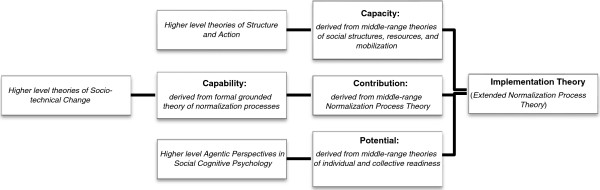
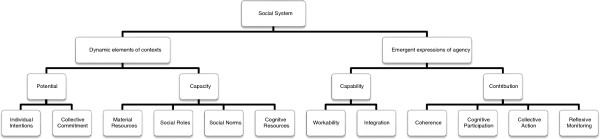
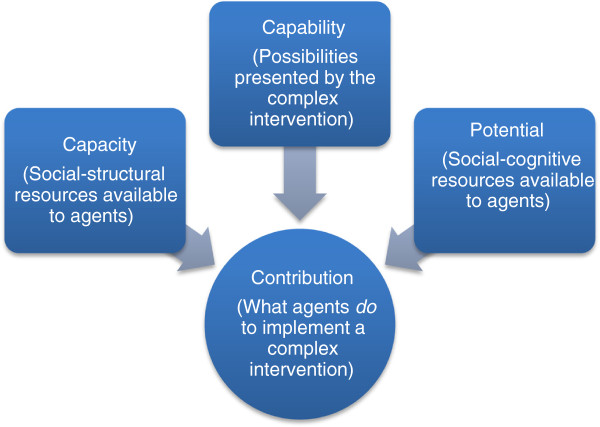
Verification
Claims the paper makes
The claims and statistics of this paper haven’t been checked yet.
Free: it reads the open-access text and checks the first 5 claims that cite a source we can check. Create a free account to check every claim.
Claims other papers make about this one
Each is checked against this paper’s own text: does it say what the citing paper says it does?
The source backs part of the claim, not all of it — or backs it for a different population, condition or comparison.
In the citing paper
“The development of NPT first involved the iterative development of a robust generic theory of implementation [5–9, 11, 12].”
From Using Normalization Process Theory in feasibility studies and process evaluations of complex healthcare interventions: a systematic review (2018) · cites this paper as [9]
Experimental — accuracy not yet measuredThe source backs part of the claim, not all of it — or backs it for a different population, condition or comparison.
In the citing paper
“NPT is a theory of implementation that focuses on what people—both individuals and groups—do rather than what they believe or intend, and it has been built up from studies of practice in many different healthcare systems.”
From Using Normalization Process Theory in feasibility studies and process evaluations of complex healthcare interventions: a systematic review (2018) · cites this paper as [9]
Experimental — accuracy not yet measuredThe cited source says what the claim attributes to it.
In the citing paper
“For example, eight frameworks did not explicitly mention stages [13,15,42,44,46,49,50,64,74]”
From A systematic review of implementation frameworks of innovations in healthcare and resulting generic implementation framework (2015) · cites this paper as [49]
The cited source says what the claim attributes to it.
In the citing paper
“May’s [49] framework described only two domains (agency and context)”
From A systematic review of implementation frameworks of innovations in healthcare and resulting generic implementation framework (2015) · cites this paper as [49]
10 more claims about this paper
Create a free account to see every claim other papers make about this one.
Self-check
Percentages, sums and reported differences re-computed from the paper’s own numbers.
The self-check needs the paper’s full text.
Citations
Cites
The theory of planned behavior
Ajzen, I. (1991) · Organizational Behavior and Human Decision Processes · doi:10.1016/0749-5978(91)90020-t · Cited by 90,587
User Acceptance of Information Technology: Toward A Unified View1
Venkatesh, V., Morris, M. G., Davis, G. B., & Davis, F. D. (2003) · MIS Quarterly · doi:10.2307/30036540 · Cited by 45,035 · cited 1×
“[22] also added a group of ‘diffusion’ constructs to those proposed by the Theory of Planned Behavior [23].”
BackgroundSelf-efficacy: Toward a unifying theory of behavioral change
Bandura, A. (1977) · Psychological Review · doi:10.1037/0033-295x.84.2.191 · Cited by 43,925
Reassembling the Social: An Introduction to Actor-Network-Theory
Latour, B. (2005) · doi:10.1093/oso/9780199256044.001.0001 · Cited by 16,778
(1990) · Choice Reviews Online · doi:10.5860/choice.27-6637 · Cited by 16,594
Social Cognitive Theory: An Agentic Perspective
Bandura, A. (2001) · Annual Review of Psychology · doi:10.1146/annurev.psych.52.1.1 · Cited by 15,510
Damschroder, L. J., Aron, D. C., Keith, R. E., Kirsh, S. R., Alexander, J. A., & Lowery, J. C. (2009) · Implementation Science · doi:10.1186/1748-5908-4-50 · Cited by 14,496 · cited 2×
“Some existing frameworks have uti lized workability constructs from diffusion of innovations theory [20,24,53], setting out, for exa mple, ideas about ‘trialability’ and ‘ease of use’ as being important component s of such models.”
BackgroundSelf-efficacy: Toward a unifying theory of behavioral change
Bandura, A. (1978) · Advances in Behaviour Research and Therapy · doi:10.1016/0146-6402(78)90002-4 · Cited by 10,586
Reassembling the social: An introduction to actor‐network‐theory
Turnbull, J. (2008) · New Zealand Geographer · doi:10.1111/j.1745-7939.2008.00151_4.x · Cited by 7,617
Motivational beliefs, values, and goals
Eccles, J. S., & Wigfield, A. (2002) · Annual Review of Psychology · doi:10.1146/annurev.psych.53.100901.135153 · Cited by 7,587 · cited 1×
“Here, potential agency [14] and motivation [68] are themselves necessary antecedents for the dynamic and emergent conditions that follow.”
Background
Research works printed but not linked: 5
- Mingers J Explanatory Mechanisms: The contribution of Critical Realism and Systems Thinking/Cybernetics 2011 Working paper. University of Kent: Canterbury
- Smith A Pope C Goodwin D Mort M 'Contested conversations': an observational study of patient handovers in the recovery room Acta Anaesth Scand 2007 51 18 19
- Winner L Autonomous technologies 1977 Cambridge: MIT Press
- Fishbein M Bandura A Triandis H Kanfer F Becker M Middlestadt S Eichler A Factors influencing behavior and behavior change: Final report-Theorist's Workshop 1992 Rockville (MD): National Institute of Mental Health
- Bandura A Marsh H, Craven RG, McInerney DM Toward an Agentic Theory of the Self., Advances in Self Research, Vol. 3: Self-processes, learning, and enabling human potential (pp. 15-49) 2008 Charlotte, NC: Information Age Publishing
Cited by
Items 701–723 of 723
Raiji, S. G., Mberia, H., & Nyakundi, A. O. (2026) · African Quarterly Social Science Review · doi:10.51867/aqssr.3.2.18
“The theory's emphasis on implementation as a dynamic, continuous, and interactive process rather than a static endpoint aligns with the study's focus on examining how media strategies influence policy execution across multiple stakeholder levels (May, 2013).”
InfluentialAbou, J., Elders, P. J. M., van Marum, R. J., & Hugtenburg, J. G. (2026) · Basic & Clinical Pharmacology & Toxicology · doi:10.1111/bcpt.70241
Rose‐Clarke, K., Rimal, D., Pradhan, I., Lamichhane, N., Jaoude, G. J. A., Hodsoll, J. P., Morrison, J., & Luitel, N. P. (2026) · PLOS Global Public Health · doi:10.1371/journal.pgph.0005991
“We sought to assess intervention implementation, mechanisms of change and contextual factors affecting implementation, mechanisms and outcomes [25,26].”
Ridgeway, J. L., Branda, M. E., Bagewadi, S., Montori, V. M., Jackson, H., Nautiyal, V., Dagoberg, A., Gomez, Y. L., Gharai, H., Khurana, C. S., et al. (2026) · Implementation Science Communications · doi:10.1186/s43058-026-00977-0
“The interview guide was developed using constructs from CFIR [30] and Normalization Process Theory (NPT) [33], and interviews were conducted by a member of the study team either in-person or using video-conferencing software.”
Barriers to and Facilitators of Telemedicine in Rural Healthcare in Japan: A Qualitative Analysis
Matsubara, D., Honda, Y., & Kotani, K. (2026) · Cureus · doi:10.7759/cureus.110032
“Even when structural and professional frameworks were well developed, participants perceived that telemedicine implementation could remain challenging without understanding and collaborating with local residents, consistent with the broader theory of healthcare implementation [24].”
Roberti, J. E., Rodríguez, A. P., Rodríguez, V., Barón, F. J., & García‐Elorrio, E. (2026) · Wellcome Open Research · doi:10.12688/wellcomeopenres.26970.1
Day, J., Frost, J., Stirzaker, A., Richards, D., Gibson, J., Pinfold, V., & Byng, R. (2026) · BMC Health Services Research · doi:10.1186/s12913-026-14959-4
“By considering the CMHF programme as a transactional space in which the community resources of the local system could be mobilised [19] we employed a qualitative realist evaluation informed by the Consolidated Framework for Implementation Research (CFIR) to guide our assessment of the contextual…”
Designing complex health system interventions: an integrated theory-informed approach
Nagraj, S., & Maraschin, F. (2026) · Frontiers in Health Services · doi:10.3389/frhs.2026.1820296
“Interventions introduced into such systems are rarely implemented as designed; instead, they are adapted, resisted, or repurposed by individuals and organisations in response to local constraints and priorities (6, 7).”
Reconceptualizing strategic partnerships and islamic philanthropy networks in Indonesia
Makhrus, M., Sriyana, J., & Suseno, P. (2026) · Multidisciplinary Reviews · doi:10.31893/multirev.2027037
“This view is in line with GST because it emphasizes interdependence, adaptation, and the flow of activities in the implementation system (May, 2013).”
Becker, T. M., Weinmann, S., Kösters, M., Riedel-Heller, S. G., & Gühne, U. (2026) · Psychiatrische Praxis · doi:10.1055/a-2900-6082
Implementation of OR in healthcare services: a systematic review
Lamé, G., Newton, C., Grieco, L., Crowe, S., Bashford, T., & Hinrichs, S. (2026) · Journal of the Operational Research Society · doi:10.1080/01605682.2026.2712994
Haskett, A., Carroll, G., Arnott, G., & Skelly-Smith, E. (2026) · Animal Welfare · doi:10.1017/awf.2026.10106
“When farriers collectively commit to changes and view regulation as legitimate and beneficial, implementation is more likely to be successful (May 2013).”
Acker, L. (2026) · University of North Florida Digital Commons (University of North Florida)
Roberti, J. E., Rodríguez, A. P., Rodríguez, V., Barón, F. J., & García‐Elorrio, E. (2026) · Wellcome Open Research · doi:10.12688/wellcomeopenres.26970.2
Kebijakan Standar Nasional Pendidikan pada Sekolah Dasar di Luwu Utara
Sakti, S., Ashariana, A., Bachtiar, B., & Nuddin, N. (2023) · Journal of Government Insight
Insights in Sports Politics, Policy and Law
Darnell, S., & Dao, M. (2026) · Frontiers research topics · doi:10.3389/978-2-8325-7569-7
Khaile, F. (2022) · University of the Western Cape Electronic Theses and Dissertations Repository (University of the Western Cape)
Delivery quality abortion care for patients with medical complexity and/or co-morbidities in England
French, R., Arkell, R., Harvey-Pescott, L., Sakuma, Y., de Londras, F., Hall, J., & Löhr, P. (2026) · LSHTM Research Online (London School of Hygiene and Tropical Medicine)
Ortloff, J.-H., & Schmitz, D. (2026) · HeilberufeScience · doi:10.1007/s16024-026-00466-3
Roberti, J. E., Rodríguez, A. P., Rodríguez, V., Jorro-Barón, F., & García‐Elorrio, E. (2026) · Wellcome Open Research · doi:10.12688/wellcomeopenres.26970.3
Raffer, C., Jänchen, I., & Scheller, H. (2026) · Financial Accountability and Management · doi:10.1111/faam.70061
Schladen, M. M. (2015) · NSUWorks (Nova Southeastern University) · Cited by 3
Metadata
- Authors
- May, C.
- Affiliations
- University of Southampton (GB)
- Corresponding author
- May, Carl
- ORCID
- May, Carl
- Venue
- Implementation Science
- Published
- 2013-02-13
- Volume
- 8
- Issue
- 1
- Pages
- 18-18
- ISSN
- 1748-5908 (ISSN-L)
- PMC
- PMC3602092
- OpenAlex
- W2152345693
- Cited by
- 656
- References
- 98
- Citations by year
- 2026: 28 · 2025: 36 · 2024: 39 · 2023: 57 · 2022: 72 · 2021: 60 · 2020: 105 · 2019: 54 · 2018: 45 · 2017: 47 · 2016: 42 · 2015: 43 · 2014: 20 · 2013: 8
- FWCI
- 68.22
- Type
- journal article
- Language
- en
- Open access
- gold
- doi.org
- Licence
- Locations
- Implementation Science (publishedVersion, cc-by)
- Europe PMC (PubMed Central) (publishedVersion, cc-by)
- PubMed Central (publishedVersion, cc-by)
- PubMed (publishedVersion)
- ePrints Soton (University of Southampton) (acceptedVersion)
- LSHTM Research Online (London School of Hygiene and Tropical Medicine) (acceptedVersion)
- Funders
- National Institute for Health and Care Research (NF-SI-0509-10017)
- Economic and Social Research Council (ES/I037342/1, ES-062-23-3274)
- Topics
- Health Sciences › Health Professions › General Health Professions › Health Policy Implementation Science
- Health Sciences › Medicine › Public Health, Environmental and Occupational Health › Clinical practice guidelines implementation
- Health Sciences › Health Professions › General Health Professions › Health Sciences Research and Education
- Keywords
- implementation theory, complex interventions, Normalization Process Theory, agency, social mechanisms, cognitive mechanisms, collective action, healthcare implementation, organizational change
- MeSH terms
- Delivery of Health Care, Diffusion of Innovation, United Kingdom, Health Policy, Humans, Organizational Innovation, State Medicine, Process Assessment, Health Care, Qualitative Research
About these checks
Registry, retraction, Cites and statistics results are computed, not judged, with one exception: a printed reference that no index lists is read once by a model before it counts as a citation error. Claims are extracted by a model and kept only when their quote appears verbatim in the text; each cited source is then checked, with a model’s help, for whether it says what the claim relies on. Those verdicts can be wrong — read the claim’s quote and the cited source before relying on one.
Statistics and arithmetic are recomputed, not judged.
Confidence bands are shown only for fields calibrated on our annotated test set. None is calibrated yet, so no band is shown.
What counts as a claim ›How we measure confidence ›How we check this ›
Are you an author, or do you see a problem with this page? Request a review
Data sources
Bibliographic data: Semantic Scholar, OpenAlex, Crossref.
Contains information from the Semantic Scholar Academic Graph Datasets, made available under the ODC Attribution License (ODC-BY 1.0).
Semantic Scholar’s data is described in: Kinney, R., et al. (2023). The Semantic Scholar Open Data Platform. arXiv:2301.10140.
