

Towards a general theory of implementation
Open accessThe DOI matches its Crossref record; 97 of the 98 references it cites were found in a registry or an index.
Abstract
Understanding and evaluating the implementation of complex interventions in practice is an important problem for healthcare managers and policy makers, and for patients and others who must operationalize them beyond formal clinical settings. It has been argued that this work should be founded on theory that provides a foundation for understanding, designing, predicting, and evaluating dynamic implementation processes. This paper sets out core constituents of a general theory of implementation, building on Normalization Process Theory and linking it to key constructs from recent work in sociology and psychology. These are informed by ideas about agency and its expression within social systems and fields, social and cognitive mechanisms, and collective action. This approach unites a number of contending perspectives in a way that makes possible a more comprehensive explanation of the implementation and embedding of new ways of thinking, enacting and organizing practice.
Overview
The claims and statistics of this paper haven’t been checked yet.
Free: it reads the open-access text and checks the first 5 claims that cite a source we can check. Create a free account to check every claim.
Integrity signals
Registry
Cites
Statistics
Figures
Verification
Claims the paper makes
The claims and statistics of this paper haven’t been checked yet.
Free: it reads the open-access text and checks the first 5 claims that cite a source we can check. Create a free account to check every claim.
Claims other papers make about this one
Each is checked against this paper’s own text: does it say what the citing paper says it does?
The source backs part of the claim, not all of it — or backs it for a different population, condition or comparison.
In the citing paper
“The development of NPT first involved the iterative development of a robust generic theory of implementation [5–9, 11, 12].”
From Using Normalization Process Theory in feasibility studies and process evaluations of complex healthcare interventions: a systematic review (2018) · cites this paper as [9]
Experimental — accuracy not yet measuredThe source backs part of the claim, not all of it — or backs it for a different population, condition or comparison.
In the citing paper
“NPT is a theory of implementation that focuses on what people—both individuals and groups—do rather than what they believe or intend, and it has been built up from studies of practice in many different healthcare systems.”
From Using Normalization Process Theory in feasibility studies and process evaluations of complex healthcare interventions: a systematic review (2018) · cites this paper as [9]
Experimental — accuracy not yet measuredThe cited source says what the claim attributes to it.
In the citing paper
“For example, eight frameworks did not explicitly mention stages [13,15,42,44,46,49,50,64,74]”
From A systematic review of implementation frameworks of innovations in healthcare and resulting generic implementation framework (2015) · cites this paper as [49]
The cited source says what the claim attributes to it.
In the citing paper
“May’s [49] framework described only two domains (agency and context)”
From A systematic review of implementation frameworks of innovations in healthcare and resulting generic implementation framework (2015) · cites this paper as [49]
10 more claims about this paper
Create a free account to see every claim other papers make about this one.
Self-check
Percentages, sums and reported differences re-computed from the paper’s own numbers.
The self-check needs the paper’s full text.
Citations
Cites
The theory of planned behavior
Ajzen, I. (1991) · Organizational Behavior and Human Decision Processes · doi:10.1016/0749-5978(91)90020-t · Cited by 90,587
User Acceptance of Information Technology: Toward A Unified View1
Venkatesh, V., Morris, M. G., Davis, G. B., & Davis, F. D. (2003) · MIS Quarterly · doi:10.2307/30036540 · Cited by 45,035 · cited 1×
“[22] also added a group of ‘diffusion’ constructs to those proposed by the Theory of Planned Behavior [23].”
BackgroundSelf-efficacy: Toward a unifying theory of behavioral change
Bandura, A. (1977) · Psychological Review · doi:10.1037/0033-295x.84.2.191 · Cited by 43,925
Reassembling the Social: An Introduction to Actor-Network-Theory
Latour, B. (2005) · doi:10.1093/oso/9780199256044.001.0001 · Cited by 16,778
(1990) · Choice Reviews Online · doi:10.5860/choice.27-6637 · Cited by 16,594
Social Cognitive Theory: An Agentic Perspective
Bandura, A. (2001) · Annual Review of Psychology · doi:10.1146/annurev.psych.52.1.1 · Cited by 15,510
Damschroder, L. J., Aron, D. C., Keith, R. E., Kirsh, S. R., Alexander, J. A., & Lowery, J. C. (2009) · Implementation Science · doi:10.1186/1748-5908-4-50 · Cited by 14,496 · cited 2×
“Some existing frameworks have uti lized workability constructs from diffusion of innovations theory [20,24,53], setting out, for exa mple, ideas about ‘trialability’ and ‘ease of use’ as being important component s of such models.”
BackgroundSelf-efficacy: Toward a unifying theory of behavioral change
Bandura, A. (1978) · Advances in Behaviour Research and Therapy · doi:10.1016/0146-6402(78)90002-4 · Cited by 10,586
Reassembling the social: An introduction to actor‐network‐theory
Turnbull, J. (2008) · New Zealand Geographer · doi:10.1111/j.1745-7939.2008.00151_4.x · Cited by 7,617
Motivational beliefs, values, and goals
Eccles, J. S., & Wigfield, A. (2002) · Annual Review of Psychology · doi:10.1146/annurev.psych.53.100901.135153 · Cited by 7,587 · cited 1×
“Here, potential agency [14] and motivation [68] are themselves necessary antecedents for the dynamic and emergent conditions that follow.”
Background
Research works printed but not linked: 5
- Mingers J Explanatory Mechanisms: The contribution of Critical Realism and Systems Thinking/Cybernetics 2011 Working paper. University of Kent: Canterbury
- Smith A Pope C Goodwin D Mort M 'Contested conversations': an observational study of patient handovers in the recovery room Acta Anaesth Scand 2007 51 18 19
- Winner L Autonomous technologies 1977 Cambridge: MIT Press
- Fishbein M Bandura A Triandis H Kanfer F Becker M Middlestadt S Eichler A Factors influencing behavior and behavior change: Final report-Theorist's Workshop 1992 Rockville (MD): National Institute of Mental Health
- Bandura A Marsh H, Craven RG, McInerney DM Toward an Agentic Theory of the Self., Advances in Self Research, Vol. 3: Self-processes, learning, and enabling human potential (pp. 15-49) 2008 Charlotte, NC: Information Age Publishing
Cited by
Items 101–200 of 723
Fuller, T., Pearson, M., Peters, J., & Anderson, R. (2015) · PLOS ONE · doi:10.1371/journal.pone.0121585 · Cited by 47
“These findings could be used to inform future studies that might, for example, test the factors that we have identified within a wider theoretical framework for understanding changes in professional practices, such as Normalization Process Theory.”
BackgroundMethodInfluentialEducational intervention to enhance adherence to short-term use of antibiotics
West, L. M., & Cordina, M. (2018) · Research in Social and Administrative Pharmacy · doi:10.1016/j.sapharm.2018.04.011 · Cited by 51
Colombini, M., Alkaiyat, A. S., Shaheen, A. A., Moreno, C. G., Feder, G. S., & Bacchus, L. (2019) · Health Policy and Planning · doi:10.1093/heapol/czz151 · Cited by 51
“Several studies have demonstrated how structural working conditions, clients’ attributes and broader cultural (extra-organizational) factors should not be underestimated during intervention development and implementation (Lipsky, 1980; Weiner, 2009; May, 2013; Gilson, 2015; Kelly et al., 2017).”
BackgroundChanging Behavior: A Theory- and Evidence-Based Approach
Hagger, M. S., Cameron, L. D., Hamilton, K., Hankonen, N. E., & Lintunen, T. (2020) · Cambridge University Press eBooks · doi:10.1017/9781108677318.001 · Cited by 63
Planning and Implementation Intention Interventions
Rhodes, R. E., Grant, S. J., & de Bruijn, G. (2020) · Cambridge University Press eBooks · doi:10.1017/9781108677318.039 · Cited by 49
Translational research in nephrology: chronic kidney disease prevention and public health
Brück, K., Stel, V. S., Fraser, S. D., de Goeij, M. C. M., Caskey, F. J., Abu–Hanna, A., & Jager, K. J. (2015) · Clinical Kidney Journal · doi:10.1093/ckj/sfv082 · Cited by 52
“However, there is evidence that the majority of funding for translational research has still historically been assigned to the translation from bench-tobedside [20] rather than on implementation [21] or population health impact.”
BackgroundGuerrero, E. G., Fenwick, K. M., & Kong, Y. (2017) · Implementation Science · doi:10.1186/s13012-017-0666-9 · Cited by 54
“In addition, they may persevere in the face of challenges to implementation and reward employees based on provision of culturally competent services [27, 28, 57].”
BackgroundBonell, C. P., Moore, G. F., Warren, E. A., & Moore, L. (2018) · Trials · doi:10.1186/s13063-018-2589-4 · Cited by 53
Nevedal, A. L., Reardon, C. M., Jackson, G. L., Cutrona, S. L., White, B., Gifford, A. L., Orvek, E., DeLaughter, K., White, L., King, H. A., et al. (2020) · Implementation Science Communications · doi:10.1186/s43058-020-00053-1 · Cited by 44
“Implementation is the means by which an EBP is assimilated into an organization and usually a deliberately initiated process, where individuals aim to bring EBPs into routine use as designed [4, 5].”
BackgroundAllan, S., Bradstreet, S., Mcleod, H., Farhall, J., Lambrou, M., Gleeson, J., Clark, A., EMPOWER Group, & Gumley, A. (2019) · Journal of Medical Internet Research · doi:10.2196/14366 · Cited by 44
“Typically, implementation theory aims to create conceptual tools that enable researchers to describe, identify, and explain crucial elements of the implementation process and its outcomes [24].”
BackgroundSegrott, J., Murphy, S., Rothwell, H., Scourfield, J., Foxcroft, D., Gillespie, D., Holliday, J., Hood, K., Hurlow, C., Morgan‐Trimmer, S., et al. (2017) · SSM - Population Health · doi:10.1016/j.ssmph.2017.01.002 · Cited by 52
“Within these systems practitioners make meaning of interventions in ways which shape how they are delivered (Bisset, Daniel & Potvin, 2009; May, 2013) – though the study of these phenomena is limited (Bisset, Potvin & Daniel, 2013; Hill, Maucione & Hood, 2007).”
BackgroundInfluentialAttitudes and Persuasive Communication Interventions
Hamilton, K., & Johnson, B. T. (2020) · Cambridge University Press eBooks · doi:10.1017/9781108677318.031 · Cited by 61
Changing Behavior Using Integrated Theories
Hagger, M. S., & Hamilton, K. (2020) · Cambridge University Press eBooks · doi:10.1017/9781108677318.015 · Cited by 51
The REFReSH study group, Drew, S., Judge, A., May, C., Farmer, A., Cooper, C., Javaid, M. K., & Gooberman-Hill, R. (2015) · Implementation Science · doi:10.1186/s13012-015-0243-z · Cited by 43
“This study has identified and explored healthcare professionals’ experiences and views about issues that affect the implementation of secondary fracture prevention services using extended Normalization Process Theory [20].”
BackgroundMethodInfluentialSelf-citationSchneider, H. M., George, A., Mukinda, F. K., & Tabana, H. (2019) · Health Systems & Reform · doi:10.1080/23288604.2019.1669943 · Cited by 43
“For example, the constructs of coherence, collective action and cognitive participation in the Normalization Process Theory describe well the change processes in the two districts 26 ; networks and leadership are part of the Consolidated Framework for Implementation Research.”
MethodDavies, C., Fattori, F., O’Donnell, D., Donnelly, S., Shé, É. N., Shea, M. O., Prihodová, L., Gleeson, C., Flynn, Á., Rock, B., et al. (2019) · BMC Health Services Research · doi:10.1186/s12913-019-4802-x · Cited by 48
An evidence-based theory of change for reducing SARS-CoV-2 transmission in reopened schools
Bonell, C. P., Meléndez‐Torres, G. J., Viner, R., Rogers, M. B., Whitworth, M., Rutter, H., Rubin, G. J., & Patton, G. C. (2020) · Health & Place · doi:10.1016/j.healthplace.2020.102398 · Cited by 44
“We reiterate the point that while schools will need to implement preventive measures quickly, evidence suggests that planning these in collaboration with staff and students will increase feasibility and acceptability, and may limit harmful consequences (May, 2013).”
InfluentialThe Less is More Study Group, Trautner, B. W., Prasad, P., Grigoryan, L., Hysong, S. J., Kramer, J. R., Rajan, S. S., Petersen, N. J., Rosen, T., Drekonja, D. M., et al. (2018) · Implementation Science · doi:10.1186/s13012-018-0709-x · Cited by 40
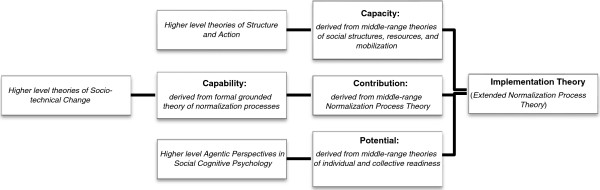
“Our conceptual framework for the development and implementation of a scalable version of the Kicking CAUTI intervention draws on May’s proposed General Theory of Implementation, which links Normalization Process Theory (NPT), [20, 24] with other sociological and psychological theories (Fig.”
MethodMeiksin, R., Crichton, J., Dodd, M., Morgan, G. S., Williams, P., Willmott, M., Allen, E., Tilouche, N., Sturgess, J., Morris, S., et al. (2020) · Public Health Research · doi:10.3310/phr08050 · Cited by 45
Lancaster, K., & Rhodes, T. (2020) · British Medical Bulletin · doi:10.1093/bmb/ldaa026 · Cited by 43
Changing policy and practice: Making sense of national guidelines for osteoarthritis
Ong, B. N., Morden, A., Brooks, L., Porcheret, M., Edwards, J. J., Sanders, T., Jinks, C., & Dziedzic, K. (2014) · Social Science & Medicine · doi:10.1016/j.socscimed.2014.01.036 · Cited by 39
“May (2013) emphasises that the intentional actions of agents are achieved through joint enterprise, and this happens from the first stage of implementation: participants attribute meaning to a complex intervention and make sense of its possibilities within their field of agency.”
BackgroundInfluentialCarswell, C., Reid, J., Walsh, I., McAneney, H., & Noble, H. R. (2019) · Pilot and Feasibility Studies · doi:10.1186/s40814-018-0389-y · Cited by 40
Sampson, F. C., O’Cathain, A., & Goodacre, S. W. (2019) · Emergency Medicine Journal · doi:10.1136/emermed-2019-208994 · Cited by 40
Bee, P., Lovell, K., Airnes, Z., & Pruszynska, A. (2016) · BMC Psychiatry · doi:10.1186/s12888-016-0761-5 · Cited by 38
“empirical investigation [13, 24] has identified as key to technology normalisation in practice.”
BackgroundDiffin, J., Ewing, G., Harvey, G., & Grande, G. (2018) · BMC Palliative Care · doi:10.1186/s12904-018-0382-5 · Cited by 41
“implementation with a focus on the core components of the PARIHS framework and the processes involved in helping to normalise the use of the intervention in practice [33] (see Additional file 1).”
MethodErvin, K. E., Reid, C. J., Moran, A. M., Opie, C., & Haines, H. M. (2019) · Human Resources for Health · doi:10.1186/s12960-019-0415-z · Cited by 38
“May [10] proposes that capability, particularly normalisation into practice, is threatened through poor resourcing or uncertain sustainability.”
BackgroundMethodInfluentialImplementing a digital patient feedback system: an analysis using normalisation process theory
Ong, B. N., Hodgson, D. E., Small, N., Nahar, P., & Sanders, C. (2020) · BMC Health Services Research · doi:10.1186/s12913-020-05234-1 · Cited by 41
Tarrant, M., Haslam, C., Carter, M., Calitri, R., & Haslam, S. A. (2020) · Cambridge University Press eBooks · doi:10.1017/9781108677318.044 · Cited by 43
What is depression? Psychiatrists’ and GPs’ experiences of diagnosis and the diagnostic process
Davidsen, A. S., & Fosgerau, C. F. (2014) · International Journal of Qualitative Studies on Health and Well-Being · doi:10.3402/qhw.v9.24866 · Cited by 45
Kien, C., Schultes, M.-T., Szeląg, M., Schoberberger, R., & Gartlehner, G. (2018) · Implementation Science · doi:10.1186/s13012-018-0837-3 · Cited by 40
“, abstract phenomena that are not directly observable) and strategies [12].”
BackgroundDemby, H., Gregory, A., Broussard, M., Dickherber, J., Atkins, S., & Jenner, L. W. (2014) · Journal of Adolescent Health · doi:10.1016/j.jadohealth.2013.12.022 · Cited by 37
“Implementation science outlines many models, theories, and frameworks of implementation; thesemodels have progressively become multilevel systemic frameworks of factors that impact implementation [8].”
BackgroundClemson, L. M., Mackenzie, L. A., Roberts, C., Poulos, R. G., Tan, A. C. W., Lovarini, M., Sherrington, C., Simpson, J. M., Willis, K. F., Lam, M. K., et al. (2017) · Implementation Science · doi:10.1186/s13012-016-0529-9 · Cited by 39
Improving theory use in social marketing: the TITE four-step theory application process
Willmott, T. J., & Rundle-Thiele, S. R. (2022) · Journal of Social Marketing · doi:10.1108/jsocm-05-2021-0117 · Cited by 38
Changing Behavior Using the Transtheoretical Model
DiClemente, C. C., & Graydon, M. M. (2020) · Cambridge University Press eBooks · doi:10.1017/9781108677318.010 · Cited by 38
Exploring the intersection of hermeneutics and implementation: a scoping review
MacLeod, M., McCaffrey, G., Wilson, E., Zimmer, L. V., Snadden, D., Zimmer, P., Jónatansdóttir, S., Fyfe, T., Koopmans, E., Ulrich, C., et al. (2023) · Systematic Reviews · doi:10.1186/s13643-023-02176-7 · Cited by 37
Changing Behavior Using the Health Belief Model and Protection Motivation Theory
Orbell, S., Zahid, H., & Henderson, C. J. (2020) · Cambridge University Press eBooks · doi:10.1017/9781108677318.004 · Cited by 40
Organizing Practice and Practicing Organization: An Outline of Translational Mobilization Theory
Allen, D. A., & May, C. R. (2017) · SAGE Open · doi:10.1177/2158244017707993 · Cited by 40
Self-citationVoorn, V. M. A., de Mheen, P. J. M., van der Hout, A., Hofstede, S. N., So‐Osman, C., Marle, M. E. V. D. A., Kaptein, A. A., Stijnen, T., Gemert, A. W. M. M. K.-V., Dahan, A., et al. (2017) · Implementation Science · doi:10.1186/s13012-017-0601-0 · Cited by 37
Gordon, K., Dainty, K. N., Gray, C. S., DeLacy, J., Shah, A., Resnick, M., & Seto, E. (2020) · JMIR Nursing · doi:10.2196/22118 · Cited by 37
“Between May and July 2019, patients were recruited through convenience sampling during their routine visit to the nurse-led clinic.”
MethodSundaram, N., Bonell, C. P., Ladhani, S. N., Langan, S., Baawuah, F., Okike, I., Ahmad, S. S. Y., Beckmann, J., Garstang, J. J., Brent, B., et al. (2021) · Health Education Research · doi:10.1093/her/cyab016 · Cited by 36
“Headteacher commitment, positive attitude and knowledge of community When describing their experiences in June 2020, all participants emphasized their commitment, aligning with the GTI concept of ‘cognitive participation’, to implementation and pride at having managed to reopen their school while implementing recommen…”
BackgroundInfluentialGopinathan, U., Lewin, S. A., & Glenton, C. (2014) · Tropical Medicine & International Health · doi:10.1111/tmi.12381 · Cited by 36
“It should be noted that many other frameworks and models have been developed to identify potential barriers to, and mechanisms for, implementing health programmes (Hanson et al. 2003; Haines et al. 2004; Fretheim et al. 2009; May et al. 2009; May 2013).”
BackgroundBridges, J., Pickering, R. M., Barker, H., Chable, R., Fuller, A., Gould, L., Libberton, P., Mesa‐Eguiagaray, I., Raftery, J., Sayer, A. A., et al. (2018) · Health Services and Delivery Research · doi:10.3310/hsdr06330 · Cited by 38
“Mean (SD) 108 (12) 113 (16) 114 (20) 112 (18) 113 (9) 113 (16) Median (LQ, UQ) 109 (99, 117) 115 (99, 128) 120 (102, 129) 116 (105, 126) 114 (105, 120) 116 (104, 126)”
Gilbert, A. W., Jones, J., Stokes, M. J., & May, C. R. (2021) · BMJ Open · doi:10.1136/bmjopen-2020-041038 · Cited by 40
Self-citationGrigorovich, A., Kulandaivelu, Y., Newman, K., Bianchi, A., Khan, S. S., Iaboni, A., & McMurray, J. (2021) · Journal of Medical Internet Research · doi:10.2196/22831 · Cited by 33
“The interaction of agents such as organizations, care providers, and residents, their contexts, and their processes (both established and introduced by an intervention or novel technology) must be anticipated or, at the very least, accommodated in a successful implementation [28,29].”
Implementation of sustainable public procurement in local governments: a measurement approach
Hsueh, L., Bretschneider, S., Stritch, J. M., & Darnall, N. (2020) · International Journal of Public Sector Management · doi:10.1108/ijpsm-09-2019-0233 · Cited by 33
Sims, S., Juliet, S. H. O., Joseph, J., Gopal, S., Raghavan, V., Venkatraman, L., & Ramachandran, P. (2022) · Frontiers in Psychiatry · doi:10.3389/fpsyt.2022.797427 · Cited by 33
“Participants’ willingness to embrace the peer support program is crucial to implementing and integrating it within the existing clinical service (15).”
BackgroundFrom pilot project to system solution: innovation, spread and scale for health system leaders
Shaw, J., Tepper, J. D., & Martin, D. (2018) · BMJ Leader · doi:10.1136/leader-2017-000055 · Cited by 38
Fulop, N., Ramsay, A. I. G., Hunter, R. M., McKevitt, C., Perry, C., Turner, S., Boaden, R., Papachristou, I., Rudd, A. G., Tyrrell, P. J., et al. (2019) · Health Services and Delivery Research · doi:10.3310/hsdr07070 · Cited by 38
McCurtin, A., Murphy, C., & Roddam, H. (2019) · Seminars in Speech and Language · doi:10.1055/s-0039-1694996 · Cited by 34
Fogg, C., Lanning, E., Shoebridge, J., Longstaff, J., Vos, R. D., Dawson-Taylor, K., Glanville-Hearson, A., Carpenter, D., Court, S., Brown, T., et al. (2022) · Ethics Medicine and Public Health · doi:10.1016/j.jemep.2022.100833 · Cited by 38
“[13 ] Within MISSION ABC, PAR enabled the evaluation of the impact of roles provided by the wider multidisciplinary team (MDT) within a service, prompting changes and re-evaluation, as per the ‘plan-do-study-act’ cycle.”
Stepping up: a nurse-led model of care for insulin initiation for people with type 2 diabetes
Furler, J. S., Blackberry, I. D., Walker, C., Manski-Nankervis, J.-A., Anderson, J., O'Neal, D., Young, D., & Best, J. (2014) · Family Practice · doi:10.1093/fampra/cmt085 · Cited by 25
“NPT is a sociological theory of implementation, which describes how new practices become incorporated in routine clinical care as a result of individual and collective work (19).”
BackgroundInfluentialGeorge, A. S., LeFevre, A. E., Jacobs, T., Kinney, M. V., Buse, K., Chopra, M., Daelmans, B. M. E. G., Haakenstad, A., Huicho, L., Khosla, R., et al. (2019) · BMJ Global Health · doi:10.1136/bmjgh-2018-001316 · Cited by 35
“Other methodologies are better suited to reveal the subjective and complex nature of consensus building, ownership or internalisation among diverse stakeholders needed to commit to the extensive collaboration and collective action required to sustain interventions and policy implementation overtime.(15) From a society…”
O'Donnell, A. J., & Kaner, E. (2017) · International Journal of Environmental Research and Public Health · doi:10.3390/ijerph14040350 · Cited by 36
Changing Behavior by Changing Environments
Marteau, T. M., Fletcher, P. C., Hollands, G. J., & Munafo, M. R. (2020) · Cambridge University Press eBooks · doi:10.1017/9781108677318.014 · Cited by 35
Peer support for traumatic injury survivors: a scoping review
Wasilewski, M. B., Rios, J., Simpson, R., Hitzig, S. L., Conn, L. G., MacKay, C., Mayo, A. L., & Robinson, L. R. (2022) · Disability and Rehabilitation · doi:10.1080/09638288.2022.2083702 · Cited by 37
Clemson, L. M., Donaldson, A., Hill, K., & Day, L. (2014) · Australian Occupational Therapy Journal · doi:10.1111/1440-1630.12132 · Cited by 31
Dunn, B. D. (2017) · Cognitive Therapy and Research · doi:10.1007/s10608-017-9831-3 · Cited by 32
“For example, a helpful framework in this regard is Normalisation Process Theory (May 2013), which discusses ways to ensure that a health care intervention becomes a routine part of clinical practice over the long term.”
BackgroundMukumbang, F. C., & Wong, G. (2025) · Qualitative Health Research · doi:10.1177/10497323251316401 · Cited by 33
Improving the physical health of people with severe mental illness: Boundaries of care provision
Ehrlich, C., Kendall, E. A., Frey, N., Kisely, S. R., Crowe, E., & Crompton, D. (2013) · International Journal of Mental Health Nursing · doi:10.1111/inm.12050 · Cited by 30
“general theory of implementation) focuses on the important constructs that influence implementation across a range of complex contexts (May 2013).”
BackgroundMethodInfluentialSavic, M., & Fomiatti, R. (2016) · Contemporary Drug Problems · doi:10.1177/0091450916641979 · Cited by 33
“However, more nuanced approaches to implementation research remind us that the implementation of an outcome monitoring tool is complex and is shaped by the local contexts and situated practices and relationships in different treatment settings (Damschroder et al., 2009; May, 2013a, 2013b).”
BackgroundBonell, C. P., Allen, E., Warren, E. A., McGowan, J., Bevilacqua, L., Jamal, F., Sadique, Z., Legood, R., Wiggins, M., Opondo, C., et al. (2019) · Public Health Research · doi:10.3310/phr07180 · Cited by 39
Changing Behavior Using the Reflective-Impulsive Model
Deutsch, R., & Strack, F. (2020) · Cambridge University Press eBooks · doi:10.1017/9781108677318.012 · Cited by 37
Research “push”, long term-change, and general practice
Morden, A., Brooks, L. A., Jinks, C., Porcheret, M., Ong, B. N., & Dziedzic, K. (2015) · Journal of Health Organization and Management · doi:10.1108/jhom-07-2014-0119 · Cited by 31
Hogan-Murphy, D., Stewart, D. C., Tonna, A. P., Strath, A., & Cunningham, S. (2020) · Research in Social and Administrative Pharmacy · doi:10.1016/j.sapharm.2020.03.005 · Cited by 29
Ehrlich, C., Kendall, E. A., Frey, N., Denton, M., & Kisely, S. R. (2015) · BMC Health Services Research · doi:10.1186/s12913-015-0744-0 · Cited by 33
“A consensus-building workshop was held in May 2013 to: (1) generate potential solutions to address the issue of improving the physical health of people with a SMI, and (2) prioritize the solutions.”
BackgroundManser, T., Frings, J., Heuser, G., & Dermott, F. M. (2016) · Zeitschrift für Evidenz Fortbildung und Qualität im Gesundheitswesen · doi:10.1016/j.zefq.2016.06.017 · Cited by 29
Berry, K., Haddock, G., Kellett, S., Awenat, Y. F., Szpak, K., & Barrowclough, C. (2016) · Journal of Clinical Psychology · doi:10.1002/jclp.22434 · Cited by 31
Lim, S. E. R., Ibrahim, K., Dodds, R. M., Purkis, A., Baxter, M. A., Rogers, A. E., Sayer, A. A., & Roberts, H. C. (2019) · Age and Ageing · doi:10.1093/ageing/afz114 · Cited by 35
Changing Behavior Using the Common-Sense Model of Self-Regulation
Cameron, L. D., Fleszar‐Pavlović, S. E., & Khachikian, T. (2020) · Cambridge University Press eBooks · doi:10.1017/9781108677318.005 · Cited by 32
A peer-led intervention to promote sexual health in secondary schools: the STASH feasibility study
Mitchell, K. R., Purcell, C., Forsyth, R., Barry, S., Hunter, R. M., Simpson, S. A., McDaid, L. M., Elliot, L., McCann, M., Wetherall, K., et al. (2020) · Public Health Research · doi:10.3310/phr08150 · Cited by 33
Exploring the utility of internal whistleblowing in healthcare via agent-based models
Rauwolf, P., & Jones, A. (2019) · BMJ Open · doi:10.1136/bmjopen-2018-021705 · Cited by 31
Developing Behavior Change Interventions
Hankonen, N. E., & Hardeman, W. (2020) · Cambridge University Press eBooks · doi:10.1017/9781108677318.021 · Cited by 38
Conte, K. P., Grøn, S., Loblay, V., Green, A. S., Milat, A., Persson, L., Innes‐Hughes, C., Mitchell, J., Thackway, S. V., Williams, M., et al. (2017) · Implementation Science · doi:10.1186/s13012-017-0686-5 · Cited by 28
Bradley, C., Irie, W. C., & Geng, E. (2024) · Frontiers in Public Health · doi:10.3389/fpubh.2023.1286156 · Cited by 29
Sartain, S. A., Stressing, S. J., & Prieto, J. A. (2014) · Health Expectations · doi:10.1111/hex.12240 · Cited by 33
Design, Implementation, and Evaluation of Behavior Change Interventions: A Ten-Task Guide
Abraham, C., & Denford, S. (2020) · Cambridge University Press eBooks · doi:10.1017/9781108677318.019 · Cited by 36
May, C. R., Hillis, A., Albers, B., Desveaux, L., Gilbert, A. W., Girling, M., Kislov, R., MacFarlane, A. E., Mair, F. S., Potthoff, S., et al. (2025) · Implementation Science · doi:10.1186/s13012-025-01444-5 · Cited by 28
“Searches for citations of papers and chapters that utilised the constructs of Normalization Process Theory [22, 26– 32, 34, 43]; that developed NPT related methods or tools [33–35]; and citations of the NPT web-enabled on-line toolkit [36] led to 9,147 references, 5,708 of which could be eliminated…”
Self-citationDyadic Behavior Change Interventions
Scholz, U., Berli, C., Lüscher, J., & Knoll, N. (2020) · Cambridge University Press eBooks · doi:10.1017/9781108677318.043 · Cited by 29
Assessing Technology Innovation of Mobile Health Apps for Medical Care Providers
Galetsi, P., Katsaliaki, K., & Kumar, S. (2022) · IEEE Transactions on Engineering Management · doi:10.1109/tem.2022.3142619 · Cited by 32
“We borrowed sociology’s NPT [54], which has been utilized in relevant studies for explaining the adoption process of health apps [55], [57], [58] but was not applied, prior to this article, in the context of mHealth apps for health professionals.”
BackgroundMethodInfluentialHarboring change: Exploring the multifaceted and complex determinants of decarbonizing ports
Alamoush, A. S. (2024) · Energy Research & Social Science · doi:10.1016/j.erss.2024.103751 · Cited by 26
Judge, A., Carr, A. J., Price, A. J., Garriga, C., Cooper, C. C., Prieto‐Alhambra, D., Old, F., Peat, G., Murphy, J., Leal, J., et al. (2020) · Health Services and Delivery Research · doi:10.3310/hsdr08040 · Cited by 31
Rothman, A. J., Klein, W. M. P., & Sheeran, P. (2020) · Cambridge University Press eBooks · doi:10.1017/9781108677318.020 · Cited by 30
Fulop, N., Ramsay, A. I. G., Vindrola‐Padros, C., Aitchison, M., Boaden, R., Brinton, V., Clarke, C. S., Hines, J. E. W., Hunter, R. M., Levermore, C., et al. (2016) · Implementation Science · doi:10.1186/s13012-016-0520-5 · Cited by 25
“clinicians working across organisational boundaries to develop service specifications) [32, 36, 37]; how changes are implemented (C3) (e.”
BackgroundSharma, S., Adetoro, O. O., Vidler, M., Drebit, S. K., Payne, B. A., Akeju, D. O., Adepoju, A., Jaiyesimi, E., Sotunsa, J., Bhutta, Z. A., et al. (2017) · BMC Health Services Research · doi:10.1186/s12913-017-2124-4 · Cited by 31
Myall, M., May, C. R., Richardson, A. M., Bogle, S., Campling, N. C., Dace, S., & Lund, S. (2020) · Journal of Health Organization and Management · doi:10.1108/jhom-06-2020-0240 · Cited by 25
“Previous studies have shown that one facet of successful implementation lies in minimal disruption to existing working practices and its differentiation from other practices to be valued (May, 2013b).”
BackgroundInfluentialSelf-citationvan Rijt, A. M., Hulter, P., Weggelaar‐Jansen, A. M., Ahaus, K., & Pluut, B. (2021) · Journal of Medical Internet Research · doi:10.2196/28045 · Cited by 25
A study of clinical and information management processes in the surgical pre-assessment clinic
Bouamrane, M.-M., & Mair, F. S. (2014) · BMC Medical Informatics and Decision Making · doi:10.1186/1472-6947-14-22 · Cited by 27
“With the increased recognition that complex interventions or innovative technologies can be difficult to implement in practice or often fail to become embedded into routine work practices, there has recently been a growing interest in using theories to provide the foundation for analysing and understanding the socio-t…”
BackgroundGrimmett, C., Armes, J., Breckons, M., Calman, L. A., Corner, J. L., Fenlon, D., Hulme, C. T., May, C., May, C. R., Ream, E., et al. (2013) · Trials · doi:10.1186/1745-6215-14-184 · Cited by 31
“Analysis will be informed by Normalization Process Theory [42,43].”
Self-citationHay, E. M., Dziedzic, K., Foster, N. E., Peat, G., van der Windt, D., Bartlam, B., Bucknall, M., Edwards, J., Healey, E. L., Holden, M. A., et al. (2018) · Programme Grants for Applied Research · doi:10.3310/pgfar06040 · Cited by 36
Badía, J. M., Perez, I. R., Menéndez, J. L., Díez-García, C., Bolaños, B. A.-R., Guaita, J. O., Sánchez, X. M. M., Pons, M. C., Nájera, R. C., Ortega‐Pérez, G., et al. (2020) · International Journal of Surgery · doi:10.1016/j.ijsu.2020.08.027 · Cited by 30
“The Normalization Process Theory [22], is a descriptive model that may help researchers and clinicians to improve practice, and perhaps may facilitate the introduction of multifaceted processes and new technologies in health systems [23].”
BackgroundBonell, C., Prost, A., Melendez-Torres, G. J., Davey, C., & Hargreaves, J. R. (2021) · Journal of Epidemiology and Community Health · doi:10.1136/jech-2020-214287 · Cited by 24
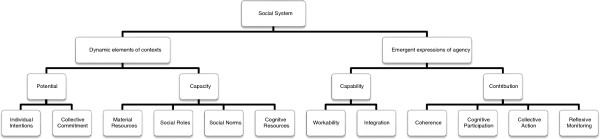
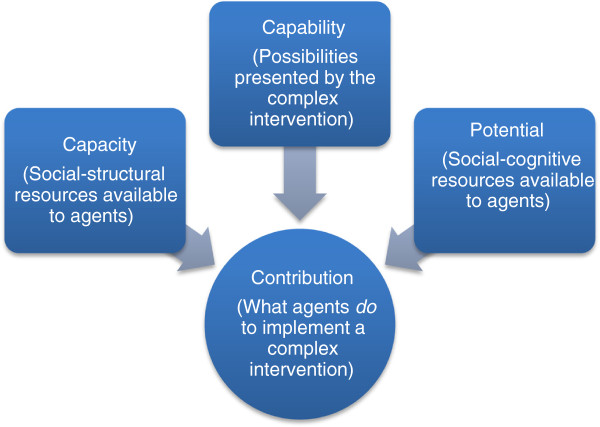
“2 23 The general theory of implementation suggests that successful implementation is promoted through: ‘ potential ’ (providers possessing the desire and ability needed for delivery); ‘ capability ’ (the intervention being workable and possible to integrate into existing systems); ‘ contribution ’…”
Wikström, E., Dellenborg, L., Wallin, L., Gillespie, B. M., & Andersson, A. E. (2018) · American Journal of Infection Control · doi:10.1016/j.ajic.2018.08.024 · Cited by 30
“This study supports the importance of the constructs and propositions suggested in NPT: capability, potential, capacity, contribution, collective action, and contextual negotiation.(20,21) Furthermore, the results from this study contribute to this implementation science framework by putting the focus on facilitating…”
BackgroundResultInfluentialvan Lieshout, F., Yang, R., Stamenova, V., Agarwal, P., Palma, D. C., Sidhu, A., Engel, K., Erwood, A., Bhatia, R. S., Bhattacharyya, O. K., et al. (2020) · Journal of Medical Internet Research · doi:10.2196/18148 · Cited by 26
“This point resonates with past work outlining how routine work practices change when new technologies are adopted [16,27,28].”
BackgroundResultKielmann, K., Dickson-Hall, L., Jassat, W., Roux, S. L., Moshabela, M., Cox, H. S., Grant, A. D., Loveday, M., Hill, J., Nicol, M. P., et al. (2021) · Health Policy and Planning · doi:10.1093/heapol/czaa147 · Cited by 26
“…willingness and capacity to implement a particular innovation (Weiner, 2009; Scaccia et al., 2015); the research on organizational readiness explicitly considers interactions between ‘emergent expressions of human agency’ and context as critical to enactment of change within the system (May, 2013).”
BackgroundInfluentialHuang, H., Jefferson, E., Gotink, M. J., Sinclair, C., Mercer, S. W., & Guthrie, B. (2021) · British Journal of General Practice · doi:10.3399/bjgp.2020.1101 · Cited by 26
“Both CQLs consistently strove to champion and facilitate the improvement agenda in their meetings, providing further evidence of ‘normalisation’ 24 and integration of quality improvement ideas, principles, and methods into contemporary clinical practice.”
Soper, B., Hinrichs, S., Drabble, S., Yaqub, O., Marjanovic, S., Hanney, S. R., & Nolte, E. (2015) · Health Services and Delivery Research · doi:10.3310/hsdr03250 · Cited by 27
Introducing Evidence Through Research “Push”: Using Theory and Qualitative Methods
Morden, A., Ong, B. N., Brooks, L. A., Jinks, C., Porcheret, M., Edwards, J., & Dziedzic, K. (2015) · Qualitative Health Research · doi:10.1177/1049732315570120 · Cited by 28
“The main focus of NPT is on collective, coordinated, and cooperative social action to understand agents at work (in this case, primary care professionals) within implementation processes (May, 2013b).”
BackgroundMethodMackenzie, M., Bradley, L., Stanley, N., Gannon, M., Barton, D., Cosgrove, K., Conway, E., & Feder, G. S. (2018) · Social Policy and Administration · doi:10.1111/spol.12467 · Cited by 27
“Further, what is being implemented is not a single task but ‘an ensemble – of material and cognitive practices’ (May, 2013:p.2).”
BackgroundGammon, J., Hunt, J., Williams, S., Daniel, S., Rees, S., & Matthewson, S. (2019) · BMC Health Services Research · doi:10.1186/s12913-019-4126-x · Cited by 27
“May offers a theory of implementation that realises implementation processes as interactions between ‘emergent expressions of agencies’ (the ways in which people make things happen through working with the different mechanisms shaping a complex intervention) and as ‘dynamic elements of context’: That is, the structura…”
BackgroundInfluentialImagery, Visualization, and Mental Simulation Interventions
Hagger, M. S., & Conroy, D. (2020) · Cambridge University Press eBooks · doi:10.1017/9781108677318.033 · Cited by 25
Metadata
- Authors
- May, C.
- Affiliations
- University of Southampton (GB)
- Corresponding author
- May, Carl
- ORCID
- May, Carl
- Venue
- Implementation Science
- Published
- 2013-02-13
- Volume
- 8
- Issue
- 1
- Pages
- 18-18
- ISSN
- 1748-5908 (ISSN-L)
- PMC
- PMC3602092
- OpenAlex
- W2152345693
- Cited by
- 656
- References
- 98
- Citations by year
- 2026: 28 · 2025: 36 · 2024: 39 · 2023: 57 · 2022: 72 · 2021: 60 · 2020: 105 · 2019: 54 · 2018: 45 · 2017: 47 · 2016: 42 · 2015: 43 · 2014: 20 · 2013: 8
- FWCI
- 68.22
- Type
- journal article
- Language
- en
- Open access
- gold
- doi.org
- Licence
- Locations
- Implementation Science (publishedVersion, cc-by)
- Europe PMC (PubMed Central) (publishedVersion, cc-by)
- PubMed Central (publishedVersion, cc-by)
- PubMed (publishedVersion)
- ePrints Soton (University of Southampton) (acceptedVersion)
- LSHTM Research Online (London School of Hygiene and Tropical Medicine) (acceptedVersion)
- Funders
- National Institute for Health and Care Research (NF-SI-0509-10017)
- Economic and Social Research Council (ES/I037342/1, ES-062-23-3274)
- Topics
- Health Sciences › Health Professions › General Health Professions › Health Policy Implementation Science
- Health Sciences › Medicine › Public Health, Environmental and Occupational Health › Clinical practice guidelines implementation
- Health Sciences › Health Professions › General Health Professions › Health Sciences Research and Education
- Keywords
- implementation theory, complex interventions, Normalization Process Theory, agency, social mechanisms, cognitive mechanisms, collective action, healthcare implementation, organizational change
- MeSH terms
- Delivery of Health Care, Diffusion of Innovation, United Kingdom, Health Policy, Humans, Organizational Innovation, State Medicine, Process Assessment, Health Care, Qualitative Research
About these checks
Registry, retraction, Cites and statistics results are computed, not judged, with one exception: a printed reference that no index lists is read once by a model before it counts as a citation error. Claims are extracted by a model and kept only when their quote appears verbatim in the text; each cited source is then checked, with a model’s help, for whether it says what the claim relies on. Those verdicts can be wrong — read the claim’s quote and the cited source before relying on one.
Statistics and arithmetic are recomputed, not judged.
Confidence bands are shown only for fields calibrated on our annotated test set. None is calibrated yet, so no band is shown.
What counts as a claim ›How we measure confidence ›How we check this ›
Are you an author, or do you see a problem with this page? Request a review
Data sources
Bibliographic data: Semantic Scholar, OpenAlex, Crossref.
Contains information from the Semantic Scholar Academic Graph Datasets, made available under the ODC Attribution License (ODC-BY 1.0).
Semantic Scholar’s data is described in: Kinney, R., et al. (2023). The Semantic Scholar Open Data Platform. arXiv:2301.10140.
