

The DOI matches its Crossref record; 85 of the 85 references it cites were found in a registry or an index.
Microglia in the aging brain: relevance to neurodegeneration
Open accessAbstract
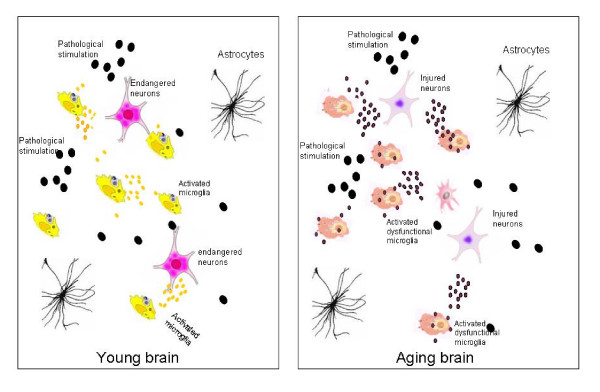
Microglia cells are the brain counterpart of macrophages and function as the first defense in the brain. Although they are neuroprotective in the young brain, microglia cells may be primed to react abnormally to stimuli in the aged brain and to become neurotoxic and destructive during neurodegeneration. Aging-induced immune senescence occurs in the brain as age-associated microglia senescence, which renders microglia to function abnormally and may eventually promote neurodegeneration. Microglia senescence is manifested by both morphological changes and alterations in immunophenotypic expression and inflammatory profile. These changes are likely caused by microinvironmental factors, but intrinsic factors cannot yet be completely excluded. Microglia senescence appears to underlie the switching of microglia from neuroprotective in the young brain to neurotoxic in the aged brain. The hypothesis of microglia senescence during aging offers a novel perspective on their roles in aging-related neurodegeneration. In Parkinson's disease and Alzheimer's disease, over-activation of microglia may play an active role in the pathogenesis because microglia senescence primes them to be neurotoxic during the development of the diseases.
Overview
The claims and statistics of this paper haven’t been checked yet.
Run the check — free, no account needed. It reads the open-access text and checks the sources it cites.
Integrity signals
Registry
Cites
Statistics
Figures
Verification
Claims the paper makes
The claims and statistics of this paper haven’t been checked yet.
Run the check — free, no account needed. It reads the open-access text and checks the sources it cites.
Claims other papers make about this one
Each is checked against this paper’s own text: does it say what the citing paper says it does?
In the citing paper
“The ageing brain is also characterised by structural and functional changes to microglial cells, which are the resident immune cell population of the central nervous system (CNS) and are the CNS equivalent of macrophages. They are activated by brain injury and local and systemic inflammation and become primed (hyper-responsive) to small stimuli with ageing, which can potentially cause damage and”
From Frailty in elderly people (2013) · cites this paper as [26]
Self-check
Percentages, sums and reported differences re-computed from the paper’s own numbers.
The self-check needs the paper’s full text.
Citations
Cites
Resting microglial cells are highly dynamic surveillants of brain parenchyma in vivo
Nimmerjahn, A., Kirchhoff, F., & Helmchen, F. (2005) · Science · doi:10.1126/science.1110647 · Cited by 5,827 · cited 2×
“By using in vivo two-photon imaging techniques, Nimmerjahn et al[37].”
BackgroundMethodInflamm‐aging: An Evolutionary Perspective on Immunosenescence
FRANCESCHI, C., BONAFÈ, M., VALENSIN, S., OLIVIERI, F., DE LUCA, M., OTTAVIANI, E., & DE BENEDICTIS, G. (2000) · Annals of the New York Academy of Sciences · doi:10.1111/j.1749-6632.2000.tb06651.x · Cited by 5,358 · cited 2×
“Extrinsic factors might include neurotransmitter, oxidative stress, neuroendocrine factors[10,68], hormones, and pathological factors such as abnormal protein aggregation [52] that exists in the microenvironment where microglia live.”
BackgroundMicroglia: a sensor for pathological events in the CNS
Kreutzberg, G. W. (1996) · Trends in Neurosciences · doi:10.1016/0166-2236(96)10049-7 · Cited by 4,396 · cited 1×
“When triggered by appropriate stimulation, microglia rapidly transformed from a resting state to an activated state with deramified shape and enhanced antigen presentation, which has been graded to a series of stages[18].”
BackgroundMicroglia: Active sensor and versatile effector cells in the normal and pathologic brain
Hanisch, U.-K., & Kettenmann, H. (2007) · Nature Neuroscience · doi:10.1038/nn1997 · Cited by 3,676 · cited 1×
“Microglia are distributed ubiquitously throughout the brain and function as resident macrophages and antigen-presenting cells in the CNS[35,36].”
BackgroundMicroglia and inflammation-mediated neurodegeneration: Multiple triggers with a common mechanism
Block, M. L., & Hong, J.-S. (2005) · Progress in Neurobiology · doi:10.1016/j.pneurobio.2005.06.004 · Cited by 1,557 · cited 1×
“These studies indicate that microglia are capable of being both neurotrophic and neurotoxic, depending on the specific stimulus, the severity of injury, and the environment [31-34].”
BackgroundMicroglial Dysfunction and Defective β-Amyloid Clearance Pathways in Aging Alzheimer's Disease Mice
Hickman, S. E., Allison, E. K., & El Khoury, J. (2008) · The Journal of Neuroscience · doi:10.1523/jneurosci.0616-08.2008 · Cited by 1,329 · cited 1×
“These genes include Abbinding scavenger receptors A (SRA), CD36, receptor for advanced glycosylation end products (RAGE), Abdegrading enzymes (insulysin, neprilysin) and MMP9 [74].”
BackgroundThe Endocrine Regulation of Aging by Insulin-like Signals
Tatar, M., Bartke, A., & Antebi, A. (2003) · Science · doi:10.1126/science.1081447 · Cited by 1,327 · cited 1×
“Insulin-like signaling pathway has been shown to regulate life span in worms, flies, and mice[ 72 ].”
BackgroundDown-Regulation of the Macrophage Lineage Through Interaction with OX2 (CD200)
Hoek, R. M., Ruuls, S. R., Murphy, C. A., Wright, G. J., Goddard, R., Zurawski, S. M., Blom, B., Homola, M. E., Streit, W. J., Brown, M. H., et al. (2000) · Science · doi:10.1126/science.290.5497.1768 · Cited by 1,022 · cited 1×
“Microglia activation is normally controlled under physiological conditions of the CNS through neuron-glia contact, CD200R-CD200 pathway[19], neuronal electrical activity[20], and/or some soluble neurotransmitters [21].”
BackgroundStreit, W. J., Braak, H., Xue, Q.-S., & Bechmann, I. (2009) · Acta Neuropathologica · doi:10.1007/s00401-009-0556-6 · Cited by 727
Dystrophic microglia in the aging human brain
Streit, W. J., Sammons, N. W., Kuhns, A. J., & Sparks, D. L. (2004) · Glia · doi:10.1002/glia.10319 · Cited by 705 · cited 2×
“”[50] Characteristics of “dystrophic” microglia that were observed in the aged brain include deramification (loss of finely branched cytoplasmic processes), cytoplasmic beading/spheroid formation, shortened and twisted cytoplasmic processes, and instances of partial or complete cytoplasmic fragmentation[50].”
Background
Cited by
Sorted by citations
Items 201–235 of 235
Lyu, J., Nagarajan, R., Sharmin, D., Mondal, P., Kambali, M., Wang, M., Zhou, J., Inoue, M., Cook, J. M., & Rudolph, U. (2026) · British Journal of Pharmacology · doi:10.1111/bph.70474 · Cited by 1
“Abnormal microglial activation and neuroin-flammation are main causal mechanisms of cognitive deficits in normal ageing (Luo et al., 2010).”
Psychological Aspects of Health and Illness in the Elderly
Gidron, Y. (2019) · Springer eBooks · doi:10.1007/978-3-030-18893-1_8 · Cited by 1
Contribution of Neuroinflammation in the Pathogenesis of Alzheimer’s Disease
Farooqui, A. A. (2017) · Elsevier eBooks · doi:10.1016/b978-0-12-809937-7.00006-9 · Cited by 1
Revisiting Metchnikoff's work in light of the COVID-19 pandemic
Cavaillon, J., & Levin, J. (2022) · Innate Immunity · doi:10.1177/17534259211070663 · Cited by 1
Zhou, Z., Li, L., Duan, M., Sun, H., Hu, Y., & Fu, Y. (2020) · bioRxiv (Cold Spring Harbor Laboratory) · doi:10.1101/2020.12.07.414433 · Cited by 1
“Evidence suggests that brain senescence contributes to AD pathogenesis (3, 4), and a link exists between the aging process and disease development (5-7).”
BackgroundRole of microglia in myelin turnover
Safaiyan, S. (2016) · eDiss (Georg-August-Universität Göttingen) · doi:10.53846/goediss-5727
Editorial: Reviews in psychiatry 2023: aging psychiatry
Capurso, C. A. (2025) · Frontiers in Psychiatry · doi:10.3389/fpsyt.2025.1601909 · Cited by 1
Microglial involvement in brain physiopathology: in vitro studies using rat primary cultures
Mengoni, I. (2014) · AMS Dottorato Institutional Doctoral Theses Repository (University of Bologna) · doi:10.6092/unibo/amsdottorato/6466
“18 changes may underlie the alterations of microglial function and their distinct responses to injury (Luo et al., 2010).”
InfluentialRegulation of Senescence by microRNAs
Grammatikakis, I., & Gorospe, M. (2013) · Wiley eBooks · doi:10.1002/9781118300312.ch4
Microglia demostrate age-dependent performance and interaction with beta-amyloid peptide
Lidónio, G. M. D. C., Brites, D. M. T. O., & Dias, D. M. A. (2013) · Portuguese National Funding Agency for Science, Research and Technology (RCAAP Project by FCT)
Ageing and the Immune Response in the CNS
Raj, D. D. A., Eggen, B. J. L., & Boddeke, H. W. G. M. (2014) · Wiley eBooks · doi:10.1002/9781118406557.ch4
Microglia in the Alzheimers brain: a help or a hindrance?
Vollert, C. T., & Eriksen, J. L. (2014) · AIMS neuroscience · doi:10.3934/neuroscience.2014.3.210
“Therefore, it has been postulated that during chronic conditions a population of chronically active microglia become destructive via an age-associated microglia senescence [101].”
BackgroundDissertação para obtenção do Grau de Mestre em Genética Molecular e Biomedicina
Filipa, A., & de Oliveira, M. I. P. (2011)
Microglial clearance function: dependence on phenotypes
Oliveira, A. F. (2011) · Portuguese National Funding Agency for Science, Research and Technology (RCAAP Project by FCT)
Lessons in Modeling, Preventing, and Treating Neural Injury: Improving Bench-to- Bedside Translation
Turner, R. C. (2013) · The Research Repository @ WVU (West Virginia University) · doi:10.33915/etd.3665
Characterization of exosomes as a diagnostic marker in neurodegenerative diseases
Stündl, A.-K. (2016) · eDiss (Georg-August-Universität Göttingen) · doi:10.53846/goediss-5944
Microglia: Features of Polarization and Aging
Harry, G. J., & McPherson, C. A. (2016) · Oxidative stress in applied basic research and clinical practice · doi:10.1007/978-3-319-33486-8_3
Development of a Plasma Biomarker to Test Oxidative Stress in Frail Elders with Traumatic Injury
Bourg, P. W. (2016) · UA Campus Repository (The University of Arizona)
Modulation of Hallmarks of Brain Aging by Environmental Enrichment
Bartolotti, N., & Lazarov, O. (2016) · Oxidative stress in applied basic research and clinical practice · doi:10.1007/978-3-319-33486-8_16
Establishment of polarized microglial cells derived from mouse embryonic stem cells
Ruegsegger, C. (2010) · Infoscience (Ecole Polytechnique Fédérale de Lausanne)
Terapia celular y génica con timulina E IGF-1 en modelos animales de neuroinflamación
Villar, M. F. Z. (2018) · El Servicio de Difusión de la Creación Intelectual (National University of La Plata) · doi:10.35537/10915/71572
Effect of Reduced Neurogenesis on Microglial Activation
Smith, A. (2020)
Patro, N., Kushwaha, S. S., & Patro, I. K. (2022) · Springer eBooks · doi:10.1007/978-981-16-8313-8_20
Muñoz‐Cánoves, P. (2018) · Faculty Opinions – Post-Publication Peer Review of the Biomedical Literature · doi:10.3410/f.734035096.793551787
Innate and adaptive immune basis of mental health effect on Alzheimer’s disease progressionPreprint
Feng, Y., Fan, J., Cheng, Y., Dai, Q., & Ma, S. (2022) · bioRxiv (Cold Spring Harbor Laboratory) · doi:10.1101/2022.06.09.495493
Timmerman, R. (2022) · Utrecht University Repository (Utrecht University) · doi:10.33540/1603
Zhao, M., Zhang, J., Yang, Q., Shi, Z., Shen, H., Pu, Y., & Han, Y. (2023) · Research Square · doi:10.21203/rs.3.rs-2984592/v1
Steroid hormone receptors in aging and neurodegenerative diseases
Kumar, R., & McEwan, I. J. (2024) · Elsevier eBooks · doi:10.1016/b978-0-323-91141-2.00001-5
Neurovirology and Brain Health—A Microglial Perspective
Biswas, A. K., & Sarma, J. D. (2024) · Healthy ageing and longevity · doi:10.1007/978-3-031-68513-2_7
Genetic modulation of immune gene co-expression in the aged mouse hippocampus by the Apbb1ip locusPreprint
Tomkins, J. E., Methi, A., Bouland, G. A., Doludda, B., Murphy, K. B., Miller, J. A., Overall, R. W., & Mozhui, K. (2025) · bioRxiv (Cold Spring Harbor Laboratory) · doi:10.1101/2025.06.04.657838
Sumita, Y., Kanai, R., Takashi, I., Nishihara, M., Agata, H., Kagami, H., Murata, H., Asahina, I., Tran, S. D., & Seki, M. (2025) · Research Square · doi:10.21203/rs.3.rs-7049957/v1
Cai, D., Ke, X., Luo, F., Li, Y., Cai, H., 祝继洪, Chen, Y., & Chen, G. (2026) · Reviews in the Neurosciences · doi:10.1515/revneuro-2026-0136
“…al. 2017; Ginhoux et al. 2010; Grabert et al. 2016; Hao et al. 2025; Hickman et al. 2013; Krasemann et al. 2017; Liebert et al. 2016; Lin et al. 2024; Luo et al. 2010; Nimmerjahn et al. 2005; Niraula et al. 2017; Microglial priming describes a state in which baseline activation may be modest, yet…”
Untersuchungen zur Rekrutierung myeloischer Zellen in einem Tiermodell der Alzheimerschen Erkrankung
Schlevogt, B. (2012) · eDiss (Georg-August-Universität Göttingen) · doi:10.53846/goediss-1158
Metadata
- Authors
- Luo, X.-G., Ding, J.-Q., & Chen, S.-D.
- Venue
- Molecular Neurodegeneration
- Published
- 2010-03-24
- Volume
- 5
- Issue
- 1
- Pages
- 12-12
- ISSN
- 1750-1326 (ISSN-L)
- PMC
- PMC2852379
- OpenAlex
- W2156427445
- Cited by
- 236
- References
- 85
- Citations by year
- 2026: 7 · 2025: 12 · 2024: 10 · 2023: 11 · 2022: 17 · 2021: 14 · 2020: 15 · 2019: 11 · 2018: 20 · 2017: 13 · 2016: 18 · 2015: 19 · 2014: 12 · 2013: 22 · 2012: 15
- FWCI
- 10.86
- Type
- journal article
- Language
- en
- Open access
- gold
- doi.org
- Licence
- cc-by
- Locations
- Molecular Neurodegeneration (publishedVersion, cc-by)
- PubMed Central (publishedVersion, cc-by)
- PubMed (publishedVersion)
- DOAJ (DOAJ: Directory of Open Access Journals) (submittedVersion, cc-by-sa)
- Topics
- Life Sciences › Neuroscience › Neurology › Neuroinflammation and Neurodegeneration Mechanisms
- Life Sciences › Biochemistry, Genetics and Molecular Biology › Molecular Biology › Inflammasome and immune disorders
- Life Sciences › Neuroscience › Neurology › Neurological Disease Mechanisms and Treatments
- Keywords
- microglia, brain aging, neurodegeneration, microglial senescence, immunosenescence, neuroinflammation, neuroprotection, Parkinson's disease, Alzheimer's disease, microglial activation, neurotoxicity
About these checks
Registry, retraction, Cites and statistics results are computed, not judged, with one exception: a printed reference that no index lists is read once by a model before it counts as a citation error. Claims are extracted by a model and kept only when their quote appears verbatim in the text; each cited source is then checked, with a model’s help, for whether it says what the claim relies on. Those verdicts can be wrong — read the claim’s quote and the cited source before relying on one.
Statistics and arithmetic are recomputed, not judged.
Confidence bands are shown only for fields calibrated on our annotated test set. None is calibrated yet, so no band is shown.
What counts as a claim ›How we measure confidence ›How we check this ›
Are you an author, or do you see a problem with this page? Request a review
