

Aβ impairs nicotinic regulation of inhibitory synaptic transmission and interneuron excitability in prefrontal cortex
Open accessThe DOI matches its Crossref record; 60 of the 60 references it cites were found in a registry or an index.
Abstract
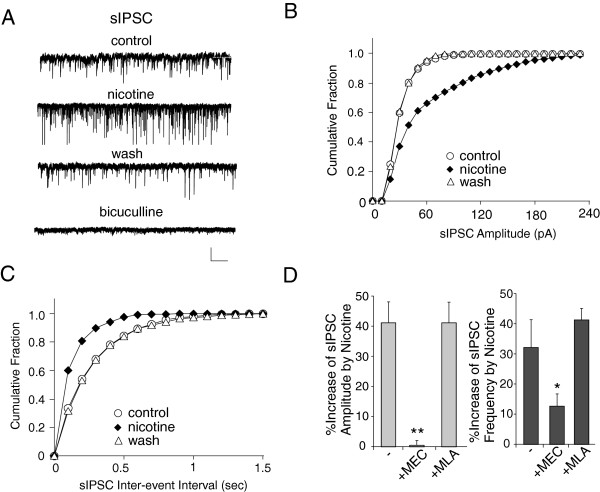
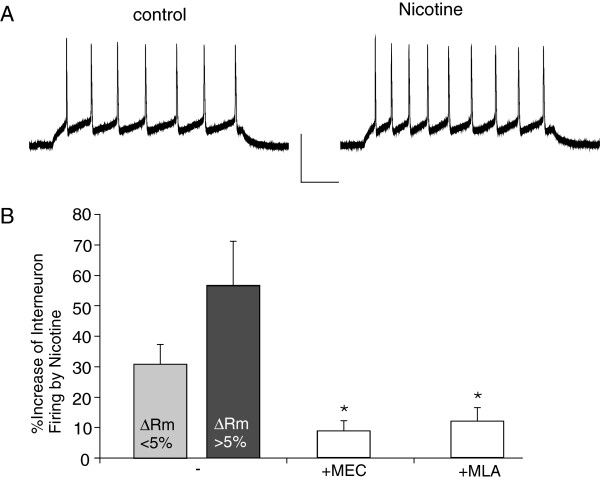
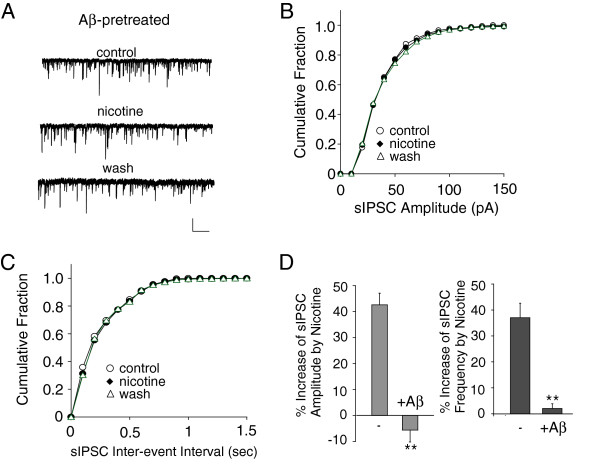
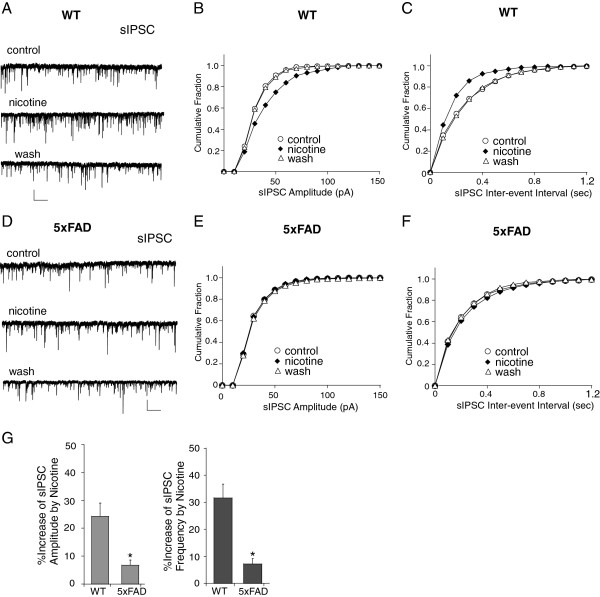
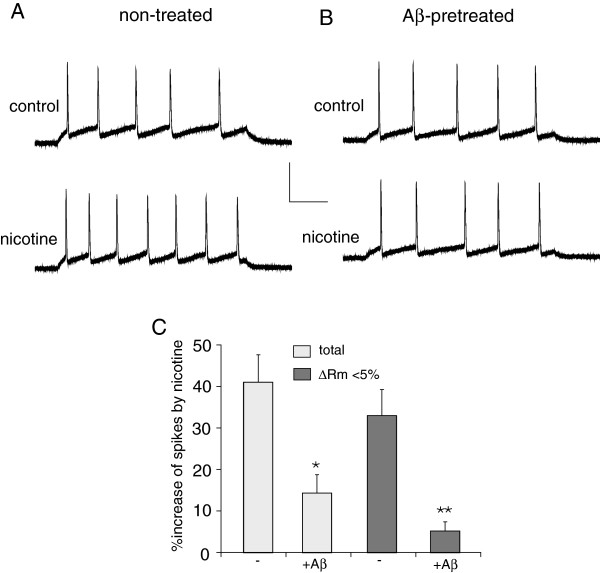
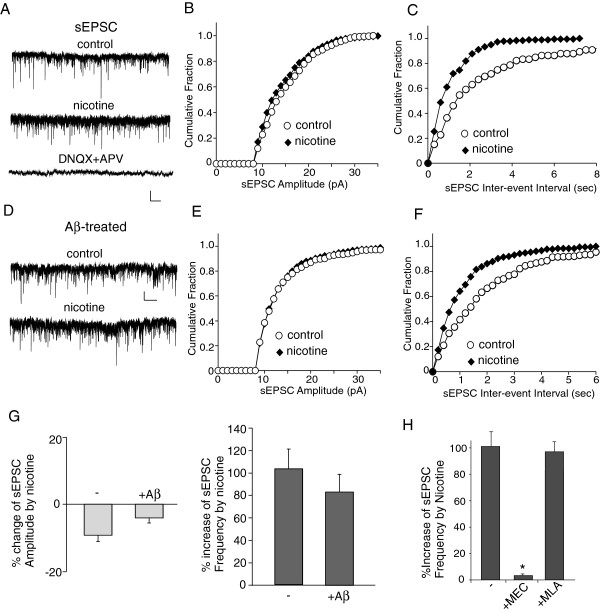
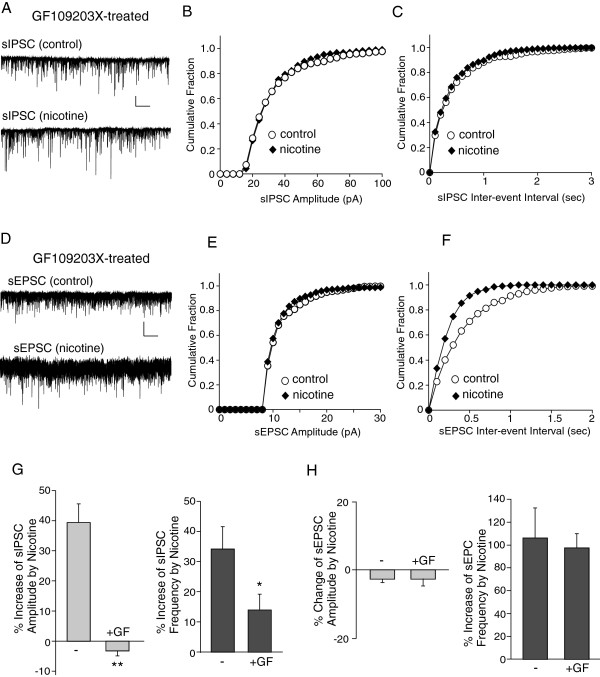
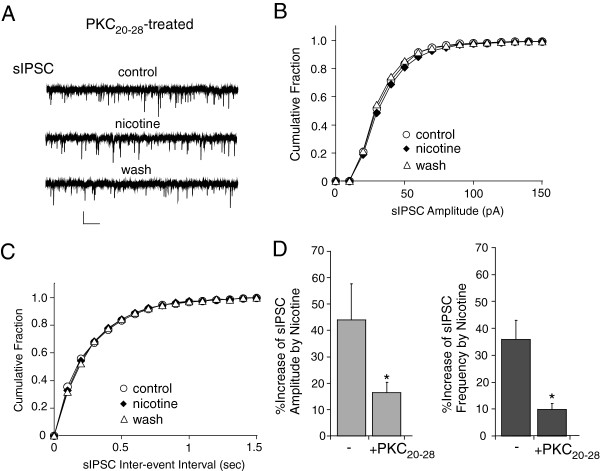
BACKGROUND: Accumulation of β-amyloid (Aβ) and cholinergic deficiency are two prominent features of Alzheimer's disease (AD). To understand how Aβ-induced dysfunction of the nicotinic system may contribute to cognitive impairment in AD, we examined the effect of Aβ on nicotinic regulation of synaptic transmission and neuronal excitability in prefrontal cortex (PFC), a brain region critical for cognitive processes. RESULTS: We found that activation of nicotinic acetylcholine receptors (nAChRs) with nicotine increased the inhibitory postsynaptic currents recorded in PFC pyramidal neurons, which was associated with the nicotine-induced increase in the excitability of PFC layer I GABAergic interneurons. Both effects of nicotine were disrupted by Aβ. However, Aβ did not impair nicotinic regulation of excitatory neurotransmission in PFC interneurons. The nicotinic effect on synaptic inhibition was also lost in transgenic mice with five familial Alzheimer's disease mutations. Inhibiting PKC attenuated nicotinic regulation of inhibitory, but not excitatory, neurotransmission. CONCLUSIONS: Our study suggests that Aβ selectively impairs nicotinic regulation of inhibitory inputs to PFC pyramidal neurons, which might be due to its interference with PKC activation. Thus, in the PFC circuits of AD, the balance between inhibition and excitation under the control of nAChRs may be disturbed by Aβ.
Overview
The claims and statistics of this paper haven’t been checked yet.
Free: it reads the open-access text and checks the first 5 claims that cite a source we can check. Create a free account to check every claim.
Integrity signals
Registry
Cites
Statistics
Figures
Verification
Claims the paper makes
The claims and statistics of this paper haven’t been checked yet.
Free: it reads the open-access text and checks the first 5 claims that cite a source we can check. Create a free account to check every claim.
Claims other papers make about this one
Each is checked against this paper’s own text: does it say what the citing paper says it does?
The source backs part of the claim, not all of it — or backs it for a different population, condition or comparison.
In the citing paper
“The cholinergic regulation of NMDA and GABA function is impaired in transgenic mice overexpressing mutant β-amyloid precursor protein (APP) 243,245,246.”
From Mechanisms of synaptic transmission dysregulation in the prefrontal cortex: pathophysiological implications (2022) · cites this paper as [245]
Experimental — accuracy not yet measuredIn the citing paper
“Activation of muscarinic or nicotinic ACh receptors in PFC pyramidal neurons also enhances inhibitory synaptic transmission through PKC-dependent mechanisms 244,245.”
From Mechanisms of synaptic transmission dysregulation in the prefrontal cortex: pathophysiological implications (2022) · cites this paper as [245]
Self-check
Percentages, sums and reported differences re-computed from the paper’s own numbers.
The self-check needs the paper’s full text.
Citations
Cites
Alzheimer's Disease: Genes, Proteins, and Therapy
Selkoe, D. J. (2001) · Physiological Reviews · doi:10.1152/physrev.2001.81.2.741 · Cited by 6,063 · cited 1×
“Background Aβ plays a critical role in the pathogenesis of Alzheimer’s disease (AD) [1-4].”
BackgroundThe cholinergic hypothesis of geriatric memory dysfunction
Bartus, R. T., Dean, R. L., Beer, B., & Lippa, A. S. (1982) · Science · doi:10.1126/science.7046051 · Cited by 5,545 · cited 1×
“In addition to Aβ accumulation, another hallmark of AD is a selective loss of cholinergic neurons in basal forebrain [9], and the loss of nicotinic acetylcholine”
BackgroundAlzheimer's Disease Is a Synaptic Failure
Selkoe, D. J. (2002) · Science · doi:10.1126/science.1074069 · Cited by 4,420 · cited 1×
“Recent evidence suggests that the cognitive deficit and memory loss in early stages of AD are due to synaptic failure [7] and functional changes in the activity of neuronal network [8].”
BackgroundOakley, H., Cole, S. L., Logan, S., Maus, E., Shao, P., Craft, J., Guillozet-Bongaarts, A., Ohno, M., Disterhoft, J., Van Eldik, L., et al. (2006) · The Journal of Neuroscience · doi:10.1523/jneurosci.1202-06.2006 · Cited by 3,530 · cited 3×
“Animals The transgenic mice that coexpress a total of five FAD mutations [APP K670N/M671L (Swedish) + I716V (Florida) + V717I (London) and PS1 M146L + L286V] [31] was a generous gift from Dr.”
BackgroundInfluentialNeurotrophic and Neurotoxic Effects of Amyloid β Protein: Reversal by Tachykinin Neuropeptides
Yankner, B. A., Duffy, L. K., & Kirschner, D. A. (1990) · Science · doi:10.1126/science.2218531 · Cited by 1,975 · cited 1×
“Earlier studies show that Aβ can cause cell death in cultured neurons [5] by inducing oxidative stress and disrupting intracellular calcium homeostasis [6].”
BackgroundTwenty years of the Alzheimer's disease amyloid hypothesis: a genetic perspective
Tanzi, R. E., & Bertram, L. (2005) · Cell · doi:10.1016/j.cell.2005.02.008 · Cited by 1,849
Oligomeric and fibrillar species of amyloid-β peptides differentially affect neuronal viability
Dahlgren, K. N., Manelli, A. M., Stine, W. B., Baker, L. K., Krafft, G. A., & LaDu, M. J. (2002) · Journal of Biological Chemistry · doi:10.1074/jbc.m201750200 · Cited by 1,452 · cited 1×
“Methods Drugs Aβ oligomer was prepared as described previously [28,57].”
MethodPresynaptic nicotinic ACh receptors
Wonnacott, S. (1997) · Trends in Neurosciences · doi:10.1016/s0166-2236(96)10073-4 · Cited by 1,308 · cited 1×
“Our results are consistent with the finding that presynaptic α4β2 receptors contribute to neurotransmission [38,39] and both somatodendritic α7 and presynaptic α4β2 receptors modulate neuronal excitability [12,40,41].”
ResultNicotinic Acetylcholine Receptors and Nicotinic Cholinergic Mechanisms of the Central Nervous System
Dani, J. A., & Bertrand, D. (2007) · Annual Review of Pharmacology and Toxicology · doi:10.1146/annurev.pharmtox.47.120505.105214 · Cited by 1,197 · cited 1×
“nAChRs are distributed in both presynaptic and postsynaptic sites [12,13], regulating transmitter release, synaptic response and neuronal excitability [14].”
BackgroundCellular actions of beta-amyloid precursor protein and its soluble and fibrillogenic derivatives
Mattson, M. P. (1997) · Physiological Reviews · doi:10.1152/physrev.1997.77.4.1081 · Cited by 1,006 · cited 1×
“Earlier studies show that Aβ can cause cell death in cultured neurons [5] by inducing oxidative stress and disrupting intracellular calcium homeostasis [6].”
Background
Cited by
Yan, Z., & Rein, B. (2022) · Molecular Psychiatry · doi:10.1038/s41380-021-01092-3 · Cited by 300
“Activation of muscarinic or nicotinic ACh receptors in PFC pyramidal neurons also enhances inhibitory synaptic transmission through PKCdependent mechanisms [244, 245].”
BackgroundSelf-citationImpact of Sleep and Circadian Rhythms on Addiction Vulnerability in Adolescents
Logan, R. W., Hasler, B. P., Forbes, E. E., Franzen, P. L., Torregrossa, M. M., Huang, Y. H., Buysse, D. J., Clark, D. B., & McClung, C. A. (2018) · Biological Psychiatry · doi:10.1016/j.biopsych.2017.11.035 · Cited by 194
The γ-secretase complex: from structure to function
Zhang, X., Li, Y., Xu, H., & Zhang, Y.-W. (2014) · Frontiers in Cellular Neuroscience · doi:10.3389/fncel.2014.00427 · Cited by 160
“The p83 fragment is rapidly degraded and widely believed to have negligible function, whereas Aβ is neurotoxic (Selkoe, 2001; Zhang et al., 2011; Proctor et al., 2012; Slowik et al., 2012; Youmans et al., 2012; Chen et al., 2013; Rosén et al., 2013).”
BackgroundM1 muscarinic acetylcholine receptor in Alzheimer’s disease
Jiang, S., Li, Y., Zhang, C., Zhao, Y., Bu, G., Xu, H., & Zhang, Y. (2014) · Neuroscience Bulletin · doi:10.1007/s12264-013-1406-z · Cited by 175
AMPA Receptors as Therapeutic Targets for Neurological Disorders
Lee, K., Goodman, L., Fourie, C., Schenk, S., Leitch, B., & Montgomery, J. M. (2015) · Advances in protein chemistry and structural biology · doi:10.1016/bs.apcsb.2015.10.004 · Cited by 123
Sun, Q., Zhang, J., Li, A., Yao, M., Liu, G., Chen, S., Luo, Y., Wang, Z., Gong, H., Li, X., et al. (2022) · Nature Communications · doi:10.1038/s41467-022-28493-4 · Cited by 93
Kolisnyk, B., Al-Onaizi, M. A., Hirata, P. H. F., Guzman, M. S., Nikolova, S., Barbash, S., Soreq, H., Bartha, R., Prado, M. A. M., & Prado, V. F. (2013) · The Journal of Neuroscience · doi:10.1523/jneurosci.1933-13.2013 · Cited by 67
Physiological Role of Amyloid Beta in Neural Cells: The Cellular Trophic Activity
C. Crdenas-Aguayo, M. D., C. Silva-Lucero, M. D., Cortes-Ortiz, M., Jimnez-Ramos, B., Gmez-Virgilio, L., Ramrez-Rodrguez, G., Vera- Arroyo, E., Fiorentino-Prez, R., Garca, U., Luna-Muoz, J., et al. (2014) · Neurochemistry · doi:10.5772/57398 · Cited by 60
Algaidi, S. A. (2025) · Brain Research · doi:10.1016/j.brainres.2025.149461 · Cited by 40
Sadleir, K. R., Eimer, W. A., Kaufman, R. J., Osten, P., & Vassar, R. (2014) · PLoS ONE · doi:10.1371/journal.pone.0101643 · Cited by 36
Fernández-Pérez, E. J., Gallegos, S., Armijo‐Weingart, L., Araya, A., Riffo-Lepe, N., Cayumán, F., & Aguayo, L. G. (2020) · Scientific Reports · doi:10.1038/s41598-020-76456-w · Cited by 38
Burstein, E. S. (2021) · CNS Drugs · doi:10.1007/s40263-021-00836-7 · Cited by 32
“glutamatergic pyramidal neurons, leading to E/I imbalance and disruption of working memory [75].”
BackgroundYang, Y., Ji, W.-G., Zhang, Y., Zhou, L., Chen, H., Yang, N., & Zhu, Z.-R. (2020) · Progress in Neuro-Psychopharmacology and Biological Psychiatry · doi:10.1016/j.pnpbp.2020.110077 · Cited by 28
Amyloid Beta Peptides Differentially Affect Hippocampal Theta Rhythms In Vitro
Gutiérrez-Lerma, A. I., Ordaz, B., & Peña‐Ortega, F. (2013) · International Journal of Peptides · doi:10.1155/2013/328140 · Cited by 30
“However, very recent evidence indicates that Aβ affects the oscillatory activity of the hippocampus mainly in two ways: the first one is a generalized reduction of both glutamatergic and GABAergic transmission of presynaptic origin [19, 62, 89, 90], and the second involves alterations in specific subpopulations of GAB…”
BackgroundTang, B., Luo, D., Yang, J., Xu, X., Zhu, B., Wang, X., Yan, Z., & Chen, G. (2015) · Scientific Reports · doi:10.1038/srep14099 · Cited by 25
Self-citationFlores-Martínez, E., & Peña‐Ortega, F. (2017) · International Journal of Peptides · doi:10.1155/2017/7386809 · Cited by 28
Chib, S., Dutta, B. J., Chalotra, R., Abubakar, M., Kumar, P., Singh, T. G., & Singh, R. (2024) · Phytotherapy Research · doi:10.1002/ptr.8406 · Cited by 25
“…of neurotransmitters in AD brain such as low rate of choline acetyltransferase is superseded by decreased Ach synthesis, loss of cholinergic neurons, neuronal and axonal cholinergic abnormalities (Geula et al. 2008), decreased postsynaptic cholinergic neurons and nAchRs (Chen, Xiong, and Yan 2013).”
Shahidi, ., Hashemi-Firouzi, N., Asl, S. S., & Komaki, A. (2019) · Behavioural Brain Research · doi:10.1016/j.bbr.2019.02.004 · Cited by 24
“The current results are similar to previous findings that beta-amyloid peptide administration induced Abeta neurotoxicity in rats [1,62,63].”
Torres-Flores, M. I., & Peña‐Ortega, F. (2022) · Neuroscience · doi:10.1016/j.neuroscience.2022.07.006 · Cited by 22
Jia, J., Peng, J., Li, Z., Wu, Y., Qun-lin, W., Tu, W., & Wu, M. (2016) · Mediators of Inflammation · doi:10.1155/2016/4854378 · Cited by 20
“reported that PKC mediated nicotineinduced neuroprotection against Aβ in neurons [42].”
BackgroundZhe, X., Liu, Y., Hu, L., Ma, B., Ai, Y.-X., & Xiong, C. (2013) · Neurochemical Research · doi:10.1007/s11064-013-1045-9 · Cited by 16
“Voltage clamp recording of synaptic currents in neurons was performed as described previously [20].”
Wu, M., Jia, J., Lei, C., Ji, L., Chen, X., Sang, H., & Xiong, L. (2014) · Journal of Molecular Neuroscience · doi:10.1007/s12031-014-0422-4 · Cited by 14
Yang, J., Liu, A., Tang, B., Luo, D., Lai, Y., Zhu, B., Wang, X., Yan, Z., & Chen, G. (2017) · BMC Genomics · doi:10.1186/s12864-017-3593-x · Cited by 15
“While nAChRs enhance AMPA receptor mediated current and firing rate in interneurons [14, 15], they cause a sustained reduction of NMDA receptor mediated currents in pyramidal neurons [16], suggesting an involvement of different molecular mechanisms.”
BackgroundSelf-citationLi, H., Lai, L., Li, X., Wang, R., Fang, X., Xu, N., & Zhao, J. (2023) · Neuromodulation Technology at the Neural Interface · doi:10.1016/j.neurom.2022.11.014 · Cited by 18
Li, S., Guan, S., Wang, Y., Cheng, L., Yang, Q., Tian, Z., Zhao, M., Wang, X., & Feng, B. (2019) · Brain Research Bulletin · doi:10.1016/j.brainresbull.2019.04.016 · Cited by 11
Nong, Y., Kim, J. S., Jia, L., Arancio, O., & Wang, Q. (2025) · Journal of Alzheimer s Disease · doi:10.1177/13872877251342273 · Cited by 9
Acetylcholine - Recent Advances and New Perspectives
Heinbockel, T. (2023) · IntechOpen eBooks · doi:10.5772/intechopen.106304 · Cited by 5
Fecik, M. J., & Savage, L. M. (2023) · IntechOpen eBooks · doi:10.5772/intechopen.110462 · Cited by 4
Assessing Cognition In A Mouse Model Of Alzheimer’s Disease
Mels, J. (2018) · Scholarship@Western (Western University) · Cited by 1
Metadata
- Authors
- Chen, G.-J., Xiong, Z., & Yan, Z.
- Affiliations
- University at Buffalo, State University of New York (US)
- Corresponding author
- Yan, Zhen
- ORCID
- Yan, Zhen
- Venue
- Molecular Neurodegeneration
- Published
- 2013
- Volume
- 8
- Issue
- 1
- Pages
- 3
- ISSN
- 1750-1326 (ISSN-L)
- PMC
- PMC3610117
- OpenAlex
- W2031040530
- Cited by
- 30
- References
- 59
- Citations by year
- 2025: 2 · 2024: 1 · 2023: 4 · 2022: 2 · 2021: 2 · 2020: 2 · 2019: 2 · 2018: 1 · 2017: 3 · 2016: 1 · 2015: 2 · 2014: 5 · 2013: 3
- FWCI
- 1.64
- Type
- journal article
- Language
- en
- Open access
- gold
- doi.org
- Licence
- cc-by
- Locations
- Molecular Neurodegeneration (publishedVersion, cc-by)
- Europe PMC (PubMed Central) (publishedVersion, cc-by)
- PubMed Central (publishedVersion, cc-by)
- PubMed (publishedVersion)
- Funders
- National Natural Science Foundation of China (81171197, 2011-1)
- National Institutes of Health
- National Institute on Aging (AG-21923, R01AG021923)
- Topics
- Life Sciences › Biochemistry, Genetics and Molecular Biology › Molecular Biology › Nicotinic Acetylcholine Receptors Study
- Life Sciences › Neuroscience › Cellular and Molecular Neuroscience › Alzheimer's disease research and treatments
- Life Sciences › Neuroscience › Cellular and Molecular Neuroscience › Neuroscience and Neuropharmacology Research
- Keywords
- amyloid-beta, nicotinic acetylcholine receptors, synaptic inhibition, GABAergic interneurons, prefrontal cortex, neuronal excitability, nicotine, protein kinase C, Alzheimer's disease, pyramidal neurons, excitation-inhibition balance, familial Alzheimer's disease mutations
- MeSH terms
- Animals, Mice, Transgenic, Synaptic Transmission, Nicotine, Receptors, Nicotinic, Amyloid beta-Peptides, Prefrontal Cortex, Pyramidal Cells, Patch-Clamp Techniques, Nicotinic Agonists, Mice, Inhibitory Postsynaptic Potentials
About these checks
Registry, retraction, Cites and statistics results are computed, not judged, with one exception: a printed reference that no index lists is read once by a model before it counts as a citation error. Claims are extracted by a model and kept only when their quote appears verbatim in the text; each cited source is then checked, with a model’s help, for whether it says what the claim relies on. Those verdicts can be wrong — read the claim’s quote and the cited source before relying on one.
Statistics and arithmetic are recomputed, not judged.
Confidence bands are shown only for fields calibrated on our annotated test set. None is calibrated yet, so no band is shown.
What counts as a claim ›How we measure confidence ›How we check this ›
Are you an author, or do you see a problem with this page? Request a review
Data sources
Bibliographic data: Semantic Scholar, OpenAlex, Crossref.
Contains information from the Semantic Scholar Academic Graph Datasets, made available under the ODC Attribution License (ODC-BY 1.0).
Semantic Scholar’s data is described in: Kinney, R., et al. (2023). The Semantic Scholar Open Data Platform. arXiv:2301.10140.
