

Molecular xenomonitoring of Dirofilaria immitis and Dirofilaria repens in mosquitoes from north-eastern Italy by real-time PCR coupled with melting curve analysis
Open accessThe DOI matches its Crossref record; 47 of the 49 references it cites were found in a registry or an index.
Abstract
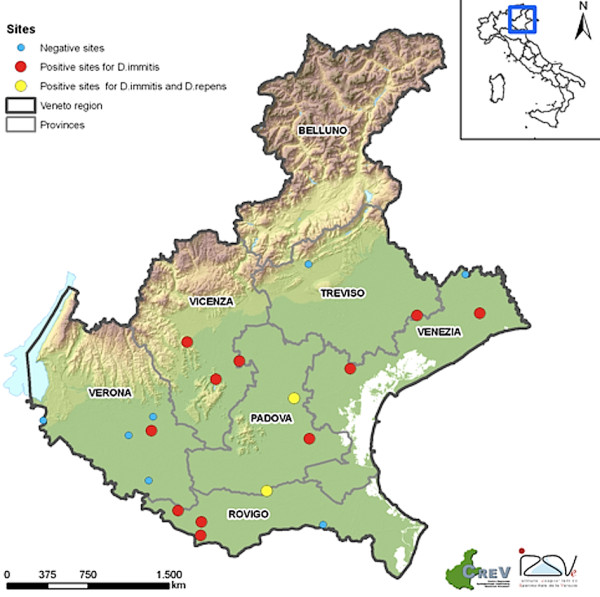
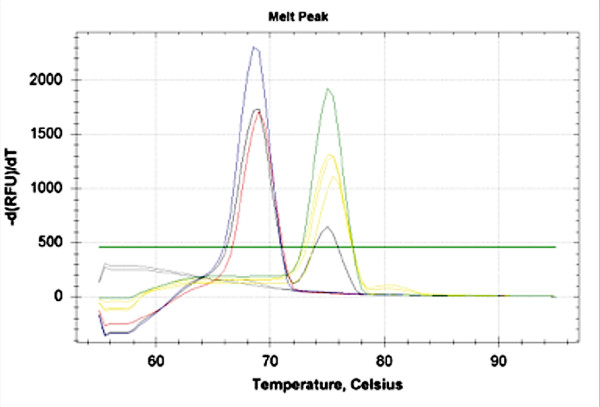
Background: Dirofilaria immitis and Dirofilaria repens are transmitted by bloodsucking culicid mosquitoes belonging to Culex, Aedes, Ochlerotatus, Anopheles and Mansonia genera. The detection of filarioids in mosquitoes for assessing distribution of vectors and/or of pathogens in a given area (also known as “xenomonitoring”), when based on individual dissection of wild-caught female mosquitoes is time consuming and hardly applicable in large epidemiological surveys. Our study aimed to evaluate the recently developed duplex real-time PCR for screening large number of culicids and to assess their positivity for D. immitis and D. repens in an area where both species are endemic. Methods: A duplex real-time PCR was used to detect and differentiate D. immitis and D. repens in mosquitoes collected in six provinces of the Veneto region using 43 carbon dioxide-baited traps under the frame of an entomological surveillance program to monitor the vectors of West Nile disease. From early May till October 2010, unfed female mosquitoes (n = 40,892) were captured in 20 selected sites. Results: Mosquitoes identified as Culex pipiens, Ochlerotatus caspius, Aedes vexans and Culex modestus were grouped into 995 pools according to species, day and site of collection (from minimum of 1 to maximum of 57). Out of 955 pools, 23 (2.41 %) scored positive for Dirofilaria spp. of which, 21 (2.2 %) for D. immitis and two (0.21 %) for D. repens. An overall Estimated Rate of Infection (ERI) of 0.06 % was recorded, being higher in Och. caspius and Ae. vexans (i.e., 0.18 % and 0.14 %, respectively). At least one mosquito pool was positive for Dirofilaria spp. in each province with the highest ERI recorded in Vicenza and Padova provinces (i.e., 0.42% and 0.16 %, respectively). Mosquitoes collected in all provinces were positive for D. immitis whereas, only two (i.e., Padova and Rovigo) provinces scored positive for D. repens. All mosquito species, except for Cx. modestus, were positive for D. immitis, whereas D. repens was only found in Cx. pipiens. Conclusions: The results suggest that both Dirofilaria species are endemic and may occur in sympatry in the examined area. The molecular approach herein used represents a powerful tool for surveillance programs of D. immitis and D. repens in the culicid vectors towards a better understanding of the epidemiology of the infections they cause and their seasonal transmission patterns.
Overview
The claims and statistics of this paper haven’t been checked yet.
Free: it reads the open-access text and checks the first 5 claims that cite a source we can check. Create a free account to check every claim.
Integrity signals
Registry
Cites
Statistics
Figures
Verification
Claims the paper makes
The claims and statistics of this paper haven’t been checked yet.
Free: it reads the open-access text and checks the first 5 claims that cite a source we can check. Create a free account to check every claim.
Claims other papers make about this one
Each is checked against this paper’s own text: does it say what the citing paper says it does?
The source backs part of the claim, not all of it — or backs it for a different population, condition or comparison.
In the citing paper
“In contrast, in a study in which more than 40,000 culicids collected from May to October 2010 in the areas of site B and C were screened for D. immitis and D. repens[11], the rates of Cx pipiens infection did not vary significantly through the season, indicating that over spring a certain number of dogs may act as a source of infection to suitable vectors.”
From Risk of canine and human exposure to Dirofilaria immitis infected mosquitoes in endemic areas of Italy (2013) · cites this paper as [11]
Experimental — accuracy not yet measuredThe source backs part of the claim, not all of it — or backs it for a different population, condition or comparison.
In the citing paper
“Interestingly, the rate of Cx pipiens infection with D. immitis estimated in this study in 1999 (0.26%-0.38%, site C) was very similar to that calculated more than ten years later (0.21-0.33%) [11].”
From Risk of canine and human exposure to Dirofilaria immitis infected mosquitoes in endemic areas of Italy (2013) · cites this paper as [11]
Experimental — accuracy not yet measuredThe source backs part of the claim, not all of it — or backs it for a different population, condition or comparison.
In the citing paper
“In an endemic area of north-eastern Italy out of 40,000 culicids captured from May to October, and screened for D. immitis and D. repens with a real-time polymerase chain reaction (PCR), Cx. p. pipiens, Oc. caspius and Am. vexans were found positive for D. immitis with an estimated rate of infestation ranging from 0.21 to 1.11%, according to date and site [64].”
From Vector-borne helminths of dogs and humans in Europe (2013) · cites this paper as [64]
Experimental — accuracy not yet measuredThe source backs part of the claim, not all of it — or backs it for a different population, condition or comparison.
In the citing paper
“This most abundant and one of the frequently infected species in Europe (Italy, Germany, the Czech Republic, Hungary, Serbia, Romania) plays a key role in the spread of Dirofilaria spp. [34, 49–53].”
From Urbanization impact on mosquito community and the transmission potential of filarial infection in central Europe (2018) · cites this paper as [49]
Experimental — accuracy not yet measuredThe cited source says what the claim attributes to it.
In the citing paper
“In contrast, in a study in which more than 40,000 culicids collected from May to October 2010 in the areas of site B and C were screened for D. immitis and D. repens[11], the rates of Cx pipiens infection did not vary significantly through the season, indicating that over spring a certain number of dogs may act as a source of infection to suitable vectors.”
From Risk of canine and human exposure to Dirofilaria immitis infected mosquitoes in endemic areas of Italy (2013) · cites this paper as [11]
2 more claims about this paper
Create a free account to see every claim other papers make about this one.
Self-check
Percentages, sums and reported differences re-computed from the paper’s own numbers.
The self-check needs the paper’s full text.
Citations
Cites
Gapped BLAST and PSI-BLAST: a new generation of protein database search programs
Altschul, S. (1997) · Nucleic Acids Research · doi:10.1093/nar/25.17.3389 · Cited by 73,302 · cited 2×
“sequences available in GenBank using Basic Local Alignment Search Tool (BLAST) [38].”
MethodChapter 4 Heartworm Disease in Animals and Humans
McCall, J. W., Genchi, C., Kramer, L. H., Guerrero, J., & Venco, L. (2008) · Advances in Parasitology · doi:10.1016/s0065-308x(08)00204-2 · Cited by 609 · cited 2×
“is challenging and requires specialised parasitological skills, impairing a reliable, prompt diagnosis [10,25].”
BackgroundRickettsial Infection in Animals and Brazilian Spotted Fever Endemicity
Sangioni, L. A., Horta, M. C., Vianna, M. C. B., Gennari, S. M., Soares, R. M., Galvão, M. A. M., Schumaker, T. T. S., Ferreira, F., Vidotto, O., & Labruna, M. B. (2005) · Emerging Infectious Diseases · doi:10.3201/eid1102.040656 · Cited by 426 · cited 1×
“Genomic DNA from all mosquito samples was extracted as described in Sangioni and colleagues [37].”
MethodCanine and feline cardiopulmonary parasitic nematodes in Europe: emerging and underestimated
Traversa, D., Di Cesare, A., & Conboy, G. (2010) · Parasites & Vectors · doi:10.1186/1756-3305-3-62 · Cited by 351 · cited 1×
“is challenging and requires specialised parasitological skills, impairing a reliable, prompt diagnosis [10,25].”
BackgroundPampiglione, S., & Rivasi, F. (2000) · PubMed · Cited by 322
Vector-borne parasitic zoonoses: emerging scenarios and new perspectives
Colwell, D. D., Dantas-Torres, F., & Otranto, D. (2011) · Veterinary Parasitology · doi:10.1016/j.vetpar.2011.07.012 · Cited by 262 · cited 1×
“repens occurred in areas previously regarded as non-endemic, as a consequence of the occurrence of simultaneous infections of the two species in both animal and vector populations [19-21].”
BackgroundSelf-citationOrihel, T. C., & Eberhard, M. L. (1998) · Clinical Microbiology Reviews · doi:10.1128/cmr.11.2.366 · Cited by 247 · cited 1×
“worldwide being agents of human dirofilariosis [6-13].”
Is heartworm disease really spreading in Europe?
Genchi, C., Rinaldi, L., Cascone, C., Mortarino, M., & Cringoli, G. (2005) · Veterinary Parasitology · doi:10.1016/j.vetpar.2005.04.009 · Cited by 222 · cited 1×
“diagnosed for a long time mostly in southern regions [14],”
BackgroundHuman dirofilariasis due to Dirofilaria (Nochtiella) repens: a review of world literature.
Pampiglione, S., Trotti, G. C., & Rivasi, F. (1995) · PubMed · Cited by 216
Dirofilarial Infections in Europe
Genchi, C., Kramer, L. H., & Rivasi, F. (2011) · Vector-Borne and Zoonotic Diseases · doi:10.1089/vbz.2010.0247 · Cited by 214 · cited 6×
“In spite of the large amount of information available on the distribution of canine dirofilariosis in Europe [20], field data on vector species of D. immitis and D. repens and on the vector infection rate are exiguous [22,23].”
BackgroundInfluential
Research works printed but not linked: 12
- Coluzzi M Osservazioni sperimentali sul comportamento di Dirofilaria repens in diversi gruppi di artropodi vettori Parassitologia 1964 4 57 62
- Sauerman DM A survey for natural potential vectors of Dirofilaria immitis in Vero beach Mosq News 1985 43 222 225
- Cancrini G Gabrielli S Vectors of Dirofilaria nematods: biology behaviour and host/parasites relationships. Dirofilaria immitis and D. repens in dog and cat and human infections Edited by Genchi C, Rinaldi L, Cringoli G. Napoli: Rolando; 2007:49–58.
- Marconcini A Magi M Incidence of canine dirofilariasis in “Maremma” (Grosseto-Italy) Ann Fac Med Vet 1991 44 153 156
- Cancrini G Kramer LH Insect vectors of Dirofilaria spp.: Heartworm infection in humans and animals Edited by Simon F and Genchi C. Universidad Salamanca; 2001:63–82.
- Petruschke G Rossi L Pollono F Genchi C Sulle filariasi canine in provincia di Varese e nel basso Canton Ticino Parassitologia 1998 40 133
- Rossi L Pollono F Meneguez PG Cancrini G Quattro specie di culicidi come possibili vettori di Dirofilaria immitis nella risaia piemontese Parassitologia 1999 41 537 542 10870556
- Iori A Cancrini G Vezzoni A Del Ninno G Tassi P Genchi C Della Torre A Coluzzi M Osservazioni sul ruolo di Culex pipiens nella trasmissione della filariasi del cane in Italia Parassitologia 1990 32 151 152
- Di Sacco B Cancrini G Genchi C Studio del tropismo nei riguardi del cane e del gatto da parte dei ditteri potenziali vettori delle filariasi in provincia di Pavia Parassitologia 1992 34 11 12
- Di Sacco B Del Zoppo B Genchi C Survey of dog Dirofilaria immitis mosquito vectors in Milan and vicinity Parassitologia 1994 36 50
- Genchi C Di Sacco B Cancrini G Epizoology of canine and feline heartworm infection in Northern Italy: possible mosquito vectors. Wilmington: American Heartworm Society 1992 1992 39 46
- Cancrini G Della Torre A Coluzzi M Different probabilities of transmission of Dirofilaria immitis and D. repens by Culex pipiens Proceedings of 6th European Multicolloquium of Parasitology 1992 Hague, Netherlands 90
Cited by
Vector-borne helminths of dogs and humans in Europe
Otranto, D., Dantas-Torres, F., Brianti, E., Traversa, D., Petrić, D., Genchi, C., & Capelli, G. (2013) · Parasites & Vectors · doi:10.1186/1756-3305-6-16 · Cited by 336
“At the same time, six more indigenous mosquito species, Culex theileri [60], Anopheles maculipennis sensu lato, Coquillettidia richiardii [61], Aedimorphus vexans, Dahliana geniculata [Aedes geniculatus] and Ochlerotatus caspius [62-64] have recently been found infected by D.”
BackgroundSelf-citationRecent advances on Dirofilaria repens in dogs and humans in Europe
Capelli, G., Genchi, C., Baneth, G., Bourdeau, P., Brianti, E., Cardoso, L., Danesi, P., Fuehrer, H.-P., Giannelli, A., Ionică, A. M., et al. (2018) · Parasites & Vectors · doi:10.1186/s13071-018-3205-x · Cited by 298
Self-citationBest Practices for Preventing Vector-Borne Diseases in Dogs and Humans
Dantas‐Torres, F., & Otranto, D. (2015) · Trends in Parasitology · doi:10.1016/j.pt.2015.09.004 · Cited by 174
“New tools for pathogen detection [53] and blood-meal identification in field-collected”
MethodSelf-citationAre vector-borne pathogen co-infections complicating the clinical presentation in dogs?
De Tommasi, A. S., Otranto, D., Dantas-Torres, F., Capelli, G., Breitschwerdt, E. B., & de Caprariis, D. (2013) · Parasites & Vectors · doi:10.1186/1756-3305-6-97 · Cited by 109
“DNA, that was performed as described elsewhere [21].”
MethodSelf-citationMontarsi, F., Ciocchetta, S., Devine, G., Ravagnan, S., Mutinelli, F., Frangipane di Regalbono, A., Otranto, D., & Capelli, G. (2015) · Parasites & Vectors · doi:10.1186/s13071-015-0800-y · Cited by 101
“The concordance between microscopy and PCR was high (0.8-0.9), however, a positivity for D. immitis in the head was found molecularly at 13 dpi, three days before microscopy.”
Self-citation
Metadata
- Authors
- Latrofa, M. S., Montarsi, F., Ciocchetta, S., Annoscia, G., Dantas-Torres, F., Ravagnan, S., Capelli, G., & Otranto, D.
- Affiliations
- Istituto Zooprofilattico Sperimentale delle Venezie (IT)
- University of Bari Aldo Moro (IT)
- Corresponding author
- Otranto, Domenico
- Venue
- Parasites & Vectors
- Published
- 2012-04-20
- Volume
- 5
- Issue
- 1
- Pages
- 76-76
- ISSN
- 1756-3305 (ISSN-L)
- PMC
- PMC3438040
- OpenAlex
- W2163295044
- Cited by
- 77
- References
- 49
- Citations by year
- 2026: 5 · 2025: 3 · 2024: 6 · 2023: 2 · 2022: 7 · 2021: 10 · 2020: 5 · 2019: 3 · 2018: 5 · 2017: 2 · 2016: 9 · 2015: 9 · 2014: 2 · 2013: 7 · 2012: 2
- FWCI
- 4.44
- Type
- journal article
- Language
- en
- Open access
- gold
- doi.org
- Licence
- cc-by
- Locations
- Parasites & Vectors (publishedVersion, cc-by)
- Europe PMC (PubMed Central) (publishedVersion, cc-by)
- PubMed Central (publishedVersion, cc-by)
- PubMed (publishedVersion)
- DOAJ (DOAJ: Directory of Open Access Journals) (submittedVersion)
- CINECA IRIS Institutional Research Information System (University of Bari Aldo Moro) (submittedVersion)
- Funders
- Bayer Animal Health
- Topics
- Health Sciences › Medicine › Infectious Diseases › Parasitic Diseases Research and Treatment
- Health Sciences › Medicine › Public Health, Environmental and Occupational Health › Research on Leishmaniasis Studies
- Health Sciences › Medicine › Public Health, Environmental and Occupational Health › Mosquito-borne diseases and control
- Keywords
- Dirofilaria immitis, Dirofilaria repens, xenomonitoring, filarial infection in mosquitoes, Culex pipiens, Ochlerotatus caspius, Aedes vexans, Culex modestus, duplex real-time PCR, melting curve analysis, vector surveillance, northeastern Italy
- MeSH terms
- Animals, Dirofilaria immitis, Dirofilariasis, Female, Humans, Insect Vectors, Italy, Culicidae, DNA, Helminth, Transition Temperature, Dirofilaria repens, Real-Time Polymerase Chain Reaction
About these checks
Registry, retraction, Cites and statistics results are computed, not judged, with one exception: a printed reference that no index lists is read once by a model before it counts as a citation error. Claims are extracted by a model and kept only when their quote appears verbatim in the text; each cited source is then checked, with a model’s help, for whether it says what the claim relies on. Those verdicts can be wrong — read the claim’s quote and the cited source before relying on one.
Statistics and arithmetic are recomputed, not judged.
Confidence bands are shown only for fields calibrated on our annotated test set. None is calibrated yet, so no band is shown.
What counts as a claim ›How we measure confidence ›How we check this ›
Are you an author, or do you see a problem with this page? Request a review
Data sources
Bibliographic data: Semantic Scholar, OpenAlex, Crossref.
Contains information from the Semantic Scholar Academic Graph Datasets, made available under the ODC Attribution License (ODC-BY 1.0).
Semantic Scholar’s data is described in: Kinney, R., et al. (2023). The Semantic Scholar Open Data Platform. arXiv:2301.10140.
