

The DOI matches its Crossref record; 77 of the 77 references it cites were found in a registry or an index.
Epigenetic understanding of gene-environment interactions in psychiatric disorders: a new concept of clinical genetics
Open accessAbstract
Epigenetics is a mechanism that regulates gene expression independently of the underlying DNA sequence, relying instead on the chemical modification of DNA and histone proteins. Although environmental and genetic factors were thought to be independently associated with disorders, several recent lines of evidence suggest that epigenetics bridges these two factors. Epigenetic gene regulation is essential for normal development, thus defects in epigenetics cause various rare congenital diseases. Because epigenetics is a reversible system that can be affected by various environmental factors, such as drugs, nutrition, and mental stress, the epigenetic disorders also include common diseases induced by environmental factors. In this review, we discuss the nature of epigenetic disorders, particularly psychiatric disorders, on the basis of recent findings: 1) susceptibility of the conditions to environmental factors, 2) treatment by taking advantage of their reversible nature, and 3) transgenerational inheritance of epigenetic changes, that is, acquired adaptive epigenetic changes that are passed on to offspring. These recently discovered aspects of epigenetics provide a new concept of clinical genetics.
Overview
The claims and statistics of this paper haven’t been checked yet.
Run the check — free, no account needed. It reads the open-access text and checks the sources it cites.
Integrity signals
Registry
Cites
Statistics
Figures
Verification
Claims the paper makes
The claims and statistics of this paper haven’t been checked yet.
Run the check — free, no account needed. It reads the open-access text and checks the sources it cites.
Claims other papers make about this one
Each is checked against this paper’s own text: does it say what the citing paper says it does?
The cited source says what the claim attributes to it.
In the citing paper
“DNA methylation (DNAm) is an epigenetic mechanism that regulates gene expression without altering DNA sequence”
From Distinct sex-specific DNA methylation differences in Alzheimer’s disease (2022) · cites this paper as [18]
The cited source says what the claim attributes to it.
In the citing paper
“and it is susceptible to environmental factors that modify the risk of diseases [18].”
From Distinct sex-specific DNA methylation differences in Alzheimer’s disease (2022) · cites this paper as [18]
Self-check
Percentages, sums and reported differences re-computed from the paper’s own numbers.
The self-check needs the paper’s full text.
Citations
Cites
Epigenetic programming by maternal behavior
Weaver, I. C. G., Cervoni, N., Champagne, F. A., D'Alessio, A. C., Sharma, S., Seckl, J. R., Dymov, S., Szyf, M., & Meaney, M. J. (2004) · Nature Neuroscience · doi:10.1038/nn1276 · Cited by 6,177
Okano, M., Bell, D. W., Haber, D. A., & Li, E. (1999) · Cell · doi:10.1016/s0092-8674(00)81656-6 · Cited by 6,143
Rett syndrome is caused by mutations in X-linked MECP2, encoding methyl-CpG-binding protein 2
Amir, R. E., Van den Veyver, I. B., Wan, M., Tran, C. Q., Francke, U., & Zoghbi, H. Y. (1999) · Nature Genetics · doi:10.1038/13810 · Cited by 4,990
Epigenetic differences arise during the lifetime of monozygotic twins
Fraga, M. F., Ballestar, E., Paz, M. F., Ropero, S., Setien, F., Ballestar, M. L., Heine-Suñer, D., Cigudosa, J. C., Urioste, M., Benitez, J., et al. (2005) · Proceedings of the National Academy of Sciences · doi:10.1073/pnas.0500398102 · Cited by 3,602
Strong association of de novo copy number mutations with autism
Sebat, J., Lakshmi, B., Malhotra, D., Troge, J., Lese-Martin, C., Walsh, T., Yamrom, B., Yoon, S., Krasnitz, A., Kendall, J., et al. (2007) · Science · doi:10.1126/science.1138659 · Cited by 2,795
Transcriptomic Analysis of Autistic Brain Reveals Convergent Molecular Pathology
Voineagu, I., Wang, X., Johnston, P., Lowe, J. K., Tian, Y., Horvath, S., Mill, J., Cantor, R. M., Blencowe, B. J., & Geschwind, D. H. (2011) · Nature · doi:10.1038/nature10110 · Cited by 1,874 · cited 1×
“A recent comprehensive study confirmed that there were differences between autistic and control brains in the expression levels of genes encoding synaptic proteins and proteins related to inflammation [12].”
BackgroundMeCP2, a Key Contributor to Neurological Disease, Activates and Represses Transcription
Chahrour, M., Jung, S. Y., Shaw, C., Zhou, X., Wong, S. T. C., Qin, J., & Zoghbi, H. Y. (2008) · Science · doi:10.1126/science.1153252 · Cited by 1,823
Sustained hippocampal chromatin regulation in a mouse model of depression and antidepressant action
Tsankova, N. M., Berton, O., Renthal, W., Kumar, A., Neve, R. L., & Nestler, E. J. (2006) · Nature Neuroscience · doi:10.1038/nn1659 · Cited by 1,780
Phenotypic plasticity and the epigenetics of human disease
Feinberg, A. P. (2007) · Nature · doi:10.1038/nature05919 · Cited by 1,613
A mouse Mecp2-null mutation causes neurological symptoms that mimic Rett syndrome
Guy, J., Hendrich, B., Holmes, M., Martin, J. E., & Bird, A. (2001) · Nature Genetics · doi:10.1038/85899 · Cited by 1,558
Autism genome-wide copy number variation reveals ubiquitin and neuronal genes
Glessner, J. T., Wang, K., Cai, G., Korvatska, O., Kim, C. E., Wood, S., Zhang, H., Estes, A., Brune, C. W., Bradfield, J. P., et al. (2009) · Nature · doi:10.1038/nature07953 · Cited by 1,421
DNA Methylation-Related Chromatin Remodeling in Activity-Dependent Bdnf Gene Regulation
Martinowich, K., Hattori, D., Wu, H., Fouse, S., He, F., Hu, Y., Fan, G., & Sun, Y. E. (2003) · Science · doi:10.1126/science.1090842 · Cited by 1,405
Derepression of BDNF Transcription Involves Calcium-Dependent Phosphorylation of MeCP2
Chen, W. G., Chang, Q., Lin, Y., Meissner, A., West, A. E., Griffith, E. C., Jaenisch, R., & Greenberg, M. E. (2003) · Science · doi:10.1126/science.1086446 · Cited by 1,232
Reversal of Neurological Defects in a Mouse Model of Rett Syndrome
Guy, J., Gan, J., Selfridge, J., Cobb, S., & Bird, A. (2007) · Science · doi:10.1126/science.1138389 · Cited by 1,230
Nutritional Control of Reproductive Status in Honeybees via DNA Methylation
Kucharski, R., Maleszka, J., Forêt, S., & Maleszka, R. (2008) · Science · doi:10.1126/science.1153069 · Cited by 1,173
Lillycrop, K. A., Phillips, E. S., Jackson, A. A., Hanson, M. A., & Burdge, G. C. (2005) · Journal of Nutrition · doi:10.1093/jn/135.6.1382 · Cited by 1,139
Epigenetic transmission of the impact of early stress across generations
Franklin, T. B., Russig, H., Weiss, I. C., Gräff, J., Linder, N., Michalon, A., Vizi, S., & Mansuy, I. M. (2010) · Biological Psychiatry · doi:10.1016/j.biopsych.2010.05.036 · Cited by 1,125 · cited 2×
“Recent research on animals has shown that behavioral characteristics can be inherited [60].”
BackgroundJames, S. J., Cutler, P., Melnyk, S., Jernigan, S., Janak, L., Gaylor, D. W., & Neubrander, J. A. (2004) · The American Journal of Clinical Nutrition · doi:10.1093/ajcn/80.6.1611 · Cited by 955
Somatic mosaicism in neuronal precursor cells mediated by L1 retrotransposition
Muotri, A. R., Chu, V. T., Marchetto, M. C. N., Deng, W., Moran, J. V., & Gage, F. H. (2005) · Nature · doi:10.1038/nature03663 · Cited by 942
Neuronal Activity–Induced Gadd45b Promotes Epigenetic DNA Demethylation and Adult Neurogenesis
Dengke, K., Jang, M., Guo, J. U., Kitabatake, Y., Chang, M.-L., Pow-anpongkul, N., Flavell, R. A., Lu, B., Ming, G., & Song, H. (2009) · Science · doi:10.1126/science.1166859 · Cited by 929
Type 2 diabetes across generations: from pathophysiology to prevention and management
Nolan, C. J., Damm, P., & Prentki, M. (2011) · The Lancet · doi:10.1016/s0140-6736(11)60614-4 · Cited by 923
L1 retrotransposition in human neural progenitor cells
Coufal, N. G., Garcia-Perez, J. L., Peng, G. E., Yeo, G. W., Mu, Y., Lovci, M. T., Morell, M., O’Shea, K. S., Moran, J. V., & Gage, F. H. (2009) · Nature · doi:10.1038/nature08248 · Cited by 814
Autism and measles, mumps, and rubella vaccine: no epidemiological evidence for a causal association
Taylor, B., Miller, E., Farrington, C., Petropoulos, M.-C., Favot-Mayaud, I., Li, J., & Waight, P. A. (1999) · The Lancet · doi:10.1016/s0140-6736(99)01239-8 · Cited by 753
Postnatal neurodevelopmental disorders: meeting at the synapse?
Zoghbi, H. Y. (2003) · Science · doi:10.1126/science.1089071 · Cited by 691
Rakyan, V. K., Chong, S., Blewitt, M. E., Cuthbert, P. C., Morgan, H. D., Luu, K. V. K., & Whitelaw, E. (2003) · Proceedings of the National Academy of Sciences · doi:10.1073/pnas.0436776100 · Cited by 642
Tobacco-smoking-related differential DNA methylation: 27K discovery and replication
Breitling, L. P., Yang, R., Korn, B., Burwinkel, B., & Brenner, H. (2011) · The American Journal of Human Genetics · doi:10.1016/j.ajhg.2011.03.003 · Cited by 640
Bourgeron, T. (2009) · Current Opinion in Neurobiology · doi:10.1016/j.conb.2009.06.003 · Cited by 637 · cited 1×
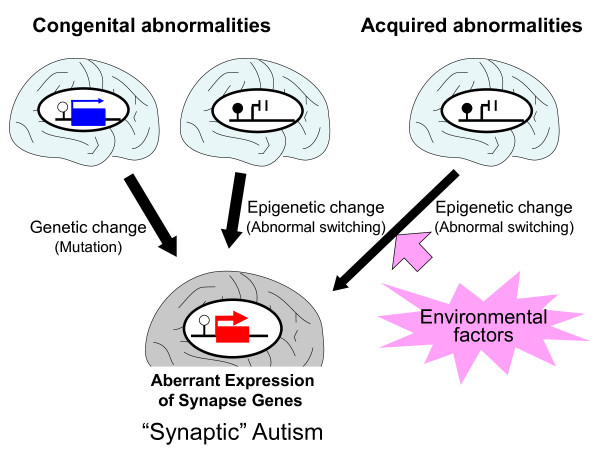
“Based on these findings, autism is now considered as a ‘synaptogenesis disorder’ [13,14],, and designated ‘synaptic autism’ [15] (Figure 1, left).”
BackgroundL1 retrotransposition in neurons is modulated by MeCP2
Muotri, A. R., Marchetto, M. C. N., Coufal, N. G., Oefner, R., Yeo, G., Nakashima, K., & Gage, F. H. (2010) · Nature · doi:10.1038/nature09544 · Cited by 626
Searching for ways out of the autism maze: genetic, epigenetic and environmental clues
Persico, A. M., & Bourgeron, T. (2006) · Trends in Neurosciences · doi:10.1016/j.tins.2006.05.010 · Cited by 575
Lillycrop, K. A., Slater-Jefferies, J. L., Hanson, M. A., Godfrey, K. M., Jackson, A. A., & Burdge, G. C. (2007) · British Journal Of Nutrition · doi:10.1017/s000711450769196x · Cited by 569
Shahbazian, M. D. (2002) · Human Molecular Genetics · doi:10.1093/hmg/11.2.115 · Cited by 554
Detection and interpretation of altered methylation patterns in cancer cells
Ushijima, T. (2005) · Nature Reviews Cancer · doi:10.1038/nrc1571 · Cited by 483 · cited 1×
“Epigenetic alterations are seen in various cancers, and are currently used clinically as diagnostic markers [44].”
BackgroundGenome, epigenome and RNA sequences of monozygotic twins discordant for multiple sclerosis
Baranzini, S. E., Mudge, J., van Velkinburgh, J. C., Khankhanian, P., Khrebtukova, I., Miller, N. A., Zhang, L., Farmer, A. D., Bell, C. J., Kim, R. W., et al. (2010) · Nature · doi:10.1038/nature08990 · Cited by 476 · cited 1×
“Therefore, although no differences have been found in the genome sequences of monozygotic twins with disease discordance for multiple sclerosis [36], some differences may be detected in the sequences of monozygotic twins with RS.”
BackgroundEpigenetic Modulation of Seizure-Induced Neurogenesis and Cognitive Decline
Jessberger, S., Nakashima, K., Clemenson, G. D., Mejia, E., Mathews, E. A., Ure, K., Ogawa, S., Sinton, C. M., Gage, F. H., & Hsieh, J. (2007) · Journal of Neuroscience · doi:10.1523/jneurosci.0110-07.2007 · Cited by 358
Personalized Epigenomic Signatures That Are Stable Over Time and Covary with Body Mass Index
Feinberg, A. P., Irizarry, R. A., Fradin, D., Aryee, M. J., Murakami, P. N., Aspelund, T., Eiríksdóttir, G., Harris, T. B., Launer, L. J., Gudnason, V. G., et al. (2010) · Science Translational Medicine · doi:10.1126/scitranslmed.3001262 · Cited by 341
Aberrant patterns of X chromosome inactivation in bovine clones
Xue, F., Tian, X. C., Du, F., Kubota, C., Taneja, M., Dinnyés, A., Dai, Y., Levine, H., Pereira, L. V., & Yang, X. (2002) · Nature Genetics · doi:10.1038/ng900 · Cited by 328
Inheritance of Stress-Induced, ATF-2-Dependent Epigenetic Change
Seong, K.-H., Li, D., Shimizu, H., Nakamura, R., & Ishii, S. (2011) · Cell · doi:10.1016/j.cell.2011.05.029 · Cited by 322
Transgenerational epigenetic inheritance: More questions than answersPreprint
Daxinger, L., & Whitelaw, E. (2010) · Genome Research · doi:10.1101/gr.106138.110 · Cited by 314
Clozapine and sulpiride but not haloperidol or olanzapine activate brain DNA demethylation
Dong, E., Nelson, M., Grayson, D. R., Costa, E., & Guidotti, A. (2008) · Proceedings of the National Academy of Sciences · doi:10.1073/pnas.0805493105 · Cited by 284
Biological memories of past environments: Epigenetic pathways to health disparities
Thayer, Z. M., & Kuzawa, C. W. (2011) · Epigenetics · doi:10.4161/epi.6.7.16222 · Cited by 266
Intelligent linkage analysis using gene density estimates
Inglehearn, C. F. (1997) · Nature Genetics · doi:10.1038/ng0597-15 · Cited by 264
Methylation-specif ic PCR simplifies imprinting analysis
Kubota, T., Das, S., Christian, S. L., Baylin, S. B., Herman, J. G., & Ledbetter, D. H. (1997) · Nature Genetics · doi:10.1038/ng0597-16 · Cited by 238
Self-citationBurdge, G. C., Lillycrop, K. A., Phillips, E. S., Slater-Jefferies, J. L., Jackson, A. A., & Hanson, M. A. (2009) · The Journal of Nutrition · doi:10.3945/jn.109.104653 · Cited by 213
Epigenetics of Early Child Development
Murgatroyd, C., & Spengler, D. (2011) · Frontiers in Psychiatry · doi:10.3389/fpsyt.2011.00016 · Cited by 212
Early Environmental Enrichment Moderates the Behavioral and Synaptic Phenotype of MeCP2 Null Mice
Lonetti, G., Angelucci, A., Morando, L., Boggio, E. M., Giustetto, M., & Pizzorusso, T. (2010) · Biological Psychiatry · doi:10.1016/j.biopsych.2009.12.022 · Cited by 207
Desulfovibrio species are potentially important in regressive autism
Finegold, S. M. (2011) · Medical Hypotheses · doi:10.1016/j.mehy.2011.04.032 · Cited by 197
Stitzel, M. L., Sethupathy, P., Pearson, D. S., Chines, P. S., Song, L., Erdos, M. R., Welch, R., Parker, S. C. J., Boyle, A. P., Scott, L. J., et al. (2010) · Cell Metabolism · doi:10.1016/j.cmet.2010.09.012 · Cited by 193
Kondo, M., Gray, L. J., Pelka, G. J., Christodoulou, J., Tam, P. P. L., & Hannan, A. J. (2008) · European Journal of Neuroscience · doi:10.1111/j.1460-9568.2008.06305.x · Cited by 190
The environment as an etiologic factor in autism: a new direction for research
London, E. A. (2000) · Environmental Health Perspectives · doi:10.1289/ehp.00108s3401 · Cited by 177
Inheritable Effect of Unpredictable Maternal Separation on Behavioral Responses in Mice
Weiss, I. C., Franklin, T. B., Vizi, S., & Mansuy, I. M. (2011) · Frontiers in Behavioral Neuroscience · doi:10.3389/fnbeh.2011.00003 · Cited by 172
Szyf, M. (2011) · Epigenetics · doi:10.4161/epi.6.8.16793 · Cited by 161
Goldman, L. R., & Koduru, S. (2000) · Environmental Health Perspectives · doi:10.1289/ehp.00108s3443 · Cited by 158
Functional imprinting and epigenetic modification of the human SNRPN gene
Glenn, C. C., Porter, K. A., Jong, M. T. C., Nicholls, R. D., & Driscoll, D. J. (1993) · Human Molecular Genetics · doi:10.1093/hmg/2.12.2001 · Cited by 155
Cerebral folate deficiency with developmental delay, autism, and response to folinic acid
Moretti, P., Sahoo, T., Hyland, Κ., Bottiglieri, T., Peters, S. U., del Gaudio, D., Roa, B., Curry, S. H., Zhu, H., Finnell, R. H., et al. (2005) · Neurology · doi:10.1212/01.wnl.0000154641.08211.b7 · Cited by 146
Lithium, an anti-psychotic drug, greatly enhances the generation of induced pluripotent stem cells
Wang, Q., Xu, X., Li, J., Liu, J., Gu, H., Zhang, R., Chen, J., Kuang, Y., Fei, J., Jiang, C., et al. (2011) · Cell Research · doi:10.1038/cr.2011.108 · Cited by 125
X chromosome reactivation and regulation in cloned embryos
Nolen, L. D., Gao, S., Han, Z., Mann, M. R. W., Chung, Y. G., Otte, A. P., Bartolomei, M. S., & Latham, K. E. (2005) · Developmental Biology · doi:10.1016/j.ydbio.2005.01.016 · Cited by 123
Valproate induces DNA demethylation in nuclear extracts from adult mouse brain
Dong, E., Chen, Y., Gavin, D. P., Grayson, D., & Guidotti, A. (2010) · Epigenetics · doi:10.4161/epi.5.8.13053 · Cited by 114
Genetic basis of autism: is there a way forward?
Eapen, V. (2011) · Current Opinion in Psychiatry · doi:10.1097/yco.0b013e328345927e · Cited by 102
Neuropsychological Effects of Childhood Cancer Treatment
Copeland, D. R., Dowell, R. E., Fletcher, J. M., Bordeaux, J., Sullivan, M. P., Jaffe, N., Frankel, L. S., Ried, H. L., & Cangır, A. (1988) · Journal of Child Neurology · doi:10.1177/088307388800300113 · Cited by 98
Environmental enrichment alters locomotor behaviour and ventricular volume in Mecp21lox mice
Nag, N., Moriuchi, J. M., Peitzman, C. G. K., Ward, B. C., Kolodny, N. H., & Berger-Sweeney, J. E. (2008) · Behavioural Brain Research · doi:10.1016/j.bbr.2008.07.008 · Cited by 97
Itoh, M., Ide, S., Takashima, S., Kudo, S., Nomura, Y., Segawa, M., Kubota, T., Mori, H., Tanaka, S., Horie, H., et al. (2007) · Journal of Neuropathology & Experimental Neurology · doi:10.1097/nen.0b013e3180302078 · Cited by 93
Self-citationLong-lasting and transgenerational effects of an environmental enrichment on memory formation
Arai, J. A., & Feig, L. A. (2010) · Brain Research Bulletin · doi:10.1016/j.brainresbull.2010.11.003 · Cited by 87
Miyake, K., Hirasawa, T., Soutome, M., Itoh, M., Goto, Y., Endoh, K., Takahashi, K., Kudo, S., Nakagawa, T., Yokoi, S., et al. (2011) · BMC Neuroscience · doi:10.1186/1471-2202-12-81 · Cited by 80
Self-citationMatsuda, H., Fukuda, N., Ueno, T., Katakawa, M., Wang, X., Watanabe, T., Matsui, S., Aoyama, T., Saito, K., Bando, T., et al. (2010) · Kidney International · doi:10.1038/ki.2010.330 · Cited by 75
Controversies in the Treatment of Autistic Children: Vitamin and Drug Therapy
Rimland, B. (1988) · Journal of Child Neurology · doi:10.1177/0883073888003001s13 · Cited by 68
Kerr, B., Silva, P. A., Walz, K., & Young, J. I. (2010) · PLoS ONE · doi:10.1371/journal.pone.0011534 · Cited by 63
Synthesis and properties of PI polyamide–SAHA conjugate
Ohtsuki, A., Kimura, M., Minoshima, M., Suzuki, T., Ikeda, M., Bando, T., Nagase, H., Shinohara, K., & Sugiyama, H. (2009) · Tetrahedron Letters · doi:10.1016/j.tetlet.2009.10.034 · Cited by 61
SHANK3,the Synapse, and Autism
Herbert, M. R. (2011) · New England Journal of Medicine · doi:10.1056/nejmcibr1104261 · Cited by 50
Sakazume, S., Ohashi, H., Sasaki, Y., Harada, N., Nakanishi, K., Sato, H., Emi, M., Endoh, K., Sohma, R., Kido, Y., et al. (2011) · Human Genetics · doi:10.1007/s00439-011-1051-4 · Cited by 49
Self-citationKubota, T., Wakui, K., Nakamura, T., Ohashi, H., Watanabe, Y., Yoshino, M., Kida, T., Okamoto, N., MATSUMURA, M., Muroya, K., et al. (2002) · Cytogenetic and Genome Research · doi:10.1159/000071604 · Cited by 48
Self-citationJunaid, M. A., Kuizon, S., Cardona, J. S., Azher, T., Murakami, N., Pullarkat, R. K., & Brown, W. T. (2011) · Biochemical and Biophysical Research Communications · doi:10.1016/j.bbrc.2011.08.027 · Cited by 48
Heritable germline epimutations in humans
Horsthemke, B. (2007) · Nature Genetics · doi:10.1038/ng0507-573b · Cited by 40
A patient with classic Rett syndrome with a novel mutation in MECP2 exon 1
Chunshu, Y., Endoh, K., Soutome, M., Kawamura, R., & Kubota, T. (2006) · Clinical Genetics · doi:10.1111/j.1399-0004.2006.00712.x · Cited by 29
Self-citationKubota, T., Saitoh, S., Matsumoto, T., Narahara, K., Fukushima, Y., Jinno, Y., & Niikawa, N. (1994) · American Journal of Medical Genetics · doi:10.1002/ajmg.1320490405 · Cited by 29
Self-citationEpigenetics and Diabetes Risk: Not Just for Imprinting Anymore?
Pollin, T. I. (2011) · Diabetes · doi:10.2337/db11-0515 · Cited by 19
Korade, Ž., & Mirnics, K. (2011) · Nature · doi:10.1038/474294a · Cited by 7
Flintoft, L. (2010) · Nature Reviews Genetics · doi:10.1038/nrg2893 · Cited by 3
Cited by
Sorted by citations
Neural Mechanisms of Stress Resilience and Vulnerability
Franklin, T. B., Saab, B. J., & Mansuy, I. M. (2012) · Neuron · doi:10.1016/j.neuron.2012.08.016 · Cited by 500
Histone Acetylome-wide Association Study of Autism Spectrum Disorder
Sun, W., Poschmann, J., Cruz-Herrera del Rosario, R., Parikshak, N. N., Hajan, H. S., Kumar, V., Ramasamy, R., Belgard, T. G., Elanggovan, B., Wong, C. C. Y., et al. (2016) · Cell · doi:10.1016/j.cell.2016.10.031 · Cited by 306
Epigenetic regulation and chromatin remodeling in learning and memory
Kim, S., & Kaang, B. (2017) · Experimental & Molecular Medicine · doi:10.1038/emm.2016.140 · Cited by 217
Autism Spectrum Disorder: Focus on Glutamatergic Neurotransmission
Montanari, M., Martella, G., Bonsi, P., & Meringolo, M. (2022) · International Journal of Molecular Sciences · doi:10.3390/ijms23073861 · Cited by 114
Epigenetics and Autism Spectrum Disorder: Is There a Correlation?
Eshraghi, A. A., Liu, C., Kay, S.-I. S., Eshraghi, R. S., Mittal, J., Moshiree, B., & Mittal, R. (2018) · Frontiers in Cellular Neuroscience · doi:10.3389/fncel.2018.00078 · Cited by 100
Metadata
- Authors
- Kubota, T., Miyake, K., & Hirasawa, T.
- Affiliations
- University of Yamanashi (JP)
- Corresponding author
- Kubota, Takeo
- ORCID
- Miyake, Kunio
- Venue
- Clinical Epigenetics
- Published
- 2012-01-20
- Volume
- 4
- Issue
- 1
- Pages
- 1-1
- ISSN
- 1868-7075 (ISSN-L)
- 1868-7083
- PMC
- PMC3305338
- OpenAlex
- W2156106199
- Cited by
- 157
- References
- 77
- Citations by year
- 2026: 2 · 2025: 11 · 2024: 7 · 2023: 15 · 2022: 12 · 2021: 16 · 2020: 14 · 2019: 12 · 2018: 11 · 2017: 14 · 2016: 7 · 2015: 8 · 2014: 14 · 2013: 11 · 2012: 3
- FWCI
- 4.63
- Type
- journal article
- Language
- en
- Open access
- gold
- doi.org
- Licence
- Locations
- Clinical Epigenetics (publishedVersion, cc-by)
- PubMed Central (publishedVersion, cc-by)
- PubMed (publishedVersion)
- DOAJ (DOAJ: Directory of Open Access Journals) (submittedVersion)
- Funders
- Ministry of Education, Culture, Sports, Science and Technology
- Japan Society for the Promotion of Science (23791156, 24659437, 23390272, 23591491, 23659519)
- Topics
- Life Sciences › Biochemistry, Genetics and Molecular Biology › Molecular Biology › Epigenetics and DNA Methylation
- Life Sciences › Biochemistry, Genetics and Molecular Biology › Genetics › Genetic Associations and Epidemiology
- Life Sciences › Biochemistry, Genetics and Molecular Biology › Genetics › Genetic Syndromes and Imprinting
- Keywords
- epigenetics, gene-environment interaction, mental illness, epigenetic disorders, DNA methylation, histone modifications, environmental factors, transgenerational epigenetic inheritance, medical genetics, epigenetic therapy
About these checks
Registry, retraction, Cites and statistics results are computed, not judged, with one exception: a printed reference that no index lists is read once by a model before it counts as a citation error. Claims are extracted by a model and kept only when their quote appears verbatim in the text; each cited source is then checked, with a model’s help, for whether it says what the claim relies on. Those verdicts can be wrong — read the claim’s quote and the cited source before relying on one.
Statistics and arithmetic are recomputed, not judged.
Confidence bands are shown only for fields calibrated on our annotated test set. None is calibrated yet, so no band is shown.
What counts as a claim ›How we measure confidence ›How we check this ›
Are you an author, or do you see a problem with this page? Request a review
