

Effects of a late supper on digestion and the absorption of dietary carbohydrates in the following morning
Open accessThe DOI matches its Crossref record; 21 of the 21 references it cites were found in a registry or an index.
Abstract
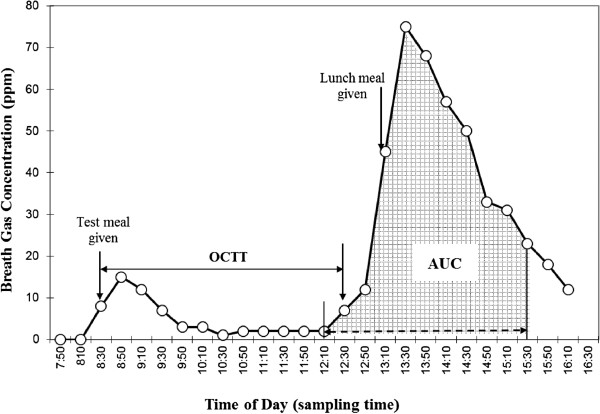
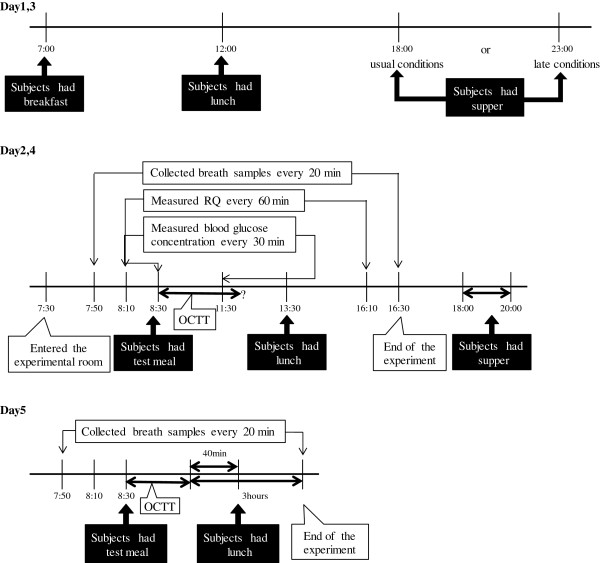
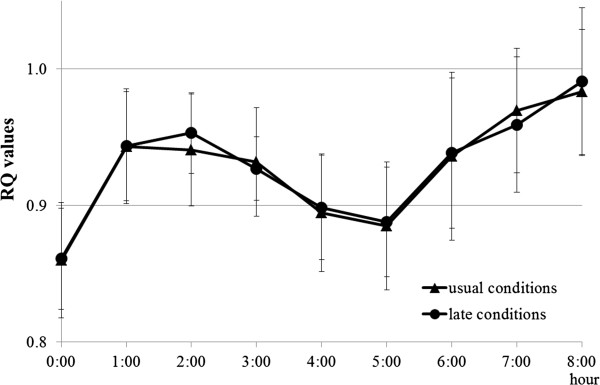
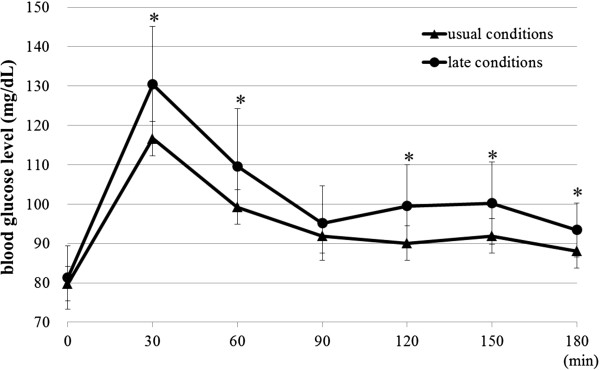
BACKGROUND: Our previous experiment showed that the light intensity exposed on the subjects during evening time had no effect in the following morning on the efficiency of the digestion and absorption of dietary carbohydrates ingested at a usual suppertime. People who keep late hours usually have a late suppertime; thus, we examined the effects of a late suppertime on gastrointestinal activity in the following morning in comparison to that of a usual suppertime. METHODS: Twelve female university students volunteered as paid participants. The breath hydrogen test was carried out to estimate the amount of unabsorbed dietary carbohydrates and the percentage of the total amount of dietary carbohydrates in the breakfast that were unabsorbed, as well as to estimate oro-cecal transit time. The respiratory quotient was also measured to find the ratio of carbohydrates/lipid metabolism in the post-breakfast state. Subjects' peripheral blood glucose concentration was measured by a blood glucose meter. The subjects participated under two different experimental conditions: with a usual suppertime (having supper at 18:00) and a late suppertime (having supper at 23:00). RESULTS: The efficiency of the digestion and absorption of dietary carbohydrates in the breakfast under late suppertime conditions was higher than that under usual suppertime conditions. Usual or late suppertime had no effect on the ratio of carbohydrates to lipids oxidized after the subjects had breakfast. There were significant differences in the blood glucose level between the two conditions at 30, 60, 120, 150, and 180 minutes after having breakfast, whereas the mean blood glucose level under late suppertime conditions was significantly higher than under usual suppertime conditions. CONCLUSIONS: Having a late supper showed a worse effect on postprandial serum glucose profiles the following morning. This study confirmed that keeping our usual meal timing is important for our health.
Overview
The claims and statistics of this paper haven’t been checked yet.
Free: it reads the open-access text and checks the first 5 claims that cite a source we can check. Create a free account to check every claim.
Integrity signals
Registry
Cites
Statistics
Figures
Verification
Claims the paper makes
The claims and statistics of this paper haven’t been checked yet.
Free: it reads the open-access text and checks the first 5 claims that cite a source we can check. Create a free account to check every claim.
Claims other papers make about this one
Each is checked against this paper’s own text: does it say what the citing paper says it does?
The cited source says what the claim attributes to it.
In the citing paper
“Furthermore, later dinner times showed a worsening of postprandial glucose profiles after breakfast on the next day (76).”
From Meal timing and its role in obesity and associated diseases (2024) · cites this paper as [76]
In the citing paper
“showed that a late supper was associated with a worse effect on postprandial glucose profiles the following morning [307].”
From Effects of diet, lifestyle, Chrononutrition and alternative dietary interventions on postprandial Glycemia and insulin resistance (2022) · cites this paper as [307]
In the citing paper
“In contrast, eating a rich or a late dinner may aggravate IR and hyperglycemia and deteriorate blood glucose levels the following morning [307,309].”
From Effects of diet, lifestyle, Chrononutrition and alternative dietary interventions on postprandial Glycemia and insulin resistance (2022) · cites this paper as [307]
Self-check
Percentages, sums and reported differences re-computed from the paper’s own numbers.
The self-check needs the paper’s full text.
Citations
Cites
Light Suppresses Melatonin Secretion in Humans
Lewy, A. J., Wehr, T. A., Goodwin, F. K., Newsome, D. A., & Markey, S. P. (1980) · Science · doi:10.1126/science.7434030 · Cited by 1,913 · cited 1×
“This result indicated that the enhancement of sympathetic nervous tone induced by bright light exposure [10,11], which was supposed to be a major regulatory factor for gastrointestinal activity, ceased the following morning when participants were able to get sleep during the night.”
BackgroundObesity and shift work: chronobiological aspects
Antunes, L. C., Levandovski, R., Dantas, G., Caumo, W., & Hidalgo, M. P. (2010) · Nutrition Research Reviews · doi:10.1017/s0954422410000016 · Cited by 493
Relationship between oral glucose tolerance and gastric emptying in normal healthy subjects
Horowitz, M., Edelbroek, M. A. L., Wishart, J. M., & Straathof, J. W. (1993) · Diabetologia · doi:10.1007/bf00400362 · Cited by 469 · cited 1×
“Therefore, the efficiency of absorption of carbohydrates after having a late supper became better than that after having the meal at a usual suppertime [23].”
BackgroundStettler, C., Allemann, S., Jüni, P., Cull, C. A., Holman, R. R., Egger, M., Krähenbühl, S., & Diem, P. (2006) · American Heart Journal · doi:10.1016/j.ahj.2005.09.015 · Cited by 467 · cited 1×
“diabetes related diseases because many clinical trials have demonstrated no glycemic threshold for induction of either microvascular or macrovascular complications; the higher the glycated hemoglobin (HbA1c), the higher the risk for diabetes [26].”
BackgroundGastrointestinal transit: The effect of the menstrual cycle
Wald, A., Van Thiel, D. H., Hoechstetter, L., Gavaler, J. S., Egler, K. M., Verm, R., Scott, L., & Lester, R. (1981) · Gastroenterology · doi:10.1016/0016-5085(81)90263-8 · Cited by 397
Brainard, G. C., Lewy, A. J., Menaker, M., Fredrickson, R. H., Miller, L. S., Weleber, R. G., Cassone, V., & Hudson, D. (1988) · Brain Research · doi:10.1016/0006-8993(88)90820-7 · Cited by 233 · cited 1×
“This result indicated that the enhancement of sympathetic nervous tone induced by bright light exposure [10,11], which was supposed to be a major regulatory factor for gastrointestinal activity, ceased the following morning when participants were able to get sleep during the night.”
BackgroundCircadian variation of diet-induced thermogenesis
Romon, M., Edme, J., Boulenguez, C., Lescroart, J., & Frimat, P. (1993) · The American Journal of Clinical Nutrition · doi:10.1093/ajcn/57.4.476 · Cited by 197 · cited 1×
“studied the influences of eating rhythm on diet-induced thermogenesis in young women and reported that diet-induced thermogenesis for the night pattern meals was lower than that for the morning pattern meals [5,6].”
BackgroundAlterations of the colonic flora and their effect on the hydrogen breath test.
Gilat, T., Ben Hur, H., Gelman-Malachi, E., Terdiman, R., & Peled, Y. (1978) · Gut · doi:10.1136/gut.19.7.602 · Cited by 176 · cited 1×
“All participants were non-smokers and they were required to report any current antibiotic therapy [14].”
BackgroundMorgan, L. M., Shi, J.-W., Hampton, S. M., & Frost, G. (2012) · British Journal of Nutrition · doi:10.1017/s0007114511006507 · Cited by 145 · cited 1×
“reported meal timing affected glucose tolerance and insulin secretion and recommended avoidance of large meals in the evening for improving postprandial glucose profiles [27].”
BackgroundAcute effect of late evening meal on diurnal variation of blood glucose and energy metabolism
Sato, M., Nakamura, K., Ogata, H., Miyashita, A., Nagasaka, S., Omi, N., Yamaguchi, S., Hibi, M., Umeda, T., Nakaji, S., et al. (2011) · Obesity Research & Clinical Practice · doi:10.1016/j.orcp.2011.02.001 · Cited by 97
Hyperinsulinaemia impairs gastrointestinal motility and slows carbohydrate absorption
Eliasson, B., Björnsson, E., Urbanavičius, V., Andersson, H., Fowelin, J., Attvall, S., Abrahamsson, H., & Smith, U. (1995) · Diabetologia · doi:10.1007/bf02369356 · Cited by 88
Hydrogen breath test assessment of orocecal transit time: comparison with barium meal study.
Hirakawa, M., Iida, M., Kohrogi, N., & Fujishima, M. (1988) · PubMed · Cited by 54
Fritz, M., Siebert, G., & Kasper, H. (1985) · British Journal of Nutrition · doi:10.1079/bjn19850124 · Cited by 53 · cited 1×
“Because it has been shown that there is a rough linear correlation between the excretion of hydrogen in the breath and the quantity of unabsorbed carbohydrate [18], the area under the curve when hydrogen concentration in the breath was plotted against time (abbreviated to AUC) was used to represent the amount of hydro…”
MethodAcute effect of late evening meal on diurnal variation of blood glucose and energy metabolism
中山, 真. (2013) · Medical Entomology and Zoology · Cited by 43
Influence of orocaecal transit time on hydrogen excretion after carbohydrate malabsorption.
Rumessen, J. J., Hamberg, O., & Gudmand-Höyer, E. (1989) · Gut · doi:10.1136/gut.30.6.811 · Cited by 31 · cited 1×
“AUC was calculated according to the trapezoidal rule [19] and was expressed in the units of parts per million · hour (ppm · h).”
MethodHirota, N., Sone, Y., & Tokura, H. (2003) · Chronobiology International · doi:10.1081/cbi-120024216 · Cited by 17 · cited 2×
“During the course of our investigations on the effect of an artificially bright evening environment on human digestive physiology, we found that staying under a dim light from 17:00 to 02:00 after taking supper at 16:30 has a better effect on the digestion and absorption of dietary carbohydrates in the supper meal tha…”
BackgroundSelf-citationMorinaka, T., Woźniewicz, M., Jeszka, J., Bajerska, J., Limtrakul, P., Makonkawkeyoon, L., Hirota, N., Kumagai, S., & Sone, Y. (2012) · Journal of PHYSIOLOGICAL ANTHROPOLOGY · doi:10.1186/1880-6805-31-10 · Cited by 17 · cited 1×
“[22], and the RQ values during the period of stable breathing were used for further analysis.”
MethodSelf-citationHirota, N., Sone, Y., & Tokura, H. (2010) · Journal of PHYSIOLOGICAL ANTHROPOLOGY · doi:10.2114/jpa2.29.79 · Cited by 6 · cited 1×
“On the other hand exposure of the subjects to bright or dim light after they had supper at 17:30 in the evening (light conditions were controlled from 15:00 to 24:00) showed no different effect on the efficiency of digestion and absorption of dietary carbohydrates in the following morning meal [9].”
BackgroundSelf-citationThe Influence of Eating Rhythm on Diet-induced Thermogenesis in Young Women
Sekino, Y., Kashiwa, E., & Nakamura, T. (2010) · Nippon Eiyo Shokuryo Gakkaishi · doi:10.4327/jsnfs.63.101 · Cited by 6 · cited 2×
“studied the influences of eating rhythm on diet-induced thermogenesis in young women and reported that diet-induced thermogenesis for the night pattern meals was lower than that for the morning pattern meals [5,6].”
BackgroundTsumura, Y., Makonakwkeyoon, L., Limtrakul, P., Hirota, N., & Sone, Y. (2010) · Journal of PHYSIOLOGICAL ANTHROPOLOGY · doi:10.2114/jpa2.29.141 · Cited by 6 · cited 1×
“The breath hydrogen test and unabsorbed dietary carbohydrates (UDC: grams as lacto sucrose equivalent), percentage of unabsorbed carbohydrates in the total carbohydrates in the breakfast (% UDC) and oro-cecal transit time (OCTT) were calculated according to our previous studies [16,17].”
MethodSelf-citationComparison of Carbohydrate Digestion between Japanese and Polish Healthy Subjects
Tsumura, Y., Hirota, N., Tokura, H., Sone, Y., Lesinski, F., Rutkowska, D., & Barinow-Wojewódzki, A. (2005) · Journal of PHYSIOLOGICAL ANTHROPOLOGY and Applied Human Science · doi:10.2114/jpa.24.507 · Cited by 5 · cited 1×
“The breath hydrogen test and unabsorbed dietary carbohydrates (UDC: grams as lacto sucrose equivalent), percentage of unabsorbed carbohydrates in the total carbohydrates in the breakfast (% UDC) and oro-cecal transit time (OCTT) were calculated according to our previous studies [16,17].”
MethodSelf-citation
Research works printed but not linked: 6
- Cabinet Office Government of Japan Issues and Initiatives for Promotion Measures of Shokuiku FY2009 Shokuiku Promotion Policy (Shokuiku White Paper). Part 1. Chapter 2 2010 Tokyo: Nikkei Printing Inc 36 54 [in Japanese]
- Nakamura K Miyashita M Ogata H Nagasaka I Tokuyama K The effect of taking supper just before going bed on the energy metabolism during the hours of sleep J Jpn Soc Obesity 2007 13 250 255 [in Japanese]
- Statistics Bureau, Director-General for Policy Planning and Statistical Research and Training Institute Ministry of internal affairs and communications, in Japan 2006 [ http://www.stat.go.jp/english/]
- Tsuchida Y Okuda T Higashine Y Mimura K Asai H A study of the factors influence the body weight reduction of women having a tendency towards obesity who have attended a diet class J Jpn Soc Obesity 2007 13 74 83 [In Japanese]
- Eastwood MA Sadler MJ, Strain JJ, Waltham BC Structure and Function of the Colon Encyclopedia of Human Nutrition, Volume 2 2005 Academic Press 945 953
- Kaneko T Sato M Sasayama R Kobayashi N Sakuma M Saso M Taguchi K Actual state of eating habits and night-eating syndrome in medical students B Yamanashi Med U 2001 18 7 10 [In Japanese with English Abstract]
Cited by
St-Onge, M.-P., Ard, J., Baskin, M. L., Chiuve, S. E., Johnson, H. M., Kris-Etherton, P., & Varady, K. (2017) · Circulation · doi:10.1161/cir.0000000000000476 · Cited by 728
Papakonstantinou, E., Oikonomou, C., Nychas, G., & Dimitriadis, G. D. (2022) · Nutrients · doi:10.3390/nu14040823 · Cited by 199
Chrononutrition in the management of diabetes
Henry, C. J., Kaur, B., & Quek, R. Y. C. (2020) · Nutrition & Diabetes · doi:10.1038/s41387-020-0109-6 · Cited by 174
Bo, S., Fadda, M., Castiglione, A., Ciccone, G., De Francesco, A., Fedele, D., Guggino, A., Parasiliti Caprino, M., Ferrara, S., Vezio Boggio, M., et al. (2015) · International Journal of Obesity · doi:10.1038/ijo.2015.138 · Cited by 171
“Other explanations for the reduced evening post-prandial thermic and metabolic answers may be the slower evening gastric emptying, with increased efficacy of dietary carbohydrates absorption [5-6], and the reported decrement in insulin sensitivity as evening progresses [3].”
Bo, S., Musso, G., Beccuti, G., Fadda, M., Fedele, D., Gambino, R., Gentile, L., Durazzo, M., Ghigo, E., & Cassader, M. (2014) · PLoS ONE · doi:10.1371/journal.pone.0108467 · Cited by 166
“Additionally, morning gastric emptying may be more rapid than evening gastric emptying [44], and an increased efficacy of absorption of dietary carbohydrates has been demonstrated under late suppertime conditions [45].”
Background
Metadata
- Authors
- Tsuchida, Y., Hata, S., & Sone, Y.
- Affiliations
- Osaka Tokiwakai Junior College (JP)
- Osaka City University (JP)
- Corresponding author
- Tsuchida, Yukie
- ORCID
- Sone, Yoshiaki
- Venue
- Journal of Physiological Anthropology
- Published
- 2013-05-25
- Volume
- 32
- Issue
- 1
- Pages
- 9-9
- ISSN
- 1880-6791 (ISSN-L)
- 1880-6805
- PMC
- PMC3685573
- OpenAlex
- W2147930876
- Cited by
- 36
- References
- 21
- Citations by year
- 2026: 2 · 2025: 1 · 2024: 6 · 2023: 2 · 2022: 6 · 2021: 2 · 2020: 4 · 2019: 3 · 2018: 1 · 2017: 3 · 2016: 1 · 2015: 1 · 2014: 3
- FWCI
- 1.54
- Type
- journal article
- Language
- en
- Open access
- gold
- doi.org
- Licence
- cc-by
- creativecommons.org/licenses/by/2.0 (tdm)
- Locations
- Journal of PHYSIOLOGICAL ANTHROPOLOGY (publishedVersion, cc-by)
- Europe PMC (PubMed Central) (publishedVersion, cc-by)
- PubMed Central (publishedVersion, cc-by)
- PubMed (publishedVersion)
- Topics
- Health Sciences › Nursing › Nutrition and Dietetics › Food composition and properties
- Health Sciences › Medicine › Gastroenterology › Gastrointestinal motility and disorders
- Health Sciences › Medicine › Physiology (medical) › Dietary Effects on Health
- Keywords
- meal timing, carbohydrate absorption, postprandial blood glucose, hydrogen breath test, respiratory quotient, light exposure at night
- MeSH terms
- Blood Glucose, Dietary Carbohydrates, Digestion, Feeding Behavior, Female, Humans, Intestinal Absorption, Time Factors, Young Adult
About these checks
Registry, retraction, Cites and statistics results are computed, not judged, with one exception: a printed reference that no index lists is read once by a model before it counts as a citation error. Claims are extracted by a model and kept only when their quote appears verbatim in the text; each cited source is then checked, with a model’s help, for whether it says what the claim relies on. Those verdicts can be wrong — read the claim’s quote and the cited source before relying on one.
Statistics and arithmetic are recomputed, not judged.
Confidence bands are shown only for fields calibrated on our annotated test set. None is calibrated yet, so no band is shown.
What counts as a claim ›How we measure confidence ›How we check this ›
Are you an author, or do you see a problem with this page? Request a review
Data sources
Bibliographic data: Semantic Scholar, OpenAlex, Crossref.
Contains information from the Semantic Scholar Academic Graph Datasets, made available under the ODC Attribution License (ODC-BY 1.0).
Semantic Scholar’s data is described in: Kinney, R., et al. (2023). The Semantic Scholar Open Data Platform. arXiv:2301.10140.
