

Gender differences in emotionality and sociability in children with autism spectrum disorders
Open accessThe DOI matches its Crossref record; 59 of the 61 references it cites were found in a registry or an index.
Abstract
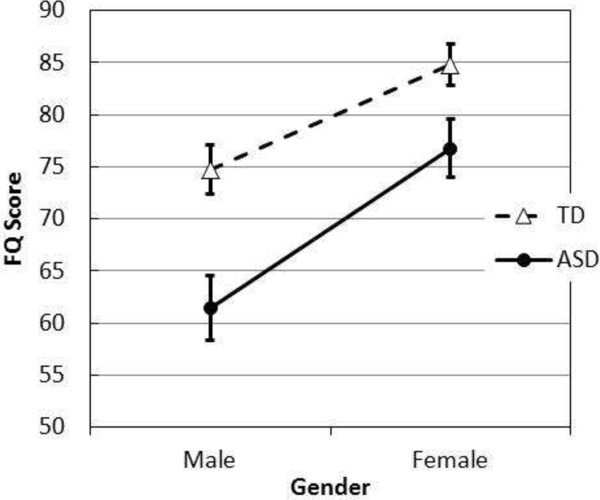
BACKGROUND: Four times as many males are diagnosed with high functioning autism compared to females. A growing body of research that focused on females with autism spectrum disorder (ASD) questions the assumption of gender invariance in ASD. Clinical observations suggest that females with ASD superficially demonstrate better social and emotional skills than males with ASD, which may camouflage other diagnostic features. This may explain the under-diagnosis of females with ASD. METHODS: We hypothesised that females with ASD would display better social skills than males with ASD on a test of friendship and social function. One hundred and one 10- to 16-year-olds (ASD females, n = 25; typically developing (TD) females, n = 25; ASD males, n = 25; TD males, n = 26) were interviewed (using the friendship questionnaire (FQ)) with high scores indicating the child has close, empathetic and supportive relationships. One parent of each child completed the FQ to assess whether there are differences in perception of friendships between parents and children. RESULTS: It was found that, independent of diagnosis, females demonstrated higher scores on the FQ than males. Further, regardless of gender, children with ASD demonstrated lower scores than TD children. Moreover, the effect of ASD was independent of gender. Interestingly, females with ASD and TD males displayed similar scores on the FQ. CONCLUSIONS: This finding is supported by clinical reports that females with ASD have more developed social skills than males with ASD. Further research is now required to examine the underlying causes for this phenomenon in order to develop gender-appropriate diagnostic criteria and interventions for ASD.
Overview
The claims and statistics of this paper haven’t been checked yet.
Free: it reads the open-access text and checks the first 5 claims that cite a source we can check. Create a free account to check every claim.
Integrity signals
Registry
Cites
Statistics
Figures
Verification
Claims the paper makes
The claims and statistics of this paper haven’t been checked yet.
Free: it reads the open-access text and checks the first 5 claims that cite a source we can check. Create a free account to check every claim.
Claims other papers make about this one
Each is checked against this paper’s own text: does it say what the citing paper says it does?
The cited source says what the claim attributes to it.
In the citing paper
“The Australian study with 25 male and 25 female adolescents with high-functioning ASD demonstrated that females with ASD showed similar social skills on a (self-report/parent-report) questionnaire of friendship and social function as typically developing males.”
From Barriers to Autism Spectrum Disorder Diagnosis for Young Women and Girls: a Systematic Review (2021) · cites this paper as Head et al. 2014
The cited source says what the claim attributes to it.
In the citing paper
“However, the study also reported that adolescents with ASD scored lower on the FQ compared to neurotypical adolescents, which is strongly supported by the literature, and study findings were consistent when using the FQ reported by adolescents compared to parent-report, providing further validation of this study’s findings.”
From Barriers to Autism Spectrum Disorder Diagnosis for Young Women and Girls: a Systematic Review (2021) · cites this paper as Head et al. 2014
The cited source says what the claim attributes to it.
In the citing paper
“in this small study, females with ASD showed similar social skills on a friendship and social function questionnaire as neurotypically developing males, demonstrating differences not only from neurotypically developing girls, but also from males with ASD.”
From Barriers to Autism Spectrum Disorder Diagnosis for Young Women and Girls: a Systematic Review (2021) · cites this paper as Head et al. 2014
The cited source says what the claim attributes to it.
In the citing paper
“the current evidence base appears to support suggestions that camouflaging is more associated with the experiences of autistic females and girls/ women, and may partially explain increased rates of missed or late diagnosis found amongst them”
From Camouflaging in autism: A systematic review (2021) · cites this paper as Head et al., 2014
In the citing paper
“Head et al. (2014)The authors compared autistic and non-autistic children's scores on a self-report measure of friendship quality, understanding, and empathy.Thus, this study did not report quantitative data measuring camouflaging.”
From Camouflaging in autism: A systematic review (2021) · cites this paper as Head et al. (2014)
Self-check
Percentages, sums and reported differences re-computed from the paper’s own numbers.
The self-check needs the paper’s full text.
Citations
Cites
Diagnostic and Statistical Manual of Mental Disorders
Williams, J. B. W., & First, M. (2013) · Encyclopedia of Social Work · doi:10.1093/acrefore/9780199975839.013.104 · Cited by 109,519
Tabachnick, B. G., & Fidell, L. S. (1983) · Cited by 80,054
Diagnostic and Statistical Manual of Mental Disorders.
Widiger, T. A. (2000) · Encyclopedia of Psychology, Vol. 3. · doi:10.1037/10518-009 · Cited by 19,744
Diagnostic and Statistical Manual of Mental Disorders, 5th Edition
(2013) · American Psychiatric Association Publishing eBooks · doi:10.1176/appi.books.9780890425596.893619 · Cited by 4,383
Discovering statistics using SPSS, 2nd ed.
Field, A. P. (2005) · Cited by 4,234
Global Prevalence of Autism and Other Pervasive Developmental Disorders
Elsabbagh, M., Divan, G., Koh, Y., Kim, Y. S., Kauchali, S., Marcín, C., Montiel‐Nava, C., Patel, V., Paula, C. S., Wang, C., et al. (2012) · Autism Research · doi:10.1002/aur.239 · Cited by 2,636 · cited 1×
“; licensee BioMed Central L Commons Attribution License (http://creativec reproduction in any medium, provided the or [5], whereas for those who are also profoundly intellectually disabled the ratio is closer to two males for each female [6].”
BackgroundRose, A. J., & Rudolph, K. D. (2006) · Psychological Bulletin · doi:10.1037/0033-2909.132.1.98 · Cited by 2,517 · cited 2×
“Intimate friendships among TD males are characterised by rough and tumble play, minimal close connection and a large group of like-minded friends, acquaintances, playmates or strangers [11,16-19].”
BackgroundUnderstanding Other Minds Perspectives From Developmental Cognitive Neuroscience
Baron‐Cohen, S., Tager-Flusberg, H. B., & Cohen, D. J. (2000) · Cited by 1,392
Childhood peer relationships: social acceptance, friendships, and peer networks
Gifford-Smith, M. E., & Brownell, C. A. (2003) · Journal of School Psychology · doi:10.1016/s0022-4405(03)00048-7 · Cited by 961
Mandy, W., Chilvers, R., Chowdhury, U., Salter, G., Seigal, A., & Skuse, D. (2012) · Journal of Autism and Developmental Disorders · doi:10.1007/s10803-011-1356-0 · Cited by 715 · cited 3×
“Currently, the literature in this area largely focuses on males with ASD, whereby females with ASD are represented by only a few participants in the sample or are excluded altogether [1].”
BackgroundResult
Research works printed but not linked: 2
- Hughes PJ Edmonds G, Beardon L Making friends is not easy Asperger Syndrome and Social Relationships: Adults Speak Out about Asperger Syndrome 2008 London: Jessica Kingsley Publishers 125 134
- Attwood T Garnett M Ford L Bulhak-Paterson D Girls and women with Asperger’s syndrome Hearts and Minds Conference: Girls and Women with Asperger’s Syndrome 2011 Victoria, Australia
Cited by
Items 101–200 of 402
Chen, Y.-W. R., Bundy, A. C., Cordier, R., Chien, Y., & Einfeld, S. (2016) · Autism · doi:10.1177/1362361316636756 · Cited by 42
Shrestha, M., Basukala, S., Thapa, N., Shrestha, O., Basnet, M., Shrestha, K., Regmi, S. K., Chhetri, S. T., & Kunwor, B. (2024) · Health Science Reports · doi:10.1002/hsr2.2005 · Cited by 40
Lundin, K., Mahdi, S., Isaksson, J., & Bölte, S. (2021) · Autism · doi:10.1177/1362361320975311 · Cited by 39
“…social motivation than neurotypical males (Head et al., 2014), which has also been found among autistic females when compared to male equivalents (Head et al., 2014; Sedgewick et al., 2016); whereas males in the general population display more externalizing behavior than females (Zahn-Waxler et…”
BackgroundInfluentialNeural responsivity to social rewards in autistic female youth
Lawrence, K. E., Hernandez, L. M., Eilbott, J., Jack, A., Aylward, E., Gaab, N., Van Horn, J. D., Bernier, R. A., Geschwind, D. H., McPartland, J. C., et al. (2020) · Translational Psychiatry · doi:10.1038/s41398-020-0824-8 · Cited by 39
‘I just rolled up my sleeves’: Mothers’ perspectives on raising girls on the autism spectrum
Fowler, K., & O’Connor, C. (2020) · Autism · doi:10.1177/1362361320956876 · Cited by 39
Mahendiran, T., Brian, J. A., Dupuis, A., Muhe, N., Wong, P. Y., Iaboni, A., & Anagnostou, E. A. (2019) · Frontiers in Psychiatry · doi:10.3389/fpsyt.2019.00804 · Cited by 38
Libster, N., Knox, A., Engin, S., Geschwind, D. H., Parish‐Morris, J., & Kasari, C. L. (2023) · Molecular Autism · doi:10.1186/s13229-023-00542-9 · Cited by 38
Rabbitte, K., Prendeville, P., & Kinsella, W. (2017) · Educational and Child Psychology · doi:10.53841/bpsecp.2017.34.2.54 · Cited by 38
Parent perspectives on autistic girls’ friendships and futures
Sedgewick, F., Hill, V., & Pellicano, E. (2018) · Autism & Developmental Language Impairments · doi:10.1177/2396941518794497 · Cited by 37
Treatment effectiveness for offenders with autism spectrum conditions: a systematic review
Melvin, C. L., Langdon, P. E., & Murphy, G. H. (2017) · Psychology Crime and Law · doi:10.1080/1068316x.2017.1324027 · Cited by 37
Dickinson, K., & Place, M. (2016) · Games for Health Journal · doi:10.1089/g4h.2015.0063 · Cited by 35
Sturrock, A., Adams, C., & Freed, J. (2021) · Frontiers in Psychology · doi:10.3389/fpsyg.2021.621742 · Cited by 35
Trastorno del espectro autista: Diagnóstico clínico y test ADOS
González, M. C., Vásquez, M., & Hernández, M. (2019) · Revista chilena de pediatría · doi:10.32641/rchped.v90i5.872 · Cited by 34
Carbone, E., Buzzelli, V., Manduca, A., Leone, S., Rava, A., & Trezza, V. (2023) · International Journal of Molecular Sciences · doi:10.3390/ijms24043920 · Cited by 33
“I Was Like a Bird Without Wings”: Autistic Women’s Retrospective Experiences in General Schools
Zakai-Mashiach, M. (2022) · Journal of Autism and Developmental Disorders · doi:10.1007/s10803-022-05717-6 · Cited by 31
Thornton, A. M., Humphrey, R. M., Kerr, D. M., Finn, D. P., & Roche, M. (2021) · Molecules · doi:10.3390/molecules26123720 · Cited by 31
Tofani, M., Scarcella, L., Galeoto, G., Giovannone, F., & Sogos, C. (2022) · Journal of Autism and Developmental Disorders · doi:10.1007/s10803-022-05498-y · Cited by 30
Cooke, K., Ridgway, K., Pecora, L. A., Westrupp, E. M., Hedley, D., Hooley, M., & Stokes, M. A. (2023) · Research in Autism · doi:10.1016/j.rasd.2023.102313 · Cited by 30
Self-citationCarpita, B., Nardi, B., Pronestì, C., Parri, F., Giovannoni, F., Cremone, I. M., Pini, S., & Dell’Osso, L. (2023) · Brain Sciences · doi:10.3390/brainsci14010037 · Cited by 30
Diagnostic Challenges of High-Functioning Autism Spectrum Disorder in Females
Gupta, M., & Chaudhary, R. (2021) · Cureus · doi:10.7759/cureus.13006 · Cited by 30
Rujeedawa, T., & Zaman, S. H. (2022) · International Journal of Environmental Research and Public Health · doi:10.3390/ijerph19031315 · Cited by 29
Gender comparisons in children with ASD entering early intervention
Fulton, A. M., Paynter, J. M., & Trembath, D. L. (2017) · Research in Developmental Disabilities · doi:10.1016/j.ridd.2017.07.009 · Cited by 29
Camouflaging in autism: a systematic reviewPreprint
Cook, J. M., Hull, L., Crane, L., & Mandy, W. (2021) · OSF Preprints (OSF Preprints) · doi:10.31219/osf.io/u5b9e · Cited by 29
Muggleton, J. T. B., MacMahon, K., & Johnston, K. (2019) · Research in Autism Spectrum Disorders · doi:10.1016/j.rasd.2019.03.004 · Cited by 29
Sex differences in social and emotional insight in youth with and without autism
Mattern, H., Cola, M., Tena, K. G., Knox, A., Russell, A. R. B., Pelella, M. R., Hauptmann, A., Covello, M., Parish‐Morris, J., & McCleery, J. P. (2023) · Molecular Autism · doi:10.1186/s13229-023-00541-w · Cited by 29
Please listen to us: Adolescent autistic girls speak about learning and academic success
Jacobs, P., Beamish, W., & McKay, L. (2020) · Improving Schools · doi:10.1177/1365480220973112 · Cited by 29
Intersection of Eating Disorders and the Female Profile of Autism
Brown, C. M., & Stokes, M. A. (2020) · Psychiatric Clinics of North America · doi:10.1016/j.psc.2020.08.009 · Cited by 28
Self-citationWhyte, E. M., & Scherf, K. S. (2017) · Clinical Psychological Science · doi:10.1177/2167702617738380 · Cited by 28
Reputation Management in Children on the Autism Spectrum
Cage, E., Bird, G., & Pellicano, E. (2016) · Journal of Autism and Developmental Disorders · doi:10.1007/s10803-016-2923-1 · Cited by 21
Bemmouna, D., Lagzouli, A., & Weiner, L. (2023) · Molecular Autism · doi:10.1186/s13229-023-00580-3 · Cited by 28
Social attention and autism symptoms in high functioning women with autism spectrum disorders
Ketelaars, M., Velt, A. I., Mol, A. J. J., Swaab, H., Bodrij, F. F., & van Rijn, S. (2017) · Research in Developmental Disabilities · doi:10.1016/j.ridd.2017.03.005 · Cited by 28
Prenatal Sex Hormone Exposure Is Associated with the Development of Autism Spectrum Disorder
Li, M., Usui, N., & Shimada, S. (2023) · International Journal of Molecular Sciences · doi:10.3390/ijms24032203 · Cited by 27
Øien, R. A., Vambheim, S. M., Hart, L., Nordahl‐Hansen, A., Erickson, C. A., Wink, L. K., Eisemann, M. R., Shic, F., Volkmar, F. R., & Grodberg, D. (2018) · Journal of Autism and Developmental Disorders · doi:10.1007/s10803-018-3488-y · Cited by 28
“Always a glass ceiling.” Gender or autism; the barrier to occupational inclusion
Hayward, S. M., McVilly, K. R., & Stokes, M. A. (2018) · Research in Autism Spectrum Disorders · doi:10.1016/j.rasd.2018.09.001 · Cited by 27
Self-citationIntersection of Eating Disorders and the Female Profile of Autism
Brown, C. M., & Stokes, M. A. (2020) · Child and Adolescent Psychiatric Clinics of North America · doi:10.1016/j.chc.2019.11.002 · Cited by 25
Self-citationTesting the social motivation theory of autism: the role of co‐occurring anxiety
Bagg, E., Pickard, H., Tan, M., Smith, T. J., Simonoff, E. A., Pickles, A. R., Leno, V. C., & Bedford, R. (2023) · Journal of Child Psychology and Psychiatry · doi:10.1111/jcpp.13925 · Cited by 25
Self-regulation predicts companionship in children with autism
Nuske, H. J., Shih, W., Sparapani, N., Baczewski, L. M., Nunnally, A. D., Hochheimer, S., Garcia, C., Castellón, F. A., Levato, L., Fischer, E., et al. (2021) · International Journal of Developmental Disabilities · doi:10.1080/20473869.2021.1917109 · Cited by 25
Nonsyndromic Craniosynostosis Is Associated with Increased Risk for Psychiatric Disorders
Tillman, K. K., Höijer, J., Ramklint, M., Ekselius, L., Nowinski, D. J., & Papadopoulos, F. C. (2020) · Plastic & Reconstructive Surgery · doi:10.1097/prs.0000000000007009 · Cited by 25
What does success mean for autistic men? A narrative exploration of self-determination
Webster, A. A., & Garvis, S. (2020) · Autism & Developmental Language Impairments · doi:10.1177/2396941520945522 · Cited by 25
Cancino-Barros, I., Villacura-Herrera, C., & Castillo, R. D. (2025) · Scientific Reports · doi:10.1038/s41598-025-06137-z · Cited by 23
Scheerer, N. E., Aime, H., Boucher, T. Q., & Iarocci, G. (2020) · Autism in Adulthood · doi:10.1089/aut.2019.0062 · Cited by 23
Presenting age and features of females diagnosed with autism spectrum disorder
Tang, J. W., Li, J. W., Baulderstone, D., & Jeyaseelan, D. (2021) · Journal of Paediatrics and Child Health · doi:10.1111/jpc.15417 · Cited by 23
Establishing Social Inclusion the Autism Way: Denying the “They Don’t Want Friends” Myth
Bennett, M., Webster, A. A., Goodall, E., & Rowland, S. (2018) · Springer eBooks · doi:10.1007/978-981-13-3359-0_9 · Cited by 22
Female gender and autism: underdiagnosis and misdiagnosis – clinical and scientific urgency
Minutoli, R., Marraffa, C., Failla, C., Pioggia, G., & Marino, F. (2026) · Frontiers in Psychiatry · doi:10.3389/fpsyt.2025.1704579 · Cited by 22
Tawankanjanachot, N., Truesdale, M., Orachon, P., & Kidd, L. (2024) · International Journal of Mental Health Systems · doi:10.1186/s13033-023-00617-3 · Cited by 21
Salehi, M., Jaka, S., Lotfi, A., Ahmad, A., Saeidi, M., & Gunturu, S. (2025) · Children · doi:10.3390/children12030297 · Cited by 21
Hassrick, E. M., Sosnowy, C. D., Holmes, L. G., Walton, J., & Shattuck, P. T. (2020) · Autism in Adulthood · doi:10.1089/aut.2019.0058 · Cited by 20
The interaction of genetic sex and prenatal alcohol exposure on health across the lifespan
Bake, S., Rouzer, S. K., Mavuri, S., Miranda, R. C., & Mahnke, A. H. (2023) · Frontiers in Neuroendocrinology · doi:10.1016/j.yfrne.2023.101103 · Cited by 20
Kadwa, R. A., Sahu, J. K., SINGHI, P. D., Malhi, P., & Mittal, B. R. (2019) · The Indian Journal of Pediatrics · doi:10.1007/s12098-019-03061-9 · Cited by 20
Płatos, M., & Pisula, E. (2020) · Research in Autism · doi:10.1016/j.rasd.2020.101716 · Cited by 20
Mahmood, H. M., Aldhalaan, H., Alshammari, T. K., Alqasem, M., Alshammari, M. A., Albekairi, N. A., & AlSharari, S. D. (2020) · Autism Research · doi:10.1002/aur.2342 · Cited by 19
Wellness Efforts for Autistic Women
Tint, A., Hamdani, Y., Sawyer, A., Desarkar, P., Ameis, S. H., Bardikoff, N., & Lai, M. (2018) · Current Developmental Disorders Reports · doi:10.1007/s40474-018-0148-z · Cited by 19
Investigation of Broad Autism Phenotype Traits as Measured by the 26-Item Autism Quotient
Camodeca, A., Hosack, A. G., & Todd, K. Q. (2018) · Journal of Psychoeducational Assessment · doi:10.1177/0734282918768706 · Cited by 19
Clarke, E., Hull, L., Loomes, R., McCormick, C. E. B., Sheinkopf, S. J., & Mandy, W. (2021) · Research in Autism Spectrum Disorders · doi:10.1016/j.rasd.2021.101844 · Cited by 17
“In verbally and cognitively able samples, autistic girls and women show greater motivation to form friendships than autistic boys and men (Dean et al., 2014; Head et al., 2014).”
BackgroundResultMetwally, A. M., El-Din, E. M. S., Sami, S. M., Raouf, E. R. A., Sallam, S. F., Elsaeid, A., El‐Saied, M. M., Ashaat, E. A., Fathy, A. M., El-Hariri, H. M., et al. (2025) · Molecular Autism · doi:10.1186/s13229-025-00665-1 · Cited by 17
Social and emotional competencies of students with special educational needs in inclusive education
Ralić, A. Ž., & Marković, J. (2024) · Journal of Research in Special Educational Needs · doi:10.1111/1471-3802.12671 · Cited by 17
Kopp, S., Asztély, K., Landberg, S., Wærn, M., Bergman, S., & Gillberg, C. (2023) · Journal of Attention Disorders · doi:10.1177/10870547231158751 · Cited by 17
Bhargava, A., & Ashwin, C. (2025) · Research in Autism · doi:10.1016/j.reia.2025.202547 · Cited by 17
Mapes, A. R., & Cavell, T. A. (2023) · Mentoring & Tutoring Partnership in Learning · doi:10.1080/13611267.2023.2164990 · Cited by 17
Does Camouflaging Cause Reduced Quality of Life? A Co-Twin Control Study
Remnélius, K. L., Neufeld, J., Isaksson, J., & Bölte, S. (2024) · Journal of Autism and Developmental Disorders · doi:10.1007/s10803-024-06583-0 · Cited by 17
Natoli, K., Brown, A., Bent, C. A., Luu, J., & Hudry, K. (2023) · Research in Autism · doi:10.1016/j.rasd.2023.102207 · Cited by 17
Lamb, G. V., Green, R. J., & Olorunju, S. A. S. (2019) · The Egyptian Journal of Neurology Psychiatry and Neurosurgery · doi:10.1186/s41983-019-0103-x · Cited by 17
Paricos, A., Sturrock, A., Twomey, K. E., & Leadbitter, K. (2024) · Research in Autism · doi:10.1016/j.rasd.2024.102338 · Cited by 16
Lim, V. H. T., Chen, Y.-W. R., Tseng, M., Bundy, A. C., & Cordier, R. (2021) · Autism · doi:10.1177/13623613211004329 · Cited by 16
den Hartog, A., de la Roche, L., Derby, B., Psaradellis, E., & Kelley, E. A. (2023) · Research in Autism · doi:10.1016/j.rasd.2023.102229 · Cited by 16
Parents’ and professionals’ views on autistic motherhood using a participatory research design
Sutcliffe-Khan, F., Larkin, F., & Hamilton, L. (2024) · Current Psychology · doi:10.1007/s12144-024-05999-2 · Cited by 15
Cardon, G. J., McQuarrie, M., Calton, S., & Gabrielsen, T. P. (2023) · Research in Autism · doi:10.1016/j.rasd.2023.102263 · Cited by 15
Sturrock, A., Foy, K., Freed, J., Adams, C., & Leadbitter, K. (2023) · International Journal of Language & Communication Disorders · doi:10.1111/1460-6984.12859 · Cited by 15
Is This Autism? A Guide for Clinicians and Everyone Else
Henderson, D., Wayland, S. C., & White, J. (2023) · Routledge eBooks · doi:10.4324/9781003242130 · Cited by 15
Giovanniello, J. R., Ahrens, S., Yu, K., & Li, B. (2021) · Biological Psychiatry Global Open Science · doi:10.1016/j.bpsgos.2021.01.001 · Cited by 14
Frigaux, A., Vacant, C., & Évrard, R. (2022) · L Évolution Psychiatrique · doi:10.1016/j.evopsy.2022.06.001 · Cited by 14
Levante, A., Martis, C., Antonioli, G., Dima, M., Duma, L., Perrone, M., & Lecciso, F. (2024) · Disabilities · doi:10.3390/disabilities4040059 · Cited by 14
Sex Differences in Autism Spectrum Disorders Across the Lifespan
Lawson, L. P. (2019) · Current Developmental Disorders Reports · doi:10.1007/s40474-019-00164-y · Cited by 13
Mori, H., Hirota, T., Monden, R., Takahashi, M., Adachi, M., & Nakamura, K. (2022) · Journal of Autism and Developmental Disorders · doi:10.1007/s10803-022-05687-9 · Cited by 13
Nguyen, C., & Ronald, A. (2013) · Scandinavian Journal of Child and Adolescent Psychiatry and Psychology · doi:10.21307/sjcapp-2014-009 · Cited by 13
Ko, J. A., Schuck, R. K., Jimenez-Muñoz, M., Baiden, K. M. P., & Vernon, T. W. (2021) · Journal of Autism and Developmental Disorders · doi:10.1007/s10803-021-05127-0 · Cited by 13
Nazari, S., Ramos‐Cabo, S., Nalabolu, S. R., Barnes, C. C., Andreason, C., Zahiri, J., Esquivel, A., Arias, S. J., Grzybowski, A., Lombardo, M. V., et al. (2025) · Nature Human Behaviour · doi:10.1038/s41562-025-02132-6 · Cited by 12
Dynia, J. M., & Solari, E. J. (2021) · Language Speech and Hearing Services in Schools · doi:10.1044/2020_lshss-20-00025 · Cited by 12
– The IAFOR Conference on Educational Research and Innovation: 2022 Official Conference Proceedings
(2022) · IAFOR Conference on Educational Research & Innovation official conference proceedings · doi:10.22492/issn.2435-1202.2022 · Cited by 11
Deficiência em Portugal: Lugares, corpos e lutas
Fontes, F., & Martins, B. S. (2023) · Imprensa da Universidade de Coimbra eBooks · doi:10.14195/978-989-26-2424-2 · Cited by 11
Carpita, B., Nardi, B., Giovannoni, F., Parri, F., Cerofolini, G., Bonelli, C., Massimetti, G., Pellecchia, E., Pini, S., Cremone, I. M., et al. (2024) · Brain Sciences · doi:10.3390/brainsci14070720 · Cited by 11
Farrag, E. A. E., Askar, M. H., Abdallah, Z., Mahmoud, S. M., Abdulhai, E. A., Abdel-Razik, E. A., Nashar, E. M. E., Alasiri, F. M., Alqahtani, A. N. S., Eldesoqui, M. B., et al. (2024) · Behavioral and Brain Functions · doi:10.1186/s12993-024-00250-1 · Cited by 11
Kinds behaving badly: intentional action and interactive kinds
Allen, S. R. (2018) · Synthese · doi:10.1007/s11229-018-1870-0 · Cited by 10
Karaminis, T. N., Gabrielatos, C., Maden-Weinberger, U., & Beattie, G. W. (2024) · Autism · doi:10.1177/13623613241303547 · Cited by 10
Berns, A. J., Liu, W. M., Ehly, S., Assouline, S. G., Kopelman, T. G., Gerken, K. C., & Ashida, S. (2016) · doi:10.17077/etd.mhtd12zn · Cited by 10
Walsh, Ó., Linehan, C., & Ryan, C. (2025) · Journal of Autism and Developmental Disorders · doi:10.1007/s10803-025-06869-x · Cited by 10
Chetcuti, L., Hardan, A. Y., Spackman, E. K., Frazier, T. W., Youngstrom, E. A., & Uljarević, M. (2024) · JAACAP Open · doi:10.1016/j.jaacop.2024.09.007 · Cited by 10
Profile of Social Skills in Students with Autism Spectrum Disorder
Strofylla, G., Charitou, S., Ασωνίτου, Κ., & Koutsouki, D. (2021) · Advances in Physical Education · doi:10.4236/ape.2021.112015 · Cited by 9
Sex Differences in Body Ownership in Adults With Autism Spectrum Disorder
Guerra, S., Spoto, A., Castiello, U., & Parma, V. (2019) · Frontiers in Psychology · doi:10.3389/fpsyg.2019.00168 · Cited by 8
Hilton, C. L., Ratcliff, K., & Hong, I. (2020) · Journal of Autism and Developmental Disorders · doi:10.1007/s10803-020-04591-4 · Cited by 8
Sex heterogeneity of dynamic brain activity and functional connectivity in autism spectrum disorder
Lu, H., Dong, Q., Gao, L., Xue, Z., Niu, X., Zhou, R., & Guo, X. (2024) · Autism Research · doi:10.1002/aur.3227 · Cited by 8
Moody, C. T., Schiltz, H. K., Ratto, A. B., Gulsrud, A. C., & Laugeson, E. A. (2022) · International review of research in developmental disabilities · doi:10.1016/bs.irrdd.2022.05.007 · Cited by 9
Kalaycı, B. M., NALBANT, K., & Akdemir, D. (2021) · Nöro Psikiyatri Arşivi · doi:10.29399/npa.27175 · Cited by 8
Nelson, T. K. (2024) · Open Access at Essex (University of Essex) · Cited by 8
Alexander, L., & Farrelly, N. (2019) · Irish Journal of Psychological Medicine · doi:10.1017/ipm.2019.3 · Cited by 7
Women & Girls on the Autism Spectrum: A Profile
Lawson, W. B. (2017) · Journal of Intellectual Disability - Diagnosis and Treatment · doi:10.6000/2292-2598.2017.05.03.4 · Cited by 7
Hodge, M. A., Sutherland, R., Boulton, K., Baracz, S. J., Ong, N., Bennett, B., Guastella, A. J., & Silove, N. (2024) · Autism · doi:10.1177/13623613241303550 · Cited by 7
Al-khresheh, M. H., & AL-Qadri, A. H. (2021) · World Journal of English Language · doi:10.5430/wjel.v11n2p29 · Cited by 7
Update on behavioral interventions for autism and developmental disabilities
Kasari, C. L. (2016) · Autism and Developmental Disorders · doi:10.17759/autdd.2016140409 · Cited by 7
TRANSTORNO DO ESPECTRO AUTISTA: RELATO DE CASO FEMININO
David, R. S. (2024) · Revista Eletrônica Multidisciplinar de Investigação Científica · doi:10.56166/remici.2023.5.v2n4.2.34 · Cited by 7
Metadata
- Authors
- Head, A. M., McGillivray, J. A., & Stokes, M. A.
- Affiliations
- Deakin University (AU)
- Corresponding author
- McGillivray, Jane A
- Venue
- Molecular Autism
- Published
- 2014-02-28
- Volume
- 5
- Issue
- 1
- Pages
- 19-19
- ISSN
- 2040-2392 (ISSN-L)
- PMC
- PMC3945617
- OpenAlex
- W2107817359
- Cited by
- 315
- References
- 60
- Citations by year
- 2026: 21 · 2025: 17 · 2024: 33 · 2023: 39 · 2022: 26 · 2021: 36 · 2020: 34 · 2019: 23 · 2018: 27 · 2017: 22 · 2016: 19 · 2015: 12 · 2014: 4
- FWCI
- 10.51
- Type
- journal article
- Language
- en
- Open access
- gold
- doi.org
- Licence
- cc-by
- Locations
- Molecular Autism (publishedVersion, cc-by)
- Europe PMC (PubMed Central) (publishedVersion, cc-by)
- PubMed Central (publishedVersion, cc-by)
- PubMed (publishedVersion)
- Topics
- Life Sciences › Neuroscience › Cognitive Neuroscience › Autism Spectrum Disorder Research
- Health Sciences › Medicine › Psychiatry and Mental health › Child Nutrition and Feeding Issues
- Life Sciences › Biochemistry, Genetics and Molecular Biology › Genetics › Genetics and Neurodevelopmental Disorders
- Keywords
- autism spectrum disorder, gender differences, social skills, friendship, emotionality, underdiagnosis, parent-child perceptions, high-functioning autism
About these checks
Registry, retraction, Cites and statistics results are computed, not judged, with one exception: a printed reference that no index lists is read once by a model before it counts as a citation error. Claims are extracted by a model and kept only when their quote appears verbatim in the text; each cited source is then checked, with a model’s help, for whether it says what the claim relies on. Those verdicts can be wrong — read the claim’s quote and the cited source before relying on one.
Statistics and arithmetic are recomputed, not judged.
Confidence bands are shown only for fields calibrated on our annotated test set. None is calibrated yet, so no band is shown.
What counts as a claim ›How we measure confidence ›How we check this ›
Are you an author, or do you see a problem with this page? Request a review
Data sources
Bibliographic data: Semantic Scholar, OpenAlex, Crossref.
Contains information from the Semantic Scholar Academic Graph Datasets, made available under the ODC Attribution License (ODC-BY 1.0).
Semantic Scholar’s data is described in: Kinney, R., et al. (2023). The Semantic Scholar Open Data Platform. arXiv:2301.10140.
