

Gender differences in emotionality and sociability in children with autism spectrum disorders
Open accessThe DOI matches its Crossref record; 59 of the 61 references it cites were found in a registry or an index.
Abstract
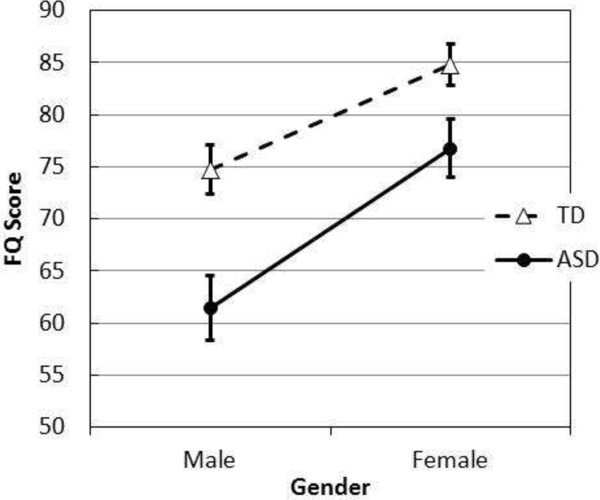
BACKGROUND: Four times as many males are diagnosed with high functioning autism compared to females. A growing body of research that focused on females with autism spectrum disorder (ASD) questions the assumption of gender invariance in ASD. Clinical observations suggest that females with ASD superficially demonstrate better social and emotional skills than males with ASD, which may camouflage other diagnostic features. This may explain the under-diagnosis of females with ASD. METHODS: We hypothesised that females with ASD would display better social skills than males with ASD on a test of friendship and social function. One hundred and one 10- to 16-year-olds (ASD females, n = 25; typically developing (TD) females, n = 25; ASD males, n = 25; TD males, n = 26) were interviewed (using the friendship questionnaire (FQ)) with high scores indicating the child has close, empathetic and supportive relationships. One parent of each child completed the FQ to assess whether there are differences in perception of friendships between parents and children. RESULTS: It was found that, independent of diagnosis, females demonstrated higher scores on the FQ than males. Further, regardless of gender, children with ASD demonstrated lower scores than TD children. Moreover, the effect of ASD was independent of gender. Interestingly, females with ASD and TD males displayed similar scores on the FQ. CONCLUSIONS: This finding is supported by clinical reports that females with ASD have more developed social skills than males with ASD. Further research is now required to examine the underlying causes for this phenomenon in order to develop gender-appropriate diagnostic criteria and interventions for ASD.
Overview
The claims and statistics of this paper haven’t been checked yet.
Free: it reads the open-access text and checks the first 5 claims that cite a source we can check. Create a free account to check every claim.
Integrity signals
Registry
Cites
Statistics
Figures
Verification
Claims the paper makes
The claims and statistics of this paper haven’t been checked yet.
Free: it reads the open-access text and checks the first 5 claims that cite a source we can check. Create a free account to check every claim.
Claims other papers make about this one
Each is checked against this paper’s own text: does it say what the citing paper says it does?
The cited source says what the claim attributes to it.
In the citing paper
“The Australian study with 25 male and 25 female adolescents with high-functioning ASD demonstrated that females with ASD showed similar social skills on a (self-report/parent-report) questionnaire of friendship and social function as typically developing males.”
From Barriers to Autism Spectrum Disorder Diagnosis for Young Women and Girls: a Systematic Review (2021) · cites this paper as Head et al. 2014
The cited source says what the claim attributes to it.
In the citing paper
“However, the study also reported that adolescents with ASD scored lower on the FQ compared to neurotypical adolescents, which is strongly supported by the literature, and study findings were consistent when using the FQ reported by adolescents compared to parent-report, providing further validation of this study’s findings.”
From Barriers to Autism Spectrum Disorder Diagnosis for Young Women and Girls: a Systematic Review (2021) · cites this paper as Head et al. 2014
The cited source says what the claim attributes to it.
In the citing paper
“in this small study, females with ASD showed similar social skills on a friendship and social function questionnaire as neurotypically developing males, demonstrating differences not only from neurotypically developing girls, but also from males with ASD.”
From Barriers to Autism Spectrum Disorder Diagnosis for Young Women and Girls: a Systematic Review (2021) · cites this paper as Head et al. 2014
The cited source says what the claim attributes to it.
In the citing paper
“the current evidence base appears to support suggestions that camouflaging is more associated with the experiences of autistic females and girls/ women, and may partially explain increased rates of missed or late diagnosis found amongst them”
From Camouflaging in autism: A systematic review (2021) · cites this paper as Head et al., 2014
In the citing paper
“Head et al. (2014)The authors compared autistic and non-autistic children's scores on a self-report measure of friendship quality, understanding, and empathy.Thus, this study did not report quantitative data measuring camouflaging.”
From Camouflaging in autism: A systematic review (2021) · cites this paper as Head et al. (2014)
Self-check
Percentages, sums and reported differences re-computed from the paper’s own numbers.
The self-check needs the paper’s full text.
Citations
Cites
Diagnostic and Statistical Manual of Mental Disorders
Williams, J. B. W., & First, M. (2013) · Encyclopedia of Social Work · doi:10.1093/acrefore/9780199975839.013.104 · Cited by 109,519
Tabachnick, B. G., & Fidell, L. S. (1983) · Cited by 80,054
Diagnostic and Statistical Manual of Mental Disorders.
Widiger, T. A. (2000) · Encyclopedia of Psychology, Vol. 3. · doi:10.1037/10518-009 · Cited by 19,744
Diagnostic and Statistical Manual of Mental Disorders, 5th Edition
(2013) · American Psychiatric Association Publishing eBooks · doi:10.1176/appi.books.9780890425596.893619 · Cited by 4,383
Discovering statistics using SPSS, 2nd ed.
Field, A. P. (2005) · Cited by 4,234
Global Prevalence of Autism and Other Pervasive Developmental Disorders
Elsabbagh, M., Divan, G., Koh, Y., Kim, Y. S., Kauchali, S., Marcín, C., Montiel‐Nava, C., Patel, V., Paula, C. S., Wang, C., et al. (2012) · Autism Research · doi:10.1002/aur.239 · Cited by 2,636 · cited 1×
“; licensee BioMed Central L Commons Attribution License (http://creativec reproduction in any medium, provided the or [5], whereas for those who are also profoundly intellectually disabled the ratio is closer to two males for each female [6].”
BackgroundRose, A. J., & Rudolph, K. D. (2006) · Psychological Bulletin · doi:10.1037/0033-2909.132.1.98 · Cited by 2,517 · cited 2×
“Intimate friendships among TD males are characterised by rough and tumble play, minimal close connection and a large group of like-minded friends, acquaintances, playmates or strangers [11,16-19].”
BackgroundUnderstanding Other Minds Perspectives From Developmental Cognitive Neuroscience
Baron‐Cohen, S., Tager-Flusberg, H. B., & Cohen, D. J. (2000) · Cited by 1,392
Childhood peer relationships: social acceptance, friendships, and peer networks
Gifford-Smith, M. E., & Brownell, C. A. (2003) · Journal of School Psychology · doi:10.1016/s0022-4405(03)00048-7 · Cited by 961
Mandy, W., Chilvers, R., Chowdhury, U., Salter, G., Seigal, A., & Skuse, D. (2012) · Journal of Autism and Developmental Disorders · doi:10.1007/s10803-011-1356-0 · Cited by 715 · cited 3×
“Currently, the literature in this area largely focuses on males with ASD, whereby females with ASD are represented by only a few participants in the sample or are excluded altogether [1].”
BackgroundResult
Research works printed but not linked: 2
- Hughes PJ Edmonds G, Beardon L Making friends is not easy Asperger Syndrome and Social Relationships: Adults Speak Out about Asperger Syndrome 2008 London: Jessica Kingsley Publishers 125 134
- Attwood T Garnett M Ford L Bulhak-Paterson D Girls and women with Asperger’s syndrome Hearts and Minds Conference: Girls and Women with Asperger’s Syndrome 2011 Victoria, Australia
Cited by
Items 301–400 of 402
Sex and autism share cell type-specific effects on cortical gene expressionPreprint
Dugan, G., DeCasien, A. R., Ghoddousi, R. A. M., Smith, R. L., Liu, S., Auluck, P. K., Marenco, S., Geschwind, D. H., Lerch, J. P., & Raznahan, A. (2026) · medRxiv · doi:10.64898/2026.10.28.26366315 · Cited by 1
McLeod, J. (2021) · doi:10.11575/prism/39237 · Cited by 1
Neurodevelopmental disorders and the journey to diagnosis: an exploration of adults' experiences
Evans, C. (2022) · Lancaster EPrints (Lancaster University) · doi:10.17635/lancaster/thesis/1658 · Cited by 1
Jack, A., Smith, J. V., McQuaid, G. A., Kenworthy, L. E., Khuu, A., Strang, J. F., Wallace, G. L., & Ratto, A. B. (2026) · medRxiv · doi:10.64898/2026.06.01.26354604 · Cited by 1
Barry, E. N. (2019) · Scholars Commons (Wilfrid Laurier University) · Cited by 1
Hughes, T. (2023) · UCL Discovery (University College London) · Cited by 1
Foggo, R. V. (2023) · Research Online (University of Wollongong) · Cited by 1
Russo, I. (2024) · UCL Discovery (University College London) · Cited by 1
Mann-Willett, F. L. (2019) · University of Birmingham Institutional Research Archive (University of Birmingham) · Cited by 1
Oral health practices and challenges facing parents of autistic children in the Western Cape
Omer, R. (2022) · University of the Western Cape Electronic Theses and Dissertations Repository (University of the Western Cape) · Cited by 1
Melal, S. (2018) · HAL · Cited by 1
Maurer, C. (2018) · theses.fr (ABES) · doi:10.70675/cc36d7a0z420ez4ea7zb3f3z1197b60ffbd4
Loneliness and Social Connection in Autistic and/or ADHD Males: A Scoping Review
Lear, J. T., Dorstyn, D., Opozda, M. J., & Zajac, I. T. (2026) · Review Journal of Autism and Developmental Disorders · doi:10.1007/s40489-026-00542-4
Saure, E. (2018)
Altérations sexe-dépendantes de la nociception dans un modèle d’autisme induit par le valproate
Glaunec, L. R. (2023) · theses.fr (ABES) · doi:10.70675/3d445796ze7caz426ezaafaza54d2130e2a3
Trastorno del Espectro Autista en Anorexia Nerviosa: Invisibles frente al espejo
Marco, G. G. (2020) · Revista de Psicoterapia · doi:10.33898/rdp.v31i115.356
Karaminis, T. N., Gabrielatos, C., Maden-Weinberger, U., & Beattie, G. W. (2024) · OSF Preprints (OSF Preprints) · doi:10.31219/osf.io/7udnr
Martínez-Ramírez, M., Gisbert, L., Setién-Ramos, I., Bonnín, C. D. M., Martínez‐Arán, A., Vieta, E., Magán‐Maganto, M., Ramos‐Quiroga, J. A., & Lugo‐Marín, J. (2026) · European Neuropsychopharmacology · doi:10.1016/j.euroneuro.2026.112887
Social camouflaging and mental health in adolescence: differences by sex and diagnosis
Bernardin, C. J. (2021) · MOspace Institutional Repository (University of Missouri) · doi:10.32469/10355/90961
Tawankanjanachot, N., Truesdale, M., Orachon, P., & Kidd, L. (2024) · Figshare · doi:10.6084/m9.figshare.24934679
Tawankanjanachot, N., Truesdale, M., Orachon, P., & Kidd, L. (2024) · Figshare · doi:10.6084/m9.figshare.24934436
Anorexia Nervosa and Comorbidities: Linking Autism
Parmeggiani, A., & Pruccoli, J. (2022) · Springer eBooks · doi:10.1007/978-3-030-67929-3_36-1
Anorexia Nervosa and Comorbidities: Linking Autism
Parmeggiani, A., & Pruccoli, J. (2023) · Springer eBooks · doi:10.1007/978-3-031-16691-4_36
Gabrielsen, T. P., Begay, K. K., Campbell, K. M., Hahn, K., & Harrington, L. T. (2023) · Springer eBooks · doi:10.1007/978-3-031-33969-1_5
Mattern, H., Cola, M., Tena, K. G., Knox, A., Russell, A., Pelella, M. R., Hauptmann, A., Covello, M., Parish‐Morris, J., & McCleery, J. P. (2023) · Figshare · doi:10.6084/m9.figshare.22621775
Gao, S., Liao, J., Li, R., & Yanjie, S. U. (2026) · Research Square · doi:10.21203/rs.3.rs-10903525/v1
Lahiri, R., Kim, S. H., Bishop, S., Lord, C., Tager-Flusberg, H. B., & Narayanan, S. (2026) · Computer Speech & Language · doi:10.1016/j.csl.2026.101993
Özbaran, N. B., Şener, Z. İ., Sarı, S., & Şahin, G. K. (2026) · Frontiers in Child and Adolescent Psychiatry · doi:10.3389/frcha.2026.1910194
Rousan, M. J., McGonigle, T., Muscatello, R. A., Vandekar, S., & Corbett, B. A. (2026) · Journal of Autism and Developmental Disorders · doi:10.1007/s10803-026-07588-7
Dificuldades no diagnóstico de Transtorno do Espectro Autista no sexo feminino
Schüür, A. P., Beiral, B. U., Gaievski, R. S., Grigio, J., de Souza, A. G., Carmanhães, G. F., & Oliveira, L. (2024) · Brazilian Journal of Health Review · doi:10.34119/bjhrv7n4-369
Impact of camouflaging on females with autism
Janicki-Menzie, C. (2021) · Scholars Archive - University at Albany (University at Albany, State University of New York) · doi:10.54014/h8g5-3ph0
CAMOUFLAGING AND AUTISM SPECTRUM DISORDER: SYSTEMATIC REVIEW
Bukva, A., & Zecevic, D. (2023) · Multidisciplinarni Pristupi u Edukaciji i Rehabilitaciji · doi:10.59519/mper5007
Cognition and Neuropsychological Profiles
Siracusano, M., Arturi, L., Riccioni, A., & Mazzone, L. (2024) · Springer eBooks · doi:10.1007/978-3-031-62072-0_3
Samoilis, G., & Lewis, C. (2026) · Neurodiversity · doi:10.1177/27546330261490701
Wood‐Downie, H. (2019) · ePrints Soton (University of Southampton)
Aspectos comportamentais e neuroquímicos do modelo de autismo induzido por ácido valpróico em ratas
Manes, M. (2023) · Digital Library of Theses and Dissertations (Universidade de São Paulo) · doi:10.11606/t.10.2023.tde-16052023-163046
Huerta, M. (2020) · Springer eBooks · doi:10.1007/978-1-4614-6435-8_909-3
Huerta, M. (2021) · Springer eBooks · doi:10.1007/978-3-319-91280-6_909
Młynarczyk-Karabin, E., Wilim, M., & Bodziony, J. (2025) · Man – Disability – Society · doi:10.71358/cns.2786
HIDING IN PLAIN SIGHT: AN ANALYSIS OF THE ‘FEMALE CAMOUFLAGE EFFECT’ IN YOUNG AUTISTIC FEMALES
Goldblum, J. (2021) · Carolina Digital Repository (University of North Carolina at Chapel Hill) · doi:10.17615/dwjn-5933
Social Motivation and Friendship Experiences of Autistic Adolescents
Sedgewick, F., & Pellicano, E. (2020) · Springer eBooks · doi:10.1007/978-1-4614-6435-8_102396-1
Social Motivation and Friendship Experiences of Autistic Adolescents
Sedgewick, F., & Pellicano, E. (2021) · Springer eBooks · doi:10.1007/978-3-319-91280-6_102396
Interpreting Female Social Relationships: Autism Friendships and Pragmatic Language
Gabrielsen, T. P., Begay, K. K., Campbell, K. M., Hahn, K., & Harrington, L. T. (2023) · Springer eBooks · doi:10.1007/978-3-031-33969-1_6
Wala, M. (2026) · Edukacyjna Analiza Transakcyjna · doi:10.16926/eat.2026.15.16.pl
Wala, M. (2026) · Edukacyjna Analiza Transakcyjna · doi:10.16926/eat.2026.15.16.en
Transtorno do espectro autista: relato de caso feminino
Leal, S. S. R., Romano, P. V. N., Bini, J. A. P., Juda, L. H. B., & da Silva, M. F. P. T. B. (2022) · Brazilian Journal of Health Review · doi:10.34119/bjhrv5n5-308
Αξιολόγηση κοινωνικών δεξιοτήτων σε μαθητές με Διαταραχή Αυτιστικού Φάσματος
Papaefstathiou, E., & Συριοπούλου-Δελλή, Χ. (2016) · Πανελλήνιο Συνέδριο Επιστημών Εκπαίδευσης · doi:10.12681/edusc.500
Fourneret, P., Mottolese, R., Gauld, C., Clément, A., Dubreucq, M., Savelon, S. V., & Dubreucq, J. (2023) · Périnatalité · doi:10.3166/rmp-2022-0192
Jezierski, M. J. (2024) · Annales Universitatis Paedagogicae Cracoviensis Studia de Cultura · doi:10.24917/20837275.16.4.4
Investigating autistic traits, sensory experiences and personality: a mixed methods approach
Venugopalan, P. (2019) · University of Southern Queensland research data collection · doi:10.26192/nkt9-5t46
Mapes, A. R. (2018) · Journal of the Arkansas Academy of Science
Rosiecka, E. (2023) · Aston Publications Explorer (Aston University) · doi:10.48780/publications.aston.ac.uk.00047173
Ward, M. (2017) · Mspace (University of Manitoba)
Exploring the Experiences of Autistic Graduate Women in Navigating the World of Work
Gleeson, C. (2024) · Trinity's Access to Research Output (TARA) (Trinity College Dublin)
Unmet Medical Home Needs and Educational Services Access in Children with Autism Spectrum Disorder
Rizk, S. (2020) · UWM Digital Commons (University of Wisconsin–Milwaukee)
Gender Differences of Internalizing and Externalizing Behaviors in Autistic Children and Adolescents
Mohite, D. (2023) · Carolina Digital Repository (University of North Carolina at Chapel Hill) · doi:10.17615/fvwt-2011
Kamuflering hos personer med autismespekterforstyrrelse – En systematisk litteraturgjennomgang
Lehre, E. E. (2021) · Duo Research Archive (University of Oslo)
Waizbard‐Bartov, E. (2023) · eScholarship (California Digital Library)
Adejayan, J. (2026) · Open Access at Essex (University of Essex) · doi:10.5526/err-00043110
Pedregal, C. R. (2026) · Goldsmiths (University of London) · doi:10.25602/gold.00040786
Architecture génétique des troubles du spectre autistique dans les îles Féroé
Carton-Buonafine, C. (2018) · theses.fr (ABES) · doi:10.70675/dbe8347ez7174z46b8z977cz5e2d1e28fb19
Hamilton, K. (2020) · Open University of Cape Town (University of Cape Town)
Associative learning deficiencies underlying aberrant feeding in the valproate rat model of autism
Lawson, K. (2025) · Research Commons (University of Waikato)
"We are Living in a World not Meant for Us": A Study About Why Girls Are Not Allowed to be Autistic
French, S. (2025) · ANU Open Research (Australian National University) · doi:10.25911/gkkw-kj90
Support model for the university student with high-functioning autism in the academic process
Uran, M. (2026) · Repository of the University of Ljubljana (University of Ljubljana)
Mazzotta, L. (2024) · Open Research Exeter (University of Exeter)
Boyle, F. (2026) · Research Portal (Queen's University Belfast) · doi:10.17034/32631594
Experiences of camouflaging by AFAB University students with ADHD in South Africa
Prinsloo, E. (2025) · Open University of Cape Town (University of Cape Town)
Goldblum, J. (2023) · Carolina Digital Repository (University of North Carolina at Chapel Hill) · doi:10.17615/mcr8-ea83
Le trouble du spectre de l’autisme au féminin : les facteurs pouvant contribuer au sous-diagnostic
Auger, C. (2025) · Le dépôt institutionnel (Université du Québec à Trois-Rivières)
Les obstacles au diagnostic du trouble du spectre de l’autisme (TSA) chez les femmes
Bournival, A. (2025) · Le dépôt institutionnel (Université du Québec à Trois-Rivières)
Liu, M.-J., Ni, H., Ma, L.-Y., Liu, T.-L., Chen, Y., Hsu, Y.-Y., & Yen, C. (2026) · Journal of the Formosan Medical Association · doi:10.1016/j.jfma.2026.10.044
Autism and well-being: Masking in autistic girls and the role of animal contact in well-being.
Norman, A. S. (2025) · ePrints Soton (University of Southampton)
Disclosure of a diagnosis of childhood autism and parents' acceptance of the disability
Παπαβασιλείου, Ι. Β., & Παπαβασιλείου, Ι. Β. (2024) · University of Thessaly Institutional Repository (University of Thessaly) · doi:10.26253/heal.uth.41727
Exploring Educational Transition Experiences and Strengths in Autistic Women
Barker, R. (2024) · White Rose eTheses Online (University of Leeds, The University of Sheffield, University of York)
Axelsson, L., & Månsson, J. (2024) · DiVA at Umeå University (Umeå University)
Asperger's Syndrome: a proposal for the improvement of social skills in Early Childhood Education
Domínguez, U. M. (2023) · Hispana
The Role of TrkB and BDNF Signaling Pathways in Autism Spectrum Disorder: Insights from Mouse Models
Abdollahi, M. (2024) · MacSphere (McMaster University) · doi:10.71548/23472
Spatial frequency processing in autism spectrum disorder
Kamensek, T. (2018) · cIRcle (University of British Columbia) · doi:10.14288/1.0368921
Heselmann, T. (2026) · SerWisS (Hochschule Hannover) · doi:10.25968/opus-3931
Muggleton, J. (2017) · ERA
Segilola, B. T., & Yara, P. O. (2026) · Zenodo (CERN European Organization for Nuclear Research) · doi:10.5281/zenodo.20290540
Pantouli, F. (2017) · City Research Online (City University London)
Using mice as a model organism for the study of communication and social behavior
Warren, M. R. (2020) · Library, Museums and Press - UDSpace (University of Delaware) · doi:10.58088/ma90-kj04
Autism and the Autism Spectrum
Volkmar, F. R., Reichow, B., WESTPHAL, A., Macari, S. L., & Øien, R. A. (2026) · Wiley eBooks · doi:10.1002/9781394389933.ch1
Harvey, S. (2025) · Research Commons (University of Waikato)
Esiste uno specifico fenotipo femminile dell'autismo in età prescolare?
GALATOLO, M. (2017) · Electronic Theses and Dissertations Repository (University of Pisa)
Bogdan, R., Kayumova, R., Schwarting, R. K. W., Wöhr, M., & Kisko, T. M. (2023) · doi:10.3389/fnbeh.2023.1190272.s001
Bailey, N. C. (2016) · Open University of Cape Town (University of Cape Town)
Chua, Y. W. (2017) · Universiti Putra Malaysia Institutional Repository (Universiti Putra Malaysia)
Verstrat, A. (2018) · Carolina Digital Repository (University of North Carolina at Chapel Hill) · doi:10.17615/nj0e-1a28
Behavioral and neurochemical aspects of the model of autism induced by valproic acid in rats
Manes, M. (2023) · LA Referencia (Red Federada de Repositorios Institucionales de Publicaciones Científicas)
Waite, M. (2024) · Summit (Simon Fraser University) · doi:10.13140/rg.2.2.23365.26081
Diferències de gènere en el TEA
Altés Fernández, M. (2022) · Rovira & Virgili repository
Ferreira, L. F. A., Marques, L. D. N., Salustiano, P., de Souza, E. C., Benevides, S. B., Soares, A. G. B., Maselli, J. F. C., L.-Fernandez, J., Murray, C., & Anunciação, L. (2025) · Cadernos de Psicologia · doi:10.9788/cp2025.1-06
Sanrey, C. (2026) · British Journal of Social Psychology · doi:10.1111/bjso.70154
Metadata
- Authors
- Head, A. M., McGillivray, J. A., & Stokes, M. A.
- Affiliations
- Deakin University (AU)
- Corresponding author
- McGillivray, Jane A
- Venue
- Molecular Autism
- Published
- 2014-02-28
- Volume
- 5
- Issue
- 1
- Pages
- 19-19
- ISSN
- 2040-2392 (ISSN-L)
- PMC
- PMC3945617
- OpenAlex
- W2107817359
- Cited by
- 315
- References
- 60
- Citations by year
- 2026: 21 · 2025: 17 · 2024: 33 · 2023: 39 · 2022: 26 · 2021: 36 · 2020: 34 · 2019: 23 · 2018: 27 · 2017: 22 · 2016: 19 · 2015: 12 · 2014: 4
- FWCI
- 10.51
- Type
- journal article
- Language
- en
- Open access
- gold
- doi.org
- Licence
- cc-by
- Locations
- Molecular Autism (publishedVersion, cc-by)
- Europe PMC (PubMed Central) (publishedVersion, cc-by)
- PubMed Central (publishedVersion, cc-by)
- PubMed (publishedVersion)
- Topics
- Life Sciences › Neuroscience › Cognitive Neuroscience › Autism Spectrum Disorder Research
- Health Sciences › Medicine › Psychiatry and Mental health › Child Nutrition and Feeding Issues
- Life Sciences › Biochemistry, Genetics and Molecular Biology › Genetics › Genetics and Neurodevelopmental Disorders
- Keywords
- autism spectrum disorder, gender differences, social skills, friendship, emotionality, underdiagnosis, parent-child perceptions, high-functioning autism
About these checks
Registry, retraction, Cites and statistics results are computed, not judged, with one exception: a printed reference that no index lists is read once by a model before it counts as a citation error. Claims are extracted by a model and kept only when their quote appears verbatim in the text; each cited source is then checked, with a model’s help, for whether it says what the claim relies on. Those verdicts can be wrong — read the claim’s quote and the cited source before relying on one.
Statistics and arithmetic are recomputed, not judged.
Confidence bands are shown only for fields calibrated on our annotated test set. None is calibrated yet, so no band is shown.
What counts as a claim ›How we measure confidence ›How we check this ›
Are you an author, or do you see a problem with this page? Request a review
Data sources
Bibliographic data: Semantic Scholar, OpenAlex, Crossref.
Contains information from the Semantic Scholar Academic Graph Datasets, made available under the ODC Attribution License (ODC-BY 1.0).
Semantic Scholar’s data is described in: Kinney, R., et al. (2023). The Semantic Scholar Open Data Platform. arXiv:2301.10140.
