

Gender differences in emotionality and sociability in children with autism spectrum disorders
Open accessThe DOI matches its Crossref record; 61 of the 61 references it cites were found in a registry or an index.
Abstract
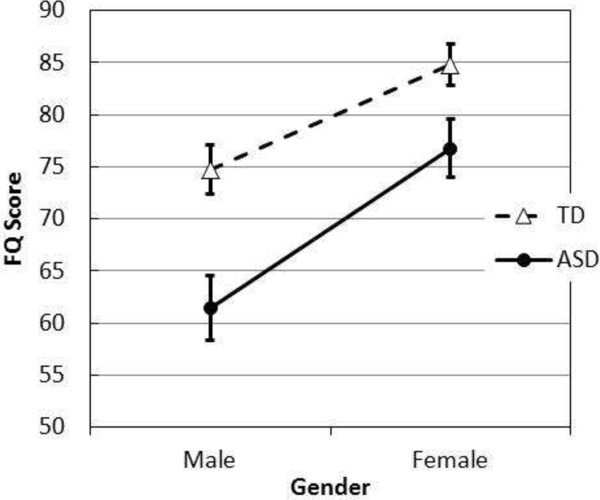
BACKGROUND: Four times as many males are diagnosed with high functioning autism compared to females. A growing body of research that focused on females with autism spectrum disorder (ASD) questions the assumption of gender invariance in ASD. Clinical observations suggest that females with ASD superficially demonstrate better social and emotional skills than males with ASD, which may camouflage other diagnostic features. This may explain the under-diagnosis of females with ASD. METHODS: We hypothesised that females with ASD would display better social skills than males with ASD on a test of friendship and social function. One hundred and one 10- to 16-year-olds (ASD females, n = 25; typically developing (TD) females, n = 25; ASD males, n = 25; TD males, n = 26) were interviewed (using the friendship questionnaire (FQ)) with high scores indicating the child has close, empathetic and supportive relationships. One parent of each child completed the FQ to assess whether there are differences in perception of friendships between parents and children. RESULTS: It was found that, independent of diagnosis, females demonstrated higher scores on the FQ than males. Further, regardless of gender, children with ASD demonstrated lower scores than TD children. Moreover, the effect of ASD was independent of gender. Interestingly, females with ASD and TD males displayed similar scores on the FQ. CONCLUSIONS: This finding is supported by clinical reports that females with ASD have more developed social skills than males with ASD. Further research is now required to examine the underlying causes for this phenomenon in order to develop gender-appropriate diagnostic criteria and interventions for ASD.
Overview
The claims and statistics of this paper haven’t been checked yet.
Free: it reads the open-access text and checks the first 5 claims that cite a source we can check. Create a free account to check every claim.
Integrity signals
Registry
Cites
Statistics
Figures
Verification
Claims the paper makes
The claims and statistics of this paper haven’t been checked yet.
Free: it reads the open-access text and checks the first 5 claims that cite a source we can check. Create a free account to check every claim.
Claims other papers make about this one
Each is checked against this paper’s own text: does it say what the citing paper says it does?
The cited source says what the claim attributes to it.
In the citing paper
“The Australian study with 25 male and 25 female adolescents with high-functioning ASD demonstrated that females with ASD showed similar social skills on a (self-report/parent-report) questionnaire of friendship and social function as typically developing males.”
From Barriers to Autism Spectrum Disorder Diagnosis for Young Women and Girls: a Systematic Review (2021) · cites this paper as Head et al. 2014
The cited source says what the claim attributes to it.
In the citing paper
“However, the study also reported that adolescents with ASD scored lower on the FQ compared to neurotypical adolescents, which is strongly supported by the literature, and study findings were consistent when using the FQ reported by adolescents compared to parent-report, providing further validation of this study’s findings.”
From Barriers to Autism Spectrum Disorder Diagnosis for Young Women and Girls: a Systematic Review (2021) · cites this paper as Head et al. 2014
The cited source says what the claim attributes to it.
In the citing paper
“in this small study, females with ASD showed similar social skills on a friendship and social function questionnaire as neurotypically developing males, demonstrating differences not only from neurotypically developing girls, but also from males with ASD.”
From Barriers to Autism Spectrum Disorder Diagnosis for Young Women and Girls: a Systematic Review (2021) · cites this paper as Head et al. 2014
The cited source says what the claim attributes to it.
In the citing paper
“the current evidence base appears to support suggestions that camouflaging is more associated with the experiences of autistic females and girls/ women, and may partially explain increased rates of missed or late diagnosis found amongst them”
From Camouflaging in autism: A systematic review (2021) · cites this paper as Head et al., 2014
In the citing paper
“Head et al. (2014)The authors compared autistic and non-autistic children's scores on a self-report measure of friendship quality, understanding, and empathy.Thus, this study did not report quantitative data measuring camouflaging.”
From Camouflaging in autism: A systematic review (2021) · cites this paper as Head et al. (2014)
Self-check
Percentages, sums and reported differences re-computed from the paper’s own numbers.
The self-check needs the paper’s full text.
Citations
Cites
Diagnostic and Statistical Manual of Mental Disorders
Williams, J. B. W., & First, M. (2013) · Encyclopedia of Social Work · doi:10.1093/acrefore/9780199975839.013.104 · Cited by 109,519
Tabachnick, B. G., & Fidell, L. S. (1983) · Cited by 80,058
Diagnostic and Statistical Manual of Mental Disorders.
Widiger, T. A. (2000) · Encyclopedia of Psychology, Vol. 3. · doi:10.1037/10518-009 · Cited by 19,744
Diagnostic and Statistical Manual of Mental Disorders, 5th Edition
(2013) · American Psychiatric Association Publishing eBooks · doi:10.1176/appi.books.9780890425596.893619 · Cited by 4,383
Discovering statistics using SPSS, 2nd ed.
Field, A. P. (2005) · Cited by 4,234
Global Prevalence of Autism and Other Pervasive Developmental Disorders
Elsabbagh, M., Divan, G., Koh, Y., Kim, Y. S., Kauchali, S., Marcín, C., Montiel‐Nava, C., Patel, V., Paula, C. S., Wang, C., et al. (2012) · Autism Research · doi:10.1002/aur.239 · Cited by 2,636 · cited 1×
“; licensee BioMed Central L Commons Attribution License (http://creativec reproduction in any medium, provided the or [5], whereas for those who are also profoundly intellectually disabled the ratio is closer to two males for each female [6].”
BackgroundRose, A. J., & Rudolph, K. D. (2006) · Psychological Bulletin · doi:10.1037/0033-2909.132.1.98 · Cited by 2,517 · cited 2×
“Intimate friendships among TD males are characterised by rough and tumble play, minimal close connection and a large group of like-minded friends, acquaintances, playmates or strangers [11,16-19].”
BackgroundUnderstanding Other Minds Perspectives From Developmental Cognitive Neuroscience
Baron‐Cohen, S., Tager-Flusberg, H. B., & Cohen, D. J. (2000) · Cited by 1,392
Childhood peer relationships: social acceptance, friendships, and peer networks
Gifford-Smith, M. E., & Brownell, C. A. (2003) · Journal of School Psychology · doi:10.1016/s0022-4405(03)00048-7 · Cited by 961
Mandy, W., Chilvers, R., Chowdhury, U., Salter, G., Seigal, A., & Skuse, D. (2012) · Journal of Autism and Developmental Disorders · doi:10.1007/s10803-011-1356-0 · Cited by 715 · cited 3×
“Currently, the literature in this area largely focuses on males with ASD, whereby females with ASD are represented by only a few participants in the sample or are excluded altogether [1].”
BackgroundResultA behavioral comparison of male and female adults with high functioning autism spectrum conditions
Lai, M.-C., Lombardo, M. V., Pasco, G., Ruigrok, A. N. V., Wheelwright, S. J., Sadek, S. A., Chakrabarti, B., MRC AIMS Consortium, & Baron-Cohen, S. (2011) · PLoS ONE · doi:10.1371/journal.pone.0020835 · Cited by 650 · cited 12×
“They assessed 27 TD adult males and 49 TD adult females, and compared these to 51 adult males and 17 adult females diagnosed with ASD on the friendship questionnaire (FQ) [40].”
MethodResultInfluentialDworzynski, K., Ronald, A., Bolton, P., & Happé, F. (2012) · Journal of the American Academy of Child & Adolescent Psychiatry · doi:10.1016/j.jaac.2012.05.018 · Cited by 633 · cited 4×
“; licensee BioMed Central L Commons Attribution License (http://creativec reproduction in any medium, provided the or [5], whereas for those who are also profoundly intellectually disabled the ratio is closer to two males for each female [6].”
BackgroundMethodResultInfluentialThe Complete Guide to Asperger’s Syndrome
McKenzie, K. (2007) · Learning Disability Practice · doi:10.7748/ldp.10.2.26.s17 · Cited by 571
Involvement or isolation? The social networks of children with autism in regular classrooms
Chamberlain, B., Kasari, C., & Rotheram-Fuller, E. (2007) · Journal of Autism and Developmental Disorders · doi:10.1007/s10803-006-0164-4 · Cited by 550
Van Wijngaarden-Cremers, P. J. M., van Eeten, E., Groen, W. B., Van Deurzen, P. A., Oosterling, I. J., & Van der Gaag, R. J. (2014) · Journal of Autism and Developmental Disorders · doi:10.1007/s10803-013-1913-9 · Cited by 547 · cited 2×
“Within this limited literature, it has been suggested that, in order for females to be diagnosed with ASD, they will generally be more impaired than males and frequently have an accompanying intellectual disability [1,3,4].”
BackgroundResultSocial Networks and Friendships at School: Comparing Children With and Without ASD
Kasari, C., Locke, J., Gulsrud, A., & Rotheram-Fuller, E. (2011) · Journal of Autism and Developmental Disorders · doi:10.1007/s10803-010-1076-x · Cited by 486
A Review of the Role of Female Gender in Autism Spectrum Disorders
Kirkovski, M., Enticott, P. G., & Fitzgerald, P. B. (2013) · Journal of Autism and Developmental Disorders · doi:10.1007/s10803-013-1811-1 · Cited by 389
Friendship stability and change in childhood and adolescence
Poulin, F., & Chan, A. (2010) · Developmental Review · doi:10.1016/j.dr.2009.01.001 · Cited by 381
Macevičiūtė, E. (2006) · Information Research · Cited by 366
The Complete Guide to Asperger’s Syndrome
Attwood, T. (2007) · Jessica Kingsley Publishers eBooks · doi:10.5040/9781805014300 · Cited by 357
Language, social, and cognitive impairments in autism and severe mental retardation
Wing, L. (1981) · Journal of Autism and Developmental Disorders · doi:10.1007/bf01531339 · Cited by 351
Sex ratios in early childhood autism and related conditions
Wing, L. (1981) · Psychiatry Research · doi:10.1016/0165-1781(81)90043-3 · Cited by 343
Sex Differences in Children's Friendships
Eder, D., & Hallinan, M. T. (1978) · American Sociological Review · doi:10.2307/2094701 · Cited by 334
Lord, C., Schopler, E., & Revicki, D. (1982) · Journal of Autism and Developmental Disorders · doi:10.1007/bf01538320 · Cited by 303 · cited 2×
“Due to this limitation in the literature, it may be more useful to utilise clinical accounts of the different presentations of females and males with ASD to better understand how these two groups develop and maintain friendships [35-38].”
BackgroundResultUnderstanding Others, and Individual Differences in Friendship Interactions in Young Children
Dunn, J., & Cutting, A. L. (1999) · Social Development · doi:10.1111/1467-9507.00091 · Cited by 302
The Complete Guide to Asperger's Syndrome
Powis, S. (2008) · Tizard Learning Disability Review · doi:10.1108/13595474200800006 · Cited by 289
Children's friendships: the beginnings of intimacy
(2005) · Choice Reviews Online · doi:10.5860/choice.42-6794 · Cited by 276
Vaquera, E., & Kao, G. (2008) · Social Science Research · doi:10.1016/j.ssresearch.2006.11.002 · Cited by 273
Social and Language Skills in Adolescent Boys with Asperger Syndrome
Koning, C., & Magill-Evans, J. (2001) · Autism · doi:10.1177/1362361301005001003 · Cited by 268
Sex Differences in Toddlers with Autism Spectrum Disorders
Carter, A. S., Black, D. O., Tewani, S., Connolly, C. E., Kadlec, M. B., & Tager-Flusberg, H. (2007) · Journal of Autism and Developmental Disorders · doi:10.1007/s10803-006-0331-7 · Cited by 262
Review of gender differences in core symptomatology in autism spectrum disorders
Rivet, T. T., & Matson, J. L. (2011) · Research in Autism Spectrum Disorders · doi:10.1016/j.rasd.2010.12.003 · Cited by 258 · cited 2×
“Furthermore, gender has been shown to impact greatly on many major aspects of development; for instance, through childhood, males demonstrate superior motor skills while female children demonstrate more advanced interpersonal and emotional skills [8].”
BackgroundBaron-Cohen, S., & Wheelwright, S. (2003) · Journal of Autism and Developmental Disorders · doi:10.1023/a:1025879411971 · Cited by 251 · cited 9×
“As to why Baron-Cohen and Wheelwright did not find a similar result to that reported here, it is highly likely that Baron-Cohen and Wheelwright’s within-group variability was dramatically increased by the wide age ranges they used (14 to 64 years) which, in turn, would be more likely to mathematically overwhelm the be…”
BackgroundResultInfluentialStrategies for Improving the Social Integration of Children with Asperger Syndrome
Attwood, T. (2000) · Autism · doi:10.1177/1362361300004001006 · Cited by 229
Friendship and Internalizing Symptoms Among Children and Adolescents with ASD
Mazurek, M. O., & Kanne, S. M. (2010) · Journal of Autism and Developmental Disorders · doi:10.1007/s10803-010-1014-y · Cited by 217
Kopp, S., & Gillberg, C. (1992) · European Child & Adolescent Psychiatry · doi:10.1007/bf02091791 · Cited by 193
Friendship in High-functioning Children with Autism Spectrum Disorder: Mixed and Non-mixed Dyads
Bauminger, N., Solomon, M., Aviezer, A., Heung, K., Brown, J. L., & Rogers, S. J. (2007) · Journal of Autism and Developmental Disorders · doi:10.1007/s10803-007-0501-2 · Cited by 188
Understanding other minds: Perspectives from developmental cognitive neuroscience, 2nd ed.
Baron‐Cohen, S., Tager-Flusberg, H. B., & Cohen, D. J. (2000) · Cited by 182
Bauminger, N., & Shulman, C. (2003) · Autism · doi:10.1177/1362361303007001007 · Cited by 167
Developmental changes and gender differences in adolescents' perceptions of friendships
De Goede, I. H. A., Branje, S. J. T., & Meeus, W. H. J. (2009) · Journal of Adolescence · doi:10.1016/j.adolescence.2009.03.002 · Cited by 166 · cited 2×
“They tend to have two or three close friends as well as a wider group of friends with whom they regularly interact [16,20-23].”
BackgroundAdolescents With Asperger Syndrome and Perceptions of Friendship
Carrington, S., Templeton, E., & Papinczak, T. (2003) · Focus on Autism and Other Developmental Disabilities · doi:10.1177/10883576030180040201 · Cited by 164
(2006) · Monographs of the Society for Research in Child Development · doi:10.1111/j.1540-5834.2006.00387.x · Cited by 122
What Boys With an Autism Spectrum Disorder Say About Establishing and Maintaining Friendships
Daniel, L. S., & Billingsley, B. S. (2010) · Focus on Autism and Other Developmental Disabilities · doi:10.1177/1088357610378290 · Cited by 119
Predicting Friendship Quality in Autism Spectrum Disorders and Typical Development
Bauminger, N., Solomon, M., & Rogers, S. J. (2010) · Journal of Autism and Developmental Disorders · doi:10.1007/s10803-009-0928-8 · Cited by 118
Mind-reading, emotion understanding, and relationships
Dunn, J. (2000) · International Journal of Behavioral Development · doi:10.1080/016502500383241 · Cited by 116
Voos, A. C., Pelphrey, K. A., Tirrell, J., Bolling, D. Z., Wyk, B. V., Kaiser, M. D., McPartland, J. C., Volkmar, F. R., & Ventola, P. (2013) · Journal of Autism and Developmental Disorders · doi:10.1007/s10803-012-1683-9 · Cited by 115
Dunn, J., Cutting, A. L., & Demetriou, H. (2000) · British Journal of Developmental Psychology · doi:10.1348/026151000165625 · Cited by 110
Toward specifying pervasive developmental disorder-not otherwise specified
Mandy, W., Charman, T., Gilmour, J., & Skuse, D. (2011) · Autism Research · doi:10.1002/aur.178 · Cited by 103 · cited 1×
“It is currently estimated that four males are diagnosed with ASD for every one female [53], leading to the natural conclusion that ASD is rarely identified in females [53].”
BackgroundCook, B. G., & Semmel, M. I. (1999) · The Journal of Special Education · doi:10.1177/002246699903300105 · Cited by 102
Gender‐Differentiated Experience in the Peer Culture: Links to Intimacy in Preadolescence
Zarbatany, L., McDougall, P., & Hymel, S. (2000) · Social Development · doi:10.1111/1467-9507.00111 · Cited by 99
Gender Bias, Female Resilience, and the Sex Ratio in Autism
Constantino, J. N., & Charman, T. (2012) · Journal of the American Academy of Child & Adolescent Psychiatry · doi:10.1016/j.jaac.2012.05.017 · Cited by 92 · cited 1×
“Among high functioning males and females, there is a common belief that males and females do not differ behaviourally, emotionally or intellectually [7].”
BackgroundGender at Play: Fourth-Grade Girls and Boys on the Playground
Boyle, D. E., Marshall, N. L., & Robeson, W. W. (2003) · American Behavioral Scientist · doi:10.1177/0002764203046010004 · Cited by 88
Friendships in Early Childhood, and Social Understanding
Maguire, M. C., & Dunn, J. (1997) · International Journal of Behavioral Development · doi:10.1080/016502597384613 · Cited by 61
Baines, E., & Blatchford, P. (2009) · British Journal of Developmental Psychology · doi:10.1348/026151008x371114 · Cited by 51
Gender effects on challenging behaviors in children with autism spectrum disorders
Kozlowski, A. M., Matson, J. L., & Rieske, R. D. (2012) · Research in Autism · doi:10.1016/j.rasd.2011.12.011 · Cited by 48
Practising gender: Children's relationships and the development of gendered behaviour and beliefs
Leman, P. J., & Tenenbaum, H. R. (2011) · British Journal of Developmental Psychology · doi:10.1111/j.2044-835x.2011.02032.x · Cited by 34
Tan, M., Reich, J., Hart, L. A., Thuma, P. E., & Grigorenko, E. L. (2011) · Journal of Autism and Developmental Disorders · doi:10.1007/s10803-011-1285-y · Cited by 34
Underwood, M. K. (2007) · Merrill-palmer Quarterly · doi:10.1353/mpq.2007.0022 · Cited by 30
Asperger syndrome and social relationships : adults speak out about Asperger syndrome
Edmonds, G., & Beardon, L. (2008) · Medical Entomology and Zoology · Cited by 18
Dynamics of Adolescent Friendships: The Interplay between Structure and Gender
Ko, P., & Buskens, V. (2011) · IEEE/ACM International Conference on Advances in Social Networks Analysis and Mining (ASONAM) · doi:10.1109/asonam.2011.30 · Cited by 9
Ting, I.-H., Alhajj, R., Karampelas, P., & Day, M.-Y. (2025) · Lecture notes in social networks · doi:10.1007/978-3-031-85386-9 · Cited by 5
(2006) · Allyn & Bacon, Inc. eBooks
Research works printed but not linked: 2
- Hughes PJ Edmonds G, Beardon L Making friends is not easy Asperger Syndrome and Social Relationships: Adults Speak Out about Asperger Syndrome 2008 London: Jessica Kingsley Publishers 125 134
- Attwood T Garnett M Ford L Bulhak-Paterson D Girls and women with Asperger’s syndrome Hearts and Minds Conference: Girls and Women with Asperger’s Syndrome 2011 Victoria, Australia
Cited by
Sex/Gender Differences and Autism: Setting the Scene for Future Research
Lai, M.-C., Lombardo, M. V., Auyeung, B., Chakrabarti, B., & Baron-Cohen, S. (2015) · Journal of the American Academy of Child & Adolescent Psychiatry · doi:10.1016/j.jaac.2014.10.003 · Cited by 1,120
Bargiela, S., Steward, R., & Mandy, W. (2016) · Journal of Autism and Developmental Disorders · doi:10.1007/s10803-016-2872-8 · Cited by 1,087
Quantifying and exploring camouflaging in men and women with autism
Lai, M.-C., Lombardo, M. V., Ruigrok, A. N., Chakrabarti, B., Auyeung, B., Szatmari, P., Happé, F., Baron-Cohen, S., & MRC AIMS Consortium (2017) · Autism · doi:10.1177/1362361316671012 · Cited by 705
“Recent studies have alluded to the presence of camouflaging in teenage (Head et al., 2014; Tierney et al., 2016) or even school age years (Hiller et al.”
The Female Autism Phenotype and Camouflaging: a Narrative Review
Hull, L., Petrides, K. V., & Mandy, W. (2020) · Review Journal of Autism and Developmental Disorders · doi:10.1007/s40489-020-00197-9 · Cited by 614
Warrier, V., Greenberg, D. M., Weir, E., Buckingham, C., Smith, P., Lai, M.-C., Allison, C., & Baron-Cohen, S. (2020) · Nature Communications · doi:10.1038/s41467-020-17794-1 · Cited by 595
Metadata
- Authors
- Head, A. M., McGillivray, J. A., & Stokes, M. A.
- Affiliations
- Deakin University (AU)
- Corresponding author
- McGillivray, Jane A
- Venue
- Molecular Autism
- Published
- 2014-02-28
- Volume
- 5
- Issue
- 1
- Pages
- 19-19
- ISSN
- 2040-2392 (ISSN-L)
- PMC
- PMC3945617
- OpenAlex
- W2107817359
- Cited by
- 315
- References
- 60
- Citations by year
- 2026: 21 · 2025: 17 · 2024: 33 · 2023: 39 · 2022: 26 · 2021: 36 · 2020: 34 · 2019: 23 · 2018: 27 · 2017: 22 · 2016: 19 · 2015: 12 · 2014: 4
- FWCI
- 10.51
- Type
- journal article
- Language
- en
- Open access
- gold
- doi.org
- Licence
- cc-by
- Locations
- Molecular Autism (publishedVersion, cc-by)
- Europe PMC (PubMed Central) (publishedVersion, cc-by)
- PubMed Central (publishedVersion, cc-by)
- PubMed (publishedVersion)
- Topics
- Life Sciences › Neuroscience › Cognitive Neuroscience › Autism Spectrum Disorder Research
- Health Sciences › Medicine › Psychiatry and Mental health › Child Nutrition and Feeding Issues
- Life Sciences › Biochemistry, Genetics and Molecular Biology › Genetics › Genetics and Neurodevelopmental Disorders
- Keywords
- autism spectrum disorder, gender differences, social skills, friendship, emotionality, underdiagnosis, parent-child perceptions, high-functioning autism
About these checks
Registry, retraction, Cites and statistics results are computed, not judged, with one exception: a printed reference that no index lists is read once by a model before it counts as a citation error. Claims are extracted by a model and kept only when their quote appears verbatim in the text; each cited source is then checked, with a model’s help, for whether it says what the claim relies on. Those verdicts can be wrong — read the claim’s quote and the cited source before relying on one.
Statistics and arithmetic are recomputed, not judged.
Confidence bands are shown only for fields calibrated on our annotated test set. None is calibrated yet, so no band is shown.
What counts as a claim ›How we measure confidence ›How we check this ›
Are you an author, or do you see a problem with this page? Request a review
Data sources
Bibliographic data: Semantic Scholar, OpenAlex, Crossref.
Contains information from the Semantic Scholar Academic Graph Datasets, made available under the ODC Attribution License (ODC-BY 1.0).
Semantic Scholar’s data is described in: Kinney, R., et al. (2023). The Semantic Scholar Open Data Platform. arXiv:2301.10140.
