

Gender differences in emotionality and sociability in children with autism spectrum disorders
Open accessThe DOI matches its Crossref record; 59 of the 61 references it cites were found in a registry or an index.
Abstract
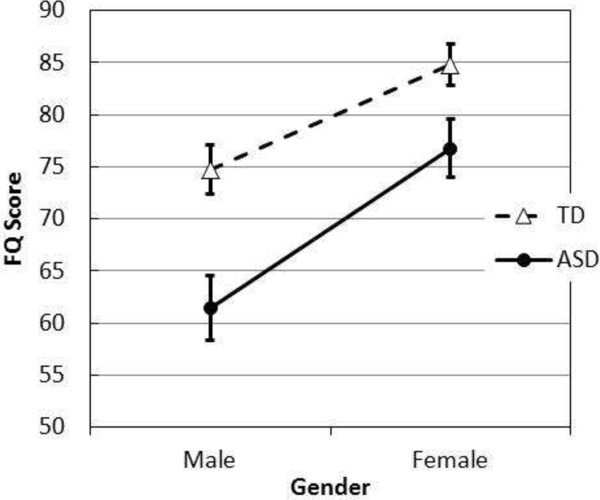
BACKGROUND: Four times as many males are diagnosed with high functioning autism compared to females. A growing body of research that focused on females with autism spectrum disorder (ASD) questions the assumption of gender invariance in ASD. Clinical observations suggest that females with ASD superficially demonstrate better social and emotional skills than males with ASD, which may camouflage other diagnostic features. This may explain the under-diagnosis of females with ASD. METHODS: We hypothesised that females with ASD would display better social skills than males with ASD on a test of friendship and social function. One hundred and one 10- to 16-year-olds (ASD females, n = 25; typically developing (TD) females, n = 25; ASD males, n = 25; TD males, n = 26) were interviewed (using the friendship questionnaire (FQ)) with high scores indicating the child has close, empathetic and supportive relationships. One parent of each child completed the FQ to assess whether there are differences in perception of friendships between parents and children. RESULTS: It was found that, independent of diagnosis, females demonstrated higher scores on the FQ than males. Further, regardless of gender, children with ASD demonstrated lower scores than TD children. Moreover, the effect of ASD was independent of gender. Interestingly, females with ASD and TD males displayed similar scores on the FQ. CONCLUSIONS: This finding is supported by clinical reports that females with ASD have more developed social skills than males with ASD. Further research is now required to examine the underlying causes for this phenomenon in order to develop gender-appropriate diagnostic criteria and interventions for ASD.
Overview
The claims and statistics of this paper haven’t been checked yet.
Free: it reads the open-access text and checks the first 5 claims that cite a source we can check. Create a free account to check every claim.
Integrity signals
Registry
Cites
Statistics
Figures
Verification
Claims the paper makes
The claims and statistics of this paper haven’t been checked yet.
Free: it reads the open-access text and checks the first 5 claims that cite a source we can check. Create a free account to check every claim.
Claims other papers make about this one
Each is checked against this paper’s own text: does it say what the citing paper says it does?
The cited source says what the claim attributes to it.
In the citing paper
“The Australian study with 25 male and 25 female adolescents with high-functioning ASD demonstrated that females with ASD showed similar social skills on a (self-report/parent-report) questionnaire of friendship and social function as typically developing males.”
From Barriers to Autism Spectrum Disorder Diagnosis for Young Women and Girls: a Systematic Review (2021) · cites this paper as Head et al. 2014
The cited source says what the claim attributes to it.
In the citing paper
“However, the study also reported that adolescents with ASD scored lower on the FQ compared to neurotypical adolescents, which is strongly supported by the literature, and study findings were consistent when using the FQ reported by adolescents compared to parent-report, providing further validation of this study’s findings.”
From Barriers to Autism Spectrum Disorder Diagnosis for Young Women and Girls: a Systematic Review (2021) · cites this paper as Head et al. 2014
The cited source says what the claim attributes to it.
In the citing paper
“in this small study, females with ASD showed similar social skills on a friendship and social function questionnaire as neurotypically developing males, demonstrating differences not only from neurotypically developing girls, but also from males with ASD.”
From Barriers to Autism Spectrum Disorder Diagnosis for Young Women and Girls: a Systematic Review (2021) · cites this paper as Head et al. 2014
The cited source says what the claim attributes to it.
In the citing paper
“the current evidence base appears to support suggestions that camouflaging is more associated with the experiences of autistic females and girls/ women, and may partially explain increased rates of missed or late diagnosis found amongst them”
From Camouflaging in autism: A systematic review (2021) · cites this paper as Head et al., 2014
In the citing paper
“Head et al. (2014)The authors compared autistic and non-autistic children's scores on a self-report measure of friendship quality, understanding, and empathy.Thus, this study did not report quantitative data measuring camouflaging.”
From Camouflaging in autism: A systematic review (2021) · cites this paper as Head et al. (2014)
Self-check
Percentages, sums and reported differences re-computed from the paper’s own numbers.
The self-check needs the paper’s full text.
Citations
Cites
Diagnostic and Statistical Manual of Mental Disorders
Williams, J. B. W., & First, M. (2013) · Encyclopedia of Social Work · doi:10.1093/acrefore/9780199975839.013.104 · Cited by 109,519
Tabachnick, B. G., & Fidell, L. S. (1983) · Cited by 80,054
Diagnostic and Statistical Manual of Mental Disorders.
Widiger, T. A. (2000) · Encyclopedia of Psychology, Vol. 3. · doi:10.1037/10518-009 · Cited by 19,744
Diagnostic and Statistical Manual of Mental Disorders, 5th Edition
(2013) · American Psychiatric Association Publishing eBooks · doi:10.1176/appi.books.9780890425596.893619 · Cited by 4,383
Discovering statistics using SPSS, 2nd ed.
Field, A. P. (2005) · Cited by 4,234
Global Prevalence of Autism and Other Pervasive Developmental Disorders
Elsabbagh, M., Divan, G., Koh, Y., Kim, Y. S., Kauchali, S., Marcín, C., Montiel‐Nava, C., Patel, V., Paula, C. S., Wang, C., et al. (2012) · Autism Research · doi:10.1002/aur.239 · Cited by 2,636 · cited 1×
“; licensee BioMed Central L Commons Attribution License (http://creativec reproduction in any medium, provided the or [5], whereas for those who are also profoundly intellectually disabled the ratio is closer to two males for each female [6].”
BackgroundRose, A. J., & Rudolph, K. D. (2006) · Psychological Bulletin · doi:10.1037/0033-2909.132.1.98 · Cited by 2,517 · cited 2×
“Intimate friendships among TD males are characterised by rough and tumble play, minimal close connection and a large group of like-minded friends, acquaintances, playmates or strangers [11,16-19].”
BackgroundUnderstanding Other Minds Perspectives From Developmental Cognitive Neuroscience
Baron‐Cohen, S., Tager-Flusberg, H. B., & Cohen, D. J. (2000) · Cited by 1,392
Childhood peer relationships: social acceptance, friendships, and peer networks
Gifford-Smith, M. E., & Brownell, C. A. (2003) · Journal of School Psychology · doi:10.1016/s0022-4405(03)00048-7 · Cited by 961
Mandy, W., Chilvers, R., Chowdhury, U., Salter, G., Seigal, A., & Skuse, D. (2012) · Journal of Autism and Developmental Disorders · doi:10.1007/s10803-011-1356-0 · Cited by 715 · cited 3×
“Currently, the literature in this area largely focuses on males with ASD, whereby females with ASD are represented by only a few participants in the sample or are excluded altogether [1].”
BackgroundResult
Research works printed but not linked: 2
- Hughes PJ Edmonds G, Beardon L Making friends is not easy Asperger Syndrome and Social Relationships: Adults Speak Out about Asperger Syndrome 2008 London: Jessica Kingsley Publishers 125 134
- Attwood T Garnett M Ford L Bulhak-Paterson D Girls and women with Asperger’s syndrome Hearts and Minds Conference: Girls and Women with Asperger’s Syndrome 2011 Victoria, Australia
Cited by
Items 201–300 of 402
Autism Spectrum Disorder – An Evolving Construct
Mandy, W. (2017) · Wiley eBooks · doi:10.1002/9781119170235.ch23 · Cited by 6
Uncertainty and Autism: How Changing with the Times is Harder for Some
Sheridan, K., Allen, K., Foggo, R. S. V., Hurem, A., Leif, E., & Freeman, N. C. (2022) · Springer eBooks · doi:10.1007/978-981-19-7757-2_13 · Cited by 6
Variables Associated With Successful Treatment Outcomes of Autistic Youth Enrolled in PEERS
McLeod, J., & McCrimmon, A. W. (2022) · Frontiers in Psychiatry · doi:10.3389/fpsyt.2022.834801 · Cited by 6
Autism and Online Dating: A Scoping Review
Neumann, M., Steiner‐Hofbauer, V., & Mittmann, G. (2024) · Review Journal of Autism and Developmental Disorders · doi:10.1007/s40489-024-00488-5 · Cited by 6
Okamoto, Y. (2017) · Acta Psychopathologica · doi:10.4172/2469-6676.100129 · Cited by 6
Peer Interactions of School-Aged Girls on the Autism Spectrum: A Scoping Review
Tso, M., Strnadová, I., Danker, J., & O'Neill, S. C. (2023) · Australasian Journal of Special and Inclusive Education · doi:10.1017/jsi.2023.2 · Cited by 6
A qualitative exploration of the experience of autistic females in Hong Kong
Lam, G. Y. H., Chow, C. K., & Chan, S. W. (2024) · Autism · doi:10.1177/13623613241295318 · Cited by 6
Nenniger, G., Hofmann, V., & Müller, C. M. (2021) · Frontiers in Psychology · doi:10.3389/fpsyg.2021.718726 · Cited by 6
Da Mata Da Silva Costa, E. (2023) · UEA Digital Repository (University of East Anglia) · Cited by 7
Transtorno do Espectro Autista: relato de mulheres que vivenciaram um diagnóstico tardio
Scalcon, A. Z., Cordeiro, M. D. D. S. G., & Marcolino-Galli, J. F. (2024) · Distúrbios da Comunicação · doi:10.23925/2176-2724.2024v36i3e67520 · Cited by 6
Nautiyal, H., Jaiswar, A., Jha, P. K., & Dwivedi, S. (2024) · Mammalian Genome · doi:10.1007/s00335-024-10036-5 · Cited by 5
George, R. (2016) · Cited by 5
Guidelines to Assist in Autism Diagnostic Assessments with Females: A Delphi Study
Trundle, G., Chester, V., Alexander, Z., Morris, P. O., & Crump, I. (2025) · Autism in Adulthood · doi:10.1089/aut.2024.0325 · Cited by 5
The Hypothesised Female ASC Phenotype: Implications for Research and Practice
Wood‐Downie, H., & Wong, B. (2017) · ePrints Soton (University of Southampton) · doi:10.15123/uel.88721 · Cited by 5
Using Social Skills Training to Enhance Inclusion for Students with ASD in Mainstream Schools
Allen, K., Boyle, C., Lauchlan, F., & Craig, H. (2020) · BRILL eBooks · doi:10.1163/9789004431171_012 · Cited by 5
The association between autism, camouflaging and anxiety with suicidal ideation in women
Zubizarreta, S. C.-P., Cruz, S., Pozo-Rodríguez, M., Suárez‐Rama, J. J., Díaz-Hernández, A., Carracedo, Á., Tubío-Fungueiriño, M., & Fernández‐Prieto, M. (2026) · Frontiers in Psychology · doi:10.3389/fpsyg.2025.1685845 · Cited by 5
Bogdan, R., Kayumova, R., Schwarting, R. K. W., Wöhr, M., & Kisko, T. M. (2023) · Frontiers in Behavioral Neuroscience · doi:10.3389/fnbeh.2023.1190272 · Cited by 5
Dekker, L. P., van der Vegt, E. J. M., Louwerse, A., Visser, K., van der Ende, J., Maras, A., Verhulst, F. C., & Greaves‐Lord, K. (2022) · Archives of Sexual Behavior · doi:10.1007/s10508-022-02444-y · Cited by 5
Current Status and Future Directions
Goldin, R. L., & Matson, J. L. (2017) · Autism and child psychopathology series · doi:10.1007/978-3-319-61738-1_26 · Cited by 5
Roberto Canitano, Y. B., Canitano, R., Bozzi, Y., & Dhossche, D. (2020) · Frontiers research topics · doi:10.3389/978-2-88963-869-7 · Cited by 5
Pearse, J. (2020) · UWE Research Repository (UWE Bristol) · Cited by 5
Klein, U. (2021) · Visual Studies · doi:10.1080/1472586x.2021.1942188 · Cited by 5
Sedgewick, F. (2018) · UCL Discovery (University College London) · Cited by 4
Uglik‐Marucha, N., Show, S., Vitoratou, S., Happe, F. G. E., & Belcher, H. (2026) · PLoS ONE · doi:10.1371/journal.pone.0337600 · Cited by 4
Lynch, J., Murphy, A. F., & da Cruz, D. M. C. (2024) · Discover Psychology · doi:10.1007/s44202-024-00234-2 · Cited by 4
Are There Sex or Gender Differences in Autistic Characteristics? An Umbrella Systematic Review
Gundeslioglu, H., Gray, K. M., Hewitt, O. M., & Langdon, P. E. (2026) · Journal of Autism and Developmental Disorders · doi:10.1007/s10803-026-07484-0 · Cited by 4
Figueroa, K., Baczewski, L. M., & Kasari, C. L. (2022) · Autism and child psychopathology series · doi:10.1007/978-3-030-98507-3_22 · Cited by 4
"Camouflaging" in Women with Autistic Traits: Measures, Mechanisms, and Mental Health Implications
Beck, J. S. (2019) · ScholarsArchive (Brigham Young University) · Cited by 4
Short report: Prison-reported rates of autism in female prisons in England
Payne, K.-L., & Gooding, E. (2024) · Autism · doi:10.1177/13623613241275477 · Cited by 4
Bennett, M., Webster, A. A., Goodall, E., & Rowland, S. (2018) · Springer eBooks · doi:10.1007/978-981-13-3359-0_11 · Cited by 4
Young women's experiences of having Autism Spectrum Disorder
Bargiela, S. (2015) · UCL Discovery (University College London) · Cited by 4
Sperry, L. A., Stokes, M. A., Gavisk, M., & Gavisk, D. C. (2021) · Springer eBooks · doi:10.1007/978-3-030-70913-6_14 · Cited by 4
Self-citationParental Human Capital Investment Responses to Children’s Disabilities
Terskaya, A. (2022) · Journal of Human Capital · doi:10.1086/722834 · Cited by 4
Autism : the literature on gender differences
Dimech, C. (2021) · Malta Medical Journal · Cited by 4
青年期自閉スペクトラム症の女性にとっての社会的カモフラージュの功罪 : 『ガールの集い』参加者の座談会を通して
岩男, 芙., Kiya, H., Bunyu, K., Tsuchihashi, Y., Ushimi, A., Junko, I. I. D. A., Fujii, H., & Mori, K. (2022) · Institutional Repositories DataBase (IRDB) · Cited by 4
Zhang, S., Gao, C., Li, R., Lv, J., Xu, J., Miao, M., Liang, H., Xu, D., Wang, B., & Huang, Y. (2026) · EBioMedicine · doi:10.1016/j.ebiom.2026.106160 · Cited by 3
Hsieh, M., Wang, H., Chen, Y., & Wang, W. (2025) · Journal of Autism and Developmental Disorders · doi:10.1007/s10803-025-06893-x · Cited by 3
Adult Women on the High-Functioning Autism Spectrum
Pearlman-Avnion, S., & Shlain, R. (2019) · Autism and child psychopathology series · doi:10.1007/978-3-030-28833-4_5 · Cited by 3
Object-centered family interactions for young autistic children: a diary study
Hu, Y., Sun, X., Yao, C., Luo, S., Liu, B., Xue, M., & Lyu, H. (2024) · Scientific Reports · doi:10.1038/s41598-024-55177-4 · Cited by 3
Cooke, K., Walsh-Adams, J., Pecora, L. A., & Stokes, M. A. (2025) · Springer eBooks · doi:10.1007/978-3-031-40858-8_279-1 · Cited by 3
Self-citationPresentation and Dress Among Individuals with Autism Spectrum Condition
Galic, I. (2014) · Cited by 3
Analysis of a Four-Factor Model of Autism Symptoms in Children Aged 3–6 Years Old
Nasledov, A., Tkacheva, L. O., Zashchirinskaia, O. V., & Александрович, М. С. (2024) · Clinical Psychology and Special Education · doi:10.17759/cpse.2023120403 · Cited by 3
Waite, M., Fouladi, R. T., & Iarocci, G. (2025) · Journal of Autism and Developmental Disorders · doi:10.1007/s10803-024-06707-6 · Cited by 3
The Relationship Between Camouflaging and Lifetime Depression Among Adult Autistic Males and Females
Gesi, C., Pisani, R., Tamburini, N., & Dell’Osso, B. M. (2025) · Brain Sciences · doi:10.3390/brainsci15090920 · Cited by 3
Differences in the Social Experiences of Autistic and Non‐Autistic Adolescents by Gender
Roberts, E., Mandy, W., & Flouri, E. (2025) · Autism Research · doi:10.1002/aur.70118 · Cited by 3
Coret, A., & Agostino, H. (2024) · Paediatrics & Child Health · doi:10.1093/pch/pxae022 · Cited by 3
Jacob, U. S., Adigwe, G. O., Pillay, J., Osisanya, A., & Olatunbosun, S. O. (2024) · Journal of Intellectual Disability - Diagnosis and Treatment · doi:10.6000/2292-2598.2024.12.03.4 · Cited by 3
Myles, O. (2017) · Figshare · Cited by 3
The female side of ADHD and ASD
Kok, F. M. (2021) · University of Groningen research database (University of Groningen / Centre for Information Technology) · doi:10.33612/diss.179073089 · Cited by 2
Hopkins, N., Iles, J. E., & Satherley, R. (2023) · Review Journal of Autism and Developmental Disorders · doi:10.1007/s40489-023-00419-w · Cited by 2
Sex Differences in Autism Spectrum Disorders: A Multidisciplinary ReviewPreprint
Nayar, K., Hunter, S. J., & Scott, M. (2022) · PsyArXiv (OSF Preprints) · doi:10.31234/osf.io/bv5yw · Cited by 2
Carcamo, M. D. L. A., Quintanilla, R. A., Tiznado, W., & Ruíz, L. M. (2024) · Mitochondrial Communications · doi:10.1016/j.mitoco.2024.12.001 · Cited by 2
Nayar, K., Bush, L., & Scott, M. (2025) · Springer eBooks · doi:10.1007/978-3-031-87228-0_2 · Cited by 2
Socio-sexual functioning in autism spectrum disorders
Hancock, G. I. (2017) · Figshare · Cited by 2
Nag, H. E. (2020) · University of Stavanger eBooks · doi:10.31265/usps.70 · Cited by 2
Carpita, B., Nardi, B., Giovannoni, F., Parri, F., Pronestì, C., Bonelli, C., Massimetti, G., Pini, S., Bruno, A., Muscatello, M. R. A., et al. (2025) · Frontiers in Psychiatry · doi:10.3389/fpsyt.2025.1646586 · Cited by 2
Cognitive-behavioral therapy adapted for youth with comorbid anxiety and autism spectrum disorder
Erps, K. H., Jellinek, E. R., Landry, L. N., Guzick, A. G., Schneider, S. C., & Storch, E. A. (2023) · Elsevier eBooks · doi:10.1016/b978-0-323-85757-4.00002-x · Cited by 2
Gay, Lesbian, and Gender Nonconforming Individuals with Autism
Stokes, M. A., Pecora, L. A., Dewinter, J., Greaves‐Lord, K., van der Miesen, A. I. R., & Hooley, M. (2022) · Autism and child psychopathology series · doi:10.1007/978-3-030-88538-0_65 · Cited by 2
Self-citationCurrent Status and Future Directions
Williams, L. W., & Matson, J. L. (2016) · Autism and child psychopathology series · doi:10.1007/978-3-319-27171-2_23 · Cited by 2
The Potential Usefulness Of The Social Attribution Task (SAT) in Diagnosing Girls with ASD
Shimoni, H. N., Leitner, Y., Yoran‐Hegesh, R., Bokek‐Cohen, Y., Gindi, S., & Weizman, A. (2021) · International Journal of Disability Development and Education · doi:10.1080/1034912x.2021.1904503 · Cited by 2
Leštarević, S., Kalanj, M., Milutinovic, L., Grujičić, R., Vasić, J., Maslak, J., Mitković-Vončina, M., Ljubomirovic, N., & Pejovic-Milovancevic, M. M. (2023) · Journal of Autism and Developmental Disorders · doi:10.1007/s10803-023-06061-z · Cited by 2
Play and Movement in 6-Month-Old Infants Later Diagnosed with Autism: A Pilot Study
Demchick, B. B., Flanagan, J. E., Parete, T., & Matteo, D. (2019) · Journal of Occupational Therapy Schools & Early Intervention · doi:10.1080/19411243.2019.1604288 · Cited by 2
Diagnosing ASD in Children Aged 6–18: Gender Differences and the Diagnostic Process
Gindi, S., Shimoni, H. N., Fink, E. Z., Fares, A., Oppenheim, N., & Leitner, Y. (2026) · Journal of Clinical Medicine · doi:10.3390/jcm15020803 · Cited by 2
Testing for Parental Inequality Aversion. Evidence from MexicoPreprint
Terskaya, A. (2017) · SSRN Electronic Journal · doi:10.2139/ssrn.3084645 · Cited by 2
Social Motivation in Adults with Autism: A Multi-method Approach
Gürbüz, E. (2020) · Durham e-Theses (Durham University) · Cited by 2
Wienand, L. (2025) · International Journal of Research Publication and Reviews · doi:10.55248/gengpi.6.0225.0925 · Cited by 2
Everett, S. (2024) · UCL Discovery (University College London) · Cited by 2
Alzamel, A. (2023) · Carolina Digital Repository (University of North Carolina at Chapel Hill) · doi:10.17615/6th7-ea16 · Cited by 2
Gkatsa, T., & Antoniou, I. (2024) · European journal of behavioral sciences · doi:10.33422/ejbs.v7i3.1275 · Cited by 2
The Gaze: The Male Need to Look vs the Female Need to Be Seen—An Evolutionary Perspective
Cummings-Knight, J. (2019) · Springer eBooks · doi:10.1007/978-3-030-04384-1_13 · Cited by 2
Reimagining autism : how drama environments can aid the diagnosis and understanding of autism
Newman, H. (2018) · Kent Academic Repository (University of Kent) · Cited by 2
“Why single me out”? Peer mentoring, autism and inclusion in mainstream schools
Bradley, R. (2017) · University of Birmingham Institutional Research Archive (University of Birmingham) · Cited by 1
Gender Bias in Autism Research on Young Adults: A Scoping Review
Podesta, L. M., & Bosman, A. M. T. (2026) · Review Journal of Autism and Developmental Disorders · doi:10.1007/s40489-026-00546-0 · Cited by 1
一个非常实用的重要结论——函数的导数(变化率)与函数的凹凸性的关系
王学红 (2009) · 考试周刊 · Cited by 1
Harrison, A. J., Bowman, K. L., Bub, K. L., Brown, J. A., Lieberman‐Betz, R. G., & Vail, C. O. (2025) · Journal of Autism and Developmental Disorders · doi:10.1007/s10803-025-07154-7 · Cited by 1
Zhu, Z., Ding, X. P., & Tong, L. (2024) · Journal of Autism and Developmental Disorders · doi:10.1007/s10803-024-06589-8 · Cited by 1
Motion processing in children with autism
Manning, C. (2014) · IOE EPrints · Cited by 1
Salehi, M., Ahmad, A., Lotfi, A., & Gunturu, S. (2024) · Research Square · doi:10.21203/rs.3.rs-3921934/v1 · Cited by 1
Jorba, M., Raventós, A., Batlle, A., Sánchez, A., & Vicente, A. (2025) · Acta Psychologica · doi:10.1016/j.actpsy.2025.106039 · Cited by 1
Russell, I. S. B., & Perreault, M. L. (2026) · Cytokine & Growth Factor Reviews · doi:10.1016/j.cytogfr.2025.12.010 · Cited by 1
A multi-method phenotypic study of sex differences in pragmatic language in autism
Landau, E. B., Brooks, S. E., Guilfoyle, J. L., Nayar, K., Crawford, S., Xing, J., Lau, J. C. Y., Martin, G. E., Voigt, R., Soorya, L. V., et al. (2026) · Frontiers in Psychiatry · doi:10.3389/fpsyt.2026.1759436 · Cited by 1
Structural connectivity of the brain in autism spectrum disorder
Gibbard, C. R. (2016) · UCL Discovery (University College London) · Cited by 1
Simoncini, M., Violi, M., Valetto, A., Bertini, V., Sanabria, F. C., Massoni, L., Dell’Osso, L., & Carmassi, C. (2023) · Frontiers in Psychiatry · doi:10.3389/fpsyt.2023.1240663 · Cited by 1
Burgess, A. Z. Z., van der Zwaag, W., Jonkman, K. M., & Begeer, S. (2026) · Autism · doi:10.1177/13623613261425136 · Cited by 1
Woman with autism spectrum condition. An outline of the characteristics
Buchholz, A. (2021) · Man – Disability – Society · doi:10.5604/01.3001.0015.0625 · Cited by 1
Friendship and Anxiety/Depression Symptoms in Boys With and Without Autism Spectrum Disorder
Harkins, C. M., Menezes, M., Sadikova, E., & Mazurek, M. O. (2023) · American Journal on Intellectual and Developmental Disabilities · doi:10.1352/1944-7558-128.2.119 · Cited by 2
Autism spectrum conditions in women: diagnosis, mental health, and the role of camouflaging
Belcher, H. (2020) · Anglia Ruskin Research Online (Anglia Ruskin University) · Cited by 1
Siracusano, M., Marcovecchio, C., Carloni, E., Riccioni, A., & Mazzone, L. (2024) · Springer eBooks · doi:10.1007/978-3-031-62072-0_2 · Cited by 1
Wei, A., Anchordoqui, A., Bogdanova, O. V., Pomiès, V., Coutelle, R., Atzori, P., Leboyer, M., Lai, M., & Amestoy, A. (2026) · Autism Research · doi:10.1002/aur.70271 · Cited by 1
Sng, C. Y., Carter, M., Stephenson, J. R., & Sweller, N. (2022) · Focus on Autism and Other Developmental Disabilities · doi:10.1177/10883576211073689 · Cited by 1
Do Autistic and Depressed Rats Express the Same Type of Maternal Care?
Zaccarelli‐Magalhães, J., Manes, M., Féba, L. S., Abreu, G. R., Flório, J. C., Ricci, E. L., Felício, L. F., & Spinosa, H. D. S. (2023) · Neuroscience · doi:10.1016/j.neuroscience.2023.11.024 · Cited by 1
Specific Challenges Faced by Females with Autism Spectrum Disorder
Davis, B. W. (2019) · ScholarsArchive (Brigham Young University) · Cited by 1
Kaupins, G. E., & Chenoweth, T. (2023) · Current Psychology · doi:10.1007/s12144-023-04268-y · Cited by 1
Transtorno do Espectro Autista: relato de caso feminino
Leal, S. S. R., Romano, P. V. N., Bini, J. A. P., Juda, L. H. B., & Silva, M. F. P. T. B. D. (2022) · Brazilian Journal of Health Review · doi:10.34119/bjhrv5n6-012 · Cited by 1
Perceptions and Strategies for Developing Social Competence in Children With ASD and Down Syndrome
NAKAJIMA, S. (2019) · Brock University Digital Repository (Brock University) · Cited by 1
Poluliakh, O. Y., Марчук, С. А., Митюкова, Т. А., & Докукина, Т. В. (2022) · Лабораторная диагностика Восточная Европа · doi:10.34883/pi.2022.11.2.015 · Cited by 1
Brake, J. (2023) · cIRcle (University of British Columbia) · doi:10.14288/1.0436958 · Cited by 1
Metadata
- Authors
- Head, A. M., McGillivray, J. A., & Stokes, M. A.
- Affiliations
- Deakin University (AU)
- Corresponding author
- McGillivray, Jane A
- Venue
- Molecular Autism
- Published
- 2014-02-28
- Volume
- 5
- Issue
- 1
- Pages
- 19-19
- ISSN
- 2040-2392 (ISSN-L)
- PMC
- PMC3945617
- OpenAlex
- W2107817359
- Cited by
- 315
- References
- 60
- Citations by year
- 2026: 21 · 2025: 17 · 2024: 33 · 2023: 39 · 2022: 26 · 2021: 36 · 2020: 34 · 2019: 23 · 2018: 27 · 2017: 22 · 2016: 19 · 2015: 12 · 2014: 4
- FWCI
- 10.51
- Type
- journal article
- Language
- en
- Open access
- gold
- doi.org
- Licence
- cc-by
- Locations
- Molecular Autism (publishedVersion, cc-by)
- Europe PMC (PubMed Central) (publishedVersion, cc-by)
- PubMed Central (publishedVersion, cc-by)
- PubMed (publishedVersion)
- Topics
- Life Sciences › Neuroscience › Cognitive Neuroscience › Autism Spectrum Disorder Research
- Health Sciences › Medicine › Psychiatry and Mental health › Child Nutrition and Feeding Issues
- Life Sciences › Biochemistry, Genetics and Molecular Biology › Genetics › Genetics and Neurodevelopmental Disorders
- Keywords
- autism spectrum disorder, gender differences, social skills, friendship, emotionality, underdiagnosis, parent-child perceptions, high-functioning autism
About these checks
Registry, retraction, Cites and statistics results are computed, not judged, with one exception: a printed reference that no index lists is read once by a model before it counts as a citation error. Claims are extracted by a model and kept only when their quote appears verbatim in the text; each cited source is then checked, with a model’s help, for whether it says what the claim relies on. Those verdicts can be wrong — read the claim’s quote and the cited source before relying on one.
Statistics and arithmetic are recomputed, not judged.
Confidence bands are shown only for fields calibrated on our annotated test set. None is calibrated yet, so no band is shown.
What counts as a claim ›How we measure confidence ›How we check this ›
Are you an author, or do you see a problem with this page? Request a review
Data sources
Bibliographic data: Semantic Scholar, OpenAlex, Crossref.
Contains information from the Semantic Scholar Academic Graph Datasets, made available under the ODC Attribution License (ODC-BY 1.0).
Semantic Scholar’s data is described in: Kinney, R., et al. (2023). The Semantic Scholar Open Data Platform. arXiv:2301.10140.
