

Gender differences in emotionality and sociability in children with autism spectrum disorders
Open accessThe DOI matches its Crossref record; 59 of the 61 references it cites were found in a registry or an index.
Abstract
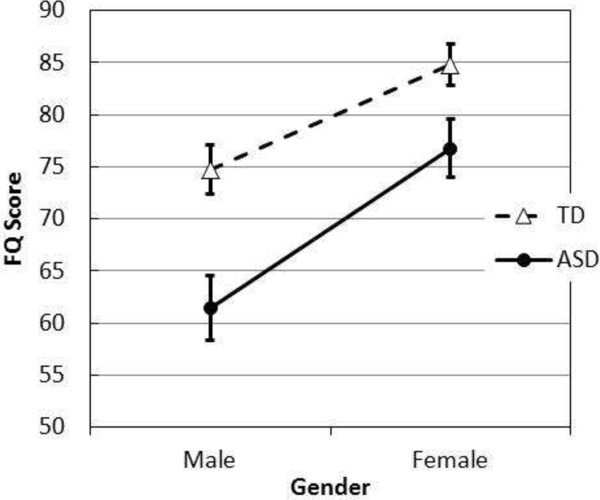
BACKGROUND: Four times as many males are diagnosed with high functioning autism compared to females. A growing body of research that focused on females with autism spectrum disorder (ASD) questions the assumption of gender invariance in ASD. Clinical observations suggest that females with ASD superficially demonstrate better social and emotional skills than males with ASD, which may camouflage other diagnostic features. This may explain the under-diagnosis of females with ASD. METHODS: We hypothesised that females with ASD would display better social skills than males with ASD on a test of friendship and social function. One hundred and one 10- to 16-year-olds (ASD females, n = 25; typically developing (TD) females, n = 25; ASD males, n = 25; TD males, n = 26) were interviewed (using the friendship questionnaire (FQ)) with high scores indicating the child has close, empathetic and supportive relationships. One parent of each child completed the FQ to assess whether there are differences in perception of friendships between parents and children. RESULTS: It was found that, independent of diagnosis, females demonstrated higher scores on the FQ than males. Further, regardless of gender, children with ASD demonstrated lower scores than TD children. Moreover, the effect of ASD was independent of gender. Interestingly, females with ASD and TD males displayed similar scores on the FQ. CONCLUSIONS: This finding is supported by clinical reports that females with ASD have more developed social skills than males with ASD. Further research is now required to examine the underlying causes for this phenomenon in order to develop gender-appropriate diagnostic criteria and interventions for ASD.
Overview
The claims and statistics of this paper haven’t been checked yet.
Free: it reads the open-access text and checks the first 5 claims that cite a source we can check. Create a free account to check every claim.
Integrity signals
Registry
Cites
Statistics
Figures
Verification
Claims the paper makes
The claims and statistics of this paper haven’t been checked yet.
Free: it reads the open-access text and checks the first 5 claims that cite a source we can check. Create a free account to check every claim.
Claims other papers make about this one
Each is checked against this paper’s own text: does it say what the citing paper says it does?
The cited source says what the claim attributes to it.
In the citing paper
“The Australian study with 25 male and 25 female adolescents with high-functioning ASD demonstrated that females with ASD showed similar social skills on a (self-report/parent-report) questionnaire of friendship and social function as typically developing males.”
From Barriers to Autism Spectrum Disorder Diagnosis for Young Women and Girls: a Systematic Review (2021) · cites this paper as Head et al. 2014
The cited source says what the claim attributes to it.
In the citing paper
“However, the study also reported that adolescents with ASD scored lower on the FQ compared to neurotypical adolescents, which is strongly supported by the literature, and study findings were consistent when using the FQ reported by adolescents compared to parent-report, providing further validation of this study’s findings.”
From Barriers to Autism Spectrum Disorder Diagnosis for Young Women and Girls: a Systematic Review (2021) · cites this paper as Head et al. 2014
The cited source says what the claim attributes to it.
In the citing paper
“in this small study, females with ASD showed similar social skills on a friendship and social function questionnaire as neurotypically developing males, demonstrating differences not only from neurotypically developing girls, but also from males with ASD.”
From Barriers to Autism Spectrum Disorder Diagnosis for Young Women and Girls: a Systematic Review (2021) · cites this paper as Head et al. 2014
The cited source says what the claim attributes to it.
In the citing paper
“the current evidence base appears to support suggestions that camouflaging is more associated with the experiences of autistic females and girls/ women, and may partially explain increased rates of missed or late diagnosis found amongst them”
From Camouflaging in autism: A systematic review (2021) · cites this paper as Head et al., 2014
In the citing paper
“Head et al. (2014)The authors compared autistic and non-autistic children's scores on a self-report measure of friendship quality, understanding, and empathy.Thus, this study did not report quantitative data measuring camouflaging.”
From Camouflaging in autism: A systematic review (2021) · cites this paper as Head et al. (2014)
Self-check
Percentages, sums and reported differences re-computed from the paper’s own numbers.
The self-check needs the paper’s full text.
Citations
Cites
Diagnostic and Statistical Manual of Mental Disorders
Williams, J. B. W., & First, M. (2013) · Encyclopedia of Social Work · doi:10.1093/acrefore/9780199975839.013.104 · Cited by 109,519
Tabachnick, B. G., & Fidell, L. S. (1983) · Cited by 80,054
Diagnostic and Statistical Manual of Mental Disorders.
Widiger, T. A. (2000) · Encyclopedia of Psychology, Vol. 3. · doi:10.1037/10518-009 · Cited by 19,744
Diagnostic and Statistical Manual of Mental Disorders, 5th Edition
(2013) · American Psychiatric Association Publishing eBooks · doi:10.1176/appi.books.9780890425596.893619 · Cited by 4,383
Discovering statistics using SPSS, 2nd ed.
Field, A. P. (2005) · Cited by 4,234
Global Prevalence of Autism and Other Pervasive Developmental Disorders
Elsabbagh, M., Divan, G., Koh, Y., Kim, Y. S., Kauchali, S., Marcín, C., Montiel‐Nava, C., Patel, V., Paula, C. S., Wang, C., et al. (2012) · Autism Research · doi:10.1002/aur.239 · Cited by 2,636 · cited 1×
“; licensee BioMed Central L Commons Attribution License (http://creativec reproduction in any medium, provided the or [5], whereas for those who are also profoundly intellectually disabled the ratio is closer to two males for each female [6].”
BackgroundRose, A. J., & Rudolph, K. D. (2006) · Psychological Bulletin · doi:10.1037/0033-2909.132.1.98 · Cited by 2,517 · cited 2×
“Intimate friendships among TD males are characterised by rough and tumble play, minimal close connection and a large group of like-minded friends, acquaintances, playmates or strangers [11,16-19].”
BackgroundUnderstanding Other Minds Perspectives From Developmental Cognitive Neuroscience
Baron‐Cohen, S., Tager-Flusberg, H. B., & Cohen, D. J. (2000) · Cited by 1,392
Childhood peer relationships: social acceptance, friendships, and peer networks
Gifford-Smith, M. E., & Brownell, C. A. (2003) · Journal of School Psychology · doi:10.1016/s0022-4405(03)00048-7 · Cited by 961
Mandy, W., Chilvers, R., Chowdhury, U., Salter, G., Seigal, A., & Skuse, D. (2012) · Journal of Autism and Developmental Disorders · doi:10.1007/s10803-011-1356-0 · Cited by 715 · cited 3×
“Currently, the literature in this area largely focuses on males with ASD, whereby females with ASD are represented by only a few participants in the sample or are excluded altogether [1].”
BackgroundResult
Research works printed but not linked: 2
- Hughes PJ Edmonds G, Beardon L Making friends is not easy Asperger Syndrome and Social Relationships: Adults Speak Out about Asperger Syndrome 2008 London: Jessica Kingsley Publishers 125 134
- Attwood T Garnett M Ford L Bulhak-Paterson D Girls and women with Asperger’s syndrome Hearts and Minds Conference: Girls and Women with Asperger’s Syndrome 2011 Victoria, Australia
Cited by
Sex/Gender Differences and Autism: Setting the Scene for Future Research
Lai, M.-C., Lombardo, M. V., Auyeung, B., Chakrabarti, B., & Baron-Cohen, S. (2015) · Journal of the American Academy of Child & Adolescent Psychiatry · doi:10.1016/j.jaac.2014.10.003 · Cited by 1,120
Bargiela, S., Steward, R., & Mandy, W. (2016) · Journal of Autism and Developmental Disorders · doi:10.1007/s10803-016-2872-8 · Cited by 1,087
Quantifying and exploring camouflaging in men and women with autism
Lai, M.-C., Lombardo, M. V., Ruigrok, A. N., Chakrabarti, B., Auyeung, B., Szatmari, P., Happé, F., Baron-Cohen, S., & MRC AIMS Consortium (2017) · Autism · doi:10.1177/1362361316671012 · Cited by 705
“Recent studies have alluded to the presence of camouflaging in teenage (Head et al., 2014; Tierney et al., 2016) or even school age years (Hiller et al.”
The Female Autism Phenotype and Camouflaging: a Narrative Review
Hull, L., Petrides, K. V., & Mandy, W. (2020) · Review Journal of Autism and Developmental Disorders · doi:10.1007/s40489-020-00197-9 · Cited by 614
Warrier, V., Greenberg, D. M., Weir, E., Buckingham, C., Smith, P., Lai, M.-C., Allison, C., & Baron-Cohen, S. (2020) · Nature Communications · doi:10.1038/s41467-020-17794-1 · Cited by 595
Halladay, A. K., Bishop, S., Constantino, J. N., Daniels, A. M., Koenig, K., Palmer, K., Messinger, D., Pelphrey, K., Sanders, S. J., Singer, A. T., et al. (2015) · Molecular Autism · doi:10.1186/s13229-015-0019-y · Cited by 574
Salari, N., Rasoulpoor, S., Rasoulpoor, S., Shohaimi, S., Jafarpour, S., Abdoli, N., Khaledi-Paveh, B., & Mohammadi, M. (2022) · Italian Journal of Pediatrics · doi:10.1186/s13052-022-01310-w · Cited by 571
“Girls with ASD represent better speech behaviour and fewer abnormalities in communicational and social skills or show different repetitive and stereotyped activities than boys [116, 117].”
BackgroundCamouflaging in autism: A systematic review
Cook, J., Hull, L., Crane, L., & Mandy, W. (2021) · Clinical Psychology Review · doi:10.1016/j.cpr.2021.102080 · Cited by 554
Development and validation of the camouflaging autistic traits questionnaire (CAT-Q)
Hull, L., Mandy, W., Lai, M.-C., Baron-Cohen, S., Allison, C., Smith, P., & Petrides, K. V. (2019) · Journal of Autism and Developmental Disorders · doi:10.1007/s10803-018-3792-6 · Cited by 496
“These include links to heightened stress or mental health conditions such as depression, and reduced access to clinical support and services as a result of difficulties being hidden (Cage et al. 2017; Head et al. 2014).”
BackgroundBarriers to Autism Spectrum Disorder Diagnosis for Young Women and Girls: a Systematic Review
Lockwood Estrin, G., Milner, V., Spain, D., Happé, F., & Colvert, E. (2021) · Review Journal of Autism and Developmental Disorders · doi:10.1007/s40489-020-00225-8 · Cited by 444
Rynkiewicz, A., Schuller, B., Marchi, E., Piana, S., Camurri, A., Lassalle, A., & Baron-Cohen, S. (2016) · Molecular Autism · doi:10.1186/s13229-016-0073-0 · Cited by 404
Sex differences in autism spectrum disorder: a review
Ferri, S. L., Abel, T., & Brodkin, E. S. (2018) · Current Psychiatry Reports · doi:10.1007/s11920-018-0874-2 · Cited by 392
Sedgewick, F., Hill, V., Yates, R., Pickering, L., & Pellicano, E. (2016) · Journal of Autism and Developmental Disorders · doi:10.1007/s10803-015-2669-1 · Cited by 296
Hull, L., Mandy, W., & Petrides, K. (2017) · Autism · doi:10.1177/1362361316669087 · Cited by 254
“No significant interactions between sex/gender and diagnosis were found using either the Friendship Questionnaire (Baron-Cohen and Wheelwright, 2005; Head et al., 2014) or the Friendships Survey (Dean et al., 2014).”
MethodThe experiences and needs of female adults with high-functioning autism spectrum disorder
Baldwin, S., & Costley, D. (2016) · Autism · doi:10.1177/1362361315590805 · Cited by 248
“It has been shown that females with ASD have higher natural inclinations towards sociability, emotionality and friendship than do males (Head et al., 2014) and are thus more likely to actively seek conformity with their neurotypical peers, utilising their cognitive skills to generate ‘appropriate’ social responses and…”
BackgroundSex Differences in Autism Spectrum Disorder: Diagnostic, Neurobiological, and Behavioral Features
Napolitano, A., Schiavi, S., La Rosa, P., Rossi-Espagnet, M. C., Petrillo, S., Bottino, F., Tagliente, E., Longo, D., Lupi, E., Casula, L., et al. (2022) · Frontiers in Psychiatry · doi:10.3389/fpsyt.2022.889636 · Cited by 234
“Studies have found that females with ASD display greater engagement with peers on the playground (52), greater social motivation (11), greater social reciprocity (53), and showed increased use of pragmatic social communication (54).”
BackgroundCamouflage and masking behavior in adult autism
Alaghband‐Rad, J., Hajikarim‐Hamedani, A., & Motamed, M. (2023) · Frontiers in Psychiatry · doi:10.3389/fpsyt.2023.1108110 · Cited by 205
Is There a Bias Towards Males in the Diagnosis of Autism? A Systematic Review and Meta-Analysis
Cruz, S., Zubizarreta, S. C.-P., Costa, A. D., Araújo, R., Martinho, J., Tubío-Fungueiriño, M., Sampaio, A., Cruz, R., Carracedo, Á., & Fernández‐Prieto, M. (2024) · Neuropsychology Review · doi:10.1007/s11065-023-09630-2 · Cited by 191
Sedgewick, F., Hill, V., & Pellicano, E. (2019) · Autism · doi:10.1177/1362361318794930 · Cited by 187
Schuck, R. K., Flores, R. E., & Fung, L. K. (2019) · Journal of Autism and Developmental Disorders · doi:10.1007/s10803-019-03998-y · Cited by 172
Social Camouflaging in Females with Autism Spectrum Disorder: A Systematic Review
Tubío-Fungueiriño, M., Cruz, S., Sampaio, A., Carracedo, A., & Fernández-Prieto, M. (2021) · Journal of Autism and Developmental Disorders · doi:10.1007/s10803-020-04695-x · Cited by 168
Wood‐Downie, H., Wong, B., Kovshoff, H., Cortese, S., & Hadwin, J. A. (2021) · Journal of Child Psychology and Psychiatry · doi:10.1111/jcpp.13337 · Cited by 162
“…understanding relationships (Baron-Cohen &Wheelwright, 2003; Dean et al., 2014, 2016; Harrop et al., 2017; Head et al., 2014; Horiuchi et al., 2014; Knickmeyeretal.,2007;Sedgewicketal.,2016,2018,2019), four to nonverbal communicative behaviour (Chawarska…”
BackgroundWestwood, H., Eisler, I., Mandy, W., Leppanen, J., Treasure, J., & Tchanturia, K. (2016) · Journal of Autism and Developmental Disorders · doi:10.1007/s10803-015-2641-0 · Cited by 160
Lehnhardt, F.-G., Falter, C. M., Gawronski, A., Pfeiffer, K., Tepest, R., Franklin, J., & Vogeley, K. (2016) · Journal of Autism and Developmental Disorders · doi:10.1007/s10803-015-2558-7 · Cited by 153
“to better observational learning of facial expressions and eye contact, ‘‘internal scripting’’ of attitudes in social interaction and a higher intellectual understanding of the rules associated with sociability, emotionality and friendship (Dworzynski et al. 2012; Head et al. 2014; Lai et al. 2011).”
BackgroundRadulski, E. M. (2022) · Human Development · doi:10.1159/000524122 · Cited by 150
Understanding autism in the light of sex/gender
Lai, M.-C., Baron-Cohen, S., & Buxbaum, J. D. (2015) · Molecular Autism · doi:10.1186/s13229-015-0021-4 · Cited by 146
Melancia, F., Schiavi, S., Servadio, M., Cartocci, V., Campolongo, P., Palmery, M., Pallottini, V., & Trezza, V. (2018) · British Journal of Pharmacology · doi:10.1111/bph.14435 · Cited by 145
Sex differences in social attention in autism spectrum disorder
Harrop, C., Jones, D., Zheng, S., Nowell, S. W., Boyd, B. A., & Sasson, N. (2018) · Autism Research · doi:10.1002/aur.1997 · Cited by 125
Allely, C. S. (2019) · Advances in Autism · doi:10.1108/aia-09-2018-0036 · Cited by 123
Diémé, B., Mavel, S., Blasco, H., Tripi, G., Bonnet-Brilhault, F., Malvy, J., Bocca, C., Andres, C. R., Nadal-Desbarats, L., & Emond, P. (2015) · Journal of Proteome Research · doi:10.1021/acs.jproteome.5b00699 · Cited by 122
Sex Differences in Autism Spectrum Disorder: Focus on High Functioning Children and Adolescents
de Giambattista, C., Ventura, P., Trerotoli, P., Margari, F., & Margari, L. (2021) · Frontiers in Psychiatry · doi:10.3389/fpsyt.2021.539835 · Cited by 116
Pellicano, E., Brett, S., den Houting, J., Heyworth, M., Magiati, I., Steward, R., Urbanowicz, A., & Stears, M. (2022) · Autism · doi:10.1177/13623613211035936 · Cited by 113
Corbett, B. A., Schwartzman, J. M., Libsack, E. J., Muscatello, R. A., Lerner, M. D., Simmons, G. L., & White, S. W. (2021) · Autism Research · doi:10.1002/aur.2440 · Cited by 113
Understanding the social experiences of adolescent females on the autism spectrum
Foggo, R. S. V., & Webster, A. A. (2016) · Research in Autism · doi:10.1016/j.rasd.2016.11.006 · Cited by 111
Jorgenson, C. D., Lewis, T., Rose, C. A., & Kanne, S. M. (2020) · Journal of Autism and Developmental Disorders · doi:10.1007/s10803-020-04491-7 · Cited by 105
Sexuality in High-Functioning Autism: A Systematic Review and Meta-analysis
Pecora, L. A., Mesibov, G. B., & Stokes, M. A. (2016) · Journal of Autism and Developmental Disorders · doi:10.1007/s10803-016-2892-4 · Cited by 101
Self-citation“Fake it ‘till you make it”: Authenticity and wellbeing in late diagnosed autistic women
Seers, K., & Hogg, R. C. (2022) · Feminism & Psychology · doi:10.1177/09593535221101455 · Cited by 99
Adaptive morphing and coping with social threat in autism: an autistic perspective
Lawson, W. B. (2020) · Journal of Intellectual Disability - Diagnosis and Treatment · doi:10.6000/2292-2598.2020.08.03.29 · Cited by 98
“protection against becoming autistic [29, 30].”
BackgroundMcQuaid, G. A., Pelphrey, K. A., Bookheimer, S. Y., Dapretto, M., Webb, S. J., Bernier, R., McPartland, J. C., Horn, J. D. V., & Wallace, G. L. (2021) · Autism · doi:10.1177/1362361321995620 · Cited by 94
Schöttle, D., Briken, P., Tüscher, O., & Turner, D. (2017) · Dialogues in Clinical Neuroscience · doi:10.31887/dcns.2017.19.4/dschoettle · Cited by 93
Lawrence, K. E., Hernandez, L. M., Bowman, H. C., Padgaonkar, N. T., Fuster, E., Jack, A., Aylward, E., Gaab, N., Van Horn, J. D., Bernier, R. A., et al. (2020) · Cerebral Cortex · doi:10.1093/cercor/bhaa105 · Cited by 93
Rynkiewicz, A., & Łucka, I. (2018) · Psychiatria Polska · doi:10.12740/pp/onlinefirst/58837 · Cited by 90
Nowell, K. P., Bernardin, C. J., Brown, C. E., & Kanne, S. M. (2020) · Journal of Autism and Developmental Disorders · doi:10.1007/s10803-020-04743-6 · Cited by 90
Patel, S. P., Nayar, K., Martin, G. E., Franich, K., Crawford, S., Diehl, J. J., & Losh, M. C. (2020) · Journal of Autism and Developmental Disorders · doi:10.1007/s10803-020-04392-9 · Cited by 89
The social experiences and sense of belonging in adolescent females with autism in mainstream school
Myles, O., Boyle, C., & Richards, A. (2019) · Educational and Child Psychology · doi:10.53841/bpsecp.2019.36.4.8 · Cited by 87
Schiavi, S., Iezzi, D., Manduca, A., Leone, S., Melancia, F., Carbone, C., Petrella, M., Mannaioni, G., Masi, A., & Trezza, V. (2019) · Frontiers in Cellular Neuroscience · doi:10.3389/fncel.2019.00479 · Cited by 86
Evans, S. C., Boan, A. D., Bradley, C., & Carpenter, L. A. (2019) · Journal of Clinical Child & Adolescent Psychology · doi:10.1080/15374416.2018.1437734 · Cited by 83
Jamison, T. R., & Schuttler, J. O. (2015) · Molecular Autism · doi:10.1186/s13229-015-0044-x · Cited by 83
Trajectories of Autism Symptom Severity Change During Early Childhood
Waizbard-Bartov, E., Ferrer, E., Young, G. S., Heath, B., Rogers, S., Wu Nordahl, C., Solomon, M., & Amaral, D. G. (2021) · Journal of Autism and Developmental Disorders · doi:10.1007/s10803-020-04526-z · Cited by 81
Ochoa‐Lubinoff, C., Makol, B. A., & Dillon, E. F. (2023) · Neurologic Clinics · doi:10.1016/j.ncl.2022.10.006 · Cited by 75
Sturrock, A., Chilton, H., Foy, K., Freed, J., & Adams, C. (2021) · Autism · doi:10.1177/13623613211002047 · Cited by 75
The Oral health status of children with autism Spectrum disorder in KwaZulu-Nata, South Africa
Naidoo, M., & Singh, S. (2018) · BMC Oral Health · doi:10.1186/s12903-018-0632-1 · Cited by 75
Mahendiran, T., Dupuis, A., Crosbie, J., Georgiades, S., Kelley, E. A., Liu, X., Nicolson, R., Schachar, R. J., Anagnostou, E. A., & Brian, J. A. (2019) · Frontiers in Psychiatry · doi:10.3389/fpsyt.2019.00607 · Cited by 73
Chen, Y.-W. R., Bundy, A. C., Cordier, R., Chien, Y., & Einfeld, S. (2015) · Journal of Autism and Developmental Disorders · doi:10.1007/s10803-015-2682-4 · Cited by 74
Friend matters: sex differences in social language during autism diagnostic interviews
Cola, M., Yankowitz, L. D., Tena, K. G., Russell, A. R. B., Bateman, L., Knox, A., Plate, S. N., Cubit, L. S., Zampella, C., Pandey, J., et al. (2022) · Molecular Autism · doi:10.1186/s13229-021-00483-1 · Cited by 73
Autism-spectrum disorders in adolescence and adulthood: focus on sexuality
Turner, D., Briken, P., & Schöttle, D. (2017) · Current Opinion in Psychiatry · doi:10.1097/yco.0000000000000369 · Cited by 70
Camouflaging Intent, First Impressions, and Age of ASC Diagnosis in Autistic Men and Women
Belcher, H., Morein‐Zamir, S., Mandy, W., & Ford, R. M. (2021) · Journal of Autism and Developmental Disorders · doi:10.1007/s10803-021-05221-3 · Cited by 70
A Systematic Review of Passing as Non-autistic in Autism Spectrum Disorder
Libsack, E. J., Keenan, E. G., Freden, C. E., Mirmina, J., Iskhakov, N., Krishnathasan, D., & Lerner, M. D. (2021) · Clinical Child and Family Psychology Review · doi:10.1007/s10567-021-00365-1 · Cited by 68
Life Skills Training for Middle and High School Students with Autism
Chiang, H.-M., Ni, X., & Lee, Y.-S. (2017) · Journal of Autism and Developmental Disorders · doi:10.1007/s10803-017-3028-1 · Cited by 68
Prevalence of Autism Spectrum Disorder in Nurseries in Lebanon: A Cross Sectional Study
Chaaya, M., Saab, D., Maalouf, F. T., & Boustany, R. (2015) · Journal of Autism and Developmental Disorders · doi:10.1007/s10803-015-2590-7 · Cited by 67
Westwood, H., Mandy, W., Simic, M., & Tchanturia, K. (2018) · Journal of Abnormal Child Psychology · doi:10.1007/s10802-017-0301-x · Cited by 66
The clinician perspective on sex differences in autism spectrum disorders
Jamison, R., Bishop, S. L., Huerta, M., & Halladay, A. K. (2017) · Autism · doi:10.1177/1362361316681481 · Cited by 66
Reversed gender ratio of autism spectrum disorder in Smith-Magenis syndrome
Nag, H. E., Nordgren, A., Anderlid, B., & Nærland, T. (2018) · Molecular Autism · doi:10.1186/s13229-017-0184-2 · Cited by 65
Lawson, L. P., Joshi, R., Barbaro, J., & Dissanayake, C. (2018) · Journal of Autism and Developmental Disorders · doi:10.1007/s10803-018-3516-y · Cited by 64
Friends and Lovers: The Relationships of Autistic and Neurotypical Women
Sedgewick, F., Crane, L., Hill, V., & Pellicano, E. (2019) · Autism in Adulthood · doi:10.1089/aut.2018.0028 · Cited by 63
Scheeren, A. M., Buil, J. M., Howlin, P., Bartels, M., & Begeer, S. (2021) · Autism · doi:10.1177/13623613211027673 · Cited by 63
Gender-specific approach in psychiatric diseases: Because sex matters
Franceschini, A., & Fattore, L. (2021) · European Journal of Pharmacology · doi:10.1016/j.ejphar.2021.173895 · Cited by 61
Sturrock, A., Yau, N., Freed, J., & Adams, C. (2019) · Journal of Autism and Developmental Disorders · doi:10.1007/s10803-019-03920-6 · Cited by 62
Sex-specific Behavioral Features of Rodent Models of Autism Spectrum Disorder
Jeon, S. J., Gonzales, E. L., Mabunga, D. F. N., Valencia, S. T., Kim, D. G., Kim, Y., Adil, K. J. L., Shin, D., Park, D., & Shin, C. Y. (2018) · Experimental Neurobiology · doi:10.5607/en.2018.27.5.321 · Cited by 60
Social skills characteristics of students with autism spectrum disorder
Syriopoulou–Delli, C. K., Agaliotis, I., & Papaefstathiou, E. (2016) · International Journal of Developmental Disabilities · doi:10.1080/20473869.2016.1219101 · Cited by 60
Navarro‐Pardo, E., López-Ramón, M. F., Alonso-Esteban, Y., & Marín, F. A. (2021) · Children · doi:10.3390/children8040262 · Cited by 60
Measuring Social Camouflaging in Individuals with High Functioning Autism: A Literature Review
Cremone, I. M., Carpita, B., Nardi, B., Casagrande, D., Stagnari, R., Amatori, G., & Dell’Osso, L. (2023) · Brain Sciences · doi:10.3390/brainsci13030469 · Cited by 59
Self-reported sex differences in high-functioning adults with autism: a meta-analysis
Moseley, R. L., Hitchiner, R., & Kirkby, J. A. (2018) · Molecular Autism · doi:10.1186/s13229-018-0216-6 · Cited by 56
O’Connor, R., van den Bedem, N. P., Blijd-Hoogewys, E. M. A., Stockmann, L., & Rieffe, C. J. (2022) · Autism · doi:10.1177/13623613211073448 · Cited by 55
Sturrock, A., Marsden, A., Adams, C., & Freed, J. (2019) · Journal of Autism and Developmental Disorders · doi:10.1007/s10803-019-04288-3 · Cited by 54
Circumscribed Interests and Attention in Autism: The Role of Biological Sex
Harrop, C., Jones, D. R., Zheng, S., Nowell, S. W., Boyd, B. A., & Sasson, N. J. (2018) · Journal of Autism and Developmental Disorders · doi:10.1007/s10803-018-3612-z · Cited by 53
Ornoy, A., Weinstein-Fudim, L., Tfilin, M., Ergaz, Z., Yanai, J., Szyf, M., & Turgeman, G. (2019) · Neurotoxicology and Teratology · doi:10.1016/j.ntt.2018.01.005 · Cited by 53
Sex differences in the reciprocal behaviour of children with autism
Backer van Ommeren, T., Koot, H. M., Scheeren, A. M., & Begeer, S. (2017) · Autism · doi:10.1177/1362361316669622 · Cited by 52
Cummings, K. K., Lawrence, K. E., Hernandez, L. M., Wood, E. T., Bookheimer, S. Y., Dapretto, M., & Green, S. A. (2020) · Autism Research · doi:10.1002/aur.2351 · Cited by 51
Medical Therapies for Children With Autism Spectrum Disorder—An Update
Edwin Williamson, M. D., Sathe, N. A., & Andrews, J. C. (2017) · doi:10.23970/ahrqepccer189 · Cited by 50
Cleaton, M. A. M., Tal‐Saban, M., Hill, E. L., & Kirby, A. (2021) · Research in Developmental Disabilities · doi:10.1016/j.ridd.2021.104010 · Cited by 50
Dietary Approaches to the Management of Autism Spectrum Disorders
Hartman, R. E., & Patel, D. (2020) · Advances in neurobiology · doi:10.1007/978-3-030-30402-7_19 · Cited by 50
Maternal experience raising girls with autism spectrum disorder: a qualitative study
Navot, N., Jorgenson, A. G., & Webb, S. J. (2017) · Child: Care, Health and Development · doi:10.1111/cch.12470 · Cited by 48
Vagni, D., Moscone, D., Travaglione, S., & Cotugno, A. (2016) · Research in Autism · doi:10.1016/j.rasd.2016.10.002 · Cited by 48
The Anxiety Caused by Secondary Schools for Autistic Adolescents: In Their Own Words
Costley, D., Emerson, A., Ropar, D., & Sheppard, E. (2021) · Education Sciences · doi:10.3390/educsci11110726 · Cited by 48
Developmental neurogenetics and multimodal neuroimaging of sex differences in autism
GENDAAR Research Consortium, Chen, C., & Van Horn, J. D. (2017) · Brain Imaging and Behavior · doi:10.1007/s11682-015-9504-3 · Cited by 47
Postorino, V., Scahill, L. D., Peppo, L. D., Fatta, L. M., Zanna, V., Castiglioni, M. C., Gillespie, S. E., Vicari, S., & Mazzone, L. (2017) · Journal of Autism and Developmental Disorders · doi:10.1007/s10803-016-3023-y · Cited by 47
Quantity and quality of empathic responding by autistic and non-autistic adolescent girls and boys
Rieffe, C. J., O’Connor, R., Bülow, A., Willems, D., Hull, L., Sedgewick, F., Stockmann, L., & Blijd-Hoogewys, E. M. A. (2020) · Autism · doi:10.1177/1362361320956422 · Cited by 47
Chang, Y.-C., Chen, C.-H., Huang, P.-C., & Lin, L.-Y. (2019) · Scandinavian Journal of Occupational Therapy · doi:10.1080/11038128.2018.1449887 · Cited by 46
Adamou, M., Johnson, M., & Alty, B. (2018) · Advances in Autism · doi:10.1108/aia-01-2018-0003 · Cited by 46
The Friendship Questionnaire, autism, and gender differences: a study revisited
Sedgewick, F., Leppänen, J., & Tchanturia, K. (2019) · Molecular Autism · doi:10.1186/s13229-019-0295-z · Cited by 46
McVey, A. J., Schiltz, H., Haendel, A., Dolan, B. K., Willar, K. S., Pleiss, S., Karst, J. S., Carson, A. M., Caiozzo, C., Vogt, E., et al. (2017) · Journal of Autism and Developmental Disorders · doi:10.1007/s10803-017-3121-5 · Cited by 46
Sexuality of Persons with Autistic Spectrum Disorders (ASD)
Parchomiuk, M. (2018) · Sexuality and Disability · doi:10.1007/s11195-018-9534-z · Cited by 46
Phillips, J. M., Uljarević, M., Schuck, R. K., Schapp, S., Solomon, E. M., Salzman, E., Allerhand, L., Libove, R. A., Frazier, T. W., & Hardan, A. Y. (2019) · Molecular Autism · doi:10.1186/s13229-019-0298-9 · Cited by 45
Inal-Kaleli, I., Doğan, N., Köse, S., & Bora, E. (2024) · International Journal of Eating Disorders · doi:10.1002/eat.24307 · Cited by 45
Autistic community connectedness as a buffer against the effects of minority stress.
Botha, M. (2020) · University of Surrey Open Research repository · doi:10.15126/thesis.00854098 · Cited by 46
Circumscribed interests in autism: are there sex differences?
Nowell, S. W., Jones, D. R., & Harrop, C. (2019) · Advances in Autism · doi:10.1108/aia-09-2018-0032 · Cited by 43
Levante, A., Martis, C., Antonioli, G., Dima, M., Duma, L., Perrone, M. R., Russo, L., & Lecciso, F. (2023) · Current Developmental Disorders Reports · doi:10.1007/s40474-023-00277-5 · Cited by 43
Craig, F., Crippa, A., GIACOMO, A. D., Ruggiero, M., Rizzato, V., Lorenzo, A., Fanizza, I., Margari, L., & Trabacca, A. (2020) · Autism Research · doi:10.1002/aur.2305 · Cited by 42
Maurer, C., Chambon, V., Bourgeois‐Gironde, S., Leboyer, M., & Zalla, T. (2017) · Cognition · doi:10.1016/j.cognition.2017.11.007 · Cited by 42
Metadata
- Authors
- Head, A. M., McGillivray, J. A., & Stokes, M. A.
- Affiliations
- Deakin University (AU)
- Corresponding author
- McGillivray, Jane A
- Venue
- Molecular Autism
- Published
- 2014-02-28
- Volume
- 5
- Issue
- 1
- Pages
- 19-19
- ISSN
- 2040-2392 (ISSN-L)
- PMC
- PMC3945617
- OpenAlex
- W2107817359
- Cited by
- 315
- References
- 60
- Citations by year
- 2026: 21 · 2025: 17 · 2024: 33 · 2023: 39 · 2022: 26 · 2021: 36 · 2020: 34 · 2019: 23 · 2018: 27 · 2017: 22 · 2016: 19 · 2015: 12 · 2014: 4
- FWCI
- 10.51
- Type
- journal article
- Language
- en
- Open access
- gold
- doi.org
- Licence
- cc-by
- Locations
- Molecular Autism (publishedVersion, cc-by)
- Europe PMC (PubMed Central) (publishedVersion, cc-by)
- PubMed Central (publishedVersion, cc-by)
- PubMed (publishedVersion)
- Topics
- Life Sciences › Neuroscience › Cognitive Neuroscience › Autism Spectrum Disorder Research
- Health Sciences › Medicine › Psychiatry and Mental health › Child Nutrition and Feeding Issues
- Life Sciences › Biochemistry, Genetics and Molecular Biology › Genetics › Genetics and Neurodevelopmental Disorders
- Keywords
- autism spectrum disorder, gender differences, social skills, friendship, emotionality, underdiagnosis, parent-child perceptions, high-functioning autism
About these checks
Registry, retraction, Cites and statistics results are computed, not judged, with one exception: a printed reference that no index lists is read once by a model before it counts as a citation error. Claims are extracted by a model and kept only when their quote appears verbatim in the text; each cited source is then checked, with a model’s help, for whether it says what the claim relies on. Those verdicts can be wrong — read the claim’s quote and the cited source before relying on one.
Statistics and arithmetic are recomputed, not judged.
Confidence bands are shown only for fields calibrated on our annotated test set. None is calibrated yet, so no band is shown.
What counts as a claim ›How we measure confidence ›How we check this ›
Are you an author, or do you see a problem with this page? Request a review
Data sources
Bibliographic data: Semantic Scholar, OpenAlex, Crossref.
Contains information from the Semantic Scholar Academic Graph Datasets, made available under the ODC Attribution License (ODC-BY 1.0).
Semantic Scholar’s data is described in: Kinney, R., et al. (2023). The Semantic Scholar Open Data Platform. arXiv:2301.10140.
