

The DOI matches its Crossref record; 32 of the 33 references it cites were found in a registry or an index.
Web-based design and analysis tools for CRISPR base editing
Open accessPublished version of a preprint
Abstract
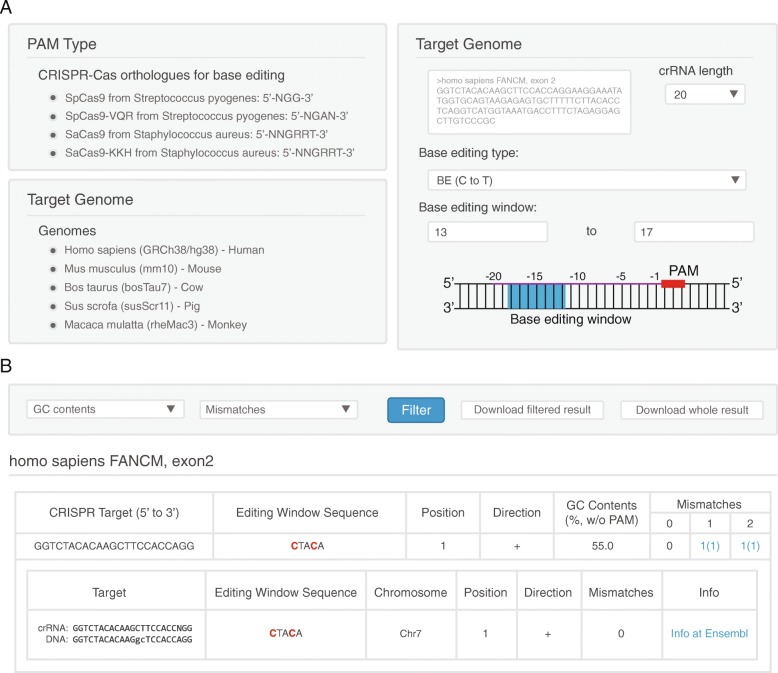
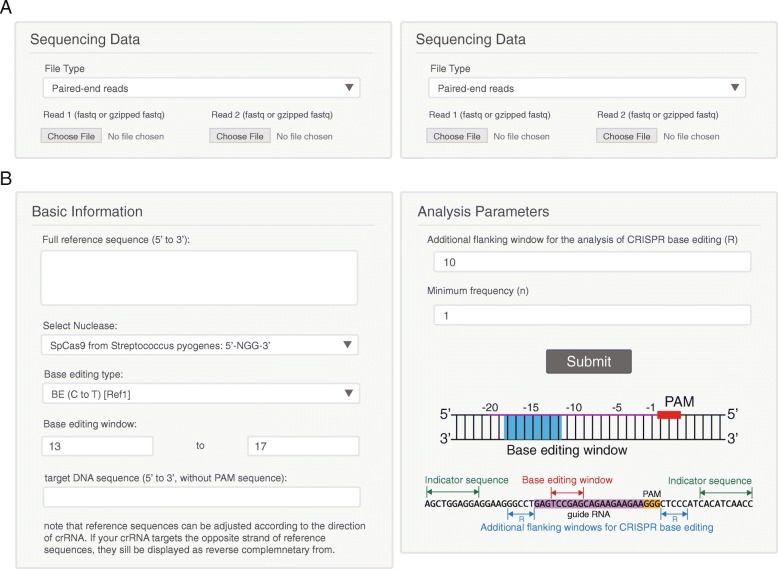
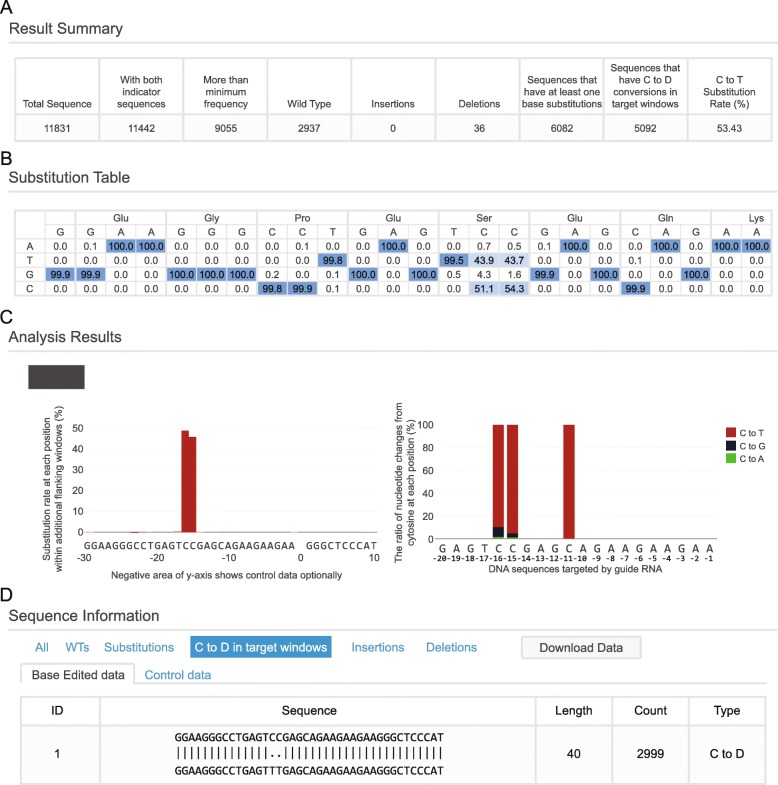
BACKGROUND: As a result of its simplicity and high efficiency, the CRISPR-Cas system has been widely used as a genome editing tool. Recently, CRISPR base editors, which consist of deactivated Cas9 (dCas9) or Cas9 nickase (nCas9) linked with a cytidine or a guanine deaminase, have been developed. Base editing tools will be very useful for gene correction because they can produce highly specific DNA substitutions without the introduction of any donor DNA, but dedicated web-based tools to facilitate the use of such tools have not yet been developed. RESULTS: We present two web tools for base editors, named BE-Designer and BE-Analyzer. BE-Designer provides all possible base editor target sequences in a given input DNA sequence with useful information including potential off-target sites. BE-Analyzer, a tool for assessing base editing outcomes from next generation sequencing (NGS) data, provides information about mutations in a table and interactive graphs. Furthermore, because the tool runs client-side, large amounts of targeted deep sequencing data (< 1 GB) do not need to be uploaded to a server, substantially reducing running time and increasing data security. BE-Designer and BE-Analyzer can be freely accessed at http://www.rgenome.net/be-designer/ and http://www.rgenome.net/be-analyzer /, respectively. CONCLUSION: We develop two useful web tools to design target sequence (BE-Designer) and to analyze NGS data from experimental results (BE-Analyzer) for CRISPR base editors.
Overview
The claims and statistics of this paper haven’t been checked yet.
Run the check — free, no account needed. It reads the open-access text and checks the sources it cites.
Integrity signals
Registry
Cites
Statistics
Figures
Verification
Claims the paper makes
The claims and statistics of this paper haven’t been checked yet.
Run the check — free, no account needed. It reads the open-access text and checks the sources it cites.
Claims other papers make about this one
Each is checked against this paper’s own text: does it say what the citing paper says it does?
The cited source doesn’t support the claim as written.
In the citing paper
“Off-target prediction was done using CRISPR RGEN Tools allowing up to three mismatches in the prediction algorithm [38].”
From Precise CRISPR/Cas9 and Cas12 Correction Using Lipoplexes in Retinal Models Derived from Patients with Inherited Retinal Dystrophies (2026) · cites this paper as [38]
Checked by a reasoning model — may be wrong.
Experimental — accuracy not yet measuredThe source backs part of the claim, not all of it — or backs it for a different population, condition or comparison.
In the citing paper
“Off-target prediction was performed using the online tool Cas-OFFinder [38], allowing up to three mismatches.”
From Precise CRISPR/Cas9 and Cas12 Correction Using Lipoplexes in Retinal Models Derived from Patients with Inherited Retinal Dystrophies (2026) · cites this paper as [38]
Experimental — accuracy not yet measured
Self-check
Percentages, sums and reported differences re-computed from the paper’s own numbers.
The self-check needs the paper’s full text.
Citations
Cites
A Programmable Dual-RNA–Guided DNA Endonuclease in Adaptive Bacterial Immunity
Jinek, M., Chylinski, K., Fonfara, I., Hauer, M., Doudna, J. A., & Charpentier, E. (2012) · Science · doi:10.1126/science.1225829 · Cited by 17,116
Multiplex Genome Engineering Using CRISPR/Cas Systems
Cong, L., Ran, F. A., Cox, D., Lin, S., Barretto, R., Habib, N., Hsu, P. D., Wu, X., Jiang, W., Marraffini, L. A., et al. (2013) · Science · doi:10.1126/science.1231143 · Cited by 15,339
The new frontier of genome engineering with CRISPR-Cas9
Doudna, J. A., & Charpentier, E. (2014) · Science · doi:10.1126/science.1258096 · Cited by 7,062
Programmable editing of a target base in genomic DNA without double-stranded DNA cleavage
Komor, A. C., Kim, Y. B., Packer, M. S., Zuris, J. A., & Liu, D. R. (2016) · Nature · doi:10.1038/nature17946 · Cited by 5,437
Programmable base editing of A•T to G•C in genomic DNA without DNA cleavage
Gaudelli, N. M., Komor, A. C., Rees, H. A., Packer, M. S., Badran, A. H., Bryson, D. I., & Liu, D. R. (2017) · Nature · doi:10.1038/nature24644 · Cited by 4,184
Double nicking by RNA-guided CRISPR Cas9 for enhanced genome editing specificity
Ran, F. A., Hsu, P. D., Lin, C.-Y., Gootenberg, J. S., Konermann, S., Trevino, A. E., Scott, D. A., Inoue, A., Matoba, S., Zhang, Y., et al. (2013) · Cell · doi:10.1016/j.cell.2013.08.021 · Cited by 3,299
High-Frequency off-Target Mutagenesis Induced by CRISPR-Cas Nucleases in Human Cells
Fu, Y., Foden, J. A., Khayter, C., Maeder, M. L., Reyon, D., Joung, J. K., & Sander, J. D. (2013) · Nature Biotechnology · doi:10.1038/nbt.2623 · Cited by 3,292
CRISPR-Cas systems for editing, regulating and targeting genomes
Sander, J. D., & Joung, J. K. (2014) · Nature Biotechnology · doi:10.1038/nbt.2842 · Cited by 3,153
Bae, S., Park, J., & Kim, J.-S. (2014) · Bioinformatics · doi:10.1093/bioinformatics/btu048 · Cited by 2,339
Self-citationCrystal structure of Cas9 in complex with guide RNA and target DNA
Nishimasu, H., Ran, F. A., Hsu, P. D., Konermann, S., Shehata, S. I., Dohmae, N., Ishitani, R., Zhang, F., & Nureki, O. (2014) · Cell · doi:10.1016/j.cell.2014.02.001 · Cited by 2,306
Engineered CRISPR-Cas9 nucleases with altered PAM specificities
Kleinstiver, B. P., Prew, M. S., Tsai, S. Q., Topkar, V. V., Nguyen, N. T., Zheng, Z., Gonzales, A. P. W., Li, Z., Peterson, R. T., Yeh, J.-R. J., et al. (2015) · Nature · doi:10.1038/nature14592 · Cited by 1,624
Evolved Cas9 variants with broad PAM compatibility and high DNA specificity
Hu, J. H., Miller, S. M., Geurts, M. H., Tang, W., Chen, L., Sun, N., Zeina, C. M., Gao, X., Rees, H. A., Lin, Z., et al. (2018) · Nature · doi:10.1038/nature26155 · Cited by 1,552
Diversity, classification and evolution of CRISPR-Cas systems
Koonin, E. V., Makarova, K. S., & Zhang, F. (2017) · Current Opinion in Microbiology · doi:10.1016/j.mib.2017.05.008 · Cited by 1,423
Analysis of off-target effects of CRISPR/Cas-derived RNA-guided endonucleases and nickases
Cho, S. W., Kim, S., Kim, Y., Kweon, J., Kim, H. S., Bae, S., & Kim, J.-S. (2014) · Genome Research · doi:10.1101/gr.162339.113 · Cited by 1,356
Self-citationTargeted nucleotide editing using hybrid prokaryotic and vertebrate adaptive immune systems
Nishida, K., Arazoe, T., Yachie, N., Banno, S., Kakimoto, M., Tabata, M., Mochizuki, M., Miyabe, A., Araki, M., Hara, K. Y., et al. (2016) · Science · doi:10.1126/science.aaf8729 · Cited by 1,349
A guide to genome engineering with programmable nucleases
Kim, S., & Kim, J. (2014) · Nature Reviews Genetics · doi:10.1038/nrg3686 · Cited by 1,216
Self-citationBikard, D., Jiang, W., Samai, P., Hochschild, A., Zhang, F., & Marraffini, L. A. (2013) · Nucleic Acids Research · doi:10.1093/nar/gkt520 · Cited by 1,145
Engineered CRISPR-Cas9 nuclease with expanded targeting space
Nishimasu, H., Shi, X., Ishiguro, S., Gao, L., Hirano, S., Okazaki, S., Noda, T., Abudayyeh, O. O., Gootenberg, J. S., Mori, H., et al. (2018) · Science · doi:10.1126/science.aas9129 · Cited by 1,100
Precise base editing in rice, wheat and maize with a Cas9-cytidine deaminase fusion
Zong, Y., Wang, Y., Li, C., Zhang, R., Chen, K., Ran, Y., Qiu, J., Wang, D., & Gao, C. (2017) · Nature Biotechnology · doi:10.1038/nbt.3811 · Cited by 896
In vivo genome editing with a small Cas9 orthologue derived from Campylobacter jejuni
Kim, E., Koo, T., Park, S. W., Kim, D., Kim, K., Cho, H.-Y., Song, D. W., Lee, K. J., Jung, M. H., Kim, S., et al. (2017) · Nature Communications · doi:10.1038/ncomms14500 · Cited by 715
Self-citationMao, Z., Bozzella, M. J., Seluanov, A., & Gorbunova, V. A. (2008) · Cell Cycle · doi:10.4161/cc.7.18.6679 · Cited by 695
Broadening the targeting range of Staphylococcus aureus CRISPR-Cas9 by modifying PAM recognition
Kleinstiver, B. P., Prew, M. S., Tsai, S. Q., Nguyen, N. T., Topkar, V. V., Zheng, Z., & Joung, J. K. (2015) · Nature Biotechnology · doi:10.1038/nbt.3404 · Cited by 611
Cas-Designer: a web-based tool for choice of CRISPR-Cas9 target sites
Park, J., Bae, S., & Kim, J. (2015) · Bioinformatics · doi:10.1093/bioinformatics/btv537 · Cited by 483
Self-citationCas-analyzer: an online tool for assessing genome editing results using NGS data
Park, J., Lim, K., Kim, J., & Bae, S. (2016) · Bioinformatics · doi:10.1093/bioinformatics/btw561 · Cited by 406
Self-citationHighly efficient RNA-guided base editing in mouse embryos
Kim, K., Ryu, S.-M., Kim, S., Baek, G., Kim, D., Lim, K., Chung, E., Kim, S., & Kim, J. (2017) · Nature Biotechnology · doi:10.1038/nbt.3816 · Cited by 378
Self-citationBillon, P., Bryant, E. E., Joseph, S. A., Nambiar, T. S., Hayward, S. B., Rothstein, R., & Ciccia, A. (2017) · Molecular Cell · doi:10.1016/j.molcel.2017.08.008 · Cited by 363
CRISPR-STOP: gene silencing through base-editing-induced nonsense mutations
Kuscu, C., Parlak, M., Tufan, T., Yang, J., Szlachta, K., Wei, X., Mammadov, R., & Adli, M. (2017) · Nature Methods · doi:10.1038/nmeth.4327 · Cited by 344
DNA-free two-gene knockout in Chlamydomonas reinhardtii via CRISPR-Cas9 ribonucleoproteins
Baek, K., Kim, D. H., Jeong, J., Sim, S. J., Melis, A., Kim, J., Jin, E., & Bae, S. (2016) · Scientific Reports · doi:10.1038/srep30620 · Cited by 342
Self-citationStreptococcus thermophilus CRISPR-cas9 systems enable specific editing of the human genome
Müller, M., Lee, C. M., Gasiunas, G., Davis, T. H., Cradick, T. J., Siksnys, V., Bao, G., Cathomen, T., & Mussolino, C. (2016) · Molecular Therapy · doi:10.1038/mt.2015.218 · Cited by 254
Correction of β-thalassemia mutant by base editor in human embryos
Liang, P., Ding, C., Sun, H., Xie, X., Xu, Y., Zhang, X., Sun, Y., Xiong, Y., Ma, W., Liu, Y., et al. (2017) · Protein & Cell · doi:10.1007/s13238-017-0475-6 · Cited by 217
Park, C. Y., Krishnan, A., Zhu, Q., Wong, A. K., Lee, Y.-S., & Troyanskaya, O. G. (2014) · Bioinformatics · doi:10.1093/bioinformatics/btu786 · Cited by 97
Effective gene editing by high-fidelity base editor 2 in mouse zygotes
Liang, P., Sun, H., Sun, Y., Zhang, X., Xie, X., Zhang, J., Zhang, Z., Chen, Y., Ding, C., Xiong, Y., et al. (2017) · Protein & Cell · doi:10.1007/s13238-017-0418-2 · Cited by 91
Cited by
Sorted by citations
Genome editing with CRISPR–Cas nucleases, base editors, transposases and prime editors
Anzalone, A. V., Koblan, L. W., & Liu, D. R. (2020) · Nature Biotechnology · doi:10.1038/s41587-020-0561-9 · Cited by 2,237
Base editing: advances and therapeutic opportunities
Porto, E. M., Komor, A. C., Slaymaker, I. M., & Yeo, G. W.-M. (2020) · Nature Reviews Drug Discovery · doi:10.1038/s41573-020-0084-6 · Cited by 499
PnB Designer: a web application to design prime and base editor guide RNAs for animals and plants
Siegner, S. M., Karasu, M. E., Schröder, M., Kontarakis, Z., & Corn, J. E. (2021) · BMC Bioinformatics · doi:10.1186/s12859-021-04034-6 · Cited by 436
Precise plant genome editing using base editors and prime editors
Molla, K. A., Sretenovic, S., Bansal, K. C., & Qi, Y. (2021) · Nature Plants · doi:10.1038/s41477-021-00991-1 · Cited by 387
Dual base editor catalyzes both cytosine and adenine base conversions in human cells
Zhang, X., Zhu, B., Chen, L., Xie, L., Yu, W., Wang, Y., Li, L., Yin, S., Yang, L., Hu, H., et al. (2020) · Nature Biotechnology · doi:10.1038/s41587-020-0527-y · Cited by 272
Metadata
- Authors
- Hwang, G.-H., Park, J., Lim, K., Kim, S., Yu, J., Yu, E., Kim, S.-T., Eils, R., Kim, J.-S., & Bae, S.
- Affiliations
- Hanyang University (KR)
- Heidelberg University (DE)
- Seoul National University (KR)
- University Hospital Heidelberg (DE)
- Corresponding author
- Bae, Sangsu
- ORCID
- Venue
- BMC Bioinformatics
- Published
- 2018-12
- Volume
- 19
- Issue
- 1
- Pages
- 542-542
- ISSN
- 1471-2105 (ISSN-L)
- PMC
- PMC6307267
- OpenAlex
- W2883250809
- Cited by
- 198
- References
- 33
- Citations by year
- 2026: 12 · 2025: 34 · 2024: 29 · 2023: 23 · 2022: 27 · 2021: 29 · 2020: 32 · 2019: 12
- FWCI
- 6.49
- Type
- journal article
- Language
- en
- Open access
- gold
- doi.org
- Licence
- Locations
- BMC Bioinformatics (publishedVersion, cc-by)
- bioRxiv (Cold Spring Harbor Laboratory) (acceptedVersion)
- Europe PMC (PubMed Central) (publishedVersion, cc-by)
- PubMed Central (publishedVersion, cc-by)
- PubMed (publishedVersion)
- heiDOK (Heidelberg University) (acceptedVersion, other-oa)
- DOAJ (DOAJ: Directory of Open Access Journals) (submittedVersion, cc-by-sa)
- Seoul National University Open Repository (Seoul National University) (submittedVersion)
- Funders
- Deutsches Krebsforschungszentrum
- National Research Foundation (2017M3A9G8084539, 2018M3A9H3022412, HI16C1012)
- Ministry of Trade, Industry and Energy (20000158)
- National Research Foundation of Korea (PJ01319301, 2018M3A9H3022412, 20000158, 2017M3A9G8084539)
- Topics
- Life Sciences › Biochemistry, Genetics and Molecular Biology › Molecular Biology › CRISPR and Genetic Engineering
- Life Sciences › Biochemistry, Genetics and Molecular Biology › Molecular Biology › RNA regulation and disease
- Life Sciences › Biochemistry, Genetics and Molecular Biology › Molecular Biology › Genomics and Phylogenetic Studies
- Keywords
- CRISPR base editing, web-based design tool, off-target sites, cytidine deaminase, guanine deaminase, dCas9, next-generation sequencing data analysis, genome editing
- MeSH terms
- Gene Editing, Humans, Internet, Clustered Regularly Interspaced Short Palindromic Repeats, CRISPR-Cas Systems
About these checks
Registry, retraction, Cites and statistics results are computed, not judged, with one exception: a printed reference that no index lists is read once by a model before it counts as a citation error. Claims are extracted by a model and kept only when their quote appears verbatim in the text; each cited source is then checked, with a model’s help, for whether it says what the claim relies on. Those verdicts can be wrong — read the claim’s quote and the cited source before relying on one.
Statistics and arithmetic are recomputed, not judged.
Confidence bands are shown only for fields calibrated on our annotated test set. None is calibrated yet, so no band is shown.
What counts as a claim ›How we measure confidence ›How we check this ›
Are you an author, or do you see a problem with this page? Request a review
