

Quasispecies in population of compositional assemblies
Open accessThe DOI matches its Crossref record; 66 of the 66 references it cites were found in a registry or an index.
Abstract
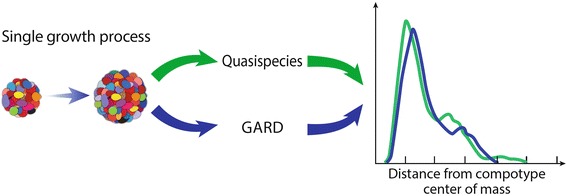
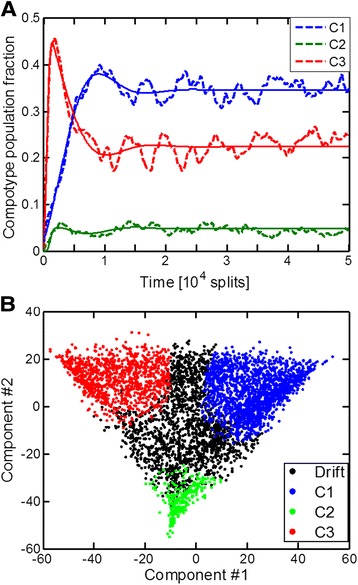
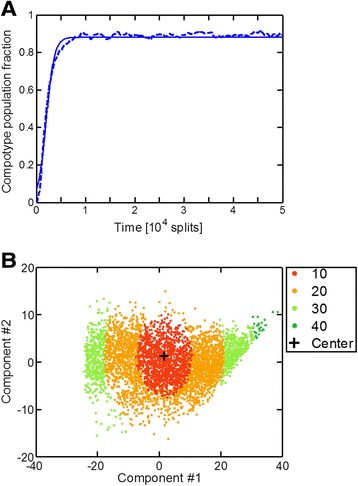
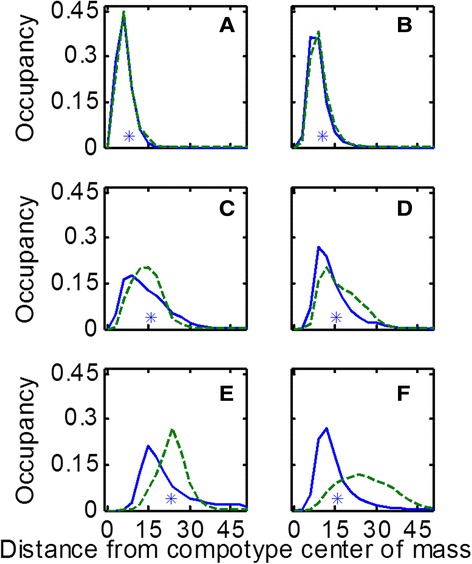
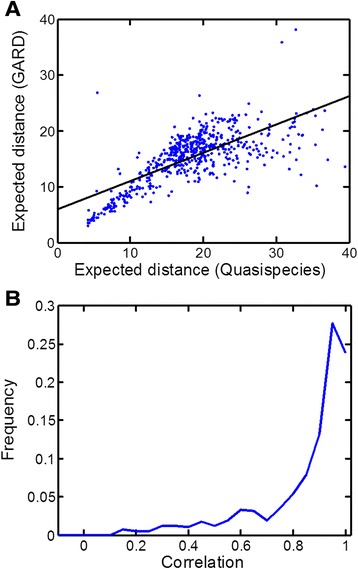
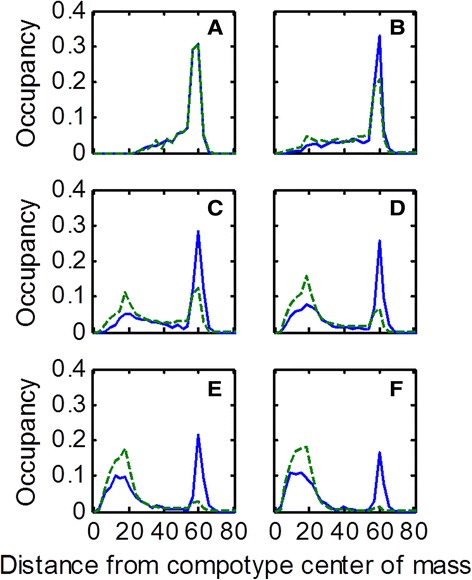
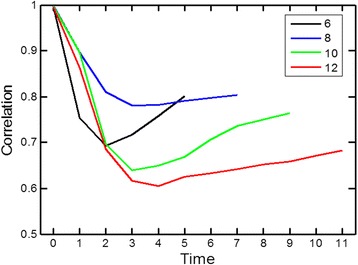
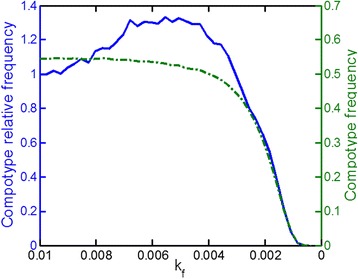
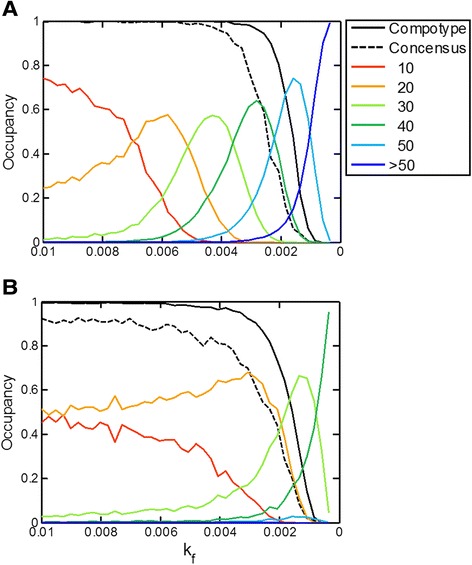
BACKGROUND: The quasispecies model refers to information carriers that undergo self-replication with errors. A quasispecies is a steady-state population of biopolymer sequence variants generated by mutations from a master sequence. A quasispecies error threshold is a minimal replication accuracy below which the population structure breaks down. Theory and experimentation of this model often refer to biopolymers, e.g. RNA molecules or viral genomes, while its prebiotic context is often associated with an RNA world scenario. Here, we study the possibility that compositional entities which code for compositional information, intrinsically different from biopolymers coding for sequential information, could show quasispecies dynamics. RESULTS: We employed a chemistry-based model, graded autocatalysis replication domain (GARD), which simulates the network dynamics within compositional molecular assemblies. In GARD, a compotype represents a population of similar assemblies that constitute a quasi-stationary state in compositional space. A compotype's center-of-mass is found to be analogous to a master sequence for a sequential quasispecies. Using single-cycle GARD dynamics, we measured the quasispecies transition matrix (Q) for the probabilities of transition from one center-of-mass Euclidean distance to another. Similarly, the quasispecies' growth rate vector (A) was obtained. This allowed computing a steady state distribution of distances to the center of mass, as derived from the quasispecies equation. In parallel, a steady state distribution was obtained via the GARD equation kinetics. Rewardingly, a significant correlation was observed between the distributions obtained by these two methods. This was only seen for distances to the compotype center-of-mass, and not to randomly selected compositions. A similar correspondence was found when comparing the quasispecies time dependent dynamics towards steady state. Further, changing the error rate by modifying basal assembly joining rate of GARD kinetics was found to display an error catastrophe, similar to the standard quasispecies model. Additional augmentation of compositional mutations leads to the complete disappearance of the master-like composition. CONCLUSIONS: Our results show that compositional assemblies, as simulated by the GARD formalism, portray significant attributes of quasispecies dynamics. This expands the applicability of the quasispecies model beyond sequence-based entities, and potentially enhances validity of GARD as a model for prebiotic evolution.
Overview
The claims and statistics of this paper haven’t been checked yet.
Free: it reads the open-access text and checks the first 5 claims that cite a source we can check. Create a free account to check every claim.
Integrity signals
Registry
Cites
Statistics
Figures
Verification
Claims the paper makes
The claims and statistics of this paper haven’t been checked yet.
Free: it reads the open-access text and checks the first 5 claims that cite a source we can check. Create a free account to check every claim.
Claims other papers make about this one
Each is checked against this paper’s own text: does it say what the citing paper says it does?
The source backs part of the claim, not all of it — or backs it for a different population, condition or comparison.
In the citing paper
“This behaviour suggests that GARD composomes are attractors in compositional dynamics, as discussed [62,106], conforming to the definition of ‘a set of numerical values toward which a system tends to evolve, for a wide variety of starting conditions' [107, p. 113].”
From Systems protobiology: origin of life in lipid catalytic networks (2018) · cites this paper as [62]
Experimental — accuracy not yet measuredThe source backs part of the claim, not all of it — or backs it for a different population, condition or comparison.
In the citing paper
“We have mapped the composome formalism to that of quasi-species, showing that the quasi-species-equivalent is always around a composome and not around random ‘drift’ assemblies [62].”
From Systems protobiology: origin of life in lipid catalytic networks (2018) · cites this paper as [62]
Experimental — accuracy not yet measuredThe cited source says what the claim attributes to it.
In the citing paper
“In undergoing selection as a cloud of similar compositions, composomes are in fact analogous to quasi-species, as we have shown [62], whereby ‘the target of selection is not an individual mutant sequence but the whole quasi-species' [109, p. 121].”
From Systems protobiology: origin of life in lipid catalytic networks (2018) · cites this paper as [62]
Self-check
Percentages, sums and reported differences re-computed from the paper’s own numbers.
The self-check needs the paper’s full text.
Citations
Cites
Selforganization of matter and the evolution of biological macromolecules
Eigen, M. (1971) · Die Naturwissenschaften · doi:10.1007/bf00623322 · Cited by 3,788 · cited 1×
“The quasispecies theory describes the replication o f asexual replicators at high error rate, and was first proposed to describe error-prone replicat ion of primitive information-carrying macromolecules at the origin of life [1,2].”
BackgroundGilbert, W. (1986) · Nature · doi:10.1038/319618a0 · Cited by 2,721 · cited 2×
“As GARD assemblies store information in the form of non-random molecular compositions, and transfer this information to fission-generated progeny, they could be considered as alternative to the RNA world scenario for the origin of life [44-50].”
BackgroundThe Hypercycle: A principle of natural self-organization
Eigen, M., & Schuster, P. M. (1979) · Cited by 1,906
Mass-spectrometry-based draft of the human proteome
Wilhelm, M., Schlegl, J., Hahne, H., Gholami, A. M., Lieberenz, M., Savitski, M. M., Ziegler, E., Butzmann, L., Gessulat, S., Marx, H., et al. (2014) · Nature · doi:10.1038/nature13319 · Cited by 1,820 · cited 1×
“In an example, the identity of a living cell can be defined, to an extent, by the counts of all its RNA types (transcriptome) and proteins types (proteome) [30-35].”
BackgroundA principle of natural self-organization: Part A: Emergence of the hypercycle
Eigen, M., & Schuster, P. (1977) · Naturwissenschaften · doi:10.1007/bf00450633 · Cited by 1,752
Sanjuán, R., Nebot, M. R., Chirico, N., Mansky, L. M., & Belshaw, R. (2010) · Journal of Virology · doi:10.1128/jvi.00694-10 · Cited by 1,246 · cited 2×
“While the theory is general to replication, a widely used application of quasispecies is in describing RNA viruses, which have low replication fidelity with measured high mutations rates [6-10], though the model’s validity for some RNA viruses has been a topic of dispute [7,9,11-13].”
BackgroundPrebiotic chemistry and the origin of the RNA world.
Leslie E., O. (2004) · Critical Reviews in Biochemistry and Molecular Biology · doi:10.1080/10409230490460765 · Cited by 1,124 · cited 1×
“As GARD assemblies store information in the form of non-random molecular compositions, and transfer this information to fission-generated progeny, they could be considered as alternative to the RNA world scenario for the origin of life [44-50].”
BackgroundThe antiquity of RNA-based evolution.
Joyce, G. F. (2002) · Nature · doi:10.1038/418214a · Cited by 1,070 · cited 2×
“As GARD assemblies store information in the form of non-random molecular compositions, and transfer this information to fission-generated progeny, they could be considered as alternative to the RNA world scenario for the origin of life [44-50].”
BackgroundMoran, P. A. P. (1958) · Mathematical Proceedings of the Cambridge Philosophical Society · doi:10.1017/s0305004100033193 · Cited by 1,065
RNA virus error catastrophe: Direct molecular test by using ribavirin
Crotty, S., Cameron, C. E., & Andino, R. (2001) · Proceedings of the National Academy of Sciences · doi:10.1073/pnas.111085598 · Cited by 849 · cited 1×
“As RNA viru ses replicate with relatively high mutations rates [10], they are susceptible to condi tions which increase their mutation rates to push them beyond the error catastrophe [20-22], a p rocess parallel to extinction by the direct induction of deleterious mutations [23,24].”
BackgroundExperimental Models of Primitive Cellular Compartments: Encapsulation, Growth, and Division
Hanczyc, M. M., Fujikawa, S. M., & Szostak, J. W. (2003) · Science · doi:10.1126/science.1089904 · Cited by 848 · cited 1×
“The genetic- (or replicator-) first scenario, also known as “information first” scenario, assumes that a molecule identical or very similar to present day RNA played the role of the self-perpetuating biopolymer [44,46,52,53].”
BackgroundQuasispecies Theory and the Behavior of RNA Viruses
Lauring, A. S., & Andino, R. (2010) · PLoS Pathogens · doi:10.1371/journal.ppat.1001005 · Cited by 846 · cited 1×
“While the theory is general to replication, a widely used application of quasispecies is in describing RNA viruses, which have low replication fidelity with measured high mutations rates [6-10], though the model’s validity for some RNA viruses has been a topic of dispute [7,9,11-13].”
BackgroundDyson, F. J. (1985) · Cited by 727
Eigen, M., McCaskill, J., & Schuster, P. (1988) · The Journal of Physical Chemistry · doi:10.1021/j100335a010 · Cited by 670 · cited 3×
“The quasispecies formalism describes a population of self-replicating genotypes (Equation 1) [2-4].”
BackgroundResultSegré, D., Ben-Eli, D., Deamer, D. W., & Lancet, D. (2001) · Origins of life and evolution of the biosphere · doi:10.1023/a:1006746807104 · Cited by 620 · cited 3×
“As a model of compositional replication/ reproduction, we employ the graded autocatalysis replication domain (GARD), a chemistry-based formalism that simulates network dynamics within amphiphile-containing compositional assemblies [36-38].”
BackgroundMethodSelf-citationSmoothness within ruggedness: the role of neutrality in adaptation.
Huynen, M. A., Stadler, P. F., & Fontana, W. (1996) · Proceedings of the National Academy of Sciences · doi:10.1073/pnas.93.1.397 · Cited by 539 · cited 1×
“more than one genotype give rise to the fittest phenotype), the error threshold can be formulated in terms of phenotypes, and it the population can sustain a lower degree of replication accuracy [18,19].”
BackgroundNesvizhskii, A. I. (2010) · Journal of Proteomics · doi:10.1016/j.jprot.2010.08.009 · Cited by 536
RNA Virus Populations as Quasispecies
Holland, J. J., De La Torre, J. C., & Steinhauer, D. A. (1992) · Current Topics in Microbiology and Immunology · doi:10.1007/978-3-642-77011-1_1 · Cited by 512 · cited 1×
“While the theory is general to replication, a widely used application of quasispecies is in describing RNA viruses, which have low replication fidelity with measured high mutations rates [6-10], though the model’s validity for some RNA viruses has been a topic of dispute [7,9,11-13].”
BackgroundSingle-cell systems biology by super-resolution imaging and combinatorial labeling
Lubeck, E., & Cai, L. (2012) · Nature Methods · doi:10.1038/nmeth.2069 · Cited by 458 · cited 1×
“In an example, the identity of a living cell can be defined, to an extent, by the counts of all its RNA types (transcriptome) and proteins types (proteome) [30-35].”
BackgroundOparin, A. I., & Morgulis, S. (1938) · Cited by 425
Compositional genomes: Prebiotic information transfer in mutually catalytic noncovalent assemblies
Segré, D., Ben-Eli, D., & Lancet, D. (2000) · Proceedings of the National Academy of Sciences · doi:10.1073/pnas.97.8.4112 · Cited by 398 · cited 7×
“composition, and occasional fission occurs such tha t an assembly is out-of-equilibrium [36].”
BackgroundMethodInfluentialSelf-citationWhat is Good Ecological Restoration?: ¿Que es una Buena Restauración Ecológica?
Higgs, E. S. (1997) · Conservation Biology · doi:10.1046/j.1523-1739.1997.95311.x · Cited by 374 · cited 1×
“The second information type is compositional information, which plays a parallel central role in biological systems [25-29,54].”
BackgroundSwetina, J., & Schuster, P. (1982) · Biophysical Chemistry · doi:10.1016/0301-4622(82)87037-3 · Cited by 350
The Coming Age of Complete, Accurate, and Ubiquitous Proteomes
Mann, M., Kulak, N. A., Nagaraj, N., & Cox, J. (2013) · Molecular Cell · doi:10.1016/j.molcel.2013.01.029 · Cited by 350 · cited 1×
“In an example, the identity of a living cell can be defined, to an extent, by the counts of all its RNA types (transcriptome) and proteins types (proteome) [30-35].”
BackgroundError catastrophe and antiviral strategy
Eigen, M. (2002) · Proceedings of the National Academy of Sciences · doi:10.1073/pnas.212514799 · Cited by 339 · cited 3×
“Similarly to a consensus-sequence [7,51], the consensus-composition is a vector, where each molecular-type i is assigned with the most probable ni value within the compotype member assemblies.”
BackgroundResultGesteland, & Cech, T. R. (1999) · Cited by 339
Lipid vesicles as possible intermediates in the origin of life
Luisi, P. L., Walde, P., & Oberholzer, T. (1999) · Current Opinion in Colloid & Interface Science · doi:10.1016/s1359-0294(99)00012-6 · Cited by 287 · cited 1×
“The metabolism-first scenario suggests that the very fi rst life precursors are likely to have been relatively elaborate molecular networks of simple m olecules [38,45,48,54,55].”
BackgroundBernhardt, H. S. (2012) · Biology Direct · doi:10.1186/1745-6150-7-23 · Cited by 276 · cited 1×
“As GARD assemblies store information in the form of n n-random molecular compositions, and transfer this information to fission-generated progeny, they could be considered as alternative to the RNA world scenario for the origi n of life [44-50].”
BackgroundQuasispecies theory in the context of population genetics
Wilke, C. O. (2005) · BMC Evolutionary Biology · doi:10.1186/1471-2148-5-44 · Cited by 276
Single-cell gene expression analysis reveals genetic associations masked in whole-tissue experiments
Wills, Q. F., Livak, K. J., Tipping, A. J., Enver, T., Goldson, A. J., Sexton, D. W., & Holmes, C. (2013) · Nature Biotechnology · doi:10.1038/nbt.2642 · Cited by 249 · cited 1×
“In an example, the identity of a living cell can be defined, to an extent, by the counts of all its RNA types (transcriptome) and proteins types (proteome) [30-35].”
BackgroundSierra, S., Dávila, M., Lowenstein, P. R., & Domingo, E. (2000) · Journal of Virology · doi:10.1128/jvi.74.18.8316-8323.2000 · Cited by 222 · cited 1×
“As RNA viruses replicate with relatively high mutations rates [10], they are susceptible to conditions which increase their mutation rates to push them beyond the error catastrophe [20-22], a process parallel to extinction by the direct induction of deleterious mutations [23,24].”
BackgroundDyson, F. (1999) · doi:10.1017/cbo9780511546303 · Cited by 219
Vasas, V., Szathmáry, E., & Santos, M. (2010) · Proceedings of the National Academy of Sciences · doi:10.1073/pnas.0912628107 · Cited by 196 · cited 1×
“This is in contrast to a previous study [61], where the Q and A vector where directly calculated by using substantially different NG and Nmax values than those typically employed in GARD, whic h enabled direct enumeration of the small number of possible composi tions.”
ResultThe Human Transcriptome: An Unfinished Story
Pertea, M. (2012) · Genes · doi:10.3390/genes3030344 · Cited by 181 · cited 1×
“In an example, the identity of a living cell can be defined, to an extent, by the counts of all its RNA types (transcriptome) and proteins types (proteome) [30-35].”
BackgroundSmall Molecule Interactions Were Central to the Origin of Life
Shapiro, R. (2006) · The Quarterly Review of Biology · doi:10.1086/506024 · Cited by 180 · cited 2×
“As GARD assemblies store information in the form of n n-random molecular compositions, and transfer this information to fission-generated progeny, they could be considered as alternative to the RNA world scenario for the origi n of life [44-50].”
BackgroundCHO Quasispecies—Implications for Manufacturing Processes
Wurm, F. (2013) · Processes · doi:10.3390/pr1030296 · Cited by 171
Biebricher, C. K., & Eigen, M. (2006) · Current Topics in Microbiology and Immunology · doi:10.1007/3-540-26397-7_1 · Cited by 170 · cited 4×
“The quasispecies formalism describes a population of self-replicating genotypes (Equation 1) [2-4].”
BackgroundInfluentialReal ribozymes suggest a relaxed error threshold
Kun, Á., Santos, M., & Szathmáry, E. (2005) · Nature Genetics · doi:10.1038/ng1621 · Cited by 151 · cited 1×
“Other biological applications of quasispecies are to the multiple laboratory instances of the Chinese hamster ovary cell line [14] and to catalytic RNA molecules [15,16].”
Quasispecies Theory in Virology
Domingo, E. (2002) · Journal of Virology · doi:10.1128/jvi.76.1.463-465.2002 · Cited by 150 · cited 2×
“While the theory is general to replication, a widely used application of quasispecies is in describing RNA viruses, which have low replication fidelity with measured high mutations rates [6-10], though the model’s validity for some RNA viruses has been a topic of dispute [7,9,11-13].”
BackgroundSegré, D., & Lancet, D. (2000) · The EMBO Reports · doi:10.1093/embo-reports/kvd063 · Cited by 133 · cited 3×
“As a model of compositional replication/ reproduction, we employ the graded autocatalysis replication domain (GARD), a chemistry-based formalism that simulates network dynamics within amphiphile-containing compositional assemblies [36-38].”
BackgroundMethodSelf-citationSmall molecule interactions were central to the origin of life
Shapiro, R. (2010) · The Nature of Life · doi:10.1017/cbo9780511730191.013 · Cited by 130
Is the Quasispecies Concept Relevant to RNA Viruses?
Holmes, E. C., & Moya, A. (2002) · Journal of Virology · doi:10.1128/jvi.76.1.460-462.2002 · Cited by 127 · cited 1×
“While the theory is general to replication, a widely used application of quasispecies is in describing RNA viruses, which have low replication fidelity with measured high mutations rates [6-10], though the model’s validity for some RNA viruses has been a topic of dispute [7,9,11-13].”
BackgroundThe place of metabolism in the origin of life
Anet, F. A. L. (2004) · Current Opinion in Chemical Biology · doi:10.1016/j.cbpa.2004.10.005 · Cited by 124 · cited 2×
“The second information type is compositional information, which plays a parallel central role in biological systems [25-29,54].”
BackgroundCompositional complementarity and prebiotic ecology in the origin of life
Hunding, A., Kepes, F., Lancet, D., Minsky, A., Norris, V., Raine, D., Sriram, K., & Root‐Bernstein, R. (2006) · BioEssays · doi:10.1002/bies.20389 · Cited by 113 · cited 1×
“Compositional entities have been invoked in models for early evolution [28,37-40].”
BackgroundSelf-citationEvolutionary dynamics of RNA-like replicator systems: A bioinformatic approach to the origin of life
Takeuchi, N., & Hogeweg, P. (2012) · Physics of Life Reviews · doi:10.1016/j.plrev.2012.06.001 · Cited by 113 · cited 1×
“As GARD assemblies store information in the form of non-random molecular compositions, and transfer this information to fission-generated progeny, they could be considered as alternative to the RNA world scenario for the origin of life [44-50].”
BackgroundKüppers, B. (1983) · Springer eBooks · doi:10.1007/978-3-642-70544-1 · Cited by 101
Evolution of the Genetic Apparatus: A Review
Orgel, L. E. (1987) · Cold Spring Harbor Symposia on Quantitative Biology · doi:10.1101/sqb.1987.052.01.004 · Cited by 97 · cited 1×
“The second information type is compositional information, which plays a parallel central role in biological systems [25-29,54].”
BackgroundThe Molecular Roots of Compositional Inheritance
SEGRÉ, D., SHENHAV, B., KAFRI, R., & LANCET, D. (2001) · Journal of Theoretical Biology · doi:10.1006/jtbi.2001.2440 · Cited by 82 · cited 1×
“When β is represented in the matrix form, it is a positive matrix, as each of its βij values are sampled from a lognormal distribution [59].”
BackgroundSelf-citationDuration and fitness dependence of quasispecies memory
Ruiz-Jarabo, C. M., Arias, A., Molina-París, C., Briones, C., Baranowski, É., Escarmís, C., & Domingo, E. (2002) · Journal of Molecular Biology · doi:10.1006/jmbi.2001.5232 · Cited by 80 · cited 1×
“While the theory is general to replication, a widel y used application of quasispecies is in describing RNA viruses, which have low replication fidelity with measured high mutations rates [6-10], though the model?s validity for some RNA viruses has been a topic of dispute [7,9,11-13].”
BackgroundQuasispecies as a matter of fact: Viruses and beyond
Ojosnegros, S., Perales, C., Mas, A., & Domingo, E. (2011) · Virus Research · doi:10.1016/j.virusres.2011.09.018 · Cited by 78 · cited 1×
“As RNA viruses replicate with relatively high mutations rates [10], they are susceptible to conditions which increase their mutation rates to push them beyond the error catastrophe [20-22], a process parallel to extinction by the direct induction of deleterious mutations [23,24].”
BackgroundError-threshold exists in fitness landscapes with lethal mutants.
Takeuchi, N., & Hogeweg, P. (2007) · BMC Evolutionary Biology · doi:10.1186/1471-2148-7-15 · Cited by 75 · cited 1×
“In the case of sequence-based quasispecies, one of the parameter that influences this threshold is polymer length, whereby longer polymers show higher error threshold suscept ibility [4,56].”
BackgroundExamining The Theory of Error Catastrophe
Summers, J., & Litwin, S. (2006) · Journal of Virology · doi:10.1128/jvi.80.1.20-26.2006 · Cited by 72 · cited 1×
“As RNA viruses replicate with relatively high mutations rates [10], they are susceptible to conditions which increase their mutation rates to push them beyond the error catastrophe [20-22], a process parallel to extinction by the direct induction of deleterious mutations [23,24].”
BackgroundExcess mutual catalysis is required for effective evolvability
Markovitch, O., & Lancet, D. (2012) · Artificial Life · doi:10.1162/artl_a_00064 · Cited by 68 · cited 5×
“The GARD10 MATLAB code was used for all simulations [42].”
BackgroundMethodInfluentialSelf-citationEvidence for the Non-quasispecies Evolution of RNA Viruses
Jenkins, G. M., Worobey, M., Woelk, C. H., & Holmes, E. C. (2001) · Molecular Biology and Evolution · doi:10.1093/oxfordjournals.molbev.a003900 · Cited by 59 · cited 1×
“While the theory is general to replication, a widely used application of quasispecies is in describing RNA viruses, which have low replication fidelity with measured high mutations rates [6-10], though the model?s validity for some RNA viruses has been a topic of dispute [7,9,11-13].”
BackgroundPhenotypic error threshold; additivity and epistasis in RNA evolution
Takeuchi, N., Poorthuis, P. H., & Hogeweg, P. (2005) · BMC Evolutionary Biology · doi:10.1186/1471-2148-5-9 · Cited by 54 · cited 1×
“more than one genotype give rise to the fittest phenotype), the error threshold can be formulated in terms of phenotypes, and it the population can sustain a lower degree of replication accuracy [18,19].”
BackgroundMultispecies population dynamics of prebiotic compositional assemblies
Markovitch, O., & Lancet, D. (2014) · Journal of Theoretical Biology · doi:10.1016/j.jtbi.2014.05.005 · Cited by 43 · cited 6×
“The latter may serve as targets for selection [42], and exhibit ecology-like constant population dynamics [43].”
BackgroundMethodInfluentialSelf-citationCollective properties of evolving molecular quasispecies
Stich, M., Briones, C., & Manrubia, S. C. (2007) · BMC Evolutionary Biology · doi:10.1186/1471-2148-7-110 · Cited by 41 · cited 1×
“Selection acts on the population as a whole rather than on the individual members [5].”
BackgroundCoevolution of compositional protocells and their environment
Shenhav, B., Oz, A., & Lancet, D. (2007) · Philosophical Transactions of the Royal Society B: Biological Sciences · doi:10.1098/rstb.2007.2073 · Cited by 40 · cited 2×
“Similar composomes are grouped into a compotype, using K-means clustering algorithm [41].”
BackgroundMethodSelf-citationPerales, C., Martín, V., & Domingo, E. (2011) · Current Opinion in Virology · doi:10.1016/j.coviro.2011.09.001 · Cited by 35 · cited 1×
“As RNA viruses replicate with relatively high mutations rates [10], they are susceptible to conditions which increase their mutation rates to push them beyond the error catastrophe [20-22], a process parallel to extinction by the direct induction of deleterious mutations [23,24].”
BackgroundA Modular Hierarchy-Based Theory of the Chemical Origins of Life Based on Molecular Complementarity
Root-Bernstein, R. S. (2012) · Accounts of Chemical Research · doi:10.1021/ar200209k · Cited by 31 · cited 2×
“Compositional entities have been invoked in models for early evolution [28,3740].”
BackgroundUse and misuse of supervised pattern recognition methods for interpreting compositional data
González, A. G. (2007) · Journal of Chromatography A · doi:10.1016/j.chroma.2007.02.091 · Cited by 26 · cited 1×
“The second information type is compositional informatio n, which plays a parallel central role in biological systems [25-29].”
BackgroundQuasispecies-like behavior observed in catalytic RNA populations evolving in a test tube
Diaz Arenas, C., & Lehman, N. (2010) · BMC Evolutionary Biology · doi:10.1186/1471-2148-10-80 · Cited by 25 · cited 1×
“Other biological applications of quasi species are to the multiple laboratory instances of the Chinese hamster ovary cell line [1 4] and to catalytic RNA molecules [15,16].”
BackgroundQuestion 7: The First Units of Life Were Not Simple Cells
Norris, V., Hunding, A., Képès, F., Lancet, D., Minsky, A., Raine, D. J., Root-Bernstein, R. S., & Sriram, K. (2007) · Origins of Life and Evolution of Biospheres · doi:10.1007/s11084-007-9088-z · Cited by 21
Self-citationMolecular Theory of Evolution: Outline of a Physico-Chemical Theory of the Origin of Life
Küppers, B. (1983) · Medical Entomology and Zoology · Cited by 16
Validation of Bacterial Replication Termination Models Using Simulation of Genomic Mutations
Kono, N., Arakawa, K., & Tomita, M. (2012) · PLoS ONE · doi:10.1371/journal.pone.0034526 · Cited by 14 · cited 1×
“The second information type is compositional information, which plays a parallel central role in biological systems [25-29,54].”
BackgroundMutations and Lethality in Simulated Prebiotic Networks
Inger, A., Solomon, A., Shenhav, B., Olender, T., & Lancet, D. (2009) · Journal of Molecular Evolution · doi:10.1007/s00239-009-9281-y · Cited by 14
Self-citation
Cited by
Systems protobiology: origin of life in lipid catalytic networks
Lancet, D., Zidovetzki, R., & Markovitch, O. (2018) · Journal of The Royal Society Interface · doi:10.1098/rsif.2018.0159 · Cited by 182
Self-citationSelf-reproducing catalytic micelles as nanoscopic protocell precursors
Kahana, A., & Lancet, D. (2021) · Nature Reviews Chemistry · doi:10.1038/s41570-021-00329-7 · Cited by 90
Self-citationEnceladus: First Observed Primordial Soup Could Arbitrate Origin-of-Life Debate
Kahana, A., Schmitt-Kopplin, P., & Lancet, D. (2019) · Astrobiology · doi:10.1089/ast.2019.2029 · Cited by 40
“Since then this notion has been further elaborated in detail in a large number of papers from our laboratory, as exemplified (Segré and Lancet, 2000; Segre et al., 2001a,b; Shenhav et al., 2003, 2004, 2005; Bar-Even et al., 2004; Markovitch and Lancet, 2012, 2014; Gross et al., 2014).”
BackgroundInfluentialSelf-citationTwenty Years of “Lipid World”: A Fertile Partnership with David Deamer
Lancet, D., Segrè, D., & Kahana, A. (2019) · Life · doi:10.3390/life9040077 · Cited by 33
“from an endogenous catalytic network with diverse mutual catalytic events deriving from nature’s probability distribution, thus resembling a primitive metabolism [39].”
BackgroundSelf-citationThe Routes of Emergence of Life from LUCA during the RNA and Viral World: A Conspectus
Jheeta, S. (2015) · Life · doi:10.3390/life5021445 · Cited by 25
“Such compotypes displayed Darwinian evolution [33], and they behaved like quasi-species [34], thus suggesting a progression from a random mixture of primordial soup to replicating and evolving entities.”
Background
Metadata
- Authors
- Gross, R., Fouxon, I., Lancet, D., & Markovitch, O.
- Affiliations
- Weizmann Institute of Science (IL)
- Corresponding author
- Markovitch, Omer
- Venue
- BMC Evolutionary Biology
- Published
- 2014-12
- Volume
- 14
- Issue
- 1
- Pages
- 265-265
- ISSN
- 1471-2148 (ISSN-L)
- PMC
- PMC4357159
- OpenAlex
- W2029574921
- Cited by
- 20
- References
- 66
- Citations by year
- 2024: 2 · 2023: 1 · 2021: 2 · 2020: 1 · 2019: 2 · 2018: 7 · 2016: 2 · 2015: 3
- FWCI
- 0.90
- Type
- journal article
- Language
- en
- Open access
- gold
- doi.org
- Locations
- BMC Evolutionary Biology (publishedVersion, cc-by)
- Europe PMC (PubMed Central) (publishedVersion, cc-by)
- PubMed Central (publishedVersion, cc-by)
- PubMed (publishedVersion)
- Apollo (University of Cambridge) (submittedVersion, cc-by)
- Newcastle University ePrints (Newcastle Univesity) (cc-by)
- Topics
- Physical Sciences › Physics and Astronomy › Astronomy and Astrophysics › Origins and Evolution of Life
- Life Sciences › Biochemistry, Genetics and Molecular Biology › Genetics › Evolution and Genetic Dynamics
- Life Sciences › Biochemistry, Genetics and Molecular Biology › Molecular Biology › RNA and protein synthesis mechanisms
- Keywords
- quasispecies model, error threshold, error catastrophe, prebiotic evolution, replication accuracy, stationary distribution
- MeSH terms
- Cells, Computer Simulation, Models, Chemical, Mutation, RNA
About these checks
Registry, retraction, Cites and statistics results are computed, not judged, with one exception: a printed reference that no index lists is read once by a model before it counts as a citation error. Claims are extracted by a model and kept only when their quote appears verbatim in the text; each cited source is then checked, with a model’s help, for whether it says what the claim relies on. Those verdicts can be wrong — read the claim’s quote and the cited source before relying on one.
Statistics and arithmetic are recomputed, not judged.
Confidence bands are shown only for fields calibrated on our annotated test set. None is calibrated yet, so no band is shown.
What counts as a claim ›How we measure confidence ›How we check this ›
Are you an author, or do you see a problem with this page? Request a review
Data sources
Bibliographic data: Semantic Scholar, OpenAlex, Crossref.
Contains information from the Semantic Scholar Academic Graph Datasets, made available under the ODC Attribution License (ODC-BY 1.0).
Semantic Scholar’s data is described in: Kinney, R., et al. (2023). The Semantic Scholar Open Data Platform. arXiv:2301.10140.
