

Improving reporting of meta-ethnography: the eMERGe reporting guidance
Open accessThe DOI matches its Crossref record; 64 of the 64 references it cites were found in a registry or an index.
Abstract
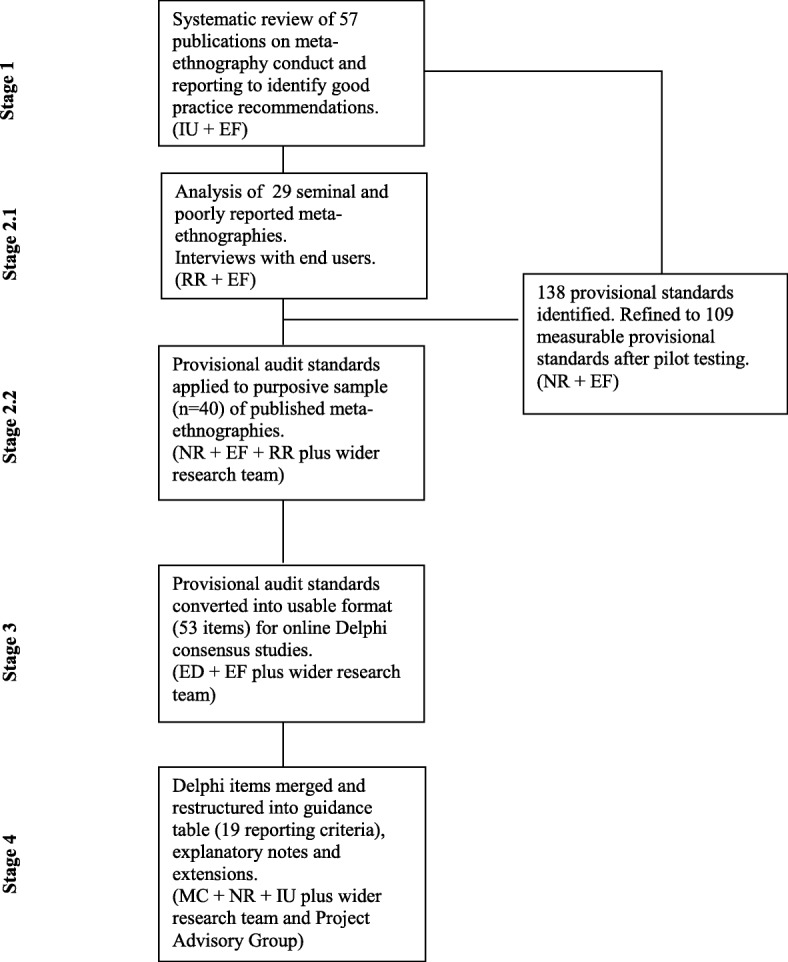
AIMS: The aim of this study was to provide guidance to improve the completeness and clarity of meta-ethnography reporting. BACKGROUND: Evidence-based policy and practice require robust evidence syntheses which can further understanding of people's experiences and associated social processes. Meta-ethnography is a rigorous seven-phase qualitative evidence synthesis methodology, developed by Noblit and Hare. Meta-ethnography is used widely in health research, but reporting is often poor quality and this discourages trust in and use of its findings. Meta-ethnography reporting guidance is needed to improve reporting quality. DESIGN: The eMERGe study used a rigorous mixed-methods design and evidence-based methods to develop the novel reporting guidance and explanatory notes. METHODS: The study, conducted from 2015 to 2017, comprised of: (1) a methodological systematic review of guidance for meta-ethnography conduct and reporting; (2) a review and audit of published meta-ethnographies to identify good practice principles; (3) international, multidisciplinary consensus-building processes to agree guidance content; (4) innovative development of the guidance and explanatory notes. FINDINGS: Recommendations and good practice for all seven phases of meta-ethnography conduct and reporting were newly identified leading to 19 reporting criteria and accompanying detailed guidance. CONCLUSION: The bespoke eMERGe Reporting Guidance, which incorporates new methodological developments and advances the methodology, can help researchers to report the important aspects of meta-ethnography. Use of the guidance should raise reporting quality. Better reporting could make assessments of confidence in the findings more robust and increase use of meta-ethnography outputs to improve practice, policy, and service user outcomes in health and other fields. This is the first tailored reporting guideline for meta-ethnography. This article is being simultaneously published in the following journals: Journal of Advanced Nursing, Psycho-oncology, Review of Education, and BMC Medical Research Methodology.
Overview
The claims and statistics of this paper haven’t been checked yet.
Free: it reads the open-access text and checks the first 5 claims that cite a source we can check. Create a free account to check every claim.
Integrity signals
Registry
Cites
Statistics
Figures
Verification
Claims the paper makes
The claims and statistics of this paper haven’t been checked yet.
Free: it reads the open-access text and checks the first 5 claims that cite a source we can check. Create a free account to check every claim.
Claims other papers make about this one
Each is checked against this paper’s own text: does it say what the citing paper says it does?
The source backs part of the claim, not all of it — or backs it for a different population, condition or comparison.
In the citing paper
“Our preservation of context and meaning of interpretations within and across studies followed guidance by France et al. [19]: we retained the original wording and framing of 2 nd -order interpretations, documented their provenance, and preserved the hierarchical links between interpretations provided by the primary studies.”
From Generative AI in Game Development: A Qualitative Research Synthesis (2026) · cites this paper as [19]
Experimental — accuracy not yet measuredThe cited source says what the claim attributes to it.
In the citing paper
“The PRISMA 2020 items are relevant for mixed-methods systematic reviews (which include quantitative and qualitative studies), but reporting guidelines addressing the presentation and synthesis of qualitative data should also be consulted [39, 40].”
From The PRISMA 2020 statement: an updated guideline for reporting systematic reviews (2021) · cites this paper as [40]
The cited source says what the claim attributes to it.
In the citing paper
“To ensure methodological rigour, we follow the eMERGe reporting guidelines [19] for meta-ethnography”
From Generative AI in Game Development: A Qualitative Research Synthesis (2026) · cites this paper as [19]
The cited source says what the claim attributes to it.
In the citing paper
“For precision and transparency, we report our meta-ethnography in accordance with the 19 criteria outlined in the dedicated eMERGe framework [19].”
From Generative AI in Game Development: A Qualitative Research Synthesis (2026) · cites this paper as [19]
The check wasn’t confident either way, so it gives no verdict — never disputed.
In the citing paper
“The PRISMA 2020 items are relevant for mixed-methods systematic reviews (which include quantitative and qualitative studies), but reporting guidelines addressing the presentation and synthesis of qualitative data should also be consulted.[39, 40]”
From The PRISMA 2020 statement: An updated guideline for reporting systematic reviews (2021) · cites this paper as [40]
Experimental — accuracy not yet measured
2 more claims about this paper
Create a free account to see every claim other papers make about this one.
Self-check
Percentages, sums and reported differences re-computed from the paper’s own numbers.
The self-check needs the paper’s full text.
Citations
Cites
Preferred Reporting Items for Systematic Reviews and Meta-Analyses: the PRISMA statement
Moher, D., Liberati, A., Tetzlaff, J., Altman, D. G., & for the PRISMA Group (2009) · BMJ · doi:10.1136/bmj.b2535 · Cited by 83,823
Preferred Reporting Items for Systematic Reviews and Meta-Analyses: The PRISMA Statement
Moher, D., Liberati, A., Tetzlaff, J., Altman, D. G., & The PRISMA Group (2009) · PLoS Medicine · doi:10.1371/journal.pmed.1000097 · Cited by 64,042
Preferred reporting items for systematic reviews and meta-analyses: the PRISMA Statement.
(2009) · PubMed Central · Cited by 44,859
Wang, G., Ma, R., Qiao, G., Wada, K., Aizawa, Y., & Satoh, T. (2015) · Integrative Medicine International · doi:10.1159/000368408 · Cited by 18,657
Enhancing transparency in reporting the synthesis of qualitative research: ENTREQ
Tong, A., Flemming, K., McInnes, E., Oliver, S., & Craig, J. (2012) · BMC Medical Research Methodology · doi:10.1186/1471-2288-12-181 · Cited by 3,569
Self-citationNoblit, G., & Hare, R. (1988) · doi:10.4135/9781412985000 · Cited by 2,723
Self-citationDixon-Woods, M., Cavers, D., Agarwal, S., Annandale, E., Arthur, A., Harvey, J., Hsu, R., Katbamna, S., Olsen, R., Smith, L., et al. (2006) · BMC Medical Research Methodology · doi:10.1186/1471-2288-6-35 · Cited by 2,289
The Delphi Method: Techniques and Applications
J., J. E., Linstone, H. A., & Turoff, M. (1976) · Technometrics · doi:10.2307/1268751 · Cited by 2,228
Meta-Ethnography: Synthesizing Qualitative Studies
Noblit, G. W., & Hare, R. D. (1988) · Medical Entomology and Zoology · Cited by 2,191
Self-citationMethods for the synthesis of qualitative research: a critical review
Barnett-Page, E., & Thomas, J. (2009) · BMC Medical Research Methodology · doi:10.1186/1471-2288-9-59 · Cited by 2,042
Self-citationGuidance for Developers of Health Research Reporting Guidelines
Moher, D., Schulz, K. F., Simera, I., & Altman, D. G. (2010) · PLoS Medicine · doi:10.1371/journal.pmed.1000217 · Cited by 1,437
Meta‐synthesis method for qualitative research: a literature review
Walsh, D., & Downe, S. (2005) · Journal of Advanced Nursing · doi:10.1111/j.1365-2648.2005.03380.x · Cited by 1,246
Using meta ethnography to synthesise qualitative research: a worked example
Britten, N., Campbell, R., Pope, C., Donovan, J., Morgan, M., & Pill, R. (2002) · Journal of Health Services Research & Policy · doi:10.1258/135581902320432732 · Cited by 1,110
Self-citationConducting a meta-ethnography of qualitative literature: Lessons learnt
Atkins, S., Lewin, S., Smith, H., Engel, M., Fretheim, A., & Volmink, J. (2008) · BMC Medical Research Methodology · doi:10.1186/1471-2288-8-21 · Cited by 981
Self-citationCampbell, R., Pound, P., Pope, C., Britten, N., Pill, R., Morgan, M., & Donovan, J. (2003) · Social Science & Medicine · doi:10.1016/s0277-9536(02)00064-3 · Cited by 921
Self-citationPlint, A. C., Moher, D., Morrison, A., Schulz, K., Altman, D. G., Hill, C., & Gaboury, I. (2006) · Medical Journal of Australia · doi:10.5694/j.1326-5377.2006.tb00557.x · Cited by 872
Resisting medicines: a synthesis of qualitative studies of medicine taking
Pound, P., Britten, N., Morgan, M., Yardley, L., Pope, C., Daker-White, G., & Campbell, R. (2005) · Social Science & Medicine · doi:10.1016/j.socscimed.2004.11.063 · Cited by 868
Self-citationLewin, S., Glenton, C., Munthe-Kaas, H., Carlsen, B., Colvin, C. J., Gülmezoglu, M., Noyes, J., Booth, A., Garside, R., & Rashidian, A. (2015) · PLOS Medicine · doi:10.1371/journal.pmed.1001895 · Cited by 866
Self-citationQualitative Metasynthesis: Reflections on Methodological Orientation and Ideological Agenda
Thorne, S., Jensen, L., Kearney, M. H., Noblit, G., & Sandelowski, M. (2004) · Qualitative Health Research · doi:10.1177/1049732304269888 · Cited by 749
Self-citationEvaluating meta-ethnography: systematic analysis and synthesis of qualitative research
Campbell, R., Pound, P., Morgan, M., Daker-White, G., Britten, N., Pill, R., Yardley, L., Pope, C., & Donovan, J. (2011) · Health Technology Assessment · doi:10.3310/hta15430 · Cited by 619
Self-citationRAMESES publication standards: meta-narrative reviews
Wong, G., Greenhalgh, T., Westhorp, G., Buckingham, J., & Pawson, R. (2013) · BMC Medicine · doi:10.1186/1741-7015-11-20 · Cited by 610
Noyes, J., Booth, A., Flemming, K., Garside, R., Harden, A., Lewin, S., Pantoja, T., Hannes, K., Cargo, M., & Thomas, J. (2018) · Journal of Clinical Epidemiology · doi:10.1016/j.jclinepi.2017.06.020 · Cited by 480
Self-citationThe JBI model of evidence-based healthcare
Pearson, A., Wiechula, R., Court, A., & Lockwood, C. (2005) · International Journal of Evidence-Based Healthcare · doi:10.1111/j.1479-6988.2005.00026.x · Cited by 451
"Brimful of STARLITE": toward standards for reporting literature searches.
Booth, A. (2006) · PubMed Central · Cited by 389
Self-citationMalpass, A., Shaw, A., Sharp, D., Walter, F., Feder, G., Ridd, M., & Kessler, D. (2009) · Social Science & Medicine · doi:10.1016/j.socscimed.2008.09.068 · Cited by 368
Qualitative synthesis and systematic review in health professions education
Bearman, M., & Dawson, P. (2013) · Medical Education · doi:10.1111/medu.12092 · Cited by 357
Pavey, T., Anokye, N., Taylor, A., Trueman, P., Moxham, T., Fox, K., Hillsdon, M., Green, C., Campbell, J., Foster, C., et al. (2011) · Health Technology Assessment · doi:10.3310/hta15440 · Cited by 351
Toye, F., Seers, K., Allcock, N., Briggs, M., Carr, E., & Barker, K. (2014) · BMC Medical Research Methodology · doi:10.1186/1471-2288-14-80 · Cited by 322
Challenges in Approaching Metasynthesis Research
Bondas, T., & Hall, E. O. C. (2007) · Qualitative Health Research · doi:10.1177/1049732306295879 · Cited by 322
Hannes, K., & Macaitis, K. (2012) · Qualitative Research · doi:10.1177/1468794111432992 · Cited by 320
Self-citationAdvancements in Research Synthesis Methods: From a Methodologically Inclusive Perspective
Suri, H., & Clarke, D. (2009) · Review of Educational Research · doi:10.3102/0034654308326349 · Cited by 316
Synthesizing qualitative research: a review of published reports
Dixon-Woods, M., Booth, A., & Sutton, A. J. (2007) · Qualitative Research · doi:10.1177/1468794107078517 · Cited by 260
Self-citationSynthesis through meta-ethnography: paradoxes, enhancements, and possibilities
Doyle, L. H. (2003) · Qualitative Research · doi:10.1177/1468794103033003 · Cited by 241
Finfgeld‐Connett, D., & Johnson, E. D. (2013) · Journal of Advanced Nursing · doi:10.1111/j.1365-2648.2012.06037.x · Cited by 215
A methodological systematic review of what’s wrong with meta-ethnography reporting
France, E. F., Ring, N., Thomas, R., Noyes, J., Maxwell, M., & Jepson, R. (2014) · BMC Medical Research Methodology · doi:10.1186/1471-2288-14-119 · Cited by 183
Self-citationRing, N., Jepson, R. G., Hoskins, G., Wilson, C., Pinnock, H., Sheikh, A., & Wyke, S. (2011) · Patient Education and Counseling · doi:10.1016/j.pec.2011.01.025 · Cited by 156
Self-citationToye, F., Seers, K., Allcock, N., Briggs, M., Carr, E., Andrews, J., & Barker, K. (2013) · BMC Medical Research Methodology · doi:10.1186/1471-2288-13-46 · Cited by 153
Booth, A. (2016) · White Rose Research Online (University of Leeds, The University of Sheffield, University of York) · doi:10.13140/rg.2.1.2318.0562 · Cited by 153
Self-citationDesperately Seeking Dissonance: Identifying the Disconfirming Case in Qualitative Evidence Synthesis
Booth, A., Carroll, C., Ilott, I., Low, L. L., & Cooper, K. (2013) · Qualitative Health Research · doi:10.1177/1049732312466295 · Cited by 145
Self-citationFlemming, K., Booth, A., Hannes, K., Cargo, M., & Noyes, J. (2017) · Journal of Clinical Epidemiology · doi:10.1016/j.jclinepi.2017.10.022 · Cited by 140
Self-citationErasmus, E. (2014) · Health Policy and Planning · doi:10.1093/heapol/czu112 · Cited by 139
Finlayson, K. W., & Dixon, A. (2008) · Nurse Researcher · doi:10.7748/nr2008.01.15.2.59.c6330 · Cited by 138
Metasynthetic Madness: What Kind of Monster Have We Created?
Thorne, S. (2017) · Qualitative Health Research · doi:10.1177/1049732316679370 · Cited by 132
Why, when and how to update a meta-ethnography qualitative synthesis
France, E. F., Wells, M., Lang, H., & Williams, B. (2016) · Systematic Reviews · doi:10.1186/s13643-016-0218-4 · Cited by 116
Self-citationMethods of synthesizing qualitative research studies for health technology assessment
Ring, N., Jepson, R. G., & Ritchie, K. (2011) · International Journal of Technology Assessment in Health Care · doi:10.1017/s0266462311000389 · Cited by 111
Self-citationSociological Explanation as Translation.
Harrell, B. J., & Turner, S. P. (1981) · Contemporary Sociology A Journal of Reviews · doi:10.2307/2066576 · Cited by 92
Qualitative evidence synthesis to improve implementation of clinical guidelines
Carroll, C. (2017) · BMJ · doi:10.1136/bmj.j80 · Cited by 90
Protocol-developing meta-ethnography reporting guidelines (eMERGe)
France, E. F., Ring, N., Noyes, J., Maxwell, M., Jepson, R., Duncan, E., Turley, R., Jones, D., & Uny, I. (2015) · BMC Medical Research Methodology · doi:10.1186/s12874-015-0068-0 · Cited by 82
Self-citationSynthesizing Qualitative Research: Choosing the Right Approach
(2011) · Wiley eBooks · doi:10.1002/9781119959847 · Cited by 80
“It Looks Great but How do I know if it Fits?”: An Introduction to Meta‐Synthesis Research
Paterson, B. L. (2011) · Synthesizing Qualitative Research · doi:10.1002/9781119959847.ch1 · Cited by 76
Metasynthesis and Bricolage: An Artistic Exercise of Creating a Collage of Meaning
Kinn, L. G., Holgersen, H., Ekeland, T., & Davidson, L. (2013) · Qualitative Health Research · doi:10.1177/1049732313502127 · Cited by 67
Metasynthesis Findings: Potential Versus Reality
Finfgeld-Connett, D. L. (2014) · Qualitative Health Research · doi:10.1177/1049732314548878 · Cited by 60
Sociological Explanation as Translation.
Kingston, P. W., & Turner, S. P. (1985) · Social Forces · doi:10.2307/2578612 · Cited by 51
A patient perspective in research on intercultural caring in maternity care: A meta-ethnography
Wikberg, A., & Bondas, T. (2010) · International Journal of Qualitative Studies on Health and Well-being · doi:10.3402/qhw.v5i1.4648 · Cited by 44
Cunningham, M., France, E. F., Ring, N., Uny, I., Duncan, E., Roberts, R. J., Jepson, R. G., Maxwell, M., Turley, R. L., & Noyes, J. (2019) · Health Services and Delivery Research · doi:10.3310/hsdr07040 · Cited by 41
Self-citationQualitative metasynthesis: a technical exercise or a source of new knowledge?
Thorne, S. E. (2015) · Psycho-Oncology · doi:10.1002/pon.3944 · Cited by 40
Uny, I., France, E. F., & Noblit, G. W. (2017) · Ethnography & Education · doi:10.1080/17457823.2017.1282320 · Cited by 36
Self-citationGlenton, C., Lewin, S., & Gülmezoglu, A. M. (2015) · Implementation Science · doi:10.1186/s13012-016-0470-y · Cited by 35
Self-citationMetasynthesis: A Goldmine for Evidence‐Based Practice
Beck, C. T. (2009) · AORN Journal · doi:10.1016/j.aorn.2009.06.025 · Cited by 32
Reviews of Qualitative Evidence: A New Milestone for Cochrane
Gülmezoglu, A. M., Chandler, J., Shepperd, S., & Pantoja, T. (2013) · Cochrane Database of Systematic Reviews · doi:10.1002/14651858.ed000073 · Cited by 32
Garside, R. (2008) · OpenGrey (Institut de l'Information Scientifique et Technique) · Cited by 30
Self-citationBooth, A. (2013) · White Rose eTheses Online (University of Leeds, The University of Sheffield, University of York) · Cited by 18
Self-citationExamination of the phases of metasynthesis: a study on patients' duties as an example.
Kangasniemi, M. K., Länsimies‐Antikainen, H., Halkoaho, A., & Pietilä, A. (2012) · PubMed · Cited by 6
(1975) · Bibliothèque et Archives nationales du Québec (Québec government)
Research works printed but not linked: 5
- Noyes J, Lewin S. Chapter 6: Supplemental guidance on selecting a method of qualitative evidence synthesis and integrating qualitative evidence with cochrane intervention reviews. In: Noyes J, Booth A, Hannes K, Harden A, Harris J, Lewin S, Lockwood C, editors. Supplementary guidance for inclusion of qualitative research in Cochrane systematic reviews of interventions. Version 1 (updated august 2011): Cochrane Collaboration Qualitative Methods Group; 2011. Available from: http://cqrmg.cochrane.org/supplemental-handbook-guidance .
- Noyes J, Lewin S. Supplementary Guidance for Inclusion of Qualitative Research in Cochrane Systematic Reviews of Interventions. Version 1 (updated August 2011). In: Noyes J, Booth A, Hannes K, Harden A, Harris J, Lewin S, Lockwood C, editors. Chapter 6: Supplemental Guidance on Selecting a Method of Qualitative Evidence Synthesis, and Integrating Qualitative Evidence with Cochrane Intervention Reviews. Cochrane Collaboration Qualitative Methods Group; 2011. Available: http://cqrmg.cochrane.org/supplemental-handbook-guidance .
- Rycroft-Malone J, Burton CR. The synthesis of qualitative data (Chapter 8). In: Richards DA, Hallberg IR, editors. Complex interventions in health: An overview of research methods. Abingdon: Routledge; 2015.
- Nunes V, Neilson J, O’Flynn N, Calvert N, Kuntze S, Smithson H, et al. Clinical guidelines and evidence review for medicines adherence: Involving patients in decisions about prescribed medicines and supporting adherence (Vol. CG76). London: National Collaborating Centre for Primary Care and Royal College of General Practitioners; 2009.
- Britten N, Pope C. Medicine taking for asthma: a worked example of meta-ethnography (chapter 3). In: Hannes K, Lockwood C, editors. . Chichester: Wiley-Blackwell BMJ Books; 2012. p. 41–58.
Cited by
The PRISMA 2020 statement: An updated guideline for reporting systematic reviews
Page, M. J., McKenzie, J. E., Bossuyt, P. M., Boutron, I., Hoffmann, T. C., Mulrow, C. D., Shamseer, L., Tetzlaff, J. M., Akl, E. A., Brennan, S. E., et al. (2021) · BMJ · doi:10.1136/bmj.n71 · Cited by 108,283
Self-citationThe PRISMA 2020 statement: an updated guideline for reporting systematic reviews
Page, M. J., McKenzie, J. E., Bossuyt, P. M., Boutron, I., Hoffmann, T. C., Mulrow, C. D., Shamseer, L., Tetzlaff, J. M., Akl, E. A., Brennan, S. E., et al. (2021) · Systematic Reviews · doi:10.1186/s13643-021-01626-4 · Cited by 13,874
Self-citationPage, M. J., Moher, D., Bossuyt, P. M., Boutron, I., Hoffmann, T. C., Mulrow, C. D., Shamseer, L., Tetzlaff, J. M., Akl, E. A., Brennan, S. E., et al. (2021) · BMJ · doi:10.1136/bmj.n160 · Cited by 13,262
Self-citationThe PRISMA 2020 Statement: An Updated Guideline for Reporting Systematic Reviews
Page, M. J., McKenzie, J. E., Bossuyt, P. M., Boutron, I., Hoffmann, T. C., Mulrow, C. D., Shamseer, L., Tetzlaff, J. M., Akl, E. A., Brennan, S. E., et al. (2021) · International Journal of Surgery · doi:10.1016/j.ijsu.2021.105906 · Cited by 11,748
Self-citationThe PRISMA 2020 statement: an updated guideline for reporting systematic reviews
Page, M. J., McKenzie, J., Bossuyt, P., Boutron, I., Hoffmann, T., mulrow, C., Shamseer, L., Tetzlaff, J., Akl, E., Brennan, S. E., et al. (2020) · doi:10.31222/osf.io/v7gm2 · Cited by 5,177
Self-citation
Metadata
- Authors
- France, E. F., Cunningham, M., Ring, N., Uny, I., Duncan, E. A. S., Jepson, R. G., Maxwell, M., Roberts, R. J., Turley, R. L., Booth, A., Britten, N., Flemming, K., Gallagher, I., Garside, R., Hannes, K., Lewin, S., Noblit, G. W., Pope, C., Thomas, J., Vanstone, M., Higginbottom, G. M. A., & Noyes, J.
- Affiliations
- University of Stirling (GB)
- Edinburgh Napier University (GB)
- University of Edinburgh (GB)
- Cardiff University (GB)
- University of Sheffield (GB)
- University of Exeter (GB)
- University of York (GB)
- KU Leuven (BE)
- South African Medical Research Council (ZA)
- University of North Carolina at Chapel Hill (US)
- University of Southampton (GB)
- McMaster University (CA)
- Bangor University (GB)
- Corresponding author
- France, Emma F.
- ORCID
- Venue
- BMC Medical Research Methodology
- Published
- 2019-01-31
- Volume
- 19
- Issue
- 1
- Pages
- 25-25
- ISSN
- 1471-2288 (ISSN-L)
- PMC
- PMC6359764
- OpenAlex
- W2895713118
- Cited by
- 469
- References
- 64
- Citations by year
- 2026: 47 · 2025: 59 · 2024: 89 · 2023: 79 · 2022: 60 · 2021: 71 · 2020: 43 · 2019: 20
- FWCI
- 32.23
- Type
- journal article
- Language
- en
- Open access
- gold
- doi.org
- Licence
- cc-by
- creativecommons.org/licenses/by/4.0/ (tdm)
- Locations
- BMC Medical Research Methodology (publishedVersion, cc-by)
- Europe PMC (PubMed Central) (publishedVersion, other-oa)
- PubMed Central (publishedVersion, cc-by)
- PubMed (publishedVersion)
- Open Research Exeter (University of Exeter) (publishedVersion, cc-by)
- Bangor University Research Portal (Bangor University) (publishedVersion, other-oa)
- White Rose Research Online (University of Leeds, The University of Sheffield, University of York) (acceptedVersion)
- ORCA Online Research @Cardiff (Cardiff University) (acceptedVersion)
- ePrints Soton (University of Southampton) (acceptedVersion)
- Lirias (KU Leuven) (acceptedVersion, cc-by)
- Lirias (submittedVersion, other-oa)
- Carolina Digital Repository (University of North Carolina at Chapel Hill) (submittedVersion)
- DOAJ (DOAJ: Directory of Open Access Journals) (submittedVersion, cc-by-sa)
- Stirling Online Research Repository (University of Stirling) (submittedVersion, cc-by)
- UCL Discovery (University College London) (submittedVersion)
- NORA - Norwegian Open Research Archives (submittedVersion, other-oa)
- Figshare (submittedVersion, cc-by)
- Figshare (submittedVersion, cc-by-nc)
- Edinburgh Napier Research Repository (Edinburgh Napier University) (submittedVersion, cc-by)
- Edinburgh Research Explorer (University of Edinburgh) (submittedVersion, cc-by)
- Funders
- McMaster University
- Wellcome Trust (WT087640MA)
- United Kingdom Clinical Research Collaboration
- Cancer Research UK
- National Institute for Health and Care Research (13/114/60, HS&DR/13/114/60)
- British Heart Foundation
- University of Southampton
- University of Nottingham
- South African Medical Research Council
- University of Stirling
- University of North Carolina at Chapel Hill
- Medical Research Council (MR/K023233/1, WT087640MA)
- Economic and Social Research Council (RES-590-28-0005)
- Norwegian Institute of Public Health
- Topics
- Social Sciences › Decision Sciences › Statistics, Probability and Uncertainty › Meta-analysis and systematic reviews
- Social Sciences › Education › Qualitative Research Methods and Applications
- Social Sciences › Sociology and Political Science › Delphi Technique in Research
- Keywords
- meta-ethnography, reporting guidelines, eMERGE, qualitative evidence synthesis, reporting quality, consensus recommendations, health research, user experience
- MeSH terms
- Anthropology, Cultural, Humans, Research Design, Guidelines as Topic, Evidence-Based Medicine, Biomedical Research, Qualitative Research, Research Report
About these checks
Registry, retraction, Cites and statistics results are computed, not judged, with one exception: a printed reference that no index lists is read once by a model before it counts as a citation error. Claims are extracted by a model and kept only when their quote appears verbatim in the text; each cited source is then checked, with a model’s help, for whether it says what the claim relies on. Those verdicts can be wrong — read the claim’s quote and the cited source before relying on one.
Statistics and arithmetic are recomputed, not judged.
Confidence bands are shown only for fields calibrated on our annotated test set. None is calibrated yet, so no band is shown.
What counts as a claim ›How we measure confidence ›How we check this ›
Are you an author, or do you see a problem with this page? Request a review
Data sources
Bibliographic data: Semantic Scholar, OpenAlex, Crossref.
Contains information from the Semantic Scholar Academic Graph Datasets, made available under the ODC Attribution License (ODC-BY 1.0).
Semantic Scholar’s data is described in: Kinney, R., et al. (2023). The Semantic Scholar Open Data Platform. arXiv:2301.10140.
