

CareACT - internet-based intervention for enhancing the psychological well-being of elderly caregivers - a study protocol of a controlled trial
Open accessThe DOI matches its Crossref record; 39 of the 43 references it cites were found in a registry or an index, and 2 are not checked yet; 9 of the 44 sources its claims cite were checked for support.
Abstract
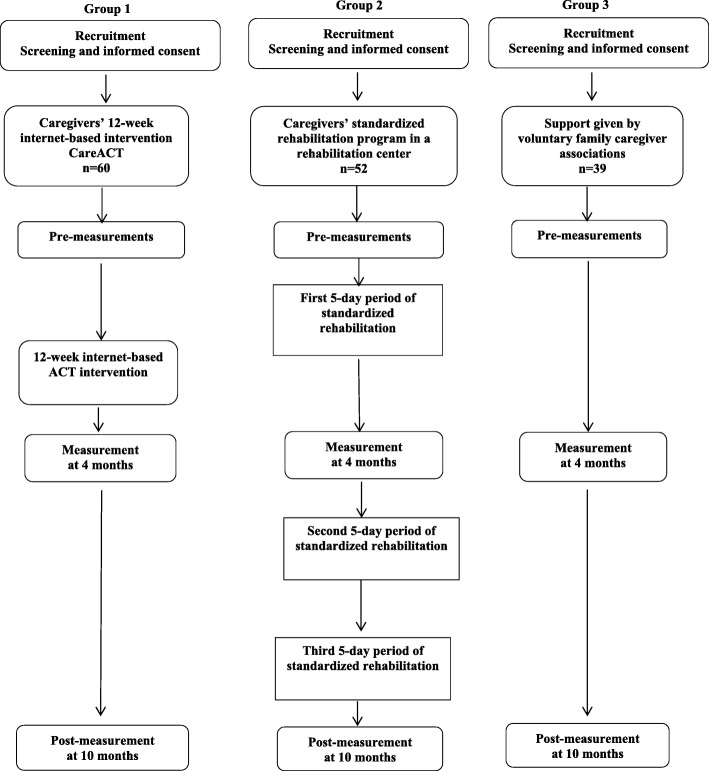
Background: The rapid increase in the number of elderly family caregivers underlines the need for new support systems. Internet-delivered psychological interventions are a potential approach, as they are easy to access for family caregivers who are often homebound with their care recipient. This study examines the relative effectiveness of an internet-based acceptance and commitment therapy (ACT) intervention or a standardized institutional rehabilitation program, first, in reducing depressive symptoms, and second, in improving the well-being and quality of life of elderly family caregivers compared to a control group receiving support from voluntary family caregiver associations. Methods: 156 family caregivers aged 60 or more are studied in a quasi-experimental study design that compares three groups of family caregivers (Group 1; n = 65: a guided 12-week web-based intervention; Group 2, n = 52: a standardized institutional rehabilitation program in a rehabilitation center; Group 3, n = 39: support provided by voluntary caregiver associations). Data collection is performed at three time-points: pre-measurement and at 4 months and 10 months thereafter. Caregivers’ depressive symptoms as a primary outcome, and perceived burden, anxiety, quality of life, sense of coherence, psychological flexibility, thought suppression, and personality as secondary outcomes are measured using validated self-report questionnaires. Physical performance and user experiences are also investigated. Between-group differences in the effects of the interventions are examined using multiple-group modeling techniques, and effect-size calculations. Discussion: The study will compare the effectiveness of a novel web-based program in reducing depressive symptoms and improving the psychological well-being of elderly family caregivers, or a standardized institutional rehabilitation program representing usual care and a control group receiving support offered by voluntary caregiver associations. The results will expand the knowledge base of clinicians and provide evidence on effective strategies to improve the mental health and overall quality of life of elderly family caregivers. Trial registration: The study was retrospectively registered in www.clinicaltrials.gov (ClinicalTrials.gov Identifier: NCT03391596 on January 4, 2018. © 2019 The Author(s).
Verified 2026-11-22 · 2 references not checked yet
Overview
CoChat Summary
TL;DR
This is a study protocol for a quasi-experimental controlled trial testing whether a 12-week guided web-based ACT intervention or a standardized rehabilitation program reduces depressive symptoms and improves well-being in family caregivers aged 60 or older, compared with support from voluntary caregiver associations. The study plans to measure outcomes at baseline, 4 months, and 10 months using self-report questionnaires, physical performance testing, and user-experience data.
Key findings
- Not stated in the paper.
- The planned sample was 156 family caregivers aged 60 or more, allocated to Group 1 (n = 65) web-based ACT, Group 2 (n = 52) standardized rehabilitation, and Group 3 (n = 39) support from caregiver associations.
- The primary outcome is depressive symptoms measured with the Beck Depression Inventory (BDI-II); the study is powered to detect a 5.8-point decrease in BDI-II versus the control group at 10 months, with 80% power.
- The protocol specifies a 12-week web intervention, 3 measurement points (pre, 4 months, 10 months), and 20-minute phone support calls every other week during the intervention.
Methods
- Quasi-experimental controlled trial comparing three groups: guided ACT-based internet intervention, standardized institutional rehabilitation, and support from voluntary family caregiver associations.
- Participants were 156 Finnish family caregivers aged 60+ reporting caregiving burden and/or depressive symptoms; Group 1 was recruited via newspaper ads, while Groups 2 and 3 were recruited via rehabilitation centers and caregiver associations.
- Main analyses use multiple-group modeling techniques and effect-size calculations; baseline differences are checked with t-tests and chi-square tests, and incomplete data are handled with FIML under MAR assumptions.
Limitations
- The paper states the study is not a randomized controlled trial because access to institutional rehabilitation follows a standardized procedure that does not allow randomization.
- The recruitment procedures differed across groups, and the authors note that newspaper-ad respondents may be more motivated for lifestyle change, creating potential selection bias.
- The caregiver association control group did not undergo screening similar to the other groups, which the paper identifies as a limitation; evident from the protocol, this also means the groups were not recruited or assessed identically.
Model-written summary. Check it against the paper before relying on it.
Integrity signals
Registry
Cites
Statistics
Figures

Verification
Claims the paper makes
8 Valid · 1 Not valid · 23 Not checked · 18 Own results and interpretations
The sources with a verdict support this claim; the rest weren’t checked yet, have no full text we could read, or their verdicts aren’t rated yet.
In the paper
“Several meta-analyses support its effectiveness across a range of psychological problems [15–17].”
§ CareACT - internet-based intervention for enhancing the psychological well-being of elderly caregivers – a study protocol of a controlled trial > Background
What the sources say
- Supportedcites [15] Hayes SC Luoma J Bond F Masuda A Lillis J Acceptance and commitment therapy: model, processes, and outcomes Behav Res Ther 2006 44 1 25 10.1016/j.brat.2005.06.006 16300724 source
The Discussion (p. 21) says the ACT model appears to work across an unusually broad range of problems, from psychosis to worksite stress. The paper presents this as promising but preliminary evidence; the claim does not assert that ACT outperforms other treatments. (LLM, conf=0.88)
- Not checked — no full text of the sourcecites [16] Powers MB Zum Vorde Sive Vording MB Emmelkamp PM Acceptance and commitment therapy: a meta-analytic review Psychother Psychosom 2009 78 2 73 80 10.1159/000190790 19142046 source
- Not matchedcites [17] Ruiz F A review of acceptance and commitment therapy (ACT) empirical evidence: correlational, experimental psychopathology, component and outcome studies Int J Psychol Psychol Ther 2010 10 125 162
Its entry has no title and year that we can search by.
plainstates a cause- Asserted: passes — The authors put it forward as true.
- Checkable: passes — It can be checked against evidence.
- Load-bearing: passes — The paper’s conclusions depend on it.
- Based: passes — The paper gives a reason why it holds.
- Supported
The cited sources support only part of this claim — read each source’s verdict below.
In the paper
“Most of the previous traditional interventions on family caregivers’ psychological, physical and social wellbeing have addressed the caregivers of care recipients with dementia [7].”
§ CareACT - internet-based intervention for enhancing the psychological well-being of elderly caregivers – a study protocol of a controlled trial > Background
What the sources say
- Partly supportedcites [7] Elvish R Lever SJ Johnstone J Cawley R Keady J Psychological interventions for carers of people with dementia: a systematic review of quantitative and qualitative evidence Clin Psychol Rev 2013 12 106 125 sourceExperimental — accuracy not yet measured
The Discussion describes psychological interventions for carers of people with dementia and says most studies examined depression, burden, social support and well-being. But the review is limited to dementia caregiving; it does not establish that most caregiver interventions overall addressed dementia, or that those interventions addressed physical well-being. (LLM, conf=0.84)
plain- Asserted: passes — The authors put it forward as true.
- Checkable: passes — It can be checked against evidence.
- Load-bearing: passes — The paper’s conclusions depend on it.
- Based: passes — The paper gives a reason why it holds.
- Partly supported
The cited sources support only part of this claim — read each source’s verdict below.
In the paper
“Individual and family counseling, psychoeducational programs, skills training programs and multi-component intervention programs have shown potential in improving caregiver mood, quality of life and delaying institutionalization of the care recipient [7–9].”
§ CareACT - internet-based intervention for enhancing the psychological well-being of elderly caregivers – a study protocol of a controlled trial > Background
What the sources say
- Partly supportedcites [7] Elvish R Lever SJ Johnstone J Cawley R Keady J Psychological interventions for carers of people with dementia: a systematic review of quantitative and qualitative evidence Clin Psychol Rev 2013 12 106 125 sourceExperimental — accuracy not yet measured
The Discussion reports that psychoeducational and skills-building interventions can affect depression, emotional well-being, and quality of life; it also reports improved well-being in multicomponent studies involving individual and family therapy. The review does not report that these interventions delay institutionalization of the person with dementia, so that part of the claim is unsupported. (LLM, conf=0.86)
- Not checked — no full text of the sourcecites [8] Gallagher-Thompson D Coon DW Evidence-based psychological treatments for distress in family caregivers of older adults Psychol Aging 2007 22 1 37 51 10.1037/0882-7974.22.1.37 17385981 source
- Not checked — no full text of the sourcecites [9] Selwood A Johnston K Katona C Lyketsos C Livingston G Systematic review of the effect of psychological interventions on family caregivers of people with dementia J Affect Disord 2007 101 1–3 75 89 10.1016/j.jad.2006.10.025 17173977 source
hedgedstates a possible cause- Asserted: passes — The authors put it forward as true.
- Checkable: passes — It can be checked against evidence.
- Load-bearing: passes — The paper’s conclusions depend on it.
- Based: passes — The paper gives a reason why it holds.
- Partly supported
In the paper
“In this study, the institutional rehabilitation program represents the usual care available to family caregivers in Finland.”
§ CareACT - internet-based intervention for enhancing the psychological well-being of elderly caregivers – a study protocol of a controlled trial > Methods/design > Interventions
What the sources say
- Not matchedcites [23] Kela. 2016. Omaishoitajien kuntoutuskurssit. Available at: https://omaishoitajat.fi/omaishoitajalle/omaishoitajien-kuntoutuskurssit-kela/. Accessed 12.10.2017.
We searched by its title and found no matching paper.
plain- Asserted: passes — The authors put it forward as true.
- Checkable: passes — It can be checked against evidence.
- Load-bearing: passes — The paper’s conclusions depend on it.
- Based: passes — The paper gives a reason why it holds.
- Not matched
In the paper
“Analyses indicate that the WHOQOL-BREF has good to excellent psychometric properties of reliability and validity [29].”
§ CareACT - internet-based intervention for enhancing the psychological well-being of elderly caregivers – a study protocol of a controlled trial > Methods/design > Outcome measures
What the sources say
- Not checked — no full text of the sourcecites [29] Skevington SM Lotfy M O'Connell KA The World Health Organization's WHOQOL-BREF quality of life assessment: psychometric properties and results of the international field trial. A report from the WHOQOL group Qual Life Res 2004 13 2 299 310 10.1023/B:QURE.0000018486.91360.00 15085902 source
hedged- Asserted: passes — The authors put it forward as true.
- Checkable: passes — It can be checked against evidence.
- Load-bearing: unclear — It is unclear whether the paper’s conclusions depend on it.
- Based: passes — The paper gives a reason why it holds.
10 more claims
Create a free account to see all 50 claims and to verify the 6 references still open.
- Probably not a substantial claim. 24
- It may state two separate claims as one. 15
- The quote only partly states this claim. 1
Citations
Cites
A Brief Measure for Assessing Generalized Anxiety Disorder: The GAD-7
Spitzer, R. L., Kroenke, K., Williams, J. B. W., & Löwe, B. (2006) · Archives of Internal Medicine · doi:10.1001/archinte.166.10.1092 · Cited by 31,765
Longitudinal data analysis using generalized linear models
LIANG, K.-Y., & ZEGER, S. L. (1986) · Biometrika · doi:10.1093/biomet/73.1.13 · Cited by 18,550
Guralnik, J. M., Simonsick, E. M., Ferrucci, L., Glynn, R. J., Berkman, L. F., Blazer, D. G., Scherr, P. A., & Wallace, R. B. (1994) · Journal of Gerontology · doi:10.1093/geronj/49.2.m85 · Cited by 9,792
Beck, A. T., Steer, R. A., & Brown, G. (2011) · PsycTESTS Dataset · doi:10.1037/t00742-000 · Cited by 7,535
Acceptance and commitment therapy: model, processes and outcomes
Hayes, S. C., Luoma, J. B., Bond, F. W., Masuda, A., & Lillis, J. (2006) · Behaviour Research and Therapy · doi:10.1016/j.brat.2005.06.006 · Cited by 6,587
Skevington, S. M., Lotfy, M., & O'Connell, K. A. (2004) · Quality of Life Research · doi:10.1023/b:qure.0000018486.91360.00 · Cited by 4,686
Bond, F. W., Hayes, S. C., Baer, R. A., Carpenter, K. M., Guenole, N., Orcutt, H. K., Waltz, T., & Zettle, R. D. (2011) · Behavior Therapy · doi:10.1016/j.beth.2011.03.007 · Cited by 3,950
The structure and properties of the sense of coherence scale
Antonovsky, A. (1993) · Social Science & Medicine · doi:10.1016/0277-9536(93)90033-z · Cited by 3,515 · cited 5×
“Sense of coherence Sense of coherence (SOC-13) Comprehensibility x x x [31, 32] Manageability”
BackgroundInfluentialCaregiver Burden: A Clinical Review
Adelman, R. D., Tmanova, L. L., Delgado, D., Dion, S., & Lachs, M. S. (2014) · JAMA · doi:10.1001/jama.2014.304 · Cited by 2,002
Help Wanted?: Providing and Paying for Long-Term Care
Colombo, F., Llena-Nozal, A., Mercier, J., & Tjadens, F. (2011) · OECD Health Policy Studies · doi:10.1787/9789264097759-en · Cited by 1,548
Wegner, D. M., & Zanakos, S. (1994) · Journal of Personality · doi:10.1111/j.1467-6494.1994.tb00311.x · Cited by 1,245
Perkowski, R., & Perkowski, A. (2000) · Cited by 891
The Role of Acceptance and Job Control in Mental Health, Job Satisfaction, and Work Performance
Bond, F. W., & Bunce, D. (2003) · Journal of Applied Psychology · doi:10.1037/0021-9010.88.6.1057 · Cited by 711
Acceptance and commitment therapy: A meta-analytic review
Powers, M. B., Zum Vörde Sive Vörding, M. B., & Emmelkamp, P. M. G. (2009) · Psychotherapy and Psychosomatics · doi:10.1159/000190790 · Cited by 619
(2010) · Redalyc (Universidad Autónoma del Estado de México) · Cited by 542
Boots, L. M. M., de Vugt, M. E., van Knippenberg, R. J. M., Kempen, G. I. J. M., & Verhey, F. R. J. (2014) · International Journal of Geriatric Psychiatry · doi:10.1002/gps.4016 · Cited by 449
Freiberger, E., de Vreede, P., Schoene, D., Rydwik, E., Mueller, V., Frändin, K., & Hopman-Rock, M. (2012) · Age and Ageing · doi:10.1093/ageing/afs099 · Cited by 413
Dementia care: mental health effects, intervention strategies, and clinical implications
Sörensen, S., Duberstein, P., Gill, D., & Pinquart, M. (2006) · The Lancet Neurology · doi:10.1016/s1474-4422(06)70599-3 · Cited by 396
Evidence-based psychological treatments for distress in family caregivers of older adults.
Gallagher-Thompson, D., & Coon, D. W. (2007) · Psychology and Aging · doi:10.1037/0882-7974.22.1.37 · Cited by 358
Selwood, A., Johnston, K., Katona, C., Lyketsos, C., & Livingston, G. (2007) · Journal of Affective Disorders · doi:10.1016/j.jad.2006.10.025 · Cited by 342
Segal, D. L., Coolidge, F. L., Cahill, B. S., & O'Riley, A. A. (2008) · Behavior Modification · doi:10.1177/0145445507303833 · Cited by 335
What Is Acceptance and Commitment Therapy?
Hayes, S. C., Strosahl, K. D., Bunting, K., Twohig, M., & Wilson, K. G. (2004) · A Practical Guide to Acceptance and Commitment Therapy · doi:10.1007/978-0-387-23369-7_1 · Cited by 301
Muris, P., Merckelbach, H., & Horselenberg, R. (1996) · Behaviour Research and Therapy · doi:10.1016/0005-7967(96)00005-8 · Cited by 281
Losada, A., Márquez-González, M., Romero-Moreno, R., Mausbach, B. T., López, J., Fernández-Fernández, V., & Nogales-González, C. (2015) · Journal of Consulting and Clinical Psychology · doi:10.1037/ccp0000028 · Cited by 255
Salokangas, R. K. R., Poutanen, O., & Stengård, E. (1995) · Acta Psychiatrica Scandinavica · doi:10.1111/j.1600-0447.1995.tb09536.x · Cited by 205
Skevington, S. M., & McCrate, F. M. (2012) · Health Expectations · doi:10.1111/j.1369-7625.2010.00650.x · Cited by 203
McKee, K. J., Philp, I., Lamura, G., Prouskas, C., Öberg, B., Krevers, B., Spazzafumo, L., Bien, B., Parker, C., Nolan, M. R., et al. (2003) · Aging & Mental Health · doi:10.1080/1360786021000006956 · Cited by 150
Balducci, C., Mnich, E., McKee, K. J., Lamura, G., Beckmann, A., Krevers, B., Wojszel, Z. B., Nolan, M., Prouskas, C., Bien, B., et al. (2008) · The Gerontologist · doi:10.1093/geront/48.3.276 · Cited by 140
Gallagher-Thompson, D., Tzuang, Y. M., Au, A., Brodaty, H., Charlesworth, G., Gupta, R., Lee, S. E., Losada, A., & Shyu, Y.-I. (2012) · Clinical Gerontologist · doi:10.1080/07317115.2012.678190 · Cited by 128
Elvish, R., Lever, S.-J., Johnstone, J., Cawley, R., & Keady, J. (2013) · Counselling and Psychotherapy Research · doi:10.1080/14733145.2012.739632 · Cited by 123 · cited 1×
“Most of the previous traditional interventions on family caregivers’ psychological, physical and social wellbeing have addressed the caregivers of care recipients with dementia [7].”
BackgroundThe ‘Short Five’ (S5): Measuring Personality Traits Using Comprehensive Single Items
Konstabel, K., Lönnqvist, J., Walkowitz, G., Konstabel, K., & Verkasalo, M. (2012) · European Journal of Personality · doi:10.1002/per.813 · Cited by 121
Prince, M., Brodaty, H., Uwakwe, R., Acosta, D., Ferri, C. P., Guerra, M., Huang, Y., Jacob, K., Llibre Rodriguez, J. J., Salas, A., et al. (2012) · International Journal of Geriatric Psychiatry · doi:10.1002/gps.2727 · Cited by 119
Guay, C., Auger, C., Demers, L., Mortenson, W. B., Miller, W. C., Gélinas-Bronsard, D., & Ahmed, S. (2017) · Journal of Medical Internet Research · doi:10.2196/jmir.7896 · Cited by 95
Scott, J. L., Dawkins, S., Quinn, M. G., Sanderson, K., Elliott, K.-E. J., Stirling, C., Schüz, B., & Robinson, A. (2016) · Aging & Mental Health · doi:10.1080/13607863.2015.1040724 · Cited by 77
The Effects of a Support Group on Dementia Caregivers’ Burden and Depression
Chu, H., Yang, C.-Y., Liao, Y.-H., Chang, L.-I., Chen, C.-H., Lin, C.-C., & Chou, K.-R. (2011) · Journal of Aging and Health · doi:10.1177/0898264310381522 · Cited by 76
Durme, T. V., Macq, J., Anthierens, S., Symons, L., Schmitz, O., Paulus, D., den Heede, K. V., & Remmen, R. (2014) · BMC Health Services Research · doi:10.1186/1472-6963-14-179 · Cited by 67
Development and validation of the experiential avoidance in caregiving questionnaire (EACQ)
Losada, A., Márquez-González, M., Romero-Moreno, R., & López, J. (2014) · Aging & Mental Health · doi:10.1080/13607863.2014.896868 · Cited by 64
Acceptance and Commitment Therapy
Hayes, S. C., & Pierson, H. (2006) · Encyclopedia of Cognitive Behavior Therapy · doi:10.1007/0-306-48581-8_1 · Cited by 35
(2011) · Cited by 33
(2015) · Työväentutkimus Vuosikirja · Cited by 1
Research works printed but not linked: 3
- Hayes SC Strosahl KD Wilson KG Acceptance and commitment therapy: an experiental approach to behavior change 1999 New York The Guilford Press
- Antonovsky A Unravelling the mystery of health 1987 San Francisco JosseyBass
- Muthén LK, Muthén BO. Mplus User’s Guide: Statistical Analysis with Latent Variables (7th ed.). Los Angeles: Muthén & Muthén. 1998-2012
Cited by
Lappalainen, P., Keinonen, K., Pakkala, I., Lappalainen, R., & Nikander, R. (2021) · Journal of Contextual Behavioral Science · doi:10.1016/j.jcbs.2021.04.005 · Cited by 34
Self-citationLappalainen, P., Pakkala, I., Lappalainen, R., & Nikander, R. (2022) · Clinical Gerontologist · doi:10.1080/07317115.2021.1912239 · Cited by 25
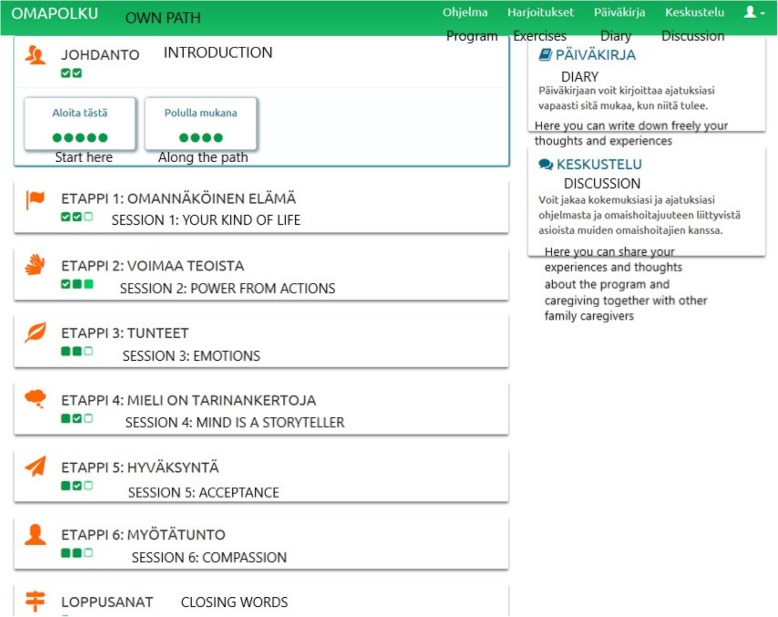
“A more detailed description of The Own Path program has previously been published (Lappalainen et al., 2019), and its detailed content can be found in https://bmcgeriatr.biomedcentral. com/articles/10.1186/s12877-019-1071-9.”
BackgroundInfluentialSelf-citationZhylkybekova, A., Koshmaganbetova, G. K., Zare, A., Mussin, N. M., Kaliyev, A. A., Bakhshalizadeh, S., Ablakimova, N., Grjibovski, A. M., Glushkova, N., & Tamadon, A. (2024) · Sustainability · doi:10.3390/su16031020 · Cited by 24
Designing digital mental health interventions for older adults: a scoping review
Rajappan, D., Yin, R., Martinengo, L., & Car, L. T. (2026) · npj Digital Medicine · doi:10.1038/s41746-026-02523-7 · Cited by 3
“These fi ndings can be partially credited to providing the necessary technical support to older adults with varying levels of technological literacy, as evidenced by experimental studies 23,50,57,68,75,85,95,101,105,107 and expert opinion papers 99,111 .”
The rationale and evidence for virtual methods of training for caregivers a narrative review
Budhrani-Shani, P., & Mathews, N. J. (2020) · Journal of Nursing Research and Practice · doi:10.37532/jnrp.2020.4(2).1-6 · Cited by 2
“If successful, the study would yield information on the persons for whom these interventions would be most beneficial, and what mechanisms mediate the intervention effects [64].”
Background
Metadata
- Authors
- Lappalainen, P., Pakkala, I., & Nikander, R.
- Affiliations
- University of Jyväskylä (FI)
- Central Finland Health Care District (FI)
- Corresponding author
- Lappalainen, Päivi
- Venue
- BMC Geriatrics
- Published
- 2019-03-05
- Volume
- 19
- Issue
- 1
- Pages
- 72-72
- ISSN
- 1471-2318 (ISSN-L)
- PMC
- PMC6402103
- OpenAlex
- W2924540847
- Semantic Scholar
- 6d878b6ec7531b89c578aa9621755e78a56c2af9
- Cited by
- 11
- References
- 43
- Citations by year
- 2026: 3 · 2025: 1 · 2024: 1 · 2023: 1 · 2022: 1 · 2021: 3 · 2020: 1
- FWCI
- 1.46
- Type
- journal article
- Language
- en
- Open access
- gold
- doi.org
- Licence
- cc-by
- creativecommons.org/licenses/by/4.0/ (tdm)
- Locations
- BMC Geriatrics (publishedVersion, cc-by)
- Europe PMC (PubMed Central) (publishedVersion, other-oa)
- PubMed Central (publishedVersion, cc-by)
- PubMed (publishedVersion)
- Jyväskylä University Digital Archive (University of Jyväskylä) (submittedVersion, cc-by)
- DOAJ (DOAJ: Directory of Open Access Journals) (submittedVersion, cc-by-sa)
- Funders
- the Social Insurance Institution (SII) of Finland
- Topics
- Social Sciences › Psychology › Clinical Psychology › Mindfulness and Compassion Interventions
- Social Sciences › Psychology › Applied Psychology › Digital Mental Health Interventions
- Health Sciences › Nursing › Research and Theory › Nursing care and research
- Keywords
- online intervention, acceptance and commitment therapy, depressive symptoms, psychological well-being, quality of life, caregiver burden, anxiety, sense of coherence, psychological flexibility, thought suppression, rehabilitation programs
- MeSH terms
- Internet-Based Intervention, Aged, Female, Humans, Male, Mental Health, Quality of Life, Surveys and Questionnaires, Retrospective Studies, Social Support, Caregivers
About these checks
Registry, retraction, Cites and statistics results are computed, not judged, with one exception: a printed reference that no index lists is read once by a model before it counts as a citation error. Claims are extracted by a model and kept only when their quote appears verbatim in the text; each cited source is then checked, with a model’s help, for whether it says what the claim relies on. Those verdicts can be wrong — read the claim’s quote and the cited source before relying on one.
The claim verdicts this report counts are experimental: their accuracy is not yet measured.
A language model drew the claims from the paper on 2026-10-11, under version 3 of the claim definition (model deepseek-v4.1-flash, prompt extract-v3).
A second model labelled each claim on 2026-10-11 (model jev-1.13-20260917, definition revision gold-guideline-v0.2).
Cited sources are checked with a language model’s help (gpt-6-sol).
Statistics and arithmetic are recomputed, not judged.
Confidence bands are shown only for fields calibrated on our annotated test set. None is calibrated yet, so no band is shown.
What counts as a claim ›How we measure confidence ›How we check this ›
Are you an author, or do you see a problem with this page? Request a review
Data sources
Bibliographic data: Semantic Scholar, OpenAlex, Crossref.
Contains information from the Semantic Scholar Academic Graph Datasets, made available under the ODC Attribution License (ODC-BY 1.0).
Semantic Scholar’s data is described in: Kinney, R., et al. (2023). The Semantic Scholar Open Data Platform. arXiv:2301.10140.
