

Stakeholder perspectives of care for people living with dementia moving from hospital to care facilities in the community: a systematic review
Open accessThe DOI matches its Crossref record; 43 of the 43 references it cites were found in a registry or an index; 17 of the 82 sources its claims cite were checked for support.
Abstract
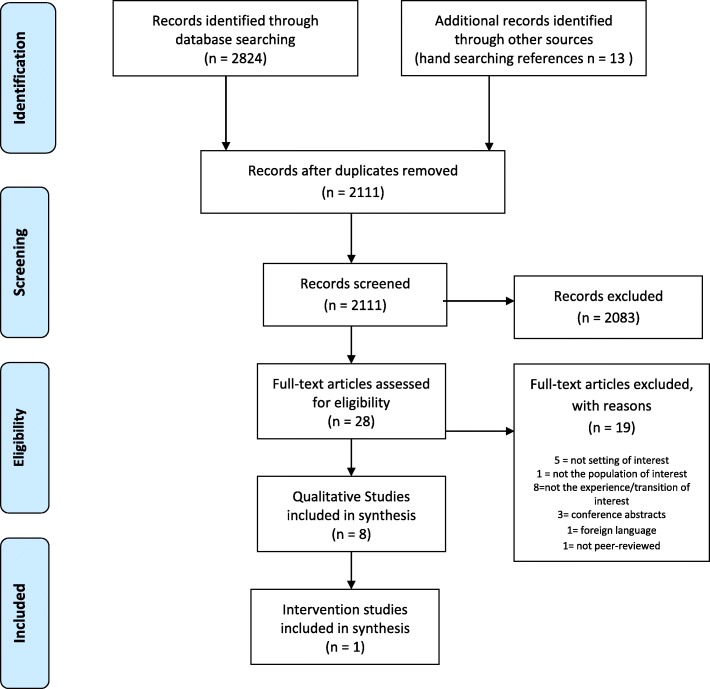
BACKGROUND: People living with dementia in care homes are regularly admitted to hospital. The transition between hospitals and care homes is an area of documented poor care leading to adverse outcomes including costly re-hospitalisation. This review aims to understand the experiences and outcomes of care for people living with dementia who undergo this transition from the perspectives of key stakeholders; people living with dementia, their families and health care professionals. METHODS: A systematic search was conducted on the CINAHL, ASSIA, EMBASE, MEDLINE, PsychINFO, and Scopus databases without any date restrictions. We hand searched reference lists of included papers. Papers were included if they focused on people living with dementia moving from hospital to a short or long term care setting in the community including sub-acute, rehabilitation, skilled nursing facilities or care homes. Titles, abstracts and full texts were screened. Two authors independently evaluated study quality using a checklist. Themes were identified and discussed to reach consensus. RESULTS: In total, nine papers reporting eight studies met the inclusion criteria for the systematic review. A total of 257 stakeholders participated; 37 people living with dementia, 95 family members, and 125 health and social care professionals. Studies took place in Australia, Canada, United Kingdom (UK), and the United States of America (US). Four themes were identified as factors influencing the experience and outcomes of the transition from the perspectives of stakeholders; preparing for transition; quality of communication; the quality of care; family engagement and roles. CONCLUSION: This systematic review presents a compelling case for the need for robust evidence to guide best practice in this important area of multi-disciplinary clinical practice. The evidence suggests this transition is challenging for all stakeholders and that people with dementia have specific needs which need attention during this period. TRIAL REGISTRATION: PROSPERO Registration Number: CRD42017082041 .
Overview
CoChat Summary
## TL;DR
This systematic review synthesized stakeholder perspectives on transitions from hospital to community care facilities for people living with dementia. Across 9 papers reporting 8 studies and 257 stakeholders, the transition was generally challenging, with recurring problems in preparation, communication, care quality, and family involvement.
## Key findings
- The review included 9 papers reporting 8 studies and 257 stakeholders: 37 people living with dementia, 95 family members, and 125 health and social care professionals.
- Four recurring themes shaped transition experiences and outcomes: preparing for transition, quality of communication, quality of care, and family engagement/roles.
- Communication was often inadequate; in all but one study, stakeholders reported communication issues, and poor communication contributed to people with dementia and families feeling unprepared, stressed, disorientated, or powerless.
- One specialist transition care programme reported reduction in agitated behaviours on the Cohen Mansfield Behavioural Inventory after transfer from hospital, with qualitative reports of improved socialisation and health outcomes; however, the paper notes some data were incomplete and should be interpreted cautiously.
## Methods
- Systematic review conducted following Centre for Reviews and Dissemination guidance and registered in PROSPERO (CRD42017082041).
- Searched CINAHL, ASSIA, EMBASE, MEDLINE, PsychINFO, and Scopus with no date restrictions, plus hand-searching reference lists; search ran in April 2018.
- Included empirical papers on experiences and/or outcomes of people living with dementia moving from hospital to short- or long-term community care settings (e.g., sub-acute, rehabilitation, skilled nursing facilities, care homes); titles/abstracts/full texts were screened and study quality was appraised independently by two reviewers.
## Limitations
- The paper states that only 8 studies were found despite a comprehensive search, and that grey literature and non-peer-reviewed journals may contain additional studies, which limits the conclusions that can be drawn.
- The included studies were mainly qualitative, with limited methods of data collection (mostly focus groups and interviews) and few observational methods, which the paper says limits evidence beyond participants’ interpretations.
- Evidence came from a limited number of Western countries and a range of facility types; the paper says findings may not be transferable to other healthcare contexts.
Model-written summary. Check it against the paper before relying on it.
Integrity signals
Registry
Cites
Statistics
Figures
Verification
Claims the paper makes
12 Valid · 2 Not valid · 49 Not checked · 66 Own results and interpretations
The cited sources support only part of this claim — read each source’s verdict below.
In the paper
“Where the transition between hospital and care home has been studied [5–8], people living with dementia are often not included.”
§ Stakeholder perspectives of care for people living with dementia moving from hospital to care facilities in the community: a systematic review > Background
What the sources say
- Partly supportedcites [5] Toles M Colon-Emeric C Naylor MD Barroso J Anderson RA Transitional care in skilled nursing facilities: a multiple case study BMC Health Serv Res 2016 16 186 10.1186/s12913-016-1427-1 27184902 PMC4869313 sourceExperimental — accuracy not yet measured
The Methods (Setting and participant sample; page unavailable) say this study of transitions involving skilled nursing facilities excluded patients with more than mild cognitive impairment. That supports the concern that some people living with dementia may be left out, but the paper does not say it excluded everyone with dementia or establish how often this happens across studies. (LLM, conf=0.85)
- Not checked yetcites [6] King BJ Gilmore-Bykovskyi AL Roiland RA Polnaszek BE Bowers BJ Kind AJ The consequences of poor communication during transitions from hospital to skilled nursing facility: a qualitative study J Am Geriatr Soc 2013 61 7 1095 1102 10.1111/jgs.12328 23731003 PMC3714367 source
Checked before — its earlier verdict is held back until a new check runs.
- Not checked — no full text of the sourcecites [7] Shah F Burack O Boockvar KS Perceived barriers to communication between hospital and nursing home at time of patient transfer J Am Med Dir Assoc 2010 11 4 239 245 10.1016/j.jamda.2009.08.006 20439042 source
- Partly supportedcites [8] Caruso LB Thwin SS Brandeis GH Following up on clinical recommendations in transitions from hospital to nursing home J Aging Res 2014 2014 873043 10.1155/2014/873043 24678422 PMC3941200 sourceExperimental — accuracy not yet measured
The Design and Methods section (2.1, page not provided) confirms that this paper studied transitions from hospital to nursing home. It lists hospice admission and unavailable records as exclusions, but does not say that people living with dementia were excluded or that transition studies often omit them. (LLM, conf=0.87)
plain- Asserted: passes — The authors put it forward as true.
- Checkable: passes — It can be checked against evidence.
- Load-bearing: passes — The paper’s conclusions depend on it.
- Based: passes — The paper gives a reason why it holds.
- Partly supported
The cited sources support only part of this claim — read each source’s verdict below.
In the paper
“Internationally, the transition between hospitals and care homes has been highlighted as a concern; with several studies noting care at this transition requires improvement [5–8].”
§ Stakeholder perspectives of care for people living with dementia moving from hospital to care facilities in the community: a systematic review > Background
What the sources say
- Partly supportedcites [5] Toles M Colon-Emeric C Naylor MD Barroso J Anderson RA Transitional care in skilled nursing facilities: a multiple case study BMC Health Serv Res 2016 16 186 10.1186/s12913-016-1427-1 27184902 PMC4869313 sourceExperimental — accuracy not yet measured
The Background describes patients moving from hospitals to skilled nursing facilities, and the Discussion identifies gaps in transitional care that need improvement. But the study’s findings concern care provided in skilled nursing facilities, particularly preparation for discharge home, rather than the transition from hospital to care home itself. The evidence is also from U.S. facilities, not an international assessment. (LLM, conf=0.86)
- Not checked yetcites [6] King BJ Gilmore-Bykovskyi AL Roiland RA Polnaszek BE Bowers BJ Kind AJ The consequences of poor communication during transitions from hospital to skilled nursing facility: a qualitative study J Am Geriatr Soc 2013 61 7 1095 1102 10.1111/jgs.12328 23731003 PMC3714367 source
Checked before — its earlier verdict is held back until a new check runs.
- Not checked — no full text of the sourcecites [7] Shah F Burack O Boockvar KS Perceived barriers to communication between hospital and nursing home at time of patient transfer J Am Med Dir Assoc 2010 11 4 239 245 10.1016/j.jamda.2009.08.006 20439042 source
- Supportedcites [8] Caruso LB Thwin SS Brandeis GH Following up on clinical recommendations in transitions from hospital to nursing home J Aging Res 2014 2014 873043 10.1155/2014/873043 24678422 PMC3941200 source
The Discussion reports that almost a quarter of hospital discharge recommendations were not followed after patients moved to nursing homes and says more work is needed to improve the discharge process. The Conclusions likewise call for better communication during these transitions. This supports the claim that care at the transition requires improvement. (LLM, conf=0.92)
plain- Asserted: passes — The authors put it forward as true.
- Checkable: passes — It can be checked against evidence.
- Load-bearing: passes — The paper’s conclusions depend on it.
- Based: passes — The paper gives a reason why it holds.
- Partly supported
The cited sources support only part of this claim — read each source’s verdict below.
In the paper
“Hospital pressures to react to the increase in admissions meant that health and social care professionals felt additional pressure to discharge because the bed was required [33, 34].”
§ Stakeholder perspectives of care for people living with dementia moving from hospital to care facilities in the community: a systematic review > Results > Narrative thematic analysis
What the sources say
- Not checked — no full text of the sourcecites [33] Gilmore-Bykovskyi AL Roberts TJ King BJ Kennelty KA Kind AJH Transitions from hospitals to skilled nursing facilities for persons with dementia: a challenging convergence of patient and system-level needs Gerontologist 2017 57 5 867 879 27174895 PMC5634404 source
- Partly supportedcites [34] Kable A Chenoweth L Pond D Hullick C Health professional perspectives on systems failures in transitional care for patients with dementia and their carers: a qualitative descriptive study BMC Health Serv Res 2015 15 567 10.1186/s12913-015-1227-z 26684210 PMC4683856 sourceExperimental — accuracy not yet measured
In Results, under “Pressure to discharge patients and incomplete discharge documentation” (page unavailable), acute hospital staff report significant pressure to discharge patients with dementia early, causing added stress for nurses and allied health staff. The passage reports rising daily discharge expectations, but does not say that increased admissions or a need for the bed caused the pressure. (LLM, conf=0.85)
plainstates a cause- Asserted: passes — The authors put it forward as true.
- Checkable: passes — It can be checked against evidence.
- Load-bearing: passes — The paper’s conclusions depend on it.
- Based: passes — The paper gives a reason why it holds.
The sources with a verdict support this claim; the rest weren’t checked yet, have no full text we could read, or their verdicts aren’t rated yet.
In the paper
“Families expressed concerns about standards of care in hospitals, in particular with assumptions being made about the psychosocial needs of the patient, the person’s level of function, (such as maintaining activities of daily living whilst in hospital) and involvement of the family [28, 30, 35].”
§ Stakeholder perspectives of care for people living with dementia moving from hospital to care facilities in the community: a systematic review > Results > Narrative thematic analysis
What the sources say
- Not checked — no full text of the sourcecites [28] Bauer M Fitzgerald L Koch S Hospital discharge as experienced by family carers of people with dementia: A case for quality improvement J Healthcare Qual 2011 33 6 9 16 10.1111/j.1945-1474.2011.00122.x 22103700 source
- Not checked — no full text of the sourcecites [30] Bloomer M Digby R Tan H Crawford K Williams A The experience of family carers of people with dementia who are hospitalised Dementia 2016 15 5 1234 1245 10.1177/1471301214558308 25394556 source
- Supportedcites [35] Kuluski K Im J McGeown M “It’s a waiting game” a qualitative study of the experience of carers of patients who require an alternate level of care BMC Health Serv Res 2017 17 1 318 10.1186/s12913-017-2272-6 28464878 PMC5414131 source
The Results sections “Patient over person” and “Carers addressing the Gaps in the system” describe carers’ concerns about patients’ preferences, independence, daily activities and socialization in hospital. The latter also reports frustration with staff expectations that families provide care, while the Discussion identifies implications for care quality and carer engagement. Together, these support the paraphrase for the patients requiring an alternate level of care studied here. (LLM, conf=0.90)
plain- Asserted: passes — The authors put it forward as true.
- Checkable: passes — It can be checked against evidence.
- Load-bearing: unclear — It is unclear whether the paper’s conclusions depend on it.
- Based: passes — The paper gives a reason why it holds.
Every source the paper cites for this claim was checked and supports it.
In the paper
“Residential care home staff also reported that when transfers happened during out of office hours, there was no registered nurse on duty [34].”
§ Stakeholder perspectives of care for people living with dementia moving from hospital to care facilities in the community: a systematic review > Results > Narrative thematic analysis
What the sources say
- Supportedcites [34] Kable A Chenoweth L Pond D Hullick C Health professional perspectives on systems failures in transitional care for patients with dementia and their carers: a qualitative descriptive study BMC Health Serv Res 2015 15 567 10.1186/s12913-015-1227-z 26684210 PMC4683856 source
In the Results section on community health professional perspectives, residential aged-care facility staff describe transfers proposed late in the day or at night, when qualified staff were not on duty. A staff member from a low-care facility says, “we haven’t got an RN here.” (LLM, conf=0.92)
plain- Asserted: passes — The authors put it forward as true.
- Checkable: passes — It can be checked against evidence.
- Load-bearing: unclear — It is unclear whether the paper’s conclusions depend on it.
- Based: passes — The paper gives a reason why it holds.
- Supported
57 more claims · 2 with their cited sources checked
Create a free account to see all 129 claims and to verify the 3 references still open.
- It may state two separate claims as one. 43
- Probably not a substantial claim. 33
Claims other papers make about this one
Each is checked against this paper’s own text: does it say what the citing paper says it does?
The source backs part of the claim, not all of it — or backs it for a different population, condition or comparison.
In the citing paper
“The systematic review further reported that studies linked the under-reporting of key care management strategies to post-discharge placement concerns.27”
From Discharge Communication of Dementia-Related Neuropsychiatric Symptoms and Care Management Strategies during Hospital to Skilled Nursing Facility Transitions (2021) · cites this paper as [27]
Experimental — accuracy not yet measuredThe source backs part of the claim, not all of it — or backs it for a different population, condition or comparison.
In the citing paper
“A recent systematic review identified specific areas of breakdown in communication between hospital and SNF providers, highlighting the omission of key information about NPS and related care management strategies such as use of 1:1 supervision, restraints, or antipsychotic medications.27”
From Discharge Communication of Dementia-Related Neuropsychiatric Symptoms and Care Management Strategies during Hospital to Skilled Nursing Facility Transitions (2021) · cites this paper as [27]
Experimental — accuracy not yet measuredThe source backs part of the claim, not all of it — or backs it for a different population, condition or comparison.
In the citing paper
“The transition from SNF to home is challenging for people with dementia (PWD), who are at risk for poor nutrition, hydration, pain control, and new health problems (e.g., respiratory infections) resulting in re-hospitalizations.4, 5”
From Unique Care Needs of People with Dementia and Their Caregivers during Transitions from Skilled Nursing Facilities to Home and Assisted Living: A Qualitative Study (2022) · cites this paper as [5]
Experimental — accuracy not yet measuredThe cited source says what the claim attributes to it.
In the citing paper
“(4) communication between providers.5, 13, 15, 16”
The cited source says what the claim attributes to it.
In the citing paper
“(3) preparation of caregivers,5, 13, 14”
1 more claim about this paper
Create a free account to see every claim other papers make about this one.
Citations
Cites
9 Dementia reconsidered: the person comes first
Kitwood, T. (2011) · Adult lives · doi:10.56687/9781447300458-013 · Cited by 3,103
Coleman, E. A. (2003) · Journal of the American Geriatrics Society · doi:10.1046/j.1532-5415.2003.51185.x · Cited by 1,109
Coleman, E. A., & Boult, C. (2003) · Journal of the American Geriatrics Society · doi:10.1046/j.1532-5415.2003.51186.x · Cited by 922
The Importance Of Transitional Care In Achieving Health Reform
Naylor, M. D., Aiken, L. H., Kurtzman, E. T., Olds, D. M., & Hirschman, K. B. (2011) · Health Affairs · doi:10.1377/hlthaff.2011.0041 · Cited by 797
Association of Incident Dementia With Hospitalizations
Phelan, E. A., Borson, S., Grothaus, L., Balch, S., & Larson, E. B. (2012) · JAMA · doi:10.1001/jama.2011.1964 · Cited by 547
A systematic review of ethnicity and pathways to care in dementia
Mukadam, N., Cooper, C., & Livingston, G. (2011) · International Journal of Geriatric Psychiatry · doi:10.1002/gps.2484 · Cited by 323
Prince, M., Knapp, M., Guerchet, M., McCrone, P., Prina, M., Comas-Herrera, M., Wittenberg, A., Adelaja, R., Hu, B., King, B., et al. (2014) · Alzheimer's Society · doi:10.13140/2.1.3629.3446 · Cited by 250
Allen, J., Hutchinson, A. M., Brown, R., & Livingston, P. M. (2014) · BMC Health Services Research · doi:10.1186/1472-6963-14-346 · Cited by 237
King, B. J., Gilmore‐Bykovskyi, A. L., Roiland, R. A., Polnaszek, B. E., Bowers, B. J., & Kind, A. J. H. (2013) · Journal of the American Geriatrics Society · doi:10.1111/jgs.12328 · Cited by 210
Interventions to Improve Transitional Care Between Nursing Homes and Hospitals: A Systematic Review
LaMantia, M. A., Scheunemann, L. P., Viera, A. J., Busby‐Whitehead, J., & Hanson, L. C. (2010) · Journal of the American Geriatrics Society · doi:10.1111/j.1532-5415.2010.02776.x · Cited by 189
Interventions to improve patient safety in transitional care – a review of the evidence
Laugaland, K., Aase, K., & Barach, P. (2012) · WORK: A Journal of Prevention, Assessment & Rehabilitation · doi:10.3233/wor-2012-0544-2915 · Cited by 184
A Decade of Transitional Care Research with Vulnerable Elders
Naylor, M. D. (2000) · The Journal of Cardiovascular Nursing · doi:10.1097/00005082-200004000-00004 · Cited by 164
The experience of people with dementia and nurses in hospital: an integrative review
Digby, R., Lee, S., & Williams, A. (2017) · Journal of Clinical Nursing · doi:10.1111/jocn.13429 · Cited by 157
Lord, K., Livingston, G., & Cooper, C. (2015) · International Psychogeriatrics · doi:10.1017/s1041610215000411 · Cited by 141
Self-citationHolland, D. E., & Harris, M. R. (2007) · Home Health Care Services Quarterly · doi:10.1300/j027v26n04_02 · Cited by 104
Systems and people under pressure: the discharge process in an acute hospital
Connolly, M., Grimshaw, J., Dodd, M., Cawthorne, J., Hulme, T., Everitt, S., Tierney, S., & Deaton, C. (2009) · Journal of Clinical Nursing · doi:10.1111/j.1365-2702.2008.02551.x · Cited by 99 · cited 1×
“[46], who reported practitioners were conflicted by competing internal and external pressures, which undermined their professionalism, caused frustration, and resulted in de-personalisation of care.”
BackgroundNaylor, M. D., Hirschman, K. B., Hanlon, A. L., Bowles, K. H., Bradway, C., McCauley, K. M., & Pauly, M. V. (2014) · Journal of Comparative Effectiveness Research · doi:10.2217/cer.14.14 · Cited by 91
Kirsebom, M., Wadensten, B., & Hedström, M. (2013) · Journal of Advanced Nursing · doi:10.1111/j.1365-2648.2012.06077.x · Cited by 73 · cited 1×
“Similar findings were noted in a Swedish study [44] that examined hospital”
ResultKable, A., Chenoweth, L., Pond, D., & Hullick, C. (2015) · BMC Health Services Research · doi:10.1186/s12913-015-1227-z · Cited by 65
Gilmore-Bykovskyi, A. L., Roberts, T. J., King, B. J., Kennelty, K. A., & Kind, A. J. H. (2017) · The Gerontologist · doi:10.1093/geront/gnw085 · Cited by 56 · cited 14×
“Six of the papers were from Australia, [28–31, 34, 36] with two reporting findings from the same study [28, 29], one was from the US [33], one from the UK [32] and one from”
BackgroundInfluentialChenoweth, L., Kable, A., & Pond, D. (2015) · Australasian Journal on Ageing · doi:10.1111/ajag.12205 · Cited by 53
Kirsebom, M. (2013) · BMJ Supportive & Palliative Care · doi:10.1136/bmjspcare-2013-000491.144 · Cited by 49
Transitional care in skilled nursing facilities: a multiple case study
Toles, M., Colón-Emeric, C., Naylor, M. D., Barroso, J., & Anderson, R. A. (2016) · BMC Health Services Research · doi:10.1186/s12913-016-1427-1 · Cited by 43
The experience of family carers of people with dementia who are hospitalised
Bloomer, M., Digby, R., Tan, H., Crawford, K., & Williams, A. (2016) · Dementia · doi:10.1177/1471301214558308 · Cited by 42 · cited 4×
“2016 [30] Semi-structured interviews / conversation approach 20 carers Explore the experience of carers through hospitalisation and rehab with a view to transitioning to residential care.”
BackgroundInfluentialDischarge planning: best practice in transitions of care
Pellett, C. (2016) · British Journal of Community Nursing · doi:10.12968/bjcn.2016.21.11.542 · Cited by 42
Walsh, J. (2016) · Cited by 42
Perceived Barriers to Communication Between Hospital and Nursing Home at Time of Patient Transfer
Shah, F., Burack, O., & Boockvar, K. S. (2010) · Journal of the American Medical Directors Association · doi:10.1016/j.jamda.2009.08.006 · Cited by 40
Bauer, M., Fitzgerald, L., & Koch, S. (2011) · Journal for Healthcare Quality · doi:10.1111/j.1945-1474.2011.00122.x · Cited by 38
Kuluski, K., Im, J., & McGeown, M. (2017) · BMC Health Services Research · doi:10.1186/s12913-017-2272-6 · Cited by 37
Fitzgerald, L. R., Bauer, M., Koch, S. H., & King, S. J. (2011) · Australian Health Review · doi:10.1071/ah09811 · Cited by 35
Stockwell‐Smith, G., Moyle, W., Marshall, A. P., Argo, A., Brown, L., Howe, S., Layton, K., Naidoo, O., Santoso, Y., Soleil‐Moudiky‐Joh, E., et al. (2018) · Journal of Clinical Nursing · doi:10.1111/jocn.14144 · Cited by 35
Digby, R., Moss, C., & Bloomer, M. (2012) · International Journal of Older People Nursing · doi:10.1111/j.1748-3743.2011.00282.x · Cited by 34
Transition care: will it deliver?
Gray, L., Travers, C., Bartlett, H., et al. (2008) · The Medical Journal of Australia · doi:10.5694/j.1326-5377.2008.tb01600.x · Cited by 28
Mockford, C. (2015) · Journal of Healthcare Leadership · doi:10.2147/jhl.s70020 · Cited by 24
Hospital Readmission of Skilled Nursing Facility Residents: A Systematic Review
Yoo, J. W., Jabeen, S., BAJWA, T. K., Kim, S. J., Leander, D., Hasan, L., Punke, J., Soryal, S., & Khan, A. (2015) · Research in Gerontological Nursing · doi:10.3928/19404921-20150129-01 · Cited by 24
Mockford, C., Seers, K., Murray, M., Oyebode, J. R., Clarke, R., Staniszewska, S. H., Suleman, R., Boex, S., Diment, Y., Grant, R., et al. (2016) · Health Expectations · doi:10.1111/hex.12477 · Cited by 17
Emmett, C., Poole, M., Bond, J., & Hughes, J. C. (2014) · International Journal of Law, Policy and the Family · doi:10.1093/lawfam/ebu012 · Cited by 14
Evaluation of a transition care cognitive assessment and management pilot
Renehan, E., Haralambous, B., Galvin, P., Kotis, M., & Dow, B. (2013) · Contemporary Nurse · doi:10.5172/conu.2013.43.2.134 · Cited by 12
Tew, J. D. (2012) · Generations · Cited by 11
Discharge Criteria and Follow-Up Support for Dementia Care Units
Mortenson, W. B., & Bishop, A. M. (2016) · Journal of Applied Gerontology · doi:10.1177/0733464815577140 · Cited by 5
Following Up on Clinical Recommendations in Transitions from Hospital to Nursing Home
Caruso, L. B., Thwin, S. S., & Brandeis, G. H. (2014) · Journal of Aging Research · doi:10.1155/2014/873043 · Cited by 4
Kind, A., Gilmore‐Bykovskyi, A. L., Kennelty, K. A., Jensen, L. L., Schmitz, E. J., Hermann, C., & Mineau, J. (2016) · Alzheimer s & Dementia · doi:10.1016/j.jalz.2016.06.2366 · Cited by 2
Fortinsky, R. H., Gitlin, L. N., Grady, J. J., et al. (2016) · Alzheimer s & Dementia · doi:10.1016/j.jalz.2016.06.2373 · Cited by 1
Cited by
Adler‐Milstein, J., Raphael, K., O’Malley, T. A., & Cross, D. A. (2021) · JAMA Network Open · doi:10.1001/jamanetworkopen.2020.33980 · Cited by 63
Health care transitions for persons living with dementia and their caregivers
Ashbourne, J., Boscart, V., Meyer, S., Tong, C. E., & Stolee, P. (2021) · BMC Geriatrics · doi:10.1186/s12877-021-02235-5 · Cited by 49
“[51], in a systematic review aiming to understand transition experiences of individuals with dementia from the perspectives of key stakeholders, found that the perspectives of individuals with dementia, their family members, and care providers did not always match.”
BackgroundTransitional ‘hospital to home’ care of older patients: healthcare professionals’ perspectives
Dolu, İ., Naharcı, M. İ., Logan, P., Paal, P., & Vaismoradi, M. (2020) · Scandinavian Journal of Caring Sciences · doi:10.1111/scs.12904 · Cited by 45
“Improved communication with older patients and their carers can be achieved using the task-oriented approach [51].”
BackgroundMethodChallenges to Systems of Long-Term Care: Mapping of the Central Concepts from an Umbrella Review
Barreira, L. F., Paiva, A., Araújo, B., & Campos, M. J. (2023) · International Journal of Environmental Research and Public Health · doi:10.3390/ijerph20031698 · Cited by 22
“Some factors are associated with this transition experience, namely the preparation, the communication quality, the quality of care, the family involvement and the roles of the family [18].”
BackgroundAndrusjak, W., Barbosa, A., & Mountain, G. A. (2021) · BMC Geriatrics · doi:10.1186/s12877-020-01959-0 · Cited by 22
Metadata
- Authors
- Richardson, A., Blenkinsopp, A., Downs, M., & Lord, K.
- Affiliations
- University of Bradford (GB)
- Corresponding author
- Richardson, Angela
- Venue
- BMC Geriatrics
- Published
- 2019-07-31
- Volume
- 19
- Issue
- 1
- Pages
- 202-202
- ISSN
- 1471-2318 (ISSN-L)
- PMC
- PMC6668086
- OpenAlex
- W2965154204
- Semantic Scholar
- 96ab3c9674bb5b01c79837806886d42624d3f067
- Cited by
- 25
- References
- 43
- Citations by year
- 2026: 3 · 2025: 3 · 2024: 3 · 2023: 3 · 2022: 5 · 2021: 6 · 2020: 2
- FWCI
- 0.60
- Type
- journal article
- Language
- en
- Open access
- gold
- doi.org
- Licence
- cc-by
- creativecommons.org/licenses/by/4.0/ (tdm)
- Locations
- BMC Geriatrics (publishedVersion, cc-by)
- Europe PMC (PubMed Central) (publishedVersion, cc-by)
- PubMed Central (publishedVersion, cc-by)
- PubMed (publishedVersion)
- DOAJ (DOAJ: Directory of Open Access Journals) (submittedVersion, cc-by-sa)
- Funders
- Alzheimer's Society (Doctoral Training Centre in Dementia Care grant 224)
- Topics
- Health Sciences › Medicine › Geriatrics and Gerontology › Geriatric Care and Nursing Homes
- Health Sciences › Nursing › Leadership and Management › Hospital Admissions and Outcomes
- Health Sciences › Medicine › Psychiatry and Mental health › Dementia and Cognitive Impairment Research
- Keywords
- dementia, care homes, long-term care, stakeholder perspectives, family involvement, communication quality, quality of care, hospital readmission, people with dementia, health and social care professionals
- MeSH terms
- Stakeholder Participation, Community Health Services, Delivery of Health Care, Dementia, Family, Health Personnel, Hospitalization, Humans, Long-Term Care, Patient Transfer
About these checks
Registry, retraction, Cites and statistics results are computed, not judged, with one exception: a printed reference that no index lists is read once by a model before it counts as a citation error. Claims are extracted by a model and kept only when their quote appears verbatim in the text; each cited source is then checked, with a model’s help, for whether it says what the claim relies on. Those verdicts can be wrong — read the claim’s quote and the cited source before relying on one.
The claim verdicts this report counts are experimental: their accuracy is not yet measured.
A language model drew the claims from the paper on 2026-10-09, under version 3 of the claim definition (model deepseek-v4.1-flash, prompt extract-v3).
A second model labelled each claim on 2026-10-09 (model jev-1.13-20260917, definition revision gold-guideline-v0.2).
Cited sources are checked with a language model’s help (gpt-6-sol).
Statistics and arithmetic are recomputed, not judged.
Confidence bands are shown only for fields calibrated on our annotated test set. None is calibrated yet, so no band is shown.
What counts as a claim ›How we measure confidence ›How we check this ›
Are you an author, or do you see a problem with this page? Request a review
Data sources
Bibliographic data: Semantic Scholar, OpenAlex, Crossref.
Contains information from the Semantic Scholar Academic Graph Datasets, made available under the ODC Attribution License (ODC-BY 1.0).
Semantic Scholar’s data is described in: Kinney, R., et al. (2023). The Semantic Scholar Open Data Platform. arXiv:2301.10140.
