

Effects of Tai Chi and Qigong on cognitive and physical functions in older adults: systematic review, meta-analysis, and meta-regression of randomized clinical trials
Open accessThe DOI matches its Crossref record; 90 of the 90 references it cites were found in a registry or an index; none of the 44 sources its claims cite is checked for support yet.
Abstract
Background: Older adults experience age-related declines in physical and cognitive functions due to interactions between aging and chronic diseases. Tai Chi and Qigong (TCQ) might be beneficial in improving the physical function and delaying the cognitive decline of this population. The potential underlying mechanism was explored to determine the effects of TCQ on cognitive function via direct or indirect pathways. Purpose: The objective of this systematic review was to determine the effects of TCQ on cognitive and physical functions in older adults using meta-analysis, and to determine the impact of TCQ on cognitive function while controlling for physical function using a meta-regression approach. Methods: A systematic search of 13 electronic databases (in English, Korean, and Chinese languages) identified 10,292 potentially eligible studies published between inception and May 2022. The bias in individual studies was assessed using the Cochrane Risk of Bias (version 2.0) tool. The heterogeneity of the studies was evaluated using a 95% prediction interval, and the meta-analysis and meta-regression were implemented using the Comprehensive Meta-Analysis (version 3) software. Results: Our search identified 17 randomized studies ( n = 2,365, mean age = 70.3 years). The results of the meta-analysis that used a random-effects model indicated that TCQ had significant effects on both cognitive (Hedges' g = 0.29, 95% confidence interval [CI] = 0.17 to 0.42) and physical (Hedges' g = 0.32, 95% CI = 0.19 to 0.44) functions. We used meta-regression to explore the effect size of TCQ in association with physical function level. The regression model was significant (Q = 25.01, p = .070), and 55% of the heterogeneity was explained by physical function as a moderator variable. The effects of TCQ on cognitive function remained significant in this model when controlling for the effect of physical function (β = 0.46, p = .011). Conclusion: This meta-regression of 17 randomized studies strongly suggests that TCQ has beneficial effects on physical and cognitive functions in older adults. The effect of TCQ on cognitive function remained significant after taking into account the significant effects of physical function as a moderator. The findings imply the potential health benefits of TCQ by promoting cognitive function in older adults directly and indirectly through enhancing physical function. PROSPERO registration number: *PROSPERO international prospective register of systematic reviews, registration ID CRD42023394358.
Overview
CoChat Summary
TL;DR
This systematic review and meta-analysis of 17 RCTs found that Tai Chi/Qigong improved cognitive and physical function in older adults, with small pooled effect sizes. Meta-regression indicated the cognitive benefit remained significant after controlling for physical function, though the abstract and results report inconsistent statistics.
Key findings
- The review included 17 RCTs; the Results section reports 2,235 participants, mean age 70.9 years, and 71.8% females, while the Abstract reports n = 2,365 and mean age 70.3 years. Interventions were Tai Chi (k = 14) or Qigong (k = 3), mean duration 19.7 weeks (range 4–52 weeks).
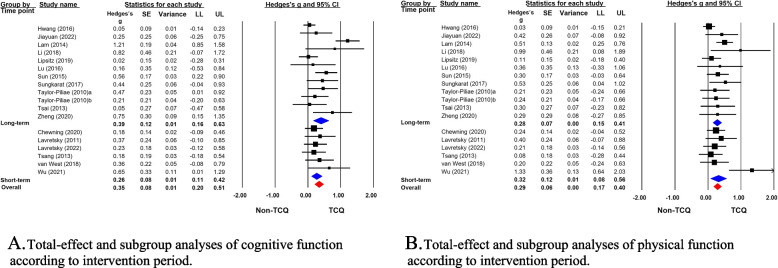
- Random-effects meta-analysis showed TCQ improved cognitive function (Hedges’ g = 0.35, 95% CI 0.20–0.51; 95% PI −0.21–0.92) and physical function (Hedges’ g = 0.29, 95% CI 0.17–0.40; 95% PI −0.02–0.60). The Abstract reports cognitive g = 0.29 (95% CI 0.17–0.42) and physical g = 0.32 (95% CI 0.19–0.44).
- Subgroup analyses found no significant difference by intervention duration for cognitive function (long-term g = 0.39 vs short-term g = 0.26; Q = 0.82, p = .364) or physical function (long-term g = 0.28 vs short-term g = 0.32; Q = 0.081, p = .776).
- Meta-regression with physical function as moderator was significant (Q = 9.06, p = .002) and explained 63% of heterogeneity; the effect of TCQ on cognitive function remained significant when controlling for physical function. The Abstract reports a different model (Q = 25.01, p = .070; 55% heterogeneity explained; β = 0.46, p = .011).
Methods
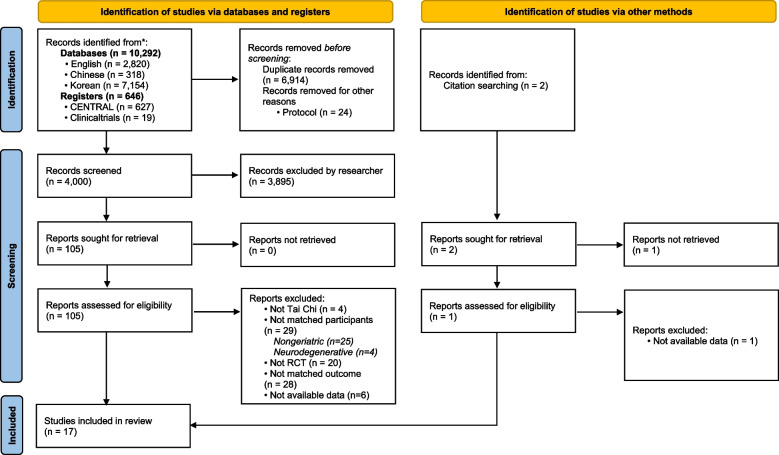
- Systematic review, meta-analysis, and meta-regression of RCTs; searched 13 electronic databases in English, Korean, and Chinese from inception to May 2022, identifying 10,292 citations and including 17 RCTs.
- Eligibility: older adults ≥60 years in community settings, without cognition-affecting disease or with only MCI, receiving Tai Chi or Qigong, with both physical and cognitive outcomes, published in English, Korean, or Chinese; excluded hospitalized/rehabilitation or neurodegenerative populations.
- Random-effects meta-analysis in Comprehensive Meta-Analysis v3; Hedges’ g with 95% CIs; heterogeneity assessed via 95% prediction intervals; Cochrane RoB 2.0; subgroup analysis by ≤12 vs >12 weeks; meta-regression with physical function as moderator; funnel plots and Egger’s regression test.
Limitations
- The paper states heterogeneity arose from varying health and cognitive statuses, different Tai Chi/Qigong types, differing durations/intensity, and varied measurement methods; random-effects, subgroup, and sensitivity analyses were used.
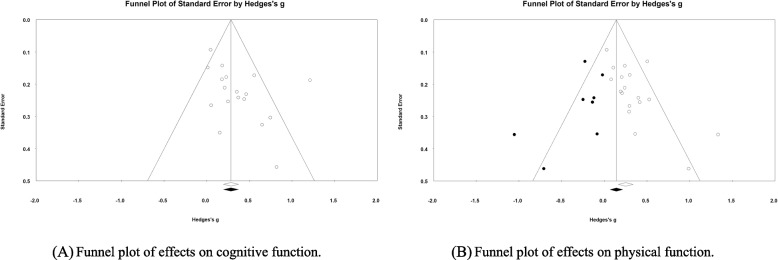
- The paper reports suspected publication bias: cognitive overall Egger’s test p = .049; physical overall p = .004; long-term physical p = .042; short-term funnel plots were asymmetrical.
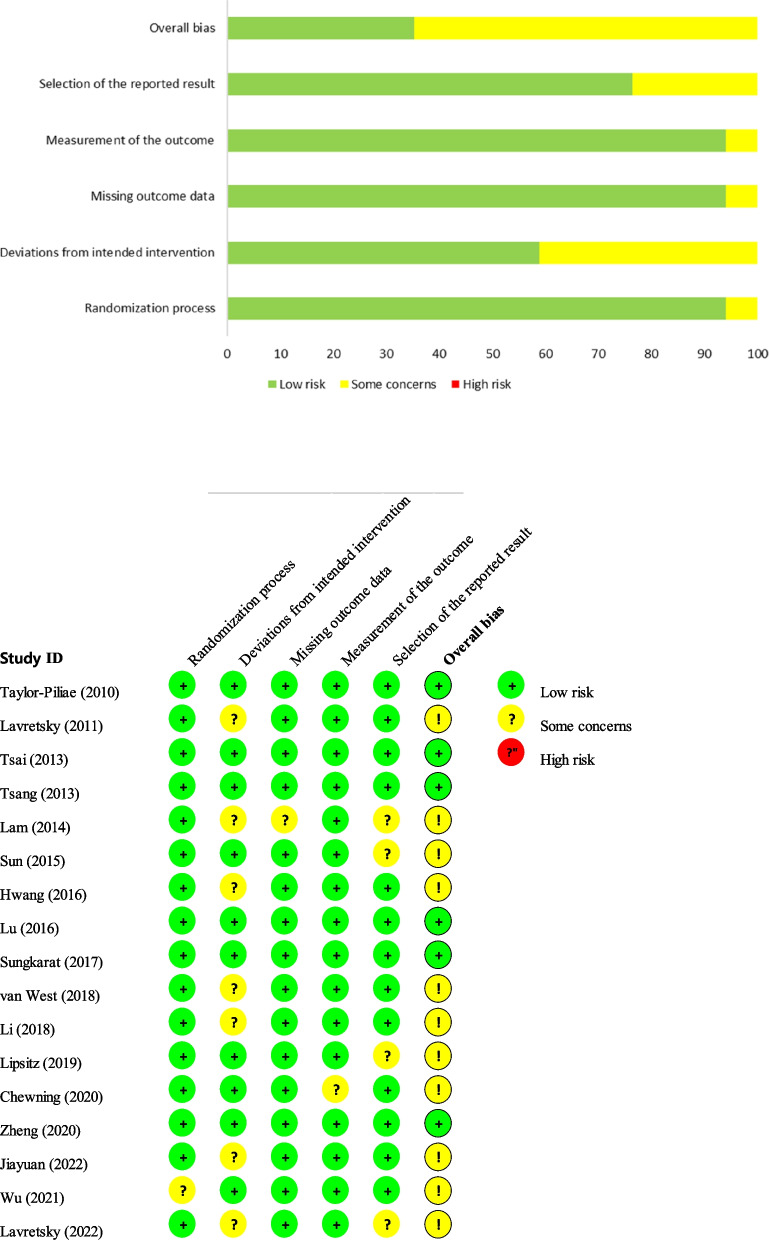
- Evident in the text: the Abstract and Results/Table 2 report inconsistent sample size, mean age, effect sizes, and meta-regression statistics; risk of bias was “some concerns” in 11/17 studies (none high risk), and safety monitoring was absent in 7/17 studies.
Model-written summary. Check it against the paper before relying on it.
Integrity signals
Registry
Cites
Statistics
Figures
Verification
Claims the paper makes
0 Valid · 1 Not valid · 27 Not checked · 125 Own results and interpretations
A result the paper reports from its own data — it cites no other source for it, so there is none to check. The quote shows it is in the paper.
In the paper
“TCQ had significant effects on both cognitive (Hedges' g = 0.29, 95% confidence interval [CI] = 0.17 to 0.42) and physical (Hedges' g = 0.32, 95% CI = 0.19 to 0.44) functions.”
§ Effects of Tai Chi and Qigong on cognitive and physical functions in older adults: systematic review, meta-analysis, and meta-regression of randomized clinical trials > Abstract > Results
plainstates a causen = 2,365- Asserted: passes — The authors put it forward as true.
- Checkable: passes — It can be checked against evidence.
- Load-bearing: passes — The paper’s conclusions depend on it.
- Based: passes — The paper gives a reason why it holds.
- Rests on an assumption not shown here.
A result the paper reports from its own data — it cites no other source for it, so there is none to check. The quote shows it is in the paper.
In the paper
“The effects of TCQ on cognitive function remained significant in this model when controlling for the effect of physical function (β = 0.46, p = .011).”
- Also stated in: § Conclusion · plain
“The effect of TCQ on cognitive function remained significant after taking into account the significant effects of physical function as a moderator.”
§ Effects of Tai Chi and Qigong on cognitive and physical functions in older adults: systematic review, meta-analysis, and meta-regression of randomized clinical trials > Abstract > Results
plainstates an associationn = 2,365 ·- Asserted: passes — The authors put it forward as true.
- Checkable: passes — It can be checked against evidence.
- Load-bearing: passes — The paper’s conclusions depend on it.
- Based: passes — The paper gives a reason why it holds.
- Rests on an assumption not shown here.
- Also stated in: § Conclusion · plain
A result the paper reports from its own data — it cites no other source for it, so there is none to check. The quote shows it is in the paper.
In the paper
“TCQ had significant effects on both cognitive (Hedges' g = 0.29, 95% confidence interval [CI] = 0.17 to 0.42) and physical (Hedges' g = 0.32, 95% CI = 0.19 to 0.44) functions.”
§ Effects of Tai Chi and Qigong on cognitive and physical functions in older adults: systematic review, meta-analysis, and meta-regression of randomized clinical trials > Abstract > Results
plainstates a causen = 2,365- Asserted: passes — The authors put it forward as true.
- Checkable: passes — It can be checked against evidence.
- Load-bearing: passes — The paper’s conclusions depend on it.
- Based: passes — The paper gives a reason why it holds.
- Rests on an assumption not shown here.
A result the paper reports from its own data — it cites no other source for it, so there is none to check. The quote shows it is in the paper.
In the paper
“55% of the heterogeneity was explained by physical function as a moderator variable.”
§ Effects of Tai Chi and Qigong on cognitive and physical functions in older adults: systematic review, meta-analysis, and meta-regression of randomized clinical trials > Abstract > Results
plainstates an associationn = 2,365- Asserted: passes — The authors put it forward as true.
- Checkable: passes — It can be checked against evidence.
- Load-bearing: passes — The paper’s conclusions depend on it.
- Based: passes — The paper gives a reason why it holds.
- Rests on an assumption not shown here.
A result the paper reports from its own data — it cites no other source for it, so there is none to check. The quote shows it is in the paper.
In the paper
“The regression model was significant (Q = 25.01, p = .070)”
§ Effects of Tai Chi and Qigong on cognitive and physical functions in older adults: systematic review, meta-analysis, and meta-regression of randomized clinical trials > Abstract > Results
plain- Asserted: passes — The authors put it forward as true.
- Checkable: passes — It can be checked against evidence.
- Load-bearing: passes — The paper’s conclusions depend on it.
- Based: passes — The paper gives a reason why it holds.
- Rests on an assumption not shown here.
62 more claims
Create a free account to see all 153 claims and to verify the 42 references still open.
- Probably not a substantial claim. 74
- The quote only partly states this claim. 1
- It may state two separate claims as one. 24
Self-check
Percentages, sums and reported differences re-computed from the paper’s own numbers.
Each contradiction between two passages listed here was confirmed by an independent check.
Rated major: it would touch a result — a value a result rests on, reported and recomputed p-values on opposite sides of the significance level, two passages that conflict with no sign which is right, or a cited work retracted before this paper was published.
In the paper
§ Effects of Tai Chi and Qigong on cognitive and physical functions in older adults: systematic review, meta-analysis, and meta-regression of randomized clinical trials > Abstract > Results
“cognitive (Hedges' g = 0.29, 95% confidence interval [CI] = 0.17 to 0.42)”
§ Effects of Tai Chi and Qigong on cognitive and physical functions in older adults: systematic review, meta-analysis, and meta-regression of randomized clinical trials > Results > Meta-analysis: synthesis of results
“cognitive function (Hedges’ g = 0.35, 95% CI = 0.20 to 0.51)”
Rated major: it would touch a result — a value a result rests on, reported and recomputed p-values on opposite sides of the significance level, two passages that conflict with no sign which is right, or a cited work retracted before this paper was published.
In the paper
§ Effects of Tai Chi and Qigong on cognitive and physical functions in older adults: systematic review, meta-analysis, and meta-regression of randomized clinical trials > Abstract > Results
“The regression model was significant (Q = 25.01, p = .070)”
§ Effects of Tai Chi and Qigong on cognitive and physical functions in older adults: systematic review, meta-analysis, and meta-regression of randomized clinical trials > Results > Meta-analysis: synthesis of results
“The regression model was significant (Q = 9.06, p = 0.002)”
Rated major: it would touch a result — a value a result rests on, reported and recomputed p-values on opposite sides of the significance level, two passages that conflict with no sign which is right, or a cited work retracted before this paper was published.
In the paper
§ Effects of Tai Chi and Qigong on cognitive and physical functions in older adults: systematic review, meta-analysis, and meta-regression of randomized clinical trials > Abstract > Results
“physical (Hedges' g = 0.32, 95% CI = 0.19 to 0.44)”
§ Effects of Tai Chi and Qigong on cognitive and physical functions in older adults: systematic review, meta-analysis, and meta-regression of randomized clinical trials > Results > Meta-analysis: synthesis of results
“physical function (Hedges’ g = 0.29, 95% CI = 0.17 to 0.40)”
Rated minor: it would not touch a result — a value no result rests on, a p-value that stays on the same side of the significance level, or a conflict that is clerical, resolved elsewhere in the paper, or outside its own findings.
In the paper
“Jiayuan, 2022 [86](China,/English) | Age ≥ 65 years,Prefrail and frail | 31 (11:18)”
§ Effects of Tai Chi and Qigong on cognitive and physical functions in older adults: systematic review, meta-analysis, and meta-regression of randomized clinical trials > Results > Modality and medium
Reported 31 · recomputed 29
Rated minor: it would not touch a result — a value no result rests on, a p-value that stays on the same side of the significance level, or a conflict that is clerical, resolved elsewhere in the paper, or outside its own findings.
In the paper
§ Effects of Tai Chi and Qigong on cognitive and physical functions in older adults: systematic review, meta-analysis, and meta-regression of randomized clinical trials > Results > Meta-analysis: synthesis of results
“the goodness-of-fit test indicated that the unexplained variance was not zero (Q = 26.04, df = 16, p = 0.05)”
§ Effects of Tai Chi and Qigong on cognitive and physical functions in older adults: systematic review, meta-analysis, and meta-regression of randomized clinical trials > Results > Meta-analysis: synthesis of results
“Goodness of fit: Test that unexplained variance is zeroT2 = 0.0208, Tau = 0.1442, I2 = 38.56%, Qresid = 30.766, df = 16, p = 0.0534”
4 more findings
Create a free account to see every finding of this check.
Cited works that were retracted
Works this paper cites that were later retracted, from the retraction notices publishers deposit. Major when the notice came out before this paper was published.
A note, not an issue: for example, a cited work that was retracted only after this paper was published, which its authors could not have known.
In the paper
“Lin R, Cui S, Yang J, Yang H, Feng Z, Wahner-Roedler DL, Zhou X, Salinas M, Mallory MJ, Do A, et al. Effects of Tai Chi on patients with mild cognitive impairment: a systematic review and meta-analysis of randomized controlled trials. Biomed Res Int. 2021;2021:5530149.”
Cited work 10.1155/2021/5530149 · retracted 2023-07-12 · notice 10.1155/2023/9789542 · this paper published 2023-06-06
Citations
Cites
1 retracted
Lin, R., Cui, S., Yang, J., Yang, H., Feng, Z., Wahner-Roedler, D. L., Zhou, X., Salinas, M., Mallory, M. J., Do, A., et al. (2021) · BioMed Research International · doi:10.1155/2021/5530149 · Cited by 24
RetractedThe PRISMA 2020 statement: An updated guideline for reporting systematic reviews
Page, M. J., McKenzie, J. E., Bossuyt, P. M., Boutron, I., Hoffmann, T. C., Mulrow, C. D., Shamseer, L., Tetzlaff, J. M., Akl, E. A., Brennan, S. E., et al. (2021) · BMJ · doi:10.1136/bmj.n71 · Cited by 108,283
RoB 2: a revised tool for assessing risk of bias in randomised trials
Sterne, J. A. C., Savović, J., Page, M. J., Elbers, R. G., Blencowe, N. S., Boutron, I., Cates, C. J., Cheng, H.-Y., Corbett, M. S., Eldridge, S. M., et al. (2019) · BMJ · doi:10.1136/bmj.l4898 · Cited by 34,787
Borenstein, M., Hedges, L. V., Higgins, J. P. T., & Rothstein, H. R. (2009) · doi:10.1002/9780470743386 · Cited by 14,225
Molecular Mechanisms of Depression: Perspectives on New Treatment Strategies
Lang, U. E., & Borgwardt, S. (2013) · Cellular Physiology and Biochemistry · doi:10.1159/000350094 · Cited by 8,475
A basic introduction to fixed-effect and random-effects models for meta-analysis
Borenstein, M., Hedges, L. V., Higgins, J. P. T., & Rothstein, H. R. (2010) · Research Synthesis Methods · doi:10.1002/jrsm.12 · Cited by 6,793
Exercise: a behavioral intervention to enhance brain health and plasticity
Cotman, C. (2002) · Trends in Neurosciences · doi:10.1016/s0166-2236(02)02143-4 · Cited by 2,739
Plea for routinely presenting prediction intervals in meta-analysis.
IntHout, J., Ioannidis, J. P. A., Rovers, M. M., & Goeman, J. J. (2016) · BMJ Open · doi:10.1136/bmjopen-2015-010247 · Cited by 2,264
Harman, D. (1981) · Proceedings of the National Academy of Sciences · doi:10.1073/pnas.78.11.7124 · Cited by 1,915
Ageing, fitness and neurocognitive function
Kramer, A. F., Hahn, S., Cohen, N. J., Banich, M. T., McAuley, E., Harrison, C. R., Chason, J., Vakil, E., Bardell, L., Boileau, R. A., et al. (1999) · Nature · doi:10.1038/22682 · Cited by 1,394
The characterisation of subjective cognitive decline
Jessen, F., Amariglio, R. E., Buckley, R. F., van der Flier, W. M., Han, Y., Molinuevo, J. L., Rabin, L., Rentz, D. M., Rodriguez-Gomez, O., Saykin, A. J., et al. (2020) · The Lancet Neurology · doi:10.1016/s1474-4422(19)30368-0 · Cited by 1,389
Beneficial effects of physical exercise on neuroplasticity and cognition
Hötting, K., & Röder, B. (2013) · Neuroscience & Biobehavioral Reviews · doi:10.1016/j.neubiorev.2013.04.005 · Cited by 991 · cited 3×
“The aerobic exercise components of TCQ can delay age-related brain atrophy and improve cerebral blood circulation [23, 24], while the tranquility of mindfulness and Qigong breathing can improve attentional focus and executive function [34, 36].”
BackgroundThe neurotrophin hypothesis for synaptic plasticity
Schinder, A. (2000) · Trends in Neurosciences · doi:10.1016/s0166-2236(00)01672-6 · Cited by 728
A comprehensive review of health benefits of qigong and tai chi
Jahnke, R., Larkey, L., Rogers, C., Etnier, J., & Lin, F. (2010) · American Journal of Health Promotion · doi:10.4278/ajhp.081013-lit-248 · Cited by 592 · cited 1×
“The meditative aspect of TCQ may affect cognition by enhancing mood [42, 43], which influences perception, attention, and memory [44, 45].”
BackgroundUnderstanding heterogeneity in meta-analysis: the role of meta-regression
Baker, W. L., Michael White, C., Cappelleri, J. C., Kluger, J., Coleman, C. I., & From the Health Outcomes, P. (2009) · International Journal of Clinical Practice · doi:10.1111/j.1742-1241.2009.02168.x · Cited by 492
Falck, R. S., Davis, J. C., Best, J. R., Crockett, R. A., & Liu-Ambrose, T. (2019) · Neurobiology of Aging · doi:10.1016/j.neurobiolaging.2019.03.007 · Cited by 437
The Dynamic Relationship Between Physical Function and Cognition in Longitudinal Aging Cohorts
Clouston, S. A. P., Brewster, P., Kuh, D., Richards, M., Cooper, R., Hardy, R., Rubin, M. S., & Hofer, S. M. (2013) · Epidemiologic Reviews · doi:10.1093/epirev/mxs004 · Cited by 429
Efficacy of Tai Chi, brisk walking, meditation, and reading in reducing mental and emotional stress
Jin, P. (1992) · Journal of Psychosomatic Research · doi:10.1016/0022-3999(92)90072-a · Cited by 425
After Reaching Retirement Age Physical Activity Sustains Cerebral Perfusion and Cognition
Rogers, R. L., Meyer, J. S., & Mortel, K. F. (1990) · Journal of the American Geriatrics Society · doi:10.1111/j.1532-5415.1990.tb03472.x · Cited by 368
The potential effects of meditation on age-related cognitive decline: a systematic review.
Gard, T., Hölzel, B. K., & Lazar, S. W. (2014) · Annals of the New York Academy of Sciences · doi:10.1111/nyas.12348 · Cited by 363 · cited 2×
“The aerobic exercise components of TCQ can delay age-related brain atrophy and improve cerebral blood circulation [23, 24], while the tranquility of mindfulness and Qigong breathing can improve attentional focus and executive function [34, 36].”
BackgroundDewey, M. E., & Saz, P. (2001) · International Journal of Geriatric Psychiatry · doi:10.1002/gps.397 · Cited by 298
Lavretsky, H., Alstein, L. L., Olmstead, R. E., Ercoli, L. M., Riparetti-Brown, M., St. Cyr, N., & Irwin, M. R. (2011) · The American Journal of Geriatric Psychiatry · doi:10.1097/jgp.0b013e31820ee9ef · Cited by 268
Meditative movement as a category of exercise: implications for research
Larkey, L., Jahnke, R., Etnier, J., & Gonzalez, J. (2009) · Journal of Physical Activity and Health · doi:10.1123/jpah.6.2.230 · Cited by 262 · cited 2×
“There are many similarities between Tai Chi and Qigong in how they focus on the body (posture and movement), breath, and mind (meditation and mindfulness) [8, 9].”
BackgroundWayne, P. M., Lee, M. S., Novakowski, J., Osypiuk, K., Ligibel, J., Carlson, L. E., & Song, R. (2018) · Journal of Cancer Survivorship · doi:10.1007/s11764-017-0665-5 · Cited by 251
Self-citationFitzpatrick, A. L., Buchanan, C. K., Nahin, R. L., DeKosky, S. T., Atkinson, H. H., Carlson, M. C., Williamson, J. D., & for the Ginkgo Evaluation of Memory (GEM) Study Investigators (2007) · The Journals of Gerontology Series A: Biological Sciences and Medical Sciences · doi:10.1093/gerona/62.11.1244 · Cited by 250
Sungkarat, S., Boripuntakul, S., Chattipakorn, N., Watcharasaksilp, K., & Lord, S. R. (2017) · Journal of the American Geriatrics Society · doi:10.1111/jgs.14594 · Cited by 203
Cooper, R., Hardy, R., Aihie Sayer, A., Ben-Shlomo, Y., Birnie, K., Cooper, C., Craig, L., Deary, I. J., Demakakos, P., Gallacher, J., et al. (2011) · PLoS ONE · doi:10.1371/journal.pone.0027899 · Cited by 199
Taylor-Piliae, R. E., Newell, K. A., Cherin, R., Lee, M. J., King, A. C., & Haskell, W. L. (2010) · Journal of Aging and Physical Activity · doi:10.1123/japa.18.3.261 · Cited by 195
Nascimento, C., Pereira, J., Andrade, L., Garuffi, M., Talib, L., Forlenza, O., Cancela, J., Cominetti, M., & Stella, F. (2014) · Current Alzheimer Research · doi:10.2174/156720501108140910122849 · Cited by 192
Nakahara, H., Doya, K., & Hikosaka, O. (2001) · Journal of Cognitive Neuroscience · doi:10.1162/089892901750363208 · Cited by 191
Sungkarat, S., Boripuntakul, S., Kumfu, S., Lord, S. R., & Chattipakorn, N. (2018) · Neurorehabilitation and Neural Repair · doi:10.1177/1545968317753682 · Cited by 174
Traditional Chinese Medicine for Alzheimer’s Disease and Other Cognitive Impairment: A Review
Pei, H., Ma, L., Cao, Y., Wang, F., Li, Z., Liu, N., Liu, M., Wei, Y., & Li, H. (2020) · The American Journal of Chinese Medicine · doi:10.1142/s0192415x20500251 · Cited by 166
Walsh, E. I., Smith, L., Northey, J., Rattray, B., & Cherbuin, N. (2020) · Ageing Research Reviews · doi:10.1016/j.arr.2020.101044 · Cited by 162
Nascimento, C. M. C., Pereira, J. R., Pires de Andrade, L., Garuffi, M., Ayan, C., Kerr, D. S., Talib, L. L., Cominetti, M. R., & Stella, F. (2014) · Journal of Alzheimer's Disease · doi:10.3233/jad-140576 · Cited by 159
Adcock, M., Fankhauser, M., Post, J., Lutz, K., Zizlsperger, L., Luft, A. R., Guimar�ães, V., Schättin, A., & de Bruin, E. D. (2020) · Frontiers in Medicine · doi:10.3389/fmed.2019.00321 · Cited by 159
BDNF upregulation during declarative memory formation in monkey inferior temporal cortex
Tokuyama, W., Okuno, H., Hashimoto, T., Li, Y. X., & Miyashita, Y. (2000) · Nature Neuroscience · doi:10.1038/80655 · Cited by 147
Self-citationTsai, P., Chang, J. Y., Beck, C. K., Kuo, Y., & Keefe, F. J. (2012) · Journal of Pain and Symptom Management · doi:10.1016/j.jpainsymman.2012.04.009 · Cited by 138
An evidence map of the effect of Tai Chi on health outcomes
Solloway, M. R., Taylor, S. L., Shekelle, P. G., Miake-Lye, I. M., Beroes, J. M., Shanman, R. M., & Hempel, S. (2016) · Systematic Reviews · doi:10.1186/s13643-016-0300-y · Cited by 125
Hsieh, C.-C., Lin, P.-S., Hsu, W., Wang, J., Huang, Y.-C., Lim, A.-Y., & Hsu, Y. (2018) · Dementia and Geriatric Cognitive Disorders · doi:10.1159/000494659 · Cited by 117
Forgas, J. P. (2017) · Elsevier eBooks · doi:10.1016/b978-0-12-801851-4.00003-3 · Cited by 114
Esch, T., Duckstein, J., Welke, J., & Braun, V. (2007) · PubMed · Cited by 107
Clarke, M. J. (2002) · Evaluation & the Health Professions · doi:10.1177/0163278702025001002 · Cited by 101
The Exercise Intensity of Tai Chi Chuan
Lan, C., Chen, S.-Y., & Lai, J.-S. (2008) · Medicine and Sport Science · doi:10.1159/000134225 · Cited by 98
WANG, W., SAWADA, M., NORIYAMA, Y., ARITA, K., OTA, T., SADAMATSU, M., KIYOTOU, R., HIRAI, M., & KISHIMOTO, T. (2010) · Psychogeriatrics · doi:10.1111/j.1479-8301.2010.00334.x · Cited by 97 · cited 1×
“The meditative aspect of TCQ may affect cognition by enhancing mood [42, 43], which influences perception, attention, and memory [44, 45].”
BackgroundHeart Rate Responses and Oxygen Consumption during Tai Chi Chuan Practice
Lan, C., Chen, S., Lai, J., & Wong, M. (2001) · The American Journal of Chinese Medicine · doi:10.1142/s0192415x01000423 · Cited by 91
Zou, L., Han, J., Li, C., Yeung, A. S., Hui, S. S.-C., Tsang, W. W. N., Ren, Z., & Wang, L. (2019) · Archives of Physical Medicine and Rehabilitation · doi:10.1016/j.apmr.2018.07.425 · Cited by 81
Hwang, H., Chen, S., Lee‐Hsieh, J., Chien, D., Chen, C., & Lin, M. (2016) · Journal of the American Geriatrics Society · doi:10.1111/jgs.13952 · Cited by 75
Tai Chi Chuan Alters Brain Functional Network Plasticity and Promotes Cognitive Flexibility
Cui, L., Tao, S., Yin, H., Shen, Q.-Q., Wang, Y., Zhu, L., & Li, X. (2021) · Frontiers in Psychology · doi:10.3389/fpsyg.2021.665419 · Cited by 75
The Effects of Mindfulness on Older Adults with Mild Cognitive Impairment
Wong, W. P., Coles, J., Chambers, R., Wu, D. B.-C., & Hassed, C. (2017) · Journal of Alzheimer's Disease Reports · doi:10.3233/adr-170031 · Cited by 74
Tai chi improves cognitive and physical function in the elderly: a randomized controlled trial
Sun, J., Kanagawa, K., Sasaki, J., Ooki, S., Xu, H., & Wang, L. (2015) · Journal of Physical Therapy Science · doi:10.1589/jpts.27.1467 · Cited by 73
Randomised Controlled Trial Of The Effect Of Tai Chi On Postural Balance Of People With Dementia
Nyman, S. R., Ingram, W. M., Sanders, J., Thomas, P., Thomas, S., Vassallo, M., Raftery, J. P., Bibi, I., & Barrado‐Martín, Y. (2019) · Clinical Interventions in Aging · doi:10.2147/cia.s228931 · Cited by 72
Zheng, G., Zheng, Y., Xiong, Z., & Ye, B. (2020) · Clinical Rehabilitation · doi:10.1177/0269215520930256 · Cited by 72
Solianik, R., Mickevičienė, D., Žlibinaitė, L., & Čekanauskaitė, A. (2021) · Experimental Gerontology · doi:10.1016/j.exger.2021.111363 · Cited by 72
Yu, A. P., Tam, B. T., Lai, C. W. K., Yu, D. S. F., Woo, J., Chung, K., Hui, S. S., Liu, J. Y. W., Gao, W., & Siu, P. M. (2018) · The American Journal of Chinese Medicine · doi:10.1142/s0192415x18500131 · Cited by 66
Adcock, M., Thalmann, M., Schättin, A., Gennaro, F., & de Bruin, E. D. (2019) · Frontiers in Aging Neuroscience · doi:10.3389/fnagi.2019.00304 · Cited by 63
Jiayuan, Z., Xiang-Zi, J., Li-Na, M., Jin-Wei, Y., & Xue, Y. (2021) · The Journal of Prevention of Alzheimer s Disease · doi:10.14283/jpad.2021.40 · Cited by 62
Siu, M.-Y., & Lee, D. T. F. (2018) · BMC Geriatrics · doi:10.1186/s12877-018-0720-8 · Cited by 58
Attentional orienting and executive control are affected by different types of meditation practice
Tsai, M.-H., & Chou, W. (2016) · Consciousness and Cognition · doi:10.1016/j.concog.2016.09.020 · Cited by 57
Zhou, S., Zhang, Y., Kong, Z., Loprinzi, P. D., Hu, Y., Ye, J., Liu, S., Yu, J. J., & Zou, L. (2019) · International Journal of Environmental Research and Public Health · doi:10.3390/ijerph16050753 · Cited by 56
Yu, A. P., Chin, E. C., Yu, D. J., Fong, D. Y., Cheng, C. P., Hu, X., Wei, G. X., & Siu, P. M. (2022) · Scientific Reports · doi:10.1038/s41598-022-12526-5 · Cited by 55
Huang, N., Li, W., Rong, X., Champ, M., Wei, L., Li, M., Mu, H., Hu, Y., Ma, Z., & Lyu, J. (2019) · Journal of Alzheimer’s Disease · doi:10.3233/jad-190487 · Cited by 54
A Randomized Controlled Trial of Tai Chi Chih or Health Education for Geriatric Depression
Lavretsky, H., Milillo, M. M., Kilpatrick, L. A., Grzenda, A. L., Wu, P., Nguyen, S. A., Ercoli, L. M., & Siddarth, P. (2021) · American Journal of Geriatric Psychiatry · doi:10.1016/j.jagp.2021.07.008 · Cited by 54
Lam, L. C. W., Chan, W. M., Kwok, T. C. Y., & Chiu, H. F. K. (2014) · PubMed · Cited by 53
Tsang, H. W. H., Lee, J. L. C., Au, D. W. H., Wong, K. K. W., & Lai, K. W. (2013) · Evidence-based Complementary and Alternative Medicine · doi:10.1155/2013/827392 · Cited by 53
Klein, P. J., Picard, G., Baumgarden, J., & Schneider, R. (2017) · Medicines · doi:10.3390/medicines4040069 · Cited by 51
Wei, L., Chai, Q., Chen, J., Wang, Q., Bao, Y., Xu, W., & Ma, E. (2022) · Disability and Rehabilitation · doi:10.1080/09638288.2020.1830311 · Cited by 50
CHEN, J., Kitanishi, T., IKEDA, T., MATSUKI, N., & Yamada, M. K. (2007) · Neurobiology of Learning and Memory · doi:10.1016/j.nlm.2007.07.009 · Cited by 47
Disseminating Tai Chi in the Community: Promoting Home Practice and Improving Balance
Chewning, B. A., Hallisy, K. M., Mahoney, J., Wilson, D., Sangasubana, N., & Gangnon, R. E. (2019) · The Gerontologist · doi:10.1093/geront/gnz006 · Cited by 47
Ladawan, S., Klarod, K., Philippe, M., Menz, V., Versen, I., Gatterer, H., & Burtscher, M. (2017) · Complementary Therapies in Medicine · doi:10.1016/j.ctim.2017.05.005 · Cited by 46
Chen, X., Marrone, G., Olson, T. P., Lundborg, C. S., Zhu, H., Wen, Z., Lu, W., & Jiang, W. (2020) · ESC Heart Failure · doi:10.1002/ehf2.12959 · Cited by 46
Pan, Z., Su, X., Fang, Q., Hou, L., Lee, Y., Chen, C. C., Lamberth, J., & Kim, M.-L. (2018) · Frontiers in Aging Neuroscience · doi:10.3389/fnagi.2018.00110 · Cited by 45
Henz, D., & Schöllhorn, W. I. (2017) · Frontiers in Psychology · doi:10.3389/fpsyg.2017.00154 · Cited by 44
The benefits of Tai Chi and brisk walking for cognitive function and fitness in older adults
Ji, Z., Li, A., Feng, T., Liu, X., You, Y., Meng, F., Wang, R., Lu, J., & Zhang, C. (2017) · PeerJ · doi:10.7717/peerj.3943 · Cited by 43
Lu, X., Siu, K., Fu, S. N., Hui-Chan, C. W. Y., & Tsang, W. W. N. (2016) · Journal of Complementary and Integrative Medicine · doi:10.1515/jcim-2015-0084 · Cited by 42
Multiple systems for motor skill learning
Clark, D., & Ivry, R. B. (2010) · Wiley Interdisciplinary Reviews Cognitive Science · doi:10.1002/wcs.56 · Cited by 41
Choo, Y. T., Jiang, Y., Hong, J., & Wang, W. (2020) · International Journal of Nursing Studies · doi:10.1016/j.ijnurstu.2020.103737 · Cited by 39
Liu, F., Chen, X., Nie, P., Lin, S., Guo, J., Chen, J., & Yu, L. (2021) · The Journal of Alternative and Complementary Medicine · doi:10.1089/acm.2021.0084 · Cited by 37
Impact of short-term meditation and expectation on executive brain functions
Prätzlich, M., Kossowsky, J., Gaab, J., & Krummenacher, P. (2016) · Behavioural Brain Research · doi:10.1016/j.bbr.2015.10.012 · Cited by 34
Zhao, X., Jin, L., & Sun, S. B. (2021) · The International Journal of Aging and Human Development · doi:10.1177/0091415020940214 · Cited by 32
A Cluster Randomized Trial of Tai Chi vs Health Education in Subsidized Housing: The MI‐WiSH Study
Lipsitz, L. A., Macklin, E. A., Travison, T. G., Manor, B. D., Gagnon, P., Tsai, T., Isaza-Aizpurúa, I., Lo, O., & Wayne, P. M. (2019) · Journal of the American Geriatrics Society · doi:10.1111/jgs.15986 · Cited by 31
Age-Varying Relationships Between Physical Function and Cognition in Older Adulthood
Sprague, B. N., Phillips, C. B., & Ross, L. A. (2019) · The Journals of Gerontology: Series B · doi:10.1093/geronb/gbx126 · Cited by 30
Dwivedi, M., Dubey, N., Pansari, A. J., Bapi, R. S., Das, M., Guha, M., Banerjee, R. K., Pramanick, G., Basu, J., & Ghosh, A. (2021) · Frontiers in Human Neuroscience · doi:10.3389/fnhum.2021.728993 · Cited by 30
Lee, J. (2020) · International Journal of Environmental Research and Public Health · doi:10.3390/ijerph17249216 · Cited by 28
Paul, K., Pourtois, G., & Harmon‐Jones, E. (2020) · Cognitive Affective & Behavioral Neuroscience · doi:10.3758/s13415-019-00764-6 · Cited by 19
George, K. M., Gilsanz, P., Peterson, R. L., Glymour, M. M., Mayeda, E. R., Mungas, D. M., Miles, S. Q., & Whitmer, R. A. (2021) · Alzheimer Disease & Associated Disorders · doi:10.1097/wad.0000000000000428 · Cited by 18
Wu, M.-T., Tang, P., Tseng, W. I., Hsu, Y., Chen, Y.-J., Goh, J. O. S., Chou, T., Chang, Y., Gau, S. S., & Lan, C. (2021) · Frontiers in Aging Neuroscience · doi:10.3389/fnagi.2020.602191 · Cited by 15
Gatto, N. M., Garcia-Cano, J., Irani, C., Liu, T., Arakaki, C., Fraser, G., Wang, C., & Lee, G. J. (2020) · American Journal of Alzheimer's Disease & Other Dementias® · doi:10.1177/1533317520960868 · Cited by 12
The Effects of Poi on Physical and Cognitive Function in Healthy Older Adults
van West, K. R., Stinear, C. M., & Buck, R. (2018) · Journal of Aging and Physical Activity · doi:10.1123/japa.2017-0273 · Cited by 10
Executive Function and Physical Function Among Community-Dwelling Egyptian Older Adults
El Said, S. M. S., Adly, N. N., & Abdul-Rahman, S. A. (2021) · Journal of Alzheimer's Disease · doi:10.3233/jad-201423 · Cited by 6
Analysis of Univariate Study-Level Summary Data Using Normal Models
Stijnen, T., White, I. R., & Schmid, C. H. (2020) · Handbook of Meta-Analysis · doi:10.1201/9781315119403-4 · Cited by 1
Research works printed but not linked: 5
- Jahnke R. The healing promise of qi: creating extraordinary wellness through qigong and tai chi. UK: McGraw Hill Professional; 2002.
- Zhang NN Lü XB Ni W Mao WQ Effect of long-term Tai Chi exercise on cognitive function of middle-aged and old people Chin J Clin Rehab 2006 10 26 7 9
- Zhuang Y Qi-gong life-nurturing 2009 Baton Rouge Yajun Zhuang
- Higgins JPT Thomas J Chandler J Cumpston M Li T Page MJ Welch VA Cochrane handbook for systematic reviews of interventions version 6.1 The Cochrane Collaboration 2020
- Li QS. Effect of Health Qigong Baduanjin on executive function and physical function in patients with Mild cognitive impairment [dissertation]. China: Shenyang Sport University; 2018.
Cited by
Addissouky, T. A., Sayed, I. E. T. E., Ali, M. M. A., Wang, Y., Baz, A. E., Elarabany, N., & Khalil, A. A. (2024) · Journal of Clinical Cardiology · doi:10.33696/cardiology.5.048 · Cited by 61
Li, L., Guo, S., Ding, B., & Zhang, J. (2024) · Frontiers in Medicine · doi:10.3389/fmed.2024.1486746 · Cited by 27
Liu, J.-Y., Dai, Y., He, Y.-X., & Lin, L. (2024) · Frontiers in Pharmacology · doi:10.3389/fphar.2023.1301102 · Cited by 24
Tai Chi, Qigong and the Treatment of Dementia
McGee, R. W. (2023) · Biomedical Journal of Scientific & Technical Research · doi:10.26717/bjstr.2023.53.008452 · Cited by 24
Sindiramutty, S. R., Jhanjhi, N. Z., Ray, S. K., Jazri, H., Khan, N. A., & Gaur, L. (2023) · Advances in medical technologies and clinical practice book series · doi:10.4018/978-1-6684-9823-1.ch003 · Cited by 23
Metadata
- Authors
- Park, M., Song, R., Ju, K., Shin, J. C., Seo, J., Fan, X., Gao, X., Ryu, A., & Li, Y.
- Affiliations
- Chungnam National University (KR)
- Indiana State University (US)
- Corresponding author
- Song, Rhayun
- Venue
- BMC Geriatrics
- Published
- 2023-06-06
- Volume
- 23
- Issue
- 1
- Pages
- 352-352
- ISSN
- 1471-2318 (ISSN-L)
- PMC
- PMC10242998
- OpenAlex
- W4379534417
- Cited by
- 78
- References
- 90
- Citations by year
- 2026: 34 · 2025: 21 · 2024: 16 · 2023: 7
- FWCI
- 2.54
- Type
- journal article
- Language
- en
- Open access
- gold
- doi.org
- Licence
- cc-by
- creativecommons.org/licenses/by/4.0 (tdm)
- creativecommons.org/licenses/by/4.0 (vor)
- Locations
- BMC Geriatrics (publishedVersion, cc-by)
- PubMed Central (publishedVersion, cc-by)
- PubMed (publishedVersion)
- DOAJ (DOAJ: Directory of Open Access Journals) (submittedVersion, cc-by-sa)
- Funders
- National Research Foundation of Korea (2022R1A2C2011502)
- Topics
- Health Sciences › Medicine › Psychiatry and Mental health › Dementia and Cognitive Impairment Research
- Social Sciences › Safety Research › Martial Arts: Techniques, Psychology, and Education
- Health Sciences › Medicine › Complementary and alternative medicine › Biofield Effects and Biophysics
- Keywords
- Tai Chi, qigong, older adults, cognitive function, physical function, cognitive decline, aging, traditional Chinese medicine, exercise intervention, age-related decline, quality of life, self-efficacy, self-confidence, self-compassion, self-acceptance
- MeSH terms
- Aged, Cognition, Humans, Randomized Controlled Trials as Topic, Tai Ji, Qigong
About these checks
Registry, retraction, Cites and statistics results are computed, not judged, with one exception: a printed reference that no index lists is read once by a model before it counts as a citation error. Claims are extracted by a model and kept only when their quote appears verbatim in the text; each cited source is then checked, with a model’s help, for whether it says what the claim relies on. Those verdicts can be wrong — read the claim’s quote and the cited source before relying on one.
A language model drew the claims from the paper on 2026-11-19, under version 3 of the claim definition (model deepseek-v4.1-flash, prompt extract-v3).
A second model labelled each claim on 2026-11-19 (model jev-1.13-20260917, definition revision gold-guideline-v0.2).
Statistics and arithmetic are recomputed, not judged.
Confidence bands are shown only for fields calibrated on our annotated test set. None is calibrated yet, so no band is shown.
What counts as a claim ›How we measure confidence ›How we check this ›
Are you an author, or do you see a problem with this page? Request a review
Data sources
Bibliographic data: Semantic Scholar, OpenAlex, Crossref.
Contains information from the Semantic Scholar Academic Graph Datasets, made available under the ODC Attribution License (ODC-BY 1.0).
Semantic Scholar’s data is described in: Kinney, R., et al. (2023). The Semantic Scholar Open Data Platform. arXiv:2301.10140.
