

A randomised controlled trial of acceptance and commitment therapy plus usual care compared to usual care alone for improving psychological health in people with motor neuron disease (COMMEND): study protocol.
Open accessThe DOI matches its Crossref record; 65 of the 66 references it cites were found in a registry or an index; 23 of the 57 sources its claims cite were checked for support.
Abstract
Background: Motor neuron disease (MND) is a rapidly progressive, fatal neurodegenerative disease that predominantly affects motor neurons from the motor cortex to the spinal cord and causes progressive wasting and weakening of bulbar, limb, abdominal and thoracic muscles. Prognosis is poor and median survival is 2-3 years following symptom onset. Psychological distress is relatively common in people living with MND. However, formal psychotherapy is not routinely part of standard care within MND Care Centres/clinics in the UK, and clear evidence-based guidance on improving the psychological health of people living with MND is lacking. Previous research suggests that Acceptance and Commitment Therapy (ACT) may be particularly suitable for people living with MND and may help improve their psychological health.Aims: To assess the clinical and cost-effectiveness of ACT modified for MND plus usual multidisciplinary care (UC) in comparison to UC alone for improving psychological health in people living with MND.Methods: The COMMEND trial is a multi-centre, assessor-blind, parallel, two-arm RCT with a 10-month internal pilot phase. 188 individuals aged ≥ 18 years with a diagnosis of definite, laboratory-supported probable, clinically probable, or possible familial or sporadic amyotrophic lateral sclerosis, and additionally the progressive muscular atrophy and primary lateral sclerosis variants, will be recruited from approximately 14 UK-based MND Care Centres/clinics and via self-referral. Participants will be randomly allocated to receive up to eight 1:1 sessions of ACT plus UC or UC alone by an online randomisation system. Participants will complete outcome measures at baseline and at 6- and 9-months post-randomisation. The primary outcome will be quality of life at six months. Secondary outcomes will include depression, anxiety, psychological flexibility, health-related quality of life, adverse events, ALS functioning, survival at nine months, satisfaction with therapy, resource use and quality-adjusted life years. Primary analyses will be by intention to treat and data will be analysed using multi-level modelling.Discussion: This trial will provide definitive evidence on the clinical and cost-effectiveness of ACT plus UC in comparison to UC alone for improving psychological health in people living with MND.Trial Registration: ISRCTN Registry, ISRCTN12655391. Registered 17 July 2017, https://www.isrctn.com/ISRCTN12655391 .Protocol Version: 3.1 (10/06/2020).
Overview
CoChat Summary
## TL;DR
This is a study protocol for the COMMEND randomized controlled trial testing acceptance and commitment therapy (ACT) plus usual multidisciplinary care versus usual care alone for people with motor neuron disease (MND). The trial will assess clinical and cost-effectiveness, with the primary outcome being quality of life at 6 months.
## Key findings
- The planned trial will recruit 188 people aged ≥ 18 years with MND from about 14 UK MND Care Centres/clinics plus self-referral.
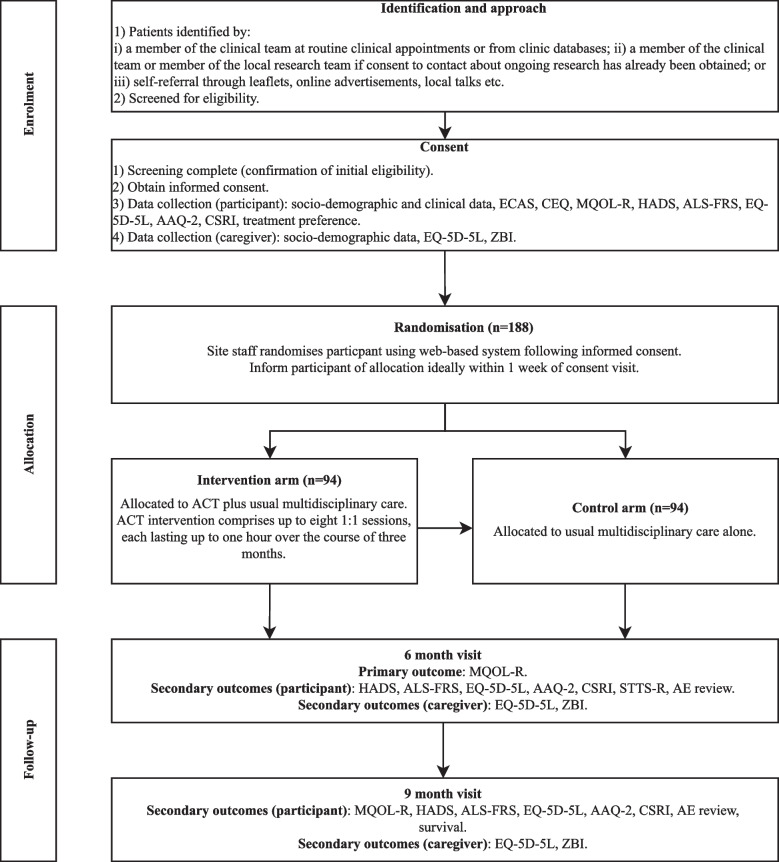
- Participants will be randomized to up to eight 1:1 ACT sessions plus usual care or usual care alone; the primary endpoint is quality of life at 6 months post-randomization.
- The sample size is powered to detect an effect size of 0.44 standard deviations with 90% power at a 5% two-sided alpha, assuming 20% attrition at 6 months.
- The protocol states the trial will also examine cost-effectiveness (including quality-adjusted life years) and secondary outcomes such as depression, anxiety, psychological flexibility, adverse events, ALS functioning, survival at 9 months, satisfaction with therapy, and caregiver burden.
## Methods
- Design: Multi-centre, assessor-blind, parallel, two-arm randomized controlled trial with a 10-month internal pilot phase; allocation is 1:1 stratified by site, and primary analyses are intention to treat using multi-level mixed effects models.
- Sample/data: 188 adults with definite/laboratory-supported probable/clinically probable/possible familial or sporadic ALS, plus progressive muscular atrophy and primary lateral sclerosis variants; recruitment from approximately 14 UK sites and self-referral. Caregivers can also participate if present, and therapists are study staff delivering the intervention.
- Intervention/comparison: ACT modified for MND, delivered in up to eight 1:1 sessions over 4 months, versus usual multidisciplinary care as outlined in NICE NG42; outcomes are collected at baseline, 6 months, and 9 months.
## Limitations
- The paper explicitly states limitations of a non-active control arm, potential unblinding of outcome assessors, and a relatively short follow-up period.
- It also notes that the short follow-up means the study will not be able to examine longer-term treatment effects.
- Evident from the protocol: because the intervention is compared with usual care rather than an active psychotherapy control, any benefit may be hard to attribute specifically to ACT rather than non-specific effects such as support; this is stated in the paper.
Model-written summary. Check it against the paper before relying on it.
Integrity signals
Registry
Cites
Statistics
Figures
Verification
Claims the paper makes
13 Valid · 3 Not valid · 17 Not checked · 23 Own results and interpretations
At least one cited source doesn’t support this claim or points to a different paper, and none confirmed it — see the verdicts below.
In the paper
“One hundred eighty-eight plwMND will be recruited from approximately 14 sites. This will allow detection of an effect size of 0.44 standard deviations, with a two-sided alpha of 5% and 90% power.”
§ A randomised controlled trial of acceptance and commitment therapy plus usual care compared to usual care alone for improving psychological health in people with motor neuron disease (COMMEND): study protocol > Qualitative component PlwMND and study therapists will be asked to anonymously complete a qualitative satisfaction questionnaire at 6 months follow-up and the end of intervention delivery, respectively, to further examine the acceptability and feasibility of ACT and UC. The satisfaction questionnaire for plwMND in the intervention arm will examine satisfaction with ACT and its suitability and relevance to plwMND, perceived benefits and limitations of the intervention, difficulties in implementing the intervention in their everyday lives, and any recommendations for revising the intervention. The version for those in the control arm will assess the acceptability and feasibility of the psychological aspects of their management within UC rather than all aspects of their management. Questions will focus on what kind of psychological support participants felt they needed and what they actually received, what was helpful and what was not, and what other psychological support would have been helpful. The satisfaction questionnaire for therapists will explore how ACT was delivered in practice (e.g. treatment fidelity, ease of delivering ACT for plwMND, difficulty of skills for participants to learn, etc.). If plwMND are unable to complete the written questionnaire (either via post, email or online) due to MND-related difficulties, they will be invited to complete the questionnaire verbally via telephone, videoconference, or face-to-face interview with an independent member of the research team. > Sample size
What the sources say
- Not checked — no full text of the sourcecites [59] Lenglet T Lacomblez L Abitbol JL Ludolph A Mora JS Robberecht W A phase II−III trial of olesoxime in subjects with amyotrophic lateral sclerosis Eur J Neurol 2014 21 3 529 536 24447620 source
- Disputedcites [60] Kuyken W Byford S Byng R Dalgleish T Lewis G Taylor R Study protocol for a randomized controlled trial comparing mindfulness-based cognitive therapy with maintenance anti-depressant treatment in the prevention of depressive relapse/recurrence: the PREVENT trial Trials 2010 11 1 99 20961444 PMC2972263 sourceExperimental — accuracy not yet measured
The Methods/Design > Sample size section describes a depression-relapse trial with 420 participants, not 188 people with MND, and gives a detectable secondary-outcome effect size of 0.40, not 0.44. The Setting, participants, recruitment and randomization section specifies four recruitment sites, not approximately 14. The sample-size prose states 80% power, although its Table 1 note says 90%; neither supports the claimed MND calculation. Page numbers are unavailable in our copy. (LLM, conf=0.90)
Checked by a reasoning model — may be wrong.
- Could not verifycites [61] A-Tjak JGL, Davis ML, Morina N, Powers MB, Smits JAJ, Emmelkamp PMG. A Meta-Analysis of the Efficacy of Acceptance and Commitment Therapy for Clinically Relevant Mental and Physical Health Problems. Psychother Psychosom. 2015;84(1):30–6. 25547522 sourceExperimental — accuracy not yet measured
The Methods section describes how trials were selected for an ACT meta-analysis, and the Results report pooled effect sizes—not a recruitment or power calculation for people with MND. Searches for 188 participants, 14 sites, an effect size of 0.44, and 90% power found no supporting passage in our copy; page numbers were unavailable. (LLM, conf=0.78)
plainn = 188- Asserted: passes — The authors put it forward as true.
- Checkable: passes — It can be checked against evidence.
- Load-bearing: passes — The paper’s conclusions depend on it.
- Based: passes — The paper gives a reason why it holds.
The cited sources support only part of this claim — read each source’s verdict below.
In the paper
“therapists within Improving Access to Psychological Therapy services frequently lack knowledge of and familiarity with MND – an important factor that was highlighted in our previous qualitative work that examined plwMND’s preferences for psychological interventions [15].”
§ A randomised controlled trial of acceptance and commitment therapy plus usual care compared to usual care alone for improving psychological health in people with motor neuron disease (COMMEND): study protocol > Introduction > Background and rationale
What the sources say
- Partly supportedcites [15] Weeks KR Gould RL Mcdermott C Lynch J Goldstein LH Graham CD Needs and preferences for psychological interventions of people with motor neuron disease Amyotroph Lateral Scler Front Degener 2019 20 7–8 521 531 31298054 sourceExperimental — accuracy not yet measured
In “Unfamiliar territory” (page unavailable), participants described a lack of MND knowledge among non-MND healthcare professionals. The Discussion (page unavailable) includes psychological therapists among professionals who may benefit from MND training. The paper does not identify IAPT therapists specifically or establish how frequently they lack that knowledge. (LLM, conf=0.87)
plain- Asserted: passes — The authors put it forward as true.
- Checkable: passes — It can be checked against evidence.
- Load-bearing: passes — The paper’s conclusions depend on it.
- Based: passes — The paper gives a reason why it holds.
- Partly supported
The cited sources support only part of this claim — read each source’s verdict below.
In the paper
“there is evidence that ACT processes such as psychological flexibility predict functioning and quality of life in MND [25] and other progressive, incurable and/or life-limiting conditions, including muscle disorders [26–28], Duchenne muscular dystrophy [29] and palliative care populations [30].”
§ A randomised controlled trial of acceptance and commitment therapy plus usual care compared to usual care alone for improving psychological health in people with motor neuron disease (COMMEND): study protocol > Introduction > Background and rationale
What the sources say
- Not checked — no full text of the sourcecites [25] Pagnini F Phillips D Bosma CM Reece A Langer E Langer E Mindfulness, physical impairment and psychological well-being in people with amyotrophic lateral sclerosis Psychol Health 2015 30 5 503 517 25361013 source
- Not matchedcites [26] Graham C. Explaining and changing adverse illness perceptions in people with muscle disease. Kings College London; 2012.
Its entry has no title and year that we can search by.
- Not checked — no full text of the sourcecites [27] Graham CD Rose MR Hankins M Chalder T Weinman J Separating emotions from consequences in muscle disease: Comparing beneficial and unhelpful illness schemata to inform intervention development J Psychosom Res 2013 74 4 320 326 23497834 source
- Supportedcites [28] Graham CD Gouick J Ferreira N Gillanders D The influence of psychological flexibility on life satisfaction and mood in muscle disorders Rehabil Psychol 2016 61 2 210 217 27196863 source
The Abstract reports that psychological flexibility predicted change in life satisfaction over four months in people with muscle disorders. This source is cited for the muscle-disorders portion of the sentence, not for MND, Duchenne muscular dystrophy, or palliative care populations. (LLM, conf=0.91)
- Partly supportedcites [29] Graham CD Rose MR What explains high life satisfaction in men living with Duchenne muscular dystrophy? A preliminary study to inform psychological intervention Muscle Nerve 2017 56 1 163 166 27935062 sourceExperimental — accuracy not yet measured
The Results report that psychological-flexibility measures differentiated men with Duchenne muscular dystrophy who had high versus low life satisfaction. The study does not establish that these processes predict functioning, and its group comparison does not establish prospective prediction of quality of life. (LLM, conf=0.84)
plainstates an association- Asserted: passes — The authors put it forward as true.
- Checkable: passes — It can be checked against evidence.
- Load-bearing: passes — The paper’s conclusions depend on it.
- Based: passes — The paper gives a reason why it holds.
The cited sources support only part of this claim — read each source’s verdict below.
In the paper
“there is emerging preliminary evidence that ACT might have advantages over conventional CBT through improved engagement, retention and durability of effects [31–34].”
§ A randomised controlled trial of acceptance and commitment therapy plus usual care compared to usual care alone for improving psychological health in people with motor neuron disease (COMMEND): study protocol > Introduction > Background and rationale
What the sources say
- Not checked — no full text of the sourcecites [31] Pakenham KI Fleming M Relations between acceptance of multiple sclerosis and positive and negative adjustments Psychol Health 2011 26 10 1292 1309 21623545 source
- Partly supportedcites [32] Veehof MM Trompetter HR Bohlmeijer ET Schreurs KMG Acceptance- and mindfulness-based interventions for the treatment of chronic pain: a meta-analytic review Cogn Behav Ther 2016 45 1 5 31 26818413 sourceExperimental — accuracy not yet measured
The Main findings section reports that effects of acceptance- and mindfulness-based interventions generally increased at follow-up, whereas a cited CBT meta-analysis found only its mood effect maintained. This offers indirect support for greater durability, but not specifically for ACT. The Comparison with active treatments section finds no significant advantage over CBT, and the passages do not establish better engagement or retention. (LLM, conf=0.85)
- Supportedcites [33] Clarke S Kingston J James K Bolderston H Remington B Acceptance and commitment therapy group for treatment-resistant participants: a randomized controlled trial J Context Behav Sci 2014 3 3 179 188 source
The Attrition section reports significantly fewer dropouts during ACT than during CBT-based treatment as usual, including five CBT participants who attended no sessions. The Discussion reports better maintenance of ACT gains at six-month follow-up and cautiously suggests ACT may be more acceptable to treatment-resistant clients. Together, these support the claim as preliminary evidence, rather than an established advantage across all settings. (LLM, conf=0.88)
- Partly supportedcites [34] Wetherell JL Liu L Patterson TL Afari N Ayers CR Thorp SR Acceptance and commitment therapy for generalized anxiety disorder in older adults: a preliminary report Behav Ther 2011 42 1 127 134 21292059 PMC3496779 sourceExperimental — accuracy not yet measured
The Results (Treatment Effects; page not provided) report that all 7 ACT participants completed therapy, compared with 5 of 9 CBT participants, providing preliminary support for a retention advantage in older adults with GAD. ACT gains remained stable at follow-up, but CBT outcomes were also stable; the paper does not establish better durability or improved treatment engagement relative to CBT. The Method (Procedure; page not provided) says the sample was too small for between-group statistical comparisons. (LLM, conf=0.86)
hedgedstates a possible cause- Asserted: passes — The authors put it forward as true.
- Checkable: passes — It can be checked against evidence.
- Load-bearing: unclear — It is unclear whether the paper’s conclusions depend on it.
- Based: passes — The paper gives a reason why it holds.
In the paper
“quality of life in MND (and hence psychological health) has been found to be more associated with psychological/existential factors than physical function/strength [49]”
§ A randomised controlled trial of acceptance and commitment therapy plus usual care compared to usual care alone for improving psychological health in people with motor neuron disease (COMMEND): study protocol > Outcomes
What the sources say
- Not checked — no full text of the sourcecites [49] Simmons Z Bremer BA Robbins RA Walsh SM Fischer S Quality of life in ALS depends on factors other than strength and physical function Neurology 2000 55 3 388 392 10932273 source
plainstates an association- Asserted: passes — The authors put it forward as true.
- Checkable: passes — It can be checked against evidence.
- Load-bearing: passes — The paper’s conclusions depend on it.
- Based: passes — The paper gives a reason why it holds.
4 more claims
Create a free account to see all 56 claims and to verify the 3 references still open.
- It may state two separate claims as one. 21
- Probably not a substantial claim. 38
Citations
Cites
Using thematic analysis in psychology
Braun, V., & Clarke, V. (2006) · Qualitative Research in Psychology · doi:10.1191/1478088706qp063oa · Cited by 194,414
The Hospital Anxiety and Depression Scale
Zigmond, A. S., & Snaith, R. P. (1983) · Acta Psychiatrica Scandinavica · doi:10.1111/j.1600-0447.1983.tb09716.x · Cited by 47,139 · cited 3×
“Additional exploratory analysis will also be undertaken to assess the consistency of treatment effect across the following subgroups: i) severity of depression and/or anxiety at baseline, according to MND-specific clinical cut-offs on the Hospital Anxiety and Depression Scale [51]; ii) patient preference for treatment…”
BackgroundMcKhann, G. M., Knopman, D. S., Chertkow, H., Hyman, B. T., Jack, C. R., Kawas, C. H., Klunk, W. E., Koroshetz, W. J., Manly, J. J., Mayeux, R., et al. (2011) · Alzheimer's & Dementia · doi:10.1016/j.jalz.2011.03.005 · Cited by 18,657
Depression and quality of life in older persons: A review
Sivertsen, H., Bjørkløf, G. H., Engedal, K., Selbæk, G., & Helvik, A.-S. (2015) · Dementia and Geriatric Cognitive Disorders · doi:10.1159/000437299 · Cited by 14,152
Hoffmann, T. C., Glasziou, P. P., Boutron, I., Milne, R., Perera, R., Moher, D., Altman, D. G., Barbour, V., Macdonald, H., Johnston, M., et al. (2014) · BMJ · doi:10.1136/bmj.g1687 · Cited by 10,548
Development and preliminary testing of the new five-level version of EQ-5D (EQ-5D-5L)
Herdman, M., Gudex, C., Lloyd, A., Janssen, M., Kind, P., Parkin, D., Bonsel, G., & Badia, X. (2011) · Quality of Life Research · doi:10.1007/s11136-011-9903-x · Cited by 9,795
Statistical Analysis with Missing Data
Little, R. J. A., & Rubin, D. B. (2002) · Wiley Series in Probability and Statistics · doi:10.1002/9781119013563 · Cited by 8,473
SPIRIT 2013 Statement: Defining Standard Protocol Items for Clinical Trials
Chan, A.-W., Tetzlaff, J. M., Altman, D. G., Laupacis, A., Gøtzsche, P. C., Krleža-Jerić, K., Hróbjartsson, A., Mann, H., Dickersin, K., Berlin, J. A., et al. (2013) · Annals of Internal Medicine · doi:10.7326/0003-4819-158-3-201302050-00583 · Cited by 7,363 · cited 1×
“Methods This protocol is reported in accordance with SPIRIT and TIDIER guidelines [36, 37].”
MethodRelatives of the Impaired Elderly: Correlates of Feelings of Burden
Zarit, S. H., Reever, K. E., & Bach-Peterson, J. (1980) · The Gerontologist · doi:10.1093/geront/20.6.649 · Cited by 5,810
El Escorial revisited: revised criteria for the diagnosis of amyotrophic lateral sclerosis
Brooks, B. R., Miller, R. G., Swash, M., & Munsat, T. L. (2000) · Amyotrophic Lateral Sclerosis and Other Motor Neuron Disorders · doi:10.1080/146608200300079536 · Cited by 5,433
Norman, G. R., Sloan, J. A., & Wyrwich, K. W. (2003) · Medical Care · doi:10.1097/01.mlr.0000062554.74615.4c · Cited by 4,700 · cited 1×
“5 standard deviations that has been consistently reported for quality of life across different clinical populations [63].”
BackgroundBond, F. W., Hayes, S. C., Baer, R. A., Carpenter, K. M., Guenole, N., Orcutt, H. K., Waltz, T., & Zettle, R. D. (2011) · Behavior Therapy · doi:10.1016/j.beth.2011.03.007 · Cited by 3,950 · cited 1×
“Acceptance and Action Questionnaire-II [52]: A 7-item self-report measure of psychological flexibility (an ACT-specific coping measure); 3.”
MethodCedarbaum, J. M., Stambler, N., Malta, E., Fuller, C., Hilt, D., Thurmond, B., & Nakanishi, A. (1999) · Journal of the Neurological Sciences · doi:10.1016/s0022-510x(99)00210-5 · Cited by 3,307
Psychometric properties of the credibility/expectancy questionnaire
Devilly, G. J., & Borkovec, T. D. (2000) · Journal of Behavior Therapy and Experimental Psychiatry · doi:10.1016/s0005-7916(00)00012-4 · Cited by 2,295 · cited 8×
“Existential and Psychological subscales of the McGill Quality of Life Questionnaire-R [45],2: These subscales have been included as secondary outcome measures as quality of life in MND (and hence psychological health) has been found to be more associated with psychological/existential factors than physical function/st…”
BackgroundInfluentialMeasuring experiential avoidance: A preliminary test of a working model
Hayes, S. C., Strosahl, K., Wilson, K. G., Bissett, R. T., Pistorello, J., Toarmino, D., Polusny, M. A., Dykstra, T. A., Batten, S. V., Bergan, J., et al. (2004) · The Psychological Record · doi:10.1007/bf03395492 · Cited by 2,140
Acceptance and commitment therapy.
Hayes, S. C., & Lillis, J. (2012) · American Psychological Association eBooks · doi:10.1037/17335-000 · Cited by 1,543
Prognostic factors in ALS: A critical review
Chiò, A., Logroscino, G., Hardiman, O., Swingler, R., Mitchell, D., Beghi, E., Traynor, B. G., & On Behalf of the Eurals Consortium (2009) · Amyotrophic Lateral Sclerosis · doi:10.3109/17482960802566824 · Cited by 1,172
Riluzole for amyotrophic lateral sclerosis (ALS)/motor neuron disease (MND)
Miller, R. G., Mitchell, J. D., & Moore, D. H. (2012) · Cochrane Database of Systematic Reviews · doi:10.1002/14651858.cd001447.pub3 · Cited by 1,058
A-Tjak, J. G. L., Davis, M. L., Morina, N., Powers, M. B., Smits, J. A. J., & Emmelkamp, P. M. G. (2015) · Psychotherapy and Psychosomatics · doi:10.1159/000365764 · Cited by 1,031 · cited 1×
“controls [61], which falls within the range found for quality of life in studies of ACT in long-term conditions [62].”
BackgroundRiluzole for amyotrophic lateral sclerosis (ALS)/motor neuron disease (MND)
Miller, R., Mitchell, J., Lyon, M., & Moore, D. (2002) · Cochrane Database of Systematic Reviews · doi:10.1002/14651858.cd001447 · Cited by 909
Strong, M. J., Abrahams, S., Goldstein, L. H., Woolley, S., Mclaughlin, P., Snowden, J., Mioshi, E., Roberts-South, A., Benatar, M., HortobáGyi, T., et al. (2017) · Amyotrophic Lateral Sclerosis and Frontotemporal Degeneration · doi:10.1080/21678421.2016.1267768 · Cited by 909 · cited 1×
“A diagnosis of dementia using standard diagnostic guidelines [40, 41].”
MethodSelf-citationThe epidemiology of ALS: a conspiracy of genes, environment and time
Al-Chalabi, A., & Hardiman, O. (2013) · Nature Reviews Neurology · doi:10.1038/nrneurol.2013.203 · Cited by 894
Self-citationVeehof, M. M., Trompetter, H. R., Bohlmeijer, E. T., & Schreurs, K. M. G. (2016) · Cognitive Behaviour Therapy · doi:10.1080/16506073.2015.1098724 · Cited by 737
Acceptance and commitment therapy and mindfulness for chronic pain: Model, process, and progress.
McCracken, L. M., & Vowles, K. E. (2014) · American Psychologist · doi:10.1037/a0035623 · Cited by 627
Self-citationThe empirical status of acceptance and commitment therapy: A review of meta-analyses
Gloster, A. T., Walder, N., Levin, M. E., Twohig, M. P., & Karekla, M. (2020) · Journal of Contextual Behavioral Science · doi:10.1016/j.jcbs.2020.09.009 · Cited by 622 · cited 1×
“ACT is an acceptance-based behaviour therapy [16] with a strong evidence base for improving outcomes (such as functioning, quality of life and mood) in chronic pain [17], and a growing evidence base in chronic disease and mental health contexts [18].”
BackgroundGraham, C. D., Gouick, J., Krahé, C., & Gillanders, D. (2016) · Clinical Psychology Review · doi:10.1016/j.cpr.2016.04.009 · Cited by 476 · cited 1×
“controls [61], which falls within the range found for quality of life in studies of ACT in long-term conditions [62].”
BackgroundSelf-citationTwohig, M. P., Hayes, S. C., Plumb, J. C., Pruitt, L. D., Collins, A. B., Hazlett-Stevens, H., & Woidneck, M. R. (2010) · Journal of Consulting and Clinical Psychology · doi:10.1037/a0020508 · Cited by 434 · cited 1×
“ACT Treatment Integrity Coding Manual [43]: A coding system that has been developed to assess treatment integrity in ACT interventions, which has been used in previous RCTs of ACT [58].”
MethodAmyotrophic lateral sclerosis: moving towards a new classification system
Al-Chalabi, A., Hardiman, O., Kiernan, M. C., Chiò, A., Rix-Brooks, B., & van den Berg, L. H. (2016) · The Lancet Neurology · doi:10.1016/s1474-4422(16)30199-5 · Cited by 390 · cited 1×
“A diagnosis of definite, laboratory-supported probable, clinically probable, or possible familial or sporadic ALS (which is diagnostically synonymous with MND [38] using the World Federation of Neurology’s El Escorial criteria [39], and additionally the progressive muscular atrophy and primary lateral sclerosis varian…”
MethodSelf-citationQuality of life in ALS depends on factors other than strength and physical function
Simmons, Z., Bremer, B. A., Robbins, R. A., Walsh, S. M., & Fischer, S. (2000) · Neurology · doi:10.1212/wnl.55.3.388 · Cited by 279
Survival in Amyotrophic Lateral Sclerosis: The Role of Psychological Factors
McDonald, E. R. (1994) · Archives of Neurology · doi:10.1001/archneur.1994.00540130027010 · Cited by 193
Kurt, A., Nijboer, F., Matuz, T., & K??bler, A. (2007) · CNS Drugs · doi:10.2165/00023210-200721040-00003 · Cited by 177
Wetherell, J. L., Liu, L., Patterson, T. L., Afari, N., Ayers, C. R., Thorp, S. R., Stoddard, J. A., Ruberg, J., Kraft, A., Sorrell, J. T., et al. (2011) · Behavior Therapy · doi:10.1016/j.beth.2010.07.002 · Cited by 175
Fisher, W. H. (2008) · Psychiatric Services · doi:10.1176/appi.ps.59.5.579 · Cited by 147
Prolonged survival in motor neuron disease: a descriptive study of the King's database 1990-2002
Turner, M. R. (2003) · Journal of Neurology, Neurosurgery & Psychiatry · doi:10.1136/jnnp.74.7.995 · Cited by 139
Kangas, M., & McDonald, S. (2011) · Neuropsychological Rehabilitation · doi:10.1080/09602011.2010.540920 · Cited by 133
Quality of life and measures of quality of life in patients with neuromuscular disorders
Burns, T. M., Graham, C. D., Rose, M. R., & Simmons, Z. (2012) · Muscle & Nerve · doi:10.1002/mus.23245 · Cited by 132 · cited 1×
“It has also been validated in plwMND [48, 49].”
Self-citationA phase II–III trial of olesoxime in subjects with amyotrophic lateral sclerosis
Lenglet, T., Lacomblez, L., Abitbol, J. L., Ludolph, A., Mora, J. S., Robberecht, W., Shaw, P. J., Pruss, R. M., Cuvier, V., Meininger, V., et al. (2014) · European Journal of Neurology · doi:10.1111/ene.12344 · Cited by 130 · cited 2×
“58 between 0 and 6 months post-randomisation for the McGill Quality of Life questionnaire in plwMND [59].”
BackgroundMethodSelf-citationRasch analysis of the Hospital Anxiety and Depression Scale (HADS) for use in motor neurone disease
Gibbons, C. J., Mills, R. J., Thornton, E. W., Ealing, J., Mitchell, J. D., Shaw, P. J., Talbot, K., Tennant, A., & Young, C. A. (2011) · Health and Quality of Life Outcomes · doi:10.1186/1477-7525-9-82 · Cited by 130 · cited 5×
“Additional exploratory analysis will also be undertaken to assess the consistency of treatment effect across the following subgroups: i) severity of depression and/or anxiety at baseline, according to MND-specific clinical cut-offs on the Hospital Anxiety and Depression Scale [51]; ii) patient preference for treatment…”
MethodInfluentialCohen, S. R., Sawatzky, R., Russell, L. B., Shahidi, J., Heyland, D. K., & Gadermann, A. M. (2017) · Palliative Medicine · doi:10.1177/0269216316659603 · Cited by 129
(2007) · doi:10.1093/med:psych/9780195304633.001.0001 · Cited by 126 · cited 1×
“The random selection of sessions will be stratified according to therapist, phase of the intervention (early, middle or late), and phase of study recruitment (early, middle or late), as previously recommended [44].”
BackgroundNew generation psychological treatments in chronic pain
McCracken, L. M., Yu, L., & Vowles, K. E. (2022) · BMJ · doi:10.1136/bmj-2021-057212 · Cited by 123
Self-citationLittle, R. J., Long, Q., & Lin, X. (2009) · Biometrics · doi:10.1111/j.1541-0420.2008.01066.x · Cited by 111
Psychological health in patients with amyotrophic lateral sclerosis
Averill, A. J., Kasarskis, E. J., & Segerstrom, S. C. (2007) · Amyotrophic Lateral Sclerosis · doi:10.1080/17482960701374643 · Cited by 110
Oei, T. P. S., & Green, A. L. (2008) · Professional Psychology: Research and Practice · doi:10.1037/0735-7028.39.4.435 · Cited by 109
Suicide among patients with amyotrophic lateral sclerosis
Fang, F., Valdimarsdóttir, U., Fürst, C. J., Hultman, C., Fall, K., Sparén, P., & Ye, W. (2008) · Brain · doi:10.1093/brain/awn161 · Cited by 100
van Groenestijn, A. C., Kruitwagen-van Reenen, E. T., Visser-Meily, J. M. A., van den Berg, L. H., & Schröder, C. D. (2016) · Health and Quality of Life Outcomes · doi:10.1186/s12955-016-0507-6 · Cited by 92
Pizzimenti, A. (2013) · Functional Neurology · doi:10.11138/fneur/2013.28.2.115 · Cited by 80
Clarke, S., Kingston, J., James, K., Bolderston, H., & Remington, B. (2014) · Journal of Contextual Behavioral Science · doi:10.1016/j.jcbs.2014.04.005 · Cited by 79
Assessing treatment integrity in acceptance and commitment therapy: strategies and suggestions
Plumb, J. C., & Vilardaga, R. (2010) · International Journal of Behavioral Consultation and Therapy · doi:10.1037/h0100912 · Cited by 75 · cited 2×
“ACT Treatment Integrity Coding Manual [43]: A coding system that has been developed to assess treatment integrity in ACT interventions, which has been used in previous RCTs of ACT [58].”
MethodRelations between acceptance of multiple sclerosis and positive and negative adjustments
Pakenham, K. I., & Fleming, M. (2011) · Psychology & Health · doi:10.1080/08870446.2010.517838 · Cited by 70
Hadlandsmyth, K., White, K. S., Nesin, A. E., & Greco, L. A. (2013) · International Journal of Behavioral Consultation and Therapy · doi:10.1037/h0100960 · Cited by 65
Prevalence of depression in amyotrophic lateral sclerosis and other motor disorders
Taylor, L., Wicks, P., Leigh, P. N., & Goldstein, L. H. (2010) · European Journal of Neurology · doi:10.1111/j.1468-1331.2010.02960.x · Cited by 62
Self-citationPagnini, F., Phillips, D., Bosma, C. M., Reece, A., & Langer, E. (2015) · Psychology & Health · doi:10.1080/08870446.2014.982652 · Cited by 62
Mood as a predictor of disability and survival in patients newly diagnosed with ALS/MND
Johnston, M., Earll, L., Giles, M., Mcclenahan, R., Stevens, D., & Morrison, V. (1999) · British Journal of Health Psychology · doi:10.1348/135910799168524 · Cited by 57
The Influence of Psychological Flexibility on Life Satisfaction and Mood in Muscle Disorders.
Graham, C. D., Gouick, J., Ferreira, N., & Gillanders, D. (2016) · Rehabilitation Psychology · doi:10.1037/rep0000092 · Cited by 54
Self-citationKuyken, W., Byford, S., Byng, R., Dalgleish, T., Lewis, G., Taylor, R., Watkins, E. R., Hayes, R., Lanham, P., Kessler, D., et al. (2010) · Trials · doi:10.1186/1745-6215-11-99 · Cited by 48
Graham, C. D., Simmons, Z., Stuart, S. R., & Rose, M. R. (2015) · Muscle & Nerve · doi:10.1002/mus.24487 · Cited by 43
Self-citationNeeds and preferences for psychological interventions of people with motor neuron disease
Weeks, K. R., Gould, R. L., Mcdermott, C., Lynch, J., Goldstein, L. H., Graham, C. D., McCracken, L., Serfaty, M., Howard, R., Al-Chalabi, A., et al. (2019) · Amyotrophic Lateral Sclerosis and Frontotemporal Degeneration · doi:10.1080/21678421.2019.1621344 · Cited by 36 · cited 2×
“Furthermore, therapists within Improving Access to Psychological Therapy services frequently lack knowledge of and familiarity with MND – an important factor that was highlighted in our previous qualitative work that examined plwMND’s preferences for psychological interventions [15].”
Self-citationThe role of acceptance in rehabilitation in life-threatening illness
Low, J., Davis, S., Drake, R., King, M., Tookman, A., Turner, K., Serfaty, M., Leurent, B., & Jones, L. (2012) · Journal of Pain and Symptom Management · doi:10.1016/j.jpainsymman.2011.03.020 · Cited by 33 · cited 1×
“[26–28], Duchenne muscular dystrophy [29] and palliative care populations [30].”
BackgroundSelf-citationGagnon, P., Fillion, L., Robitaille, M.-A., Girard, M., Tardif, F., Cochrane, J.-P., Le Moignan Moreau, J., & Breitbart, W. (2015) · Palliative and Supportive Care · doi:10.1017/s147895151400073x · Cited by 29 · cited 1×
“it was able to distinguish between days rated as bad, average and good in people with cancer [46, 47].”
BackgroundGraham, C. D., Rose, M. R., Hankins, M., Chalder, T., & Weinman, J. (2013) · Journal of Psychosomatic Research · doi:10.1016/j.jpsychores.2012.09.012 · Cited by 27
Self-citationImpact of the covid-19 pandemic on amyotrophic lateral sclerosis care in the UK
Musson, L. S., Collins, A., Opie-Martin, S., Bredin, A., Hobson, E. V., Barkhouse, E., Coulson, M. C., Stavroulakis, T., Gould, R. L., Al-Chalabi, A., et al. (2023) · Amyotrophic Lateral Sclerosis and Frontotemporal Degeneration · doi:10.1080/21678421.2022.2040533 · Cited by 17 · cited 1×
“We recently highlighted the negative impact of COVID-19 and related restrictions on this clinically vulnerable group, including reduced access to UC, increased rates of anxiety and increased social isolation due to shielding [69].”
BackgroundSelf-citationGraham, C. D., & Rose, M. R. (2017) · Muscle & Nerve · doi:10.1002/mus.25495 · Cited by 14 · cited 1×
“[26–28], Duchenne muscular dystrophy [29] and palliative care populations [30].”
BackgroundSelf-citation(2008) · doi:10.1093/med:psych/9780195304633.003.0013 · Cited by 11
Gould, R. L., Rawlinson, C., Thompson, B., Weeks, K., Gossage-Worrall, R., Cantrill, H., Serfaty, M. A., Graham, C. D., McCracken, L. M., White, D., et al. (2023) · Pilot and Feasibility Studies · doi:10.1186/s40814-023-01354-7 · Cited by 10
Self-citation(2000) · Pure Amsterdam UMC · doi:10.1002/1097-0142(20001015)89:8
Research works printed but not linked: 2
- National Institute for Health and Care Excellence. Motor neurone disease: Assessment and management (NG42) [Internet]. 2016. Available from: www.nice.org.uk/Guidance/NG42. 26962594
- Curtis L Burns A Unit costs of health and social care 2015 2015 Personal Social Services Research Unit University of Kent
Cited by
Neuropsychological impairment in amyotrophic lateral sclerosis–frontotemporal spectrum disorder
Abrahams, S. (2023) · Nature Reviews Neurology · doi:10.1038/s41582-023-00878-z · Cited by 91
Gould, R. L., McDermott, C. J., Thompson, B. J., Rawlinson, C. V., Bursnall, M., Bradburn, M., Kumar, P., Turton, E. J., White, D. A., Serfaty, M. A., et al. (2024) · The Lancet · doi:10.1016/s0140-6736(24)00533-6 · Cited by 38
“16 This is due to its more pragmatic approach of helping people to live their lives in meaningful ways alongside the condition rather than focusing primarily on alleviating distress or symptoms, or thinking more realistically; strategies which might offer less scope for improvement given the…”
Self-citationBjelica, B., Bartels, M.-B., Hesebeck‐Brinckmann, J., & Petri, S. (2024) · Journal of Neurology · doi:10.1007/s00415-024-12455-5 · Cited by 51
Brain Vascular Health in ALS Is Mediated through Motor Cortex Microvascular Integrity
Schreiber, S., Bernal, J., Arndt, P., Schreiber, F., Müller, P., Morton, L., Braun-Dullaeus, R. C., Hernández, M. V., Duarte, R., Wardlaw, J. M., et al. (2023) · Cells · doi:10.3390/cells12060957 · Cited by 35
Post-stroke emotionalism: Diagnosis, pathophysiology, and treatment
Broomfield, N. M., Blake, J., Gracey, F., & Steverson, T. (2024) · International Journal of Stroke · doi:10.1177/17474930241242952 · Cited by 15
Metadata
- Authors
- Gould, R. L., Thompson, B. J., Rawlinson, C., Kumar, P., White, D., Serfaty, M. A., Graham, C. D., McCracken, L. M., Bursnall, M., Bradburn, M., Young, T., Howard, R. J., Al-Chalabi, A., Goldstein, L. H., Lawrence, V., Cooper, C., Shaw, P. J., & McDermott, C. J.
- Affiliations
- University College London (GB)
- University of Sheffield (GB)
- Queen's University Belfast (GB)
- Uppsala University (SE)
- King's College London (GB)
- Corresponding author
- Gould, Rebecca L.
- ORCID
- Venue
- BMC Neurology
- Published
- 2022-11-15
- Volume
- 22
- Issue
- 1
- Pages
- 431-431
- ISSN
- 1471-2377 (ISSN-L)
- PMC
- PMC9664029
- OpenAlex
- W4309323790
- Semantic Scholar
- 11fc665f9c8ff754343c5ffe9ec6272b54120851
- Cited by
- 16
- References
- 65
- Citations by year
- 2026: 3 · 2024: 6 · 2023: 7
- FWCI
- 2.97
- Type
- journal article
- Language
- en
- Open access
- gold
- doi.org
- Licence
- cc-by
- creativecommons.org/licenses/by/4.0 (tdm)
- creativecommons.org/licenses/by/4.0 (vor)
- Locations
- BMC Neurology (publishedVersion, cc-by)
- PubMed Central (publishedVersion, cc-by)
- PubMed (publishedVersion)
- White Rose Research Online (University of Leeds, The University of Sheffield, University of York) (acceptedVersion)
- Research Portal (Queen's University Belfast) (acceptedVersion, other-oa)
- Strathprints: The University of Strathclyde institutional repository (University of Strathclyde) (acceptedVersion, other-oa)
- Research Portal (King's College London) (acceptedVersion, cc-by)
- KTH Publication Database DiVA (KTH Royal Institute of Technology) (submittedVersion, other-oa)
- DOAJ (DOAJ: Directory of Open Access Journals) (submittedVersion, cc-by-sa)
- UCL Discovery (University College London) (submittedVersion)
- Funders
- National Institute for Health and Care Research (16.81.01)
- Motor Neurone Disease Association (914225)
- Topics
- Social Sciences › Psychology › Clinical Psychology › Mindfulness and Compassion Interventions
- Health Sciences › Medicine › Clinical Neurology › Amyotrophic Lateral Sclerosis Research
- Health Sciences › Medicine › Oncology › Cancer survivorship and care
- Keywords
- acceptance and commitment therapy, motor neuron disease, amyotrophic lateral sclerosis, mental health, psychological distress, quality of life, depression, anxiety, psychological flexibility, cost-effectiveness, usual care, progressive muscular atrophy, primary lateral sclerosis, resource utilization (health care), quality-adjusted life years, survival, treatment satisfaction, adverse events
- MeSH terms
- Cost-Benefit Analysis, Humans, Quality of Life, Randomized Controlled Trials as Topic, Motor Neuron Disease, Neurodegenerative Diseases, Acceptance and Commitment Therapy
About these checks
Registry, retraction, Cites and statistics results are computed, not judged, with one exception: a printed reference that no index lists is read once by a model before it counts as a citation error. Claims are extracted by a model and kept only when their quote appears verbatim in the text; each cited source is then checked, with a model’s help, for whether it says what the claim relies on. Those verdicts can be wrong — read the claim’s quote and the cited source before relying on one.
The claim verdicts this report counts are experimental: their accuracy is not yet measured.
A language model drew the claims from the paper on 2026-10-11, under version 3 of the claim definition (model deepseek-v4.1-flash, prompt extract-v3).
A second model labelled each claim on 2026-10-11 (model jev-1.13-20260917, definition revision gold-guideline-v0.2).
Cited sources are checked with a language model’s help (gpt-6-sol).
Statistics and arithmetic are recomputed, not judged.
Confidence bands are shown only for fields calibrated on our annotated test set. None is calibrated yet, so no band is shown.
What counts as a claim ›How we measure confidence ›How we check this ›
Are you an author, or do you see a problem with this page? Request a review
Data sources
Bibliographic data: Semantic Scholar, OpenAlex, Crossref.
Contains information from the Semantic Scholar Academic Graph Datasets, made available under the ODC Attribution License (ODC-BY 1.0).
Semantic Scholar’s data is described in: Kinney, R., et al. (2023). The Semantic Scholar Open Data Platform. arXiv:2301.10140.
