

Medical decision-making in children and adolescents: developmental and neuroscientific aspects
Open accessThe DOI matches its Crossref record; 85 of the 89 references it cites were found in a registry or an index, and 1 are not checked yet; 23 of the 100 sources its claims cite were checked for support.
Abstract
BACKGROUND: Various international laws and guidelines stress the importance of respecting the developing autonomy of children and involving minors in decision-making regarding treatment and research participation. However, no universal agreement exists as to at what age minors should be deemed decision-making competent. Minors of the same age may show different levels of maturity. In addition, patients deemed rational conversation-partners as a child can suddenly become noncompliant as an adolescent. Age, context and development all play a role in decision-making competence. In this article we adopt a perspective on competence that specifically focuses on the impact of brain development on the child's decision-making process. MAIN BODY: We believe that the discussion on decision-making competence of minors can greatly benefit from a multidisciplinary approach. We adopted such an approach in order to contribute to the understanding on how to deal with children in decision-making situations. Evidence emerging from neuroscience research concerning the developing brain structures in minors is combined with insights from various other fields, such as psychology, decision-making science and ethics. Four capacities have been described that are required for (medical) decision-making: (1) communicating a choice; (2) understanding; (3) reasoning; and (4) appreciation. Each capacity is related to a number of specific skills and abilities that need to be sufficiently developed to support the capacity. Based on this approach it can be concluded that at the age of 12 children can have the capacity to be decision-making competent. However, this age coincides with the onset of adolescence. Early development of the brain's reward system combined with late development of the control system diminishes decision-making competence in adolescents in specific contexts. We conclude that even adolescents possessing capacities required for decision-making, may need support of facilitating environmental factors. CONCLUSION: This paper intends to offer insight in neuroscientific mechanisms underlying the medical decision-making capacities in minors and to stimulate practices for optimal involvement of minors. Developing minors become increasingly capable of decision-making, but the neurobiological development in adolescence affects competence in specific contexts. Adequate support should be offered in order to create a context in which minors can make competently make decisions.
Verified 2026-11-25 · 1 reference not checked yet
Overview
CoChat Summary
TL;DR
This narrative review argues that decision-making competence in minors develops unevenly across childhood and adolescence and cannot be fixed to a single age cut-off. Based on neuroscience plus ethics/psychology/decision science, the authors conclude that children around age 12 may be competent in some contexts, but adolescents often need support because hot, peer-influenced, or emotional situations can reduce competence.
Key findings
- The paper organizes medical decision-making into four capacity standards: communicating a choice, understanding, reasoning, and appreciation.
- Based on developmental evidence, the authors state that “at the age of 12 children can have the capacity to be decision-making competent,” but this age coincides with adolescence, when competence can fluctuate by context.
- In a recent study of pediatric patients aged 6–18 years using MacCAT-CR, children 11.2 years and above generally appeared competent, children 9.6 years and younger generally were not competent, and the crossover point was estimated at 10.4 years.
- The paper argues that adolescents’ early-developing reward system and later-developing control system make them more vulnerable to risk-taking, especially in “hot” or peer-present situations; in “cold” situations, risk-taking is similar to children and adults.
Methods
- Narrative, multidisciplinary review: the authors combine neuroscience research on brain development with psychology, decision-making science, ethics, and medical practice.
- They focus on the four Appelbaum and Grisso capacity standards and relate each to developmental trajectories and brain areas.
- They also use previously published empirical findings, including a MacCAT-CR study in pediatric patients aged 6–18 years, to translate the model into clinical practice.
Limitations
- The authors explicitly state that this paper provides only “initial insight” because neuroscience on these abilities is “a relatively new and developing science” with “many questions left to be answered.”
- They also say they cannot give a precise age cut-off for competence, and that age-based thresholds do not imply competence for every decision or situation.
- Evident from the text: this is a review, not a primary empirical study of a new sample, so its conclusions depend on the quality and scope of the cited literature.
Model-written summary. Check it against the paper before relying on it.
Integrity signals
Registry
Cites
Statistics
Figures
Verification
Claims the paper makes
20 Valid · 3 Not valid · 43 Not checked · 34 Own results and interpretations
The cited sources support only part of this claim — read each source’s verdict below.
In the paper
“Accordingly, decision-making in the presence of peers is substantially different from individual decisions [56].”
§ Medical decision-making in children and adolescents: developmental and neuroscientific aspects > Background > Risk, sensation-seeking and self-regulation
What the sources say
- Partly supportedcites [56] Albert D Chein J Steinberg L The teenage brain: influences on adolescent decision making Curr Dir Psychol 2013 22 114 120 10.1177/0963721412471347 PMC4276317 25544805 sourceExperimental — accuracy not yet measured
The Identification of Mechanisms section reports that adolescents took more risks and preferred immediate rewards when peers were present than when alone. But the claim leaves out an important limit: the paper reports no peer-related increase in risk-taking among adults and no difference on the adolescent inhibitory-control task. It therefore supports a difference in some adolescent decisions, not decision-making generally. (LLM, conf=0.86)
states an association- Asserted: passes — The authors put it forward as true.
- Checkable: passes — It can be checked against evidence.
- Load-bearing: unclear — It is unclear whether the paper’s conclusions depend on it.
- Based: passes — The paper gives a reason why it holds.
- Partly supported
The cited sources support only part of this claim — read each source’s verdict below.
In the paper
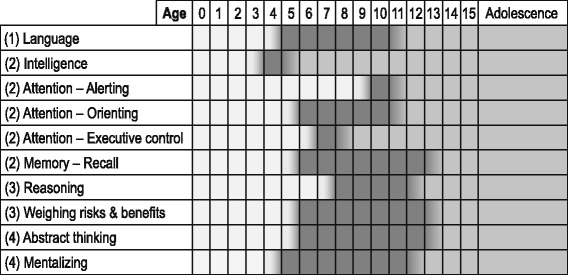
“Children at the age of 10–12 appear to have recall abilities compared to adults [31–33].”
§ Medical decision-making in children and adolescents: developmental and neuroscientific aspects > Background > Development of abilities and brain areas related to the four capacity standards
What the sources say
- Partly supportedcites [31] Rhodes SM Murphy D Hancock PJ Developmental changes in the engagement of episodic retrieval processes and their relationship with working memory during the period of middle childhood Br J Dev Psychol 2011 29 865 882 10.1111/j.2044-835X.2010.02014.x 21995741 sourceExperimental — accuracy not yet measured
The Discussion reports that 11-year-olds engaged recollection to the same degree as adults. It also says 10-year-olds differed from adults, while the study did not test 12-year-olds. The source therefore supports an adult comparison at age 11, not across the stated 10–12 age range. (LLM, conf=0.88)
- Not checked — no full text of the sourcecites [32] Sprondel V Kipp KH Mecklinger A Developmental changes in item and source memory: evidence from an ERP recognition memory study with children, adolescents, and adults Child Dev 2011 82 1638 1953 10.1111/j.1467-8624.2011.01642.x 21883163 source
- Not checked — no full text of the sourcecites [33] Czernochowski D Mecklinger A Johansson M Age-related changes in the control of episodic retrieval: an ERP study of recognition memory in children and adults Dev Sci 2009 12 1026 1040 10.1111/j.1467-7687.2009.00841.x 19840057 source
hedged- Asserted: passes — The authors put it forward as true.
- Checkable: passes — It can be checked against evidence.
- Load-bearing: unclear — It is unclear whether the paper’s conclusions depend on it.
- Based: passes — The paper gives a reason why it holds.
- Partly supported
The cited sources support only part of this claim — read each source’s verdict below.
In the paper
“Children at the age of 6 to 8 already demonstrate the ability for logic reasoning [34, 35].”
§ Medical decision-making in children and adolescents: developmental and neuroscientific aspects > Background > Development of abilities and brain areas related to the four capacity standards
What the sources say
- Partly supportedcites [34] Markovits H Barrouillet P Gauffroy C The development of abstract conditional reasoning The development of thinking and reasoning 2013 London Psychology Press 71 94 sourceExperimental — accuracy not yet measured
The review (Thinking and reasoning beyond Piaget's conceptions, p. 11) states that 'children as young as six or seven years can give the logical responses of uncertainty to AC and DA with category-based' conditional premises, and elsewhere (pp. 10-11) that analogical reasoning appears by age three and counterfactual rationality by three to four — so logical responding in specific domains at 6-7 is supported. But the claim's upper bound of 8 years is not stated anywhere in our copy, and the source does not attribute a general 'ability for logic reasoning' to that age band: it stresses that abstract conditional reasoning 'is not available before the end of adolescence' (p. 11) and that even adults often fail to reason logically. The unsupported part is the blanket, age-6-to-8 general competence. (LLM, conf=0.75)
- Not checked — no full text of the sourcecites [35] Pillow BH Pearson RM Hecht M Bremer A Children’s and adults’ judgments of the certainty of deductive inferences, inductive inferences, and guesses J Genet Psychol 2010 171 203 217 10.1080/00221320903300403 20836430 source
boosted- Asserted: passes — The authors put it forward as true.
- Checkable: passes — It can be checked against evidence.
- Load-bearing: passes — The paper’s conclusions depend on it.
- Based: passes — The paper gives a reason why it holds.
- Partly supported
The cited sources support only part of this claim — read each source’s verdict below.
In the paper
“Improvement of the efficiency of working memory with age further increases the ability to think about abstract and hypothetical things, situations and norms and values [34, 41].”
§ Medical decision-making in children and adolescents: developmental and neuroscientific aspects > Background > Development of abilities and brain areas related to the four capacity standards
What the sources say
- Partly supportedcites [34] Markovits H Barrouillet P Gauffroy C The development of abstract conditional reasoning The development of thinking and reasoning 2013 London Psychology Press 71 94 sourceExperimental — accuracy not yet measured
The review (Thinking and reasoning beyond Piaget's conceptions, p. 11) does state that age-related changes in general factors including working memory capacities affect all types of reasoning, and it describes the protracted development of abstract conditional reasoning (Markovits) and counterfactual/hypothetical thinking (Meehan & Byrne, pp. 10-11) — supporting the abstract/hypothetical half of the claim. However, it never says that increased working-memory efficiency produces a greater capacity to think about norms and values; the only 'normative' material (pp. 10, 12) concerns normative responding in dual-process reasoning tasks, i.e. logical/normative responses to biases, not moral norms or values. Moreover, the source frames the working-memory/capacity link cautiously and even warns that 'any view of development as a progressive shift from intuitive and heuristic responses to rational reasoning leading to normative responses is an oversimplification' (p. 12), so the straightforward causal improvement asserted in the citing sentence overstates it. (LLM, conf=0.72)
- Partly supportedcites [41] Pike MM Barnes MA Barron RW The role of illustrations in children’s inferential comprehension J Exp Child Psychol 2010 105 243 255 10.1016/j.jecp.2009.10.006 19954799 sourceExperimental — accuracy not yet measured
The Developmental Differences section (page unavailable) says inhibition of irrelevant information becomes more efficient with age, and the Individual Differences section (page unavailable) finds that working memory predicts children's ability to make bridging inferences while reading. The paper does not establish that age-related gains in working-memory efficiency increase the ability to think about abstract or hypothetical matters, norms, or values. (LLM, conf=0.84)
plainstates a cause- Asserted: passes — The authors put it forward as true.
- Checkable: passes — It can be checked against evidence.
- Load-bearing: passes — The paper’s conclusions depend on it.
- Based: passes — The paper gives a reason why it holds.
- Partly supported
The sources with a verdict support this claim; the rest weren’t checked yet, have no full text we could read, or their verdicts aren’t rated yet.
In the paper
“The brain in adolescence differs significantly from the brain in childhood and adulthood [45–48].”
§ Medical decision-making in children and adolescents: developmental and neuroscientific aspects > Background > Adolescence and decision-making competence
What the sources say
- Not matchedcites [45] Crone EA Het puberende brein 2008 The Netherlands Bert Bakker
We searched by its title and found no matching paper.
- Supportedcites [46] Steinberg L A behavioral scientist looks at the science of adolescent brain development Brain Cogn 2010 72 160 164 10.1016/j.bandc.2009.11.003 19963311 PMC2904973 source
In the Commentary, Steinberg states that the adolescent brain is different from both the child's and the adult's brain, in morphology and function. The passage directly supports the citing sentence. (LLM, conf=0.95)
- Supportedcites [47] Casey BJ Jones RM Hare TA The adolescent brain Ann N Y Acad Sci 2008 1124 111 126 10.1196/annals.1440.010 18400927 PMC2475802 source
The Introduction describes structural brain changes continuing throughout adolescence and into adulthood, including changes in gray and white matter. It also reports dopamine levels peaking during adolescence compared with earlier and later life, supporting the broad comparison with childhood and adulthood. (LLM, conf=0.91)
- Not checked — no full text of the sourcecites [48] Blakemore SJ Robbins TW Decision-making in the adolescent brain Nat Neurosci 2012 15 1184 1191 10.1038/nn.3177 22929913 source
plain- Asserted: passes — The authors put it forward as true.
- Checkable: passes — It can be checked against evidence.
- Load-bearing: passes — The paper’s conclusions depend on it.
- Based: passes — The paper gives a reason why it holds.
- Not matched
55 more claims · 10 with their cited sources checked
Create a free account to see all 100 claims and to verify the 4 references still open.
- It may state two separate claims as one. 34
- Probably not a substantial claim. 8
Claims other papers make about this one
Each is checked against this paper’s own text: does it say what the citing paper says it does?
The cited source says what the claim attributes to it.
In the citing paper
“In addition, ongoing neurobiological development during adolescence may affect competency of decision-making.”
From Requests for Medical Assistance in Dying by Young Dutch People With Psychiatric Disorders (2025) · cites this paper as [7]
Citations
Cites
The attention system of the human brain
Posner, M. I., & Petersen, S. E. (1990) · Annual Review of Neuroscience · doi:10.1146/annurev.ne.13.030190.000325 · Cited by 8,070
Dynamic mapping of human cortical development during childhood through early adulthood
Gogtay, N., Giedd, J. N., Lusk, L., Hayashi, K. M., Greenstein, D., Vaituzis, A. C., Nugent, T. F., Herman, D. H., Clasen, L. S., Toga, A. W., et al. (2004) · Proceedings of the National Academy of Sciences · doi:10.1073/pnas.0402680101 · Cited by 5,604 · cited 6×
“The development of each ability starts at an early age, and continues to mature to a small or larger extent into adolescence or even beyond Thus, the control system (PFC) develops slowly, even into early adulthood whereas the reward system (amygdala and possibly nucleus accumbens) already changes in early adolescence…”
BackgroundInfluentialNine Ways to Reduce Cognitive Load in Multimedia Learning
Mayer, R. E., & Moreno, R. (2003) · Educational Psychologist · doi:10.1207/s15326985ep3801_6 · Cited by 4,207 · cited 1×
“In the UK, children under the age of 16 cannot be treated without parental consent, unless they prove to be mature according to the Gillick ruling [4].”
BackgroundOfficial Journal of the European Communities
(1984) · Analytical Proceedings · doi:10.1039/ap9842100196 · Cited by 4,027
A social neuroscience perspective on adolescent risk-taking
Steinberg, L. (2008) · Developmental Review · doi:10.1016/j.dr.2007.08.002 · Cited by 3,644
The attention system of the human brain: 20 years after
Petersen, S. E., & Posner, M. I. (2012) · Annual Review of Neuroscience · doi:10.1146/annurev-neuro-062111-150525 · Cited by 3,439
Casey, B. J., Jones, R. M., & Hare, T. A. (2008) · Annals of the New York Academy of Sciences · doi:10.1196/annals.1440.010 · Cited by 3,345
Understanding adolescence as a period of social–affective engagement and goal flexibility
Crone, E. A., & Dahl, R. E. (2012) · Nature Reviews Neuroscience · doi:10.1038/nrn3313 · Cited by 2,507 · cited 5×
“ates a perfect situation for learning new skills that are important to function in a social context [53, 55].”
BackgroundInfluentialDevelopment and neurophysiology of mentalizing
Frith, U., & Frith, C. D. (2003) · Philosophical Transactions of the Royal Society of London. Series B: Biological Sciences · doi:10.1098/rstb.2002.1218 · Cited by 2,306 · cited 1×
“Between the age of 3 and 4, children already start to recognize their own beliefs and desires, which contribute to the development of personal norms and values, and start to understand how these influence their actions [25, 39, 40].”
BackgroundIs Adolescence a Sensitive Period for Sociocultural Processing?
Blakemore, S.-J., & Mills, K. L. (2014) · Annual Review of Psychology · doi:10.1146/annurev-psych-010213-115202 · Cited by 2,264 · cited 3×
“In addition, self-awareness increases during adolescence [55].”
Background
Research works printed but not linked: 3
- Shaffer D Kipp K Developmental psychology 2007 Belmont Thomson Wadsworth
- Reed J Warner-Rogers J Child Neuropsychology; Concept, Theory and Practice 2008 Oxford Wiley-Blackwell
- Crone EA Het puberende brein 2008 The Netherlands Bert Bakker
Cited by
Items 301–350 of 350
Hwang, J. W., Chien, S. J., Wang, C., Kuo, K.-C., Tang, K.-S., Lee, Y., Chen, Y., Lo, M., Lee, I., Chuah, S., et al. (2023) · Adolescent Health Medicine and Therapeutics · doi:10.2147/ahmt.s429238
“43 Educational institutions, such as schools, can play a vital role in enhancing disease and vaccine education.”
BackgroundBrizioli, S. (2023) · Springer eBooks · doi:10.1007/978-3-031-42944-6_36
Ethics of Pediatric Gender-Affirming Care: A Case Study Comparison
Jackson, G. R., Chen, D., Coyne, C. A., Donahue, K., & Campo‐Engelstein, L. (2024) · Clinical Practice in Pediatric Psychology · doi:10.1037/cpp0000487
Taylor, R. E. (2024) · Cambridge University Press eBooks · doi:10.1017/9781108680158.009
Bawah, R. K., Osman, W., Pireh, D., et al. (2024) · International Journal of Africa Nursing Sciences · doi:10.1016/j.ijans.2024.100714
McArdle, E., Teelin, K., Borschuk, A., & Brown, A. E. C. (2024) · The Journal of Clinical Ethics · doi:10.1086/729413
Child-parent agreement on knowledge, self-perception, and behavior in oral health
Silva, M. G., Diniz, A. C. S., Rodrigues, V. P., Ribeiro, C. C. C., & Firoozmand, L. M. (2024) · Revista Sustinere · doi:10.12957/sustinere.2024.74328 · Cited by 1
Ethical Considerations in Fetal and Pediatric Cardiology
Gandhi, R., Kirsch, R. E., & Patel, A. (2024) · Springer eBooks · doi:10.1007/978-3-031-07563-6_4
Roberts, B., Cooper, Z., Landery, G., Stanley, S., Majda, B. T., Collins, K. R., Akkari, P., Hood, S. D., & Rodger, J. (2024) · medRxiv · doi:10.1101/2024.08.25.24312539
“While adolescents may benefit from professional support and guidance during medical decision-making processes [83], study participants primarily expressed a desire for more personalised treatment to fit their unique circumstances.”
BackgroundPediatric Consultation and Liaison Psychiatry
Becker, J. E., Smith, J. R., Souza, C. M. D., & Hazen, E. P. (2024) · Springer eBooks · doi:10.1007/978-3-030-51366-5_8
Kliemann, A., Winter, S., Fegert, J. M., & Berthold, O. (2024) · Monatsschrift Kinderheilkunde · doi:10.1007/s00112-024-02046-z
Ou, L., Chen, A. C., Reifsnider, E., Todd, M. W., Amresh, A., & Mun, C. J. (2024) · Games for Health Journal · doi:10.1089/g4h.2024.0011 · Cited by 3
Neurocognitive development and medical decision-making
Teo, J. P. E., Sood, N. T., Pace, C., & Seal, M. L. (2024) · Elsevier eBooks · doi:10.1016/b978-0-443-22323-5.00009-5 · Cited by 1
Psychosocial and contextual influences on children's healthcare participation
Swords, L. (2024) · Elsevier eBooks · doi:10.1016/b978-0-443-22323-5.00005-8
Danhauser, K., Mantoan, L. D. L., Dittmer, J. M., Leutner, S., Endres, S., Strniscak, K., Pfropfreis, J., Bialke, M., Stahl, D., Frey, B. A., et al. (2024) · PLOS Digital Health · doi:10.1371/journal.pdig.0000661 · Cited by 1
Ethical Considerations in Collaborative Pediatric Kidney Care
Freeman, M. A., & Molitor, S. J. (2024) · Springer eBooks · doi:10.1007/978-3-031-64672-0_10
Miedany, Y. M. E., Lotfy, H. M., Hegazy, L. A., Gaafary, M. M. E., Mahran, S., Plummer, S., Hassan, W. A., Abu-Zaid, M. H., & Elwakil, W. (2024) · Egyptian Rheumatology and Rehabilitation · doi:10.1186/s43166-024-00292-3
Rigotti, E., Zaffanello, M., Patuzzo, S., et al. (2025) · Children · doi:10.3390/children12020120
Professionalism in Engagement and Patient/Family Communication
Pferdehirt, R., & Carter, B. S. (2025) · Oxford University Press eBooks · doi:10.1093/med/9780197640814.003.0022
Can Minors Make Major Medical Decisions?
Chandrasekhar, S. (2025) · doi:10.1093/med/9780197681541.003.0030
Adolescent Shared Decision-Making: A Concept Analysis
Smelko, A. R., & Lippincott, C. L. R. (2025) · Research and theory for nursing practice · doi:10.1891/rtnp-2024-0113
Piloting a paediatric nuclear medicine colouring-in book in Australia and New Zealand
Mangelsen, R. J., Holman, R. R., Guerrero, K., & Jones, K. L. (2025) · Journal of medical imaging and radiation sciences · doi:10.1016/j.jmir.2025.101919
The World Congress of Pediatric Dermatology: Key Sessions and Takeaways
Sibbald, C. J. (2025) · Canadian dermatology today. · doi:10.58931/cdt.2025.62141
Cavve, B. S., Byrne, M. L., & Moore, J. K. (2025) · Psychoneuroendocrinology · doi:10.1016/j.psyneuen.2025.107555 · Cited by 1
“…people has found that most adolescents, from around 14-years-old, are capable of understanding, reasoning about, and making informed decisions in clinical contexts in a similar manner to most adults (Buyanova and Arsalidou, 2021; Hein et al., 2014; Mann et al., 1989; Weithorn and Campbell, 1982).”
Grubic, N., Maximova, K., Chioléro, A., Siddiqi, A., Carsley, S., Batomen, B., Harris, K. M., & Carmeli, C. (2025) · CJC Open · doi:10.1016/j.cjco.2025.08.002 · Cited by 1
Jääskeläinen, F. D. M. (2025) · Pediatría Integral · doi:10.63149/j.pedint.53
Autonomy in adolescents in palliative care and its biopsychosocial impact: A systematic review
Castro, A. R., Silva, J. B., Pereira-Neves, A., Rocha-Neves, J. P., Ribeiro, H. C., & Dourado, M. (2025) · Palliative Care and Social Practice · doi:10.1177/26323524251386501 · Cited by 1
“18,32,33 Health decision-making capacity, defined as an adoles-cent’s ability to understand information, evaluate therapeutic options, and express an informed choice, 32–34 depends not only on chronological age, but on their cognitive, emotional, and social capabilities.”
Ma, Y., Tian, Y., Su, S., Ma, X., Xue, F., Hu, R., Ma, Q., & Wang, Z. (2025) · Research Square · doi:10.21203/rs.3.rs-7846524/v1
Ng’ang’a, W. S., Cheboi, S. K., Omemo, P., & Maima, A. O. (2025) · medRxiv · doi:10.64898/2025.12.01.25341402
Gerfo, E. L., & Ponzano, F. (2025) · Springer eBooks · doi:10.1007/978-3-031-76422-6_637
Isterdael, C. V., Claessens, Z., & Huys, I. (2026) · Frontiers in Pediatrics · doi:10.3389/fped.2026.1765938
Eye care adherence in pediatric and elderly: Understanding and addressing the challenges
Villani, E., Curci, A., Bonsignore, F., Diana, V., Doğru, M., Kolko, M., Nischal, K. K., Romano, M. R., Sacchi, M., Vrijens, B., et al. (2026) · Progress in Retinal and Eye Research · doi:10.1016/j.preteyeres.2026.101448
Coninck, D. D., Devillé, C., Bavel, J. V., de Winter, P., Toelen, J., & Leeuwen, K. G. V. (2026) · Gezinstherapie Wereldwijd · doi:10.1007/s12440-026-00271-4
The living will system in mainland China: legislative status quo, dilemmas and prospects
Tian, L. (2026) · Frontiers in Public Health · doi:10.3389/fpubh.2026.1767356
Shared decision making in eating disorders: the patient and clinician perspectives
Carbone, E. A., Rania, M., de Filippis, R., D’Onofrio, E., Aloi, M., Fazio, P. D., & Segura‐Garcìa, C. (2026) · Frontiers in Psychiatry · doi:10.3389/fpsyt.2026.1754797
Ren, Y., Tang, S. L. S., Ji, G., Li, R., Liu, J., Xia, R., & Fei, Y. (2026) · Archives of Public Health · doi:10.1186/s13690-026-01904-4 · Cited by 3
“It has been shown that adolescents’ expectations for clinical improvements through participation are some-times unrealistically high and they are prone to risk-taking, particularly in emotional situations [18, 21].”
Duann, J. S., Martin, L. J., Brinkman, W. B., et al. (2026) · Journal of Adolescent Health · doi:10.1016/j.jadohealth.2026.02.011
“Earlier research into medical decision-making suggests that the cognitive components of decision-making are in place by age 13, with the abstract thinking, risk and benefit weighing, and mentalizing among the last to develop [6].”
And doctor makes three: A push for shared decision-making in adolescent contraceptive use
Bajada, A. (2026) · Clinical Ethics · doi:10.1177/14777509261445741
Fortuin, B. B., Kösters, M. P., Langen, F. F. V., Chinapaw, M. J. M., & Hoogsteder, M. H. H. (2026) · BMC Health Services Research · doi:10.1186/s12913-026-14824-4
“This enables them to make informed (medical) decisions and expressing their opinion on health, daily functioning, lifestyle and therefore being able to participate in research [22–24].”
From misrecognition to autonomy: advancing human rights for intersex adolescents
Baird, S. (2026) · The International Journal of Human Rights · doi:10.1080/13642987.2026.2691749
Breaking silence: Challenges of non-disclosure directives in paediatric clinical practice
Ali, M. E. (2026) · Journal of Child Health Care · doi:10.1177/13674935261451523
Navigating Consent and Confidentiality in Adolescent Substance Use Treatment
Alam, S., & Kaliamurthy, S. (2026) · Child and Adolescent Psychiatric Clinics of North America · doi:10.1016/j.chc.2026.05.009
Applying Spiritual AIM With Pediatric Cancer Patients and Families: A Composite Case Report
Sheldon, W., Berning, J. N., Springer, M., et al. (2026) · Journal of Pain and Symptom Management · doi:10.1016/j.jpainsymman.2026.07.006
Including Youth Perspectives in Decisions Affecting Their Lives
Klemfuss, J. Z., & McWilliams, K. (2026) · Policy Insights from the Behavioral and Brain Sciences · doi:10.1177/23727322261470327
“Namely, the competence standard requires that children have the capacity to make decisions similar to adults (Grootens-Wiegers et al., 2017).”
From genes to environment: A life-course approach to prevent pediatric autoimmune diseases
Al‐Beltagi, M., Saeed, N. K., Bediwy, A. S., Bediwy, E. A., & Elbeltagi, R. M. (2026) · World Journal of Clinical Pediatrics · doi:10.5409/wjcp.117421
Lei, R., Estill, J., Liu, H., Cheng, L., Li, Q., Chen, Y., & Wang, C. (2026) · BMJ Paediatrics Open · doi:10.1136/bmjpo-2026-004796
Factors influencing shared decision-making in microtia reconstruction: A systematic review
Zhu, A. Q., Yu, S. E., Luu, K., & Brodie, K. D. (2026) · International Journal of Pediatric Otorhinolaryngology · doi:10.1016/j.ijporl.2026.112967
Esteves, I. M., Pestana‐Santos, M., Sampaio, F., & Santos, M. R. (2026) · BMC Medical Ethics · doi:10.1186/s12910-026-01565-6
“[3, 4] Eliciting children’s preferences systematically therefore serves two connected purposes: it respects developing autonomy, and it generates evidence that can align healthcare services with what children themselves value.”
Suspended will: The ethical journey of paediatric stem cell donors
Zhu, X., Gao, Y., Li, J., Li, M., Yang, F., Guo, R., Chen, X., Wang, Y., Xu, H., & Feng, X. (2026) · Nursing Ethics · doi:10.1177/09697330261483850
Hakala, K., Vranetič, T., Moell, A., Fegert, J. M., Radobuljac, M. D., Vermeiren, R. R. J. M., & Kaltiala‐Heino, R. (2026) · European Child & Adolescent Psychiatry · doi:10.1007/s00787-026-03185-2 · Cited by 1
Metadata
- Authors
- Grootens-Wiegers, P., Hein, I. M., van den Broek, J. M., & de Vries, M. C.
- Affiliations
- Amsterdam UMC Location University of Amsterdam (NL)
- ORCID
- Hein, Irma M.
- Venue
- BMC Pediatrics
- Published
- 2017-05-08
- Volume
- 17
- Issue
- 1
- Pages
- 120-120
- ISSN
- 1471-2431 (ISSN-L)
- PMC
- PMC5422908
- OpenAlex
- W2613806924
- Semantic Scholar
- 81919ff0ed2c5afddae8a0f76e6f394b519281f3
- Cited by
- 357
- References
- 89
- Citations by year
- 2026: 25 · 2025: 49 · 2024: 51 · 2023: 61 · 2022: 30 · 2021: 78 · 2020: 33 · 2019: 17 · 2018: 11 · 2017: 1
- FWCI
- 3.17
- Type
- journal article
- Language
- en
- Open access
- gold
- doi.org
- Licence
- cc-by
- Locations
- BMC Pediatrics (publishedVersion, cc-by)
- Europe PMC (PubMed Central) (publishedVersion, cc-by)
- PubMed Central (publishedVersion, cc-by)
- PubMed (publishedVersion)
- Pure Amsterdam UMC (publishedVersion, other-oa)
- VU Research Portal (publishedVersion, other-oa)
- Data Archiving and Networked Services (DANS) (submittedVersion)
- DOAJ (DOAJ: Directory of Open Access Journals) (submittedVersion)
- Data Archiving and Networked Services (DANS) (submittedVersion, other-oa)
- Funders
- Universiteit Leiden
- ZonMw (113203016)
- Topics
- Health Sciences › Medicine › Pediatrics, Perinatology and Child Health › Ethics and Legal Issues in Pediatric Healthcare
- Social Sciences › Sociology and Political Science › Children's Rights and Participation
- Social Sciences › Psychology › Clinical Psychology › Healthcare Decision-Making and Restraints
- Keywords
- clinical decision-making, minors, adolescents, decision-making capacity, brain development, adolescent brain, reward systems, executive function, autonomy, informed consent, research participation
- MeSH terms
- Adolescent, Psychology, Adolescent, Age Factors, Brain, Child, Child Development, Psychology, Child, Decision Making, Humans, Mental Competency, Adolescent Development, Informed Consent By Minors
About these checks
Registry, retraction, Cites and statistics results are computed, not judged, with one exception: a printed reference that no index lists is read once by a model before it counts as a citation error. Claims are extracted by a model and kept only when their quote appears verbatim in the text; each cited source is then checked, with a model’s help, for whether it says what the claim relies on. Those verdicts can be wrong — read the claim’s quote and the cited source before relying on one.
The claim verdicts this report counts are experimental: their accuracy is not yet measured.
A language model drew the claims from the paper on 2026-10-09, under version 3 of the claim definition (model deepseek-v4.1-flash, prompt extract-v3).
A second model labelled each claim on 2026-10-09 (model jev-1.13-20260917, definition revision gold-guideline-v0.2).
Cited sources are checked with a language model’s help (gpt-6-sol and qwen3.8-omni-flash).
Statistics and arithmetic are recomputed, not judged.
Confidence bands are shown only for fields calibrated on our annotated test set. None is calibrated yet, so no band is shown.
What counts as a claim ›How we measure confidence ›How we check this ›
Are you an author, or do you see a problem with this page? Request a review
Data sources
Bibliographic data: Semantic Scholar, OpenAlex, Crossref.
Contains information from the Semantic Scholar Academic Graph Datasets, made available under the ODC Attribution License (ODC-BY 1.0).
Semantic Scholar’s data is described in: Kinney, R., et al. (2023). The Semantic Scholar Open Data Platform. arXiv:2301.10140.
