

A systematic review including meta-analysis of work environment and burnout symptoms
Open accessThe DOI matches its Crossref record; 37 of the 38 references it cites were found in a registry or an index; none of the 77 sources its claims cite is checked for support yet.
Abstract
BACKGROUND: Practitioners and decision makers in the medical and insurance systems need knowledge on the relationship between work exposures and burnout. Many burnout studies - original as well as reviews - restricted their analyses to emotional exhaustion or did not report results on cynicism, personal accomplishment or global burnout. To meet this need we carried out this review and meta-analyses with the aim to provide systematically graded evidence for associations between working conditions and near-future development of burnout symptoms. METHODS: A wide range of work exposure factors was screened. Inclusion criteria were: 1) Study performed in Europe, North America, Australia and New Zealand 1990-2013. 2) Prospective or comparable case control design. 3) Assessments of exposure (work) and outcome at baseline and at least once again during follow up 1-5 years later. Twenty-five articles met the predefined relevance and quality criteria. The GRADE-system with its 4-grade evidence scale was used. RESULTS: Most of the 25 studies focused emotional exhaustion, fewer cynicism and still fewer personal accomplishment. Moderately strong evidence (grade 3) was concluded for the association between job control and reduced emotional exhaustion and between low workplace support and increased emotional exhaustion. Limited evidence (grade 2) was found for the associations between workplace justice, demands, high work load, low reward, low supervisor support, low co-worker support, job insecurity and change in emotional exhaustion. Cynicism was associated with most of these work factors. Reduced personal accomplishment was only associated with low reward. There were few prospective studies with sufficient quality on adverse chemical, biological and physical factors and burnout. CONCLUSION: While high levels of job support and workplace justice were protective for emotional exhaustion, high demands, low job control, high work load, low reward and job insecurity increased the risk for developing exhaustion. Our approach with a wide range of work exposure factors analysed in relation to the separate dimensions of burnout expanded the knowledge of associations, evidence as well as research needs. The potential of organizational interventions is illustrated by the findings that burnout symptoms are strongly influenced by structural factors such as job demands, support and the possibility to exert control.
Overview
CoChat Summary
TL;DR
This systematic review and meta-analysis found that several work environment factors were associated with burnout symptoms, with the strongest evidence for low job control and low workplace support in relation to emotional exhaustion. Using the GRADE system, the authors concluded that structural workplace factors such as demands, support, and control are important for burnout risk.
Key findings
- Among 25 included studies, most focused on emotional exhaustion; fewer examined cynicism/depersonalisation, and still fewer personal accomplishment.
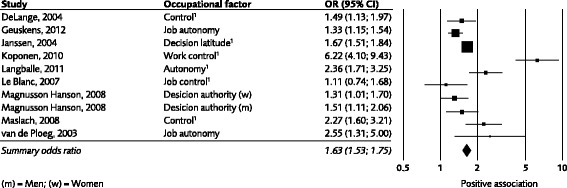
- Moderate scientific evidence (grade 3) supported a relationship between low job control and increased emotional exhaustion: 9 studies, weighted OR 1.63 (95% CI 1.53 to 1.75).
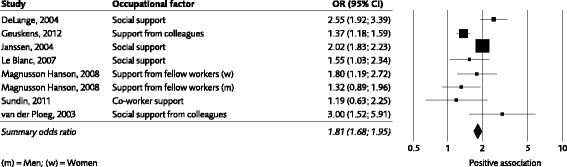
- Moderate evidence also supported low workplace support and emotional exhaustion: 7 studies, weighted OR 1.81 (95% CI 1.68 to 1.95).
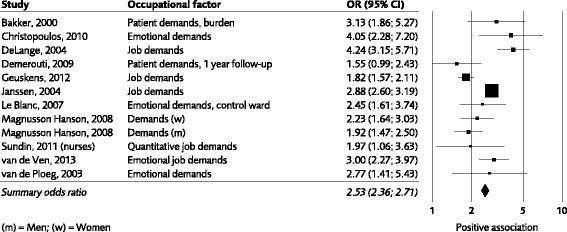
- Several other associations were supported by limited evidence (grade 2), including unspecified psychological demands and emotional exhaustion: 11 studies, weighted OR 2.53 (95% CI 2.36 to 2.71); high work load and emotional exhaustion: 5 studies, weighted OR 4.22 (95% CI 3.50 to 5.11); low reward and emotional exhaustion: weighted OR 1.86 (1.37 to 2.52); job insecurity and emotional exhaustion: weighted OR 1.39 (1.22 to 1.57).
- Reduced personal accomplishment was only associated with low reward, and there were few prospective studies of sufficient quality on chemical, biological, or physical exposures and burnout.
Methods
- Systematic review with meta-analyses, using the GRADE system to rate evidence; the authors state they followed PRISMA “as far as possible.”
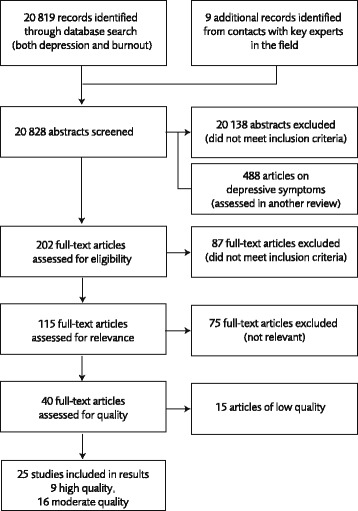
- Search covered 1990 to August 2013 in PubMed, Embase, Psychinfo, Arbline, Cochrane Library, and NIOSHTIC-2; 20,819 abstracts were identified, 115 full-text articles met inclusion criteria, and 25 articles were retained as high or medium quality.
- Included studies had to be from Europe, North America, Australia, or New Zealand; be prospective or comparable case-control designs; have baseline exposure and follow-up outcome assessment 1–5 years later; and include at least 100 exposed persons with control for at least age and gender.
- For meta-analysis, the authors used weighted odds ratios when possible, fixed-effects models, and the least adjusted model from each study for forest plots.
Limitations
- The paper states that few prospective studies of sufficient quality were available for some exposures, especially adverse chemical, biological, and physical factors; some associations were based on only one or two studies.
- The authors note that all 25 included studies relied on self-reported exposure and burnout, which may inflate associations; they say more objective measures would be beneficial.
- Evident from the text: the review could not conduct full homogeneity analyses for all outcomes because studies used many different statistical measures, and it could not do separate analyses by sex because gender-specific results were rarely reported.
Model-written summary. Check it against the paper before relying on it.
Integrity signals
Registry
Cites
Statistics
Figures
Verification
Claims the paper makes
0 Valid · 0 Not valid · 43 Not checked · 66 Own results and interpretations
A result the paper reports from its own data — it cites no other source for it, so there is none to check. The quote shows it is in the paper.
In the paper
“Reduced personal accomplishment was only associated with low reward.”
§ A systematic review including meta-analysis of work environment and burnout symptoms > Abstract > Results
plainstates an association- Asserted: passes — The authors put it forward as true.
- Checkable: passes — It can be checked against evidence.
- Load-bearing: passes — The paper’s conclusions depend on it.
- Based: passes — The paper gives a reason why it holds.
A result the paper reports from its own data — it cites no other source for it, so there is none to check. The quote shows it is in the paper.
In the paper
“Limited evidence (grade 2) was found for the associations between workplace justice, demands, high work load, low reward, low supervisor support, low co-worker support, job insecurity and change in emotional exhaustion.”
§ A systematic review including meta-analysis of work environment and burnout symptoms > Abstract > Results
plainstates an association- Asserted: passes — The authors put it forward as true.
- Checkable: passes — It can be checked against evidence.
- Load-bearing: passes — The paper’s conclusions depend on it.
- Based: passes — The paper gives a reason why it holds.
A result the paper states — it cites no source for it, so there is none to check. The quote shows it is in the paper.
In the paper
“There were few prospective studies with sufficient quality on adverse chemical, biological and physical factors and burnout.”
§ A systematic review including meta-analysis of work environment and burnout symptoms > Abstract > Results
plain- Asserted: passes — The authors put it forward as true.
- Checkable: passes — It can be checked against evidence.
- Load-bearing: unclear — It is unclear whether the paper’s conclusions depend on it.
- Based: passes — The paper gives a reason why it holds.
A result the paper reports from its own data — it cites no other source for it, so there is none to check. The quote shows it is in the paper.
In the paper
“Limited evidence (grade 2) was found for the associations between workplace justice, demands, high work load, low reward, low supervisor support, low co-worker support, job insecurity and change in emotional exhaustion.”
§ A systematic review including meta-analysis of work environment and burnout symptoms > Abstract > Results
plainstates an association- Asserted: passes — The authors put it forward as true.
- Checkable: passes — It can be checked against evidence.
- Load-bearing: passes — The paper’s conclusions depend on it.
- Based: passes — The paper gives a reason why it holds.
50 more claims
Create a free account to see all 109 claims and to verify the 77 references still open.
- It may state two separate claims as one. 41
- The quote only partly states this claim. 6
- Probably not a substantial claim. 21
Claims other papers make about this one
Each is checked against this paper’s own text: does it say what the citing paper says it does?
The source backs part of the claim, not all of it — or backs it for a different population, condition or comparison.
In the citing paper
“Unlike EE or DP, PA is more strongly influenced by structural and environmental factors, including work autonomy, recognition, opportunities for professional development, and organizational culture [60,61].”
From Effects of Third-Wave Cognitive Behavioral Therapy for Healthcare Professionals’ Burnout: A Systematic Review and Meta-Analysis (2025) · cites this paper as [61]
Experimental — accuracy not yet measured
Self-check
Percentages, sums and reported differences re-computed from the paper’s own numbers.
Rated major: it would touch a result — a value a result rests on, reported and recomputed p-values on opposite sides of the significance level, two passages that conflict with no sign which is right, or a cited work retracted before this paper was published.
In the paper
“If a work environment factor has a 30% prevalence and is associated with a relative risk of 1.6, the resulting population attributable risk is 7%, i.e. the proportion of disease in the exposed group that could be prevented by eliminating the risk factor.”
§ A systematic review including meta-analysis of work environment and burnout symptoms > Conclusions
Reported 0.07 · recomputed 0.1875
Citations
Cites
Preferred Reporting Items for Systematic Reviews and Meta-Analyses: the PRISMA statement
Moher, D., Liberati, A., Tetzlaff, J., Altman, D. G., & for the PRISMA Group (2009) · BMJ · doi:10.1136/bmj.b2535 · Cited by 83,823
Preferred reporting items for systematic reviews and meta-analyses: the PRISMA Statement.
(2009) · PubMed Central · Cited by 44,859
Preferred reporting items for systematic reviews and meta-analyses: The PRISMA statement
Moher, D., Liberati, A., Tetzlaff, J., Altman, D. G., & the PRISMA Group* (2009) · Annals of Internal Medicine · doi:10.7326/0003-4819-151-4-200908180-00135 · Cited by 37,554
Dermyshi, E., Wang, Y., Yan, C., Hong, W., Qiu, G., Gong, X., & Zhang, T. (2017) · Neonatology · doi:10.1159/000454668 · Cited by 24,451
The measurement of experienced burnout
Maslach, C., & Jackson, S. E. (1981) · Journal of Organizational Behavior · doi:10.1002/job.4030020205 · Cited by 14,496 · cited 7×
“Homogeneity test could not be conducted on burnout screening instruments, since very few studies used any other instrument than the MBI [4].”
MethodInfluentialMaslach, C., Schaufeli, W. B., & Leiter, M. P. (2001) · Annual Review of Psychology · doi:10.1146/annurev.psych.52.1.397 · Cited by 12,852 · cited 2×
“In 18 of the 25 studies, MBI, MBI-General Survey [4, 5] or the Dutch adaption of MBI, the Utrecht Burnout Questionnaire [24] were used.”
BackgroundMethodGRADE guidelines: 1. Introduction—GRADE evidence profiles and summary of findings tables
Guyatt, G., Oxman, A. D., Akl, E. A., Kunz, R., Vist, G., Brozek, J., Norris, S., Falck-Ytter, Y., Glasziou, P., & deBeer, H. (2011) · Journal of Clinical Epidemiology · doi:10.1016/j.jclinepi.2010.04.026 · Cited by 10,681 · cited 2×
“To our knowledge, the current meta-analytic study and review is the first that has been carried out according to the GRADE system [17].”
MethodThe measurement of engagement and burnout: a two sample confirmatory factor analytic approach.
Schaufeli, W. B., Salanova, M., González-romá, V., & Bakker, A. B. (2002) · Journal of Happiness Studies · doi:10.1023/a:1015630930326 · Cited by 10,014 · cited 1×
“In 18 of the 25 studies, MBI, MBI-General Survey [4, 5] or the Dutch adaption of MBI, the Utrecht Burnout Questionnaire [24] were used.”
MethodHealthy work: stress, productivity, and the reconstruction of working life
(1990) · Choice Reviews Online · doi:10.5860/choice.28-0381 · Cited by 8,220 · cited 2×
“Job control and workplace support comprise, together with job demands, the demand – controlsupport model [29, 30].”
BackgroundFreudenberger, H. J. (1974) · Journal of Social Issues · doi:10.1111/j.1540-4560.1974.tb00706.x · Cited by 5,463 · cited 3×
“Herbert Freudenberger [1], a clinical psychologist working in an alternative health care agency, and in 1976 by Christina Maslach [2], a social psychologist studying workplace emotions.”
BackgroundInfluential
Research works printed but not linked: 3
- Maslach C Burnout Hum Behav 1976 5 9 16 22
- Kant IJ Jansen NWH Van Amelsvoort LGPM Mohren DCL Swaen GMH Burnout in de werkende bevolking. Resultaten van de Maastrichtse Cohort Studie. [Burnout in the working population. Results of the Maastricht Cohort Study] Gedrag & Organisatie 2004 17 5 17
- Karasek RA Job content questionnaire and user’s guide 1985 Lowell University of Massachusetts
Cited by
Items 101–200 of 789
Job demands, organizational justice, and emotional exhaustion in prison officers
Clements, A. J., & Kinman, G. (2021) · Criminal Justice Studies · doi:10.1080/1478601x.2021.1999114 · Cited by 55
“Heavy and intense workloads are associated with emotional exhaustion (Aronsson et al., 2017; Boekhorst, Singh, & Burke, 2017).”
AI Chatbots for Psychological Health for Health Professionals: Scoping Review
Baek, G., Cha, C., & Han, J.-H. (2025) · JMIR Human Factors · doi:10.2196/67682 · Cited by 54
“According to recent studies, more than 50% of health professionals worldwide experience symptoms of burnout, such as fatigue, cynicism, and decreased effectiveness, leading to low job satisfaction [2], high turnover [3], and low-quality patient care [4].”
Le syndrome d’épuisement professionnel : définition, typologie et prise en charge
Roy, I. (2018) · Soins Psychiatrie · doi:10.1016/j.spsy.2018.06.005 · Cited by 34
The physical activity paradox: a longitudinal study of the implications for burnout
de Vries, J. D., & Bakker, A. B. (2021) · International Archives of Occupational and Environmental Health · doi:10.1007/s00420-021-01759-y · Cited by 48
Lee, E. Y., Kim, K. J., Ko, S., & Song, E. K. (2022) · BMC Nursing · doi:10.1186/s12912-022-00985-0 · Cited by 49
“Also, it was reported that nurses with a high workload are likely to have a three times higher risk for depersonalization than those with a low workload in a systematic review of the work environment and burnout symptoms [7].”
BackgroundDaly, A., Carey, R. N., Darcey, E., Chih, H., LaMontagne, A. D., Milner, A. J., & Reid, A. (2018) · PLoS ONE · doi:10.1371/journal.pone.0203998 · Cited by 36
“Job insecurity has been linked to poor physical health [12, 13], burnout symptoms [14], lower life satisfaction [15], and lower levels of job satisfaction [16].”
BackgroundGrangeia, T. D. A. G., de Jorge, B., Cecílio‐Fernandes, D., Tio, R. A., & Filho, C. (2018) · Health Professions Education · doi:10.1016/j.hpe.2018.11.001 · Cited by 45
Daly, A., Carey, R. N., Darcey, E., Chih, H., LaMontagne, A. D., Milner, A. J., & Reid, A. (2019) · International Journal of Environmental Research and Public Health · doi:10.3390/ijerph16050735 · Cited by 39
Wissell, S., Karimi, L., Serry, T. A., Furlong, L., & Hudson, J. (2022) · International Journal of Environmental Research and Public Health · doi:10.3390/ijerph191710719 · Cited by 43
Marante, L. M., Hall-Mills, S. S., & Farquharson, K. (2023) · Language Speech and Hearing Services in Schools · doi:10.1044/2022_lshss-22-00047 · Cited by 41
The relative importance of work-related psychosocial factors in physician burnout
Gluschkoff, K., Hakanen, J., Elovainio, M. J., Vänskä, J., & Heponiemi, T. (2021) · Occupational Medicine · doi:10.1093/occmed/kqab147 · Cited by 43
“The work-related psychosocial risk factors for burnout—such as time pressure, lack of workplace support, poor job control and organizational injustice [6,7]—can be categorized into high job demands and low job resources [8].”
BackgroundResultPsychosocial occupational exposures and mental illness—a systematic review with meta-analyses
Seidler, A., Schubert, M., Freiberg, A., Drössler, S., Hussenoeder, F. S., Conrad, I., Riedel-Heller, S. G., & Starke, K. R. (2022) · Deutsches Ärzteblatt international · doi:10.3238/arztebl.m2022.0295 · Cited by 71
Yankouskaya, A., Babiker, A., Rizvi, S., Alshakhsi, S., Liebherr, M., & Ali, R. (2025) · ACM Transactions on the Web · doi:10.1145/3765895 · Cited by 32
“This work-reward cycle may contribute to individuals taking larger workloads, which could lead to burnout, emotional exhaustion, and work-life imbalance, which are predictors of behavioral addiction patterns [50].”
Staff perception of Lean, care-giving, thriving and exhaustion: a longitudinal study in primary care
Kaltenbrunner, M., Bengtsson, L. G., Mathiassen, S. E., Högberg, H., & Engström, M. (2019) · BMC Health Services Research · doi:10.1186/s12913-019-4502-6 · Cited by 41
A predictive model for decreasing clinical no-show rates in a primary care setting
Ahmad, M. U., Zhang, A., & Mhaskar, R. S. (2019) · International Journal of Healthcare Management · doi:10.1080/20479700.2019.1698864 · Cited by 34
“In a systematic review, burnout for staff is related to low job control, workplace demands, low support in the workplace, high workloads, low reward or compensation, and job insecurity [45].”
BackgroundLi, J., Li, S., Jing, T., Bai, M., Zhang, Z., & Liang, H. (2022) · Psychology Research and Behavior Management · doi:10.2147/prbm.s365311 · Cited by 57
“Employees that perceived low psychological safety were reported to be prone to negative emotions such as burnout.(32) Another possible reason is that psychological safety may contribute to coordination and cooperation through tacit teamwork and peer communication,(35) which reduces the anxiety and pressure that usuall…”
BackgroundSleep timing, workplace well-being and mental health in healthcare workers
Coelho, J., Lucas, G., Micoulaud‐Franchi, J., Tran, B., Yon, D. K., Taillard, J., d’Incau, E., Philip, P., Boyer, L., & Fond, G. B. (2023) · Sleep Medicine · doi:10.1016/j.sleep.2023.09.013 · Cited by 36
Zhou, S., Li, M., Chen, S.-R., Jiang, D., Qu, Y., & Xu, X. (2024) · BMC Psychology · doi:10.1186/s40359-024-01779-6 · Cited by 52
“Studies indicate that the daily expenditure of resources required to manage work-related pressures such as danger and trauma can exhaust officers’ reserves and eventually lead to burnout [48].”
BackgroundThe Protective Effect of Fair and Supportive Leadership against Burnout in Police Employees
Sørengaard, T. A., & Langvik, E. (2022) · Safety and Health at Work · doi:10.1016/j.shaw.2022.09.002 · Cited by 54
“Workers often attribute burnout and insufficient sleep to factors at work [38,39].”
BackgroundBurnout in the disciplines of medical radiation science: A systematic review
Shields, M., James, D., McCormack, L., & Warren‐Forward, H. M. (2021) · Journal of medical imaging and radiation sciences · doi:10.1016/j.jmir.2021.04.001 · Cited by 33
Clima laboral y burnout en profesores universitarios
Méndez, R. M. Y., Ramirez-Asís, E., García-Figueroa, M. E., & Montaño, J. L. A. (2021) · Revista Electrónica Interuniversitaria de Formación del Profesorado · doi:10.6018/reifop.476651 · Cited by 30
Nilsson, K. H., Santander, N. M., Lee, M. K., Brulin, E., Bodin, T., & Håkansta, C. (2025) · Safety Science · doi:10.1016/j.ssci.2025.106863 · Cited by 53
“Many job quality factors believed to be negatively impacted by AM have been identified in previous research as predictors of work-related ill health (Alarcon, 2011; Aronsson et al., 2017).”
Job Stress Factors Affect Workplace Resignation and Burnout among Japanese Rural Physicians
Saijo, Y., Yoshioka, E., Hanley, S. J. B., Kitaoka, K., & Yoshida, T. (2018) · The Tohoku Journal of Experimental Medicine · doi:10.1620/tjem.245.167 · Cited by 44
“Systematic reviews have also shown that high job demand and low social support are risks for common mental disorders and burnout symptoms (Stansfeld and Candy 2006; Nieuwenhuijsen et al. 2010; Aronsson et al. 2017).”
BackgroundSantos, A., Chambel, M. J., & Castanheira, F. (2019) · International Journal of Nursing Studies · doi:10.1016/j.ijnurstu.2019.103438 · Cited by 36
Sun, X., Zhang, L., Zhang, C., Liu, J., & Ge, H. (2020) · BMC Public Health · doi:10.1186/s12889-020-8245-4 · Cited by 53
Factors associated with burnout and job satisfaction in Chinese hospital pharmacists
Zhao, J., Zhang, X., & Du, S. (2020) · Medicine · doi:10.1097/md.0000000000021919 · Cited by 38
“A systematic review indicated that lowworkplace support increased emotional exhaustion and that low supervisor support and low co-worker support were associated with burnout symptoms.([42]) Nurse working environment-job satisfaction relationships have been the focus of most studies.”
BackgroundNielsen, K. M., Antino, M., Rodríguez‐Muñoz, A., & Sanz‐Vergel, A. I. (2021) · Work & Stress · doi:10.1080/02678373.2021.1889072 · Cited by 36
“…a) exhaustion is argued to be the most important component of burnout (Halbesleben & Bowler, 2007), b) it is the most frequently studied component (Aronsson et al., 2017), c) a team-based organisational intervention in the healthcare sector found the most impact on this component (Le Blanc et…”
BackgroundInfluentialAronsson, G., Marklund, S., Leineweber, C., & Helgesson, M. (2021) · SSM - Population Health · doi:10.1016/j.ssmph.2021.100893 · Cited by 43
“, 2016), symptoms of burnout (Aronsson et al., 2017), disturbed sleep (Linton et al.”
BackgroundSelf-citationBurnout and depression in college students
Wang, X., Yang, M., Ren, L., Wang, Q., Liang, S., Li, Y., Li, Y., Zhan, Q., Huang, S., Xie, K., et al. (2024) · Psychiatry Research · doi:10.1016/j.psychres.2024.115828 · Cited by 50
“Since its emergence, the concept of burnout has attracted increasing attention worldwide and has gradually expanded to include a more general range of occupations (Aronsson et al., 2017; Embriaco et al., 2007; Shanafelt et al., 2019).”
BackgroundBianchi, R., & Schonfeld, I. S. (2024) · Work & Stress · doi:10.1080/02678373.2024.2364590 · Cited by 48
“A large body of research has documented associations between work-related factors and burnout (Aronsson et al., 2017; Halbesleben, 2006; Schonfeld & Chang, 2017; Seidler et al., 2014).”
Basińska, B., & Gruszczyńska, E. (2020) · Psychology Research and Behavior Management · doi:10.2147/prbm.s244397 · Cited by 33
Organizational Justice and Health: A Survey in Hospital Workers
Magnavita, N., Chiorri, C., Maran, D. A., Garbarino, S., Prinzio, R. R. D., Gasbarri, M., Matera, C., Cerrina, A., Gabriele, M., & Labella, M. (2022) · International Journal of Environmental Research and Public Health · doi:10.3390/ijerph19159739 · Cited by 40
Berman, A. H., Kolaas, K., Petersen, E. M., Bendtsen, P., Hedman‐Lagerlöf, E., Linderoth, C., Müssener, U., Sinadinovic, K., Spak, F., Gremyr, I., et al. (2018) · BMC Family Practice · doi:10.1186/s12875-018-0829-z · Cited by 27
“Negative working conditions can be related to increased emotional exhaustion and burnout among staff if work demands are high and the possibility of controlling one’s work situation is low [23], as well as when one’s efforts are not perceived as generating sufficient reward [24].”
Prevalence of Osteoporosis in Patients with Distal Radius Fracture from Low-Energy Trauma
Niempoog, S., Sukkarnkosol, S., & Boontanapibul, K. (2019) · Malaysian Orthopaedic Journal · doi:10.5704/moj.1911.003 · Cited by 30
Maassen, S. M., Weggelaar‐Jansen, A. M., Brekelmans, G., Vermeulen, H., & van Oostveen, C. (2020) · International Journal for Quality in Health Care · doi:10.1093/intqhc/mzaa072 · Cited by 42
“Implications for practice A positive healthcare WE is vital for high-performing healthcare organizations to provide good quality of care and retain a happy, healthy professional workforce [2, 6, 7, 76] so obtaining periodical insight into WE assessment on the team level is important [72].”
BackgroundRegistered Nurses’ Evidence‐Based Practice Revisited: A Longitudinal Study in Mid‐Career
Rudman, A., Boström, A., Wallin, L., Gustavsson, P. J., & Ehrenberg, A. (2020) · Worldviews on Evidence-Based Nursing · doi:10.1111/wvn.12468 · Cited by 27
“In 2014, the Swedish Agency for Health Technology Assessment and Assessment of Social Services found a lack of longitudinal research with longer follow-ups and called for specific knowledge about the health, career and societal effects of long-term exposure to stressors in the work environment (Aronsson et al., 2017;…”
BackgroundKerr, P., Torre, M. B. D., Giguère, C., LUPIEN, S. J., & Juster, R. (2020) · Journal of Psychosomatic Research · doi:10.1016/j.jpsychores.2020.110352 · Cited by 34
Burnout in Portuguese Teachers: A Systematic Review
Mota, A. I., Lopes, J. A. L., & Oliveira, C. R. (2021) · European Journal of Educational Research · doi:10.12973/eu-jer.10.2.693 · Cited by 52
McGrath, K., Matthews, L. R., & Heard, R. C. (2022) · Australian Journal of Rural Health · doi:10.1111/ajr.12857 · Cited by 42
van Elk, F., Robroek, S. J., Burdorf, A., & Hengel, K. M. O. (2022) · Occupational and Environmental Medicine · doi:10.1136/oemed-2022-108478 · Cited by 27
Appelbom, S., Bujacz, A., Finnes, A., Ahlbeck, K., Bromberg, F., Holmberg, J., Larsson, L., Olgren, B., Wanecek, M., Wetterborg, D., et al. (2021) · Frontiers in Psychiatry · doi:10.3389/fpsyt.2021.713251 · Cited by 33
Yulita, Y., Idris, M. A., & Abdullah, S. S. (2021) · Scandinavian Journal of Psychology · doi:10.1111/sjop.12789 · Cited by 37
Burnout and Long-term Sickness Absence From the Teaching Function: A Cohort Study
Salvagioni, D. A. J., Mesas, A. E., Melanda, F. N., Gonzáléz, A. D., & de Andrade, S. M. (2022) · Safety and Health at Work · doi:10.1016/j.shaw.2022.01.006 · Cited by 44
“Structural factors related to work, such as work overload, high psychological demands, insufficient social support and low control over the work process, increase the probability of burnout among workers [1,2].”
BackgroundAffective Attitudes Toward Robots at Work: A Population-Wide Four-Wave Survey Study
Savela, N., Latikka, R., Oksa, R., Kortelainen, S., & Oksanen, A. (2022) · International Journal of Social Robotics · doi:10.1007/s12369-022-00877-y · Cited by 33
“Attention should be given to prevent cynicism at work and burnout in general by reinforcing the abilities and resources with actions, such as giving employees opportunities to influence and control their work, workload, and hours; enhancing stress management skills and possibilities for recovery; and fostering workpla…”
BackgroundChlap, N., & Brown, R. F. (2022) · International Journal of the Legal Profession · doi:10.1080/09695958.2022.2032082 · Cited by 35
“Supervisor support was unrelated to stress/affective distress and burnout (Thorsteinsson et al. 2014), similar to the results of other studies, although some studies found this to be the case (Aronsson et al. 2017).”
BackgroundResultWorking conditions, health and exhaustion among social workers in Germany
Hollederer, A. (2022) · European Journal of Social Work · doi:10.1080/13691457.2022.2063813 · Cited by 56
“As is generally known, high demands, work load, low reward and job insecurity increased the risk for developing exhaustion (Aronsson et al., 2017).”
BackgroundDecent Work and Burnout: A Profile Study With Academic Personnel
Dinis, A. C., Ferraro, T., Pais, L., & dos Santos, N. R. (2022) · Psychological Reports · doi:10.1177/00332941221100454 · Cited by 38
“…job control (Tytherleigh et al., 2005); relationship factors, such as con fl icts in the workplace; or low social support from colleagues or leaders (Aronsson et al., 2017; Borritz et al., 2006; European Foundation for the Improvement of Living and Working Conditions (Eurofound), 2018, World…”
Burnout symptoms and workplace satisfaction among veterinary emergency care providers
Holowaychuk, M. K., & Lamb, K. E. (2023) · Journal of Veterinary Emergency and Critical Care · doi:10.1111/vec.13271 · Cited by 37
Tang, C. S., Lim, M., Koh, J. M., & Cheung, F. Y.-L. (2019) · Journal of Gambling Studies · doi:10.1007/s10899-019-09837-0 · Cited by 33
Lu, Y., Zhang, Z., Gao, S., Yan, H., Zhang, L., & Liu, J. (2020) · BioMed Research International · doi:10.1155/2020/6890186 · Cited by 25
“reward, and job insecurity increased the risk for developing burnout [6].”
BackgroundThe Correlation of Burnout and Optimism among Medical Residents
Fowler, J. B., Fiani, B., Kiessling, J. W., Khan, Y. R., Li, C., Quadri, S. A., Mahato, D., & Siddiqi, J. (2020) · Cureus · doi:10.7759/cureus.6860 · Cited by 32
Eskilsson, T., Norlund, S., Lehti, A., & Wiklund, M. (2020) · Journal of Occupational Rehabilitation · doi:10.1007/s10926-020-09914-x · Cited by 33
Priddle, H., Pickup, S., Hayes, C., & on Behalf of the Association of Reproductive and Clinical Scientists (ARCS) (2021) · Human Fertility · doi:10.1080/14647273.2021.1871782 · Cited by 26
“Overly high ideals held by workers about their profession can also contribute (Aronsson et al., 2017; Maslach & Jackson, 1984).”
BackgroundArvidsson, I., Leo, U., Oudin, A., Nilsson, K., Håkansson, C., Österberg, K., & Persson, R. (2021) · International Journal of Environmental Research and Public Health · doi:10.3390/ijerph18105376 · Cited by 31
“That supportive leadership is an important work environment issue is also confirmed by its protective effect against exhaustion and burnout [19,20,26].”
BackgroundRapisarda, F., Vallarino, M., Brousseau‐Paradis, C., Benedictis, L. D., Corbière, M., Villotti, P., Cavallini, E., Briand, C., Cailhol, L., & LESAGE, A. D. (2022) · International Journal of Environmental Research and Public Health · doi:10.3390/ijerph19073806 · Cited by 34
Agyapong, B., Wei, Y., Dias, R. D. L., & Agyapong, V. I. O. (2022) · JMIR Research Protocols · doi:10.2196/37934 · Cited by 37
“Increased levels of job support, however, were a protective factor against emotional exhaustion [29].”
BackgroundThe Impact of Quality of Work Organization on Distress and Absenteeism among Healthcare Workers
Magnavita, N., Chiorri, C., Karimi, L., & Karanika‐Murray, M. (2022) · International Journal of Environmental Research and Public Health · doi:10.3390/ijerph192013458 · Cited by 38
Grigorescu, S., Cazan, A., Rogozea, L. M., & Grigorescu, D. O. (2020) · The EPMA Journal · doi:10.1007/s13167-020-00201-6 · Cited by 31
“Other factors which could cause burnout are the long work period in 12-h shifts [15], the existence of a second job [16], the multiple, repetitive interactions with specific categories of patients (uncooperative, aggressive or/and in terminal stages) [17–19], the permanent increase of responsibility and the precarious…”
BackgroundBattling Burnout at the Frontlines of Health Care Amid COVID-19
Howell, B. A. M. (2021) · AACN Advanced Critical Care · doi:10.4037/aacnacc2021454 · Cited by 23
“These novel circumstances render physical and psychological demands that are associated with the development of burnout symptoms.(28) Treatment of patients with COVID-19 presents emotionally charged situations that require urgent and sometimes complex quality care.”
BackgroundInfluentialOffice Design’s Impact on Psychosocial Work Environment and Emotional Health
Danielsson, C. B., & Theorell, T. (2024) · International Journal of Environmental Research and Public Health · doi:10.3390/ijerph21040438 · Cited by 33
“Meanwhile low social support combined with high psychological demands further increases the risk of depression and anxiety among employees [12,20,21].”
BackgroundSelf-citationIch kann nicht mehr: Burn-out – eine Aufrüttelung
Hartog, C. S. (2017) · Medizinische Klinik - Intensivmedizin und Notfallmedizin · doi:10.1007/s00063-017-0362-1 · Cited by 31
Perceived Motivational Climates and Employee Energy: The Mediating Role of Basic Psychological Needs
Nerstad, C. G. L., Caniëls, M. C. J., Roberts, G. C., & Richardsen, A. M. (2020) · Frontiers in Psychology · doi:10.3389/fpsyg.2020.01509 · Cited by 39
“Our study intends to contribute to the literature by answering such calls to clarify environmental determinants and mechanisms of future energy from a motivational point of view (Meyer and Gagné, 2008; Shirom, 2010; Aronsson et al., 2017; Vansteenkiste et al., 2020).”
BackgroundInfluentialAssessment of Professional Quality of Life in the Alabama Physical Therapy Workforce
Bowens, A. N., Amamoo, M. A., Blake, D. D., & Clark, B. A. (2021) · Physical Therapy · doi:10.1093/ptj/pzab089 · Cited by 25
How do working conditions affect the turnover intention of medical social workers in China?
Li, N., Peng, J., & Yang, R. (2022) · BMC Health Services Research · doi:10.1186/s12913-021-07435-8 · Cited by 32
“who discovered the significant impact of low job control on burnout symptom [22].”
BackgroundSerafin, L. I., Kusiak, A., & Czarkowska‐Pączek, B. (2022) · International Journal of Environmental Research and Public Health · doi:10.3390/ijerph19031730 · Cited by 32
Coronavirus disease 2019 aftermath: psychological trauma in ICU healthcare workers
Wahlster, S., & Hartog, C. S. (2022) · Current Opinion in Critical Care · doi:10.1097/mcc.0000000000000994 · Cited by 31
“Copyright © 2022 Wolters Kluwe high levels of job support and workplace justice were protective for emotional exhaustion [18].”
BackgroundMental health outcomes among urban public transport workers: A systematic literature review
Cendales, B., Ortíz, V. G., Useche, S. A., Cedillo, L., Stephenson, D. W. H., & Landsbergis, P. A. (2024) · Journal of Transport & Health · doi:10.1016/j.jth.2024.101804 · Cited by 32
Prevalence of psychological distress on public health officials amid COVID-19 pandemic
Nishimura, Y., Miyoshi, T., Hagiya, H., & Otsuka, F. (2022) · Asian Journal of Psychiatry · doi:10.1016/j.ajp.2022.103160 · Cited by 26
“…burnout in our study, which could stem from environmental factors or cultural differences, as shown in previous studies done in Japan, with relatively lower burnout prevalence at the baseline than those from the US or European countries (Aronsson et al., 2017; Nishimura et al., 2021a, 2019, 2021b).”
Burnout syndrome in healthcare workers during the COVID-19 pandemic: a systematic review
Silva, V. S. T. M., Freire, A. C. T. N., Zinezzi, D. P., Ribeiro, F. C. R., Coutinho, G. D., Lima, I. M. B., Crispi, I. C., Porto, J. D., Silva, L. G. P., Miranda, L. H. A., et al. (2022) · Revista Brasileira de Medicina do Trabalho · doi:10.47626/1679-4435-2022-849 · Cited by 41
Emotional labour strategies and job burnout: A meta‐analysis of Chinese employees
Yin, Y., Sun, S., Song, L., Jin, C., & Wang, Y. (2022) · Asian Journal Of Social Psychology · doi:10.1111/ajsp.12554 · Cited by 27
Cain, C., Taborda-Whitt, C., Frazer, M., Schellinger, S. E., White, K. M., Kaasovic, J., Nelson, B. J., & Chant, A. (2017) · Journal of Interprofessional Care · doi:10.1080/13561820.2017.1356809 · Cited by 33
“Despite this assumption, studies show that burnout is closely linked to workplace stressors rather than client-related stressors (Aronsson et al., 2017; Montgomery, Todorova, Baban, & Panagopoulou, 2013; Spinelli, Fernstrom, Britt, & Pratt, 2016).”
BackgroundResultInfluentialFrögli, E., Rudman, A., Lövgren, M., & Gustavsson, P. J. (2019) · Work · doi:10.3233/wor-192892 · Cited by 37
“This too is in line with previous research showing that a supportive work environment protects against developing symptoms of burnout [28].”
InfluentialHuang, Y., Guo, H., Wang, S., Zhong, S., He, Y., Chen, H., Zhou, J., & Wang, X. (2024) · BMC Public Health · doi:10.1186/s12889-023-17514-6 · Cited by 40
“Burnout is a prolonged response to chronic emotional and interpersonal stressors at work, and it includes three dimensions, namely emotional exhaustion, deperson-alization and personal accomplishment [18].”
BackgroundBurnout prevention team-process evaluation of an organizational health intervention
Buruck, G., Tomaschek, A., & Lanfer, S. S. L. (2018) · Journal of Public Health · doi:10.1007/s10389-018-0999-0 · Cited by 23
Vancappel, A., Jansen, E., Ouhmad, N., Desmidt, T., Étain, B., Bergey, C., d’Ussel, M., Krebs, M., Paquet, C., Réveillère, C., et al. (2021) · Frontiers in Psychiatry · doi:10.3389/fpsyt.2021.701127 · Cited by 23
“Other authors have proposed that repeated stress could be the cause of burnout (22, 23).”
BackgroundAn analysis of client complaints and their effects on veterinary support staff
Rogers, C. W., Murphy, L. A., Murphy, R. A., Malouf, K. A., Natsume, R. E., Ward, B. D., Tansey, C., & Nakamura, R. K. (2022) · Veterinary Medicine and Science · doi:10.1002/vms3.725 · Cited by 25
Hadžibajramović, E., Hansson, M., Åkerström, M., Dencker, A., & Hensing, G. K. E. (2022) · BMC Health Services Research · doi:10.1186/s12913-022-08552-8 · Cited by 27
Andersson, M., Fredholm, A., Nordin, A., & Engström, Å. H. (2023) · SAGE Open Nursing · doi:10.1177/23779608231169218 · Cited by 39
“The most prevalent risk factors for stress-related health concerns are high workload, emotional demands (Hasselberg et al., 2014), lack of support, lack of work control (Aronsson et al., 2017), and an imbalance between work and recovery (Håkansson & Ahlborg, 2017).”
BackgroundTackling Burnout in the School Setting: Practical Tips for School-Based Speech-Language Pathologists
Marante, L. M., & Farquharson, K. (2021) · Perspectives of the ASHA Special Interest Groups · doi:10.1044/2021_persp-20-00262 · Cited by 21
Januário, L. B., Karstad, K., Rugulies, R., Bergström, G., Holtermann, A., & Hallman, D. (2019) · International Journal of Environmental Research and Public Health · doi:10.3390/ijerph16193610 · Cited by 25
Elster, M. J., O’Sullivan, P. S., Muller-Juge, V., Sheu, L., Kaiser, S. V., & Hauer, K. E. (2021) · Perspectives on Medical Education · doi:10.1007/s40037-021-00676-7 · Cited by 20
Ciampa, V., Steffens, N. K., Schuh, S. C., Fraccaroli, F., & van Dick, R. (2018) · Work & Stress · doi:10.1080/02678373.2018.1521884 · Cited by 26
“…job control, low workplace support, workplace injustice, high workload, low reward, low supervisor support, low co-worker support, job insecurity and change (Demerouti, Bakker, & Bulters, 2004; Michielsen, Willemsen, Croon, de Vries, & Van Heck, 2004; for a review see also Aronsson et al., 2017).”
BackgroundTerregino, C. A., Byerley, J. S., Henderson, D. D., Friedman, E. S., Elks, M. L., Kirstein, I. J., Hunderfund, A. N. L., & Fancher, T. L. (2021) · Medical Teacher · doi:10.1080/0142159x.2021.1935832 · Cited by 29
Yi, X., Li, X., Ma, X., & Li, F. (2021) · Journal of Affective Disorders · doi:10.1016/j.jad.2021.10.002 · Cited by 24
Møller, C. M., Clausen, T., Aust, B., & Eiberg, J. (2021) · Journal of Vascular Surgery · doi:10.1016/j.jvs.2021.11.042 · Cited by 23
The Relationships Between Grit, Burnout, and Demographic Characteristics in Medical Students
Lee, D., Reasoner, K., Davidson, C. A., Pennings, J. S., & Lee, D. H. (2022) · Psychological Reports · doi:10.1177/00332941221087899 · Cited by 27
Tjøsvoll, S. O., Wiggen, Ø. N., Gonzalez-Sanchez, V. E., Seeberg, T. M., Redzovic, S. E., Liaset, I. F., Holtermann, A., & Fimland, M. S. (2022) · Annals of Work Exposures and Health · doi:10.1093/annweh/wxac052 · Cited by 24
“Alongside organizational factors, autonomy at work, and psychosocial variables (Aronsson et al., 2017), the mentioned physical work demands could contribute to health complaints and adverse effects in home care workers (Carneiro et al.”
BackgroundThe Effect of Work Stress on the Well-Being of Primary and Secondary School Teachers in China
Liao, J., Wang, X., & Wang, X. (2023) · International Journal of Environmental Research and Public Health · doi:10.3390/ijerph20021154 · Cited by 33
“Teachers are the key to education, and their well-being directly affects their work efficiency and directly or indirectly affects students’ learning and health [5,6].”
BackgroundLei, M., Alam, G. M., & Hassan, A. (2023) · Sustainability · doi:10.3390/su15118873 · Cited by 35
Burnout, satisfacción y calidad de vida laboral en funcionarios de la salud pública chilenos
Salgado-Roa, J. A., & Dulčić, F. J. L. (2019) · Universidad y Salud · doi:10.22267/rus.202201.169 · Cited by 68
When does job burnout not hurt employee behaviours?
Turek, D. (2020) · Journal of Organizational Effectiveness People and Performance · doi:10.1108/joepp-04-2020-0055 · Cited by 32
Duncan, A. R., & Hellman, C. M. (2020) · The Permanente Journal · doi:10.7812/tpp/19.240 · Cited by 19
“A number of different protective factors, such as workplace support and job control, have been identified that are associated with significantly lower rates and levels of chronic stress and burnout.(14) Early exposures to chronic professional stress left unchecked by protective psychological factors may further exacer…”
BackgroundLehmann, J., Schwarz, E., Azad, Z. R., Gritzka, S., Seifried-Dübon, T., Diebig, M., Gast, M., Kilian, R., Nater, U. M., Jarczok, M. N., et al. (2021) · BMC Public Health · doi:10.1186/s12889-021-10398-4 · Cited by 27
Shoman, Y., Rousson, V., Bianchi, R., & Canu, I. G. (2022) · International Journal of Environmental Research and Public Health · doi:10.3390/ijerph192013037 · Cited by 28
Mensah, A., Toivanen, S., Diewald, M., Hassan, M. U., & Nyberg, A. (2022) · Social Science & Medicine · doi:10.1016/j.socscimed.2022.115520 · Cited by 28
“It is well established that a poor work environment is a major risk factor for mental ill-health and also plays a role in the inequality that exists in mental ill-health (Nied-hammer et al., 2021; Aronsson et al., 2017).”
BackgroundClaponea, R. M., & Iorga, M. (2023) · Behavioral Sciences · doi:10.3390/bs13030225 · Cited by 21
“[15], focusing on the association between work conditions and the development of burnout symptoms in health professionals, it was highlighted that emotional demands were studied in relation to emotional exhaustion in several studies [16–19].”
ResultBeer, L. T. D., Christensen, M., Sørengaard, T. A., Innstrand, S. T., & Schaufeli, W. B. (2023) · Scandinavian Journal of Psychology · doi:10.1111/sjop.12996 · Cited by 25
Björk, L., Glise, K., Pousette, A., Bertilsson, M., & Holmgren, K. E. (2018) · BMC Public Health · doi:10.1186/s12889-018-5714-0 · Cited by 20
Barcons, C., García, B., Sarri, C., Rodríguez, E., Cunillera, O., Parellada, N., Fernandez, B., Alvarado, C. E., Barrio, C., Fleta, J. C., et al. (2019) · BMC Family Practice · doi:10.1186/s12875-019-1036-2 · Cited by 28
Slabšinskienė, E., Gorelik, A., Kavaliauskienė, A., & Zaborskis, A. (2021) · International Journal of Environmental Research and Public Health · doi:10.3390/ijerph18083968 · Cited by 27
Metadata
- Authors
- Aronsson, G., Theorell, T., Grape, T., Hammarström, A., Hogstedt, C., Marteinsdottir, I., Skoog, I., Träskman-Bendz, L., & Hall, C.
- Affiliations
- Stockholm University (SE)
- Umeå University (SE)
- Karolinska Institutet (SE)
- University of Gothenburg (SE)
- SBU - Swedish Agency for Health Technology Assessment and Assessment of Social Services (SE)
- Corresponding author
- Aronsson, Gunnar
- Venue
- BMC Public Health
- Published
- 2017-03-16
- Volume
- 17
- Issue
- 1
- Pages
- 264-264
- ISSN
- 1471-2458 (ISSN-L)
- PMC
- PMC5356239
- OpenAlex
- W2595367318
- Cited by
- 789
- References
- 38
- Citations by year
- 2026: 66 · 2025: 95 · 2024: 101 · 2023: 99 · 2022: 130 · 2021: 129 · 2020: 74 · 2019: 48 · 2018: 41 · 2017: 6
- FWCI
- 7.13
- Type
- journal article
- Language
- en
- Open access
- gold
- doi.org
- Licence
- cc-by
- Locations
- BMC Public Health (publishedVersion, cc-by)
- PubMed Central (publishedVersion, cc-by)
- PubMed (publishedVersion)
- DiVA (Linkoping University) (submittedVersion, other-oa)
- KTH Publication Database DiVA (KTH Royal Institute of Technology) (submittedVersion, other-oa)
- DOAJ (DOAJ: Directory of Open Access Journals) (submittedVersion, cc-by-sa)
- Lund University Publications (Lund University) (submittedVersion)
- Funders
- The Swedish Council of Health Technology Assessment
- Topics
- Social Sciences › Psychology › Social Psychology › Stress and Burnout Research
- Health Sciences › Medicine › Public Health, Environmental and Occupational Health › Occupational Health and Burnout
- Health Sciences › Health Professions › General Health Professions › Healthcare professionals’ stress and burnout
- Keywords
- burnout, emotional exhaustion, cynicism, personal accomplishment, job control, workplace support, workplace justice, job demands, workload, job insecurity, supervisor support, coworker support, occupational exposure, work environment, organizational interventions
- MeSH terms
- Achievement, Adult, Australia, Burnout, Professional, Europe, Mental Fatigue, Female, Humans, Male, New Zealand, North America, Prospective Studies, Surveys and Questionnaires, Reward, Social Justice, Organizational Culture, Case-Control Studies, Occupational Exposure, Workload, Workplace
About these checks
Registry, retraction, Cites and statistics results are computed, not judged, with one exception: a printed reference that no index lists is read once by a model before it counts as a citation error. Claims are extracted by a model and kept only when their quote appears verbatim in the text; each cited source is then checked, with a model’s help, for whether it says what the claim relies on. Those verdicts can be wrong — read the claim’s quote and the cited source before relying on one.
A language model drew the claims from the paper on 2026-10-11, under version 3 of the claim definition (model deepseek-v4.1-flash, prompt extract-v3).
A second model labelled each claim on 2026-10-11 (model jev-1.13-20260917, definition revision gold-guideline-v0.2).
Statistics and arithmetic are recomputed, not judged.
Confidence bands are shown only for fields calibrated on our annotated test set. None is calibrated yet, so no band is shown.
What counts as a claim ›How we measure confidence ›How we check this ›
Are you an author, or do you see a problem with this page? Request a review
Data sources
Bibliographic data: Semantic Scholar, OpenAlex, Crossref.
Contains information from the Semantic Scholar Academic Graph Datasets, made available under the ODC Attribution License (ODC-BY 1.0).
Semantic Scholar’s data is described in: Kinney, R., et al. (2023). The Semantic Scholar Open Data Platform. arXiv:2301.10140.
