

A systematic review including meta-analysis of work environment and burnout symptoms
Open accessThe DOI matches its Crossref record; 37 of the 38 references it cites were found in a registry or an index; none of the 77 sources its claims cite is checked for support yet.
Abstract
BACKGROUND: Practitioners and decision makers in the medical and insurance systems need knowledge on the relationship between work exposures and burnout. Many burnout studies - original as well as reviews - restricted their analyses to emotional exhaustion or did not report results on cynicism, personal accomplishment or global burnout. To meet this need we carried out this review and meta-analyses with the aim to provide systematically graded evidence for associations between working conditions and near-future development of burnout symptoms. METHODS: A wide range of work exposure factors was screened. Inclusion criteria were: 1) Study performed in Europe, North America, Australia and New Zealand 1990-2013. 2) Prospective or comparable case control design. 3) Assessments of exposure (work) and outcome at baseline and at least once again during follow up 1-5 years later. Twenty-five articles met the predefined relevance and quality criteria. The GRADE-system with its 4-grade evidence scale was used. RESULTS: Most of the 25 studies focused emotional exhaustion, fewer cynicism and still fewer personal accomplishment. Moderately strong evidence (grade 3) was concluded for the association between job control and reduced emotional exhaustion and between low workplace support and increased emotional exhaustion. Limited evidence (grade 2) was found for the associations between workplace justice, demands, high work load, low reward, low supervisor support, low co-worker support, job insecurity and change in emotional exhaustion. Cynicism was associated with most of these work factors. Reduced personal accomplishment was only associated with low reward. There were few prospective studies with sufficient quality on adverse chemical, biological and physical factors and burnout. CONCLUSION: While high levels of job support and workplace justice were protective for emotional exhaustion, high demands, low job control, high work load, low reward and job insecurity increased the risk for developing exhaustion. Our approach with a wide range of work exposure factors analysed in relation to the separate dimensions of burnout expanded the knowledge of associations, evidence as well as research needs. The potential of organizational interventions is illustrated by the findings that burnout symptoms are strongly influenced by structural factors such as job demands, support and the possibility to exert control.
Overview
CoChat Summary
TL;DR
This systematic review and meta-analysis found that several work environment factors were associated with burnout symptoms, with the strongest evidence for low job control and low workplace support in relation to emotional exhaustion. Using the GRADE system, the authors concluded that structural workplace factors such as demands, support, and control are important for burnout risk.
Key findings
- Among 25 included studies, most focused on emotional exhaustion; fewer examined cynicism/depersonalisation, and still fewer personal accomplishment.
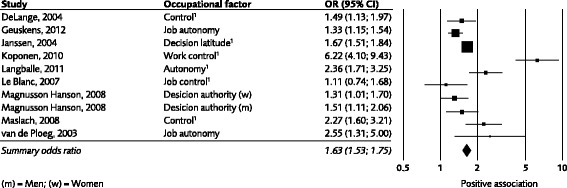
- Moderate scientific evidence (grade 3) supported a relationship between low job control and increased emotional exhaustion: 9 studies, weighted OR 1.63 (95% CI 1.53 to 1.75).
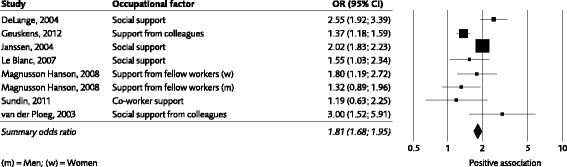
- Moderate evidence also supported low workplace support and emotional exhaustion: 7 studies, weighted OR 1.81 (95% CI 1.68 to 1.95).
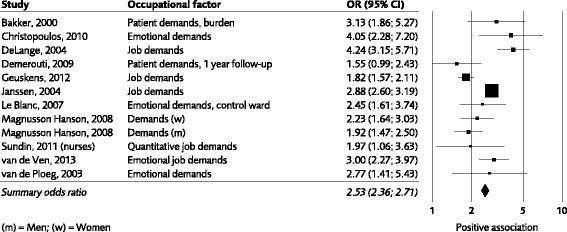
- Several other associations were supported by limited evidence (grade 2), including unspecified psychological demands and emotional exhaustion: 11 studies, weighted OR 2.53 (95% CI 2.36 to 2.71); high work load and emotional exhaustion: 5 studies, weighted OR 4.22 (95% CI 3.50 to 5.11); low reward and emotional exhaustion: weighted OR 1.86 (1.37 to 2.52); job insecurity and emotional exhaustion: weighted OR 1.39 (1.22 to 1.57).
- Reduced personal accomplishment was only associated with low reward, and there were few prospective studies of sufficient quality on chemical, biological, or physical exposures and burnout.
Methods
- Systematic review with meta-analyses, using the GRADE system to rate evidence; the authors state they followed PRISMA “as far as possible.”
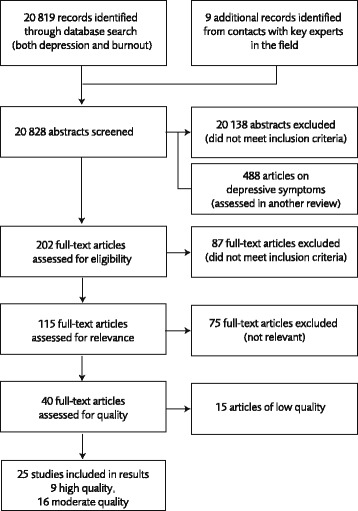
- Search covered 1990 to August 2013 in PubMed, Embase, Psychinfo, Arbline, Cochrane Library, and NIOSHTIC-2; 20,819 abstracts were identified, 115 full-text articles met inclusion criteria, and 25 articles were retained as high or medium quality.
- Included studies had to be from Europe, North America, Australia, or New Zealand; be prospective or comparable case-control designs; have baseline exposure and follow-up outcome assessment 1–5 years later; and include at least 100 exposed persons with control for at least age and gender.
- For meta-analysis, the authors used weighted odds ratios when possible, fixed-effects models, and the least adjusted model from each study for forest plots.
Limitations
- The paper states that few prospective studies of sufficient quality were available for some exposures, especially adverse chemical, biological, and physical factors; some associations were based on only one or two studies.
- The authors note that all 25 included studies relied on self-reported exposure and burnout, which may inflate associations; they say more objective measures would be beneficial.
- Evident from the text: the review could not conduct full homogeneity analyses for all outcomes because studies used many different statistical measures, and it could not do separate analyses by sex because gender-specific results were rarely reported.
Model-written summary. Check it against the paper before relying on it.
Integrity signals
Registry
Cites
Statistics
Figures
Verification
Claims the paper makes
0 Valid · 0 Not valid · 43 Not checked · 66 Own results and interpretations
A result the paper reports from its own data — it cites no other source for it, so there is none to check. The quote shows it is in the paper.
In the paper
“Reduced personal accomplishment was only associated with low reward.”
§ A systematic review including meta-analysis of work environment and burnout symptoms > Abstract > Results
plainstates an association- Asserted: passes — The authors put it forward as true.
- Checkable: passes — It can be checked against evidence.
- Load-bearing: passes — The paper’s conclusions depend on it.
- Based: passes — The paper gives a reason why it holds.
A result the paper reports from its own data — it cites no other source for it, so there is none to check. The quote shows it is in the paper.
In the paper
“Limited evidence (grade 2) was found for the associations between workplace justice, demands, high work load, low reward, low supervisor support, low co-worker support, job insecurity and change in emotional exhaustion.”
§ A systematic review including meta-analysis of work environment and burnout symptoms > Abstract > Results
plainstates an association- Asserted: passes — The authors put it forward as true.
- Checkable: passes — It can be checked against evidence.
- Load-bearing: passes — The paper’s conclusions depend on it.
- Based: passes — The paper gives a reason why it holds.
A result the paper states — it cites no source for it, so there is none to check. The quote shows it is in the paper.
In the paper
“There were few prospective studies with sufficient quality on adverse chemical, biological and physical factors and burnout.”
§ A systematic review including meta-analysis of work environment and burnout symptoms > Abstract > Results
plain- Asserted: passes — The authors put it forward as true.
- Checkable: passes — It can be checked against evidence.
- Load-bearing: unclear — It is unclear whether the paper’s conclusions depend on it.
- Based: passes — The paper gives a reason why it holds.
A result the paper reports from its own data — it cites no other source for it, so there is none to check. The quote shows it is in the paper.
In the paper
“Limited evidence (grade 2) was found for the associations between workplace justice, demands, high work load, low reward, low supervisor support, low co-worker support, job insecurity and change in emotional exhaustion.”
§ A systematic review including meta-analysis of work environment and burnout symptoms > Abstract > Results
plainstates an association- Asserted: passes — The authors put it forward as true.
- Checkable: passes — It can be checked against evidence.
- Load-bearing: passes — The paper’s conclusions depend on it.
- Based: passes — The paper gives a reason why it holds.
50 more claims
Create a free account to see all 109 claims and to verify the 77 references still open.
- It may state two separate claims as one. 41
- The quote only partly states this claim. 6
- Probably not a substantial claim. 21
Claims other papers make about this one
Each is checked against this paper’s own text: does it say what the citing paper says it does?
The source backs part of the claim, not all of it — or backs it for a different population, condition or comparison.
In the citing paper
“Unlike EE or DP, PA is more strongly influenced by structural and environmental factors, including work autonomy, recognition, opportunities for professional development, and organizational culture [60,61].”
From Effects of Third-Wave Cognitive Behavioral Therapy for Healthcare Professionals’ Burnout: A Systematic Review and Meta-Analysis (2025) · cites this paper as [61]
Experimental — accuracy not yet measured
Self-check
Percentages, sums and reported differences re-computed from the paper’s own numbers.
Rated major: it would touch a result — a value a result rests on, reported and recomputed p-values on opposite sides of the significance level, two passages that conflict with no sign which is right, or a cited work retracted before this paper was published.
In the paper
“If a work environment factor has a 30% prevalence and is associated with a relative risk of 1.6, the resulting population attributable risk is 7%, i.e. the proportion of disease in the exposed group that could be prevented by eliminating the risk factor.”
§ A systematic review including meta-analysis of work environment and burnout symptoms > Conclusions
Reported 0.07 · recomputed 0.1875
Citations
Cites
Preferred Reporting Items for Systematic Reviews and Meta-Analyses: the PRISMA statement
Moher, D., Liberati, A., Tetzlaff, J., Altman, D. G., & for the PRISMA Group (2009) · BMJ · doi:10.1136/bmj.b2535 · Cited by 83,823
Preferred reporting items for systematic reviews and meta-analyses: the PRISMA Statement.
(2009) · PubMed Central · Cited by 44,859
Preferred reporting items for systematic reviews and meta-analyses: The PRISMA statement
Moher, D., Liberati, A., Tetzlaff, J., Altman, D. G., & the PRISMA Group* (2009) · Annals of Internal Medicine · doi:10.7326/0003-4819-151-4-200908180-00135 · Cited by 37,554
Dermyshi, E., Wang, Y., Yan, C., Hong, W., Qiu, G., Gong, X., & Zhang, T. (2017) · Neonatology · doi:10.1159/000454668 · Cited by 24,451
The measurement of experienced burnout
Maslach, C., & Jackson, S. E. (1981) · Journal of Organizational Behavior · doi:10.1002/job.4030020205 · Cited by 14,496 · cited 7×
“Homogeneity test could not be conducted on burnout screening instruments, since very few studies used any other instrument than the MBI [4].”
MethodInfluentialMaslach, C., Schaufeli, W. B., & Leiter, M. P. (2001) · Annual Review of Psychology · doi:10.1146/annurev.psych.52.1.397 · Cited by 12,852 · cited 2×
“In 18 of the 25 studies, MBI, MBI-General Survey [4, 5] or the Dutch adaption of MBI, the Utrecht Burnout Questionnaire [24] were used.”
BackgroundMethodGRADE guidelines: 1. Introduction—GRADE evidence profiles and summary of findings tables
Guyatt, G., Oxman, A. D., Akl, E. A., Kunz, R., Vist, G., Brozek, J., Norris, S., Falck-Ytter, Y., Glasziou, P., & deBeer, H. (2011) · Journal of Clinical Epidemiology · doi:10.1016/j.jclinepi.2010.04.026 · Cited by 10,681 · cited 2×
“To our knowledge, the current meta-analytic study and review is the first that has been carried out according to the GRADE system [17].”
MethodThe measurement of engagement and burnout: a two sample confirmatory factor analytic approach.
Schaufeli, W. B., Salanova, M., González-romá, V., & Bakker, A. B. (2002) · Journal of Happiness Studies · doi:10.1023/a:1015630930326 · Cited by 10,014 · cited 1×
“In 18 of the 25 studies, MBI, MBI-General Survey [4, 5] or the Dutch adaption of MBI, the Utrecht Burnout Questionnaire [24] were used.”
MethodHealthy work: stress, productivity, and the reconstruction of working life
(1990) · Choice Reviews Online · doi:10.5860/choice.28-0381 · Cited by 8,220 · cited 2×
“Job control and workplace support comprise, together with job demands, the demand – controlsupport model [29, 30].”
BackgroundFreudenberger, H. J. (1974) · Journal of Social Issues · doi:10.1111/j.1540-4560.1974.tb00706.x · Cited by 5,463 · cited 3×
“Herbert Freudenberger [1], a clinical psychologist working in an alternative health care agency, and in 1976 by Christina Maslach [2], a social psychologist studying workplace emotions.”
BackgroundInfluential
Research works printed but not linked: 3
- Maslach C Burnout Hum Behav 1976 5 9 16 22
- Kant IJ Jansen NWH Van Amelsvoort LGPM Mohren DCL Swaen GMH Burnout in de werkende bevolking. Resultaten van de Maastrichtse Cohort Studie. [Burnout in the working population. Results of the Maastricht Cohort Study] Gedrag & Organisatie 2004 17 5 17
- Karasek RA Job content questionnaire and user’s guide 1985 Lowell University of Massachusetts
Cited by
Items 501–600 of 789
Job Burnout of Contractual Workers in Nueva Ecija
Santos, K. E. S., & Jesus, C. D. D. (2020) · OALib · doi:10.4236/oalib.1106113 · Cited by 3
“The source of burnout is often the point of the potential value of multifactorial interventions in structural work environment factors [6].”
BackgroundKordsmeyer, A.-C., Efimov, I., Harth, V., & Mache, S. (2022) · BMJ Open · doi:10.1136/bmjopen-2022-063118 · Cited by 5
Mieć czy być? Powrót do pytania o istotę szczęścia
Zaleśkiewicz, T. (2019) · Nauka · doi:10.24425/nauka.2019.126180 · Cited by 4
Haven, T. L., de Goede, M., Tijdink, J. K., & Oort, F. J. (2018) · PsyArXiv (OSF Preprints) · doi:10.31234/osf.io/r5hn7 · Cited by 3
Reorganizing and Downsizing: How Employees’ Health Is Affected According to Epidemiological Research
Theorell, T. (2022) · Handbook series in occupational health sciences · doi:10.1007/978-3-030-29010-8_7 · Cited by 3
Self-citationThomson, B., Klasmeier, K. N., & Nielsen, K. M. (2024) · Journal of Change Management · doi:10.1080/14697017.2024.2337443 · Cited by 4
“These aspects are known antecedents of burnout (Aronsson et al., 2017), particularly EE as its most salient (Maslach & Leiter, 2008; Nielsen et al., 2021) yet under-researched aspect in the context of restructuring (Oreg et al., 2011; 2013).”
BackgroundImpact of strategies and interventions for improving work-life balance
van de Pol, M. H. J., & Hameleers, R. J. M. G. (2024) · Edward Elgar Publishing eBooks · doi:10.4337/9781803922348.00038 · Cited by 3
Terzic, S., Bapayeva, G., Kadroldinova, N., Sarría‐Santamera, A., Gusmanov, A., Sanchez-Anguiano, A., Aimagambetova, G. N., Laganà, A. S., Ukybassova, T., Kongrtay, K., et al. (2024) · Critical Public Health · doi:10.1080/09581596.2024.2382696 · Cited by 4
“Additional work-related burnout risk factors might encompass high job demands, experiencing role conflict, having to deal with a highly uncertain work environment, and perceiving poor social support or organizational justice (Aronsson et al., 2017).”
InfluentialFalkenström, E., & Selberg, R. (2025) · Politics & Policy · doi:10.1111/polp.12646 · Cited by 2
“Employee burnout, stress, significant levels of sick leave, a high degree of voluntary part-time work, and high turnover rates are well-documented phenomena in Swedish healthcare (see e.g., Aronsson et al. 2017; Arbetsmiljöverket 2023).”
Andersson, M., Fredholm, A., Nordin, A., & Engström, Å. H. (2025) · Nordic journal of nursing research · doi:10.1177/20571585251324637 · Cited by 2
Prieto, M. G.-V., García‐Martínez, I., Checa-Domene, L., & Gavín-Chocano, Ó. (2025) · Revista RETOS XXI · doi:10.30827/retosxxi.9.2025.31165 · Cited by 2
Palafox, P. L., Kroll, T. A., & Morgan, M. (2025) · Language Speech and Hearing Services in Schools · doi:10.1044/2025_lshss-24-00098 · Cited by 6
Pienaar, J. W., Falkenberg, H., Ström, P., & Sverke, M. (2025) · The International Review of Retail Distribution and Consumer Research · doi:10.1080/09593969.2025.2544929 · Cited by 15
“Aronsson et al. (2017) have presented evidence that job control and support at work matter most for emotional exhaustion.”
Guiriba, G. M., Hills, D., & Peck, B. (2025) · Australian Critical Care · doi:10.1016/j.aucc.2025.101460 · Cited by 3
Ning, W., Ho, T., Lee–Partridge, J. E., Chen, Y., & Chen, Y. (2025) · Evidence-based HRM a Global Forum for Empirical Scholarship · doi:10.1108/ebhrm-09-2024-0331 · Cited by 3
Hartanto, A., Hu, M., Goh, A. H. Y., & Tong, E. M. W. (2025) · Motivation and Emotion · doi:10.1007/s11031-025-10164-8 · Cited by 2
“Employees facing overwhelming workloads and extended work hours are found to be at a heightened risk of burnout. especially when they have little control over their tasks or schedules (Aronsson et al., 2017).”
Kunas, B., Gruber, H., & Laireiter, A. (2026) · Current Psychology · doi:10.1007/s12144-025-08757-0 · Cited by 3
“As predicted, the intensity and frequency of stressors showed negative correlations with mental health outcomes and risk factors such as maladaptive coping, consistent with prior literature (Aronsson et al., 2017).”
Cakirpaloglu, S. D., Navrátilová, D., Bartoníčková, D., Grusová, K., Schovankova, T., Reiterová, E., Greaves, P. J., Steven, A., Rolf, F., & Dosdale, C. (2026) · Journal of Interprofessional Education & Practice · doi:10.1016/j.xjep.2026.100812 · Cited by 4
Habtu, Y., Kumie, A., Selamu, M., Hasen, H., Kusheta, S., Demelash, R., & Girma, E. (2026) · Discover Mental Health · doi:10.1007/s44192-026-00416-5 · Cited by 2
“High job strain, characterised by elevated job demands and reduced job control, triggers chronic stress responses through complex interactions, such as increasing burnout [75, 76], leading to feelings of helplessness, mood swings, and other cardinal symptoms of depression.”
Factors Associated with Burnout Syndrome in Multiprofessional Residents
de Oliveira, R. F., Pereira, M. A. D., da Silva, M. L., Costa, M. L. T., de Aquino, É. C., & Naghettini, A. V. (2020) · Revista Brasileira de Educação Médica · doi:10.1590/1981-5271v44.2-20190153.ing · Cited by 2
Perä, S., Hellman, T., Molin, F., & Svartengren, M. (2021) · International Journal of Environmental Research and Public Health · doi:10.3390/ijerph18168394 · Cited by 5
“Correlations between work in stressful psychosocial work environments and health problems have been shown for stress-related illnesses [3], fatigue [4,5], depression [6], general mental illness [7], sleep problems [8], cardiovascular disease [9], high blood pressure [10], stroke [11], musculoskeletal problems [12], an…”
BackgroundJohnson, K. E., & Stoner, A. M. (2021) · Social Work and Social Sciences Review · doi:10.1921/swssr.v22i2.1534 · Cited by 3
“Aronsson et al. (2017) conducted a meta-analysis of research on work environment and burnout.”
MethodHotel employee commitment and satisfaction in Anhui, Province of China
Xu, J., & Felicen, S. S. (2021) · International Journal of Research Studies in Management · doi:10.5861/ijrsm.2021.m7739 · Cited by 2
“Aronsson et al. (2017) state that personal interactions at the workstation also influence the morale of the employees.”
Prevalence and Causes of Burnout among Physicians in Arar City, KSA
Alanazi, A. M., Altarfawi, K. A. S., Aledeilah, R. D., Alsulobi, A. M., & Meshref, H. N. M. (2022) · The Egyptian Journal of Hospital Medicine · doi:10.21608/ejhm.2022.220744 · Cited by 2
Medical assistants identify strategies and barriers to clinic efficiency
Gold (2022) · The Journal of Family Practice · doi:10.12788/jfp.0364 · Cited by 2
The long-term effect of job mobility on workers’ mental health: a propensity score analysis
Maniscalco, L., Schouteden, M., Boon, J., Vandenbroeck, S., Mehlum, I. S., Godderis, L., & Matranga, D. (2022) · BMC Public Health · doi:10.1186/s12889-022-13558-2 · Cited by 4
“A multicohort study, together with some meta-analysis including longitudinal studies, showed a prospective association between the increment in job strain and poorer mental health, besides coronary heart disease, stroke and diabetes [15, 16, 38].”
BackgroundMethodLaborie, C., & de Chatillon, E. A. (2022) · Relations industrielles · doi:10.7202/1091589ar · Cited by 11
PROFESSIONAL QULAITY OF LIFE AND BURN OUT AMONG PSYSIOTHERAPISTS IN LATAVIA
Barone, L., & Zakriževska-Belogrudova, M. (2022) · Proceedings of CBU in Social Sciences · doi:10.12955/pss.v3.298 · Cited by 3
“The negative outcomes include a drop in productivity, on-job casualties, customer dissatisfaction, and complaints (Dev et al., 2019; Jácome et al., 2021; West et al., 2018; Melvin, 2015; Maslach & Leiter, 2016; Aronsson et al., 2017; Sinclair et al., 2016).”
BackgroundSpanish Burnout Inventory (SBI) Validation among University Professors During COVID-19
Mendoza-Martínez, I. A., Rivera, B. R. G., & Hemsworth, D. (2023) · Investigación Administrativa · doi:10.35426/iav52n131.01 · Cited by 4
“Burnout is a psychological response to persistent work-related stress of an interpersonal and emotional type that appears in professionals in service organizations (Maslach et al., 2017; Maslach et al., 1981; Maslach et al., 2001; Aronsson et al., 2017).”
BackgroundEvaluation of a Group Therapy for Work-Related Mental Disorders
Hondong, S., Morawa, E., Kastel-Hoffmann, S., Kandler, A., & Erim, Y. (2023) · International Journal of Environmental Research and Public Health · doi:10.3390/ijerph20032673 · Cited by 3
Asplund, S., Lindgren, B., Åström, S., Hedlund, M., & Åhlin, J. (2023) · Work · doi:10.3233/wor-220225 · Cited by 9
“Previous reviews have concluded that employees who felt unsupported in the workplace developed more symptoms of ED [17, 64], and that good support at work can protect against ED [53].”
BackgroundResultChallenging (-Hindering) Employment and Employee Health
Haines, V. Y., Registre, J. F. R., & Guerrero, S. (2023) · Relations industrielles · doi:10.7202/1097689ar · Cited by 3
Saarinen, A. I. L., Hietala, J. A., Lyytikäinen, L., Mishra, B. H., Sormunen, E., Kähönen, M. A. P., Rovio, S., Viikari, J. S. A., Raitakari, O. T., Lehtimäki, T. J., et al. (2023) · Psychiatry Research · doi:10.1016/j.psychres.2023.115355 · Cited by 2
Teacher job burnout and psychosocial working conditions in school
Bortnowska, H., Seiler, B., & SEILER, A. (2023) · Scientific Papers of Silesian University of Technology Organization and Management Series · doi:10.29119/1641-3466.2023.176.32 · Cited by 4
Ilich, L., & Акіліна, О. (2024) · Advances in data mining and database management book series · doi:10.4018/979-8-3693-1886-7.ch008 · Cited by 3
Experiences of rehabilitation coordination among people on sick leave with mental health problems
Lork, K., Danielsson, L., Larsson, M. E. H., & Holmgren, K. E. (2024) · Scandinavian Journal of Primary Health Care · doi:10.1080/02813432.2024.2361242 · Cited by 2
“…levels [44]. this is remarkable, as the importance of the work environment for employees’ well-being is widely recognised in the literature [45,46]. in the present study the participants confirmed the need for targeted interventions at work and they experienced rehabilitation coordination as…”
BackgroundWirtz, P. H., Auer, A., Semmer, N. K., Ehlert, U., & Nußbeck, F. W. (2024) · Frontiers in Psychology · doi:10.3389/fpsyg.2023.1232172 · Cited by 5
Rother, J. J., Darius, S., Thielmann, B., & Böckelmann, I. (2024) · Zentralblatt für Arbeitsmedizin Arbeitsschutz und Ergonomie · doi:10.1007/s40664-024-00551-2 · Cited by 4
Optimization of Human Resources in the Construction Industry at PT. Superior Pusadega
Yusana, Y., Helmi, S., Isnawijayani, & Trisninawati (2024) · Sinergi International Journal of Management and Business · doi:10.61194/ijmb.v2i4.198 · Cited by 2
“Apart from that, R2 and R6 also noted that the recruitment process includes a competency test (Aronsson et al., 2017).”
BackgroundChia, S. I. (2024) · Palgrave studies in cross-disciplinary business research, in association with EuroMed Academy of Business · doi:10.1007/978-3-031-65587-6_12 · Cited by 2
Sozialkapital, emotionale Bindung und Burnout im Krankenhaus
Ehresmann, C., & Badura, B. (2024) · Fehlzeiten-Report · doi:10.1007/978-3-662-69620-0_18 · Cited by 2
Snir, S., Regev, D., Korman-Hacohen, S., & Roginsky, E. (2024) · Psychology in the Schools · doi:10.1002/pits.23325 · Cited by 3
Åkerström, M., Severin, J., Roczniewska, M. A., Jónsdóttir, I. H., & Hadžibajramović, E. (2024) · PLoS ONE · doi:10.1371/journal.pone.0311788 · Cited by 5
Lu, Y., & Ma, L. (2024) · Engineering Construction & Architectural Management · doi:10.1108/ecam-05-2024-0645 · Cited by 5
Latent profiles of burnout and engagement in working students across work and educational contexts
Rüschoff, B., & Kowalewski, T. (2024) · Journal of Education and Work · doi:10.1080/13639080.2024.2437699 · Cited by 5
“Likewise, resources often refer to situational factors such as job autonomy and social or supervisory support (Aronsson et al. 2017; Lesener, Gusy, et al. 2020).”
Burnout trajectories among healthcare workers during a pandemic, and predictors of change
Bondjers, K., Hyland, P., Atar, D., Christensen, J. O., Nilsen, K. B., Reitan, S. K., Rosseland, L. A., Wentzel‐Larsen, T., Wøien, H., Zwart, J., et al. (2025) · BMC Health Services Research · doi:10.1186/s12913-025-12802-w · Cited by 9
Kowalski, L., Finnes, A., Koch, S., & Bujacz, A. (2025) · JMIR Formative Research · doi:10.2196/71032 · Cited by 8
“This mismatch may have severe implications, as chronic exposure to work stress is a well-known risk factor for mental health problems, such as burnout and depression [4-6].”
Systemic Depletion and Collective Burnout in Always-On Organizations
Wright, E., Bennett, C., Turner, J., & Harris, O. (2024) · Journal of Applied Organizational Systems and Behavior · doi:10.51847/rovzzko6l1 · Cited by 2
University Brand Asset Construction Based on Big Data and Meta-Analysis
Fang, H., & Liu, Y. (2020) · Journal of Physics Conference Series · doi:10.1088/1742-6596/1533/4/042071 · Cited by 2
Belousova, S. S. (2021) · Вестник Российского университета дружбы народов. Серия: Психология и педагогика · doi:10.22363/2313-1683-2021-18-1-194-216 · Cited by 3
Organizational Strategies for Addressing Burnout and Trauma-Related Employment Stress
Holland, M. L., Brock, S. E., Oren, T., & van Eckhardt, M. (2021) · Springer eBooks · doi:10.1007/978-3-030-83492-0_6 · Cited by 2
Laptop + Smartphone = ein mobiler Arbeitsplatz?
Bundesanstalt für Arbeitsschutz und Arbeitsmedizin (BAuA), D., Tegtmeier, P., Lafrenz, B., & Bundesanstalt für Arbeitsschutz und Arbeitsmedizin (BAuA), D. (2021) · ASU Arbeitsmedizin Sozialmedizin Umweltmedizin · doi:10.17147/asu-1-161086 · Cited by 2
A Changing Working Life—Both Up-Skilling and Down-Skilling, More Pressure and Control
Börnfelt, P.-O. (2023) · Springer eBooks · doi:10.1007/978-3-031-21667-1_9 · Cited by 2
Systematic Review on Stress, Insomnia and Burnout Syndrome in Secondary School Teachers
Ortiz, V. L., Bustos, Y. V. C., & Rivera-Porras, D. (2023) · Revista UNIMAR · doi:10.31948/rev.unimar/unimar41-2-art12 · Cited by 3
Steputat-Rätze, A., Gilbert, K. E., Pietrzyk, U., & Wöhlert, R. (2023) · Zeitschrift für Arbeitswissenschaft · doi:10.1007/s41449-023-00357-7 · Cited by 3
“At the same time, the increased work demands and their adverse consequences in person-related services point to the requirement of preventive work design (e.g., Aronsson et al. 2017; O’Connor et al. 2018).”
BackgroundGiorgi, G., Mucci, N., Fabio, A. D., & Ariza‐Montes, A. (2019) · Frontiers in Psychology · doi:10.3389/fpsyg.2019.02193 · Cited by 5
Hoy, A. V., Rzeszutek, M., Pięta, M., Navas, J. M. M., Rodríguez-Mora, Á., Midgley, N., Omylinska‐Thurston, J., Dopierala, A., Falkenström, F., Ferlin, J., et al. (2022) · Research Square · doi:10.21203/rs.3.rs-1414848/v1 · Cited by 2
Berkovich, I. (2026) · International Journal of Educational Management · doi:10.1108/ijem-01-2025-0037 · Cited by 2
The role of university teachers’ occupational activity in the burnout syndrome
Smagulov, N. K., Lyssakova, T. N., Adilbekova, A. A., Evnevich, A. M., Gitenis, N. V., & DMITRIYEV, P. S. (2022) · Hygiene and Sanitation · doi:10.47470/0016-9900-2022-101-4-398-405 · Cited by 4
Burnout among Portuguese pastoral ministers
Dias, P. C., Peixoto, R., & Rodrigues, L. M. F. (2023) · Mental Health Religion & Culture · doi:10.1080/13674676.2023.2183384 · Cited by 4
“According to the literature, high job demands and low possibility of exerting control in tasks are key issues in burnout (Aronsson et al., 2017).”
BackgroundScheerbaum, P., Scheerbaum, M., & Schöffski, O. (2023) · Gesundheitsökonomie & Qualitätsmanagement · doi:10.1055/a-2129-3253 · Cited by 1
Ivánkovits, L., Kazinczi, C., Kocsis, K., Stankovic, M., Koday, Z., Pető, Z., & Töreki, A. (2024) · BMC Psychology · doi:10.1186/s40359-024-01518-x · Cited by 2
“This complex phenomenon occurs when an individual is exposed to work stressors that simultaneously affect their mental, psychological, and somatic state as well as their overall performance [4, 5].”
BackgroundOrganisational Citizenship Behaviours and job burnout among employees of nonprofit organisations
Bortnowska, H., & Seiler, B. (2024) · Management · doi:10.58691/man/183808 · Cited by 6
Negrete‐Najar, J. P., Sverdlin, A. R., Rodríguez, A. A., & Navarrete‐Reyes, A. P. (2024) · Qualitative Health Research · doi:10.1177/10497323241245340 · Cited by 2
“Literature supports that there is an increased risk of developing depression, burnout, and anxiety when employees are exposed to such situations (Aronsson et al., 2017; Theorell et al., 2015, 2016).”
Rose, U., Buchallik, F., Burr, H., & Kersten, N. (2025) · Das Gesundheitswesen · doi:10.1055/a-2505-9011 · Cited by 1
Basińska, B., Schaufeli, W. B., & Gruszczyńska, E. (2025) · Anxiety Stress & Coping · doi:10.1080/10615806.2025.2471325 · Cited by 5
“This is a key assumption of job demands–resources (JD–”
Tett, R. P., Devlin, N., Galloway, K., Rigby, E., Ounpraseuth, S., & Martínez, R. N. (2025) · Stress and Health · doi:10.1002/smi.70027 · Cited by 1
Intangible rewards and the workplace well-being of civilian Department of National Defence employees
Blais, A.-R. (2025) · Journal of Military Veteran and Family Health · doi:10.3138/jmvfh-2024-0041 · Cited by 1
Job Crafting Theory and Perspectives
Tims, M., & Twemlow, M. (2025) · Oxford University Press eBooks · doi:10.1093/oso/9780197692554.003.0016 · Cited by 1
Lindekilde, N., Melander-Nyboe, P., Vang, M. L., Elklit, A., Andersen, L.-P. S., Bäckström, D., & Pihl‐Thingvad, J. (2025) · Prehospital Emergency Care · doi:10.1080/10903127.2025.2521407 · Cited by 1
“From a theoretical perspective, it is also supported that working with socially vulnerable patients can be emotionally demanding and increasing the risk of burnout symptoms (9,10, 13,14).”
Murray, K., McGregor, A., Jin, R., Xu, F., & Leach, L. (2025) · Body Image · doi:10.1016/j.bodyim.2025.101948 · Cited by 4
Hybrid work: The role of privacy fit and cooperation fit for employees’ health
Rieder, K., Neumeier, C., Hofmann, V., Testa, E. S., & Widmaier, S. (2025) · Gruppe Interaktion Organisation Zeitschrift für Angewandte Organisationspsychologie (GIO) · doi:10.1007/s11612-025-00832-1 · Cited by 1
“Consistent with that, singular studies and meta-analyses show that several job demands are significantly and positively related to exhaustion, whereas resources show negative or no significant relationships (Aronsson et al. 2017; Demerouti et al. 2001; Shoman et al. 2021).”
Taylor, P., Harris, D., & Aidman, E. (2025) · Sustainability · doi:10.3390/su17177845 · Cited by 3
The impact of horizontal violence among nurses on their job burnout: a moderated mediation model
Liu, X., Liang, R., Li, Y., Yuan, Y., Ruan, T., & Jian, R. (2025) · Frontiers in Public Health · doi:10.3389/fpubh.2025.1633956 · Cited by 1
“The reliability and validity of this scale have been validated in many countries and regions (37).”
Amparan, C. I., Gonzalez, K. D., Pennathur, A., Mancera, B. M., & Pennathur, P. R. (2025) · Journal of Public Health Research · doi:10.1177/22799036251395259 · Cited by 4
“16–21 In examining contributors to burnout, earlier studies in the 90s focused primarily on emotional exhaustion 22 and explored individual-level factors and coping strategies rather than organizational and system-level contributors.”
Nivalainen, S. (2025) · Research on Aging · doi:10.1177/01640275251404414 · Cited by 2
Machine learning-based prediction of occupational exposure risks among oral healthcare workers
Zhu, J., Wang, L., Yu, Z., Liu, J., Wu, S., Li, J. R., Shan, D., & Zhang, J. (2026) · Frontiers in Public Health · doi:10.3389/fpubh.2025.1713841 · Cited by 1
“When facing complex patient conditions or high-risk medical operations, healthcare workers with high work motivation can quickly adjust their work strategies to avoid psychological stress and occupational exposure risks caused by environmental changes (27, 28).”
Niedhammer, I., Quatrevaux, M., & Bertrais, S. (2026) · European Journal of Public Health · doi:10.1093/eurpub/ckag012 · Cited by 1
Love, Compassion, and Personality as Predictors of Burnout in Nurses: A Path Analysis Study
Batiridou, A. L., Dragioti, E., Konstanti, Z., Mantzoukas, S., & Gouva, M. (2026) · Healthcare · doi:10.3390/healthcare14030404 · Cited by 1
“These findings add nuance to review-level evidence by illustrating how dispositional characteristics and differentiated forms of emotional engagement can co-occur within a single explanatory framework, rather than appearing as isolated correlates of burnout [7,8,10].”
Tian, S., Ma, L., Tian, F., & Li, H. (2026) · Ergonomics · doi:10.1080/00140139.2026.2627528 · Cited by 1
Chiboub, N., Gandon, G., Wasmer, A.-S., Bonneterre, V., & Gauchet, A. (2026) · Pratiques Psychologiques · doi:10.1016/j.prps.2026.02.003 · Cited by 1
Ambujam, J. K., Francis, P. T., Olickal, J. J., Sarma, P. S., & Thankappan, K. R. (2026) · BMJ Open · doi:10.1136/bmjopen-2025-113120 · Cited by 2
“Targeted interventions to address burnout risk factors and strengthen resilience may enhance well-being and improve the quality of care provided by nursing professionals in Kerala.”
Badi, S. M., Suliman, A., Torku, A., & Yasin, K. (2026) · Construction Management and Economics · doi:10.1080/01446193.2026.2669769 · Cited by 1
“High engagement is associated with enhanced motivation, performance, and satisfaction (e.g. Demerouti et al. 2010), whereas elevated emotional exhaustion is linked to stress, disengagement, and impaired health outcomes (e.g. Aronsson et al. 2017).”
Multidomain correlates of burnout: A population-based study using supervised machine learning
Monstadt, A., Friedrich, Y., Rottstädt, F., Weiss, M., Behrens, T., Casjens, S., Frost, J., Massag, J., Moor, I., Opel, N., et al. (2026) · Social Psychiatry and Psychiatric Epidemiology · doi:10.1007/s00127-026-03113-4 · Cited by 1
“…role conflicts, and working in care-giving professions are associated with a higher burnout risk – as are low resources such as lack of autonomy, insufficient salary, no possibility to influence important decisions, and little experience in the field [ 1, 15–18] (for meta-analysis see [19, 20]).”
Identification of Predictors of Burnout Among Employees of Socially Significant Professions
Zavgorodnii, I., Lаlymеnко, О. S., Perova, I., Zhernova, P. Y., & Kiriak, A. (2020) · Communications in computer and information science · doi:10.1007/978-3-030-61656-4_30 · Cited by 1
Ceribeli, H. B., Aguiar, T. C., & Maciel, G. N. (2021) · Revista de Carreiras e Pessoas · doi:10.23925/recape.v11i3.48671 · Cited by 1
“…(HAKANEN; SCHAUFELI, 2012); pressões exageradas quanto ao tempo de entrega das tarefas (WITTMER; MARTIN, 2010); sensação de insegurança na organização (ARONSSON et al., 2017); bem como falta de horários de trabalho padronizados e de identificação com a cultura organizacional (AVANZI et al., 2014).”
BackgroundReif, J. A. M., Spieß, E., & Pfaffinger, K. F. (2021) · Springer eBooks · doi:10.1007/978-3-030-58498-6_1 · Cited by 1
Ibnshamsah, S. F., & Alsharqi, O. Z. (2022) · Global Journal of Health Science · doi:10.5539/gjhs.v14n7p36 · Cited by 1
“Excessive demands with little control plus low support at the workplace were significant elements linked to higher burnout risk (Aronsson et al., 2017). However, expatriate nurses formed the majority of the workforce, and being away from their families during difficult times might cause mixed emotions that lead to bur…”
BackgroundInfluentialDames, S., Young, W., Krigolson, O. E., Zhang, K., Stoller, L., & Bartle, R. (2022) · Quality Advancement in Nursing Education - Avancées en formation infirmière · doi:10.17483/2368-6669.1330 · Cited by 1
“Burnout is defined as experiencing overwork, chronic stress, and interpersonal strain that results in symptoms of emotional exhaustion, cynicism, or depersonalization, and reduced personal accomplishment (Aronsson et al., 2017).”
BackgroundOccupational Health and Safety in the Healthcare Sector
Modenese, A., & Gobba, F. (2022) · MDPI eBooks · doi:10.3390/books978-3-0365-4593-6 · Cited by 1
Köse, S. (2023) · Journal of Business Research - Turk · doi:10.20491/isarder.2023.1644 · Cited by 1
СУЧАСНІ ПОГЛЯДИ НА ВИНИКНЕННЯ СИНДРОМУ ЕМОЦІЙНОГО ВИГОРАННЯ В МЕДИЧНИХ ПРАЦІВНИКІВ: ОГЛЯД ЛІТЕРАТУРИ
Голованова, І. А., Хорош, М. В., Ляхова, Н. О., Бєлікова, І. В., Краснова, О. І., Подвін, А. М., & Sakhniuk, S. O. (2023) · Public Health Journal · doi:10.32782/pub.health.2023.4.1 · Cited by 2
Pratt, C. G., Xu, C. T., & Quillin, R. C. (2024) · Global Surgical Education - Journal of the Association for Surgical Education · doi:10.1007/s44186-024-00247-4 · Cited by 1
“Furthermore, a 2017 systematic review of the workplace and burnout symptoms showed that low control over work environment, high workload, and job insecurity increased the risk of developing emotional exhaustion, a known symptom of professional burnout [6].”
Hagström, A. S., & Hammarström, A. (2024) · BMC Public Health · doi:10.1186/s12889-024-19447-0 · Cited by 4
“Such job situations are related to both depression and burnout among employees, who are mainly women [44, 45].”
BackgroundSelf-citationMat, N. A. N., & Surat, S. (2024) · Special Education [SE] · doi:10.59055/se.v2i1.29 · Cited by 1
Hartvigsson, T., Sandman, L., Bergström, G., & Brämberg, E. B. (2024) · Health Care Analysis · doi:10.1007/s10728-024-00491-1 · Cited by 2
“These risk factors include high workload, low reward and support, and job insecurity [ 33–35].”
Kowalski, L., Finnes, A., Koch, S., Stenling, A., & Bujacz, A. (2024) · BMC Digital Health · doi:10.1186/s44247-024-00120-w · Cited by 4
Nilsen, C., Finkel, D., Sindi, S., & Kåreholt, I. (2025) · Advances in Life Course Research · doi:10.1016/j.alcr.2025.100661 · Cited by 3
Formazin, M., Martus, P., Burr, H., Pohrt, A., Choi, B., & Karasek, R. A. (2025) · International Journal of Environmental Research and Public Health · doi:10.3390/ijerph22030386 · Cited by 1
Burnout in the general population: Role of anxiety, depression and traumatic events
Romo, L., Duret, C., Cruchet, L., Nann, S., Tessier, S., & Zerhouni, O. (2025) · Journal of Affective Disorders Reports · doi:10.1016/j.jadr.2025.100941 · Cited by 2
Metadata
- Authors
- Aronsson, G., Theorell, T., Grape, T., Hammarström, A., Hogstedt, C., Marteinsdottir, I., Skoog, I., Träskman-Bendz, L., & Hall, C.
- Affiliations
- Stockholm University (SE)
- Umeå University (SE)
- Karolinska Institutet (SE)
- University of Gothenburg (SE)
- SBU - Swedish Agency for Health Technology Assessment and Assessment of Social Services (SE)
- Corresponding author
- Aronsson, Gunnar
- Venue
- BMC Public Health
- Published
- 2017-03-16
- Volume
- 17
- Issue
- 1
- Pages
- 264-264
- ISSN
- 1471-2458 (ISSN-L)
- PMC
- PMC5356239
- OpenAlex
- W2595367318
- Cited by
- 789
- References
- 38
- Citations by year
- 2026: 66 · 2025: 95 · 2024: 101 · 2023: 99 · 2022: 130 · 2021: 129 · 2020: 74 · 2019: 48 · 2018: 41 · 2017: 6
- FWCI
- 7.13
- Type
- journal article
- Language
- en
- Open access
- gold
- doi.org
- Licence
- cc-by
- Locations
- BMC Public Health (publishedVersion, cc-by)
- PubMed Central (publishedVersion, cc-by)
- PubMed (publishedVersion)
- DiVA (Linkoping University) (submittedVersion, other-oa)
- KTH Publication Database DiVA (KTH Royal Institute of Technology) (submittedVersion, other-oa)
- DOAJ (DOAJ: Directory of Open Access Journals) (submittedVersion, cc-by-sa)
- Lund University Publications (Lund University) (submittedVersion)
- Funders
- The Swedish Council of Health Technology Assessment
- Topics
- Social Sciences › Psychology › Social Psychology › Stress and Burnout Research
- Health Sciences › Medicine › Public Health, Environmental and Occupational Health › Occupational Health and Burnout
- Health Sciences › Health Professions › General Health Professions › Healthcare professionals’ stress and burnout
- Keywords
- burnout, emotional exhaustion, cynicism, personal accomplishment, job control, workplace support, workplace justice, job demands, workload, job insecurity, supervisor support, coworker support, occupational exposure, work environment, organizational interventions
- MeSH terms
- Achievement, Adult, Australia, Burnout, Professional, Europe, Mental Fatigue, Female, Humans, Male, New Zealand, North America, Prospective Studies, Surveys and Questionnaires, Reward, Social Justice, Organizational Culture, Case-Control Studies, Occupational Exposure, Workload, Workplace
About these checks
Registry, retraction, Cites and statistics results are computed, not judged, with one exception: a printed reference that no index lists is read once by a model before it counts as a citation error. Claims are extracted by a model and kept only when their quote appears verbatim in the text; each cited source is then checked, with a model’s help, for whether it says what the claim relies on. Those verdicts can be wrong — read the claim’s quote and the cited source before relying on one.
A language model drew the claims from the paper on 2026-10-11, under version 3 of the claim definition (model deepseek-v4.1-flash, prompt extract-v3).
A second model labelled each claim on 2026-10-11 (model jev-1.13-20260917, definition revision gold-guideline-v0.2).
Statistics and arithmetic are recomputed, not judged.
Confidence bands are shown only for fields calibrated on our annotated test set. None is calibrated yet, so no band is shown.
What counts as a claim ›How we measure confidence ›How we check this ›
Are you an author, or do you see a problem with this page? Request a review
Data sources
Bibliographic data: Semantic Scholar, OpenAlex, Crossref.
Contains information from the Semantic Scholar Academic Graph Datasets, made available under the ODC Attribution License (ODC-BY 1.0).
Semantic Scholar’s data is described in: Kinney, R., et al. (2023). The Semantic Scholar Open Data Platform. arXiv:2301.10140.
