

A systematic review including meta-analysis of work environment and burnout symptoms
Open accessThe DOI matches its Crossref record; 37 of the 38 references it cites were found in a registry or an index; none of the 77 sources its claims cite is checked for support yet.
Abstract
BACKGROUND: Practitioners and decision makers in the medical and insurance systems need knowledge on the relationship between work exposures and burnout. Many burnout studies - original as well as reviews - restricted their analyses to emotional exhaustion or did not report results on cynicism, personal accomplishment or global burnout. To meet this need we carried out this review and meta-analyses with the aim to provide systematically graded evidence for associations between working conditions and near-future development of burnout symptoms. METHODS: A wide range of work exposure factors was screened. Inclusion criteria were: 1) Study performed in Europe, North America, Australia and New Zealand 1990-2013. 2) Prospective or comparable case control design. 3) Assessments of exposure (work) and outcome at baseline and at least once again during follow up 1-5 years later. Twenty-five articles met the predefined relevance and quality criteria. The GRADE-system with its 4-grade evidence scale was used. RESULTS: Most of the 25 studies focused emotional exhaustion, fewer cynicism and still fewer personal accomplishment. Moderately strong evidence (grade 3) was concluded for the association between job control and reduced emotional exhaustion and between low workplace support and increased emotional exhaustion. Limited evidence (grade 2) was found for the associations between workplace justice, demands, high work load, low reward, low supervisor support, low co-worker support, job insecurity and change in emotional exhaustion. Cynicism was associated with most of these work factors. Reduced personal accomplishment was only associated with low reward. There were few prospective studies with sufficient quality on adverse chemical, biological and physical factors and burnout. CONCLUSION: While high levels of job support and workplace justice were protective for emotional exhaustion, high demands, low job control, high work load, low reward and job insecurity increased the risk for developing exhaustion. Our approach with a wide range of work exposure factors analysed in relation to the separate dimensions of burnout expanded the knowledge of associations, evidence as well as research needs. The potential of organizational interventions is illustrated by the findings that burnout symptoms are strongly influenced by structural factors such as job demands, support and the possibility to exert control.
Overview
CoChat Summary
TL;DR
This systematic review and meta-analysis found that several work environment factors were associated with burnout symptoms, with the strongest evidence for low job control and low workplace support in relation to emotional exhaustion. Using the GRADE system, the authors concluded that structural workplace factors such as demands, support, and control are important for burnout risk.
Key findings
- Among 25 included studies, most focused on emotional exhaustion; fewer examined cynicism/depersonalisation, and still fewer personal accomplishment.
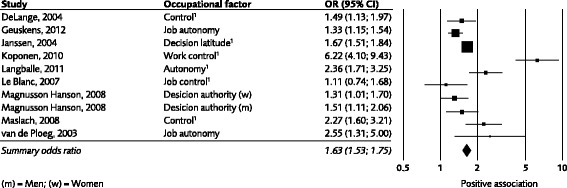
- Moderate scientific evidence (grade 3) supported a relationship between low job control and increased emotional exhaustion: 9 studies, weighted OR 1.63 (95% CI 1.53 to 1.75).
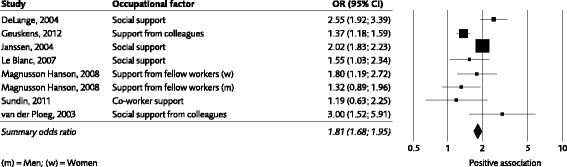
- Moderate evidence also supported low workplace support and emotional exhaustion: 7 studies, weighted OR 1.81 (95% CI 1.68 to 1.95).
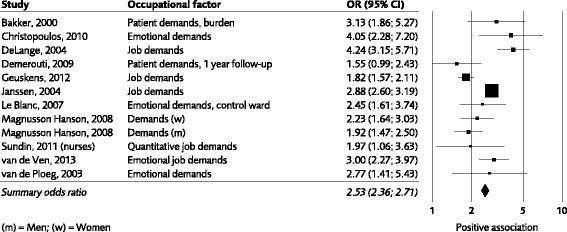
- Several other associations were supported by limited evidence (grade 2), including unspecified psychological demands and emotional exhaustion: 11 studies, weighted OR 2.53 (95% CI 2.36 to 2.71); high work load and emotional exhaustion: 5 studies, weighted OR 4.22 (95% CI 3.50 to 5.11); low reward and emotional exhaustion: weighted OR 1.86 (1.37 to 2.52); job insecurity and emotional exhaustion: weighted OR 1.39 (1.22 to 1.57).
- Reduced personal accomplishment was only associated with low reward, and there were few prospective studies of sufficient quality on chemical, biological, or physical exposures and burnout.
Methods
- Systematic review with meta-analyses, using the GRADE system to rate evidence; the authors state they followed PRISMA “as far as possible.”
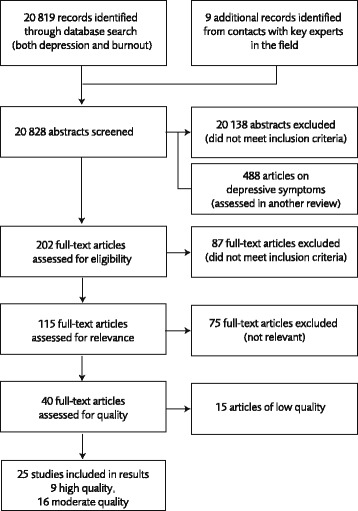
- Search covered 1990 to August 2013 in PubMed, Embase, Psychinfo, Arbline, Cochrane Library, and NIOSHTIC-2; 20,819 abstracts were identified, 115 full-text articles met inclusion criteria, and 25 articles were retained as high or medium quality.
- Included studies had to be from Europe, North America, Australia, or New Zealand; be prospective or comparable case-control designs; have baseline exposure and follow-up outcome assessment 1–5 years later; and include at least 100 exposed persons with control for at least age and gender.
- For meta-analysis, the authors used weighted odds ratios when possible, fixed-effects models, and the least adjusted model from each study for forest plots.
Limitations
- The paper states that few prospective studies of sufficient quality were available for some exposures, especially adverse chemical, biological, and physical factors; some associations were based on only one or two studies.
- The authors note that all 25 included studies relied on self-reported exposure and burnout, which may inflate associations; they say more objective measures would be beneficial.
- Evident from the text: the review could not conduct full homogeneity analyses for all outcomes because studies used many different statistical measures, and it could not do separate analyses by sex because gender-specific results were rarely reported.
Model-written summary. Check it against the paper before relying on it.
Integrity signals
Registry
Cites
Statistics
Figures
Verification
Claims the paper makes
0 Valid · 0 Not valid · 43 Not checked · 66 Own results and interpretations
A result the paper reports from its own data — it cites no other source for it, so there is none to check. The quote shows it is in the paper.
In the paper
“Reduced personal accomplishment was only associated with low reward.”
§ A systematic review including meta-analysis of work environment and burnout symptoms > Abstract > Results
plainstates an association- Asserted: passes — The authors put it forward as true.
- Checkable: passes — It can be checked against evidence.
- Load-bearing: passes — The paper’s conclusions depend on it.
- Based: passes — The paper gives a reason why it holds.
A result the paper reports from its own data — it cites no other source for it, so there is none to check. The quote shows it is in the paper.
In the paper
“Limited evidence (grade 2) was found for the associations between workplace justice, demands, high work load, low reward, low supervisor support, low co-worker support, job insecurity and change in emotional exhaustion.”
§ A systematic review including meta-analysis of work environment and burnout symptoms > Abstract > Results
plainstates an association- Asserted: passes — The authors put it forward as true.
- Checkable: passes — It can be checked against evidence.
- Load-bearing: passes — The paper’s conclusions depend on it.
- Based: passes — The paper gives a reason why it holds.
A result the paper states — it cites no source for it, so there is none to check. The quote shows it is in the paper.
In the paper
“There were few prospective studies with sufficient quality on adverse chemical, biological and physical factors and burnout.”
§ A systematic review including meta-analysis of work environment and burnout symptoms > Abstract > Results
plain- Asserted: passes — The authors put it forward as true.
- Checkable: passes — It can be checked against evidence.
- Load-bearing: unclear — It is unclear whether the paper’s conclusions depend on it.
- Based: passes — The paper gives a reason why it holds.
A result the paper reports from its own data — it cites no other source for it, so there is none to check. The quote shows it is in the paper.
In the paper
“Limited evidence (grade 2) was found for the associations between workplace justice, demands, high work load, low reward, low supervisor support, low co-worker support, job insecurity and change in emotional exhaustion.”
§ A systematic review including meta-analysis of work environment and burnout symptoms > Abstract > Results
plainstates an association- Asserted: passes — The authors put it forward as true.
- Checkable: passes — It can be checked against evidence.
- Load-bearing: passes — The paper’s conclusions depend on it.
- Based: passes — The paper gives a reason why it holds.
50 more claims
Create a free account to see all 109 claims and to verify the 77 references still open.
- It may state two separate claims as one. 41
- The quote only partly states this claim. 6
- Probably not a substantial claim. 21
Claims other papers make about this one
Each is checked against this paper’s own text: does it say what the citing paper says it does?
The source backs part of the claim, not all of it — or backs it for a different population, condition or comparison.
In the citing paper
“Unlike EE or DP, PA is more strongly influenced by structural and environmental factors, including work autonomy, recognition, opportunities for professional development, and organizational culture [60,61].”
From Effects of Third-Wave Cognitive Behavioral Therapy for Healthcare Professionals’ Burnout: A Systematic Review and Meta-Analysis (2025) · cites this paper as [61]
Experimental — accuracy not yet measured
Self-check
Percentages, sums and reported differences re-computed from the paper’s own numbers.
Rated major: it would touch a result — a value a result rests on, reported and recomputed p-values on opposite sides of the significance level, two passages that conflict with no sign which is right, or a cited work retracted before this paper was published.
In the paper
“If a work environment factor has a 30% prevalence and is associated with a relative risk of 1.6, the resulting population attributable risk is 7%, i.e. the proportion of disease in the exposed group that could be prevented by eliminating the risk factor.”
§ A systematic review including meta-analysis of work environment and burnout symptoms > Conclusions
Reported 0.07 · recomputed 0.1875
Citations
Cites
Preferred Reporting Items for Systematic Reviews and Meta-Analyses: the PRISMA statement
Moher, D., Liberati, A., Tetzlaff, J., Altman, D. G., & for the PRISMA Group (2009) · BMJ · doi:10.1136/bmj.b2535 · Cited by 83,823
Preferred reporting items for systematic reviews and meta-analyses: the PRISMA Statement.
(2009) · PubMed Central · Cited by 44,859
Preferred reporting items for systematic reviews and meta-analyses: The PRISMA statement
Moher, D., Liberati, A., Tetzlaff, J., Altman, D. G., & the PRISMA Group* (2009) · Annals of Internal Medicine · doi:10.7326/0003-4819-151-4-200908180-00135 · Cited by 37,554
Dermyshi, E., Wang, Y., Yan, C., Hong, W., Qiu, G., Gong, X., & Zhang, T. (2017) · Neonatology · doi:10.1159/000454668 · Cited by 24,451
The measurement of experienced burnout
Maslach, C., & Jackson, S. E. (1981) · Journal of Organizational Behavior · doi:10.1002/job.4030020205 · Cited by 14,496 · cited 7×
“Homogeneity test could not be conducted on burnout screening instruments, since very few studies used any other instrument than the MBI [4].”
MethodInfluentialMaslach, C., Schaufeli, W. B., & Leiter, M. P. (2001) · Annual Review of Psychology · doi:10.1146/annurev.psych.52.1.397 · Cited by 12,852 · cited 2×
“In 18 of the 25 studies, MBI, MBI-General Survey [4, 5] or the Dutch adaption of MBI, the Utrecht Burnout Questionnaire [24] were used.”
BackgroundMethodGRADE guidelines: 1. Introduction—GRADE evidence profiles and summary of findings tables
Guyatt, G., Oxman, A. D., Akl, E. A., Kunz, R., Vist, G., Brozek, J., Norris, S., Falck-Ytter, Y., Glasziou, P., & deBeer, H. (2011) · Journal of Clinical Epidemiology · doi:10.1016/j.jclinepi.2010.04.026 · Cited by 10,681 · cited 2×
“To our knowledge, the current meta-analytic study and review is the first that has been carried out according to the GRADE system [17].”
MethodThe measurement of engagement and burnout: a two sample confirmatory factor analytic approach.
Schaufeli, W. B., Salanova, M., González-romá, V., & Bakker, A. B. (2002) · Journal of Happiness Studies · doi:10.1023/a:1015630930326 · Cited by 10,014 · cited 1×
“In 18 of the 25 studies, MBI, MBI-General Survey [4, 5] or the Dutch adaption of MBI, the Utrecht Burnout Questionnaire [24] were used.”
MethodHealthy work: stress, productivity, and the reconstruction of working life
(1990) · Choice Reviews Online · doi:10.5860/choice.28-0381 · Cited by 8,220 · cited 2×
“Job control and workplace support comprise, together with job demands, the demand – controlsupport model [29, 30].”
BackgroundFreudenberger, H. J. (1974) · Journal of Social Issues · doi:10.1111/j.1540-4560.1974.tb00706.x · Cited by 5,463 · cited 3×
“Herbert Freudenberger [1], a clinical psychologist working in an alternative health care agency, and in 1976 by Christina Maslach [2], a social psychologist studying workplace emotions.”
BackgroundInfluential
Research works printed but not linked: 3
- Maslach C Burnout Hum Behav 1976 5 9 16 22
- Kant IJ Jansen NWH Van Amelsvoort LGPM Mohren DCL Swaen GMH Burnout in de werkende bevolking. Resultaten van de Maastrichtse Cohort Studie. [Burnout in the working population. Results of the Maastricht Cohort Study] Gedrag & Organisatie 2004 17 5 17
- Karasek RA Job content questionnaire and user’s guide 1985 Lowell University of Massachusetts
Cited by
Items 301–400 of 789
Liaset, I. F., Fimland, M. S., Holtermann, A., Mathiassen, S. E., & Redzovic, S. E. (2023) · BMC Health Services Research · doi:10.1186/s12913-023-09691-2 · Cited by 11
The Relationship between Job Burnout and Emotional Intelligence: A Meta-Analysis”
de Mendonça, N. R. F., de Santana, A. N., & Bueno, J. M. H. (2023) · Revista Psicologia Organizações e Trabalho · doi:10.5935/rpot/2023.2.23748 · Cited by 29
Fältén, R., Berntson, E., & Bernhard‐Oettel, C. (2024) · Work & Stress · doi:10.1080/02678373.2024.2309627 · Cited by 10
“…Thun et al., 2018), and despite the growing body of work emphasising systematic di ff erences in organisational contexts in the public sector (e.g. Aronsson et al., 2017; Härenstam et al., 2022), there remains a notable gap in the literature concerning the speci fi c link between organisational…”
Psychosocial Climate as Antecedent for Resources to Manage Emotional Demands at Work
Andersen, L. P., Andersen, D. R., & Pihl‐Thingvad, J. (2025) · International Journal of Environmental Research and Public Health · doi:10.3390/ijerph22010064 · Cited by 16
Health Worker Burnout and Moral Injury: Drivers, Effects, and Remedies
Grumbach, K., & Willard‐Grace, R. (2025) · Annual Review of Public Health · doi:10.1146/annurev-publhealth-071823-122832 · Cited by 19
Burnout among labour inspectors in Greece: A nationwide cross-sectional study
Anyfantis, I. D., Papagiannis, D., & Rachiotis, G. (2020) · Safety Science · doi:10.1016/j.ssci.2020.105134 · Cited by 17
Kalinienė, G., Lukšienė, D., Ustinavičienė, R., Škėmienė, L., & Januškevičius, V. (2021) · International Journal of Environmental Research and Public Health · doi:10.3390/ijerph18115603 · Cited by 19
“Experience with interventions directed at psychosocial organizational factors shows that structural factors, such as work needs, support and control, are particularly important for burnout prevention [32,41].”
BackgroundNyberg, A., Härenstam, A., Johansson, G., & Peristera, P. (2021) · Aligning perspectives on health, safety and well-being · doi:10.1007/978-3-030-77734-0_3 · Cited by 12
Sfeir, M., Zeitoun, A., Hallit, S. R., & Obeïd, S. (2022) · Perspectives In Psychiatric Care · doi:10.1111/ppc.13107 · Cited by 12
Ferreira, P. S., & Gomes, S. (2022) · Administrative Sciences · doi:10.3390/admsci12030087 · Cited by 19
Hoy, A. V., Rzeszutek, M., Pięta, M., Navas, J. M. M., Rodríguez-Mora, Á., Midgley, N., Omylinska‐Thurston, J., Dopierala, A., Falkenström, F., Ferlin, J., et al. (2022) · Scientific Reports · doi:10.1038/s41598-022-17669-z · Cited by 15
Vivion, M., Jauvin, N., Nicolakakis, N., Pelletier, M., Letellier, M.-C., & Biron, C. (2023) · International Journal of Environmental Research and Public Health · doi:10.3390/ijerph20126116 · Cited by 14
Pihl‐Thingvad, J., Elklit, A., Brandt, L. P. A., & Andersen, L. L. (2019) · International Archives of Occupational and Environmental Health · doi:10.1007/s00420-019-01424-5 · Cited by 15
Kim, H. R., Kim, S. M., Han, D. H., & Lee, Y. S. (2019) · Archives of Environmental & Occupational Health · doi:10.1080/19338244.2019.1666789 · Cited by 10
“lack of job autonomy, low compensation, and work instability increase the risk of burnout.(1) Furthermore,”
BackgroundWolff, M. B., O’Connor, P. J., Wilson, M. G., & Gay, J. L. (2021) · Journal of Occupational and Environmental Medicine · doi:10.1097/jom.0000000000002134 · Cited by 10
“For healthcare workers, low social support can predict increased burnout.(3,16) However, less is known about supports outside of work or types of support (eg, family or friend support, emotional, and informational support) and its impact on job stress and burnout.”
BackgroundSeverin, J., Björk, L., Corin, L., Jónsdóttir, I. H., & Åkerström, M. (2021) · International Journal of Environmental Research and Public Health · doi:10.3390/ijerph18041778 · Cited by 12
The State of Job Burnout Amongst New Zealand Managers: Implications for Employment Relations
Haar, J. M. (2021) · New Zealand journal of employment relations · doi:10.24135/nzjer.v46i1.49 · Cited by 14
“The meta-analysis by Aronsson et al. (2017) identified workloads as critical to burnout and job control, and autonomy as critical ways burnout can be managed and reduced.”
BackgroundNuebling, M., Hegewald, J., Starke, K. R., Lincke, H.-J., Jankowiak, S., Liebers, F., Latza, U., Letzel, S., Riechmann‐Wolf, M., Gianicolo, E., et al. (2022) · BMC Public Health · doi:10.1186/s12889-021-12240-3 · Cited by 21
“The systematic review of Aronsson and colleagues [23] summarized evidence from prospective studies of working conditions and burnout, finding evidence of associations between low job control, job demands, and workplace support with burnout, but few prospective studies examining other working conditions.”
BackgroundInfluentialEvaluation of employee occupational stress by estimating the loss of human capital in Japan
Piao, X., & Managi, S. (2022) · BMC Public Health · doi:10.1186/s12889-022-12751-7 · Cited by 18
Barrech, A., Kilian, R., Rottler, E., Jerg‐Bretzke, L., Holzer, M. S., Rieger, M. A., Jarczok, M. N., Gündel, H., & Rothermund, E. (2018) · International Journal of Environmental Research and Public Health · doi:10.3390/ijerph15020227 · Cited by 11
Leka, S., & Jain, A. (2025) · SSRN Electronic Journal · doi:10.2139/ssrn.5114626 · Cited by 10
Branson, J. L. (2023) · Voices A World Forum for Music Therapy · doi:10.15845/voices.v23i1.3259 · Cited by 9
The burnout experience among teachers: A profile analysis
Mota, A. I., Lopes, J. A. L., & Oliveira, C. R. (2023) · Psychology in the Schools · doi:10.1002/pits.22956 · Cited by 20
Job stress and burnout among Finnish municipal employees without depression or anxiety
Kainalainen, A., Korhonen, P. E., Penttinen, M. A., & Liira, J. (2024) · Occupational Medicine · doi:10.1093/occmed/kqae019 · Cited by 20
Healthcare worker burnout during a persistent crisis: a case–control study
Appelbom, S., Nordström, A., Finnes, A., Wicksell, R. K., & Bujacz, A. (2024) · Occupational Medicine · doi:10.1093/occmed/kqae032 · Cited by 16
“More specifically, burnout refers to the combination of high job demands and insufficient job resources that implicates the workers’ ability to cope with those demands [6,7].”
BackgroundMa, P., Sagara, T., Takase, M., Sugiura, K., Nakamoto, I., Muto, Y., Higashi, K., Fujiwara, Y., & Murayama, H. (2025) · Geriatrics and gerontology international/Geriatrics & gerontology international · doi:10.1111/ggi.15058 · Cited by 11
“37 In the burnout literature, although it is found that work control/ workplace support are associated with emotional exhaustion, 38 the buffering effect of work control and workplace support on the relationship between job demands and burnout is overall weak and inconsistent, owning to the…”
Andersen, L. P., Andersen, D. R., & Pihl‐Thingvad, J. (2025) · BMC Public Health · doi:10.1186/s12889-025-25085-x · Cited by 18
Association between burnout and wellness culture among emergency medicine providers
Jyothindran, R., d’Etienne, J. P., Marcum, K., Ho, A. F., Robinson, R. D., Tijerina, A., Graca, C., Knowles, H. C., Zenarosa, N. R., & Wang, H. (2021) · Clinical and Experimental Emergency Medicine · doi:10.15441/ceem.20.074 · Cited by 14
Burnout effect on working mothers in leadership positions during the COVID-19 lockdown
y Cano, Y. M., Ruiz, D. D., & Cuilty, K. (2023) · Gender in Management An International Journal · doi:10.1108/gm-03-2022-0085 · Cited by 13
PROFESSIONAL BURNOUT IN DOCTORS: THE VALUE OF THE INTENSITY AND QUALITY OF THE WORK
Sorokin, G. A., Suslov, V. L., Яковлев, Е. В., & Frolova, N. M. (2018) · Hygiene and Sanitation · doi:10.18821/0016-9900-2018-97-12-1221-1225 · Cited by 10
Lexén, A., Kalsås, K., Liiri, J., & Håkansson, C. (2020) · Scandinavian Journal of Occupational Therapy · doi:10.1080/11038128.2020.1817544 · Cited by 15
Thielmann, B., Karlsen, H. R., Darius, S., & Böckelmann, I. (2021) · Journal of Occupational and Environmental Medicine · doi:10.1097/jom.0000000000002307 · Cited by 12
“The positive effect of organizational interventions is supported by the finding that burnout symptoms are strongly influenced by structural factors (eg, job demands, support, opportunity to exert control).(41) The kind of interaction and feedback between supervisors and employees promotes self-efficacy of employees.”
BackgroundGritzka, S., Angerer, P., Pietrowsky, R., & Diebig, M. (2022) · International Journal of Environmental Research and Public Health · doi:10.3390/ijerph19031739 · Cited by 9
Saxvik, A., Törnbom, K., Petersson, E., Hange, D., Nejati, S., Björkelund, C., & Svenningsson, I. (2022) · PLoS ONE · doi:10.1371/journal.pone.0271180 · Cited by 13
“It was previously shown that job support and experienced justice at work were protective factors that reduced the risks of emotional burnout [7].”
BackgroundMaung, T. M., Tan, S. Y., Tay, C. L., Kabir, M. S., Shirin, L., & Chia, T. Y. (2022) · Sustainability · doi:10.3390/su141710664 · Cited by 13
“Burnout is known to be increased by emotional exhaustion, high demands, low job control, an excessive workload, and low reward [12].”
BackgroundA Three-Way Synergistic Effect of Work on Employee Well-Being: Human Sustainability Perspective
Mariappanadar, S., & Hochwarter, W. A. (2022) · International Journal of Environmental Research and Public Health · doi:10.3390/ijerph192214842 · Cited by 17
“The hindrance stressor perspective of the challenge-hindrance stress model [36] maintains that job demands are likely to affect employee job performance and personal goals negatively.”
BackgroundOakman, J., Lambert, K. A., Weale, V. P., Stuckey, R., & Graham, M. (2023) · International Journal of Environmental Research and Public Health · doi:10.3390/ijerph20043046 · Cited by 17
“The Impact of the psychosocial wo”k en’ironment on employee health outcomes, including cardiovascular disease [10], mental health disorders [11,12], and musculoskeletal disorders [13–15], is well established and supported by an extensive evidence base.”
BackgroundDuncan, A. R., Bell, S. B., & Hellman, C. M. (2022) · Current Psychology · doi:10.1007/s12144-022-03324-3 · Cited by 12
“This is expected given that adequate exercise and sleep are tied to reduced stress, which would be connected to less burnout in turn (Aronsson et al., 2017; Demerouti et al., 2001; Dolezal et al., 2017; Mosley et al., 1994).”
BackgroundSelf-compassion and psychological well-being of radiographers at work
Jacquet, L., Paucsik, M., Guy, J., Ève, K., Ben-Taarit, I., & Lantheaume, S. (2023) · International Journal of Qualitative Studies on Health and Well-Being · doi:10.1080/17482631.2023.2287621 · Cited by 17
“The lack of social support, notably by colleagues, may also cause professional burnout among radiographers (Aronsson et al., 2017; Jasperse et al., 2014; Killion, 2009; Raj, 2006).”
Maintaining a Sustainable Work–Life Balance: An Interdisciplinary Path to a Better Future
Kruyen, P., Andre, S., & HEIJDEN, B. I. J. M. V. D. (2024) · Edward Elgar Publishing eBooks · doi:10.4337/9781803922348 · Cited by 17
From employee socialization to co‐evolution: A lifespan multidisciplinary conceptualization
Houle, S. A., Morin, A. J. S., Vandenberghe, C., Tóth‐Király, I., & Fernet, C. (2024) · Applied Psychology · doi:10.1111/apps.12572 · Cited by 12
Aye, L. M., Tan, M., Schaefer, A., Thurairajasingam, S., Geldsetzer, P., Soon, L.-K., Reininghaus, U., Bärnighausen, T., & Su, T. T. (2024) · Digital Health · doi:10.1177/20552076241278313 · Cited by 26
Segovia, A. O., Barrado, J., & Millán, L. (2024) · Frontiers in Veterinary Science · doi:10.3389/fvets.2024.1454775 · Cited by 9
de Oliveira, R. F., Pereira, M. A. D., da Silva, M. L., Costa, M. L. T., de Aquino, É. C., & Naghettini, A. V. (2020) · Revista Brasileira de Educação Médica · doi:10.1590/1981-5271v44.2-20190153 · Cited by 8
Toyoshima, M., Takenoshita, S., Hasegawa, H., Kimura, T., & Nomura, K. (2020) · International Journal of Environmental Research and Public Health · doi:10.3390/ijerph17145221 · Cited by 9
Subjective and objective demands on different types of differential stress inventory
Karlsen, H. R., Böckelmann, I., & Thielmann, B. (2021) · International Archives of Occupational and Environmental Health · doi:10.1007/s00420-020-01632-4 · Cited by 8
Nyberg, A., Peristera, P., Toivanen, S., & Johansson, G. (2021) · International Journal of Environmental Research and Public Health · doi:10.3390/ijerph19010053 · Cited by 10
“For example, in systematic reviews, high job demands [9–12] and poor decision authority [9,12,13] are associated with increased risks of common mental disorders, which are the most common diagnoses behind sickness absences in Sweden [14].”
BackgroundPsychological distress and symptom-related burnout in asthma during the COVID-19 pandemic
Salsman, M. L., Nordberg, H. O., Howell, J., Berthet-Miron, M. M., Rosenfield, D., & Ritz, T. (2023) · Journal of Behavioral Medicine · doi:10.1007/s10865-023-00412-y · Cited by 10
“These feelings are thought to result from the increased energy demand of coping in high-stress environments, with emotional exhaustion thought to be the first domain of burnout to appear in response to prolonged stress (Aronsson et al., 2017).”
BackgroundPedreira‐Robles, G., Garcimartín, P., Pérez‐Sáez, M. J., Pascual, A. B., Crespo, M., & Fraile, V. M. (2024) · BMC Health Services Research · doi:10.1186/s12913-024-11200-y · Cited by 8
“The majority of the studies in this area of analysis conclude that heavy care workloads are one of the most important factors that most negatively impacts professionals and their role in relation to the individuals they care for [41, 42].”
BackgroundBurr, H., & d’Errico, A. (2018) · SOCIOLOGIA DEL LAVORO · doi:10.3280/sl2018-150009 · Cited by 10
Limmer, A., & Schütz, A. (2020) · International Archives of Occupational and Environmental Health · doi:10.1007/s00420-020-01555-0 · Cited by 11
Drivers and sequelae of burnout in U.S. dermatology trainees
Marchalik, R., Marchalik, D., Wang, H., & Pasieka, H. B. (2021) · International Journal of Women’s Dermatology · doi:10.1016/j.ijwd.2021.05.001 · Cited by 8
Severin, J., Svensson, M., & Åkerström, M. (2022) · International Journal of Environmental Research and Public Health · doi:10.3390/ijerph19052998 · Cited by 16
He, Q., Xu, P., Wang, H., Wang, S., Yang, L., Ba, Z., & Huang, H. (2023) · Frontiers in Psychiatry · doi:10.3389/fpsyt.2023.1096082 · Cited by 17
“For example, exposure to job insecurity not only leads to job burnout and resignation behaviors, but it can also damage the quality of life of medical staff (11, 12).”
BackgroundМалинаускас, Р. К., & Malinauskiene, V. A. (2023) · Healthcare · doi:10.3390/healthcare11142096 · Cited by 10
“Investigating burnout in various occupations has consistently attracted much scientific consideration [1] because it is critical to identify and address its warning signs and forestall its adverse long-term health consequences.”
BackgroundKato, Y., Chiba, R., Yamaguchi, S., Goto, K., Umeda, M., & Miyamoto, Y. (2021) · Healthcare · doi:10.3390/healthcare9020107 · Cited by 13
“Moreover, considering the stressful environments surrounding nurses as mentioned above, control over practice might help to reduce stigma towards people with schizophrenia through improving mental health among nurses [27,49,50].”
BackgroundÅkerström, M., Severin, J., Imberg, H., Jónsdóttir, I. H., Björk, L., & Corin, L. (2021) · International Archives of Occupational and Environmental Health · doi:10.1007/s00420-021-01686-y · Cited by 14
Gutierrez-Martínez, I., González‐Santos, J., Rodríguez-Fernández, P., Eguizábal, J. A. J., Campo, J. A. D. B.-D., & Gonzalez-Bernal, J. J. (2021) · International Journal of Environmental Research and Public Health · doi:10.3390/ijerph18095036 · Cited by 9
Systematic review of servant leadership and burnout
Mahon, D. (2024) · Mental Health and Social Inclusion · doi:10.1108/mhsi-02-2024-0027 · Cited by 11
Park, T. K., Kim, J., Pierce, B. J., & Lee, H. (2024) · Social Work · doi:10.1093/sw/swae017 · Cited by 7
Grimmond, T., King, T. L., LaMontagne, A. D., Oostermeijer, S., Harrap, B., Newberry‐Dupé, J., & Reavley, N. J. (2024) · American Journal of Industrial Medicine · doi:10.1002/ajim.23620 · Cited by 19
Chua, M. M., Ang, W. H. D., Siew, A. L., & Chen, H. (2024) · Journal of Advanced Nursing · doi:10.1111/jan.16459 · Cited by 10
Bouche, A., Jaussaud, J., Pic, O., Koleck, M., Dupuy, L., Ouvrard, C., Amieva, H., & Rascle, N. (2025) · Journal of Advanced Nursing · doi:10.1111/jan.16709 · Cited by 11
Uslukaya, A., Demirtaş, Z., Alanoğlu, M., & Zincirli, M. (2025) · Psychology in the Schools · doi:10.1002/pits.23393 · Cited by 10
Fun at work, job engagement, and burnout: a meta-analysis and narrative synthesis
Tzioti, E., Montgomery, A., Spiliou, M., Mouratidis, C., Chalili, V., Maliousis, I., & Lainidi, O. (2025) · Cogent Psychology · doi:10.1080/23311908.2025.2492453 · Cited by 12
“…congruently, a meta-analysis of burnout and the work environment has not included studies assessing the relationship between FaW and burnout (aronsson et al., 2017), nor has a meta-analysis assessing the relationship between burnout, job demands, resources, and attitudes (alarcon, 2011).”
Simões, C., Fronteira, I., & Pedro, A. R. (2025) · Frontiers in Public Health · doi:10.3389/fpubh.2025.1540214 · Cited by 10
“They have emphasized the interconnected relationships among burnout, depression, and anxiety, highlighting the multifactorial etiology of the syndrome, while showing that unfavourable work environments are closely linked to the development of burnout symptoms (13, 14).”
Lahti, J., Knop, J., Lallukka, T. M., Harkko, J., & Kouvonen, A. M. (2022) · Psychological Reports · doi:10.1177/00332941221106393 · Cited by 8
“Factors related to working environment have been widely investigated in relation to burnout and according to a systematic review and meta-analyses (Aronsson et al., 2017) and a review (Seidler et al., 2014), adverse psychosocial working conditions, such as excessive job demands and especially low…”
BackgroundInfluentialJohansson, G., Engström, Å. H., & Juuso, P. (2022) · International Journal of Qualitative Studies on Health and Well-Being · doi:10.1080/17482631.2022.2146857 · Cited by 11
“Work-environment factors, such as low support and the feeling of not having control in one’s job, also increase the risk for stress-related illness (Aronsson et al., 2017).”
BackgroundAsaoka, H., Sasaki, N., Koido, Y., Kawashima, Y., Ikeda, M., Miyamoto, Y., & Nishi, D. (2023) · Journal of Occupational Health · doi:10.1002/1348-9585.12422 · Cited by 8
“2019164NI- (1) (2) (3) (4)) and the research ethics committee of the National Hospital Organization Disaster Medical Center (No.”
BackgroundMethodScharf, C., & Berntson, E. (2023) · Nordic Psychology · doi:10.1080/19012276.2023.2271173 · Cited by 14
“Being able to discuss your operations with a peer has in a number of studies found to be important for employees (Aronsson et al., 2017) as well as for managers (Håkansson et al., 2021).”
Arnal, A. C. I., Galiana, L., Sánchez‐Ruiz, J., & Sansó, N. (2023) · Healthcare · doi:10.3390/healthcare12010004 · Cited by 14
“Additionally, plenty of studies have proved that greater working hours [66], too many administrative tasks [64], the working environment, administrative support, and the availability of support services and relationships with colleagues [47] are also related to burnout levels.”
BackgroundBelizario, M. V., Mamani-Benito, O. J., Zerga-Morales, C., Chaparro, J. E. T., & Morales-García, W. C. (2024) · Frontiers in Education · doi:10.3389/feduc.2024.1302624 · Cited by 21
Burnout und psychosoziale Arbeitsbedingungen in Berufsgruppen mit hohen kognitiven Anforderungen
Kersten, N., Formazin, M., & Müller, G. (2020) · Zentralblatt für Arbeitsmedizin Arbeitsschutz und Ergonomie · doi:10.1007/s40664-020-00409-3 · Cited by 7
“Hohe quantitative Anforderungen bei der Arbeit und Arbeitsplatzunsicherheit sind mit höheren BurnoutScores verbunden, wobei quantitative Anforderungen in unserer Stichprobe den stärksten Zusammenhang mit Burnout haben und damit im Einklang mit Ergebnissen früherer Untersuchungen stehen, die nicht auf die drei Berufsgr…”
BackgroundTurist Rehberlerinin İş Güvencesizliği Algılarının Tükenmişlik Düzeyleri Üzerindeki Etkisi
Katlav, E. Ö., ÇETİN, B., & Perçin, N. Ş. (2021) · Seyahat ve Otel İşletmeciliği Dergisi · doi:10.24010/soid.809985 · Cited by 11
Haraldsson, P., Josefsson, K. A., Rolander, B., Strengbom, E., & Jonker, D. (2021) · Applied Ergonomics · doi:10.1016/j.apergo.2021.103493 · Cited by 7
Brämberg, E. B., Arapovic-Johansson, B., Bültmann, U., Svedberg, P., & Bergström, G. (2021) · BMC Public Health · doi:10.1186/s12889-021-11786-6 · Cited by 9
“- is vital for the employees’ mental wellbeing [22, 23].”
BackgroundStroe, A. Z., Stuparu, A. F., Axelerad, S. D., Axelerad, D. D., & Moraru, A. (2021) · Journal of Mind and Medical Sciences · doi:10.22543/7674.82.p197208 · Cited by 7
Voss, A., Bogdanski, M., Walther, M., Langohr, B., Albrecht, R., Seifert, G., & Sandbothe, M. (2022) · Frontiers in Public Health · doi:10.3389/fpubh.2022.863671 · Cited by 12
“Recent studies investigated the mechanisms and consequences of occupational stress that leads to burnout (15–17).”
Biomarkers of chronic occupational stress (literature review)
Bezrukova, G. A., & Mikerov, A. N. (2022) · Hygiene and Sanitation · doi:10.47470/0016-9900-2022-101-6-649-654 · Cited by 13
The role of self-reported stressors in recovery from Exhaustion Disorder: a longitudinal study
Eklöf, B., Larsson, H., Ellbin, S., Jónsdóttir, I. H., O’Dwyer, S., & Hansson, C. (2022) · BMC Psychiatry · doi:10.1186/s12888-022-04172-y · Cited by 10
“Moreover, a systematic review and meta-analysis found that high workload increases the risk of developing exhaustion [11].”
BackgroundPowell, T. M., Scott, J., Yuma, P., & Hsiao, Y. (2022) · Health & Social Care in the Community · doi:10.1111/hsc.14059 · Cited by 9
“Symptoms of burnout externalise in work- related behaviours, including disengagement, cynicism and/or inefficacy in tasks (Aronsson et al., 2017), result from exhaustion from performing emotionally demanding jobs (Cieslak et al., 2014; Mateen & Dorji, 2009).”
BackgroundAyalew, M., Deribe, B., Hussen, S., Defar, S., Shimber, E. T., & Gedefaw, A. (2023) · Frontiers in Psychiatry · doi:10.3389/fpsyt.2023.1142926 · Cited by 11
“It has been noted that lack of public support, long working hours, a high degree of work related stress, work instability, and an unfavorable physical environment are risk factors for the development of symptoms of mental disorders in government employees (84–86).”
Lamesa, D., Seifu, W., Abdella, J., & Ezo, E. (2023) · SAGE Open Nursing · doi:10.1177/23779608231215599 · Cited by 7
“Today, EBNP is considered a key component of modern nursing care (Aronsson et al., 2017; Davidson & Brown, 2014; Mariann et al., 2020; Saunders et al., 2019).”
BackgroundHumanizing the Working Environment in Health Care Through Music and Movement
Horwitz, E. B. (2018) · Springer eBooks · doi:10.1007/978-3-319-76240-1_12 · Cited by 8
Integral Organizational Wellness™: An evidence‐based model of socially inspired well‐being
Bennett, J. B. (2018) · Journal of Applied Biobehavioral Research · doi:10.1111/jabr.12136 · Cited by 15
Kärkkäinen, R., Kinni, R., Saaranen, T. K., & Räsänen, K. (2018) · Cogent Psychology · doi:10.1080/23311908.2018.1551472 · Cited by 14
“A strong practical, structural/instrumental, and emotional support can be important as perceptions of the management (Consiglio et al., 2014) and level of supervisor support (Aronsson et al., 2017) influence employee burnout.”
BackgroundInfluentialNyberg, A., Johansson, G., Westerlund, H., Rostila, M., & Toivanen, S. (2019) · Scandinavian Journal of Work Environment & Health · doi:10.5271/sjweh.3853 · Cited by 11
The Role of Leisure-Time Physical Activity in the Change of Work-Related Stress (ERI) over Time
du Prel, J., Siegrist, J., & Borchart, D. (2019) · International Journal of Environmental Research and Public Health · doi:10.3390/ijerph16234839 · Cited by 8
“Recent evidence supports this notion for coronary heart disease [5], depressive disorders [6], and burnout [7].”
BackgroundBjörkenstam, E., Helgesson, M., & Mittendorfer‐Rutz, E. (2020) · Social Psychiatry and Psychiatric Epidemiology · doi:10.1007/s00127-020-01874-0 · Cited by 9
Psychiatry as a vocation: Moral injury, COVID-19, and the phenomenology of clinical practice
Broome, M. R., Rodrigues, J., Ritunnano, R., & Humpston, C. S. (2023) · Clinical Ethics · doi:10.1177/14777509231208361 · Cited by 7
Investigating women’s work experience in hospitality with the job demands-resources theory
Zhong, Y. (2024) · Journal of Hospitality and Tourism Insights · doi:10.1108/jhti-05-2024-0408 · Cited by 6
Lönnqvist, K., Sinervo, T. S., Kaihlanen, A., & Elovainio, M. J. (2025) · BMC Health Services Research · doi:10.1186/s12913-024-12164-9 · Cited by 13
“A large body of evidence suggests that organizational injustice, job strain, and a lack of team climate at work may lead to health problems [2].”
Habtu, Y., Kumie, A., Selamu, M., Kaba, M., Harada, H., & Girma, E. (2025) · PLoS ONE · doi:10.1371/journal.pone.0319870 · Cited by 8
Insomnia mediates the longitudinal association between loneliness and burnout among nurses
Świtaj, P., Baka, Ł., Kapica, Ł., Bugajska, J., Januszczak, J., & Sienkiewicz‐Jarosz, H. (2025) · Scientific Reports · doi:10.1038/s41598-025-11264-8 · Cited by 8
Lan, Y., Liu, S., & Chen, H. (2026) · Frontiers in Computer Science · doi:10.3389/fcomp.2026.1756441 · Cited by 10
Burnout profiles among French workers in health units for inmates: results of the EHCAU study
Boulier, S., Baumann, C., Rousseau, H., Horrach, P., & Bourion-Bédès, S. (2021) · BMC Health Services Research · doi:10.1186/s12913-021-06600-3 · Cited by 7
Wiisak, J., Suhonen, R., Galazzi, A., Gastmans, C., Keogh, B., Papastavrou, E., Stefanopoulos, N., Palese, A., & Stolt, M. (2024) · International Nursing Review · doi:10.1111/inr.13080 · Cited by 7
Anandarajah, G., Sleeth, G., Mennillo, M. R., & Srinivasan, A. (2025) · BMC Medical Education · doi:10.1186/s12909-025-06788-6 · Cited by 16
Securing jobs with individual trait and organisational support?
Zeidan, S., Prentice, C., & Nguyen, M. (2022) · International journal of organizational analysis · doi:10.1108/ijoa-12-2021-3076 · Cited by 10
Arslan, İ. B., Lucassen, N., de Haan, A. D., Jongerling, J., Bakker, A. B., & Prinzie, P. (2023) · International Journal of Behavioral Development · doi:10.1177/01650254231152422 · Cited by 8
“Organizational and occupational factors, such as time pressure, job control, and social support have been studied most often as resources (Aronsson et al., 2017).”
Background
Metadata
- Authors
- Aronsson, G., Theorell, T., Grape, T., Hammarström, A., Hogstedt, C., Marteinsdottir, I., Skoog, I., Träskman-Bendz, L., & Hall, C.
- Affiliations
- Stockholm University (SE)
- Umeå University (SE)
- Karolinska Institutet (SE)
- University of Gothenburg (SE)
- SBU - Swedish Agency for Health Technology Assessment and Assessment of Social Services (SE)
- Corresponding author
- Aronsson, Gunnar
- Venue
- BMC Public Health
- Published
- 2017-03-16
- Volume
- 17
- Issue
- 1
- Pages
- 264-264
- ISSN
- 1471-2458 (ISSN-L)
- PMC
- PMC5356239
- OpenAlex
- W2595367318
- Cited by
- 789
- References
- 38
- Citations by year
- 2026: 66 · 2025: 95 · 2024: 101 · 2023: 99 · 2022: 130 · 2021: 129 · 2020: 74 · 2019: 48 · 2018: 41 · 2017: 6
- FWCI
- 7.13
- Type
- journal article
- Language
- en
- Open access
- gold
- doi.org
- Licence
- cc-by
- Locations
- BMC Public Health (publishedVersion, cc-by)
- PubMed Central (publishedVersion, cc-by)
- PubMed (publishedVersion)
- DiVA (Linkoping University) (submittedVersion, other-oa)
- KTH Publication Database DiVA (KTH Royal Institute of Technology) (submittedVersion, other-oa)
- DOAJ (DOAJ: Directory of Open Access Journals) (submittedVersion, cc-by-sa)
- Lund University Publications (Lund University) (submittedVersion)
- Funders
- The Swedish Council of Health Technology Assessment
- Topics
- Social Sciences › Psychology › Social Psychology › Stress and Burnout Research
- Health Sciences › Medicine › Public Health, Environmental and Occupational Health › Occupational Health and Burnout
- Health Sciences › Health Professions › General Health Professions › Healthcare professionals’ stress and burnout
- Keywords
- burnout, emotional exhaustion, cynicism, personal accomplishment, job control, workplace support, workplace justice, job demands, workload, job insecurity, supervisor support, coworker support, occupational exposure, work environment, organizational interventions
- MeSH terms
- Achievement, Adult, Australia, Burnout, Professional, Europe, Mental Fatigue, Female, Humans, Male, New Zealand, North America, Prospective Studies, Surveys and Questionnaires, Reward, Social Justice, Organizational Culture, Case-Control Studies, Occupational Exposure, Workload, Workplace
About these checks
Registry, retraction, Cites and statistics results are computed, not judged, with one exception: a printed reference that no index lists is read once by a model before it counts as a citation error. Claims are extracted by a model and kept only when their quote appears verbatim in the text; each cited source is then checked, with a model’s help, for whether it says what the claim relies on. Those verdicts can be wrong — read the claim’s quote and the cited source before relying on one.
A language model drew the claims from the paper on 2026-10-11, under version 3 of the claim definition (model deepseek-v4.1-flash, prompt extract-v3).
A second model labelled each claim on 2026-10-11 (model jev-1.13-20260917, definition revision gold-guideline-v0.2).
Statistics and arithmetic are recomputed, not judged.
Confidence bands are shown only for fields calibrated on our annotated test set. None is calibrated yet, so no band is shown.
What counts as a claim ›How we measure confidence ›How we check this ›
Are you an author, or do you see a problem with this page? Request a review
Data sources
Bibliographic data: Semantic Scholar, OpenAlex, Crossref.
Contains information from the Semantic Scholar Academic Graph Datasets, made available under the ODC Attribution License (ODC-BY 1.0).
Semantic Scholar’s data is described in: Kinney, R., et al. (2023). The Semantic Scholar Open Data Platform. arXiv:2301.10140.
