

A systematic review including meta-analysis of work environment and burnout symptoms
Open accessThe DOI matches its Crossref record; 37 of the 38 references it cites were found in a registry or an index; none of the 77 sources its claims cite is checked for support yet.
Abstract
BACKGROUND: Practitioners and decision makers in the medical and insurance systems need knowledge on the relationship between work exposures and burnout. Many burnout studies - original as well as reviews - restricted their analyses to emotional exhaustion or did not report results on cynicism, personal accomplishment or global burnout. To meet this need we carried out this review and meta-analyses with the aim to provide systematically graded evidence for associations between working conditions and near-future development of burnout symptoms. METHODS: A wide range of work exposure factors was screened. Inclusion criteria were: 1) Study performed in Europe, North America, Australia and New Zealand 1990-2013. 2) Prospective or comparable case control design. 3) Assessments of exposure (work) and outcome at baseline and at least once again during follow up 1-5 years later. Twenty-five articles met the predefined relevance and quality criteria. The GRADE-system with its 4-grade evidence scale was used. RESULTS: Most of the 25 studies focused emotional exhaustion, fewer cynicism and still fewer personal accomplishment. Moderately strong evidence (grade 3) was concluded for the association between job control and reduced emotional exhaustion and between low workplace support and increased emotional exhaustion. Limited evidence (grade 2) was found for the associations between workplace justice, demands, high work load, low reward, low supervisor support, low co-worker support, job insecurity and change in emotional exhaustion. Cynicism was associated with most of these work factors. Reduced personal accomplishment was only associated with low reward. There were few prospective studies with sufficient quality on adverse chemical, biological and physical factors and burnout. CONCLUSION: While high levels of job support and workplace justice were protective for emotional exhaustion, high demands, low job control, high work load, low reward and job insecurity increased the risk for developing exhaustion. Our approach with a wide range of work exposure factors analysed in relation to the separate dimensions of burnout expanded the knowledge of associations, evidence as well as research needs. The potential of organizational interventions is illustrated by the findings that burnout symptoms are strongly influenced by structural factors such as job demands, support and the possibility to exert control.
Overview
CoChat Summary
TL;DR
This systematic review and meta-analysis found that several work environment factors were associated with burnout symptoms, with the strongest evidence for low job control and low workplace support in relation to emotional exhaustion. Using the GRADE system, the authors concluded that structural workplace factors such as demands, support, and control are important for burnout risk.
Key findings
- Among 25 included studies, most focused on emotional exhaustion; fewer examined cynicism/depersonalisation, and still fewer personal accomplishment.
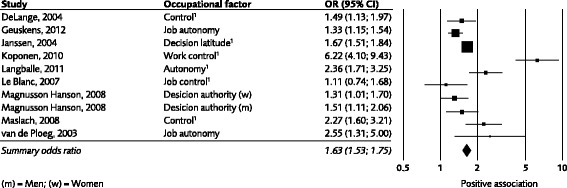
- Moderate scientific evidence (grade 3) supported a relationship between low job control and increased emotional exhaustion: 9 studies, weighted OR 1.63 (95% CI 1.53 to 1.75).
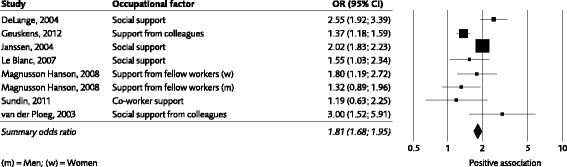
- Moderate evidence also supported low workplace support and emotional exhaustion: 7 studies, weighted OR 1.81 (95% CI 1.68 to 1.95).
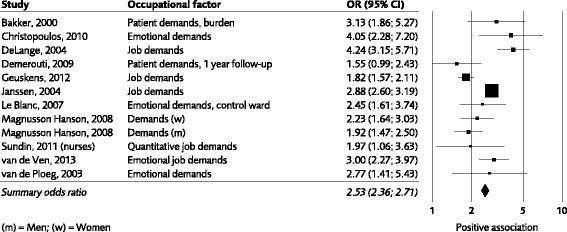
- Several other associations were supported by limited evidence (grade 2), including unspecified psychological demands and emotional exhaustion: 11 studies, weighted OR 2.53 (95% CI 2.36 to 2.71); high work load and emotional exhaustion: 5 studies, weighted OR 4.22 (95% CI 3.50 to 5.11); low reward and emotional exhaustion: weighted OR 1.86 (1.37 to 2.52); job insecurity and emotional exhaustion: weighted OR 1.39 (1.22 to 1.57).
- Reduced personal accomplishment was only associated with low reward, and there were few prospective studies of sufficient quality on chemical, biological, or physical exposures and burnout.
Methods
- Systematic review with meta-analyses, using the GRADE system to rate evidence; the authors state they followed PRISMA “as far as possible.”
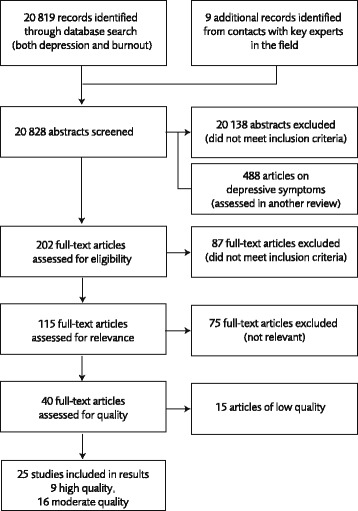
- Search covered 1990 to August 2013 in PubMed, Embase, Psychinfo, Arbline, Cochrane Library, and NIOSHTIC-2; 20,819 abstracts were identified, 115 full-text articles met inclusion criteria, and 25 articles were retained as high or medium quality.
- Included studies had to be from Europe, North America, Australia, or New Zealand; be prospective or comparable case-control designs; have baseline exposure and follow-up outcome assessment 1–5 years later; and include at least 100 exposed persons with control for at least age and gender.
- For meta-analysis, the authors used weighted odds ratios when possible, fixed-effects models, and the least adjusted model from each study for forest plots.
Limitations
- The paper states that few prospective studies of sufficient quality were available for some exposures, especially adverse chemical, biological, and physical factors; some associations were based on only one or two studies.
- The authors note that all 25 included studies relied on self-reported exposure and burnout, which may inflate associations; they say more objective measures would be beneficial.
- Evident from the text: the review could not conduct full homogeneity analyses for all outcomes because studies used many different statistical measures, and it could not do separate analyses by sex because gender-specific results were rarely reported.
Model-written summary. Check it against the paper before relying on it.
Integrity signals
Registry
Cites
Statistics
Figures
Verification
Claims the paper makes
0 Valid · 0 Not valid · 43 Not checked · 66 Own results and interpretations
A result the paper reports from its own data — it cites no other source for it, so there is none to check. The quote shows it is in the paper.
In the paper
“Reduced personal accomplishment was only associated with low reward.”
§ A systematic review including meta-analysis of work environment and burnout symptoms > Abstract > Results
plainstates an association- Asserted: passes — The authors put it forward as true.
- Checkable: passes — It can be checked against evidence.
- Load-bearing: passes — The paper’s conclusions depend on it.
- Based: passes — The paper gives a reason why it holds.
A result the paper reports from its own data — it cites no other source for it, so there is none to check. The quote shows it is in the paper.
In the paper
“Limited evidence (grade 2) was found for the associations between workplace justice, demands, high work load, low reward, low supervisor support, low co-worker support, job insecurity and change in emotional exhaustion.”
§ A systematic review including meta-analysis of work environment and burnout symptoms > Abstract > Results
plainstates an association- Asserted: passes — The authors put it forward as true.
- Checkable: passes — It can be checked against evidence.
- Load-bearing: passes — The paper’s conclusions depend on it.
- Based: passes — The paper gives a reason why it holds.
A result the paper states — it cites no source for it, so there is none to check. The quote shows it is in the paper.
In the paper
“There were few prospective studies with sufficient quality on adverse chemical, biological and physical factors and burnout.”
§ A systematic review including meta-analysis of work environment and burnout symptoms > Abstract > Results
plain- Asserted: passes — The authors put it forward as true.
- Checkable: passes — It can be checked against evidence.
- Load-bearing: unclear — It is unclear whether the paper’s conclusions depend on it.
- Based: passes — The paper gives a reason why it holds.
A result the paper reports from its own data — it cites no other source for it, so there is none to check. The quote shows it is in the paper.
In the paper
“Limited evidence (grade 2) was found for the associations between workplace justice, demands, high work load, low reward, low supervisor support, low co-worker support, job insecurity and change in emotional exhaustion.”
§ A systematic review including meta-analysis of work environment and burnout symptoms > Abstract > Results
plainstates an association- Asserted: passes — The authors put it forward as true.
- Checkable: passes — It can be checked against evidence.
- Load-bearing: passes — The paper’s conclusions depend on it.
- Based: passes — The paper gives a reason why it holds.
50 more claims
Create a free account to see all 109 claims and to verify the 77 references still open.
- It may state two separate claims as one. 41
- The quote only partly states this claim. 6
- Probably not a substantial claim. 21
Claims other papers make about this one
Each is checked against this paper’s own text: does it say what the citing paper says it does?
The source backs part of the claim, not all of it — or backs it for a different population, condition or comparison.
In the citing paper
“Unlike EE or DP, PA is more strongly influenced by structural and environmental factors, including work autonomy, recognition, opportunities for professional development, and organizational culture [60,61].”
From Effects of Third-Wave Cognitive Behavioral Therapy for Healthcare Professionals’ Burnout: A Systematic Review and Meta-Analysis (2025) · cites this paper as [61]
Experimental — accuracy not yet measured
Self-check
Percentages, sums and reported differences re-computed from the paper’s own numbers.
Rated major: it would touch a result — a value a result rests on, reported and recomputed p-values on opposite sides of the significance level, two passages that conflict with no sign which is right, or a cited work retracted before this paper was published.
In the paper
“If a work environment factor has a 30% prevalence and is associated with a relative risk of 1.6, the resulting population attributable risk is 7%, i.e. the proportion of disease in the exposed group that could be prevented by eliminating the risk factor.”
§ A systematic review including meta-analysis of work environment and burnout symptoms > Conclusions
Reported 0.07 · recomputed 0.1875
Citations
Cites
Preferred Reporting Items for Systematic Reviews and Meta-Analyses: the PRISMA statement
Moher, D., Liberati, A., Tetzlaff, J., Altman, D. G., & for the PRISMA Group (2009) · BMJ · doi:10.1136/bmj.b2535 · Cited by 83,823
Preferred reporting items for systematic reviews and meta-analyses: the PRISMA Statement.
(2009) · PubMed Central · Cited by 44,859
Preferred reporting items for systematic reviews and meta-analyses: The PRISMA statement
Moher, D., Liberati, A., Tetzlaff, J., Altman, D. G., & the PRISMA Group* (2009) · Annals of Internal Medicine · doi:10.7326/0003-4819-151-4-200908180-00135 · Cited by 37,554
Dermyshi, E., Wang, Y., Yan, C., Hong, W., Qiu, G., Gong, X., & Zhang, T. (2017) · Neonatology · doi:10.1159/000454668 · Cited by 24,451
The measurement of experienced burnout
Maslach, C., & Jackson, S. E. (1981) · Journal of Organizational Behavior · doi:10.1002/job.4030020205 · Cited by 14,496 · cited 7×
“Homogeneity test could not be conducted on burnout screening instruments, since very few studies used any other instrument than the MBI [4].”
MethodInfluentialMaslach, C., Schaufeli, W. B., & Leiter, M. P. (2001) · Annual Review of Psychology · doi:10.1146/annurev.psych.52.1.397 · Cited by 12,852 · cited 2×
“In 18 of the 25 studies, MBI, MBI-General Survey [4, 5] or the Dutch adaption of MBI, the Utrecht Burnout Questionnaire [24] were used.”
BackgroundMethodGRADE guidelines: 1. Introduction—GRADE evidence profiles and summary of findings tables
Guyatt, G., Oxman, A. D., Akl, E. A., Kunz, R., Vist, G., Brozek, J., Norris, S., Falck-Ytter, Y., Glasziou, P., & deBeer, H. (2011) · Journal of Clinical Epidemiology · doi:10.1016/j.jclinepi.2010.04.026 · Cited by 10,681 · cited 2×
“To our knowledge, the current meta-analytic study and review is the first that has been carried out according to the GRADE system [17].”
MethodThe measurement of engagement and burnout: a two sample confirmatory factor analytic approach.
Schaufeli, W. B., Salanova, M., González-romá, V., & Bakker, A. B. (2002) · Journal of Happiness Studies · doi:10.1023/a:1015630930326 · Cited by 10,014 · cited 1×
“In 18 of the 25 studies, MBI, MBI-General Survey [4, 5] or the Dutch adaption of MBI, the Utrecht Burnout Questionnaire [24] were used.”
MethodHealthy work: stress, productivity, and the reconstruction of working life
(1990) · Choice Reviews Online · doi:10.5860/choice.28-0381 · Cited by 8,220 · cited 2×
“Job control and workplace support comprise, together with job demands, the demand – controlsupport model [29, 30].”
BackgroundFreudenberger, H. J. (1974) · Journal of Social Issues · doi:10.1111/j.1540-4560.1974.tb00706.x · Cited by 5,463 · cited 3×
“Herbert Freudenberger [1], a clinical psychologist working in an alternative health care agency, and in 1976 by Christina Maslach [2], a social psychologist studying workplace emotions.”
BackgroundInfluential
Research works printed but not linked: 3
- Maslach C Burnout Hum Behav 1976 5 9 16 22
- Kant IJ Jansen NWH Van Amelsvoort LGPM Mohren DCL Swaen GMH Burnout in de werkende bevolking. Resultaten van de Maastrichtse Cohort Studie. [Burnout in the working population. Results of the Maastricht Cohort Study] Gedrag & Organisatie 2004 17 5 17
- Karasek RA Job content questionnaire and user’s guide 1985 Lowell University of Massachusetts
Cited by
Items 701–789 of 789
Claverie, D., Duffaud, A. M., Pellissier, S., Jacob, S., Vigier, C., Déserts, M. D. D., Pasquier, P., Escarment, J., Canini, F., & Trousselard, M. (2025) · PLoS ONE · doi:10.1371/journal.pone.0328064
“Burnout is an important psycho-pathology in caregivers working in ICUs [3] that usually accompanies work-related wear [4].”
Kelley, B., He, Q., Mennillo, L. G., Roseman, J. L., & Anandarajah, G. (2025) · Family Practice · doi:10.1093/fampra/cmaf063
Kloster, H. M., Bora, S., Slovin, A., Rogers, S. R., Garg, A., Kemper, K. J., Selbst, S. M., Serwint, J. R., & Lim, S. W. (2025) · Hospital Pediatrics · doi:10.1542/hpeds.2024-008243 · Cited by 1
Kowalski, L., Finnes, A., Koch, S., & Bujacz, A. (2025) · doi:10.2196/preprints.83753
Bun, R. S., Bouziad, K. A., Daouda, O. S., Miliani, K., Temime, L., Hocine, M. N., & Astagneau, P. (2025) · medRxiv · doi:10.1101/2025.09.18.25336086
Dieckmännken, I., & Hollederer, A. (2025) · Sozial Extra · doi:10.1007/s12054-025-00812-1
Reflective teaching, teacher immunity, and burnout: Investigating possible links
Navidinia, H., & Gholizadeh, F. Z. (2025) · System · doi:10.1016/j.system.2025.103865 · Cited by 4
Managers’ experiences of work capacity in employees with depression and anxiety
Björk, L., Hultquist, J., Hensing, G. K. E., & Bertilsson, M. (2025) · Scandinavian Journal of Occupational Therapy · doi:10.1080/11038128.2025.2570900
“This suggests that more women are affected because they often work in environments where factors that affect mental health negatively (e.g. job insecurity, high demands, high workload, low job control and low reward) are common [21,37].”
Fathi, M., Kananifar, N., Atashpour, S. H., Bardideh, F., & Atashpour, S. S. (2025) · Scientific Reports · doi:10.1038/s41598-025-23148-y
“In contrast, the findings of the present study are consistent with the results of the research by Aronsson et al. (2017).”
InfluentialŻenda, A., Kożusznik, B., Paliga, M., & Blukacz, M. (2025) · Przegląd Psychologiczny · doi:10.31648/przegldpsychologiczny.11349 · Cited by 1
“Although much research has examined the impact of organisational climate on stress and burnout in the workplace (Aronsson et al., 2017; Loh et al., 2019), the specific role of organisational climate in shaping experiences of humilia-tion – a distinct and intensely self-conscious emotion – has…”
Girardi, D., Arcucci, E., Rapisarda, S., Corso, L. D., Riedl, R., & Falco, A. (2025) · Acta Psychologica · doi:10.1016/j.actpsy.2025.106020 · Cited by 3
Decent work and burnout: the moderating role of career calling
Faria, L., & Porto, S. (2025) · British Journal of Guidance and Counselling · doi:10.1080/03069885.2025.2600360
“…are crucial for mental health, while the absence of these elements, including an imbalance between e ff ort and reward or lack of social support, is associated with higher rates of burnout (Aronsson et al., 2017; Ferraro et al., 2020; Go š tautait ė et al., 2020; Wu et al., 2025; Xue et al., 2024).”
Feher, G., Kapus, K., Tibold, A., Banko, Z., Berke, G., Gács, B., Váradi, I., Nyulas, R., & Matuz, A. (2024) · Figshare · doi:10.6084/m9.figshare.26860649
Wacker, E., Fischer, A., & Schorlemmer, J. (2021) · Figshare · doi:10.6084/m9.figshare.14443101
Huang, Y., Guo, H., Wang, S., Zhong, S., He, Y., Chen, H., Zhou, J., & Wang, X. (2024) · Figshare · doi:10.6084/m9.figshare.24934153
Ivánkovits, L., Kazinczi, C., Kocsis, K., Stankovic, M., Koday, Z., Pető, Z., & Töreki, A. (2024) · Figshare · doi:10.6084/m9.figshare.26669469
Zhou, S., Li, M., Chen, S., Jiang, D., Qu, Y., & Xu, X. (2024) · Figshare · doi:10.6084/m9.figshare.26721762
Kohnen, D., De Witte, H., Schaufeli, W. B., Dello, S. A. G., Bruyneel, L., & Sermeus, W. (2024) · Figshare · doi:10.6084/m9.figshare.25001637
Zhou, S., Li, M., Chen, S., Jiang, D., Qu, Y., & Xu, X. (2024) · Figshare · doi:10.6084/m9.figshare.26721765
Scheepers, R. A., van den Broek, T., Cramm, J. M., Finkenflügel, H., & Nieboer, A. P. (2024) · Figshare · doi:10.6084/m9.figshare.26607229
Piao, X., & Managi, S. (2022) · Figshare · doi:10.6084/m9.figshare.19289728
Hadžibajramović, E., Hansson, M., Åkerström, M., Dencker, A., & Hensing, G. K. E. (2022) · Figshare · doi:10.6084/m9.figshare.21151420
Hadžibajramović, E., Hansson, M., Åkerström, M., Dencker, A., & Hensing, G. K. E. (2022) · Figshare · doi:10.6084/m9.figshare.21151423
Additional file 1 of Occupational stress: evidence from industries affected by COVID-19 in Japan
Piao, X., Xie, J., & Managi, S. (2022) · Figshare · doi:10.6084/m9.figshare.19793126
Beno, A., Bertilsson, M., Holmgren, K., Glise, K., Pousette, A., Segerfelt, K., & Björk, L. (2023) · Figshare · doi:10.6084/m9.figshare.24172036
Hadžibajramović, E., Hansson, M., Åkerström, M., Dencker, A., & Hensing, G. K. E. (2022) · Figshare · doi:10.6084/m9.figshare.21151417
Beno, A., Bertilsson, M., Holmgren, K., Glise, K., Pousette, A., Segerfelt, K., & Björk, L. (2023) · Figshare · doi:10.6084/m9.figshare.24172033
Hadžibajramović, E., Hansson, M., Åkerström, M., Dencker, A., & Hensing, G. K. E. (2022) · Figshare · doi:10.6084/m9.figshare.21151414
Dalky, H. F., Shatnawi, B. A., Dalky, A. F., & Alkhawaldeh, A. (2025) · SAGE Open Nursing · doi:10.1177/23779608251400639
Sevilla, K. C. (2025) · Scientific Journal Care & Tech · doi:10.69821/caretech.v3i2.50
Qu, Y., Zheng, S., Yang, T., Zheng, L., Jiang, F., & Yang, F. (2026) · Frontiers in Public Health · doi:10.3389/fpubh.2025.1722353
Winkler, E. (2026) · Journal of Workplace Behavioral Health · doi:10.1080/15555240.2025.2611055
“Moreover, there is good evidence to suggest that job control has a reducing effect on emotional exhaustion (Aronsson et al., 2017), including for funeral directors (Schladitz, 2017).”
Wu, Y., Huang, J., Hai, J., Huang, L., Wu, T., Ding, Q., Wei, Z., Zhao, J., Liang, B., & Zhu, P. (2026) · BMC Health Services Research · doi:10.1186/s12913-026-14018-y · Cited by 1
“Several previous systematic reviews have indicated that long working hours and frequent overtime are key contributors to burnout among healthcare workers globally [50, 54, 55], and our study aligns with these findings.”
Beyond Measure: Human-Values-Based Care
Jain, P., & Hirsh, D. A. (2026) · Journal of General Internal Medicine · doi:10.1007/s11606-025-10139-y
Capel, P. J. A. (2026) · Springer eBooks · doi:10.1007/978-3-662-71831-5_20
PRESENTEEISM – A NECESSARY DISCUSSION FOR HEALTH PROFESSIONALS
Landim, F. S., Scremin, M., Prado, P. F. D., Ornelas, Y. C. R. C., Antunes, V. I. V. F., Santos, A. C., Alves, E. P. F., Silva, R. K. P., Fonseca, A. D. G., Arcanjo, I. N., et al. (2026) · Health and Society · doi:10.51249/hs.v6i01.2831
Freire, J. C., de Oliveira, R. R. L., Feitosa, S. B., Gomes, P. P., Queiroz, D. D. R., Bezerra, J., & Hardman, C. M. (2025) · Cuadernos de Educación y Desarrollo · doi:10.55905/cuadv17n8-066
Silva, I. N. D. L., de Oliveira, R. R. L., Feitosa, S. B., Júnior, R. D. S. W., Queiroz, D. D. R., de Menezes, V. G., & Hardman, C. M. (2025) · Cuadernos de Educación y Desarrollo · doi:10.55905/cuadv17n8-068 · Cited by 1
The Impact of Exercise on Teacher Satisfaction and Retention: A Scoping Review
Wilkens, S. A., & Milla, C. (2026) · IGI Global eBooks · doi:10.4018/979-8-3373-6157-4.ch012
Kuek, T. Y., & Chen, I. (2025) · International Journal of Education Psychology and Counseling · doi:10.35631/ijepc.1061077
Real Utopias: Visions for Healthy and Sustainable Organizations
Hornung, S., Höge, T., Lampert, B., & Unterrainer, C. (2026) · Handbook series in occupational health sciences · doi:10.1007/978-3-031-88856-4_35-1
Shapovalov, O., & Zotova, L. (2025) · The Scientific Notes of the Pedagogical Department · doi:10.26565/2074-8167-2025-56-05 · Cited by 2
Brakenridge, C. L., Silverwood, A. J., Ashley, D. P., Healy, G. N., Goode, A. D., Parker, S. L., Brough, P. A., & Clark, B. (2026) · Work & Stress · doi:10.1080/02678373.2026.2633716
Agyei, F., Affum, P., Amoah, D. O., Apiiyah, B. L., Anane, B. T., Danso, N., Agyeiwaa, C., Kando, S. B., & Yabani, P. A. (2026) · Journal of Mental Health · doi:10.1080/09638237.2026.2645549 · Cited by 1
“Research highlights the importance of organizational factors such as support, workload, autonomy, and emotional demands in maintaining employee mental health (Aronsson et al., 2017; Baidoo et al., 2023; Berglund et al., 2024; Boot et al., 2024; Demerouti et al., 2021).”
Kidron, A., Ben-Dor, R., Otap, D., Barsky, I., & Cohen, J. E. (2026) · JCO Oncology Practice · doi:10.1200/op-25-01282
Marshall, S. K., Mewes, K., Noomad, N., Durawee, W., & Hayeeabdunromae, A. (2026) · Frontiers in Public Health · doi:10.3389/fpubh.2026.1782228 · Cited by 1
“Furthermore, a review of work environments and burnout by Aronsson et al. discovered substantial evidence of a link between job control and less emotional exhaustion and a link between inadequate workplace support and greater emotional exhaustion (76).”
Cougot, B. (2021) · theses.fr (ABES) · doi:10.70675/b33ff873z5a6az427az9757z4b0e8f531ea1 · Cited by 1
Zhao, S., Li, H., Dong, Y., Xin, M., Wang, J., Tang, Z., Jia, Y., Ma, H., & Qu, H. (2026) · Journal of Health Organization and Management · doi:10.1108/jhom-08-2025-0482
Ames, I., & Dettmers, J. (2026) · Zeitschrift für Arbeits- und Organisationspsychologie A&O · doi:10.1026/0932-4089/a000475
Professional burnout: modern models, factors, and stages of development
Lobus, N. V., Tikhonov, I. N., & Kargol, I. V. (2026) · Counseling Psychology and Psychotherapy · doi:10.17759/cpp.2026340102 · Cited by 1
Understanding the Experience of Partner Hiring: A Relationship Perspective
Brown, C. C., McNaughtan, J. L., McNaughtan, E. D., & Jackson, G. R. (2026) · Journal of Education Human Resources · doi:10.3138/jehr-2024-0015
Chiboub, N., & Gauchet, A. (2026) · doi:10.64628/aak.twt6nfude
Baka, Ł., Kapica, Ł., Sienkiewicz‐Jarosz, H., Bugajska, J., Bańkowska, M., Neugebauer, K., Pietras, K., & Świtaj, P. (2026) · Chronobiology International · doi:10.1080/07420528.2026.2663950
“…and meta-analyses have demonstrated, high emotional demands are associated with an increased risk of impaired mental health among employees (Madsen et al. 2019; Nielsen et al. 2022), including job burnout (Hülsheger and Schewe 2011; Aronsson et al. 2017; Baka et al. 2021; Kaluza et al. 2022).”
Psychische Gesundheit in der Berufsdermatologie
Lukaschek, K., Waitek, M., & Weisshaar, E. (2026) · Die Dermatologie · doi:10.1007/s00105-026-05688-0
Buscema, F., Converso, D., Prieto, L. L., & Colombo, L. (2026) · F1000Research · doi:10.12688/f1000research.179637.1
Kaltenbrunner, M., & Ahmadi, N. (2026) · International Journal of Occupational Safety and Ergonomics · doi:10.1080/10803548.2026.2638078
Bermejo-Franco, A., Veiga-Pérez, D., Lejeune, M. Q., Muñoz-Bermúdez, N., Mallo-López, A., & del-Blanco-Muñiz, J. Á. (2026) · BMC Medical Education · doi:10.1186/s12909-026-09560-6
“Contributing factors include excessive work-load, limited control over tasks, insufficient support, and discrepancies between expectations and workplace realities [6].”
Yong, M., & Suh, H. (2026) · Emerging Adulthood · doi:10.1177/21676968261455372
“Converging evidence suggests its association with various indicators of psychological distress (Salvagioni et al., 2017; Taris et al., 2010) and occupational functioning (Aronsson et al., 2017; Linzer et al., 2025), highlighting its wide implication.”
Čopková, R. (2026) · Healthcare · doi:10.3390/healthcare14121680
“Burnout may affect not only individual functioning but also quality of care, team stability, and service sustainability [43].”
InfluentialDamen, M. A. W., Detaille, S. I., Carlier, B. E., Engels, J. A., & de Lange, A. H. (2026) · American Journal of Health Promotion · doi:10.1177/08901171261457853
Reineholm, C., Åkerström, M., & Jónsdóttir, I. H. (2026) · Safety Science · doi:10.1016/j.ssci.2026.107339 · Cited by 1
Arslanparcasi, Y. (2026) · Journal of Happiness Studies · doi:10.1007/s10902-026-01048-w
“…health and well-being and are positively associated with occupational stress, exhaustion, burnout, and other health-related outcomes (Angrave & Charlwood, 2015 ; Aronsson et al., 2017; Bannai & Tamakoshi, 2014 ; Burke et al., 2009 ; Demerouti et al., 2001 ; Karasek, 1979; Lin et al., 2013).”
de Sousa, J. E., de Oliveira, A. M., Mazzei, L. G., Bergamaschi, C. D. C., Carrillo, J. F. S., Pina, B. P., Paes, R. D., & Lopes, L. C. (2026) · MethodsX · doi:10.1016/j.mex.2026.104025
Perlinger, J., Ehrenthal, J. C., Montag, C., & Kretschmar, T. (2026) · PLoS ONE · doi:10.1371/journal.pone.0352860
“While high workloads, increased job demands, job insecurity or a low degree of control or reward increase the risk of burnout, support and fairness at the workplace have a protective effect against the development of burnout [132].”
Decuyper, A., Moens, M., Tuytens, M., Vanderlinde, R., & Thomas, L. (2026) · Teachers and Teaching · doi:10.1080/13540602.2026.2700741
Ma, J., Xu, Q., Shi, L., & Zhang, Y. (2026) · Frontiers in Public Health · doi:10.3389/fpubh.2026.1861160
“Previous research has suggested that during crises, heavy workloads, emotional exhaustion, and resource scarcity may be associated with depletion of both cognitive and material reserves, thereby potentially exacerbating fatigue through accelerated resource depletion (44, 45).”
Hassanzadeh, J. F. (2026) · The Journal of Mental Health Training Education and Practice · doi:10.1108/jmhtep-05-2025-0055
ElHichou-Ahmed, C., Gil-Monte, P. R., & Figueiredo‐Ferraz, H. (2026) · Encyclopedia · doi:10.3390/encyclopedia6080162
“…mapping for identifying research structures [13,16,32], theoretically by contextualizing the evolution of burnout within occupational health research [3,4,9], and practically by identifying emerging research areas that may inform future scientific agendas and evidence synthesis efforts [26,27].”
Egozi, L., & Pardo, A. (2026) · Occupational Health · doi:10.3390/occuphealth1030033
Böckelmann, I., Hartung, J., Darius, S., Sammito, S., & Thielmann, B. (2026) · Frontiers in Physiology · doi:10.3389/fphys.2026.1908141 · Cited by 1
(2020) · Elsevier eBooks · doi:10.1016/b978-3-437-24035-5.00022-5
Harms, P. D., Fezzey, T. N. A., & Yakushko, N. (2026) · Human Resource Management Review · doi:10.1016/j.hrmr.2026.101170
Máté, M., Jensch, A., & Ózsvári, L. (2026) · Healthcare · doi:10.3390/healthcare14172749
Ahamed, A. F. M. J., & Lundell, F. (2026) · Journal of Workplace Behavioral Health · doi:10.1080/15555240.2026.2724355
The effects of job autonomy on work engagement and burnout: a meta-analysis across ages and cultures
Firouzjaeiangalougah, M., & Procházka, J. (2026) · Work & Stress · doi:10.1080/02678373.2026.2718052 · Cited by 1
Roest, J. J., Vang, M. L., Stams, G. J. J. M., Turkanović, I., Ratling, D., Verkennis, D., Dekker, A., van Miert, V., & Kuiper, C. H. Z. (2026) · Clinical Psychology Review · doi:10.1016/j.cpr.2026.102801
Organizational justice and burnout: A dimensional meta-analysis
Howe, M., Courcy, F., & Trépanier, S. (2026) · Journal of Workplace Behavioral Health · doi:10.1080/15555240.2026.2730271
“Two meta-analyses (Aronsson et al., 2017; Robbins et al., 2012) covering studies from 1990 to 2013 reported a moderate negative association between organizational justice and overall burnout and a protective effect primarily limited to emotional exhaustion.”
InfluentialSalutogenic resource profiles and compassion fatigue among nurses: a latent profile analysis
Zhang, S., He, M., & Lou, W. (2026) · Frontiers in Public Health · doi:10.3389/fpubh.2026.1906172
Mohan Kumar, M., Narayanan, S., & Aparnavi, P. (2026) · BioSocial Health Journal. · doi:10.34172/bshj.185
Ngo, T. T., Manahan, L. T., Estioko, E. D., & Pham, H. T. T. (2026) · Journal of Nursing Management · doi:10.1155/jonm/1362411
“Experiments have repeatedly shown that poor working conditions lead to job discontent [5], poor performance, turnover intentions [6] and otherwise negative health, job involvement and satisfactory care [7].”
Dieckmännken, I., & Hollederer, A. (2026) · Journal of Social Work Practice · doi:10.1080/02650533.2026.2739976
Burnout and associate factors among Bank employees in Angola. A cross-sectional studyPreprint
Coelho, M. F. S. E., Sundin, Ö., Macassa, G., Pignatelli, C., & Soares, J. J. F. (2026) · Research Square · doi:10.21203/rs.3.rs-11012624/v1
Yim, W. S., Sundram, B. M., Azzeri, A. B., Lim, Y. C., Supramaniam, R. K., Vallasamy, S. K., & Hassan, S. N. (2026) · PLoS ONE · doi:10.1371/journal.pone.0360481
“Prolonged exposure to adverse working conditions may also contribute to emotional exhaustion and sleep disturbances [11,13].”
Herold, M. L., & Rosner, R. (2026) · Frontiers in Psychology · doi:10.3389/fpsyg.2026.1883184
“…meta-analytic and longitudinal research across helping professions, which consistently links burnout and work-related distress to stable psychosocial work characteristics such as high demands, limited resources, and role ambiguity (Aronsson et al., 2017; Guthier et al., 2020; Lesener et al., 2020).”
Sigursteinsdóttir, H. (2026) · Work · doi:10.1177/10519815261491690
Šimůnková, E., Kozáková, E., & Hon, Z. (2026) · Frontiers in Psychology · doi:10.3389/fpsyg.2026.1876583
Tapşın, F. O., Tapşın, F. O., & Çakmak, G. (2026) · Frontiers in Psychology · doi:10.3389/fpsyg.2026.1968120
Kamal, M., Coe, J. B., Clow, K. M., Saragosa, M., Nowrouzi‐Kia, B., & Gohar, B. (2026) · Health Services Insights · doi:10.1177/11786329261497948
Women’s job satisfaction: evidence from Nepal
Brauner‐Otto, S. R., & Andlay, T. (2026) · Contemporary South Asia · doi:10.1080/09584935.2026.2723995
Metadata
- Authors
- Aronsson, G., Theorell, T., Grape, T., Hammarström, A., Hogstedt, C., Marteinsdottir, I., Skoog, I., Träskman-Bendz, L., & Hall, C.
- Affiliations
- Stockholm University (SE)
- Umeå University (SE)
- Karolinska Institutet (SE)
- University of Gothenburg (SE)
- SBU - Swedish Agency for Health Technology Assessment and Assessment of Social Services (SE)
- Corresponding author
- Aronsson, Gunnar
- Venue
- BMC Public Health
- Published
- 2017-03-16
- Volume
- 17
- Issue
- 1
- Pages
- 264-264
- ISSN
- 1471-2458 (ISSN-L)
- PMC
- PMC5356239
- OpenAlex
- W2595367318
- Cited by
- 789
- References
- 38
- Citations by year
- 2026: 66 · 2025: 95 · 2024: 101 · 2023: 99 · 2022: 130 · 2021: 129 · 2020: 74 · 2019: 48 · 2018: 41 · 2017: 6
- FWCI
- 7.13
- Type
- journal article
- Language
- en
- Open access
- gold
- doi.org
- Licence
- cc-by
- Locations
- BMC Public Health (publishedVersion, cc-by)
- PubMed Central (publishedVersion, cc-by)
- PubMed (publishedVersion)
- DiVA (Linkoping University) (submittedVersion, other-oa)
- KTH Publication Database DiVA (KTH Royal Institute of Technology) (submittedVersion, other-oa)
- DOAJ (DOAJ: Directory of Open Access Journals) (submittedVersion, cc-by-sa)
- Lund University Publications (Lund University) (submittedVersion)
- Funders
- The Swedish Council of Health Technology Assessment
- Topics
- Social Sciences › Psychology › Social Psychology › Stress and Burnout Research
- Health Sciences › Medicine › Public Health, Environmental and Occupational Health › Occupational Health and Burnout
- Health Sciences › Health Professions › General Health Professions › Healthcare professionals’ stress and burnout
- Keywords
- burnout, emotional exhaustion, cynicism, personal accomplishment, job control, workplace support, workplace justice, job demands, workload, job insecurity, supervisor support, coworker support, occupational exposure, work environment, organizational interventions
- MeSH terms
- Achievement, Adult, Australia, Burnout, Professional, Europe, Mental Fatigue, Female, Humans, Male, New Zealand, North America, Prospective Studies, Surveys and Questionnaires, Reward, Social Justice, Organizational Culture, Case-Control Studies, Occupational Exposure, Workload, Workplace
About these checks
Registry, retraction, Cites and statistics results are computed, not judged, with one exception: a printed reference that no index lists is read once by a model before it counts as a citation error. Claims are extracted by a model and kept only when their quote appears verbatim in the text; each cited source is then checked, with a model’s help, for whether it says what the claim relies on. Those verdicts can be wrong — read the claim’s quote and the cited source before relying on one.
A language model drew the claims from the paper on 2026-10-11, under version 3 of the claim definition (model deepseek-v4.1-flash, prompt extract-v3).
A second model labelled each claim on 2026-10-11 (model jev-1.13-20260917, definition revision gold-guideline-v0.2).
Statistics and arithmetic are recomputed, not judged.
Confidence bands are shown only for fields calibrated on our annotated test set. None is calibrated yet, so no band is shown.
What counts as a claim ›How we measure confidence ›How we check this ›
Are you an author, or do you see a problem with this page? Request a review
Data sources
Bibliographic data: Semantic Scholar, OpenAlex, Crossref.
Contains information from the Semantic Scholar Academic Graph Datasets, made available under the ODC Attribution License (ODC-BY 1.0).
Semantic Scholar’s data is described in: Kinney, R., et al. (2023). The Semantic Scholar Open Data Platform. arXiv:2301.10140.
