

A systematic review including meta-analysis of work environment and burnout symptoms
Open accessThe DOI matches its Crossref record; 37 of the 38 references it cites were found in a registry or an index; none of the 77 sources its claims cite is checked for support yet.
Abstract
BACKGROUND: Practitioners and decision makers in the medical and insurance systems need knowledge on the relationship between work exposures and burnout. Many burnout studies - original as well as reviews - restricted their analyses to emotional exhaustion or did not report results on cynicism, personal accomplishment or global burnout. To meet this need we carried out this review and meta-analyses with the aim to provide systematically graded evidence for associations between working conditions and near-future development of burnout symptoms. METHODS: A wide range of work exposure factors was screened. Inclusion criteria were: 1) Study performed in Europe, North America, Australia and New Zealand 1990-2013. 2) Prospective or comparable case control design. 3) Assessments of exposure (work) and outcome at baseline and at least once again during follow up 1-5 years later. Twenty-five articles met the predefined relevance and quality criteria. The GRADE-system with its 4-grade evidence scale was used. RESULTS: Most of the 25 studies focused emotional exhaustion, fewer cynicism and still fewer personal accomplishment. Moderately strong evidence (grade 3) was concluded for the association between job control and reduced emotional exhaustion and between low workplace support and increased emotional exhaustion. Limited evidence (grade 2) was found for the associations between workplace justice, demands, high work load, low reward, low supervisor support, low co-worker support, job insecurity and change in emotional exhaustion. Cynicism was associated with most of these work factors. Reduced personal accomplishment was only associated with low reward. There were few prospective studies with sufficient quality on adverse chemical, biological and physical factors and burnout. CONCLUSION: While high levels of job support and workplace justice were protective for emotional exhaustion, high demands, low job control, high work load, low reward and job insecurity increased the risk for developing exhaustion. Our approach with a wide range of work exposure factors analysed in relation to the separate dimensions of burnout expanded the knowledge of associations, evidence as well as research needs. The potential of organizational interventions is illustrated by the findings that burnout symptoms are strongly influenced by structural factors such as job demands, support and the possibility to exert control.
Overview
CoChat Summary
TL;DR
This systematic review and meta-analysis found that several work environment factors were associated with burnout symptoms, with the strongest evidence for low job control and low workplace support in relation to emotional exhaustion. Using the GRADE system, the authors concluded that structural workplace factors such as demands, support, and control are important for burnout risk.
Key findings
- Among 25 included studies, most focused on emotional exhaustion; fewer examined cynicism/depersonalisation, and still fewer personal accomplishment.
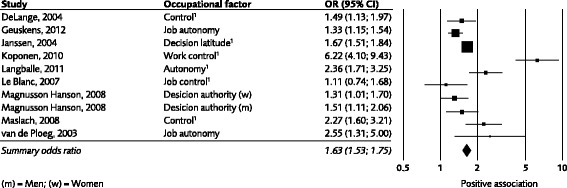
- Moderate scientific evidence (grade 3) supported a relationship between low job control and increased emotional exhaustion: 9 studies, weighted OR 1.63 (95% CI 1.53 to 1.75).
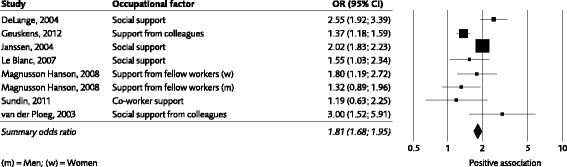
- Moderate evidence also supported low workplace support and emotional exhaustion: 7 studies, weighted OR 1.81 (95% CI 1.68 to 1.95).
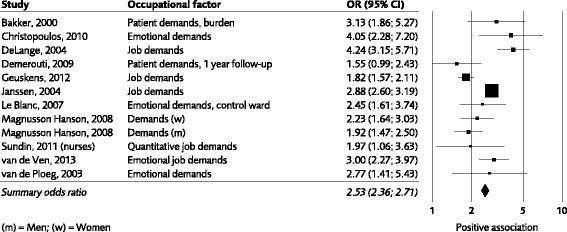
- Several other associations were supported by limited evidence (grade 2), including unspecified psychological demands and emotional exhaustion: 11 studies, weighted OR 2.53 (95% CI 2.36 to 2.71); high work load and emotional exhaustion: 5 studies, weighted OR 4.22 (95% CI 3.50 to 5.11); low reward and emotional exhaustion: weighted OR 1.86 (1.37 to 2.52); job insecurity and emotional exhaustion: weighted OR 1.39 (1.22 to 1.57).
- Reduced personal accomplishment was only associated with low reward, and there were few prospective studies of sufficient quality on chemical, biological, or physical exposures and burnout.
Methods
- Systematic review with meta-analyses, using the GRADE system to rate evidence; the authors state they followed PRISMA “as far as possible.”
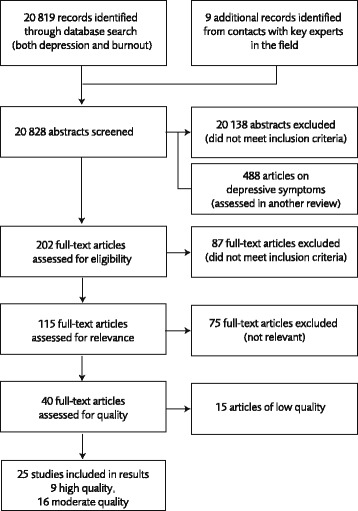
- Search covered 1990 to August 2013 in PubMed, Embase, Psychinfo, Arbline, Cochrane Library, and NIOSHTIC-2; 20,819 abstracts were identified, 115 full-text articles met inclusion criteria, and 25 articles were retained as high or medium quality.
- Included studies had to be from Europe, North America, Australia, or New Zealand; be prospective or comparable case-control designs; have baseline exposure and follow-up outcome assessment 1–5 years later; and include at least 100 exposed persons with control for at least age and gender.
- For meta-analysis, the authors used weighted odds ratios when possible, fixed-effects models, and the least adjusted model from each study for forest plots.
Limitations
- The paper states that few prospective studies of sufficient quality were available for some exposures, especially adverse chemical, biological, and physical factors; some associations were based on only one or two studies.
- The authors note that all 25 included studies relied on self-reported exposure and burnout, which may inflate associations; they say more objective measures would be beneficial.
- Evident from the text: the review could not conduct full homogeneity analyses for all outcomes because studies used many different statistical measures, and it could not do separate analyses by sex because gender-specific results were rarely reported.
Model-written summary. Check it against the paper before relying on it.
Integrity signals
Registry
Cites
Statistics
Figures
Verification
Claims the paper makes
0 Valid · 0 Not valid · 43 Not checked · 66 Own results and interpretations
A result the paper reports from its own data — it cites no other source for it, so there is none to check. The quote shows it is in the paper.
In the paper
“Reduced personal accomplishment was only associated with low reward.”
§ A systematic review including meta-analysis of work environment and burnout symptoms > Abstract > Results
plainstates an association- Asserted: passes — The authors put it forward as true.
- Checkable: passes — It can be checked against evidence.
- Load-bearing: passes — The paper’s conclusions depend on it.
- Based: passes — The paper gives a reason why it holds.
A result the paper reports from its own data — it cites no other source for it, so there is none to check. The quote shows it is in the paper.
In the paper
“Limited evidence (grade 2) was found for the associations between workplace justice, demands, high work load, low reward, low supervisor support, low co-worker support, job insecurity and change in emotional exhaustion.”
§ A systematic review including meta-analysis of work environment and burnout symptoms > Abstract > Results
plainstates an association- Asserted: passes — The authors put it forward as true.
- Checkable: passes — It can be checked against evidence.
- Load-bearing: passes — The paper’s conclusions depend on it.
- Based: passes — The paper gives a reason why it holds.
A result the paper states — it cites no source for it, so there is none to check. The quote shows it is in the paper.
In the paper
“There were few prospective studies with sufficient quality on adverse chemical, biological and physical factors and burnout.”
§ A systematic review including meta-analysis of work environment and burnout symptoms > Abstract > Results
plain- Asserted: passes — The authors put it forward as true.
- Checkable: passes — It can be checked against evidence.
- Load-bearing: unclear — It is unclear whether the paper’s conclusions depend on it.
- Based: passes — The paper gives a reason why it holds.
A result the paper reports from its own data — it cites no other source for it, so there is none to check. The quote shows it is in the paper.
In the paper
“Limited evidence (grade 2) was found for the associations between workplace justice, demands, high work load, low reward, low supervisor support, low co-worker support, job insecurity and change in emotional exhaustion.”
§ A systematic review including meta-analysis of work environment and burnout symptoms > Abstract > Results
plainstates an association- Asserted: passes — The authors put it forward as true.
- Checkable: passes — It can be checked against evidence.
- Load-bearing: passes — The paper’s conclusions depend on it.
- Based: passes — The paper gives a reason why it holds.
50 more claims
Create a free account to see all 109 claims and to verify the 77 references still open.
- It may state two separate claims as one. 41
- The quote only partly states this claim. 6
- Probably not a substantial claim. 21
Claims other papers make about this one
Each is checked against this paper’s own text: does it say what the citing paper says it does?
The source backs part of the claim, not all of it — or backs it for a different population, condition or comparison.
In the citing paper
“Unlike EE or DP, PA is more strongly influenced by structural and environmental factors, including work autonomy, recognition, opportunities for professional development, and organizational culture [60,61].”
From Effects of Third-Wave Cognitive Behavioral Therapy for Healthcare Professionals’ Burnout: A Systematic Review and Meta-Analysis (2025) · cites this paper as [61]
Experimental — accuracy not yet measured
Self-check
Percentages, sums and reported differences re-computed from the paper’s own numbers.
Rated major: it would touch a result — a value a result rests on, reported and recomputed p-values on opposite sides of the significance level, two passages that conflict with no sign which is right, or a cited work retracted before this paper was published.
In the paper
“If a work environment factor has a 30% prevalence and is associated with a relative risk of 1.6, the resulting population attributable risk is 7%, i.e. the proportion of disease in the exposed group that could be prevented by eliminating the risk factor.”
§ A systematic review including meta-analysis of work environment and burnout symptoms > Conclusions
Reported 0.07 · recomputed 0.1875
Citations
Cites
Preferred Reporting Items for Systematic Reviews and Meta-Analyses: the PRISMA statement
Moher, D., Liberati, A., Tetzlaff, J., Altman, D. G., & for the PRISMA Group (2009) · BMJ · doi:10.1136/bmj.b2535 · Cited by 83,823
Preferred reporting items for systematic reviews and meta-analyses: the PRISMA Statement.
(2009) · PubMed Central · Cited by 44,859
Preferred reporting items for systematic reviews and meta-analyses: The PRISMA statement
Moher, D., Liberati, A., Tetzlaff, J., Altman, D. G., & the PRISMA Group* (2009) · Annals of Internal Medicine · doi:10.7326/0003-4819-151-4-200908180-00135 · Cited by 37,554
Dermyshi, E., Wang, Y., Yan, C., Hong, W., Qiu, G., Gong, X., & Zhang, T. (2017) · Neonatology · doi:10.1159/000454668 · Cited by 24,451
The measurement of experienced burnout
Maslach, C., & Jackson, S. E. (1981) · Journal of Organizational Behavior · doi:10.1002/job.4030020205 · Cited by 14,496 · cited 7×
“Homogeneity test could not be conducted on burnout screening instruments, since very few studies used any other instrument than the MBI [4].”
MethodInfluentialMaslach, C., Schaufeli, W. B., & Leiter, M. P. (2001) · Annual Review of Psychology · doi:10.1146/annurev.psych.52.1.397 · Cited by 12,852 · cited 2×
“In 18 of the 25 studies, MBI, MBI-General Survey [4, 5] or the Dutch adaption of MBI, the Utrecht Burnout Questionnaire [24] were used.”
BackgroundMethodGRADE guidelines: 1. Introduction—GRADE evidence profiles and summary of findings tables
Guyatt, G., Oxman, A. D., Akl, E. A., Kunz, R., Vist, G., Brozek, J., Norris, S., Falck-Ytter, Y., Glasziou, P., & deBeer, H. (2011) · Journal of Clinical Epidemiology · doi:10.1016/j.jclinepi.2010.04.026 · Cited by 10,681 · cited 2×
“To our knowledge, the current meta-analytic study and review is the first that has been carried out according to the GRADE system [17].”
MethodThe measurement of engagement and burnout: a two sample confirmatory factor analytic approach.
Schaufeli, W. B., Salanova, M., González-romá, V., & Bakker, A. B. (2002) · Journal of Happiness Studies · doi:10.1023/a:1015630930326 · Cited by 10,014 · cited 1×
“In 18 of the 25 studies, MBI, MBI-General Survey [4, 5] or the Dutch adaption of MBI, the Utrecht Burnout Questionnaire [24] were used.”
MethodHealthy work: stress, productivity, and the reconstruction of working life
(1990) · Choice Reviews Online · doi:10.5860/choice.28-0381 · Cited by 8,220 · cited 2×
“Job control and workplace support comprise, together with job demands, the demand – controlsupport model [29, 30].”
BackgroundFreudenberger, H. J. (1974) · Journal of Social Issues · doi:10.1111/j.1540-4560.1974.tb00706.x · Cited by 5,463 · cited 3×
“Herbert Freudenberger [1], a clinical psychologist working in an alternative health care agency, and in 1976 by Christina Maslach [2], a social psychologist studying workplace emotions.”
BackgroundInfluential
Research works printed but not linked: 3
- Maslach C Burnout Hum Behav 1976 5 9 16 22
- Kant IJ Jansen NWH Van Amelsvoort LGPM Mohren DCL Swaen GMH Burnout in de werkende bevolking. Resultaten van de Maastrichtse Cohort Studie. [Burnout in the working population. Results of the Maastricht Cohort Study] Gedrag & Organisatie 2004 17 5 17
- Karasek RA Job content questionnaire and user’s guide 1985 Lowell University of Massachusetts
Cited by
Job Demands–Resources Theory: Ten Years Later
Bakker, A. B., Demerouti, E., & Sanz-Vergel, A. (2023) · Annual Review of Organizational Psychology and Organizational Behavior · doi:10.1146/annurev-orgpsych-120920-053933 · Cited by 1,844
“Aronsson et al. (2017) built on previous meta-analyses and included longitudinal studies in their analysis.”
MethodZhang, W.-R., Wang, K., Yin, L., Zhao, W.-F., Xue, Q., Peng, M., Min, B.-Q., Tian, Q., Leng, H.-X., Du, J.-L., et al. (2020) · Psychotherapy and Psychosomatics · doi:10.1159/000507639 · Cited by 1,690
“Lowering job demands and workload [31] , while increasing job control and reward might help to protect medical health workers.”
BackgroundLi, L. Z., Yang, P., Singer, S. J., Pfeffer, J., Mathur, M. B., & Shanafelt, T. (2024) · JAMA Network Open · doi:10.1001/jamanetworkopen.2024.43059 · Cited by 501
Niedhammer, I., Bertrais, S., & Witt, K. (2021) · Scandinavian Journal of Work, Environment & Health · doi:10.5271/sjweh.3968 · Cited by 370
“Two literature reviews, of low or moderate quality, explored the associations between psychosocial work exposures and burnout (15, 62), only one was based on prospective design (15), and both provided estimates that were all significant.”
BackgroundGuseva Canu, I., Marca, S. C., Dell'Oro, F., Balázs, Á., Bergamaschi, E., Besse, C., Bianchi, R., Bislimovska, J., Koscec Bjelajac, A., Bugge, M., et al. (2021) · Scandinavian Journal of Work, Environment & Health · doi:10.5271/sjweh.3935 · Cited by 274
“] We validated this search strategy by achieving exhaustiveness of the studies included in the latest systematic review on occupational burnout (2).”
BackgroundMethodTechnostress at work and mental health: concepts and research results
Dragano, N., & Lunau, T. (2020) · Current Opinion in Psychiatry · doi:10.1097/yco.0000000000000613 · Cited by 249
López‐López, I. M., Gómez‐Urquiza, J. L., Cañadas, G. R., De la Fuente, E. I., Albendín‐García, L., & Cañadas‐De la Fuente, G. A. (2019) · International Journal of Mental Health Nursing · doi:10.1111/inm.12606 · Cited by 239
Symptoms in Health Care Workers during the COVID-19 Epidemic. A Cross-Sectional Survey
Magnavita, N., Tripepi, G., & Di Prinzio, R. R. (2020) · International Journal of Environmental Research and Public Health · doi:10.3390/ijerph17145218 · Cited by 235
“Since self-reporting of symptoms is known to be influenced by psychosocial factors such as loneliness [38], occupational stress [39] or conditions of fatigue and sleep deprivation [40], we adjusted the multiple logistic regression calculation of the OR by introducing, in model I, age, gender, family status, the presen…”
MethodStress and ways of coping among nurse managers: An integrative review
Labrague, L. J., McEnroe‐Petitte, D. M., Leocadio, M. C., Van Bogaert, P., & Cummings, G. G. (2018) · Journal of Clinical Nursing · doi:10.1111/jocn.14165 · Cited by 212
“Based on the DCS Model, persistent exposure to high job demands such heavy workloads, inadequate resources, and financial responsibilities could potentially harm the health and well-being of an individual and the organization; however, adequate job resources such as job control (decision authority) can serve as a buff…”
BackgroundLevels of Burnout and Risk Factors in Medical Area Nurses: A Meta-Analytic Study
Molina-Praena, J., Ramirez-Baena, L., Gómez-Urquiza, J. L., Cañadas, G. R., De la Fuente, E. I., & Cañadas-De la Fuente, G. A. (2018) · International Journal of Environmental Research and Public Health · doi:10.3390/ijerph15122800 · Cited by 187
“In some countries, nurses from MA is responsible for a higher number of beds and patients than in other services [63], a situation that contributes to overload and consequent burnout [64].”
Addressing Burnout in Radiologists
Chetlen, A. L., Chan, T. L., Ballard, D. H., Frigini, L. A., Hildebrand, A., Kim, S., Brian, J. M., Krupinski, E. A., & Ganeshan, D. (2019) · Academic Radiology · doi:10.1016/j.acra.2018.07.001 · Cited by 184
Resilience in Organizations: An Integrative Multilevel Review and Editorial Introduction
Raetze, S., Duchek, S., Maynard, M. T., & Kirkman, B. L. (2021) · Group & Organization Management · doi:10.1177/10596011211032129 · Cited by 185
“…and high demands in the workplace (e.g., stress experiences, reduced physical and mental health, and impaired well-being) are well documented (Aronsson et al., 2017) and reflected in increased mental health problems, absences, and rising economic health costs (National Center for Health…”
BackgroundMagnavita, N., Chirico, F., Garbarino, S., Bragazzi, N. L., Santacroce, E., & Zaffina, S. (2021) · International Journal of Environmental Research and Public Health · doi:10.3390/ijerph18084361 · Cited by 178
“A systematic review of prospective studies demonstrated that high psychosocial demands, high workload, low job control, low reward, and job insecurity increased the risk of developing BOS in HCWs [69].”
BackgroundPastores, S. M., Kvetan, V., Coopersmith, C. M., Farmer, J. C., Sessler, C., Christman, J. W., D’Agostino, R., Diaz-Gomez, J., Gregg, S. R., Khan, R. A., et al. (2019) · Critical Care Medicine · doi:10.1097/ccm.0000000000003637 · Cited by 175
Lee, H.-F., Chiang, H.-Y., & Kuo, H.-T. (2019) · Journal of Nursing Management · doi:10.1111/jonm.12648 · Cited by 165
Lin, R., Lin, Y.-T., Hsia, Y., & Kuo, C. (2021) · Journal of Occupational Health · doi:10.1002/1348-9585.12228 · Cited by 205
Arvidsson, I., Leo, U., Larsson, A. H., Håkansson, C., Persson, R., & Björk, J. (2019) · BMC Public Health · doi:10.1186/s12889-019-6972-1 · Cited by 224
“traditional risk factors such as high demands, low job control, high workload, low reward and job insecurity increased the risk for developing exhaustion [8].”
BackgroundAtroszko, P. A., Demetrovics, Z., & Griffiths, M. D. (2020) · International Journal of Environmental Research and Public Health · doi:10.3390/ijerph17020660 · Cited by 138
Oksanen, A., Oksa, R., Savela, N., Mantere, E., Savolainen, I., & Kaakinen, M. (2021) · Computers in Human Behavior · doi:10.1016/j.chb.2021.106853 · Cited by 133
“We also acknowledge the recent work done on technostress (Pirkkalainen et al., 2019; Suh & Lee, 2017; Tarafdar et al., 2019, 2020), work exhaustion, and burnout (Alarcon, 2011; Aronsson et al., 2017; Schaufeli et al., 2009).”
BackgroundResultHsu, H. (2018) · International Journal of Environmental Research and Public Health · doi:10.3390/ijerph16010050 · Cited by 181
“A meta-analysis study showed that higher job support and higher job control are moderately strongly related to lower emotional exhaustion [23].”
BackgroundDeterminants of Burnout among Teachers: A Systematic Review of Longitudinal Studies
Mijakoski, D., Cheptea, D., Marca, S. C., Shoman, Y., Çağlayan, Ç., Bugge, M., Gnesi, M., Godderis, L., Kıran, S., McElvenny, D. M., et al. (2022) · International Journal of Environmental Research and Public Health · doi:10.3390/ijerph19095776 · Cited by 223
Burnout is more strongly linked to neuroticism than to work-contextualized factors
Bianchi, R. (2018) · Psychiatry Research · doi:10.1016/j.psychres.2018.11.015 · Cited by 143
Predictors of Occupational Burnout: A Systematic Review
Shoman, Y., May, E. E., Marca, S. C., Wild, P. P., Bianchi, R., Bugge, M., Çağlayan, Ç., Cheptea, D., Gnesi, M., Godderis, L., et al. (2021) · International Journal of Environmental Research and Public Health · doi:10.3390/ijerph18179188 · Cited by 164
“Prior systematic reviews of predictors of occupational burnout [12–22] had some restrictions, either because they focused on a specific occupational group (physicians, nurses, mental health professionals) [12,15,20] or studied only job-related predictors [23,24]; or selected studies with a particular duration of follo…”
BackgroundKohnen, D., Witte, H. D., Schaufeli, W. B., Dello, S., Bruyneel, L., & Sermeus, W. (2024) · Human Resources for Health · doi:10.1186/s12960-023-00886-6 · Cited by 232
“For instance, earlier studies assessed burnout rather as a one-dimensional construct by solely focusing on the emotional exhaustion dimension of the Maslach Burnout Inventory (MBI) [12].”
BackgroundIn Pursuit of Work Performance: Testing the Contribution of Emotional Intelligence and Burnout
Gómez, M. S., & Bresó, E. (2020) · International Journal of Environmental Research and Public Health · doi:10.3390/ijerph17155373 · Cited by 160
“A decrease in job performance, job commitment, physical health, mental health, and an increase in job task error are examples of the consequences of work overload [39].”
BackgroundYankouskaya, A., Liebherr, M., & Ali, R. (2025) · Human-Centric Intelligent Systems · doi:10.1007/s44230-025-00090-w · Cited by 100
“This can lead to burnout, exhaustion, and a deteriorating work-life balance, much like how addiction leads to diminishing returns and increased harm over time [74–76].”
An urgent call to address work‐related psychosocial hazards and improve worker well‐being
Schulte, P. A., Sauter, S. L., Pandalai, S. P., Tiesman, H. M., Chosewood, L. C., Cunningham, T. R., Wurzelbacher, S. J., Pana‐Cryan, R., Swanson, N. G., Chang, C., et al. (2024) · American Journal of Industrial Medicine · doi:10.1002/ajim.23583 · Cited by 143
Burnout of Healthcare Workers amid the COVID-19 Pandemic: A Japanese Cross-Sectional Survey
Nishimura, Y., Miyoshi, T., Hagiya, H., Kosaki, Y., & Otsuka, F. (2021) · International Journal of Environmental Research and Public Health · doi:10.3390/ijerph18052434 · Cited by 97
“Amid the prolonged struggles against COVID-19, burnout, a chronic psychological condition with a loss of enthusiasm and personal accomplishment, feelings of physical and mental exhaustion, and depersonalization [4], of the frontline healthcare professionals has become a significant concern.”
BackgroundContinuous worsening of population emotional stress globally: universality and variations
Piao, X., Xie, J., & Managi, S. (2024) · BMC Public Health · doi:10.1186/s12889-024-20961-4 · Cited by 142
Work-Life Balance and Mental Health Needs of Health Professionals During COVID-19 Pandemic in Turkey
Ayar, D., Karaman, M. A., & Karaman, R. (2021) · International Journal of Mental Health and Addiction · doi:10.1007/s11469-021-00717-6 · Cited by 125
“There were a large number of scientific studies in the literature supporting the increased risk of developing depression, burnout syndrome, and myocardial infarction when health professionals are exposed to such working hours (Aronsson et al., 2017; Theorell et al., 2015).”
BackgroundProfiling development of burnout over eight years: relation with job demands and resources
Mäkikangas, A., Leiter, M. P., Kinnunen, U. M., & Feldt, T. (2020) · European Journal of Work and Organizational Psychology · doi:10.1080/1359432x.2020.1790651 · Cited by 159
“Aronsson et al. (2017) further established this relation in their meta-analysis and showed that high workload best predicted exhaustion longitudinally, but some evidence for a positive relation with cynicism was also detected.”
BackgroundResultInfluentialAust, B., Leduc, C., Cresswell‐Smith, J., O’Brien, C., Rugulies, R., Leduc, M., Dhálaigh, D. N., Dushaj, A., Fanaj, N., Guinart, D., et al. (2024) · International Archives of Occupational and Environmental Health · doi:10.1007/s00420-024-02065-z · Cited by 140
“…important role that good psychosocial working conditions play for workers’ mental health and wellbeing has been pointed out by scholars for decades and synthesised in recent meta-analyses of high-profile epidemiological studies (Theorell et al. 2015; Aronsson et al. 2017; Niedhammer et al. 2021).”
Burnout: a comprehensive review
Demerouti, E. (2024) · Zeitschrift für Arbeitswissenschaft · doi:10.1007/s41449-024-00452-3 · Cited by 177
“Longitudinal studies reveal that job control and workplace support mitigate emotional exhaustion, while workload and job insecurity increase its risk (Aronsson et al. 2017).”
Hayes, G. M., LaLonde‐Paul, D. F., Perret, J. L., Steele, A. M., McConkey, M. J., Lane, W. G., Kopp, R. J., Stone, H. K., Miller, M. L., & Jones‐Bitton, A. (2019) · Journal of Veterinary Emergency and Critical Care · doi:10.1111/vec.12916 · Cited by 95
Mäkiniemi, J.-P., Oksanen, A., & Mäkikangas, A. (2021) · International Journal of Environmental Research and Public Health · doi:10.3390/ijerph18137146 · Cited by 117
Adamopoulos, I., Lamnisos, D., Syrou, N. F., & Boustras, G. (2021) · Safety Science · doi:10.1016/j.ssci.2021.105592 · Cited by 84
Axén, I., Brämberg, E. B., Vaez, M., Lundin, A., & Bergström, G. (2020) · International Archives of Occupational and Environmental Health · doi:10.1007/s00420-020-01535-4 · Cited by 93
COVID-19 and Working Conditions in Health Care
Theorell, T. (2020) · Psychotherapy and Psychosomatics · doi:10.1159/000507765 · Cited by 67
“There is a large volume of scientific literature supporting that there is increased risk of developing depression, burnout syndrome, and myocardial infarction when employees are exposed to such situations [3] [4] [5] .”
BackgroundSelf-citationStimulating Intrinsic Motivation in Millennial Students: A New Generation, a New Approach
Chaudhuri, J. D. (2019) · Anatomical Sciences Education · doi:10.1002/ase.1884 · Cited by 131
“These changes have been bolstered by the introduction of longer electives (Ames et al., 2017; Aronsson et al., 2017), and establishment of learning communities that allow students to focus more on material they have identified as being of greater long-term value in their professional career…”
Backgroundvan Dick, R., Cordes, B. L., Lemoine, J. E., Steffens, N. K., Haslam, S. A., Akfirat, S. A., Ballada, C. J. A., Bazarov, T. Y., Aruta, J. J. B. R., Avanzi, L., et al. (2021) · International Journal of Environmental Research and Public Health · doi:10.3390/ijerph182212081 · Cited by 82
“Importantly, though, there is also evidence that these conditions—and workers’ experience of them—can be heavily structured by line managers and team leaders, not least through their provision of social support [7].”
BackgroundSpanish Language Concordance in U.S. Medical Care: A Multifaceted Challenge and Call to Action
Ortega, P. (2018) · Academic Medicine · doi:10.1097/acm.0000000000002307 · Cited by 69
Institutional Factors Associated With Burnout Among Assistant Professors
Duke, N. N., Gross, A. C., Moran, A., Hodsdon, J., Demirel, N., Osterholm, E. A., Sunni, M., & Pitt, M. B. (2019) · Teaching and Learning in Medicine · doi:10.1080/10401334.2019.1638263 · Cited by 74
“Institutional and workplace factors reliably linked to burnout include perceptions of work overload, increasing psychological and emotional job demands, perceptions of low control in the office and practice environment, perceived lack of fairness and reciprocity, and lack of social support including low supervisor and…”
BackgroundCerdas, S., Härenstam, A., Johansson, G., & Nyberg, A. (2019) · BMC Public Health · doi:10.1186/s12889-019-6917-8 · Cited by 70
The link between burnout and job performance: a meta-analysis
Corbeanu, A., Iliescu, D., Ion, A., & Spînu, R. (2023) · European Journal of Work and Organizational Psychology · doi:10.1080/1359432x.2023.2209320 · Cited by 99
“Our inclusion of all three dimensions of burnout – and the relationships revealed for all three – may be relevant in the discussion around the propensity to reduce burnout to merely its exhaustion component in clinical diagnosis (Aronsson et al., 2017).”
BackgroundSurgeon Burnout: Defining, Identifying, and Addressing the New Reality
Senturk, J., & Melnitchouk, N. (2019) · Clinics in Colon and Rectal Surgery · doi:10.1055/s-0039-1692709 · Cited by 73
Wang, D., Kan, W., Qin, S., Zhao, C., Sun, Y., Mao, W., Bian, X., Ou, Y., Zhao, Z., & Hu, Y. (2020) · Stress and Health · doi:10.1002/smi.2973 · Cited by 78
Reddy, B., Thomas, S., Karachiwala, B., Sadhu, R., Iyer, A., Sen, G., Mehrtash, H., & Tunçalp, Ö. (2022) · PLOS Global Public Health · doi:10.1371/journal.pgph.0001134 · Cited by 81
Kolomitro, K., Kenny, N., & Sheffield, S. L. (2019) · The International Journal for Academic Development · doi:10.1080/1360144x.2019.1705303 · Cited by 98
“…and respectful leadership, social support networks, workplace relationships, and positive recognition and reward structures in promoting workplace well-being (Aronsson et al., 2017; Brunetto et al., 2013; Gillespie, Walsh, Winefield, Dua, & Stough, 2001; Hyett & Parker, 2015; Sabagh et al., 2018).”
BackgroundInfluentialSeibt, R., & Kreuzfeld, S. (2021) · International Journal of Environmental Research and Public Health · doi:10.3390/ijerph18041535 · Cited by 92
Koch, J., & Schermuly, C. C. (2021) · British Journal of Management · doi:10.1111/1467-8551.12536 · Cited by 75
“In line with the JD-R model, workload (i.e. proximal job demand) is a central predictor of emotional exhaustion (Aronsson, 2017).”
BackgroundMethodInfluentialBunjak, A., Černe, M., Nagy, N., & Bruch, H. (2021) · Human Relations · doi:10.1177/00187267211059826 · Cited by 95
“From a societal perspective, burnout is recognized as a serious public health issue with prevalence levels varying between 4% and 18% worldwide (Aronsson et al., 2017), whereas the costs related to its negative consequences are measured in billions (European Agency for Safety and Health at Work,…”
BackgroundPiao, X., Xie, J., & Managi, S. (2022) · BMC Public Health · doi:10.1186/s12889-021-12350-y · Cited by 58
“For example, better work-reward ratio, reduce the work quantity for each employee to better the employee psychological well-being [23, 24, 37, 39],”
BackgroundPsychosocial Work Environment Among Musicians and in the General Workforce in Norway
Détári, A., Egermann, H., Bjerkeset, O. A., & Vaag, J. R. (2020) · Frontiers in Psychology · doi:10.3389/fpsyg.2020.01315 · Cited by 79
“, 2017), such as burnout (Lindblom et al., 2006; Aronsson et al., 2017), and depression (Bonde, 2008; Theorell et al.”
BackgroundPulford, A., Thapa, A., Thomson, R., Guilding, A., Green, M. J., Leyland, A. H., Popham, F., & Katikireddi, S. V. (2022) · Journal of Epidemiology & Community Health · doi:10.1136/jech-2022-219292 · Cited by 65
Workplace burnout and health issues among Colombian correctional officers
Useche, S. A., Montoro, L. V., Ruíz, J. I., Vanegas, C., Sanmartín, J., & Ferreres, E. A. (2019) · PLoS ONE · doi:10.1371/journal.pone.0211447 · Cited by 83
Elder, E. G., Johnston, A. N. B., Wallis, M. C., & Crilly, J. L. (2020) · International Emergency Nursing · doi:10.1016/j.ienj.2020.100841 · Cited by 61
Is Burnout Primarily Linked to Work-Situated Factors? A Relative Weight Analytic Study
Bianchi, R., García, G. M., & Rolland, J. (2021) · Frontiers in Psychology · doi:10.3389/fpsyg.2020.623912 · Cited by 86
Ståhl, A.-C. F., Ståhl, C., & Smith, P. M. (2018) · BMC Public Health · doi:10.1186/s12889-018-5778-x · Cited by 48
“The relationship between low job control, low social support, and high psychological demands with increased burnout over time are well established [8, 9].”
BackgroundThe Burnout Phenomenon: A Résumé After More Than 15,000 Scientific Publications
Hillert, A., Albrecht, A., & Voderholzer, U. (2020) · Frontiers in Psychiatry · doi:10.3389/fpsyt.2020.519237 · Cited by 101
Thapa, D. R., Stengård, J., Ekström, A., Josefsson, K. A., Krettek, A., & Nyberg, A. (2022) · BMC Nursing · doi:10.1186/s12912-022-00924-z · Cited by 98
Souchet, A. D., Lourdeaux, D., Burkhardt, J., & Hancock, P. A. (2023) · Frontiers in Psychology · doi:10.3389/fpsyg.2023.1161932 · Cited by 72
“However, the ecological theory (postural instability) also relies on extensive experimental results (Theorell et al., 2015; Aronsson et al., 2017; Stanney et al., 2020b).”
BackgroundStrömbäck, M., Fjellman‐Wiklund, A., Keisu, S., Sturesson, M., & Eskilsson, T. (2020) · PLoS ONE · doi:10.1371/journal.pone.0234897 · Cited by 66
“Improved health symptoms do not automatically lead to improved RTW, and this confirms the need to develop interventions that bridge rehabilitation with organizational arrangements [13, 15, 18] and prevent the onset of SED at workplaces [6].”
InfluentialLulli, L. G., Giorgi, G., Pandolfi, C., Foti, G., Finstad, G. L., Arcangeli, G., & Mucci, N. (2021) · Sustainability · doi:10.3390/su132413869 · Cited by 74
Burnout among nurses working in the primary health care centers in Saudi Arabia, a multicenter study
Shahin, M. A., 1 Joint Program of Preventive Medicine Post Graduate Studies, M. O. H., Al‐Dubai, S. A. R., Abdoh, D. S., Alahmadi, A. S., Ali, A. K., & Hifnawy, T. M. S. (2020) · AIMS Public Health · doi:10.3934/publichealth.2020065 · Cited by 79
“A previous meta-analysis study found that job insecurity, low job control, low reward, high demands and high work load increased the risk for developing burnout [21].”
MethodOccupational stress, burnout, and change fatigue as predictors of quiet quitting among teachers
Dilekçi, Ü., Ayça, K. A. Y. A., & Çiçek, İ. (2025) · Acta Psychologica · doi:10.1016/j.actpsy.2025.104812 · Cited by 92
Li, H., Yuan, B., Meng, Q., & Kawachi, I. I. (2019) · International Journal of Environmental Research and Public Health · doi:10.3390/ijerph16193555 · Cited by 57
Psychosocial factors and Burnout Syndrome among mental health professionals
Moreira, A. S., & de Lucca, S. R. (2020) · Revista Latino-Americana de Enfermagem · doi:10.1590/1518-8345.4175.3336 · Cited by 103
“Most studies found no association between low social support and depersonalization, but we believe that high social support reduces the chances of manifesting such a dimension(38).”
BackgroundResultInfluentialImpact of the COVID-19 Pandemic on Burnout in Primary Care Physicians in Catalonia
Gombau, G. S., Montero-Alía, J. J., Gabriel, E. M., & Torán‐Monserrat, P. (2021) · International Journal of Environmental Research and Public Health · doi:10.3390/ijerph18179031 · Cited by 64
“The meta-analysis published by Aronsson [42] warned about the great social impact of the demands of the job, the lack of control of the environment, and lack of support.”
BackgroundVaillancourt, E. S., & Wasylkiw, L. (2019) · Canadian Journal of Nursing Research · doi:10.1177/0844562119846274 · Cited by 65
“Several environmental factors appear to trigger the development of symptoms of burnout including high workload, access to resources, social support, and emotional demands (Aronsson et al., 2017).”
BackgroundAdoption of Health Mobile Apps during the COVID-19 Lockdown: A Health Belief Model Approach
Alharbi, N., AlGhanmi, A. S., & Fahlevi, M. (2022) · International Journal of Environmental Research and Public Health · doi:10.3390/ijerph19074179 · Cited by 59
“With that, people need to start getting used to digital technology in their daily lives, one of which is the use of mobile health apps [33].”
BackgroundFramke, E., Sørensen, J. K., Alexanderson, K. A. E., Farrants, K., Kivimäki, M., Nyberg, S. T., Pedersen, J., Madsen, I. E. H., & Rugulies, R. (2021) · The Lancet Public Health · doi:10.1016/s2468-2667(21)00185-7 · Cited by 65
Effect sizes and cut-off points: a meta-analytical review of burnout in latin American countries
Arroyo, J., & Segovia, A. O. (2018) · Psychology Health & Medicine · doi:10.1080/13548506.2018.1469780 · Cited by 57
“Recently, the meta-analysis by Aronsson et al. (2017) does not contain samples from these countries either.”
BackgroundBeer, L. T. D., Schaufeli, W. B., & Witte, H. D. (2022) · BMC Public Health · doi:10.1186/s12889-022-13978-0 · Cited by 55
“Introduction The case for burnout has been well established over the last few decades [1, 2] and the term is now well-known and used in general conversation.”
BackgroundSabei, S. D. A., ABUALRUB, R. F., Yahyaei, A. A., Rawajfah, O. A., Labrague, L. J., Burney, I. A., & Al‐Maqbali, M. (2023) · International Emergency Nursing · doi:10.1016/j.ienj.2023.101321 · Cited by 61
Aronsson, V., Toivanen, S., Leineweber, C., & Nyberg, A. (2018) · Scandinavian Journal of Public Health · doi:10.1177/1403494818812638 · Cited by 54
Nixon, P., Boß, L., Heber, E., Ebert, D. D., & Lehr, D. (2021) · BMC Public Health · doi:10.1186/s12889-021-11504-2 · Cited by 43
“Meta-analytic evidence showed that exposure to work-related stressors could precede the onset of depressive symptoms [31] and clinical depression [6].”
BackgroundResilience as a Protective Factor for Depressive Mood and Anxiety among Korean Employees
Shin, Y. C., Kim, S. M., Kim, H., Min, K. J., Yoo, S.-K., Kim, E., & Jeon, S. W. (2019) · Journal of Korean Medical Science · doi:10.3346/jkms.2019.34.e188 · Cited by 53
Aboagye, E., Björklund, C., Gustafsson, K., Hagberg, J., Aronsson, G., Marklund, S., Leineweber, C., & Bergström, G. (2019) · Journal of Occupational and Environmental Medicine · doi:10.1097/jom.0000000000001701 · Cited by 46
Self-citationSilva‐Costa, A., Ferreira, P. C. D. S., Griep, R. H., & Rotenberg, L. (2020) · International Journal of Environmental Research and Public Health · doi:10.3390/ijerph17186758 · Cited by 56
Buruck, G., Pfarr, A.-L., Penz, M. S., Wekenborg, M., Rothe, N., & Walther, A. (2020) · Behavioral Sciences · doi:10.3390/bs10110174 · Cited by 71
Kaltenegger, H. C., Becker, L., Rohleder, N., Nowak, D., Quartucci, C., & Weigl, M. (2023) · International Archives of Occupational and Environmental Health · doi:10.1007/s00420-023-01967-8 · Cited by 66
“In particular, the following knowledge gaps remain: First, while it is well-researched that exposure to workplace stressors is associated with mental health problems (Madsen et al. 2017; Aronsson et al. 2017), studies on work stressors related to digital technologies and mental health outcomes are sparse with first re…”
ResultKim, H. R., Kim, S. M., Hong, J. S., Han, D. H., Yoo, S.-K., Min, K. J., & Lee, Y. S. (2018) · BMC Public Health · doi:10.1186/s12889-018-5997-1 · Cited by 47
Occupational stress and burnout among healthcare professionals
Matyushkina, E. Y., Roy, A. P., Rakhmanina, A. A., & Холмогорова, А. Б. (2020) · Journal of Modern Foreign Psychology · doi:10.17759/jmfp.2020090104 · Cited by 63
Meta-Analysis of Factors Associated with Occupational Therapist Burnout
Park, E. (2021) · Occupational Therapy International · doi:10.1155/2021/1226841 · Cited by 50
Åkerström, M., Corin, L., Severin, J., Jónsdóttir, I. H., & Björk, L. (2021) · International Journal of Environmental Research and Public Health · doi:10.3390/ijerph18041916 · Cited by 50
Harsini, A. Z., Gilbert‐Ouimet, M., Langlois, L., Biron, C., Pelletier, J., Beaulieu, M., & Truchon, M. (2022) · Journal of Psychiatric Research · doi:10.1016/j.jpsychires.2022.09.006 · Cited by 53
The Role of the Workplace Environment in Shaping Employees’ Well-Being
Dumitriu, S., Bocean, C. G., Vărzaru, A. A., Al-Floarei, A. T., Sperdea, N. M., Popescu, F. L., & Băloi, I.-C. (2025) · Sustainability · doi:10.3390/su17062613 · Cited by 163
Direct and Indirect Effects of Belief in a Just World and Supervisor Support on Burnout via Bullying
Desrumaux, P., Gillet, N., & Nicolas, C. (2018) · International Journal of Environmental Research and Public Health · doi:10.3390/ijerph15112330 · Cited by 43
Burnout of Healthcare Workers Amid the COVID-19 Pandemic: A Follow-Up Study
Nishimura, Y., Miyoshi, T., Sato, A., Hasegawa, K., Hagiya, H., Kosaki, Y., & Otsuka, F. (2021) · International Journal of Environmental Research and Public Health · doi:10.3390/ijerph182111581 · Cited by 49
“Given the uncertainty concerning how long the COVID-19 pandemic may last, HCW burnout, which is a chronic psychological condition with a loss of enthusiasm and personal accomplishment, feelings of physical and mental exhaustion, and depersonalization [10], continues to be a considerable concern from the occupational a…”
BackgroundAtalay, M. Ö., AYDEMİR, P., & Acuner, T. (2022) · SAGE Open · doi:10.1177/21582440221093343 · Cited by 56
“EE is considered to be associated with a variety of work-related consequences, both behavioral and attitudinal (Aronsson et al., 2017; Lee et al., 2011) and is found to be an essential negative underlying motive that has a direct effect on the psychological condition of employees (Wright &…”
BackgroundCanu, I. G., Mesot, O., Györkös, C., Médiouni, Z., Mehlum, I. S., & Bugge, M. (2019) · Industrial Health · doi:10.2486/indhealth.2018-0159 · Cited by 57
The role of work resources between job demands and burnout in male nurses
Xian, M., Zhai, H., Xiong, Y., & Yuan, H. (2019) · Journal of Clinical Nursing · doi:10.1111/jocn.15103 · Cited by 49
The Curvilinear Relationship Between Career Calling and Work Fatigue: A Moderated Mediating Model
Zhou, J., Zhang, J. W., & Xuan, X. Y. (2020) · Frontiers in Psychology · doi:10.3389/fpsyg.2020.583604 · Cited by 44
Johansson, G., Juuso, P., & Engström, Å. H. (2022) · Scandinavian Journal of Caring Sciences · doi:10.1111/scs.13089 · Cited by 51
Nilsen, K. H., Lauritzen, C., Vis, S. A., & Iversen, A. (2023) · Human Resources for Health · doi:10.1186/s12960-023-00829-1 · Cited by 51
Leineweber, C., Bernhard‐Oettel, C., Eib, C., Peristera, P., & Li, J. (2021) · Journal of Occupational Health · doi:10.1002/1348-9585.12203 · Cited by 45
A Cognitive Behavioral Model Proposing That Clinical Burnout May Maintain Itself
Almén, N. (2021) · International Journal of Environmental Research and Public Health · doi:10.3390/ijerph18073446 · Cited by 36
“For example, a systematic review including meta-analysis of work environment and burn-out symptoms by Aronsson et al. [40] showed that high levels of different types of demands, a high workload, and job insecurity increased the risk of developing exhaustion.”
BackgroundResultCrossover of daily job stressors among dual‐career couples: A dyadic examination
Chen, Z., & Ellis, A. M. (2021) · Journal of Organizational Behavior · doi:10.1002/job.2520 · Cited by 35
Haven, T. L., de Goede, M., Tijdink, J. K., & Oort, F. J. (2019) · Research Integrity and Peer Review · doi:10.1186/s41073-019-0066-6 · Cited by 45
Möckli, N., Denhaerynck, K., Geest, S. D., Leppla, L., Beckmann, S., Hediger, H., & Zúñiga, F. (2020) · Health & Social Care in the Community · doi:10.1111/hsc.13010 · Cited by 58
“…levels of burnout (Hasselhorn et al., 2003, Jourdain and Chênevert, 2007, Heinen et al., 2013) — an outcome in which negative work environment factors play a key role (Heinen et al., 2013, Li et al., 2013, Van Bogaert et al., 2013, Cooper et al., 2016, Aronsson et al., 2017, Jarrín et al., 2017).”
Background
Metadata
- Authors
- Aronsson, G., Theorell, T., Grape, T., Hammarström, A., Hogstedt, C., Marteinsdottir, I., Skoog, I., Träskman-Bendz, L., & Hall, C.
- Affiliations
- Stockholm University (SE)
- Umeå University (SE)
- Karolinska Institutet (SE)
- University of Gothenburg (SE)
- SBU - Swedish Agency for Health Technology Assessment and Assessment of Social Services (SE)
- Corresponding author
- Aronsson, Gunnar
- Venue
- BMC Public Health
- Published
- 2017-03-16
- Volume
- 17
- Issue
- 1
- Pages
- 264-264
- ISSN
- 1471-2458 (ISSN-L)
- PMC
- PMC5356239
- OpenAlex
- W2595367318
- Cited by
- 789
- References
- 38
- Citations by year
- 2026: 66 · 2025: 95 · 2024: 101 · 2023: 99 · 2022: 130 · 2021: 129 · 2020: 74 · 2019: 48 · 2018: 41 · 2017: 6
- FWCI
- 7.13
- Type
- journal article
- Language
- en
- Open access
- gold
- doi.org
- Licence
- cc-by
- Locations
- BMC Public Health (publishedVersion, cc-by)
- PubMed Central (publishedVersion, cc-by)
- PubMed (publishedVersion)
- DiVA (Linkoping University) (submittedVersion, other-oa)
- KTH Publication Database DiVA (KTH Royal Institute of Technology) (submittedVersion, other-oa)
- DOAJ (DOAJ: Directory of Open Access Journals) (submittedVersion, cc-by-sa)
- Lund University Publications (Lund University) (submittedVersion)
- Funders
- The Swedish Council of Health Technology Assessment
- Topics
- Social Sciences › Psychology › Social Psychology › Stress and Burnout Research
- Health Sciences › Medicine › Public Health, Environmental and Occupational Health › Occupational Health and Burnout
- Health Sciences › Health Professions › General Health Professions › Healthcare professionals’ stress and burnout
- Keywords
- burnout, emotional exhaustion, cynicism, personal accomplishment, job control, workplace support, workplace justice, job demands, workload, job insecurity, supervisor support, coworker support, occupational exposure, work environment, organizational interventions
- MeSH terms
- Achievement, Adult, Australia, Burnout, Professional, Europe, Mental Fatigue, Female, Humans, Male, New Zealand, North America, Prospective Studies, Surveys and Questionnaires, Reward, Social Justice, Organizational Culture, Case-Control Studies, Occupational Exposure, Workload, Workplace
About these checks
Registry, retraction, Cites and statistics results are computed, not judged, with one exception: a printed reference that no index lists is read once by a model before it counts as a citation error. Claims are extracted by a model and kept only when their quote appears verbatim in the text; each cited source is then checked, with a model’s help, for whether it says what the claim relies on. Those verdicts can be wrong — read the claim’s quote and the cited source before relying on one.
A language model drew the claims from the paper on 2026-10-11, under version 3 of the claim definition (model deepseek-v4.1-flash, prompt extract-v3).
A second model labelled each claim on 2026-10-11 (model jev-1.13-20260917, definition revision gold-guideline-v0.2).
Statistics and arithmetic are recomputed, not judged.
Confidence bands are shown only for fields calibrated on our annotated test set. None is calibrated yet, so no band is shown.
What counts as a claim ›How we measure confidence ›How we check this ›
Are you an author, or do you see a problem with this page? Request a review
Data sources
Bibliographic data: Semantic Scholar, OpenAlex, Crossref.
Contains information from the Semantic Scholar Academic Graph Datasets, made available under the ODC Attribution License (ODC-BY 1.0).
Semantic Scholar’s data is described in: Kinney, R., et al. (2023). The Semantic Scholar Open Data Platform. arXiv:2301.10140.
