

A systematic review including meta-analysis of work environment and burnout symptoms
Open accessThe DOI matches its Crossref record; 37 of the 38 references it cites were found in a registry or an index; none of the 77 sources its claims cite is checked for support yet.
Abstract
BACKGROUND: Practitioners and decision makers in the medical and insurance systems need knowledge on the relationship between work exposures and burnout. Many burnout studies - original as well as reviews - restricted their analyses to emotional exhaustion or did not report results on cynicism, personal accomplishment or global burnout. To meet this need we carried out this review and meta-analyses with the aim to provide systematically graded evidence for associations between working conditions and near-future development of burnout symptoms. METHODS: A wide range of work exposure factors was screened. Inclusion criteria were: 1) Study performed in Europe, North America, Australia and New Zealand 1990-2013. 2) Prospective or comparable case control design. 3) Assessments of exposure (work) and outcome at baseline and at least once again during follow up 1-5 years later. Twenty-five articles met the predefined relevance and quality criteria. The GRADE-system with its 4-grade evidence scale was used. RESULTS: Most of the 25 studies focused emotional exhaustion, fewer cynicism and still fewer personal accomplishment. Moderately strong evidence (grade 3) was concluded for the association between job control and reduced emotional exhaustion and between low workplace support and increased emotional exhaustion. Limited evidence (grade 2) was found for the associations between workplace justice, demands, high work load, low reward, low supervisor support, low co-worker support, job insecurity and change in emotional exhaustion. Cynicism was associated with most of these work factors. Reduced personal accomplishment was only associated with low reward. There were few prospective studies with sufficient quality on adverse chemical, biological and physical factors and burnout. CONCLUSION: While high levels of job support and workplace justice were protective for emotional exhaustion, high demands, low job control, high work load, low reward and job insecurity increased the risk for developing exhaustion. Our approach with a wide range of work exposure factors analysed in relation to the separate dimensions of burnout expanded the knowledge of associations, evidence as well as research needs. The potential of organizational interventions is illustrated by the findings that burnout symptoms are strongly influenced by structural factors such as job demands, support and the possibility to exert control.
Overview
CoChat Summary
TL;DR
This systematic review and meta-analysis found that several work environment factors were associated with burnout symptoms, with the strongest evidence for low job control and low workplace support in relation to emotional exhaustion. Using the GRADE system, the authors concluded that structural workplace factors such as demands, support, and control are important for burnout risk.
Key findings
- Among 25 included studies, most focused on emotional exhaustion; fewer examined cynicism/depersonalisation, and still fewer personal accomplishment.
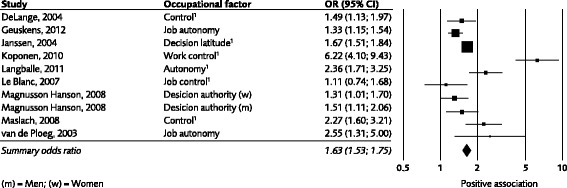
- Moderate scientific evidence (grade 3) supported a relationship between low job control and increased emotional exhaustion: 9 studies, weighted OR 1.63 (95% CI 1.53 to 1.75).
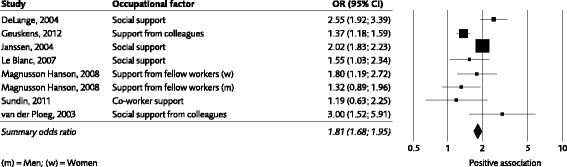
- Moderate evidence also supported low workplace support and emotional exhaustion: 7 studies, weighted OR 1.81 (95% CI 1.68 to 1.95).
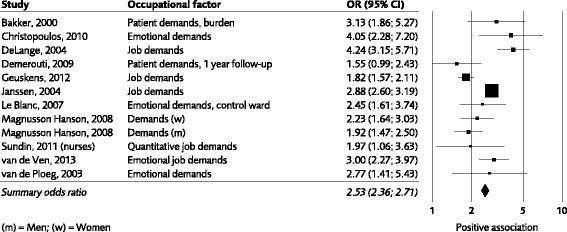
- Several other associations were supported by limited evidence (grade 2), including unspecified psychological demands and emotional exhaustion: 11 studies, weighted OR 2.53 (95% CI 2.36 to 2.71); high work load and emotional exhaustion: 5 studies, weighted OR 4.22 (95% CI 3.50 to 5.11); low reward and emotional exhaustion: weighted OR 1.86 (1.37 to 2.52); job insecurity and emotional exhaustion: weighted OR 1.39 (1.22 to 1.57).
- Reduced personal accomplishment was only associated with low reward, and there were few prospective studies of sufficient quality on chemical, biological, or physical exposures and burnout.
Methods
- Systematic review with meta-analyses, using the GRADE system to rate evidence; the authors state they followed PRISMA “as far as possible.”
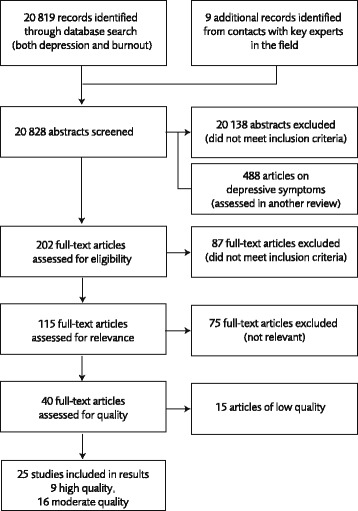
- Search covered 1990 to August 2013 in PubMed, Embase, Psychinfo, Arbline, Cochrane Library, and NIOSHTIC-2; 20,819 abstracts were identified, 115 full-text articles met inclusion criteria, and 25 articles were retained as high or medium quality.
- Included studies had to be from Europe, North America, Australia, or New Zealand; be prospective or comparable case-control designs; have baseline exposure and follow-up outcome assessment 1–5 years later; and include at least 100 exposed persons with control for at least age and gender.
- For meta-analysis, the authors used weighted odds ratios when possible, fixed-effects models, and the least adjusted model from each study for forest plots.
Limitations
- The paper states that few prospective studies of sufficient quality were available for some exposures, especially adverse chemical, biological, and physical factors; some associations were based on only one or two studies.
- The authors note that all 25 included studies relied on self-reported exposure and burnout, which may inflate associations; they say more objective measures would be beneficial.
- Evident from the text: the review could not conduct full homogeneity analyses for all outcomes because studies used many different statistical measures, and it could not do separate analyses by sex because gender-specific results were rarely reported.
Model-written summary. Check it against the paper before relying on it.
Integrity signals
Registry
Cites
Statistics
Figures
Verification
Claims the paper makes
0 Valid · 0 Not valid · 43 Not checked · 66 Own results and interpretations
A result the paper reports from its own data — it cites no other source for it, so there is none to check. The quote shows it is in the paper.
In the paper
“Reduced personal accomplishment was only associated with low reward.”
§ A systematic review including meta-analysis of work environment and burnout symptoms > Abstract > Results
plainstates an association- Asserted: passes — The authors put it forward as true.
- Checkable: passes — It can be checked against evidence.
- Load-bearing: passes — The paper’s conclusions depend on it.
- Based: passes — The paper gives a reason why it holds.
A result the paper reports from its own data — it cites no other source for it, so there is none to check. The quote shows it is in the paper.
In the paper
“Limited evidence (grade 2) was found for the associations between workplace justice, demands, high work load, low reward, low supervisor support, low co-worker support, job insecurity and change in emotional exhaustion.”
§ A systematic review including meta-analysis of work environment and burnout symptoms > Abstract > Results
plainstates an association- Asserted: passes — The authors put it forward as true.
- Checkable: passes — It can be checked against evidence.
- Load-bearing: passes — The paper’s conclusions depend on it.
- Based: passes — The paper gives a reason why it holds.
A result the paper states — it cites no source for it, so there is none to check. The quote shows it is in the paper.
In the paper
“There were few prospective studies with sufficient quality on adverse chemical, biological and physical factors and burnout.”
§ A systematic review including meta-analysis of work environment and burnout symptoms > Abstract > Results
plain- Asserted: passes — The authors put it forward as true.
- Checkable: passes — It can be checked against evidence.
- Load-bearing: unclear — It is unclear whether the paper’s conclusions depend on it.
- Based: passes — The paper gives a reason why it holds.
A result the paper reports from its own data — it cites no other source for it, so there is none to check. The quote shows it is in the paper.
In the paper
“Limited evidence (grade 2) was found for the associations between workplace justice, demands, high work load, low reward, low supervisor support, low co-worker support, job insecurity and change in emotional exhaustion.”
§ A systematic review including meta-analysis of work environment and burnout symptoms > Abstract > Results
plainstates an association- Asserted: passes — The authors put it forward as true.
- Checkable: passes — It can be checked against evidence.
- Load-bearing: passes — The paper’s conclusions depend on it.
- Based: passes — The paper gives a reason why it holds.
50 more claims
Create a free account to see all 109 claims and to verify the 77 references still open.
- It may state two separate claims as one. 41
- The quote only partly states this claim. 6
- Probably not a substantial claim. 21
Claims other papers make about this one
Each is checked against this paper’s own text: does it say what the citing paper says it does?
The source backs part of the claim, not all of it — or backs it for a different population, condition or comparison.
In the citing paper
“Unlike EE or DP, PA is more strongly influenced by structural and environmental factors, including work autonomy, recognition, opportunities for professional development, and organizational culture [60,61].”
From Effects of Third-Wave Cognitive Behavioral Therapy for Healthcare Professionals’ Burnout: A Systematic Review and Meta-Analysis (2025) · cites this paper as [61]
Experimental — accuracy not yet measured
Self-check
Percentages, sums and reported differences re-computed from the paper’s own numbers.
Rated major: it would touch a result — a value a result rests on, reported and recomputed p-values on opposite sides of the significance level, two passages that conflict with no sign which is right, or a cited work retracted before this paper was published.
In the paper
“If a work environment factor has a 30% prevalence and is associated with a relative risk of 1.6, the resulting population attributable risk is 7%, i.e. the proportion of disease in the exposed group that could be prevented by eliminating the risk factor.”
§ A systematic review including meta-analysis of work environment and burnout symptoms > Conclusions
Reported 0.07 · recomputed 0.1875
Citations
Cites
Preferred Reporting Items for Systematic Reviews and Meta-Analyses: the PRISMA statement
Moher, D., Liberati, A., Tetzlaff, J., Altman, D. G., & for the PRISMA Group (2009) · BMJ · doi:10.1136/bmj.b2535 · Cited by 83,823
Preferred reporting items for systematic reviews and meta-analyses: the PRISMA Statement.
(2009) · PubMed Central · Cited by 44,859
Preferred reporting items for systematic reviews and meta-analyses: The PRISMA statement
Moher, D., Liberati, A., Tetzlaff, J., Altman, D. G., & the PRISMA Group* (2009) · Annals of Internal Medicine · doi:10.7326/0003-4819-151-4-200908180-00135 · Cited by 37,554
Dermyshi, E., Wang, Y., Yan, C., Hong, W., Qiu, G., Gong, X., & Zhang, T. (2017) · Neonatology · doi:10.1159/000454668 · Cited by 24,451
The measurement of experienced burnout
Maslach, C., & Jackson, S. E. (1981) · Journal of Organizational Behavior · doi:10.1002/job.4030020205 · Cited by 14,496 · cited 7×
“Homogeneity test could not be conducted on burnout screening instruments, since very few studies used any other instrument than the MBI [4].”
MethodInfluentialMaslach, C., Schaufeli, W. B., & Leiter, M. P. (2001) · Annual Review of Psychology · doi:10.1146/annurev.psych.52.1.397 · Cited by 12,852 · cited 2×
“In 18 of the 25 studies, MBI, MBI-General Survey [4, 5] or the Dutch adaption of MBI, the Utrecht Burnout Questionnaire [24] were used.”
BackgroundMethodGRADE guidelines: 1. Introduction—GRADE evidence profiles and summary of findings tables
Guyatt, G., Oxman, A. D., Akl, E. A., Kunz, R., Vist, G., Brozek, J., Norris, S., Falck-Ytter, Y., Glasziou, P., & deBeer, H. (2011) · Journal of Clinical Epidemiology · doi:10.1016/j.jclinepi.2010.04.026 · Cited by 10,681 · cited 2×
“To our knowledge, the current meta-analytic study and review is the first that has been carried out according to the GRADE system [17].”
MethodThe measurement of engagement and burnout: a two sample confirmatory factor analytic approach.
Schaufeli, W. B., Salanova, M., González-romá, V., & Bakker, A. B. (2002) · Journal of Happiness Studies · doi:10.1023/a:1015630930326 · Cited by 10,014 · cited 1×
“In 18 of the 25 studies, MBI, MBI-General Survey [4, 5] or the Dutch adaption of MBI, the Utrecht Burnout Questionnaire [24] were used.”
MethodHealthy work: stress, productivity, and the reconstruction of working life
(1990) · Choice Reviews Online · doi:10.5860/choice.28-0381 · Cited by 8,220 · cited 2×
“Job control and workplace support comprise, together with job demands, the demand – controlsupport model [29, 30].”
BackgroundFreudenberger, H. J. (1974) · Journal of Social Issues · doi:10.1111/j.1540-4560.1974.tb00706.x · Cited by 5,463 · cited 3×
“Herbert Freudenberger [1], a clinical psychologist working in an alternative health care agency, and in 1976 by Christina Maslach [2], a social psychologist studying workplace emotions.”
BackgroundInfluential
Research works printed but not linked: 3
- Maslach C Burnout Hum Behav 1976 5 9 16 22
- Kant IJ Jansen NWH Van Amelsvoort LGPM Mohren DCL Swaen GMH Burnout in de werkende bevolking. Resultaten van de Maastrichtse Cohort Studie. [Burnout in the working population. Results of the Maastricht Cohort Study] Gedrag & Organisatie 2004 17 5 17
- Karasek RA Job content questionnaire and user’s guide 1985 Lowell University of Massachusetts
Cited by
Items 601–700 of 789
Garza, T., Reio, T. G., Perdomo, S. J. S., Alboroto, R., & McNaughtan, J. L. (2025) · Human Resource Development International · doi:10.1080/13678868.2025.2542895 · Cited by 1
“Burnout has emerged as a global phenomenon, affecting workers across diverse professions and cultures (Aronsson et al., 2017).”
InfluentialSalute psicologica e lavoro: fattori di rischio occupazionale e organizzativo
Fraccaroli, F., & Depolo, M. (2017) · GIORNALE DI DIRITTO DEL LAVORO E DI RELAZIONI INDUSTRIALI · doi:10.3280/gdl2017-156001 · Cited by 1
Jacobowitz, W. (2018) · Public Health - Open Journal · doi:10.17140/phoj-3-126 · Cited by 2
A influência da aversão à perda na decisão de se sobrecarregar no trabalho
Modesto, J. G., Rodrigues, T. S. L., & Queiroga, F. (2020) · Estudos Interdisciplinares em Psicologia · doi:10.5433/2236-6407.2020v11n2p166 · Cited by 5
HEALTH OF THE TEACHER OF HIGHER EDUCATION INSTITUTIONS (EFFICIENCY – DEVELOPMENT)
Дубовик, О. М., & Dubovyk, V. Y. (2021) · Wiadomości Lekarskie · doi:10.36740/wlek202103239 · Cited by 1
“In professions, which are connected with the system of relations “man-man”, the orientation to the other human, as equal participant of interaction, has great importance [2,14].”
Burn-out – eine extreme Stressfolge
Seibold, S. (2022) · Springer eBooks · doi:10.1007/978-3-662-64190-3_4 · Cited by 1
Jończyk, J. (2022) · Nowoczesne Systemy Zarządzania · doi:10.37055/nsz/150305 · Cited by 2
“the complex environment of the middle East: a systematic review, BMC Public Health, nr 19(1).”
Backgroundde Boer, C., Vayre, É., & Delobbe, N. (2022) · Leykam Buchverlag eBooks · doi:10.56560/isbn.978-3-7011-0496-3_4 · Cited by 3
Balachandar, R., Ketharam, A., & Bharath, S. (2021) · doi:10.31234/osf.io/tdzp3 · Cited by 1
Dresden, T. U., Gilbert, K., Pietrzyk, U., Dresden, T. U., Steputat-Rätze, A., & Dresden, T. U. (2021) · doi:10.25368/2021.96 · Cited by 1
“Der Zusammenhang zwischen den Arbeitsbedingungen und psychischen sowie physischen Fehlbeanspruchungsfolgen ist nicht nur generell beschreibbar (z. B. Rau & Buyken, 2015), sondern auch und insbesondere für Interaktionsarbeit (z. B. Aronsson et al., 2017; O’Connor, Muller Neff & Pitman, 2018).”
BackgroundBoadu, A., Nlooto, M., & Karpoormath, R. V. (2022) · doi:10.22541/au.166068546.68447309/v1 · Cited by 1
Appelbom, S., Nordström, A., Finnes, A., Wicksell, R. K., & Bujacz, A. (2023) · doi:10.31234/osf.io/vzt6g · Cited by 1
AI Chatbots for Psychological Health for Health Professionals: A Scoping Review (Preprint)Preprint
Han, J.-H., Baek, G., & Cha, C. (2024) · doi:10.2196/preprints.67682 · Cited by 1
Physician burnout and violence at the workplace
Dhaliwal, U. (2018) · Research and humanities in medical education
Áherslur stjórnenda árangursríkra fyrirtækja og hugmyndafræði þjónandi forystu
Hjálmarsdóttir, S., & Gunnarsdóttir, S. (2018) · Tímarit um viðskipti og efnahagsmál · doi:10.24122/tve.a.2018.15.2.7 · Cited by 15
Golparvar, M., & Safari, S. (2018) · Biannual Journal of Contemporary Psychology · doi:10.32598/bjcp.13.1.2
Teacher Burnout: A Comparison Between Title I and Non-Title I Elementary School Teachers
Russell, S. A. (2019) · Digital Commons (Liberty University)
Sproson, L. (2018) · e-space (Manchester Metropolitan University)
Pre-nosological monitoring of the health statuses of female obstetrician-gynecologists
Lisok, A., Наумов, И. А., Pavliukovets, A., Makarov, S., & Svistunovich, L. (2019) · Health Problems of Civilization · doi:10.5114/hpc.2019.88302
“These allow assessment of the body’s functional state in a constantly changing environment [5, 6].”
BackgroundÞróun starfsumhverfis á Landspítala: Kulnun í starfi, starfsánægja og gæði þjónustu
Knútsdóttir, J. K., Gunnarsdóttir, S., & Kristinsson, K. (2019) · Tímarit um viðskipti og efnahagsmál · doi:10.24122/tve.a.2019.16.2.3 · Cited by 12
Measuring psychological and physiological stress in emergency clinicians
Merrick, E. T., Grant, J. B., McKune, A. J., D'Cunha, N. M., Murphy, E., Naumovski, N., & Fry, M. (2020) · Australasian Emergency Care · doi:10.1016/j.auec.2020.05.001
Cunha, I. M., Vieira, I. S., Fernandez, M. D. S., & Szortyka, A. L. S. C. (2020) · Interfaces Científicas - Saúde e Ambiente · doi:10.17564/2316-3798.2020v8n2p499-514 · Cited by 5
Besta umbunin er að sjá eitthvað lifna: Upplifun sérfræðinga í ráðuneytum af ánægju í starfi
Gunnarsdóttir, S., & Kristjánsdóttir, E. S. (2020) · Tímarit um viðskipti og efnahagsmál · doi:10.24122/tve.a.2020.17.1.1 · Cited by 1
Madaki, U. Y., Daya, A. A., & Aji, A. (2020) · Scholars Journal of Physics Mathematics and Statistics · doi:10.36347/sjpms.2020.v07i11.002
“However their study has been criticized by Theorell [10], for its inability to consider the fact that everybody respond differently to stressful situations.”
BackgroundPsychosocial factors and burnout syndrome among mental health professionals
Moreira, A. S. (2019) · LA Referencia (Red Federada de Repositorios Institucionales de Publicaciones Científicas)
Drug Use and Suicidal Behavior at Work
Barbi, K. B. S., Messias, J. C. C., & Guimarães, L. A. M. (2021) · Springer eBooks · doi:10.1007/978-3-030-62855-0_37
Emotional intelligence:a new way to assess it and its importance to understand work outcomes
Gómez, M. S. (2021) · Tesis Doctorals en Xarxa (Consorci de Serveis Universitaris de Catalunya) · doi:10.6035/14109.2021.423380
Risk perception, burnout, and knowledge of chemotherapy nurses during the COVID-19 pandemic
Koral, L. (2021) · Family practice and palliative care · doi:10.22391/fppc.818225
Ede, L., & Rantakeisu, U. (2021) · Nordic Journal of Social Research · doi:10.7577/njsr.4051
“Hence, the intention of the current study is not to explain the causes behind stress-related mental health problems, which other studies have done (Aronsson et al., 2017; Sverke et al., 2016; Bryngelsson, 2013), but to”
BackgroundMillán-Gómez, A. P., Ribeiro-González, M. L., Alcalá-Santiago, M. F., Barranco-Cantero, A., Colmenero-Expósito, I., & Talavera-Martínez, A. (2020) · Medicina y Seguridad del Trabajo · doi:10.4321/s0465-546x2020000400003
“Se ha identificado una correlación entre una salud emocional inadecuada y la insatisfacción laboral; ésta podría comportarse como el primer indicador identificable de agotamiento (3,4,5) .”
BackgroundReorganizing and Downsizing: How Employees’ Health Is Affected According to Epidemiological Research
Theorell, T. (2021) · Handbook series in occupational health sciences · doi:10.1007/978-3-030-24936-6_7-1
Self-citationArslan, İ. B., Lucassen, N., de Haan, A. D., Jongerling, J., Bakker, A. B., & Prinzie, P. (2021) · doi:10.31219/osf.io/c2nv4
ASPECTOS CLÍNICOS DO CÂNCER DE TESTÍCULO
de Sousa, G. L. S., Rodrigues, K. P., Aguiar, C. S., Costa, K. B., Garcia, M. R. S., Ramos, A. S. M. B., Marques, C. P. C., Costa, S. D. S., & Pessoa, D. L. R. (2022) · doi:10.22533/at.ed.8682225055
ARANHAS DE INTERESSE EM SAÚDE NO ESTADO DO CEARÁ
Azevedo, R., Ramalho, R. D., Lira, A. F. D. A., & de Azevedo, F. R. (2022) · doi:10.22533/at.ed.8682225054
EFECTOS DE LA POSICIÓN PRONO EN PACIENTES CON SÍNDROME DE DISTRES RESPIRATORIO AGUDO POR LA COVID-19
J., M. S. R., & Lauretta Juan, F. (2022) · doi:10.22533/at.ed.86822250510
EFICÁCIA DE UM PROGRAMA SOBRE MANEJO DA LACTAÇÃO COM PUÉRPERAS DE UM HOSPITAL PÚBLICO DE SALVADOR
Sacramento, L. S. C., Oliveira, L. D. S., Souza, K. F., & Rosa, D. M. (2022) · doi:10.22533/at.ed.86822250512
AVALIAÇÃO DO PACIENTE COM AVC FEITA POR EQUIPE MULTIPROFISSIONAL
Borges, M. E. F., Ramos, L. C. M. D., Duarte, A. P., Ramos, M. M., da Silva, S. A., Jaroszewski, C. A. D. S., de Souza, N. M., & silva, E. G. (2022) · doi:10.22533/at.ed.8682225056
ESCORPIÕES DE INTERESSE EM SAÚDE NO ESTADO DO CEARÁ
Ramalho, R. D., Azevedo, R., Lira, A. F. D. A., & de Azevedo, F. R. (2022) · doi:10.22533/at.ed.86822250513
CLIMA LABORAL PREDICTOR DEL SÍNDROME DE BURNOUT EN PROFESORES UNIVERSITARIOS
Méndez, R. M. Y., Ramirez-Asís, E., & Figueroa, M. G. (2022) · doi:10.22533/at.ed.8682225058
Vatam, C. D. M., & Einloft, L. (2022) · doi:10.22533/at.ed.86822250511
SÍNDROME DE BURNOUT: INDICADORES PARA UM DIAGNÓSTICO ADEQUADO
Napoleão, L. D., PEREIRA, G. D. C., MACEDO, A. J. B., Pagliarini, B. C. D., Barros, V. S. M. E., Neta, I. G. C. S., Pires, A. R. U., Neto, S. L. F., Azevedo, M. L. D. S., dos Reis, M. A. O. D. M., et al. (2022) · Editora Pasteur eBooks · doi:10.29327/562655.4-34
Callado, A. M. A. P., & Lucas, P. R. M. B. (2022) · Editora Artemis eBooks · doi:10.37572/edart_2808226061
Shofi, M., & Erwandi, D. (2022) · PREPOTIF Jurnal Kesehatan Masyarakat · doi:10.31004/prepotif.v6i1.3300
Soares, J. P., Lopes, R. H., Mendonça, P. B. D. S., Silva, C. R. D. V., Rodrigues, C. C. F. M., & de Castro, J. L. (2022) · doi:10.2196/preprints.42338
BURNOUT SYNDROME AMONG MEDICAL PROFESSIONALS: LITERATURE REVIEW
Ж.М., Ж., А.С., К., Серикбаев, А. С., Rakhmatullina, N., Aitmurzinova, G., & Seitkabylov, A. (2022) · Oncologia i radiologia Kazakhstana · doi:10.52532/2521-6414-2022-2-64-59-65 · Cited by 1
Self-Care: Without You There Is No PhD
Ayres, Z. J. (2022) · Springer eBooks · doi:10.1007/978-3-031-14194-2_4
Queirós, C. M. L., Oliveira, S., Fonseca, S. M., Faria, S., & Cunha, S. (2022) · Territorium · doi:10.14195/1647-7723_29-2_4
Factors Related to Burnout in The Covid-19 Vaccination Team in Subang District 2020-2022
Maulana, M. A., Isbayuputra, M., Parahyanti, E., Soemarko, D. S., & Ratnasari, Y. (2022) · The Indonesian Journal of Community and Occupational Medicine · doi:10.53773/ijcom.v2i2.59.75-82
Fernández-Arata, M., la Cruz, G. C.-D., & Domínguez-Lara, S. (2022) · Psihologijske teme · doi:10.31820/pt.31.3.6 · Cited by 6
Vasiliu, O. (2022) · Romanian Journal of Military Medicine · doi:10.55453/rjmm.2022.125.3.25
Küçükkelepçe, G. E., Şeker, S. A., & Karaca, T. (2022) · Mediterranean Nursing and Midwifery · doi:10.5152/mnm.2022.2233118 · Cited by 1
Daryanto, B., Putri, F. R., Kurniawan, J., Ilmawan, M., & Fajar, J. K. (2022) · Jurnal Klinik dan Riset Kesehatan · doi:10.11594/jk-risk.02.1.2
Shelton, C. D., & Hon, S. (2023) · IntechOpen eBooks · doi:10.5772/intechopen.107500
OS PAPÉIS DO REDESENHO DO TRABALHO E DA SEGURANÇA PSICOLÓGICA NA PREVENÇÃO DE SINTOMAS DO BURNOUT
BANDEIRA, E. (2023) · doi:10.17771/pucrio.acad.62221 · Cited by 1
Balachandar, R., Ketharam, A., & Bharath, S. (2023) · doi:10.31234/osf.io/hsm4x
เด่นจารุกูล, ด., & ภิรมย์สมบัติ, ช. (2021) · Chula Digiverse · doi:10.58837/chula.the.2021.878 · Cited by 1
Yoon, S., Goh, H., Low, X. C., Weng, J. H., & Heaukulani, C. (2023) · SSRN Electronic Journal · doi:10.2139/ssrn.4579836
Zhou, S., Li, M., Chen, S.-R., Jiang, D., & Qu, Y. (2023) · Research Square · doi:10.21203/rs.3.rs-3436081/v1
Satisfacción laboral y burnout en profesionales de la salud durante la pandemia por la COVID-19
Reyes, P. N. T., & Reluz, C. G. C. (2023) · Revista Ecuatoriana de Psicología · doi:10.33996/repsi.v6i16.104
Social Apathy and Emotional Burnout Syndrome as the Measurement of Phenomenon of Anomie
Hakobyan, N. R., Hovhannisyan, K., & Khachatryan, A. (2023) · Proceedings of The World Conference on Social Sciences · doi:10.33422/6th.worldcss.2023.08.100
Workload and the mysterious law of karma
Bentin, J. M., & Jonsdottir, F. R. (2023) · BMJ · doi:10.1136/bmj.p2686
Social Apathy and Emotional Burnout Syndrome as the Measurement of Phenomenon of Anomie
Khachatryan, A., Hovhannisyan, K., & Hakobyan, N. R. (2023) · Proceedings of The World Conference on Social Sciences · doi:10.33422/worldcss.v2i1.96
Balachandar, R., Ketharam, A., & Bharath, S. (2023) · Journal of Psychiatry Spectrum · doi:10.4103/jopsys.jopsys_22_23
Ribeiro, C. H., Gonçalves, J. F. G., Carpinetti, C. L., Freitas, C. M. A. D., Caldas, J. M. L., Pereira, H. V., FILHO, F. C. G., & de Souza, S. C. (2023) · Brazilian Journal of Health Review · doi:10.34119/bjhrv6n6-423 · Cited by 1
Op naar een gezonde en veilige ggz: meer werkgeluk, minder verzuim
Parnassia Groep, H., Adrichem, P., Bijkerk, J., & Parnassia Groep, A. (2024) · GGZ Vaktijdschrift · doi:10.31739/ggzv.2024.1.2
Vallejo, S. A. A., González, G. J., Ramírez, I. A. U., Hernández, C. J. C., & Jaramillo‐Morales, O. A. (2024) · Ciencia Latina Revista Científica Multidisciplinar · doi:10.37811/cl_rcm.v8i1.9698
Ballarotti, B. (2023) · Digital Library of Theses and Dissertations (Universidade de São Paulo) · doi:10.11606/t.5.2023.tde-22022024-143636
Factores de riesgos psicosociales intralaborales y estrés laboral en profesionales de la salud
Pachacama-Ríos, D. C., Peralta-Beltrán, Á. R., Rodríguez, R. C., & Matheu-González, C. (2023) · Revista Arbitrada Interdisciplinaria de Ciencias de la Salud Salud y Vida · doi:10.35381/s.v.v7i2.3484 · Cited by 13
Föräldrars tredje skift och utmattningssyndrom: En explorativ studie
Hibbs, J. (2024) · Arbetsmarknad & Arbetsliv · doi:10.58236/aa.24747 · Cited by 3
“Forskning kring orsaker till utmattningssyndrom har huvudsakligen fokuserat på arbetsrelaterade faktorer (Aronsson et al., 2017; Deligkaris et al., 2014; Håkans-son et al., 2021; Page & Graves, 2021).”
BackgroundRiduan, M., Helmi, S., Gunarto, M., & Trisninawati, T. (2024) · International Journal of Finance Research · doi:10.47747/ijfr.v5i2.1743
Exploration of the Association between Technostress and Burnout among Healthcare Professionals
Babiker, M., Merisalu, E., & Roja, Ž. (2024) · International Journal of Social Relevance & Concern · doi:10.26821/ijsrc.12.3.2024.120306 · Cited by 3
Assesment of Occupational Anxiety of Emergency Aid and Disaster Management Students
Çalışkan, C., & Kınık, K. (2024) · Paramedik ve Acil Sağlık Hizmetleri Dergisi · doi:10.54862/pashid.1395951
FATORES ASSOCIADOS AO PRESENTEÍSMO EM TRABALHADORES NO TERRITÓRIO BRASILEIRO: REVISÃO INTEGRATIVA
de Araújo, L. B., da Silva, L. A., Bueno, A. D. A., Batista, M. H. D. J., Maia, L. G., & Silva, H. D. O. (2024) · Revista Contemporânea · doi:10.56083/rcv4n7-017 · Cited by 3
Genrich, M., Angerer, P., Gündel, H., Küllenberg, J. K., Maatouk, I., Puschner, B., & Müller, A. K. (2024) · Gruppe Interaktion Organisation Zeitschrift für Angewandte Organisationspsychologie (GIO) · doi:10.1007/s11612-024-00765-1
“Em-pirische Studien zeigen auf, dass solche psychosozialen Arbeitsbelastungen Arbeitsstress von Beschäftigten verur-sachen, und langfristig psychische Störungen und Burnout Erkrankungen hervorrufen können (Aronsson et al. 2017; Beschoner 2019).”
Björk, L., Hultquist, J., Hensing, G. K. E., & Bertilsson, M. (2024) · medRxiv · doi:10.1101/2024.09.06.24313226
Unpleasant emotions and life satisfaction - a study of burnout among nurses
Dušević, D., Komosar-Cvetković, M., & Kužet-Mioković, I. (2024) · Cardiologia Croatica · doi:10.15836/ccar2024.650
Scheerbaum, P., Scheerbaum, M., & Schöffski, O. (2024) · Angewandte Nuklearmedizin · doi:10.1055/a-2359-7769
ABNOTIVISM OF A TEACHER IN THE FORMATION OF CREATIVE THINKING OF STUDENTS
Akhmetova, G. M., & Dzhumabayeva, A. (2024) · doi:10.34660/inf.2022.71.99.018
Мустяцэ, К., Семеновна, Ч. Н., Дмитриевич, Р. А., & Zanfirova, M. A. (2024) · doi:10.34660/inf.2022.91.15.029
VISCOELASTIC BUFFER FLUIDS FOR WELL CASING ENHANCEMENT
Агзамов, Ф. А., & Евгеньевна, Л. М. (2024) · doi:10.34660/inf.2022.42.26.030
MORPHOLOGICAL AND FUNCTIONAL PARAMETERS AND SPECIES COMPOSITION OF CYPRINUS CARPIO MICROBIOCENOSES
Subbotina, Y. M., & Lenchenko, S. (2024) · International Conference Process Management and Scientific Developments · doi:10.34660/inf.2021.16.22.013
DIDACTIC WORKING CONDITIONS FOR FILLING GAPS IN STUDENTS' KNOWLEDGE
Sailybaev, A. A., Zhumagulova, Z. A., & Karipova, A. T. (2024) · International Conference Process Management and Scientific Developments · doi:10.34660/inf.2021.58.28.007
ECONOMIC AND GEOGRAPHICAL POTENTIAL OF CENTRAL ASIA AND THE PLACE IN IT OF WATER RESOURCES
Mavloni, M. S. (2024) · International Conference Process Management and Scientific Developments · doi:10.34660/inf.2021.42.20.004
Bezrukova, G. A., Novikova, T. A., & Александровна, К. Н. (2024) · Hygiene and Sanitation · doi:10.47470/0016-9900-2024-103-11-1278-1285
Driven by purpose, weary in pursuit: Exploring competitive employment for autistic adults
Erdal, K., Gelléri, P., & Billstedt, E. (2024) · Journal of Vocational Rehabilitation · doi:10.1177/10522263241285205 · Cited by 1
“Chronic exposure to stressors, coupled with limited resources, increases the likelihood of burnout (Aronsson et al., 2017; Demerouti et al., 2001).”
Research Progress of Occupational Exposure and Protection in Medical Institutions
肖, 杉. (2025) · Advances in Clinical Medicine · doi:10.12677/acm.2025.151141
Opinto-ohjaajien työhyvinvointiprofiilit ja niiden yhteys työn vaatimuksiin ja voimavaroihin
Rantanen, J., Mäkikangas, A., Puukari, S., & Silvonen, J. (2025) · Psykologia · doi:10.62443/psykologia.v55i2-3.89062 · Cited by 14
Almén, N., Ekström, S., Grytzelius, O., & Jansson, B. (2025) · Nordic Psychology · doi:10.1080/19012276.2025.2472633 · Cited by 1
“Although stress behavior is primarily adaptive, high levels of stress are associated with a wide range of negative outcomes, such as mental disorders and burnout (e.g. Aronsson et al., 2017; Hintsa et al., 2016; van der Molen et al., 2020).”
Nilsen, K. H., Lauritzen, C., Vis, S. A., Iversen, A., & Handegård, B. H. (2025) · Human Services Organizations Management Leadership & Governance · doi:10.1080/23303131.2025.2479487
“Interventions targeting organizational and administrative aspects have been more effective in reducing turnover compared to those focusing on individual employee factors (Aronsson et al., 2017; de Guzman et al., 2020; DePanfilis & Zlotnik, 2008; Webb & Carpenter, 2012).”
Schonfeld, I. S., & Ph.D., R. B. (2025) · Wiley eBooks · doi:10.1002/9781394249626.ch02
Heylen, J., Szekér, L., & Lenaerts, K. (2025) · Human well-being research and policy making · doi:10.1007/978-3-031-87616-5_3
Ferrer, J. M., & Delariarte, C. F. (2025) · Psychology and Education A Multidisciplinary Journal · doi:10.70838/pemj.400707
Relationship between burnout, job satisfaction and psychological wellbeing in Spanish Civil Guard
García-Guirao, N. M., Izquierdo, M. G., Giner-Alegría, C. A., & García, J. M. D. H. (2025) · Police Practice and Research · doi:10.1080/15614263.2025.2521503 · Cited by 3
“…burnout is associated with indicators of diminished wellbeing, such as psychosomatic complaints, anxious and depressive symptoms, and absenteeism (Aronsson et al., 2017; Deligkaris et al., 2014; Jackman et al., 2020; Kula, 2017; Luceño-Moreno et al., 2021; McCarty et al., 2019; Queirós et al.,…”
Żenda, A., Kożusznik, B., Paliga, M., & Blukacz, M. (2025) · Przegląd Psychologiczny · doi:10.31648/przegldpsychologiczny.11561
Wasungu, D. B., N’djao, A., Kinde, R., Sanwogou, L. G., Adom, A., Akolly, K., Douti, Y., & Hilim, P. M. (2025) · Journal of Interventional Epidemiology and Public Health · doi:10.37432/jieph-d-25-00012
Ailing, S., Zainol, Z., & Xuehui, H. (2025) · ANP Journal Of Social Sciences And Humanities · doi:10.53797/anp.jssh.v6i2.2.2025
Beno, A., Jónsdóttir, I. H., & Lindegård, A. (2025) · Journal of Occupational Rehabilitation · doi:10.1007/s10926-025-10311-5
“However, previous research has identified poor working conditions as a major risk of being diagnosed with stress-related disorders [7–9].”
Metadata
- Authors
- Aronsson, G., Theorell, T., Grape, T., Hammarström, A., Hogstedt, C., Marteinsdottir, I., Skoog, I., Träskman-Bendz, L., & Hall, C.
- Affiliations
- Stockholm University (SE)
- Umeå University (SE)
- Karolinska Institutet (SE)
- University of Gothenburg (SE)
- SBU - Swedish Agency for Health Technology Assessment and Assessment of Social Services (SE)
- Corresponding author
- Aronsson, Gunnar
- Venue
- BMC Public Health
- Published
- 2017-03-16
- Volume
- 17
- Issue
- 1
- Pages
- 264-264
- ISSN
- 1471-2458 (ISSN-L)
- PMC
- PMC5356239
- OpenAlex
- W2595367318
- Cited by
- 789
- References
- 38
- Citations by year
- 2026: 66 · 2025: 95 · 2024: 101 · 2023: 99 · 2022: 130 · 2021: 129 · 2020: 74 · 2019: 48 · 2018: 41 · 2017: 6
- FWCI
- 7.13
- Type
- journal article
- Language
- en
- Open access
- gold
- doi.org
- Licence
- cc-by
- Locations
- BMC Public Health (publishedVersion, cc-by)
- PubMed Central (publishedVersion, cc-by)
- PubMed (publishedVersion)
- DiVA (Linkoping University) (submittedVersion, other-oa)
- KTH Publication Database DiVA (KTH Royal Institute of Technology) (submittedVersion, other-oa)
- DOAJ (DOAJ: Directory of Open Access Journals) (submittedVersion, cc-by-sa)
- Lund University Publications (Lund University) (submittedVersion)
- Funders
- The Swedish Council of Health Technology Assessment
- Topics
- Social Sciences › Psychology › Social Psychology › Stress and Burnout Research
- Health Sciences › Medicine › Public Health, Environmental and Occupational Health › Occupational Health and Burnout
- Health Sciences › Health Professions › General Health Professions › Healthcare professionals’ stress and burnout
- Keywords
- burnout, emotional exhaustion, cynicism, personal accomplishment, job control, workplace support, workplace justice, job demands, workload, job insecurity, supervisor support, coworker support, occupational exposure, work environment, organizational interventions
- MeSH terms
- Achievement, Adult, Australia, Burnout, Professional, Europe, Mental Fatigue, Female, Humans, Male, New Zealand, North America, Prospective Studies, Surveys and Questionnaires, Reward, Social Justice, Organizational Culture, Case-Control Studies, Occupational Exposure, Workload, Workplace
About these checks
Registry, retraction, Cites and statistics results are computed, not judged, with one exception: a printed reference that no index lists is read once by a model before it counts as a citation error. Claims are extracted by a model and kept only when their quote appears verbatim in the text; each cited source is then checked, with a model’s help, for whether it says what the claim relies on. Those verdicts can be wrong — read the claim’s quote and the cited source before relying on one.
A language model drew the claims from the paper on 2026-10-11, under version 3 of the claim definition (model deepseek-v4.1-flash, prompt extract-v3).
A second model labelled each claim on 2026-10-11 (model jev-1.13-20260917, definition revision gold-guideline-v0.2).
Statistics and arithmetic are recomputed, not judged.
Confidence bands are shown only for fields calibrated on our annotated test set. None is calibrated yet, so no band is shown.
What counts as a claim ›How we measure confidence ›How we check this ›
Are you an author, or do you see a problem with this page? Request a review
Data sources
Bibliographic data: Semantic Scholar, OpenAlex, Crossref.
Contains information from the Semantic Scholar Academic Graph Datasets, made available under the ODC Attribution License (ODC-BY 1.0).
Semantic Scholar’s data is described in: Kinney, R., et al. (2023). The Semantic Scholar Open Data Platform. arXiv:2301.10140.
