

A systematic review including meta-analysis of work environment and burnout symptoms
Open accessThe DOI matches its Crossref record; 37 of the 38 references it cites were found in a registry or an index; none of the 77 sources its claims cite is checked for support yet.
Abstract
BACKGROUND: Practitioners and decision makers in the medical and insurance systems need knowledge on the relationship between work exposures and burnout. Many burnout studies - original as well as reviews - restricted their analyses to emotional exhaustion or did not report results on cynicism, personal accomplishment or global burnout. To meet this need we carried out this review and meta-analyses with the aim to provide systematically graded evidence for associations between working conditions and near-future development of burnout symptoms. METHODS: A wide range of work exposure factors was screened. Inclusion criteria were: 1) Study performed in Europe, North America, Australia and New Zealand 1990-2013. 2) Prospective or comparable case control design. 3) Assessments of exposure (work) and outcome at baseline and at least once again during follow up 1-5 years later. Twenty-five articles met the predefined relevance and quality criteria. The GRADE-system with its 4-grade evidence scale was used. RESULTS: Most of the 25 studies focused emotional exhaustion, fewer cynicism and still fewer personal accomplishment. Moderately strong evidence (grade 3) was concluded for the association between job control and reduced emotional exhaustion and between low workplace support and increased emotional exhaustion. Limited evidence (grade 2) was found for the associations between workplace justice, demands, high work load, low reward, low supervisor support, low co-worker support, job insecurity and change in emotional exhaustion. Cynicism was associated with most of these work factors. Reduced personal accomplishment was only associated with low reward. There were few prospective studies with sufficient quality on adverse chemical, biological and physical factors and burnout. CONCLUSION: While high levels of job support and workplace justice were protective for emotional exhaustion, high demands, low job control, high work load, low reward and job insecurity increased the risk for developing exhaustion. Our approach with a wide range of work exposure factors analysed in relation to the separate dimensions of burnout expanded the knowledge of associations, evidence as well as research needs. The potential of organizational interventions is illustrated by the findings that burnout symptoms are strongly influenced by structural factors such as job demands, support and the possibility to exert control.
Overview
CoChat Summary
TL;DR
This systematic review and meta-analysis found that several work environment factors were associated with burnout symptoms, with the strongest evidence for low job control and low workplace support in relation to emotional exhaustion. Using the GRADE system, the authors concluded that structural workplace factors such as demands, support, and control are important for burnout risk.
Key findings
- Among 25 included studies, most focused on emotional exhaustion; fewer examined cynicism/depersonalisation, and still fewer personal accomplishment.
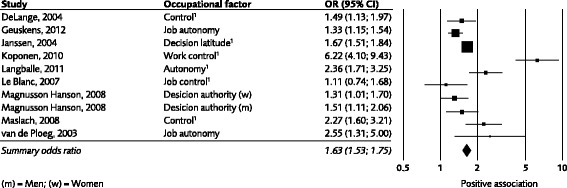
- Moderate scientific evidence (grade 3) supported a relationship between low job control and increased emotional exhaustion: 9 studies, weighted OR 1.63 (95% CI 1.53 to 1.75).
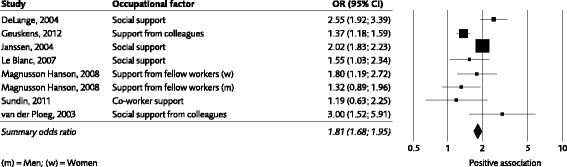
- Moderate evidence also supported low workplace support and emotional exhaustion: 7 studies, weighted OR 1.81 (95% CI 1.68 to 1.95).
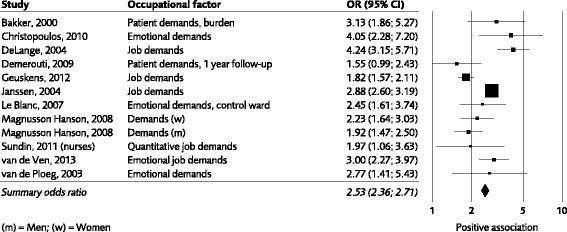
- Several other associations were supported by limited evidence (grade 2), including unspecified psychological demands and emotional exhaustion: 11 studies, weighted OR 2.53 (95% CI 2.36 to 2.71); high work load and emotional exhaustion: 5 studies, weighted OR 4.22 (95% CI 3.50 to 5.11); low reward and emotional exhaustion: weighted OR 1.86 (1.37 to 2.52); job insecurity and emotional exhaustion: weighted OR 1.39 (1.22 to 1.57).
- Reduced personal accomplishment was only associated with low reward, and there were few prospective studies of sufficient quality on chemical, biological, or physical exposures and burnout.
Methods
- Systematic review with meta-analyses, using the GRADE system to rate evidence; the authors state they followed PRISMA “as far as possible.”
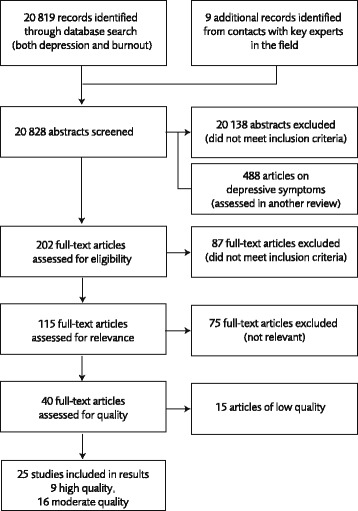
- Search covered 1990 to August 2013 in PubMed, Embase, Psychinfo, Arbline, Cochrane Library, and NIOSHTIC-2; 20,819 abstracts were identified, 115 full-text articles met inclusion criteria, and 25 articles were retained as high or medium quality.
- Included studies had to be from Europe, North America, Australia, or New Zealand; be prospective or comparable case-control designs; have baseline exposure and follow-up outcome assessment 1–5 years later; and include at least 100 exposed persons with control for at least age and gender.
- For meta-analysis, the authors used weighted odds ratios when possible, fixed-effects models, and the least adjusted model from each study for forest plots.
Limitations
- The paper states that few prospective studies of sufficient quality were available for some exposures, especially adverse chemical, biological, and physical factors; some associations were based on only one or two studies.
- The authors note that all 25 included studies relied on self-reported exposure and burnout, which may inflate associations; they say more objective measures would be beneficial.
- Evident from the text: the review could not conduct full homogeneity analyses for all outcomes because studies used many different statistical measures, and it could not do separate analyses by sex because gender-specific results were rarely reported.
Model-written summary. Check it against the paper before relying on it.
Integrity signals
Registry
Cites
Statistics
Figures
Verification
Claims the paper makes
0 Valid · 0 Not valid · 43 Not checked · 66 Own results and interpretations
A result the paper reports from its own data — it cites no other source for it, so there is none to check. The quote shows it is in the paper.
In the paper
“Reduced personal accomplishment was only associated with low reward.”
§ A systematic review including meta-analysis of work environment and burnout symptoms > Abstract > Results
plainstates an association- Asserted: passes — The authors put it forward as true.
- Checkable: passes — It can be checked against evidence.
- Load-bearing: passes — The paper’s conclusions depend on it.
- Based: passes — The paper gives a reason why it holds.
A result the paper reports from its own data — it cites no other source for it, so there is none to check. The quote shows it is in the paper.
In the paper
“Limited evidence (grade 2) was found for the associations between workplace justice, demands, high work load, low reward, low supervisor support, low co-worker support, job insecurity and change in emotional exhaustion.”
§ A systematic review including meta-analysis of work environment and burnout symptoms > Abstract > Results
plainstates an association- Asserted: passes — The authors put it forward as true.
- Checkable: passes — It can be checked against evidence.
- Load-bearing: passes — The paper’s conclusions depend on it.
- Based: passes — The paper gives a reason why it holds.
A result the paper states — it cites no source for it, so there is none to check. The quote shows it is in the paper.
In the paper
“There were few prospective studies with sufficient quality on adverse chemical, biological and physical factors and burnout.”
§ A systematic review including meta-analysis of work environment and burnout symptoms > Abstract > Results
plain- Asserted: passes — The authors put it forward as true.
- Checkable: passes — It can be checked against evidence.
- Load-bearing: unclear — It is unclear whether the paper’s conclusions depend on it.
- Based: passes — The paper gives a reason why it holds.
A result the paper reports from its own data — it cites no other source for it, so there is none to check. The quote shows it is in the paper.
In the paper
“Limited evidence (grade 2) was found for the associations between workplace justice, demands, high work load, low reward, low supervisor support, low co-worker support, job insecurity and change in emotional exhaustion.”
§ A systematic review including meta-analysis of work environment and burnout symptoms > Abstract > Results
plainstates an association- Asserted: passes — The authors put it forward as true.
- Checkable: passes — It can be checked against evidence.
- Load-bearing: passes — The paper’s conclusions depend on it.
- Based: passes — The paper gives a reason why it holds.
50 more claims
Create a free account to see all 109 claims and to verify the 77 references still open.
- It may state two separate claims as one. 41
- The quote only partly states this claim. 6
- Probably not a substantial claim. 21
Claims other papers make about this one
Each is checked against this paper’s own text: does it say what the citing paper says it does?
The source backs part of the claim, not all of it — or backs it for a different population, condition or comparison.
In the citing paper
“Unlike EE or DP, PA is more strongly influenced by structural and environmental factors, including work autonomy, recognition, opportunities for professional development, and organizational culture [60,61].”
From Effects of Third-Wave Cognitive Behavioral Therapy for Healthcare Professionals’ Burnout: A Systematic Review and Meta-Analysis (2025) · cites this paper as [61]
Experimental — accuracy not yet measured
Self-check
Percentages, sums and reported differences re-computed from the paper’s own numbers.
Rated major: it would touch a result — a value a result rests on, reported and recomputed p-values on opposite sides of the significance level, two passages that conflict with no sign which is right, or a cited work retracted before this paper was published.
In the paper
“If a work environment factor has a 30% prevalence and is associated with a relative risk of 1.6, the resulting population attributable risk is 7%, i.e. the proportion of disease in the exposed group that could be prevented by eliminating the risk factor.”
§ A systematic review including meta-analysis of work environment and burnout symptoms > Conclusions
Reported 0.07 · recomputed 0.1875
Citations
Cites
Preferred Reporting Items for Systematic Reviews and Meta-Analyses: the PRISMA statement
Moher, D., Liberati, A., Tetzlaff, J., Altman, D. G., & for the PRISMA Group (2009) · BMJ · doi:10.1136/bmj.b2535 · Cited by 83,823
Preferred reporting items for systematic reviews and meta-analyses: the PRISMA Statement.
(2009) · PubMed Central · Cited by 44,859
Preferred reporting items for systematic reviews and meta-analyses: The PRISMA statement
Moher, D., Liberati, A., Tetzlaff, J., Altman, D. G., & the PRISMA Group* (2009) · Annals of Internal Medicine · doi:10.7326/0003-4819-151-4-200908180-00135 · Cited by 37,554
Dermyshi, E., Wang, Y., Yan, C., Hong, W., Qiu, G., Gong, X., & Zhang, T. (2017) · Neonatology · doi:10.1159/000454668 · Cited by 24,451
The measurement of experienced burnout
Maslach, C., & Jackson, S. E. (1981) · Journal of Organizational Behavior · doi:10.1002/job.4030020205 · Cited by 14,496 · cited 7×
“Homogeneity test could not be conducted on burnout screening instruments, since very few studies used any other instrument than the MBI [4].”
MethodInfluentialMaslach, C., Schaufeli, W. B., & Leiter, M. P. (2001) · Annual Review of Psychology · doi:10.1146/annurev.psych.52.1.397 · Cited by 12,852 · cited 2×
“In 18 of the 25 studies, MBI, MBI-General Survey [4, 5] or the Dutch adaption of MBI, the Utrecht Burnout Questionnaire [24] were used.”
BackgroundMethodGRADE guidelines: 1. Introduction—GRADE evidence profiles and summary of findings tables
Guyatt, G., Oxman, A. D., Akl, E. A., Kunz, R., Vist, G., Brozek, J., Norris, S., Falck-Ytter, Y., Glasziou, P., & deBeer, H. (2011) · Journal of Clinical Epidemiology · doi:10.1016/j.jclinepi.2010.04.026 · Cited by 10,681 · cited 2×
“To our knowledge, the current meta-analytic study and review is the first that has been carried out according to the GRADE system [17].”
MethodThe measurement of engagement and burnout: a two sample confirmatory factor analytic approach.
Schaufeli, W. B., Salanova, M., González-romá, V., & Bakker, A. B. (2002) · Journal of Happiness Studies · doi:10.1023/a:1015630930326 · Cited by 10,014 · cited 1×
“In 18 of the 25 studies, MBI, MBI-General Survey [4, 5] or the Dutch adaption of MBI, the Utrecht Burnout Questionnaire [24] were used.”
MethodHealthy work: stress, productivity, and the reconstruction of working life
(1990) · Choice Reviews Online · doi:10.5860/choice.28-0381 · Cited by 8,220 · cited 2×
“Job control and workplace support comprise, together with job demands, the demand – controlsupport model [29, 30].”
BackgroundFreudenberger, H. J. (1974) · Journal of Social Issues · doi:10.1111/j.1540-4560.1974.tb00706.x · Cited by 5,463 · cited 3×
“Herbert Freudenberger [1], a clinical psychologist working in an alternative health care agency, and in 1976 by Christina Maslach [2], a social psychologist studying workplace emotions.”
BackgroundInfluential
Research works printed but not linked: 3
- Maslach C Burnout Hum Behav 1976 5 9 16 22
- Kant IJ Jansen NWH Van Amelsvoort LGPM Mohren DCL Swaen GMH Burnout in de werkende bevolking. Resultaten van de Maastrichtse Cohort Studie. [Burnout in the working population. Results of the Maastricht Cohort Study] Gedrag & Organisatie 2004 17 5 17
- Karasek RA Job content questionnaire and user’s guide 1985 Lowell University of Massachusetts
Cited by
Items 401–500 of 789
Giamos, D., Shkoler, O., Tziner, A. E., Vasiliu, C., & Shertzer, Y. (2023) · Journal of Advances in Management Research · doi:10.1108/jamr-09-2022-0195 · Cited by 15
Effects of Patient Safety Culture on Nurse Burnout in the Operating Room
Lee, Y. S., & Koh, C. K. (2020) · Korean Journal of Stress Research · doi:10.17547/kjsr.2020.28.3.118 · Cited by 6
“이 결과는 많은 근무량은 정서적 고갈을 유도한다는 결과 를 통합한 메타분석(Aronsson et al., 2017), 좋은 근무환 경에서 일하는 간호사가 열악한 근무환경에서 일하는 간호 사보다 낮은 정서적 고갈을 경험한다는 연구(Nantsupawat et al., 2017)와 동일한 맥락이다.”
Assessing Risks Awareness in Operating Rooms among Post-Graduate Students: A Pilot Study
Corvino, A. R., Manco, P., Garzillo, E. M., Monaco, M. G. L., Greco, A., Gerbino, S., Caputo, F., Macchiaroli, R., & Lamberti, M. (2021) · Sustainability · doi:10.3390/su13073860 · Cited by 6
“Finally, transversal risk factors are related to the work organization and the high degree of responsibility associated with the surgical act [26].”
BackgroundPandemics and burnout in mental health professionals
Ensari, N. (2021) · Industrial and Organizational Psychology · doi:10.1017/iop.2021.6 · Cited by 6
“Not only MHPs but also their clients are adversely affected by burnout: empathy toward the patients and the quality of care are reduced (Aronsson et al., 2017; Volpe et al., 2014); unhelpful and rejecting feelings toward patients emerge (Holmqvist & Jeanneau, 2006); and tardiness, spacing out…”
BackgroundPaulsson, S. Å., Hellman, T., Svartengren, M., & Molin, F. (2023) · International Journal of Environmental Research and Public Health · doi:10.3390/ijerph20054010 · Cited by 14
Inoue, A., Eguchi, H., Kachi, Y., & Tsutsumi, A. (2025) · Safety and Health at Work · doi:10.1016/j.shaw.2025.02.001 · Cited by 16
“…with the “ health impairment process, ” in the JD-R model, which assumes that high job demands lead to strain and health impairment [36], as well as meta-analytic fi ndings on the association of psychological demands with psychological health problems (common mental disorders and burnout) [37,38].”
Graf, B., Beinig, R., Schwickert, S., & Schischke, D. (2026) · International Journal of Information Management · doi:10.1016/j.ijinfomgt.2026.103045 · Cited by 8
Impact of faculty well-being on medical student education
Bynum, R. C., Richman, J., Corey, B., & Fazendin, J. M. (2022) · Global Surgical Education - Journal of the Association for Surgical Education · doi:10.1007/s44186-022-00082-5 · Cited by 7
“It has been validated in residents, medical students, and physicians [1, 5].”
InfluentialGarcía, A. J., Merino‐Soto, C., & García-Rivas, J. (2023) · European Journal of Investigation in Health Psychology and Education · doi:10.3390/ejihpe13080111 · Cited by 8
Cortisol levels and perceived stress in emergency call operators
Kulczycka, K., Chilimoniuk, B., Rymuszka, A., Stychno, E., Bałanda-Bałdyga, A., & Pałucka, K. (2025) · Frontiers in Public Health · doi:10.3389/fpubh.2025.1539516 · Cited by 8
Consecuencias del agotamiento laboral en tiendas de conveniencia
Máynez-Guaderrama, A. I., & Cavazos‐Arroyo, J. (2021) · Investigación Administrativa · doi:10.35426/iav50n128.03 · Cited by 10
“…laborales, conflicto de rol y ambigüedad, falta de apoyo social, limitada participación en la toma de decisiones, falta de justicia y el riesgo ocupacional, entre otros (Baldwin et al., 1997; Baeriswyl et al., 2017; Tayfur y Arslan, 2013; Lopes de Carvalho et al., 2020; Aronsson et al., 2017).”
BackgroundValidity Evidence of Brazilian Portuguese Version of the Professional Fulfillment Index
Silva-Júnior, J. S., Ogata, A. J. N., Scarpellini, B., da Cunha, A. A., Trockel, M., & Demarch, R. B. (2022) · American Journal of Health Promotion · doi:10.1177/08901171221086945 · Cited by 6
“Occupational burnout is conceptualized as an exhaustion condition due to prolonged exposure to work-related stressors,(1) such as job strain with high demands and low control, effort-reward imbalance at work, and job insecurity.(2) It has been recognized as an important problem that impairs workers’ health, in physica…”
BackgroundDobson, M., Schnall, P. L., Rosskam, E., & Landsbergis, P. A. (2019) · Springer eBooks · doi:10.1007/978-3-319-75381-2_13-1 · Cited by 7
Experiences of being a manager in the municipal sector in rural northern Sweden
Asplund, S., Åhlin, J., Åström, S., & Lindgren, B. (2022) · International Journal of Qualitative Studies on Health and Well-Being · doi:10.1080/17482631.2022.2139346 · Cited by 16
“Working in human service organizations involves a higher risk of sick leave than working in other organizations (Aronsson et al., 2017; Seidler et al., 2014).”
BackgroundWang, L., Shi, Y., Hu, Z. Y., Li, Y., Ang, Y., Jing, P., Zhang, B., Cao, X., Loerbroks, A., Li, J., et al. (2022) · International Journal of Environmental Research and Public Health · doi:10.3390/ijerph192417018 · Cited by 5
“It is generally recognized from research on correlations involving work stress, disease, and job burnout that job burnout is a mediator for the relation of work stress to CHD and other health outcomes [60,61].”
BackgroundThe language of healthcare worker emotional exhaustion: A linguistic analysis of longitudinal survey
Belz, F. F., Adair, K. C., Proulx, J., Frankel, A. S., & Sexton, J. B. (2022) · Frontiers in Psychiatry · doi:10.3389/fpsyt.2022.1044378 · Cited by 6
“Moreover, the comment prompt (“Do you have any other comments, questions, or concerns?”) may have elicited a first-person framework unlike natural language or conversation, as prior studies have shown the focus of writing can influence linguistic choices (31, 50).”
ResultBurnout Experience among Iranian Teachers during the COVID-19 Pandemic
Mota, A. I., & Alaghband‐Rad, J. (2023) · Higher Education Studies · doi:10.5539/hes.v13n1p50 · Cited by 7
“Being in one of the occupations where the incidence of burnout is traditionally higher (Aronsson et al., 2017; Droogenbroeck & Spruyt, 2015), teachers also had to adapt to the challenges of the COVID-19 pandemic (e.g., transition into digital classrooms, modifying instructional materials,…”
BackgroundHolmlund, L., Bültmann, U., Bergström, G., Warnqvist, A., & Brämberg, E. B. (2023) · International Archives of Occupational and Environmental Health · doi:10.1007/s00420-023-01970-z · Cited by 8
Relationship Between Self‐Compassion and Turnover Intention Among Early Career Nurses in Japan1
Sugawara, D., Mizuno, M., Tani, S., Fukiya, K., & Sato, J. (2023) · Japanese Psychological Research · doi:10.1111/jpr.12462 · Cited by 7
Beno, A., Bertilsson, M., Holmgren, K. E., Glise, K., Pousette, A., Segerfelt, K., & Björk, L. (2023) · BMC Family Practice · doi:10.1186/s12875-023-02151-0 · Cited by 8
“Work-related conditions often play an important role, and factors such as high demands and low control, high workload, low reward, and job insecurity increase the risk of developing stress-related symptoms [7].”
BackgroundEklund, A., Karlsson, I., Bergström, G., Holmlund, L., & Brämberg, E. B. (2024) · BMC Public Health · doi:10.1186/s12889-024-20564-z · Cited by 7
“Neverthe-less, there are also risk factors for CMDs in the work environment, such as high workload, low control (job strain), low reward, poor social support at the workplace, and lack of fairness at the workplace [11, 12].”
BackgroundOrigin Storytelling in Faculty Well-being: A Pilot Study
Nutting, R., Nilsen, K. M., Walling, A. D., & Level, E. (2021) · PRiMER · doi:10.22454/primer.2021.833623 · Cited by 6
College students’ perceptions of anticipated career burnout
Wells, S. E., Black, K. J., Bremmer, C., Melhorn, E., & Zelin, A. I. (2021) · Journal of American College Health · doi:10.1080/07448481.2021.1909045 · Cited by 9
Gémes, K., Björkenstam, E., Rahman, S. G., Gustafsson, K., Taipale, H. T., Tanskanen, A. J., Ekselius, L., Mittendorfer‐Rutz, E., & Helgesson, M. (2022) · International Journal of Environmental Research and Public Health · doi:10.3390/ijerph19127254 · Cited by 8
Çelebi, İ., ŞEMERET, N., ALKAŞ, G., KELEŞ, A., & ŞEN, E. (2023) · Turkiye Klinikleri Journal of Health Sciences · doi:10.5336/healthsci.2022-92994 · Cited by 6
Boysen, E., Schiller, B., Mörtl, K., Gündel, H., & Holzer, M. S. (2018) · International Journal of Environmental Research and Public Health · doi:10.3390/ijerph15010108 · Cited by 5
Low-grade systemic inflammation and the workplace
Viljoen, M., & Thomas, B. L. (2021) · Work · doi:10.3233/wor-213523 · Cited by 13
Deng, H., Li, X., Abulimiti, X., Mutailifu, Z., Zheng, S., Lin, X., & Li, F. (2021) · Research Square · doi:10.21203/rs.3.rs-368800/v1 · Cited by 5
Graßhoff, J., Safieddine, B., Sperlich, S., & Beller, J. (2025) · BMC Public Health · doi:10.1186/s12889-025-21462-8 · Cited by 7
Müller, A., Schulte, E.-M., Morstatt, A. I., & Kauffeld, S. (2025) · Gruppe Interaktion Organisation Zeitschrift für Angewandte Organisationspsychologie (GIO) · doi:10.1007/s11612-025-00834-z · Cited by 4
“…numerous reviews emphasize the assumption that continuous exposure to various occupational demands such as workload and job insecurity and other emotional, physical, and cognitive demands lead to exhaustion (e.g., Alarcon 2011; Aronsson et al. 2017; Bakker et al. 2023; Shoman et al. 2021).”
Ma, R., Bai, H., Cheng, J., & Qian, H. (2025) · Behavioral Sciences · doi:10.3390/bs15101424 · Cited by 7
“Without a sense of control, they are forced to reactively endure pressures rather than proactively manage them (Aronsson et al., 2017).”
Gao, X., Zeng, S., Huang, Y., Hao, C., Xiang, X., Meng, S., Wang, L., Yang, X., Pathak, J. L., Liu, Y., et al. (2025) · BMC Medical Education · doi:10.1186/s12909-025-08262-9 · Cited by 4
“…modifiable lifestyle factors showed significant associations, including regular exercise (28% lower burnout scores [49, 50]), poor self-rated health (doubled burnout risk, OR = 2.1 [51]), and workload intensity as the strongest predictor (β = 0.42) exceeding even resilience effects [52, 53].”
InfluentialSíndrome de burnout em docentes universitários dos cursos de saúde
de Oliveira, H. J. P., da Silva, V. M. P., da Silva, R. A., Vasconcelos, S. C., Oliveira, M. D. J. G. D. S., Inácio, A. S., Lima, M. D. D. C., & da Silva, F. P. (2022) · Revista de Salud Pública · doi:10.15446/rsap.v23n6.92326 · Cited by 4
Zhang, Y., Zhang, H., Li, L., & Li, J. (2023) · Heliyon · doi:10.1016/j.heliyon.2023.e21288 · Cited by 4
“Long working hours are likely to cause reduced memory and attention span [29] and increased fatigue, and hence greater susceptibility to fatigue errors [30].”
BackgroundA system science perspective on burn-out: development of an expert-based causal loop diagram
Barsties, L. S., van den Berg, S. W., Leone, S. S., Nicolaou, M., & van Oostrom, S. H. (2023) · Frontiers in Public Health · doi:10.3389/fpubh.2023.1271591 · Cited by 6
“That supervisors play a key role in preventing burn-out is supported by a systematic review and meta-analysis that concludes that a lack of workplace support leads to burn-out symptoms (12, 23).”
BackgroundDoes Career Calling Help Manage Intensified Job Demands and Maintain Good Performance?
Mauno, S., & Vianello, M. (2024) · Scandinavian Journal of Work and Organizational Psychology · doi:10.16993/sjwop.251 · Cited by 10
Shields, M., James, D., & McCormack, L. (2024) · Journal of Medical Radiation Sciences · doi:10.1002/jmrs.834 · Cited by 6
Mizuno, M., Sugawara, D., Tani, S., Fukiya, K., & Sato, J. (2021) · The Japanese journal of psychology · doi:10.4992/jjpsy.92.20317 · Cited by 5
Baka, Ł., Ścigała, D. K., & Grala, K. (2021) · Sustainability · doi:10.3390/su131910623 · Cited by 6
“In fact, a meta-analysis of studies has shown that the strongest determinant of job burnout is the high level of chronic job demands [30,32,33].”
BackgroundPuls, H., Schmidt, R., Zenger, M., Kampling, H., Kruse, J., Brähler, E., & Hilbert, A. (2021) · Nutrients · doi:10.3390/nu13113867 · Cited by 11
Larrucea‐Iruretagoyena, M., & Orue, I. (2021) · Behavioral Psychology/Psicología Conductual · doi:10.51668/bp.8321314s · Cited by 6
Staff burnout in the Children and Young People Secure Estate (CYPSE) in England
Lane, R., Labno, A., D’Souza, S., Ullman, R., Singleton, R., Bevington, D., Law, D., Rogers, A., Jacob, J., & Edbrooke-Childs, J. H. (2023) · Journal of Workplace Behavioral Health · doi:10.1080/15555240.2023.2181177 · Cited by 4
“High levels of work-related stress and burnout have been identified in staff groups across a wide range of occupations, particularly those that involve a high degree of person-to-person interaction (Aronsson et al., 2017; Johnson et al., 2005).”
BackgroundFannin, A., Hooley, C., Reeves, C. J., Marçal, K. E., Treglown, R., & Woerner, R. (2023) · Work · doi:10.3233/wor-220507 · Cited by 5
“Workplace burnout is a specific form of stress driven primarily by occupational stressors [14] that affects individuals through both attitudinal (e.g., disengagement, cynicism) and energy (e.g., exhaustion) channels [24].”
Apostolara, P., Αδαμακίδου, Θ., Mouta, E., Вус, В., Malliarou, M. M., Μαντζώρου, Μ., & Papathanasiou, I. V. (2023) · Polski Merkuriusz Lekarski · doi:10.36740/merkur202303107 · Cited by 4
Stress and Burnout among Medical Workers in Indonesia: A Study during COVID-19 Pandemic
Hisan, U. K., & Amri, M. M. (2023) · Journal of Public Health Sciences · doi:10.56741/jphs.v2i02.346 · Cited by 6
“In addition, training [35, 36] and working environment [37-39] are important to reduce workers' stress and burnout.”
Considine, J., Dempster, J., Wong, N. M., Kiprillis, N., & Boyd, L. (2024) · Australian Health Review · doi:10.1071/ah23179 · Cited by 4
Job burnout among healthcare workers—The impact of the COVID-19 pandemic
Wlazło, M., Łaskawiec-Żuławińska, D., Grajek, M. K., & Korzonek-Szlacheta, I. (2024) · Applied Psychology Research · doi:10.59400/apr.v3i1.359 · Cited by 6
“These traits contribute to the development of burnout by predisposing employees to cope inappropriately with high demands in the work environment (Aronsson et al., 2017; Bakker and Costa, 2014).”
BackgroundAylmer, R., Aylmer, M., & Dias, M. D. O. (2024) · European Journal of Theoretical and Applied Sciences · doi:10.59324/ejtas.2024.2(2).53 · Cited by 8
Return to Work Trajectories of Swedish Employees on Sick-Leave Due to Common Mental Disorders
Toropova, A., Brämberg, E. B., & Bergström, G. (2024) · Journal of Occupational Rehabilitation · doi:10.1007/s10926-024-10216-9 · Cited by 5
“This is in line with previous studies, which found that the duration of previous sick-leave predicted the length of future sickness absence [11, 13, 14].”
Burnout among students of medical universities in Poland
Zarobkiewicz, M. K., Sławiński, M., Woźniakowski, M. M., Wawryk‐Gawda, E., Kulak-Janczy, E., Korzeniowska, S., & Jodłowska‐Jędrych, B. (2018) · Polish Journal of Public Health · doi:10.2478/pjph-2018-0005 · Cited by 4
“another risk factor of burnout [22] Surprisingly, according to a recent Saudi Arabian study, there is no statistically significant association between medical students’ burnout and their extracurricular activities [11].”
ResultKessemeier, F. M., Gündel, H., von Wietersheim, J., Holzer, M. S., & Rothermund, E. (2020) · Zeitschrift für Psychiatrie Psychologie und Psychotherapie · doi:10.1024/1661-4747/a000412 · Cited by 5
“…Erkrankungen: Dazu zählen vor allem psychische Erkrankungen wie Depressionen, kardiovaskuläre und muskuloskelettale Erkrankungen (Angerer, Gündel & Siegrist, 2014; Aronsson et al., 2017; Madsen et al., 2017; McEwen, 2017; Ross, Foster & Ionescu, 2017; Theorell, 2019; Theorell et al., 2015).”
BackgroundPerceived burnout and coping strategies among fitness instructors: a mixed methods approach
Prochnow, T. M., Oglesby, L. W., Patterson, M. S., & Meyer, M. R. U. (2020) · Managing Sport and Leisure · doi:10.1080/23750472.2020.1825986 · Cited by 4
Liu, M.-S., Wang, M.-L. M., & Lee, C. H. (2021) · Personnel Review · doi:10.1108/pr-07-2020-0547 · Cited by 6
Pakarinen, S., Lohilahti, J., Sokka, L., Korpela, J., Huotilainen, M., & Müller, K. (2021) · European Journal of Neuroscience · doi:10.1111/ejn.15429 · Cited by 6
“Occupational burnout is a chronic condition that develops gradually as a result of prolonged exposure to work stress and insufficient resources for recovery (Aronsson et al., 2017; Maslach et al., 2001; Schaufeli & Enzmann, 1998).”
BackgroundKersten, N., & Formazin, M. (2021) · Zentralblatt für Arbeitsmedizin Arbeitsschutz und Ergonomie · doi:10.1007/s40664-021-00444-8 · Cited by 9
Shi, Y., Zhu, C., Jiang, R., Zhang, M., Cai, H., Zhao, H., Sun, H., Liu, Y., Ye, Y., Ma, Y., et al. (2021) · Journal of Psychosomatic Research · doi:10.1016/j.jpsychores.2021.110690 · Cited by 6
Sifaki-Pistolla, D. I., Mechili, E. A., Melidoniotis, E., Argyriadis, A., Patelarou, E., & Chatzea, V. (2022) · International Journal of Environmental Research and Public Health · doi:10.3390/ijerph191710467 · Cited by 4
Zhou, X., Zhao, X., Sun, N., Wang, D., & Tong, R. (2023) · Stress and Health · doi:10.1002/smi.3219 · Cited by 6
Conway, P. M., Rose, U., Formazin, M., Schöllgen, I., d’Errico, A., Balducci, C., & Burr, H. (2023) · International Archives of Occupational and Environmental Health · doi:10.1007/s00420-023-01959-8 · Cited by 7
“In the occupational health literature, it is established that being exposed to adverse psychosocial working conditions poses a risk to mental health (Aronsson et al. 2017; Madsen et al. 2017; Rugulies et al. 2017; Theorell et al. 2015).”
BackgroundInfluentialSustainable Work Organisations
Börnfelt, P.-O. (2023) · Springer eBooks · doi:10.1007/978-3-031-21667-1_10 · Cited by 4
Krumm, S., Krieg, G., Lamp, N., Marek, F., Nickel, P., Panzirsch, M., Stiawa, M., Beschoner, P., Brieger, P., Frasch, K., et al. (2023) · BMC Psychiatry · doi:10.1186/s12888-023-04979-3 · Cited by 4
Reyes, V., Unanue, W., Vignoles, V. L., & den Broeck, A. V. (2023) · Work & Stress · doi:10.1080/02678373.2023.2239198 · Cited by 8
“Furthermore, given that the literature on the antecedents of burnout is only built on a few studies of methodologically high quality (Aronsson et al., 2017), we also add to the literature by using the most rigorous analyses to test the prospective relationship between materialism and burnout…”
BackgroundNational Comparison of Burnout for a Cohort of Surgical and Nonsurgical Female Trainees
Shah, A. N., Vinaithirthan, V., Syed, A. S., Thurmon, K., Mann, A., & Fainstad, T. L. (2024) · Journal of Surgical Research · doi:10.1016/j.jss.2024.01.010 · Cited by 5
Benavides, F. G., Utzet, M., Serra, C., Delano, P., García-Gómez, M., Ayala, A., Delclós, J., Ronda, E., López, V. G., & García, A. M. (2024) · Gaceta Sanitaria · doi:10.1016/j.gaceta.2024.102378 · Cited by 32
Rose, U., Müller, G., Freude, G., & Kersten, N. (2018) · Das Gesundheitswesen · doi:10.1055/a-0586-3551 · Cited by 5
Tam, H. L., Mao, A., Cheong, P. L., & Van, I. K. (2020) · International Journal of Environmental Research and Public Health · doi:10.3390/ijerph17186921 · Cited by 7
Besse, C. S., Bonsack, C., Gilles, I., & Golay, P. (2021) · Journal of Mental Health · doi:10.1080/09638237.2021.1922635 · Cited by 4
George, S., Saffar, E. M. A., & Almohammedsaleh, Z. (2021) · International Conference on Sustainable Islamic Business and Finance (SIBF) · doi:10.1109/ieeeconf53626.2021.9686330 · Cited by 4
Zhang, H., Li, A., Zhu, B., Niu, Y., Ruan, Z., Liu, L., Gao, X., Wang, K., Yin, L., Mao, P., et al. (2020) · Psychological Medicine · doi:10.1017/s0033291720003220 · Cited by 6
“Thus, they are at risk of burnout (Aronsson et al., 2017; Zhang, Wang, et al., 2020).”
InfluentialCombating Burnout: Back to Medicine as a Calling
Gold, K. J. (2019) · The Annals of Family Medicine · doi:10.1370/afm.2476 · Cited by 6
Yankouskaya, A., Liebherr, M., & Ali, R. (2024) · SSRN Electronic Journal · doi:10.2139/ssrn.4972612 · Cited by 4
Han, J.-H., Lee, M., Cha, C., & Baek, G. (2025) · Healthcare · doi:10.3390/healthcare13243253 · Cited by 3
“Unlike EE or DP, PA is more strongly influenced by structural and environmental factors, including work autonomy, recognition, opportunities for professional development, and organizational culture [60,61].”
The Bridge Symptoms of Work–Family Conflict, Sleep Disorder, and Job Burnout: A Network Analysis
Sun, J., Wang, S., Huang, Y., Lam, S. T., Zhao, Y., He, Y., Peng, H., Guo, H., & Wang, X. (2024) · Depression and Anxiety · doi:10.1155/2024/2499188 · Cited by 5
“Burnout is a prolonged response to chronic emotional and interpersonal stressors at work, and it encompasses three dimensions, namely (1) emotional exhaustion, (2) deperson-alization or cynicism, and (3) reduced personal accomplishment [11].”
Fältén, R., Berntson, E., & Bernhard‐Oettel, C. (2025) · Nordic Psychology · doi:10.1080/19012276.2024.2444932 · Cited by 6
“Previous research has emphasised high job demands and resource shortages as reasons for health issues like depression and burnout (e.g. Aronsson et al., 2017; Harvey et al., 2017; Thapa et al., 2022) leading to sickness absence.”
A meta-analysis of the relationship between transformational leadership and employee burnout
Yuan, X. (2025) · Current Psychology · doi:10.1007/s12144-025-08099-x · Cited by 8
“…by personal characteristics, such as perfectionism (Hill & Curran, 2016), age and years of experience (Brewer & Shapard, 2004), gender (Purvanova & Muros, 2010), and environmental characteristics, such as work-nonwork conflict (Reichl et al., 2014 ), and work environment (Aronsson et al., 2017).”
Batur, A. (2025) · Turkish Journal of Emergency Medicine · doi:10.4103/tjem.tjem_277_24 · Cited by 4
“[27] In our study, depersonalization and EE were found to increase the level of fatigue.”
Forsyth, J., Shaw, J. J., & Shepherd, A. (2025) · Frontiers in Public Health · doi:10.3389/fpubh.2025.1656223 · Cited by 8
Jiang, L., Fang, L., Xu, Y., Zhang, Q., Dai, S., Tian, J., Wu, W., Fang, Y., Zhang, M., & Yu, H. (2025) · Frontiers in Public Health · doi:10.3389/fpubh.2025.1669092 · Cited by 8
Does workers’ experience of knowledge on emotional demands protect against burnout?
Pihl‐Thingvad, J., Andersen, D. R., & Andersen, L. P. (2025) · BMC Psychology · doi:10.1186/s40359-025-03716-7 · Cited by 5
“Overall, the scientific evidence was assessed as weak [21], and existing research thus underlines the necessity of further longitudinal studies to corroborate the probable association between emotional demands and levels of burnout.”
InfluentialUnsolicited patient images and burnout in dermatology
Jiang, S. W., Flynn, S. M., Borre, E. D., & Nicholas, M. W. (2022) · Clinical and Experimental Dermatology · doi:10.1093/ced/llac035 · Cited by 3
Psychometric Assessment of the Physicians’ Job Demands and Resources Scale
Moreira, S., Oliveira, S., Vala, J., Costa‐Lopes, R., & Pinto, A. M. (2023) · Evaluation & the Health Professions · doi:10.1177/01632787231195077 · Cited by 3
“However, the research still lacks a systematic description of physicians ’ speci fi c job demands and resources, and no consensus regarding the instruments to assess these variables has been found (Aronsson et al., 2017; Lee et al., 2021).”
BackgroundMethodDemands and Resources: Weighing Interaction Effects on Occupational Burnout
Egozi, L., & Pardo, A. (2023) · Journal of Occupational and Environmental Medicine · doi:10.1097/jom.0000000000002975 · Cited by 4
Burnout: Symptomatik, Diagnostik und Behandlungsansätze
Kramuschke, M., Renner, A., & Kersting, A. (2024) · Der Nervenarzt · doi:10.1007/s00115-024-01649-x · Cited by 5
Eskilsson, T., Olsson, D., Ekbäck, A.-M., & Järvholm, L. S. (2024) · BMC Psychiatry · doi:10.1186/s12888-024-05975-x · Cited by 5
“From a preventive perspective, the workplace is important since psychosocial risk factors at work (high demands, low job control, high work load, low reward and job insecurity) [11] and presenteeism with reduced work performance [12] increase the risk of developing exhaustion.”
BackgroundStensland, S. Ø., Bondjers, K., Zwart, J., Rosseland, L. A., Atar, D., Christensen, J. O., Matre, D., Glad, K. A., Wentzel‐Larsen, T., Wøien, H., et al. (2025) · Public Health in Practice · doi:10.1016/j.puhip.2025.100582 · Cited by 5
Mifsud, D., Acampora, N., Rao, N., Shafik, A., Carmody, S., & Chandran, A. S. (2025) · Science and Medicine in Football · doi:10.1080/24733938.2025.2476486 · Cited by 4
“Studies have suggested that this is the first stage in the process of eventual burnout (Cropanzano et al. 2003 - (Seidler et al. 2014)) and that it is largely the result of organisational factors (Tummers et al. 2002; Aronsson et al. 2017).”
Vilhelmsen, M., Ludvigsen, T. P., Thomassen, K., & Rasmussen, C. D. N. (2025) · BMC Health Services Research · doi:10.1186/s12913-025-12746-1 · Cited by 4
“Exposure to high physical and psychosocial demands challenges a healthy and capable workforce [5], due to increased risk for musculoskeletal pain and burn-out [6], leading to impaired work ability and long-term sickness absence [3, 7, 8].”
Димитрова, T., Tarpomanova, T., Tsvetkova, A., Тоsheva, Y., Venkova, V., & Тодорова, А. (2025) · Healthcare · doi:10.3390/healthcare13202607 · Cited by 4
Domínguez-Lara, S., Fernández-Arata, M., la Cruz, G. C.-D., García, A., & Merino‐Soto, C. (2021) · Revista Iberoamericana de Diagnóstico y Evaluación - e Avaliação Psicológica · doi:10.21865/ridep59.2.02 · Cited by 4
Handtke, O., Günther, L. V., & Mösko, M. (2022) · PLoS ONE · doi:10.1371/journal.pone.0275003 · Cited by 3
Factor Validity of Measurement for Burnout in Chilean Prison Officers
Álvarez-Cabrera, P. L., López-Reyes, K. V., Fuertes, F. C., & Sánchez-Moreno, E. (2022) · Revista Colombiana de Psicología · doi:10.15446/rcp.v31n1.82590 · Cited by 3
“…inherently stressful and involves physical, emotional, and social wear, an environment that requires testing all your personal resources against work stress and human relationship management (Wang, Chen, Li & Gao, 2017; Álvarez-Cabrera et al. 2019; Viljoen & Claassen, 2017; Aronsson et al. 2017).”
BackgroundSanté des personnels soignants : l’importance des activités physiques adaptées
Coudevylle, G. R., Sinnapah, S., Ginoux, C., & Bouchard, J. (2023) · La Revue de l Infirmière · doi:10.1016/j.revinf.2023.04.011 · Cited by 3
The Impact of Burnout on Female Academics’ Resiliency
Hill-Berry, N. P., Adams, D.-M. W., & Thomas-Brown, P.-G. (2023) · Springer eBooks · doi:10.1007/978-3-031-34140-3_6 · Cited by 6
Björkelund, C., Petersson, E., Svenningsson, I., Saxvik, A., Wiegner, L., Hensing, G. K. E., Jónsdóttir, I. H., Larsson, M. E. H., Wikberg, C., Ariai, N., et al. (2024) · Scandinavian Journal of Primary Health Care · doi:10.1080/02813432.2024.2329212 · Cited by 4
“…than men [1]. the reason for this gender difference is not fully understood. a recent review of Nordic research showed that gender differences in sickness absence with psychiatric disorders mainly were explained by factors related to women and men working in different labour market sectors [3,6].”
BackgroundOsca, A., Millán, L., Vela, L., & Barrado, J. (2024) · BMC Public Health · doi:10.1186/s12889-024-19704-2 · Cited by 6
“To reduce the perception of work overload, veterinarians can also be trained in organizational skills and task design because an adequate and balanced distribution of tasks [37] can reduce physical fatigue and emotional exhaustion.”
BackgroundSahin, E. B., & Homberg, F. (2024) · IntechOpen eBooks · doi:10.5772/intechopen.1006691 · Cited by 4
Relationship between voice impairment and stress coping styles in professionally active teachers
Nawrocka, L., Garstecka, A., Mackiewicz–Nartowicz, H., Kozakiewicz-Rutkowska, A., Burduk, P., & Sinkiewicz, A. (2024) · Irish Journal of Medical Science (1971 -) · doi:10.1007/s11845-024-03816-0 · Cited by 7
“The burden of maintaining high teaching standards and meeting social expectations makes teachers more likely to suffer from occupational stress and burnout [19–21].”
Jach, H. K., Damian, R. I., & Murayama, K. (2025) · Learning and Instruction · doi:10.1016/j.learninstruc.2025.102138 · Cited by 4
Behind the Leash: Burnout, Compassion Fatigue, and Occupational Strain in Dog Trainers
Malone, A. (2025) · Behavioral Sciences · doi:10.3390/bs15060798 · Cited by 4
“…in veterinary and human healthcare contexts suggest more experience might relate to lower stress or better outcomes (Beaumont et al., 2016; Tomasi et al., 2019), while other evidence points to burnout accumulating over time despite experience (Aronsson et al., 2017; Stevens & Al-Abbadey, 2023).”
Risk of developing hypertension in underground workers when psycho-vegetative status is transforming
Николаевна, М. Н., Paramonova, S. V., Sedinina, N. S., & Ustinova, O. Y. (2021) · Health Risk Analysis · doi:10.21668/health.risk/2021.4.11 · Cited by 4
Metadata
- Authors
- Aronsson, G., Theorell, T., Grape, T., Hammarström, A., Hogstedt, C., Marteinsdottir, I., Skoog, I., Träskman-Bendz, L., & Hall, C.
- Affiliations
- Stockholm University (SE)
- Umeå University (SE)
- Karolinska Institutet (SE)
- University of Gothenburg (SE)
- SBU - Swedish Agency for Health Technology Assessment and Assessment of Social Services (SE)
- Corresponding author
- Aronsson, Gunnar
- Venue
- BMC Public Health
- Published
- 2017-03-16
- Volume
- 17
- Issue
- 1
- Pages
- 264-264
- ISSN
- 1471-2458 (ISSN-L)
- PMC
- PMC5356239
- OpenAlex
- W2595367318
- Cited by
- 789
- References
- 38
- Citations by year
- 2026: 66 · 2025: 95 · 2024: 101 · 2023: 99 · 2022: 130 · 2021: 129 · 2020: 74 · 2019: 48 · 2018: 41 · 2017: 6
- FWCI
- 7.13
- Type
- journal article
- Language
- en
- Open access
- gold
- doi.org
- Licence
- cc-by
- Locations
- BMC Public Health (publishedVersion, cc-by)
- PubMed Central (publishedVersion, cc-by)
- PubMed (publishedVersion)
- DiVA (Linkoping University) (submittedVersion, other-oa)
- KTH Publication Database DiVA (KTH Royal Institute of Technology) (submittedVersion, other-oa)
- DOAJ (DOAJ: Directory of Open Access Journals) (submittedVersion, cc-by-sa)
- Lund University Publications (Lund University) (submittedVersion)
- Funders
- The Swedish Council of Health Technology Assessment
- Topics
- Social Sciences › Psychology › Social Psychology › Stress and Burnout Research
- Health Sciences › Medicine › Public Health, Environmental and Occupational Health › Occupational Health and Burnout
- Health Sciences › Health Professions › General Health Professions › Healthcare professionals’ stress and burnout
- Keywords
- burnout, emotional exhaustion, cynicism, personal accomplishment, job control, workplace support, workplace justice, job demands, workload, job insecurity, supervisor support, coworker support, occupational exposure, work environment, organizational interventions
- MeSH terms
- Achievement, Adult, Australia, Burnout, Professional, Europe, Mental Fatigue, Female, Humans, Male, New Zealand, North America, Prospective Studies, Surveys and Questionnaires, Reward, Social Justice, Organizational Culture, Case-Control Studies, Occupational Exposure, Workload, Workplace
About these checks
Registry, retraction, Cites and statistics results are computed, not judged, with one exception: a printed reference that no index lists is read once by a model before it counts as a citation error. Claims are extracted by a model and kept only when their quote appears verbatim in the text; each cited source is then checked, with a model’s help, for whether it says what the claim relies on. Those verdicts can be wrong — read the claim’s quote and the cited source before relying on one.
A language model drew the claims from the paper on 2026-10-11, under version 3 of the claim definition (model deepseek-v4.1-flash, prompt extract-v3).
A second model labelled each claim on 2026-10-11 (model jev-1.13-20260917, definition revision gold-guideline-v0.2).
Statistics and arithmetic are recomputed, not judged.
Confidence bands are shown only for fields calibrated on our annotated test set. None is calibrated yet, so no band is shown.
What counts as a claim ›How we measure confidence ›How we check this ›
Are you an author, or do you see a problem with this page? Request a review
Data sources
Bibliographic data: Semantic Scholar, OpenAlex, Crossref.
Contains information from the Semantic Scholar Academic Graph Datasets, made available under the ODC Attribution License (ODC-BY 1.0).
Semantic Scholar’s data is described in: Kinney, R., et al. (2023). The Semantic Scholar Open Data Platform. arXiv:2301.10140.
