

A systematic review including meta-analysis of work environment and burnout symptoms
Open accessThe DOI matches its Crossref record; 37 of the 38 references it cites were found in a registry or an index; none of the 77 sources its claims cite is checked for support yet.
Abstract
BACKGROUND: Practitioners and decision makers in the medical and insurance systems need knowledge on the relationship between work exposures and burnout. Many burnout studies - original as well as reviews - restricted their analyses to emotional exhaustion or did not report results on cynicism, personal accomplishment or global burnout. To meet this need we carried out this review and meta-analyses with the aim to provide systematically graded evidence for associations between working conditions and near-future development of burnout symptoms. METHODS: A wide range of work exposure factors was screened. Inclusion criteria were: 1) Study performed in Europe, North America, Australia and New Zealand 1990-2013. 2) Prospective or comparable case control design. 3) Assessments of exposure (work) and outcome at baseline and at least once again during follow up 1-5 years later. Twenty-five articles met the predefined relevance and quality criteria. The GRADE-system with its 4-grade evidence scale was used. RESULTS: Most of the 25 studies focused emotional exhaustion, fewer cynicism and still fewer personal accomplishment. Moderately strong evidence (grade 3) was concluded for the association between job control and reduced emotional exhaustion and between low workplace support and increased emotional exhaustion. Limited evidence (grade 2) was found for the associations between workplace justice, demands, high work load, low reward, low supervisor support, low co-worker support, job insecurity and change in emotional exhaustion. Cynicism was associated with most of these work factors. Reduced personal accomplishment was only associated with low reward. There were few prospective studies with sufficient quality on adverse chemical, biological and physical factors and burnout. CONCLUSION: While high levels of job support and workplace justice were protective for emotional exhaustion, high demands, low job control, high work load, low reward and job insecurity increased the risk for developing exhaustion. Our approach with a wide range of work exposure factors analysed in relation to the separate dimensions of burnout expanded the knowledge of associations, evidence as well as research needs. The potential of organizational interventions is illustrated by the findings that burnout symptoms are strongly influenced by structural factors such as job demands, support and the possibility to exert control.
Overview
CoChat Summary
TL;DR
This systematic review and meta-analysis found that several work environment factors were associated with burnout symptoms, with the strongest evidence for low job control and low workplace support in relation to emotional exhaustion. Using the GRADE system, the authors concluded that structural workplace factors such as demands, support, and control are important for burnout risk.
Key findings
- Among 25 included studies, most focused on emotional exhaustion; fewer examined cynicism/depersonalisation, and still fewer personal accomplishment.
- Moderate scientific evidence (grade 3) supported a relationship between low job control and increased emotional exhaustion: 9 studies, weighted OR 1.63 (95% CI 1.53 to 1.75).
- Moderate evidence also supported low workplace support and emotional exhaustion: 7 studies, weighted OR 1.81 (95% CI 1.68 to 1.95).
- Several other associations were supported by limited evidence (grade 2), including unspecified psychological demands and emotional exhaustion: 11 studies, weighted OR 2.53 (95% CI 2.36 to 2.71); high work load and emotional exhaustion: 5 studies, weighted OR 4.22 (95% CI 3.50 to 5.11); low reward and emotional exhaustion: weighted OR 1.86 (1.37 to 2.52); job insecurity and emotional exhaustion: weighted OR 1.39 (1.22 to 1.57).
- Reduced personal accomplishment was only associated with low reward, and there were few prospective studies of sufficient quality on chemical, biological, or physical exposures and burnout.
Methods
- Systematic review with meta-analyses, using the GRADE system to rate evidence; the authors state they followed PRISMA “as far as possible.”
- Search covered 1990 to August 2013 in PubMed, Embase, Psychinfo, Arbline, Cochrane Library, and NIOSHTIC-2; 20,819 abstracts were identified, 115 full-text articles met inclusion criteria, and 25 articles were retained as high or medium quality.
- Included studies had to be from Europe, North America, Australia, or New Zealand; be prospective or comparable case-control designs; have baseline exposure and follow-up outcome assessment 1–5 years later; and include at least 100 exposed persons with control for at least age and gender.
- For meta-analysis, the authors used weighted odds ratios when possible, fixed-effects models, and the least adjusted model from each study for forest plots.
Limitations
- The paper states that few prospective studies of sufficient quality were available for some exposures, especially adverse chemical, biological, and physical factors; some associations were based on only one or two studies.
- The authors note that all 25 included studies relied on self-reported exposure and burnout, which may inflate associations; they say more objective measures would be beneficial.
- Evident from the text: the review could not conduct full homogeneity analyses for all outcomes because studies used many different statistical measures, and it could not do separate analyses by sex because gender-specific results were rarely reported.
Model-written summary. Check it against the paper before relying on it.
Integrity signals
Registry
Cites
Statistics
Figures
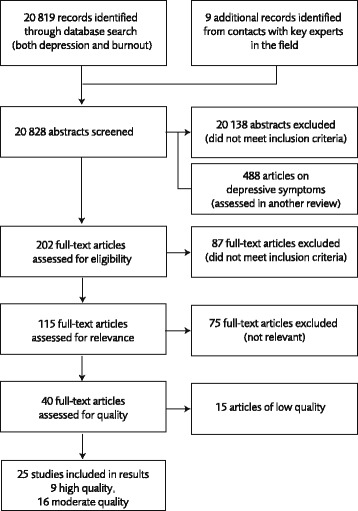
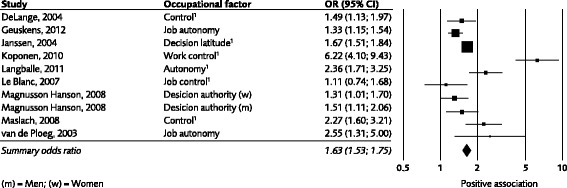
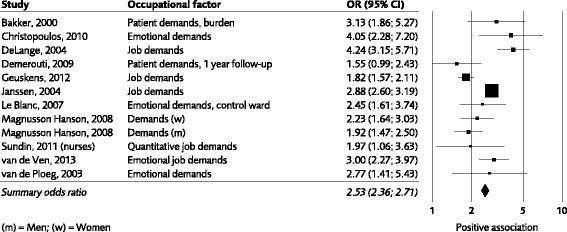
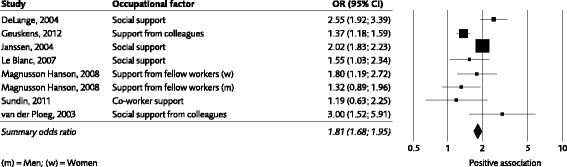
Verification
Claims the paper makes
0 Valid · 0 Not valid · 43 Not checked · 66 Own results and interpretations
A result the paper reports from its own data — it cites no other source for it, so there is none to check. The quote shows it is in the paper.
In the paper
“Reduced personal accomplishment was only associated with low reward.”
§ A systematic review including meta-analysis of work environment and burnout symptoms > Abstract > Results
plainstates an association- Asserted: passes — The authors put it forward as true.
- Checkable: passes — It can be checked against evidence.
- Load-bearing: passes — The paper’s conclusions depend on it.
- Based: passes — The paper gives a reason why it holds.
A result the paper reports from its own data — it cites no other source for it, so there is none to check. The quote shows it is in the paper.
In the paper
“Limited evidence (grade 2) was found for the associations between workplace justice, demands, high work load, low reward, low supervisor support, low co-worker support, job insecurity and change in emotional exhaustion.”
§ A systematic review including meta-analysis of work environment and burnout symptoms > Abstract > Results
plainstates an association- Asserted: passes — The authors put it forward as true.
- Checkable: passes — It can be checked against evidence.
- Load-bearing: passes — The paper’s conclusions depend on it.
- Based: passes — The paper gives a reason why it holds.
A result the paper states — it cites no source for it, so there is none to check. The quote shows it is in the paper.
In the paper
“There were few prospective studies with sufficient quality on adverse chemical, biological and physical factors and burnout.”
§ A systematic review including meta-analysis of work environment and burnout symptoms > Abstract > Results
plain- Asserted: passes — The authors put it forward as true.
- Checkable: passes — It can be checked against evidence.
- Load-bearing: unclear — It is unclear whether the paper’s conclusions depend on it.
- Based: passes — The paper gives a reason why it holds.
A result the paper reports from its own data — it cites no other source for it, so there is none to check. The quote shows it is in the paper.
In the paper
“Limited evidence (grade 2) was found for the associations between workplace justice, demands, high work load, low reward, low supervisor support, low co-worker support, job insecurity and change in emotional exhaustion.”
§ A systematic review including meta-analysis of work environment and burnout symptoms > Abstract > Results
plainstates an association- Asserted: passes — The authors put it forward as true.
- Checkable: passes — It can be checked against evidence.
- Load-bearing: passes — The paper’s conclusions depend on it.
- Based: passes — The paper gives a reason why it holds.
50 more claims
Create a free account to see all 109 claims and to verify the 77 references still open.
- It may state two separate claims as one. 41
- The quote only partly states this claim. 6
- Probably not a substantial claim. 21
Claims other papers make about this one
Each is checked against this paper’s own text: does it say what the citing paper says it does?
The source backs part of the claim, not all of it — or backs it for a different population, condition or comparison.
In the citing paper
“Unlike EE or DP, PA is more strongly influenced by structural and environmental factors, including work autonomy, recognition, opportunities for professional development, and organizational culture [60,61].”
From Effects of Third-Wave Cognitive Behavioral Therapy for Healthcare Professionals’ Burnout: A Systematic Review and Meta-Analysis (2025) · cites this paper as [61]
Experimental — accuracy not yet measured
Self-check
Percentages, sums and reported differences re-computed from the paper’s own numbers.
Rated major: it would touch a result — a value a result rests on, reported and recomputed p-values on opposite sides of the significance level, two passages that conflict with no sign which is right, or a cited work retracted before this paper was published.
In the paper
“If a work environment factor has a 30% prevalence and is associated with a relative risk of 1.6, the resulting population attributable risk is 7%, i.e. the proportion of disease in the exposed group that could be prevented by eliminating the risk factor.”
§ A systematic review including meta-analysis of work environment and burnout symptoms > Conclusions
Reported 0.07 · recomputed 0.1875
Citations
Cites
Preferred Reporting Items for Systematic Reviews and Meta-Analyses: the PRISMA statement
Moher, D., Liberati, A., Tetzlaff, J., Altman, D. G., & for the PRISMA Group (2009) · BMJ · doi:10.1136/bmj.b2535 · Cited by 83,823
Preferred reporting items for systematic reviews and meta-analyses: the PRISMA Statement.
(2009) · PubMed Central · Cited by 44,859
Preferred reporting items for systematic reviews and meta-analyses: The PRISMA statement
Moher, D., Liberati, A., Tetzlaff, J., Altman, D. G., & the PRISMA Group* (2009) · Annals of Internal Medicine · doi:10.7326/0003-4819-151-4-200908180-00135 · Cited by 37,554
Dermyshi, E., Wang, Y., Yan, C., Hong, W., Qiu, G., Gong, X., & Zhang, T. (2017) · Neonatology · doi:10.1159/000454668 · Cited by 24,451
The measurement of experienced burnout
Maslach, C., & Jackson, S. E. (1981) · Journal of Organizational Behavior · doi:10.1002/job.4030020205 · Cited by 14,496 · cited 7×
“Homogeneity test could not be conducted on burnout screening instruments, since very few studies used any other instrument than the MBI [4].”
MethodInfluentialMaslach, C., Schaufeli, W. B., & Leiter, M. P. (2001) · Annual Review of Psychology · doi:10.1146/annurev.psych.52.1.397 · Cited by 12,852 · cited 2×
“In 18 of the 25 studies, MBI, MBI-General Survey [4, 5] or the Dutch adaption of MBI, the Utrecht Burnout Questionnaire [24] were used.”
BackgroundMethodGRADE guidelines: 1. Introduction—GRADE evidence profiles and summary of findings tables
Guyatt, G., Oxman, A. D., Akl, E. A., Kunz, R., Vist, G., Brozek, J., Norris, S., Falck-Ytter, Y., Glasziou, P., & deBeer, H. (2011) · Journal of Clinical Epidemiology · doi:10.1016/j.jclinepi.2010.04.026 · Cited by 10,681 · cited 2×
“To our knowledge, the current meta-analytic study and review is the first that has been carried out according to the GRADE system [17].”
MethodThe measurement of engagement and burnout: a two sample confirmatory factor analytic approach.
Schaufeli, W. B., Salanova, M., González-romá, V., & Bakker, A. B. (2002) · Journal of Happiness Studies · doi:10.1023/a:1015630930326 · Cited by 10,014 · cited 1×
“In 18 of the 25 studies, MBI, MBI-General Survey [4, 5] or the Dutch adaption of MBI, the Utrecht Burnout Questionnaire [24] were used.”
MethodHealthy work: stress, productivity, and the reconstruction of working life
(1990) · Choice Reviews Online · doi:10.5860/choice.28-0381 · Cited by 8,220 · cited 2×
“Job control and workplace support comprise, together with job demands, the demand – controlsupport model [29, 30].”
BackgroundFreudenberger, H. J. (1974) · Journal of Social Issues · doi:10.1111/j.1540-4560.1974.tb00706.x · Cited by 5,463 · cited 3×
“Herbert Freudenberger [1], a clinical psychologist working in an alternative health care agency, and in 1976 by Christina Maslach [2], a social psychologist studying workplace emotions.”
BackgroundInfluential
Research works printed but not linked: 3
- Maslach C Burnout Hum Behav 1976 5 9 16 22
- Kant IJ Jansen NWH Van Amelsvoort LGPM Mohren DCL Swaen GMH Burnout in de werkende bevolking. Resultaten van de Maastrichtse Cohort Studie. [Burnout in the working population. Results of the Maastricht Cohort Study] Gedrag & Organisatie 2004 17 5 17
- Karasek RA Job content questionnaire and user’s guide 1985 Lowell University of Massachusetts
Cited by
Items 201–300 of 789
Karcz, E., Zdun‐Ryżewska, A., & Zimmermann, A. E. (2022) · Healthcare · doi:10.3390/healthcare10010145 · Cited by 26
“Our analysis is confirmed by studies by other authors showing that a high level of support protects against exhaustion [34].”
BackgroundResultAljuffali, L. A., Alshabanah, M. O., & Almalag, H. M. (2022) · Saudi Pharmaceutical Journal · doi:10.1016/j.jsps.2022.01.017 · Cited by 23
Tackling the Pandemic a Year Later: Burnout Among Home Palliative Care Clinicians
Ercolani, G., Varani, S., Ostan, R., Franchini, L., Yaaqovy, A. D., Pannuti, R., Biasco, G., & Bruera, E. D. (2021) · Journal of Pain and Symptom Management · doi:10.1016/j.jpainsymman.2021.12.027 · Cited by 20
Kok, N., Zegers, M., Teerenstra, S., Fuchs, M., van der Hoeven, J. G., van Gurp, J. L. P., & Hoedemaekers, C. (2023) · Critical Care Medicine · doi:10.1097/ccm.0000000000005940 · Cited by 20
“No improvement in team climate was identified although key elements of the organizational culture—which have previously been shown to mitigate burnout symptoms (11, 39, 40)—improved in ICUs that organized MCD.”
BackgroundCurrent Foreign Studies of Professional Burnout in Teachers
Kochetkov, N. V., Marinova, T. Y., Orlov, V. A., Raskhodchikova, M. N., & Haymovskaya, N. A. (2023) · Journal of Modern Foreign Psychology · doi:10.17759/jmfp.2023120204 · Cited by 31
The effect of work environment on burnout among nursing directors: A cross‐sectional study
Takemura, Y., Kunie, K., & Ichikawa, N. (2019) · Journal of Nursing Management · doi:10.1111/jonm.12909 · Cited by 24
Alotni, M. A., & Elgazzar, S. E. (2020) · The Open Nursing Journal · doi:10.2174/1874434602014010190 · Cited by 27
Physician wellness in orthopaedic surgery: a multinational survey study
Mir, H. R., Downes, K. L., Chen, A. F., Grewal, R. S., Kelly, D. M., Lee, M. J., Leucht, P., & Dulai, S. K. (2021) · Bone & Joint Open · doi:10.1302/2633-1462.211.bjo-2021-0153 · Cited by 20
Long-term improvement of psychological well-being in the workplace: What and how
Piao, X., & Managi, S. (2022) · Social Science & Medicine · doi:10.1016/j.socscimed.2022.114851 · Cited by 30
Mao, Y., Hu, Y., Feng, Z., Wang, R., Chen, X., Zhang, W., & Yang, G. (2020) · Health & Social Care in the Community · doi:10.1111/hsc.12957 · Cited by 20
Arenas, D. L., Viduani, A., Bassols, A. M. S., & Hauck, S. (2022) · Journal of Occupational and Environmental Medicine · doi:10.1097/jom.0000000000002526 · Cited by 23
“Healthy lifestyle habits and older age were shown to be protective factors, which corroborates pre-pandemic studies.(32,48) Additionally, in LMICs, the access to the necessary technologies for this working modality plays a significant role in determining the proportion of workers who can WFH.”
BackgroundInfluentialDanauskė, E., Raišienė, A. G., & Korsakienė, R. (2023) · Verslas teorija ir praktika · doi:10.3846/btp.2023.16953 · Cited by 41
“Meanwhile, factors related to employee interaction, such as non-collaborative leadership, conflicting or poor communication, lack of support, are significant for employee burnout (Shoman et al., 2021; Aronsson et al., 2017; Edú-Valsania et al., 2022).”
BackgroundFehér, G., Kapus, K., Tibold, A., Bankó, Z., Berke, G., Gács, B., Váradi, I., Nyulas, R., & Matuz, A. (2024) · BMC Public Health · doi:10.1186/s12889-024-19797-9 · Cited by 27
“In line with this, a large body of research focused on workplace factors and revealed that they play an important role in the development of burnout [2].”
BackgroundPihl‐Thingvad, J., Andersen, L. P., Pihl‐Thingvad, S., Elklit, A., Brandt, L. P. A., & Andersen, L. L. (2021) · International Journal of Nursing Studies · doi:10.1016/j.ijnurstu.2021.103971 · Cited by 21
Dias, P. C., Peixoto, R., & Cadime, I. (2021) · Social Psychology of Education · doi:10.1007/s11218-021-09640-z · Cited by 29
A narrative review of research on healthcare staff’s burnout during the COVID-19 pandemic
Khosravi, M., Ghiasi, Z., & Ganjali, A. (2021) · Proceedings of Singapore Healthcare · doi:10.1177/20101058211040575 · Cited by 23
“This time-lag is diagnostically important because not all people with high scores on emotional exhaustion experience personalization and inefficiency.(17) So, it is necessary to understand the early signs and symptoms of occupational burnout, as red flags among healthcare staff, during the COVID-19 pandemic.”
BackgroundWell-Being and Functioning at Work Following Thefts and Robberies: A Comparative Study
Setti, I., van der Velden, P. G., Sommovigo, V., Ferretti, M. S., Giorgi, G., O’Shea, D. E., & Argentero, P. (2018) · Frontiers in Psychology · doi:10.3389/fpsyg.2018.00168 · Cited by 21
“Furthermore, because workload is positively associated with emotional exhaustion (Aronsson et al., 2017) which, in turn, may impair workers’ mental health, those who perceive higher workload could be more likely to seek treatment than those who experience low workload.”
Pinheiro, J. P., Sbicigo, J. B., & Remor, E. (2020) · Ciência & Saúde Coletiva · doi:10.1590/1413-81232020259.30672018 · Cited by 20
“Empathy among medical students: Is there a relation with quality of life and burnout? PLoS One 2014; 9(4):e94133.”
BackgroundSoares, J. P., Lopes, R. H., Mendonça, P. B. D. S., Silva, C. R. D. V., Rodrigues, C. C. F. M., & de Castro, J. L. (2022) · JMIR Research Protocols · doi:10.2196/42338 · Cited by 25
“The main characteristics of burnout syndrome are emotional exhaustion, resulting in fatigue; depersonalization, associated with negative behaviors and cynicism in work relationships; and low scores in personal accomplishment, with feelings of incompetence and low productivity [12-14].”
BackgroundGenrich, M., Angerer, P., Worringer, B., Gündel, H., Kröner, F., & Müller, A. (2022) · International Journal of Environmental Research and Public Health · doi:10.3390/ijerph191912610 · Cited by 23
Coelho, J., Taillard, J., Bernard, A., Lopez, R., Fond, G. B., Boyer, L., Lucas, G., Alla, F., Buysse, D. J., Wallace, M. L., et al. (2023) · Journal of Clinical Medicine · doi:10.3390/jcm12051895 · Cited by 17
Hendriana, E., Christoper, A., Zain, H. O. A., & Pricilia, N. (2023) · Jurnal Manajemen Teori dan Terapan | Journal of Theory and Applied Management · doi:10.20473/jmtt.v16i1.41703 · Cited by 60
Brouwers, M., Bor, H. H. J., Laan, R., van Weel, C., & van Weel-Baumgarten, E. M. (2018) · Patient Education and Counseling · doi:10.1016/j.pec.2018.05.008 · Cited by 19
Nordenmark, M., Almén, N., & Vinberg, S. (2020) · Societies · doi:10.3390/soc10030067 · Cited by 35
The impact of nurse manager caring behaviors and work environment on burnout syndrome among nurses
Putra, K. R., Sutadi, H., Setyowati, S., & Hariyati, R. T. S. (2021) · Kontakt · doi:10.32725/kont.2021.019 · Cited by 27
“Int J Occup Med Environ Health 26(4): 593–604.”
BackgroundBurnout and Engagement at the Northernmost University in the World
Kaiser, S., Richardsen, A. M., & Martinussen, M. (2021) · SAGE Open · doi:10.1177/21582440211031552 · Cited by 22
Psychosocial working conditions of shiftworking nurses: A long‐term latent transition analysis
Bujacz, A., Rudman, A., Gustavsson, P. J., Dahlgren, A., & Tucker, P. (2021) · Journal of Nursing Management · doi:10.1111/jonm.13430 · Cited by 24
“A systematic review (Aronsson et al., 2017) found that low job control, low workplace social support and high job demands were linked to increased risk of burnout, that is, emotional exhaustion, depersonalisation and reduced personal accomplishment (Maslach, 1982).”
BackgroundFrögéli, E., Annell, S., Rudman, A., Inzunza, M., & Gustavsson, P. J. (2022) · International Journal of Environmental Research and Public Health · doi:10.3390/ijerph19127356 · Cited by 26
Beno, A., Hensing, G. K. E., Lindegård, A., & Jónsdóttir, I. H. (2021) · BMC Public Health · doi:10.1186/s12889-021-11242-5 · Cited by 17
“Thus, factors such as high demands and low control, high work load, low reward, and job insecurity, increase the risk of developing exhaustion [11].”
BackgroundEditorial: Factors and health outcomes of job burnout
Stufano, A., Awoonor‐Williams, J. K., & Vimercati, L. (2022) · Frontiers in Public Health · doi:10.3389/fpubh.2022.1023462 · Cited by 19
“This is because these types of studies enable identification of the temporal relationship between the exposure (burnout syndrome) and the outcomes (consequences) (16, 17).”
BackgroundVeldhuis, G. A., Sluijs, T., van Zwieten, M. H. J., Bouwman, J., Wiezer, N. M., & Wortelboer, H. M. (2020) · International Journal of Environmental Research and Public Health · doi:10.3390/ijerph17165964 · Cited by 21
“Multiple studies suggest that burnout is the result of a complex dynamic interaction of multiple variables from not only individual factors, but also social and workplace factors [5,24,46].”
BackgroundWacker, E., Fischer, A., & Schorlemmer, J. (2021) · Journal of Occupational Medicine and Toxicology · doi:10.1186/s12995-021-00303-5 · Cited by 18
Pujol-Cols, L., Dabos, G. E., & Lazzaro-Salazar, M. V. (2021) · Journal of Management & Organization · doi:10.1017/jmo.2021.2 · Cited by 18
Standal, M. I., Foldal, V. S., Hagen, R., Aasdahl, L., Johnsen, R., Fors, E. A., & Solbjør, M. (2021) · Frontiers in Psychology · doi:10.3389/fpsyg.2021.596073 · Cited by 16
Teachers Voices: A Qualitative Study on Burnout in the Portuguese Educational System
Mota, A. I., Lopes, J. A. L., & Oliveira, C. R. (2021) · Education Sciences · doi:10.3390/educsci11080392 · Cited by 20
“Compared with other careers, teaching has been identified as one of the careers with the highest levels of perceived stress [6].”
BackgroundClausen, T., Sørensen, J. K., Dalsager, L., Karlsen, I., & Kristiansen, J. (2022) · Occupational and Environmental Medicine · doi:10.1136/oemed-2022-108444 · Cited by 17
Tanimoto, A. S., Richter, A., & Lindfors, P. (2023) · Annals of Work Exposures and Health · doi:10.1093/annweh/wxac094 · Cited by 26
“, 2019), and low reward was associated with exhaustion (Aronsson et al., 2017).”
BackgroundInfluentialHilty, D. M., Groshong, L. W., Coleman, M., Maheu, M. M., Armstrong, C. M., Smout, S. A., Crawford, A. S., Drude, K. P., & Krupinski, E. A. (2023) · Clinical Social Work Journal · doi:10.1007/s10615-023-00865-3 · Cited by 29
“, 2018), burnout (American Medical Association, 2015; Aronsson et al., 2017; Dima et al., 2021; Maslach et al., 2017; Scaramuzzino et al., 2021; Stehman et al., 2019; Swenson et al., 2017; West et al., 2016), burnout with EHRs (Downing and Marriott 2020; Shanafelt et al.”
BackgroundShoman, Y., Ranjbar, S., Strippoli, M. F., von Känel, R., Preisig, M., & Canu, I. G. (2023) · International Journal of Public Health · doi:10.3389/ijph.2023.1606160 · Cited by 23
Yoon, S., Goh, H., Low, X. C., Weng, J. H., & Heaukulani, C. (2024) · BMJ Health & Care Informatics · doi:10.1136/bmjhci-2024-101045 · Cited by 22
“This indicates that future digital mental wellness platforms should incorporate adaptive algorithms to customise content based on user profiles.”
Sconfienza, C., Lindfors, P., Lantz, A., & Sverke, M. (2019) · Journal of Occupational Health · doi:10.1002/1348-9585.12020 · Cited by 19
Effects of organisational and patient factors on doctors’ burnout: a national survey in China
Cheng, Y., Wang, F., Zhang, L., Zhang, P., Ye, B., Sun, Y. J., Zhu, X., Zhang, N., & Liang, Y. (2019) · BMJ Open · doi:10.1136/bmjopen-2018-024531 · Cited by 17
“Frequent participation in clinical meetings might increase the doctors’ workload, which was suggested to be an important risk factor to doctors’ burnout.(37) Besides, frequent participation in clinical case meetings may give rise to work conflict in WM doctors, which also might aggregate job burnout.”
Wong, K. P., Kaliya-Perumal, A.-K., & Oh, J. Y.-L. (2019) · Malaysian Orthopaedic Journal · doi:10.5704/moj.1907.003 · Cited by 23
Job Insecurity: A Comparative Analysis between Migrant and Native Workers in Australia
Liu, X., Bowe, S. J., Milner, A. J., Li, L., Too, L. S., & LaMontagne, A. D. (2019) · International Journal of Environmental Research and Public Health · doi:10.3390/ijerph16214159 · Cited by 24
Mental Health Outcomes Among Civil Servants Aiding in Coronavirus Disease 2019 Control
Hu, Q., Hu, X., Zheng, B., & Li, L. (2021) · Frontiers in Public Health · doi:10.3389/fpubh.2021.601791 · Cited by 19
Cougot, B., Gillet, N., Gauvin, J., Caillet, P., Fleury‐Bahi, G., Ollierou, F., Armant, A., Peltier, A., Getz, I., Bach‐Ngohou, K., et al. (2022) · Journal of Nursing Management · doi:10.1111/jonm.13829 · Cited by 39
Murayama, H., Nonaka, K., Hasebe, M., & Fujiwara, Y. (2020) · Journal of Occupational Health · doi:10.1002/1348-9585.12177 · Cited by 15
Haben digitale Technologien bei der Arbeit Einfluss auf die psychische Gesundheit?
Dragano, N., Riedel-Heller, S. G., & Lunau, T. (2021) · Der Nervenarzt · doi:10.1007/s00115-021-01192-z · Cited by 27
Longitudinal Reciprocal Relationships Between the Psychosocial Work Environment and Burnout
Shahidi, F. V., Smith, P. M., Oudyk, J., & Gignac, M. A. M. (2021) · Journal of Occupational and Environmental Medicine · doi:10.1097/jom.0000000000002396 · Cited by 18
The Greek Burnout Assessment Tool: Examining Its Adaptation and Validity
Androulakis, G., Georgiou, D. A., Lainidi, O., Montgomery, A., & Schaufeli, W. B. (2023) · International Journal of Environmental Research and Public Health · doi:10.3390/ijerph20105827 · Cited by 23
“, [23]) has resulted in (a) an increased number of published research that equates burnout primarily with emotional exhaustion (EE) [24], (b) leading to other dimensions being considered less important; and (c) significantly restricting the potential of other dimensions as important to furthering our understanding of…”
BackgroundScheepers, R. A., van den Broek, T., Cramm, J. M., Finkenflügel, H., & Nieboer, A. P. (2023) · Human Resources for Health · doi:10.1186/s12960-023-00847-z · Cited by 21
Castellini, G., Tarchi, L., Cassioli, E., Ricca, V., Daga, G. A., Aguglia, A., Albert, U., Atti, A. R., Barlati, S., Blasi, G., et al. (2024) · Acta Psychiatrica Scandinavica · doi:10.1111/acps.13649 · Cited by 17
“73,74 Furthermore, a reduction of self-appraised conflict management skills was observed across years of training.”
BackgroundAmatori, S., Gobbi, E., Sisti, D., Pivato, G., Giombini, G., Rombaldoni, R., Calcagnini, G., Rocchi, M., & Perroni, F. (2024) · Frontiers in Public Health · doi:10.3389/fpubh.2024.1375817 · Cited by 14
Yang, H.-J., Cheng, Y., Liu, Y.-L., & Cheng, W. (2024) · Journal of Occupational Health · doi:10.1093/joccuh/uiae079 · Cited by 19
Adaptation and Evaluation of Military Resilience Skills Training for Pediatric Residents
Bursch, B., Lloyd, J., Mogil, C., Wijesekera, K., Miotto, K. A., Wu, M., Wilkinson, R., Klomhaus, A. M., Iverson, A., & Lester, P. E. (2017) · Journal of Medical Education and Curricular Development · doi:10.1177/2382120517741298 · Cited by 16
Dobson, M., Schnall, P. L., Rosskam, E., & Landsbergis, P. A. (2020) · Springer eBooks · doi:10.1007/978-3-030-24334-0_13 · Cited by 18
Assadi, T., Sadeghi, F., Noyani, A., Seidabadi, A., & Yekesadat, S. M. (2019) · Open Access Macedonian Journal of Medical Sciences · doi:10.3889/oamjms.2019.744 · Cited by 14
“Occupational burnout is a phenomenon in which the cumulative effects of workplace stress gradually make individuals desperate, forcing them to withdraw mentally [11], [12].”
BackgroundSelected chronic diseases and their risk factors in teachers
Bortkiewicz, A., Szyjkowska, A., Siedlecka, J., Makowiec-Dąbrowska, T., & Gadzicka, E. (2020) · Medycyna Pracy · doi:10.13075/mp.5893.00831 · Cited by 16
Vinstrup, J., Meng, A., Sundstrup, E., & Andersen, L. L. (2021) · International Journal of Environmental Research and Public Health · doi:10.3390/ijerph18147437 · Cited by 17
“neglected, a growing body of evidence emphasizes the importance of including several aspects of the psychosocial work environment when informing policies [3,6,39].”
BackgroundAsplund, S., Åhlin, J., Åström, S., & Lindgren, B. (2022) · International Journal of Qualitative Studies on Health and Well-Being · doi:10.1080/17482631.2022.2056957 · Cited by 29
“…with previous research showing that organizational changes, low job control, and lack of support have been associated with job insecurity, work-related stress, and stress-related exhaustion (Aronsson et al., 2017; Bhui et al., 2016; Lindeberg et al., 2011; Skaalvik & Skaalvik, 2015; Smollan, 2015).”
BackgroundVammen, M. A., Mikkelsen, S., Forman, J. L., Hansen, Å. M., Bonde, J. P., Grynderup, M. B., Kolstad, H. A., Kærlev, L., Rugulies, R., & Thomsen, J. F. (2019) · International Archives of Occupational and Environmental Health · doi:10.1007/s00420-018-01398-w · Cited by 20
Rydenfält, C., Persson, R., Arvidsson, I., Holgersson, C., Johansson, G. I., Östlund, B., & Persson, J. (2021) · Home Health Care Management & Practice · doi:10.1177/1084822320986933 · Cited by 22
Addressing Nursing Personnel Burnout in Long-Term Care: Implementation of a Gratitude Journal
Camero, I., & Carrico, C. (2022) · Holistic Nursing Practice · doi:10.1097/hnp.0000000000000512 · Cited by 16
Dettmers, J., & Stempel, C. R. (2021) · International Journal of Environmental Research and Public Health · doi:10.3390/ijerph18137107 · Cited by 22
“Comparing different effect sizes of stressors by meta-analyses [4,11,12] shows substantial differences in the levels of correlations between different psychological stressors and impaired health.”
The self-reported stress and stressors in tram and long-haul truck drivers
Onninen, J., Pylkkönen, M., Hakola, T., Puttonen, S., Virkkala, J., Tolvanen, A. J., & Sallinen, M. (2022) · Applied Ergonomics · doi:10.1016/j.apergo.2022.103761 · Cited by 16
“Work stress is associated with negative effects on both physiological (Bose et al., 2009; Steptoe and Kivim ¨ aki, 2012) and mental health (Aronsson et al., 2017; Harvey et al., 2017).”
BackgroundHaar, J. M. (2022) · International Journal of Selection and Assessment · doi:10.1111/ijsa.12393 · Cited by 21
Allen, J. A., Thiese, M. S., Eden, E., & Knowles, S. E. (2022) · Journal of Occupational and Environmental Medicine · doi:10.1097/jom.0000000000002641 · Cited by 18
Mao, X., Hou, T., Wang, H., Tang, Y., Ni, C., Zhang, Y., Zhang, J., Deng, W., Chen, L., Wang, X., et al. (2024) · Cambridge Prisms Global Mental Health · doi:10.1017/gmh.2024.42 · Cited by 17
“However, prior studies revealed that leadership style of nurse leader (Wei et al., 2020), team communication (Galletta et al., 2016) and work environment (Aronsson et al., 2017; Lee et al., 2019) were also vital factors influencing burnout among nurses.”
BackgroundEffective strategies for coping with burnout. A study on Romanian teachers
Albulescu, P., Tușer, A., & Șulea, C. (2019) · Psihologia Resurselor Umane · doi:10.24837/pru.2018.2.487 · Cited by 22
“Although the relationship between high psychological demands with increased burnout over time is well established (Seidler et al., 2014; Aronsson et al., 2017), only a few studies are testing this relationship for teachers (Lorente Prieto, Salanova Soria, Martínez Martínez, & Schaufeli, 2008).”
BackgroundOccupational stress: evidence from industries affected by COVID-19 in Japan
Piao, X., Xie, J., & Managi, S. (2022) · BMC Public Health · doi:10.1186/s12889-022-13257-y · Cited by 15
Chacón, A., Navarro, M. L. A., Pérez-Chacón, M., & Mas, M. D. L. M. B. (2023) · Behavioral Sciences · doi:10.3390/bs13060496 · Cited by 25
Burnout in Otolaryngology–Head and Neck Surgery: A Single Academic Center Experience
Geelan‐Hansen, K. R., Anne, S., & Benninger, M. S. (2018) · Otolaryngology · doi:10.1177/0194599818774740 · Cited by 14
“A workplace with high workload and low job control also has a relationship with depersonalization and reduced personal accomplishment.(8) This study indicates a low burnout profile in a single institution similar to a previously published singleinstitution study; however, this contrasts with national studies that indi…”
BackgroundResultInfluentialAguilar-Nájera, O., Zamora-Nava, L. E., Grajales-Figueroa, G., Valdovinos-Díaz, M. Á., & Téllez-Ávila, F. I. (2020) · Postgraduate Medicine · doi:10.1080/00325481.2019.1707486 · Cited by 14
“These figures are slightly lower than those reported in other countries [7].”
BackgroundResultMeschede, M., Roick, C., Ehresmann, C., Badura, B., Meyer, M., Ducki, A., & Schröder, H. (2020) · Springer eBooks · doi:10.1007/978-3-662-61524-9_22 · Cited by 22
Gruszczyńska, E., Basińska, B., & Schaufeli, W. B. (2021) · PLoS ONE · doi:10.1371/journal.pone.0251257 · Cited by 21
“Similarly, in numerous empirical studies, job burnout has been operationalized in terms of an energetic component as a depletion of vital resources [7,53,61].”
BackgroundBergman, L. E., Bernhard‐Oettel, C., Bujacz, A., Leineweber, C., & Toivanen, S. (2021) · Frontiers in Psychology · doi:10.3389/fpsyg.2020.598303 · Cited by 19
Expressive writing as a practice against work stress: A literature review
Lukenda, K., Sülzenbrück, S., & Sutter, C. (2023) · Journal of Workplace Behavioral Health · doi:10.1080/15555240.2023.2240512 · Cited by 22
“Research investigating the impact of working conditions on health repeatedly points to the link between stress and negative outcomes, such as burnout or depression (Alarcon, 2011; Aronsson et al., 2017; Theorell et al., 2015).”
BackgroundAn Unmet goal? A Scale Development and Model test of the role of Inclusive Leadership
Merlini, K. P., Moon, N. A., McKenzie-James, A. A., Caylor, J. R., Redmond, A., Nguyen, D. H., & Richardson, P. (2024) · Journal of Business and Psychology · doi:10.1007/s10869-024-09955-6 · Cited by 21
“However, JD-R has since been extended by works that illustrate the direct effects of resources, such as social support, on strain, and, specifically, emotional exhaustion (Aronsson et al., 2017; Crawford et al., 2010).”
Concurrent and lagged effects of psychosocial job stressors on symptoms of burnout
Hadžibajramović, E., Ahlborg, G., & Grimby‐Ekman, A. (2019) · International Archives of Occupational and Environmental Health · doi:10.1007/s00420-019-01437-0 · Cited by 21
Satake, Y., & Arao, H. (2020) · International Emergency Nursing · doi:10.1016/j.ienj.2020.100917 · Cited by 16
Una medida muy breve del burnout: evidencia de validez de constructo en trabajadores peruanos
Merino‐Soto, C., García, A. J., Bringas, A. G. A., & Velarde-Mercado, B. (2018) · Ansiedad y Estrés · doi:10.1016/j.anyes.2018.07.001 · Cited by 15
Marchand, A., & Blanc, M.-È. (2020) · International Archives of Occupational and Environmental Health · doi:10.1007/s00420-020-01534-5 · Cited by 12
Yong, J., Park, J., Park, Y. G., Lee, H., Lee, G., & Rim, S. (2020) · The Journal of Continuing Education in Nursing · doi:10.3928/00220124-20200415-06 · Cited by 14
Fang, C. M., McMahon, K., Miller, M. L., & Rosenthal, M. Z. (2021) · Journal of Clinical Psychology · doi:10.1002/jclp.23245 · Cited by 18
Winnand, P., Fait, Y., Ooms, M., Bock, A., Heitzer, M., Laurentius, T., Bollheimer, L. C., Hölzle, F., Priebe, J. A., & Modabber, A. (2023) · BMC Nursing · doi:10.1186/s12912-023-01424-4 · Cited by 15
“Work environment conditions are critical factors that influence nurses’ mental health [58].”
BackgroundKrishnan, C., Singh, S., & Baba, M. M. (2023) · International Journal of Social Psychiatry · doi:10.1177/00207640231196741 · Cited by 17
“Numerous scientific studies have been published in the literature to support the idea that people who work such long hours have an increased risk of developing depression, burnout syndrome, and myocardial infarction (Aronsson et al., 2017).”
BackgroundHowe, A. S., Jules, K., Tan, J. K., Khan, R., Li, A., Edwards, B. M., King, E. C., Nizzer, S., Gohar, B., Yazdani, A., et al. (2024) · Home Health Care Management & Practice · doi:10.1177/10848223231225246 · Cited by 12
“50 Lastly, it is plausible that personal resources (e.g., feelings of job importance and self-efficacy) could influence the perception of workplace resource availability, work-related stress, and experience of burnout while working in home care.”
BackgroundPap, Z., Tisu, L., & Vîrgă, D. (2025) · Journal of Business and Psychology · doi:10.1007/s10869-025-10017-8 · Cited by 16
“…the organizational context reflects this vision, with thousands of studies documenting the nature of work as stressful, hard, and focused on generating performance instead of enjoyment (for meta-analyses, see Aronsson et al., 2017; Cerasoli et al., 2014; Guthier et al., 2020; Nielsen et al., 2017).”
Kerr, P., LUPIEN, S. J., & Juster, R. (2020) · Psychoneuroendocrinology · doi:10.1016/j.psyneuen.2020.104634 · Cited by 12
Lu, Y., Zhang, Z., Gao, S., Yan, H., Zhang, L., & Liu, J. (2020) · International Archives of Occupational and Environmental Health · doi:10.1007/s00420-020-01587-6 · Cited by 12
Understanding the Relationship between Situational Strength and Burnout: A Multi-Sample Analysis
Arroyo, J., Moncayo, I. C., Gómez-García, A. R., & Segovia, A. O. (2020) · International Journal of Environmental Research and Public Health · doi:10.3390/ijerph18010162 · Cited by 15
“, educational level, marital status, parental status, personality traits, work conditions such as workload and job insecurity [10,47,51]).”
BackgroundMenghini, L., & Balducci, C. (2021) · International Journal of Environmental Research and Public Health · doi:10.3390/ijerph18063263 · Cited by 20
Lu, Y., Liu, Q., Yan, H., & Liu, T. (2022) · BMJ Open · doi:10.1136/bmjopen-2021-051911 · Cited by 15
Osei, H. V., Asiedu-Appiah, F., & Ansah, R. O. (2022) · Journal of Human Resources in Hospitality & Tourism · doi:10.1080/15332845.2023.2126929 · Cited by 18
“The exhaustion is initially expressed as anxiety and stress due to work functions and continuous work pressure (Coates & Howe, 2015; David, 2016; Aronsson et al., 2017; Marrugo, 2018).”
Backgroundde Ecatepec, U. E. D. V., Narváez, F. S., Orozco, J. J. V., & de México, I. D. C. D. L. E. D. E. (2017) · Papeles de Población · doi:10.22185/24487147.2017.94.038 · Cited by 36
The relation between social capital and burnout: a longitudinal study
Janssens, H., Braeckman, L., Vlerick, P., de Ven, B. V., Clercq, B. D., & Clays, E. (2018) · International Archives of Occupational and Environmental Health · doi:10.1007/s00420-018-1341-4 · Cited by 13
Reduced professional efficacy is associated with a blunted salivary alpha-amylase awakening response
Landolt, K., Maruff, P. T., Horan, B., Kingsley, M., Kinsella, G., O’Halloran, P., Hale, M. W., & Wright, B. J. (2018) · Physiology & Behavior · doi:10.1016/j.physbeh.2018.11.038 · Cited by 17
Müller, G., Brendel, B., Freude, G., Potter, G. G., Rose, U., Burr, H., Falkenstein, M., & Martus, P. (2018) · Journal of Occupational and Environmental Medicine · doi:10.1097/jom.0000000000001328 · Cited by 15
Balachandar, R., Ketharam, A., & Bharath, S. (2022) · Industrial Health · doi:10.2486/indhealth.2022-0019 · Cited by 12
Niedhammer, I., Pineau, E., Bertrais, S., & Gallie, D. (2023) · PLoS ONE · doi:10.1371/journal.pone.0287229 · Cited by 10
Metadata
- Authors
- Aronsson, G., Theorell, T., Grape, T., Hammarström, A., Hogstedt, C., Marteinsdottir, I., Skoog, I., Träskman-Bendz, L., & Hall, C.
- Affiliations
- Stockholm University (SE)
- Umeå University (SE)
- Karolinska Institutet (SE)
- University of Gothenburg (SE)
- SBU - Swedish Agency for Health Technology Assessment and Assessment of Social Services (SE)
- Corresponding author
- Aronsson, Gunnar
- Venue
- BMC Public Health
- Published
- 2017-03-16
- Volume
- 17
- Issue
- 1
- Pages
- 264-264
- ISSN
- 1471-2458 (ISSN-L)
- PMC
- PMC5356239
- OpenAlex
- W2595367318
- Cited by
- 789
- References
- 38
- Citations by year
- 2026: 66 · 2025: 95 · 2024: 101 · 2023: 99 · 2022: 130 · 2021: 129 · 2020: 74 · 2019: 48 · 2018: 41 · 2017: 6
- FWCI
- 7.13
- Type
- journal article
- Language
- en
- Open access
- gold
- doi.org
- Licence
- cc-by
- Locations
- BMC Public Health (publishedVersion, cc-by)
- PubMed Central (publishedVersion, cc-by)
- PubMed (publishedVersion)
- DiVA (Linkoping University) (submittedVersion, other-oa)
- KTH Publication Database DiVA (KTH Royal Institute of Technology) (submittedVersion, other-oa)
- DOAJ (DOAJ: Directory of Open Access Journals) (submittedVersion, cc-by-sa)
- Lund University Publications (Lund University) (submittedVersion)
- Funders
- The Swedish Council of Health Technology Assessment
- Topics
- Social Sciences › Psychology › Social Psychology › Stress and Burnout Research
- Health Sciences › Medicine › Public Health, Environmental and Occupational Health › Occupational Health and Burnout
- Health Sciences › Health Professions › General Health Professions › Healthcare professionals’ stress and burnout
- Keywords
- burnout, emotional exhaustion, cynicism, personal accomplishment, job control, workplace support, workplace justice, job demands, workload, job insecurity, supervisor support, coworker support, occupational exposure, work environment, organizational interventions
- MeSH terms
- Achievement, Adult, Australia, Burnout, Professional, Europe, Mental Fatigue, Female, Humans, Male, New Zealand, North America, Prospective Studies, Surveys and Questionnaires, Reward, Social Justice, Organizational Culture, Case-Control Studies, Occupational Exposure, Workload, Workplace
About these checks
Registry, retraction, Cites and statistics results are computed, not judged, with one exception: a printed reference that no index lists is read once by a model before it counts as a citation error. Claims are extracted by a model and kept only when their quote appears verbatim in the text; each cited source is then checked, with a model’s help, for whether it says what the claim relies on. Those verdicts can be wrong — read the claim’s quote and the cited source before relying on one.
A language model drew the claims from the paper on 2026-10-11, under version 3 of the claim definition (model deepseek-v4.1-flash, prompt extract-v3).
A second model labelled each claim on 2026-10-11 (model jev-1.13-20260917, definition revision gold-guideline-v0.2).
Statistics and arithmetic are recomputed, not judged.
Confidence bands are shown only for fields calibrated on our annotated test set. None is calibrated yet, so no band is shown.
What counts as a claim ›How we measure confidence ›How we check this ›
Are you an author, or do you see a problem with this page? Request a review
Data sources
Bibliographic data: Semantic Scholar, OpenAlex, Crossref.
Contains information from the Semantic Scholar Academic Graph Datasets, made available under the ODC Attribution License (ODC-BY 1.0).
Semantic Scholar’s data is described in: Kinney, R., et al. (2023). The Semantic Scholar Open Data Platform. arXiv:2301.10140.
