

The DOI matches its Crossref record; 111 of the 113 references it cites were found in a registry or an index.
The relationship between organisational stressors and mental wellbeing within police officers: a systematic review
Open accessAbstract
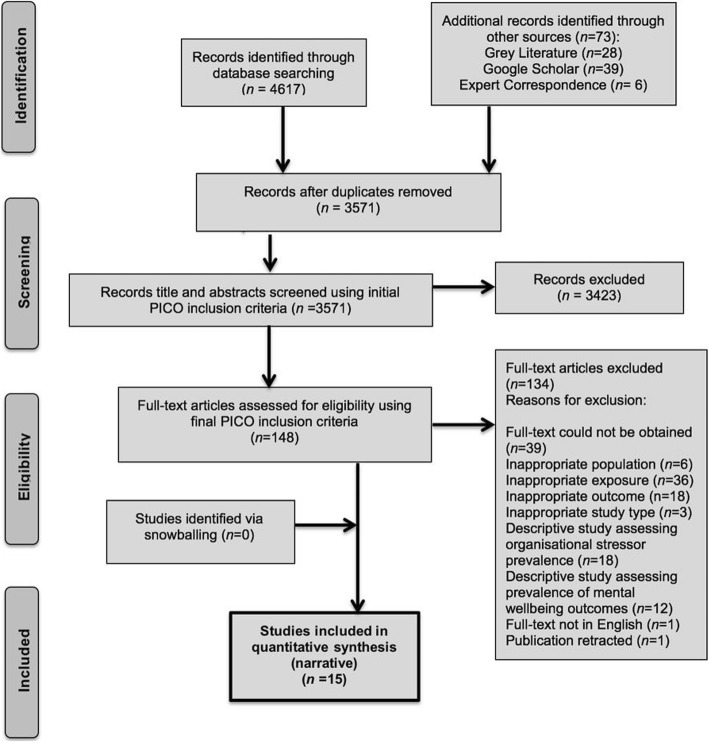
Background: Occupational stressors in police work increase the risk for officer mental health morbidities. Officers’ poor mental wellbeing is harmful to the individual, can affect professionalism, organisational effectiveness, and public safety. While the impact of operational stressors on officers’ mental wellbeing is well documented, no review has systematically investigated organisational stressor impacts. This study aimed to conduct a systematic review to assess the relationship between organisational stressors and police officer mental wellbeing. Methods: Systematic review conducted following PRISMA and Cochrane Collaboration guidelines. Literature search was undertaken from 1990 to May 2017 on four databases (EBSCOHOST Medline/SocINDEX/PsycINFO/OVID Embase) and grey literature. Included articles were critically appraised and assessed for risk of bias. Narrative and evidence syntheses were performed by specific mental health outcomes. Results: In total, 3571 results were returned, and 15 studies met the inclusion criteria. All included studies were published in English between 1995 and 2016, had cross-sectional study designs, spanned across four continents and covered 15,150 officers. Strong evidence of significant associations was identified for organisational stressors and the outcomes of: occupational stress, psychiatric symptoms/psychological distress, emotional exhaustion and personal accomplishment. The organisational stressors most often demonstrating consistently significant associations with mental health outcomes included lack of support, demand, job pressure, administrative/organisational pressure and long working-hours. Conclusions: This review is the first to systematically examine organisational stressors and mental health in police officers. Organisational stressors that can be targeted by interventions and policy changes to secure officer wellbeing, a healthy work environment, and benefits to the organisation and the public are identified.
Overview
The claims and statistics of this paper haven’t been checked yet.
Run the check — free, no account needed. It reads the open-access text and checks the sources it cites.
Integrity signals
Registry
Cites
Statistics
Figures
Verification
Claims the paper makes
The claims and statistics of this paper haven’t been checked yet.
Run the check — free, no account needed. It reads the open-access text and checks the sources it cites.
Claims other papers make about this one
Each is checked against this paper’s own text: does it say what the citing paper says it does?
The source backs part of the claim, not all of it — or backs it for a different population, condition or comparison.
In the citing paper
“Police activity is, thus, described in the literature as stressful, leading to poor physical and mental health outcomes over time, in which burnout is included”
From Psychosocial risk and protective factors associated with burnout in police officers: A systematic review (2023) · cites this paper as Purba and Demou, 2019
Experimental — accuracy not yet measuredThe source backs part of the claim, not all of it — or backs it for a different population, condition or comparison.
In the citing paper
“In terms or organisational factors, high job demands, effort-reward imbalance, low decision latitude, perceived injustice, low social sup port, lack of leadership, organisational culture, and working in urban environments were found to be associated with burnout, in line with the wide literature (Nieuwenhuijsen et al., 2010; Purba and Demou, 2019; Sherwood et al., 2019).”
From Psychosocial risk and protective factors associated with burnout in police officers: A systematic review (2023) · cites this paper as Purba and Demou, 2019
Experimental — accuracy not yet measured
Self-check
Percentages, sums and reported differences re-computed from the paper’s own numbers.
The self-check needs the paper’s full text.
Citations
Cites
Preferred reporting items for systematic reviews and meta-analyses: the PRISMA Statement.
(2009) · PubMed Central · Cited by 44,859
Preferred Reporting Items for Systematic Reviews and Meta-Analyses: The PRISMA Statement
Moher, D., Liberati, A., Tetzlaff, J., & Altman, D. G. (2009) · Journal of Clinical Epidemiology · doi:10.1016/j.jclinepi.2009.06.005 · Cited by 19,575
(2014) · Medical Entomology and Zoology · Cited by 17,633
Systematic reviews: CRD's guidance for undertaking reviews in health care
Tacconelli, E. (2010) · The Lancet Infectious Diseases · doi:10.1016/s1473-3099(10)70065-7 · Cited by 3,262
Popay, J., Roberts, H., Sowden, A., Petticrew, M., Arai, L., Rodgers, M., Britten, N., Roen, K., & Duffy, S. (2006) · Lancaster University · doi:10.13140/2.1.1018.4643 · Cited by 2,070
Psychosocial work environment and mental health—a meta-analytic review
Stansfeld, S., & Candy, B. (2006) · Scandinavian Journal of Work, Environment & Health · doi:10.5271/sjweh.1050 · Cited by 1,875
Babbie, E. R. (1998) · Cited by 1,729
Jha, A. (2023) · Routledge eBooks · doi:10.4324/9781032624860-3 · Cited by 1,665
Herzog, R., Álvarez-Pasquin, M. J., Díaz, C., Del Barrio, J. L., Estrada, J. M., & Gil, Á. (2013) · BMC Public Health · doi:10.1186/1471-2458-13-154 · Cited by 1,652
"The very best of the millennium": Longitudinal research and the demand-control-(support) model.
de Lange, A., Taris, T. W., Kompier, M. A. J., Houtman, I. L. D., & Bongers, P. M. (2003) · Journal of Occupational Health Psychology · doi:10.1037/1076-8998.8.4.282 · Cited by 1,105
Research works printed but not linked: 23
- Executive HS. Work related stress, anxiety and depression statistics in Great Britain 2016. Suffolk: Health and Safety Executive; 2016.
- COEH CfOEH. Occupational physicians reporting activiity. Quarterly report. Manchester: University of Manchester; 2000.
- Rollinson D. Organisational behaviour and analysis: an integrated appraoch. 3rd ed. London: Pearson Education Limited; 2005.
- Ward GE. Physiological, psychological and social issues specifically related to the police profession. Law Order. 1979;27(1):12.
- Policing Co. Code of ethics a code of practice for the principles and standards of professional behaviour for the policing profession of England and Wales. Coventry: College of Policing Ltd; 2014.
- Schaufeli WB, Maslach C, Marek T. Profesional burnout: recent developments in theory and research. Washington: Taylor & Francis; 1993.
- Territo L, Vetter HJ. Stress and police personnel. J Police Sci Adm. 1981;9(2):195–208.
- UNISON. 2014 police staff stress survey report. London: UNISON; 2014.
- Kroes WH. Society’s victims- the police: an analysis of job stress in policing. 2nd ed. Springfied: Charlie Thomas; 1985.
- Alexander DA, Innes G, Irving BL, Sinclair S, Walker LG. Health, stress and policing: a study in Grampion police. London: The Police Foundation; 1991.
- Alexander D, Walker L, Innes G, Irving B. Police stress at work. UK: Police Foundation; 1993.
- Koortzen P. The dimensionality of police stressors. Acta Criminologiae et Medicinae Legalis Japonica. 1996;9(2):55–63.
- Husain W. The levels of depression, anxiety and stress in police officers. Acad Res Int. 2014;5(4):458–65.
- Health and Safety Executive (HSE). Striking the balance between operational and health and safety duties in the police service. Suffolk: Health and Safety Executive; 2008.
- Higgins JP, Green S. Cochrane handbook for systematic reviews of interventions version 5.0.2. London: The Cochrane Collaboration; 2009.
- Torgerson C. Systematic reviews. London: Continuum; 2003.
- Bioethics NCo. The findings of a series of engagement activites exploring the culture of scientific research in the UK. London: Nuffield College of Bioethics; 2014.
- Boland A, Cherry G, Dickson R. Doing a systematic review a students guide. London: SAGE Publications; 2014.
- Bernard B. A critical review of epidemiological evidence for work-related muscoloskeletal disorders of the neck, upper extremity and low back. Cincinnati: National Institute for Occupational Safety and Health; 1997.
- Leka S, Griffiths A, Cox T. Protecting workers health series No 3: Work organization & stress. Geneva: World Health Organization (WHO); 2004.
- Xavier P, Prabhakar K. A study of police stress and burnout among Tamil Nadu police. Int J Pharm Sci Rev Res. 2016;38(2):159–61.
- Finn P, Tomz JE. Developing a law enforcement stress program for officers and their families. In: Issues and practices in criminal justice. Washington D.C: National Insitute of Justice; 1996.
- Elliot-Davies M, Houdmont J. Officer demand, capacity and welfare survey descriptive statistics summary report: mental health and wellbeing January 2017. Surrey: Police Federation of England and Wales (PFEW); 2017.
Cited by
Sorted by citations
Items 201–300 of 329
Non-pharmacological mental health interventions for law enforcement officers: A systematic review
Delgado, H. N., & Wu, Y. (2026) · Archives of Psychiatric Nursing · doi:10.1016/j.apnu.2026.152098 · Cited by 1
Good Cops in a Greedy Institution? Dutch Police Officers’ Stories of Compound Moral Injury
Eikenaar, T. (2026) · Journal of Business Ethics · doi:10.1007/s10551-026-06291-y · Cited by 1
Police Leadership Under Pressure: Job Demand Stress, Resources, and Psychological Health
Hankin, K., Drew, J. M., & Keech, J. J. (2026) · Police Quarterly · doi:10.1177/10986111261453772 · Cited by 1
Subjective Well-Being: Assessing the Stress, Job, and Life Satisfaction of Police Leaders
White, D. R., & Schafer, J. A. (2026) · Criminal Justice and Behavior · doi:10.1177/00938548261484630 · Cited by 1
Johari, M. A., Ahmad, S., & Ismail, Z. (2021) · International Journal of Academic Research in Business and Social Sciences · doi:10.6007/ijarbss/v11-i11/11779 · Cited by 1
“…terrorist attacks, limited human and material resources, criticism from the public and society, lack of understanding from friends and family that can affect their psychological well-being and cause physical fatigue (Queiros et al., 2020; Purba & Demou, 2019; Magnavita et al., 2018; Wang, 2010).”
Backgroundinterpretative phenomenological analysis of burnout among British police officers
Thomas, D. L. (2022) · Consciousness Spirituality & Transpersonal Psychology · doi:10.53074/cstp.2022.32 · Cited by 1
Police Mental Health in Ghana: Examining the Effects of Personality and Police Rank
Anum, A., Acquah, B., & Tutu, A. O. (2023) · Trends in Psychology · doi:10.1007/s43076-023-00302-x · Cited by 1
“A systematic review by Purba and Demou (2019) showed that there was evidence that supported associations between organizational stressors and the outcomes of occupational stress, psychiatric symptoms/psychological distress, emotional exhaustion, and personal accomplishment.”
Morley, R. H., Fulton, C. L., Bowman, S. W., & Trujillo, L. T. (2023) · Journal of Police and Criminal Psychology · doi:10.1007/s11896-023-09612-3 · Cited by 3
Rawdin, C. (2023) · Policing A Journal of Policy and Practice · doi:10.1093/police/paad074 · Cited by 1
“These ‘orga-nizational stressors’—including lack of support, job pressure, and workload—are significantly associated with poorer well-being and mental health outcomes for police officers (Purba and Demou, 2019).”
BackgroundHardiness and baton performance among police student trainees
Skoglund, T. H., Lie, A. L., Jakobsen, E. K., & Risan, P. (2023) · Policing A Journal of Policy and Practice · doi:10.1093/police/paad077 · Cited by 1
Rodrigues, C. M. L., Faiad, C., & Silva, M. C. (2024) · Revista Ciência & Polícia · doi:10.59633/2316-8765.2024.335 · Cited by 1
Trauma and Percieved Internal Support of Police Officers in Kenya
Ndero, P. K., Kimamo, C. O., & Mwaura, L. (2024) · American Journal of Psychology · doi:10.47672/ajp.1801 · Cited by 1
“On the whole in Kenya and elsewhere in the globe police work environment is not calibrated to yield trauma informed support for police officers and this constitutes a major research gap (Purba & Demou, 2019).”
BackgroundStress, job satisfaction, and workplace climate in Italian police workers
Maran, D. A., Grandi, A., & Colombo, L. (2024) · Policing A Journal of Policy and Practice · doi:10.1093/police/paae079 · Cited by 2
The Relevance of Mental Health Programmes in the Namibian Police Services
Haufiku, J., Mtetwa, E., & Javangwe, G. (2024) · Journal of Public Administration and Development Alternatives · doi:10.55190/jpada.2024.315 · Cited by 1
Krick, A., Schniedertüns, P., & Felfe, J. (2024) · Springer eBooks · doi:10.1007/978-3-658-44282-8_56-1 · Cited by 1
MS, D. J. L., Huynh, C., & Boehme, H. M. (2025) · Journal of Crime and Justice · doi:10.1080/0735648x.2025.2491131 · Cited by 1
“…the occupation (e.g., having to use deadly force, responding to a crime in progress, and witnessing traumatic events) as well as the organization (e.g., inconsistent leadership styles, bureaucratic red tape, and frequent policy changes) (Charman and Bennett 2022; Purba and Demou 2019; Shane 2010).”
Jones, M., Mojtahedi, D., & West, A. G. (2025) · Policing An International Journal · doi:10.1108/pijpsm-07-2024-0117 · Cited by 1
Intervensi Webinar : Cara Mengatasi Stres Kerja Pada Pekerja Wanita Yang Memiliki Peran Ganda
Putro, Q. D., Siregar, M. E. L., Pradita, L., Zahra, L., Siregar, M. E. L., & Grasiaswaty, N. (2021) · Surya Abdimas · doi:10.37729/abdimas.v5i4.1327 · Cited by 1
Rancic, N. K., Veljković, D., Mirković, M., Kulić, L., Jovanović, V., Stamenkovic, B. N., Maksimović, N., Ciric, V. M., Živković-Marinkov, E., Giljača, S., et al. (2023) · Preprints.org · doi:10.20944/preprints202308.0786.v1 · Cited by 1
Ajayi, C., & Ogunro, V. O. (2023) · Qeios · doi:10.32388/86xgis · Cited by 1
Occupational Stress and Coping Mechanism Among District Armed Reserve (DAR) Police, Karnataka, IndiaPreprint
Shonly, K. G., & Thekkel, S. T. (2024) · Research Square · doi:10.21203/rs.3.rs-5329873/v1 · Cited by 1
APRENDIZAGEM BASEADA NOS TRÊS MOMENTOS PEDAGÓGICOS
de Jesus, N. F. D. S., & Santos, C. D. J. (2021) · RFB Editora eBooks · doi:10.46898/rfb.9786558891130.24
Conclusions and Recommendations, Policy Implications, and Future Research
Johnson, O., Papazoglou, K., Violanti, J. M., & Pascarella, J. E. (2021) · Springer eBooks · doi:10.1007/978-3-030-83974-1_14
DOMENICO DE MASI NAS PRODUÇÕES ACADÊMICAS BRASILEIRAS
Lopes, K. M. V., da Silva, W. V., SOARES, T. V. L., & Darsie, M. M. P. (2021) · RFB Editora eBooks · doi:10.46898/rfb.9786558891130.27
Queirós, C. M. L., Fonseca, S. M., Faria, S., Cunha, S., Passos, F., Vara, N., & CAMPOS, R. C. (2021) · RISCOS - Associação Portuguesa de Riscos, Prevenção e Segurança eBooks · doi:10.34037/978-989-9053-06-9_1.2_33
Stress and Conflict During the Covid-19 Pandemic: The Impact on Petaling Jaya Police Officers
Rahman, F. A. A., Jody, J. M., Noor, N. H. M., Yusof, M. I. M., & Harsono, D. (2022) · Environment-Behaviour Proceedings Journal · doi:10.21834/ebpj.v7i19.3251
“Lack of support, demand, job pressure, administrative/organizational pressure, and long working hours were the most often identified organizational stressors with significant relationships with police mental health outcomes (Purba & Demou, 2019).”
BackgroundJohari, M., Ahmad, S., & Ismail, Z. (2022) · Jurnal Dunia Pengurusan · doi:10.55057/jdpg.2022.4.1.10
Oliveira, L. P. D. A. (2022) · Digital Library of Theses and Dissertations (Universidade de São Paulo) · doi:10.11606/t.5.2022.tde-28092022-091246
Santos, I. M. F., de Souza, V. H., Júnior, M. B. F., & da Silva, A. C. S. (2022) · Editora Omnis Scietia eBooks · doi:10.47094/978-65-5854-895-9/234-249
Huynh, C., Boehme, H. M., & MS, D. J. L. (2023) · Criminal Justice Review · doi:10.1177/07340168231154274 · Cited by 1
“Law enforcement of fi cers are frequently exposed to high levels of stress, which can stem from various aspects of the job and/or the organizational work environment (Adams & Buck, 2010; Purba & Demou, 2019; Shane, 2010; Violanti et al., 2016).”
СПЕЦИФІКА ЕМОЦІЙНИХ ПЕРЕЖИВАНЬ У РІЗНОВІКОВИХ ТА РІЗНОГЕНДЕРНИХ ГРУПАХ ПОЛІЦЕЙСЬКИХ
Reznik, K. (2023) · Дніпровський науковий часопис публічного управління психології права · doi:10.51547/ppp.dp.ua/2023.1.34
Assessment on the Level of Job Stress of the Police Officers during Pandemic in Tagum City
Parcon, G. F., Besgas, A. L., Almazan, R., Libres, J., & Olbes, J. J. (2023) · Journal of Legal Subjects · doi:10.55529//jls.33.22.25
ببناء الجاهزية: دراسة حالة للعوامل المهنية التي تؤثر على مستويات ‘السعادة’ لضباط شرطة أبو ظبي
الكعبي, ف. (2023) · Policing A Journal of Policy and Practice · doi:10.1093/police/paac088
Determinants of mental health of police officers: A pathway modelPreprint
Ryu, G. W. (2023) · Research Square · doi:10.21203/rs.3.rs-3219368/v1 · Cited by 1
Impact of Work on Emotional Well-being
Gupta, R. (2023) · Sushruta Journal of Health Policy & Opinions · doi:10.38192/15.3.3
Adaptive Management Strategy and Mental Wellbeing of the South Jakarta Metropolitan Police
Candrawati, N. K. A., Setyabudi, C. M., & -, B. S. (2023) · International Journal For Multidisciplinary Research · doi:10.36948/ijfmr.2023.v05i05.6830
“Emotional intelligence is the ability to recognize, understand, manage and use emotions effectively (Purba & Demou, 2019) .”
BackgroundIllias, M., Riach, K., & Demou, E. (2023) · Research Square · doi:10.21203/rs.3.rs-3499758/v1
Self-citationARSENIAN, M. B., & Giovani, É. M. (2023) · RGO - Revista Gaúcha de Odontologia · doi:10.1590/1981-86372023005420230047
“…feelings of exhaustion, frustration and tension; intermediate stage, characterized by depersonalization, professional insensitivity towards clients, colleagues and managers; and advanced stage, characterized by low personal fulfillment at work, self-deprecation, devaluation and isolation [13,14].”
BackgroundPENGARUH STRES KERJA TERHADAP KEPUASAN KERJA DENGAN COPING STYLE SEBAGAI MEDIASI
Aji, B. S., Abdillah, M. R., & Oemar, F. (2023) · Jurnal Daya Saing · doi:10.35446/dayasaing.v9i2.1048
Troubles mentaux courants et usage de la force dans la police : intérêts et enjeux
Telle, É., Pham, T. H., & Vicenzutto, A. (2024) · Annales Médico-psychologiques revue psychiatrique · doi:10.1016/j.amp.2023.12.006
Health Status of Traffic Police in Duhok Governorate, Kurdistan Region- Iraq
Hassan, N. E., Abdulrahman, S., & Abduljaleel, R. (2024) · Egyptian Academic Journal of Biological Sciences. C, Physiology and Molecular Biology/Egyptian Academic Journal of Biological Sciences. C, Physiology and Molecular Biology · doi:10.21608/eajbsc.2024.339958
Policiais militares em Fortaleza/Ceará, Brasil: quem são e a que tipo de violência estão expostos?
Carvalho, G. S. D. O., Lima, V. A. F., de Figueiredo, C. L. M., de Lima, T. F., Mota, R. M. S., & Macena, R. H. M. (2024) · Saúde (Santa Maria) · doi:10.5902/2236583469026
Psychometric properties and invariance of the Police Stress Questionnaire in the Romanian context
Petreuș, A.-D., Vîrgă, D., & Okros, N. (2024) · Current Psychology · doi:10.1007/s12144-024-06167-2 · Cited by 2
“…health complaints (high rates of cardiovascu - lar disease, substance abuse, burnout, and post-traumatic stress disorder) (Magnavita et al., 2018 ; Purba & Demou, 2019 ), and mental health complaints (anxiety, depression, behavioural/ emotional control, and general positive affect), on the one…”
InfluentialOlogunde, O. A., Ajayi, C., & Ogunro, V. O. (2024) · Qeios · doi:10.32388/86xgis.2
“…for the new employee, provision of safety and health policies, safety communication, education training on personal protective equipment, collaboration among management and employee representative which may lead to higher job satisfaction (Eskandari, 2017; Purba & Demou, 2019 ; Harrison, 2019).”
BackgroundResultStress among working women in the field of teaching
Anusya, A., & Chitra, V. (2024) · Journal of B-Research. · doi:10.26634/bresearch.24.1.20899
Korneeva, Y. A., Rykalov, R. А., Martirosova, N. V., & Simonova, N. N. (2024) · Moscow University Psychology Bulletin · doi:10.11621/lpj-24-24
Liang, Z., Zhang, M., Tang, T., Ye, H., Yang, M. J., Yao, M., Chen, J., Li, H., & Zeng, Y. (2024) · Research Square · doi:10.21203/rs.3.rs-4645839/v1
Leisure Satisfaction as a Predictor of Job Satisfaction and Performance Among Male Police OfficersPreprint
Akçakese, A., Tükel, Y., Demirel, M., & Çalış, M. (2024) · Research Square · doi:10.21203/rs.3.rs-5408150/v1
ESCALA DE DESAFIOS DOS PROFISSIONAIS DE SEGURANÇA PÚBLICA
Corrêa, J. S., Lopes, L. F. D., de Almeida, D. M., & Camargo, M. E. (2025) · Revista Brasileira de Segurança Pública · doi:10.31060/rbsp.2025.v19.n1.1937
Health-oriented Leadership (HoL) - Führungskompetenz in der Polizei
Krick, A., & Felfe, J. (2024) · Springer eBooks · doi:10.1007/978-3-658-44282-8_58-1
Thinking About Police Misconduct, Harm and Chronic Embitterment
McDaniel, J. L. M. (2025) · Critical criminological perspectives · doi:10.1007/978-3-031-83390-8_11
Era Disrupsi Teknologi Dan Dampaknya Pada Karakter Remaja
Musri, I., & Berek, F. (2023) · Jurnal Teologi Injili dan Pendidikan Agama · doi:10.55606/jutipa.v1i3.124
Ryu, G. W., & Choi, M. (2025) · Archives of Environmental & Occupational Health · doi:10.1080/19338244.2025.2510634
Supporting Police Well-Being Through an Adaptive Shift Management System: Co-Design Study
Ayorinde, O. T., Doğan, H., Adedoyin, F. F., Jiang, N., Bitters, F., & Dempsey, S. (2025) · JMIR Formative Research · doi:10.2196/69986 · Cited by 6
“Purba and Demou [22] highlighted the impact of occupational stressors such as lack of support, working long hours, high work demand, and administrative and organizational pressure [23], which have been significantly associated with negative mental health outcomes among police personnel [21].”
Relationship between burnout, job satisfaction and psychological wellbeing in Spanish Civil Guard
García-Guirao, N. M., Izquierdo, M. G., Giner-Alegría, C. A., & García, J. M. D. H. (2025) · Police Practice and Research · doi:10.1080/15614263.2025.2521503 · Cited by 2
“These findings are consistent with previous studies (Purba & Demou, 2019; Yun et al., 2015).”
Görev, Yetki ve Arabuluculuk Kavramlarının Psikolojik Taciz Açısından Değerlendirilmesi
Cengiz, S. (2025) · MEYAD Akademi · doi:10.59007/meyadakademi.1701505
Implementation of COVID-19 Policies by Philippine National Police Personnel in the Province of Capiz
Salido, C., Caduco, S., Celino, E., Barredo, J., & Prado, P. E. (2025) · Psychology and Education A Multidisciplinary Journal · doi:10.70838/pemj.420510
Yuan, Z., Liang, Z., Tang, T., Ye, H., Yang, M. J., Lin, F., Guo, Y. Q., & Zhang, M. (2025) · Research Square · doi:10.21203/rs.3.rs-6426286/v1
Prevalência de Transtornos Mentais e Comportamentais em uma Instituição Policial Brasileira
Pedraza, F. S., & Peres, A. J. D. S. (2025) · Revista Psicologia e Saúde · doi:10.20435/pssa.v1i1.2990
Gonçalves, S. G., Mesas, A. E., Bravo, D. S., Birolim, M. M., Guidoni, C. M., Nunes, E. D. F. P. D. A., Nierotka, R. P., & Rodrigues, R. (2025) · Epidemiologia e Serviços de Saúde · doi:10.1590/s2237-96222025v34e20240714.pt
Gonçalves, S. G., Mesas, A. E., Bravo, D. S., Birolim, M. M., Guidoni, C. M., Nunes, E. D. F. P. D. A., Nierotka, R. P., & Rodrigues, R. (2025) · Epidemiologia e Serviços de Saúde · doi:10.1590/s2237-96222025v34e20240714.en · Cited by 1
“Due to its importance, occupational stress, coexistence of greater work demands and less control over this process, commonly called high-strain work (11,12), has been associated with psychiatric symptoms, emotional exhaustion, mental suffering, and worse professional achievement (13).”
Bornales, J., & Besas, M. J. (2025) · Psychology and Education A Multidisciplinary Journal · doi:10.70838/pemj.440609
INTERVENÇÕES EM PROMOÇÃO E PREVENÇÃO EM SAÚDE MENTAL ENTRE PROFISSIONAIS DE SEGURANÇA PÚBLICA
da Costa, L. F., Madalozzo, M. M., Cioato, A. C., & Horn, É. L. D. V. (2025) · Revista Brasileira de Segurança Pública · doi:10.31060/rbsp.2025.v19.n2.2163
Small, V. (2025) · Springer eBooks · doi:10.1007/978-981-96-9558-4_1
“You’ll never get it out of your head”: the toll of SUID investigations on law enforcement officials
Snippen, J. R., Hofer, M. S., & McDonald, H. S. (2025) · Police Practice and Research · doi:10.1080/15614263.2025.2557532
“…by police have gained increasing attention in the United States (US) and the United Kingdom (UK) (Hanover et al., 2024; Porter & Gavin, 2024; Purba & Demou, 2019; Steel et al., 2021), and it has been shown that interactions with death are uncomfortable for law enforcement (Carpenter et al.,…”
Organizational Trauma Within Policing: A Case Study of the United Kingdom
Halford, E. (2025) · The Journal of Applied Behavioral Science · doi:10.1177/00218863251388133
“…examined in depth within policing, there is a substantial body of behavioral science literature addressing both the profession ’ s traumatic impact on individuals (see the review by Regehr et al., 2021) and the organizational stressors that in fl uence employee well-being (see Purba & Demou, 2019).”
Beyond the badge: organizational barriers to police anxiety and mental health support
Rawlinson, L., Harkin, B., Davies, L. E., & Yates, A. (2025) · Policing A Journal of Policy and Practice · doi:10.1093/police/paaf039
Illias, M., Riach, K., Basinas, I., Miller, J. K., Burchell, B. J., & Demou, E. (2025) · Policing A Journal of Policy and Practice · doi:10.1093/police/paaf037 · Cited by 1
Self-citationLima, A. D. G. T., de Santana, E. M., Barros, A. C., de Medeiros, S. E. G., Cavalcanti, D. D. F., & de Aquino, J. M. (2025) · Texto & Contexto - Enfermagem · doi:10.1590/1980-265x-tce-2025-0013en
Saúde mental no trabalho policial: burnout e modos de enfrentamento em duas corporações brasileiras
de Oliveira, J. F., dos Santos, F. B., Arroyo, T. R., Vieira, E., Borges, M. A., & Lourenção, L. G. (2025) · Revista Portuguesa de Investigação Comportamental e Social · doi:10.31211/rpics.2025.11.2.399
Izquierdo, M. G., García-Guirao, N. M., García, J. M. D. H., & Giner-Alegría, C. A. (2025) · Policing A Journal of Policy and Practice · doi:10.1093/police/paaf055
Huang, Y., Guo, H., Wang, S., Zhong, S., He, Y., Chen, H., Zhou, J., & Wang, X. (2024) · Figshare · doi:10.6084/m9.figshare.24934153
Garrido, M. V., Herold, R., Rohwer, E., Mache, S., Terschürenm, C., Preisser, A. M., & Harth, V. (2022) · Figshare · doi:10.6084/m9.figshare.20887260
Zhou, S., Li, M., Chen, S., Jiang, D., Qu, Y., & Xu, X. (2024) · Figshare · doi:10.6084/m9.figshare.26721762
Zhou, S., Li, M., Chen, S., Jiang, D., Qu, Y., & Xu, X. (2024) · Figshare · doi:10.6084/m9.figshare.26721765
Esther, B., & Obosi, A. C. (2023) · Research Square · doi:10.21203/rs.3.rs-3263840/v1
Wang, J., Huang, Y., Wang, S., Zhang, Z., He, Y., Wang, X., & Guo, H. (2024) · Figshare · doi:10.6084/m9.figshare.25271878
Illias, M., Riach, K., & Demou, E. (2024) · Figshare · doi:10.6084/m9.figshare.27129623
Self-citationJia, D., & Yuan, X. (2025) · Journal of medicine and physical education. · doi:10.62517/jmpe.202518310
Lambert, E. G., Qureshi, H., White, D. R., Hogan, N. L., Frank, J., & Barton, S. M. (2026) · Criminal Justice Studies · doi:10.1080/1478601x.2026.2615835
“The limited research to date on the well-being of police officers has focused on other areas than life satisfaction, such as depression or post-traumatic stress disorder (PTSD) (Anders et al., 2022; Copenhaver & Tewksbury, 2018; Purba & Demou, 2019).”
Moreno, A. F., Scharf, T., Hill, R., Vilalta, S. R., & Oliveira-Silva, P. (2025) · Policing A Journal of Policy and Practice · doi:10.1093/police/paaf065 · Cited by 3
Kazar, G., Üstün, D. C., Kadıoğlu, F., & Tokdemir, O. B. (2026) · Buildings · doi:10.3390/buildings16040776
Prevalence of Occupational Stress Among Female Police Officers in Dhaka Metropolitan Area
Akter, M. S., & Talukder, M. I. A. (2026) · American Behavioral Scientist · doi:10.1177/00027642261423338
Lourenção, L. G., dos Santos, F. B., Arroyo, T. R., Vieira, E., & Borges, M. A. (2026) · Psychiatry International · doi:10.3390/psychiatryint7020057 · Cited by 1
“Evidence on structured support initiatives and operational predictability also points to potentially protective institutional components that may be leveraged in prevention strategies [64–66].”
The dual Sides of the Police Badge: Understanding Well-being and Ill-being in a Police Organization
Araújo, A. C. A., Paschoal, T., & Ferreira, M. C. (2026) · Journal of Police and Criminal Psychology · doi:10.1007/s11896-026-09800-x
“Notable exceptions include Purba and Demou (2019), who conducted a systematic review on the relationship between organizational stressors and psychological well-being, and Cohen et al. (2019), who investigated sources of occupational and organizational stress in police work.”
Chen, W.-Y., Wang, W.-Y., Huang, Y.-H., Hsu, S. P. C., Wang, Y.-M., Ching-Po, L., & Sun, C.-W. (2026) · Scientific Reports · doi:10.1038/s41598-026-38896-8
Contreras, I. M., & Novaco, R. W. (2026) · Policing An International Journal · doi:10.1108/pijpsm-10-2025-0218
Esther, B., & Obosi, A. C. (2026) · BMC Psychology · doi:10.1186/s40359-026-04421-9 · Cited by 1
“” [17].”
Investigating Resilience, Burnout, and Empathy: An Exploratory Study of Small City Police Officers
Fansher, A. K., Fleming, J. C., & Zedaker, S. B. (2026) · Journal of Police and Criminal Psychology · doi:10.1007/s11896-026-09806-5 · Cited by 1
“…operational stressors (e.g., exposure to violence, high caseloads, bureaucratic constraints) and organizational stressors (e.g., unclear guidance, excessive paperwork) (Gershon et al., 2009; Hall et al., 2010 ; Purba & Demou, 2019; Santa Maria et al., 2018; Shane, 2010; Violanti et al., 2017).”
Comparación de los estilos de vida saludable, género y relaciones familiares de policías municipales
Landeros-Velázquez, M. G., Orea-Zarate, J. D., Peredo–Rivera, E., Paredes-Linares, A. Y., & Gutiérrez‐García, A. G. (2025) · Diversitas · doi:10.15332/22563067.10951
“Los agentes de policía tienen un alto riesgo de sufrir enfermedades cardiovasculares (Zimmerman, 2012), así como estrés, ansiedad y depresión Nelson & Smith, 2016; Purba & Demou, 2019).”
Coping under pressure: police-specific stressors and mental health in Catalonia police forces
Moreno, A. F., Oliveira‐Silva, P., Hill, R., & Vilalta, S. R. (2026) · Frontiers in Psychiatry · doi:10.3389/fpsyt.2026.1800257
Dupont, C., & Martin, J. (2025) · International Journal of Social and Psychological Aspects of Healthcare · doi:10.51847/71xixafrxn
Feasibility of Mindfulness Training for Police Officers at the Spanish National Police Academy
Navarrete, J., García-Salvador, M. Á., Rodríguez‐Freire, C., Feliu‐Soler, A., & Luciano, J. V. (2026) · Journal of Police and Criminal Psychology · doi:10.1007/s11896-026-09818-1
Schade, S., & Thielgen, M. M. (2026) · Springer eBooks · doi:10.1007/978-3-658-49902-0_2
Zeng, Q. (2026) · Journal of big data and computing. · doi:10.62517/jbdc.202601125
Szabó, C., & Udvardi-Zsoldos, P. (2026) · Belügyi Szemle · doi:10.38146/bsz-ajia.2026.v74.i5.pp1313-1328
Maurya, R. K., & Panchal, S. (2026) · Journal of Workplace Behavioral Health · doi:10.1080/15555240.2026.2690133
Building Trust, Handling Emotions, and Empowering Victims
Jarl, J., & Danell, J.-A. B. (2026) · Nordic Journal of Studies in Policing · doi:10.18261/njsp.13.1.9
“Purba and Demou (2019) report similar findings among domestic violence investigators, where officers described feeling exhausted after interactions with victims that required substantial emotional engagement, often referred to as emotional labor.”
Metadata
- Authors
- Purba, A., & Demou, E.
- Affiliations
- University of Glasgow (GB)
- MRC/CSO Social and Public Health Sciences Unit (GB)
- Corresponding author
- Demou, Evangelia
- Venue
- BMC Public Health
- Published
- 2019-10-15
- Volume
- 19
- Issue
- 1
- Pages
- 1286-1286
- ISSN
- 1471-2458 (ISSN-L)
- PMC
- PMC6792329
- OpenAlex
- W2980327373
- Cited by
- 328
- References
- 113
- Citations by year
- 2026: 59 · 2025: 51 · 2024: 70 · 2023: 59 · 2022: 43 · 2021: 34 · 2020: 12
- FWCI
- 3.44
- Type
- journal article
- Language
- en
- Open access
- gold
- doi.org
- Locations
- BMC Public Health (publishedVersion, cc-by)
- PubMed Central (publishedVersion, cc-by)
- PubMed (publishedVersion)
- ENLIGHTEN (Jurnal Bimbingan dan Konseling Islam) (acceptedVersion, cc-by-sa)
- DOAJ (DOAJ: Directory of Open Access Journals) (submittedVersion, cc-by-sa)
- Funders
- Medical Research Council (MC_PC_13027)
- Topics
- Social Sciences › Psychology › Social Psychology › Stress and Burnout Research
- Health Sciences › Medicine › Public Health, Environmental and Occupational Health › Workplace Health and Well-being
- Health Sciences › Medicine › Public Health, Environmental and Occupational Health › Occupational Health and Burnout
- Keywords
- organisational stressors, police officers, psychological well-being, occupational stress, psychological distress, emotional exhaustion, job demands, lack of support, long working hours, administrative pressure, police mental health
- MeSH terms
- Occupational Stress, Mental Disorders, Humans, Mental Health, Risk Factors, Police
About these checks
Registry, retraction, Cites and statistics results are computed, not judged, with one exception: a printed reference that no index lists is read once by a model before it counts as a citation error. Claims are extracted by a model and kept only when their quote appears verbatim in the text; each cited source is then checked, with a model’s help, for whether it says what the claim relies on. Those verdicts can be wrong — read the claim’s quote and the cited source before relying on one.
Statistics and arithmetic are recomputed, not judged.
Confidence bands are shown only for fields calibrated on our annotated test set. None is calibrated yet, so no band is shown.
What counts as a claim ›How we measure confidence ›How we check this ›
Are you an author, or do you see a problem with this page? Request a review
