

The DOI matches its Crossref record; 111 of the 113 references it cites were found in a registry or an index.
The relationship between organisational stressors and mental wellbeing within police officers: a systematic review
Open accessAbstract
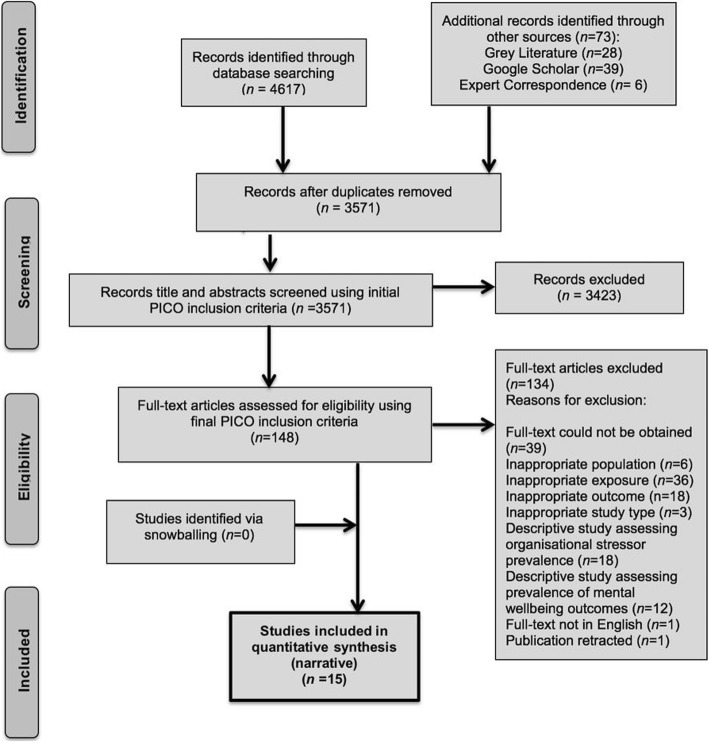
Background: Occupational stressors in police work increase the risk for officer mental health morbidities. Officers’ poor mental wellbeing is harmful to the individual, can affect professionalism, organisational effectiveness, and public safety. While the impact of operational stressors on officers’ mental wellbeing is well documented, no review has systematically investigated organisational stressor impacts. This study aimed to conduct a systematic review to assess the relationship between organisational stressors and police officer mental wellbeing. Methods: Systematic review conducted following PRISMA and Cochrane Collaboration guidelines. Literature search was undertaken from 1990 to May 2017 on four databases (EBSCOHOST Medline/SocINDEX/PsycINFO/OVID Embase) and grey literature. Included articles were critically appraised and assessed for risk of bias. Narrative and evidence syntheses were performed by specific mental health outcomes. Results: In total, 3571 results were returned, and 15 studies met the inclusion criteria. All included studies were published in English between 1995 and 2016, had cross-sectional study designs, spanned across four continents and covered 15,150 officers. Strong evidence of significant associations was identified for organisational stressors and the outcomes of: occupational stress, psychiatric symptoms/psychological distress, emotional exhaustion and personal accomplishment. The organisational stressors most often demonstrating consistently significant associations with mental health outcomes included lack of support, demand, job pressure, administrative/organisational pressure and long working-hours. Conclusions: This review is the first to systematically examine organisational stressors and mental health in police officers. Organisational stressors that can be targeted by interventions and policy changes to secure officer wellbeing, a healthy work environment, and benefits to the organisation and the public are identified.
Overview
The claims and statistics of this paper haven’t been checked yet.
Run the check — free, no account needed. It reads the open-access text and checks the sources it cites.
Integrity signals
Registry
Cites
Statistics
Figures
Verification
Claims the paper makes
The claims and statistics of this paper haven’t been checked yet.
Run the check — free, no account needed. It reads the open-access text and checks the sources it cites.
Claims other papers make about this one
Each is checked against this paper’s own text: does it say what the citing paper says it does?
The source backs part of the claim, not all of it — or backs it for a different population, condition or comparison.
In the citing paper
“Police activity is, thus, described in the literature as stressful, leading to poor physical and mental health outcomes over time, in which burnout is included”
From Psychosocial risk and protective factors associated with burnout in police officers: A systematic review (2023) · cites this paper as Purba and Demou, 2019
Experimental — accuracy not yet measuredThe source backs part of the claim, not all of it — or backs it for a different population, condition or comparison.
In the citing paper
“In terms or organisational factors, high job demands, effort-reward imbalance, low decision latitude, perceived injustice, low social sup port, lack of leadership, organisational culture, and working in urban environments were found to be associated with burnout, in line with the wide literature (Nieuwenhuijsen et al., 2010; Purba and Demou, 2019; Sherwood et al., 2019).”
From Psychosocial risk and protective factors associated with burnout in police officers: A systematic review (2023) · cites this paper as Purba and Demou, 2019
Experimental — accuracy not yet measured
Self-check
Percentages, sums and reported differences re-computed from the paper’s own numbers.
The self-check needs the paper’s full text.
Citations
Cites
Preferred reporting items for systematic reviews and meta-analyses: the PRISMA Statement.
(2009) · PubMed Central · Cited by 44,859
Preferred Reporting Items for Systematic Reviews and Meta-Analyses: The PRISMA Statement
Moher, D., Liberati, A., Tetzlaff, J., & Altman, D. G. (2009) · Journal of Clinical Epidemiology · doi:10.1016/j.jclinepi.2009.06.005 · Cited by 19,575
(2014) · Medical Entomology and Zoology · Cited by 17,633
Systematic reviews: CRD's guidance for undertaking reviews in health care
Tacconelli, E. (2010) · The Lancet Infectious Diseases · doi:10.1016/s1473-3099(10)70065-7 · Cited by 3,262
Popay, J., Roberts, H., Sowden, A., Petticrew, M., Arai, L., Rodgers, M., Britten, N., Roen, K., & Duffy, S. (2006) · Lancaster University · doi:10.13140/2.1.1018.4643 · Cited by 2,070
Psychosocial work environment and mental health—a meta-analytic review
Stansfeld, S., & Candy, B. (2006) · Scandinavian Journal of Work, Environment & Health · doi:10.5271/sjweh.1050 · Cited by 1,875
Babbie, E. R. (1998) · Cited by 1,729
Jha, A. (2023) · Routledge eBooks · doi:10.4324/9781032624860-3 · Cited by 1,665
Herzog, R., Álvarez-Pasquin, M. J., Díaz, C., Del Barrio, J. L., Estrada, J. M., & Gil, Á. (2013) · BMC Public Health · doi:10.1186/1471-2458-13-154 · Cited by 1,652
"The very best of the millennium": Longitudinal research and the demand-control-(support) model.
de Lange, A., Taris, T. W., Kompier, M. A. J., Houtman, I. L. D., & Bongers, P. M. (2003) · Journal of Occupational Health Psychology · doi:10.1037/1076-8998.8.4.282 · Cited by 1,105
Research works printed but not linked: 23
- Executive HS. Work related stress, anxiety and depression statistics in Great Britain 2016. Suffolk: Health and Safety Executive; 2016.
- COEH CfOEH. Occupational physicians reporting activiity. Quarterly report. Manchester: University of Manchester; 2000.
- Rollinson D. Organisational behaviour and analysis: an integrated appraoch. 3rd ed. London: Pearson Education Limited; 2005.
- Ward GE. Physiological, psychological and social issues specifically related to the police profession. Law Order. 1979;27(1):12.
- Policing Co. Code of ethics a code of practice for the principles and standards of professional behaviour for the policing profession of England and Wales. Coventry: College of Policing Ltd; 2014.
- Schaufeli WB, Maslach C, Marek T. Profesional burnout: recent developments in theory and research. Washington: Taylor & Francis; 1993.
- Territo L, Vetter HJ. Stress and police personnel. J Police Sci Adm. 1981;9(2):195–208.
- UNISON. 2014 police staff stress survey report. London: UNISON; 2014.
- Kroes WH. Society’s victims- the police: an analysis of job stress in policing. 2nd ed. Springfied: Charlie Thomas; 1985.
- Alexander DA, Innes G, Irving BL, Sinclair S, Walker LG. Health, stress and policing: a study in Grampion police. London: The Police Foundation; 1991.
- Alexander D, Walker L, Innes G, Irving B. Police stress at work. UK: Police Foundation; 1993.
- Koortzen P. The dimensionality of police stressors. Acta Criminologiae et Medicinae Legalis Japonica. 1996;9(2):55–63.
- Husain W. The levels of depression, anxiety and stress in police officers. Acad Res Int. 2014;5(4):458–65.
- Health and Safety Executive (HSE). Striking the balance between operational and health and safety duties in the police service. Suffolk: Health and Safety Executive; 2008.
- Higgins JP, Green S. Cochrane handbook for systematic reviews of interventions version 5.0.2. London: The Cochrane Collaboration; 2009.
- Torgerson C. Systematic reviews. London: Continuum; 2003.
- Bioethics NCo. The findings of a series of engagement activites exploring the culture of scientific research in the UK. London: Nuffield College of Bioethics; 2014.
- Boland A, Cherry G, Dickson R. Doing a systematic review a students guide. London: SAGE Publications; 2014.
- Bernard B. A critical review of epidemiological evidence for work-related muscoloskeletal disorders of the neck, upper extremity and low back. Cincinnati: National Institute for Occupational Safety and Health; 1997.
- Leka S, Griffiths A, Cox T. Protecting workers health series No 3: Work organization & stress. Geneva: World Health Organization (WHO); 2004.
- Xavier P, Prabhakar K. A study of police stress and burnout among Tamil Nadu police. Int J Pharm Sci Rev Res. 2016;38(2):159–61.
- Finn P, Tomz JE. Developing a law enforcement stress program for officers and their families. In: Issues and practices in criminal justice. Washington D.C: National Insitute of Justice; 1996.
- Elliot-Davies M, Houdmont J. Officer demand, capacity and welfare survey descriptive statistics summary report: mental health and wellbeing January 2017. Surrey: Police Federation of England and Wales (PFEW); 2017.
Cited by
Sorted by citations
Items 301–329 of 329
Police adverse career experiences (PACEs): development of a police in-service outcome survey tool
Halford, E. (2026) · Journal of Forensic Practice · doi:10.1108/jfp-10-2025-0102
Redefining talent in police organizations: a case study of Abu Dhabi police
Stubbs, G., Sebire, J., Altaee, S., Aljneibi, A., & Alfalahi, A. (2026) · Policing A Journal of Policy and Practice · doi:10.1093/police/paag034
Différences de genre et santé mentale en milieu policier : une revue de la littérature
Angehrn, A., & Desrochers, A. B. (2026) · Revue québécoise de psychologie · doi:10.7202/1126760ar
Deschênes, A.-A., Gendron, A., Marin, M., Émeriau-Farges, C., & Lapointe, F. (2026) · Revue québécoise de psychologie · doi:10.7202/1126764ar
Sondhi, A., Abinashi, D., Ward, R., & Williams, E. (2026) · Policing A Journal of Policy and Practice · doi:10.1093/police/paag038 · Cited by 1
Burnout of police oficers from the Krakow Garrison
Ostrowska, M., Podlasiński, C., Żurawski, S. K., Czternastek, M., & Wysokińśka-Senkus, A. (2026) · Journal of Modern Science · doi:10.13166/jms/224785
“Research conducted by Purba and Demou (2019) demonstrated that organizational stressors, workload and lack of institutional support significantly increase the risk of burnout among law enforcement personnel.”
Health Outcomes and Behavioral Risk Factors Among US Law Enforcement Officers
Kang, B., Lu, Y.-F., & Rogers, E. M. (2026) · American Journal of Preventive Medicine · doi:10.1016/j.amepre.2026.108529
Lin, K., Wu, Y., Ivković, S. K., Sun, I. Y., Chang, K.-M., Hong, J.-W., Maskály, J., & Neyroud, P. (2026) · Criminal Justice and Behavior · doi:10.1177/00938548261467877
“Similarly, Purba and Demou (2019), in a systematic review, identified organizational support, communication, and fairness as consistent predictors of improved mental well-being and reduced stress.”
InfluentialPolice officer wellness: findings from the national wellness survey for public safety personnel
Blalock, J. R., Tavakoli, A., Bourke, M. L., Black, R. A., & Hasselt, V. B. V. (2026) · Policing An International Journal · doi:10.1108/pijpsm-02-2026-0053
António, H., Albuquerque, S., de Castro, M. V., Bouchard, S., Gamito, P. S., & Pinto, R. J. (2026) · Psychiatry International · doi:10.3390/psychiatryint7040173
“Systematic evidence indicates that anxiety, depression, and general psychological distress are relevant mental health outcomes in this occupational group, supporting the need to examine psychological distress alongside PTSD symptom severity [7].”
Ricciardelli, R., & Carbonell, M. (2026) · Intelligence & National Security · doi:10.1080/02684527.2026.2707132
Prevalence And Factors Associated With Dysphonia In Military Police Officers
de Moraes, S. M., Teixeira, L. C., & de Medeiros, A. M. (2026) · Journal of Voice · doi:10.1016/j.jvoice.2026.07.046
Iloma, D. O. (2026) · OIDA International Journal of Sustainable Development · doi:10.64211/oidaijsd190902
Lau, B., Fostervold, K. I., & Bjørkelo, B. (2026) · International Archives of Occupational and Environmental Health · doi:10.1007/s00420-026-02231-5
“Systematic reviews show that officers are frequently exposed to psychosocial stressors such as heavy workload, irregular shift work, limited organizational support, and administrative pressures (Purba & Demou 2019; Ugwu & Idemudia 2024).”
Johnson, M. S., Johnson, S. U., Ko, H. M., Memon, A., Milne, R. J., & Baugerud, G. A. (2026) · Journal of Police and Criminal Psychology · doi:10.1007/s11896-026-09831-4
Quinito, R. (2026) · JPAIR Multidisciplinary Research · doi:10.7719/jpair.v66i1.1055
Fu, J., Chen, C., & Lai, X. (2026) · Frontiers in Psychology · doi:10.3389/fpsyg.2026.1955185
Malinowska-Borowska, J., Meiser, M., & Górski, M. K. (2026) · Frontiers in Public Health · doi:10.3389/fpubh.2026.1917062
Qiu, J., Lai, X., Deng, J., & Wang, K. (2026) · Frontiers in Psychology · doi:10.3389/fpsyg.2026.1938729
PERFIL E PADRÕES DE MORTALIDADE ENTRE POLICIAIS MILITARES BRASILEIROS: UMA REVISÃO INTEGRATIVA
Meneses, J. D. B., da Silva, C. S. O., Meneses, R. S. O. D. B., Bushatsky, M., & Andrade, E. S. D. S. (2026) · Revista Multidisciplinar do Nordeste Mineiro · doi:10.66104/994vvq58
Telle, É., Cornez, F., Pham, T. H., & Vicenzutto, A. (2026) · International Journal of Environmental Research and Public Health · doi:10.3390/ijerph23101260
On the Assessment of Potentially Traumatic Events and Posttraumatic Stress in Adults
Frewen, P., Pong, T., Morris, C., Bao, Z., & Bailey, T. (2026) · Journal of Health Service Psychology · doi:10.1007/s42843-026-00167-5
Occupational stress and mental health of police officers in Nigeria
Oladeji, B. D., Adefolarin, A. O., Oluwatobi, H., Oluwasanu, M. M., Titiloye, M. A., Unogu, M. O., Okafor, P., Ajayi, D. O., Uvere, E., & Ajuwon, A. J. (2026) · Work · doi:10.1177/10519815261493909
Sasi, A., Ravi, R., Olickal, J. J., & Thankappan, K. R. (2026) · Frontiers in Public Health · doi:10.3389/fpubh.2026.1949658
ICHKI ISHLAR XODIMLARIDA KASBIY STRESSGA BARDOSHLILIKNI RIVOJLANTIRISHNING PSIXOLOGIK ASOSLARI
Jo'rayevich, S. X. (2026) · Buxoro xalqaro universiteti ilmiy axborotnomasi · doi:10.67780/buxoro-xalqaro-universiteti-ilmiy-axborotnomasi.2026.40284623
Discipline, and wellbeing in An Garda Síochána: An Irish policing case study
Sweeney, K. W. (2026) · The Police Journal Theory Practice and Principles · doi:10.1177/0032258x261498336
Alaniz, K., White, D. R., Ingram, J. R., & Schafer, J. A. (2026) · Criminal Justice and Behavior · doi:10.1177/00938548261497196
Aquino-Santos, H. C., Tavares‐Vasconcelos, J. S., Silva-Reis, A., Brandão-Rangel, M. A. R., Morais‐Felix, R. T., Santa‐Rosa, F. A., Bachi, A. L. L., Soares, V., Salehian, O., Frison, C. R., et al. (2026) · Experimental Physiology · doi:10.1113/ep094113
“However, previous studies have demonstrated that chronic exposure to stressful occupational environments might induce habituation phenomena and alter stress perception, particularly in tactical and emergency-response professions (Purba and Demou, 2019).”
Metadata
- Authors
- Purba, A., & Demou, E.
- Affiliations
- University of Glasgow (GB)
- MRC/CSO Social and Public Health Sciences Unit (GB)
- Corresponding author
- Demou, Evangelia
- Venue
- BMC Public Health
- Published
- 2019-10-15
- Volume
- 19
- Issue
- 1
- Pages
- 1286-1286
- ISSN
- 1471-2458 (ISSN-L)
- PMC
- PMC6792329
- OpenAlex
- W2980327373
- Cited by
- 328
- References
- 113
- Citations by year
- 2026: 59 · 2025: 51 · 2024: 70 · 2023: 59 · 2022: 43 · 2021: 34 · 2020: 12
- FWCI
- 3.44
- Type
- journal article
- Language
- en
- Open access
- gold
- doi.org
- Locations
- BMC Public Health (publishedVersion, cc-by)
- PubMed Central (publishedVersion, cc-by)
- PubMed (publishedVersion)
- ENLIGHTEN (Jurnal Bimbingan dan Konseling Islam) (acceptedVersion, cc-by-sa)
- DOAJ (DOAJ: Directory of Open Access Journals) (submittedVersion, cc-by-sa)
- Funders
- Medical Research Council (MC_PC_13027)
- Topics
- Social Sciences › Psychology › Social Psychology › Stress and Burnout Research
- Health Sciences › Medicine › Public Health, Environmental and Occupational Health › Workplace Health and Well-being
- Health Sciences › Medicine › Public Health, Environmental and Occupational Health › Occupational Health and Burnout
- Keywords
- organisational stressors, police officers, psychological well-being, occupational stress, psychological distress, emotional exhaustion, job demands, lack of support, long working hours, administrative pressure, police mental health
- MeSH terms
- Occupational Stress, Mental Disorders, Humans, Mental Health, Risk Factors, Police
About these checks
Registry, retraction, Cites and statistics results are computed, not judged, with one exception: a printed reference that no index lists is read once by a model before it counts as a citation error. Claims are extracted by a model and kept only when their quote appears verbatim in the text; each cited source is then checked, with a model’s help, for whether it says what the claim relies on. Those verdicts can be wrong — read the claim’s quote and the cited source before relying on one.
Statistics and arithmetic are recomputed, not judged.
Confidence bands are shown only for fields calibrated on our annotated test set. None is calibrated yet, so no band is shown.
What counts as a claim ›How we measure confidence ›How we check this ›
Are you an author, or do you see a problem with this page? Request a review
