

Weight stigma experiences and self-exclusion from sport and exercise settings among people with obesity
Open accessThe DOI matches its Crossref record; 77 of the 77 references it cites were found in a registry or an index.
Abstract
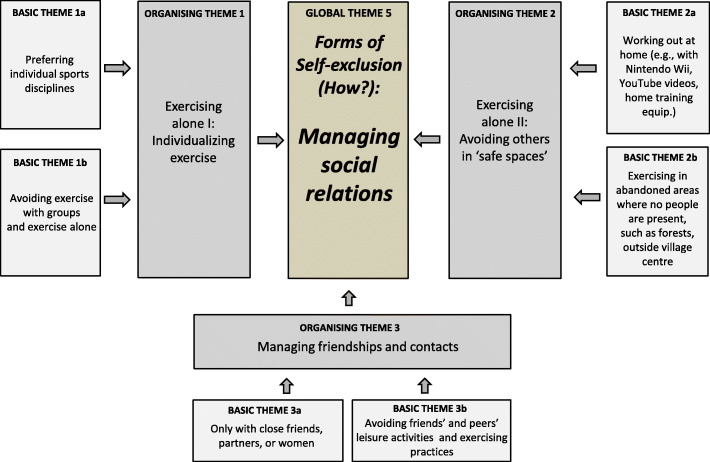
Background: A central strategy to tackle the health risks of obesity is regular physical activity (PA), exercising and participating in sports. However, people with obesity regularly experience weight-related stigma and discrimination in sport and exercise settings. Research has indicated that they often cope with such experiences by simply excluding themselves from sport and exercise. Meanwhile, self-exclusion as a coping strategy has not been fully understood and it remains unclear to what extent self-exclusion from PA settings is accompanied by general inactivity among people with obesity. The goal of this interview study was to determine to what extent physical inactivity among adults with obesity is the result of weight stigma-induced self-exclusion in and from sport and PA settings. Methods: We conducted semi-structured interviews with thirty adult men and women with obesity (average BMI: 40.64) and asked them about experiences with their body, weight stigma and coping behaviours in sport and exercise settings across their lifespans. Employing constant comparative analysis and a thematic network approach, we analysed the interview data to identify the most common reasons for and different strategies of self-exclusion. Results: Participants reported that they excluded themselves from sport and exercise settings due to traumatic weight stigma experiences, self-discrimination and fear of stigma, using a variety of strategies. Exposure to discrimination was prevented by selectively avoiding certain settings or strategically frequenting them at certain times only, but also by exercising in ‘safe’ spaces, e.g. at home. Furthermore, people with obesity reported strategically managing their social relations in order to avoid stigmatising reactions by others in exercise settings, for example by exercising individually and avoiding social PA. Most notably, our results strongly indicate that not all self-excluding coping strategies result in less exercising. Conclusions: In order to successfully promote physical activity among people with obesity, the various forms of self-exclusion should be taken into account as pathways of stigma regarding physical activity. People with obesity may exclude themselves from certain PA settings, yet could still be exercising on their own or in other ways. One focus of public health strategies should thus be directed at the potentially socially isolating effects.
Overview
The claims and statistics of this paper haven’t been checked yet.
Free: it reads the open-access text and checks the first 5 claims that cite a source we can check. Create a free account to check every claim.
Integrity signals
Registry
Cites
Statistics
Figures
Verification
Claims the paper makes
The claims and statistics of this paper haven’t been checked yet.
Free: it reads the open-access text and checks the first 5 claims that cite a source we can check. Create a free account to check every claim.
Self-check
Percentages, sums and reported differences re-computed from the paper’s own numbers.
The self-check needs the paper’s full text.
Citations
Cites
The social construction of reality : a treatise in the sociology of knowledge
Simpson, G., Berger, P. L., & Luckmann, T. (1967) · American Sociological Review · doi:10.2307/2091739 · Cited by 16,462
Stigma: Notes on the Management of Spoiled Identity
(1969) · Postgraduate Medical Journal · doi:10.1136/pgmj.45.527.642 · Cited by 14,231
Stigma: Notes on the Management of Spoiled Identity.
Seeman, M., & Goffman, E. (1964) · American Sociological Review · doi:10.2307/2091442 · Cited by 10,716
Link, B. G., & Phelan, J. C. (2001) · Annual Review of Sociology · doi:10.1146/annurev.soc.27.1.363 · Cited by 8,848
Lippa, N. C., & Sanderson, S. C. (2013) · Human Heredity · doi:10.1159/000353712 · Cited by 6,078
Thematic networks: an analytic tool for qualitative research
Attride-Stirling, J. (2001) · Qualitative Research · doi:10.1177/146879410100100307 · Cited by 5,506
The Social Construction of Reality: A Treatise in the Sociology of Knowledge
Gustafson, J. M., Berger, P. L., Luckmann, T., & Luckmann, T. (1968) · Journal for the Scientific Study of Religion · doi:10.2307/1385127 · Cited by 4,311
Levesque, R. J. R. (2017) · Encyclopedia of Adolescence · doi:10.1007/978-3-319-32132-5_447-2 · Cited by 4,021
The Stigma of Obesity: A Review and Update
Puhl, R. M., & Heuer, C. A. (2009) · Obesity · doi:10.1038/oby.2008.636 · Cited by 3,323
Series: Practical guidance to qualitative research. Part 4: Trustworthiness and publishing
Korstjens, I., & Moser, A. (2018) · European Journal of General Practice · doi:10.1080/13814788.2017.1375092 · Cited by 3,217
Social determinants of health: the solid facts
Wilkinson, R. G., & Marmot, M. G. (2003) · University Libraries (University of Maryland) · doi:10.13016/yroj-yfcz · Cited by 2,709
Routledge Handbook of Qualitative Research in Sport and Exercise
(2016) · Routledge eBooks · doi:10.4324/9781315762012 · Cited by 2,015
Obesity Stigma: Important Considerations for Public Health
Puhl, R. M., & Heuer, C. A. (2010) · American Journal of Public Health · doi:10.2105/ajph.2009.159491 · Cited by 1,917
The paradox of self-stigma and mental illness.
Corrigan, P. W., & Watson, A. C. (2002) · Clinical Psychology: Science and Practice · doi:10.1093/clipsy.9.1.35 · Cited by 1,872
Stigma and its public health implications
Link, B. G., & Phelan, J. C. (2006) · The Lancet · doi:10.1016/s0140-6736(06)68184-1 · Cited by 1,498
Cognitive Processes in Stereotyping and Intergroup Behavior
(2015) · Psychology Press eBooks · doi:10.4324/9781315668758 · Cited by 1,476
Collecting data using a semi‐structured interview: a discussion paper
Louise Barriball, K., & While, A. (1994) · Journal of Advanced Nursing · doi:10.1111/j.1365-2648.1994.tb01088.x · Cited by 1,464
Joint international consensus statement for ending stigma of obesity
Rubino, F., Puhl, R. M., Cummings, D. E., Eckel, R. H., Ryan, D. H., Mechanick, J. I., Nadglowski, J., Ramos Salas, X., Schauer, P. R., Twenefour, D., et al. (2020) · Nature Medicine · doi:10.1038/s41591-020-0803-x · Cited by 1,152
Confronting and Coping with Weight Stigma: An Investigation of Overweight and Obese Adults
Puhl, R. M., & Brownell, K. D. (2006) · Obesity · doi:10.1038/oby.2006.208 · Cited by 1,041
Increases in morbid obesity in the USA: 2000–2005
Sturm, R. (2007) · Public Health · doi:10.1016/j.puhe.2007.01.006 · Cited by 727
(2012) · SpringerReference · doi:10.1007/springerreference_223608 · Cited by 714
Health Consequences of Weight Stigma: Implications for Obesity Prevention and Treatment
Puhl, R., & Suh, Y. (2015) · Current Obesity Reports · doi:10.1007/s13679-015-0153-z · Cited by 654
Weight bias internalization and health: a systematic review
Pearl, R. L., & Puhl, R. M. (2018) · Obesity Reviews · doi:10.1111/obr.12701 · Cited by 642
Obesity stigmatization and coping: Relation to mental health symptoms, body image, and self-esteem
Myers, A., & Rosen, J. (1999) · International Journal of Obesity · doi:10.1038/sj.ijo.0800765 · Cited by 555
Wu, Y., & Berry, D. C. (2018) · Journal of Advanced Nursing · doi:10.1111/jan.13511 · Cited by 536
Influence of peers and friends on children's and adolescents' eating and activity behaviors
Salvy, S.-J., de la Haye, K., Bowker, J. C., & Hermans, R. C. J. (2012) · Physiology & Behavior · doi:10.1016/j.physbeh.2012.03.022 · Cited by 486
Is Fat a Feminist Issue? Exploring the Gendered Nature of Weight Bias
Fikkan, J. L., & Rothblum, E. D. (2012) · Sex Roles · doi:10.1007/s11199-011-0022-5 · Cited by 455
Meisenbach, R. J. (2010) · Journal of Applied Communication Research · doi:10.1080/00909882.2010.490841 · Cited by 432
Vartanian, L. R., & Shaprow, J. G. (2008) · Journal of Health Psychology · doi:10.1177/1359105307084318 · Cited by 401
Weight stigmatization and bias reduction: perspectives of overweight and obese adults
Puhl, R. M., Moss-Racusin, C. A., Schwartz, M. B., & Brownell, K. D. (2007) · Health Education Research · doi:10.1093/her/cym052 · Cited by 389
Internalized Societal Attitudes Moderate the Impact of Weight Stigma on Avoidance of Exercise
Vartanian, L. R., & Novak, S. A. (2011) · Obesity · doi:10.1038/oby.2010.234 · Cited by 381
Qualitative Sozialforschung: Lehrbuch
Lamnek, S. (2005) · Cited by 355
Series: Practical guidance to qualitative research
Moser, A., & Korstjens, I. (2017) · Cited by 350
Hunger, J. M., Major, B., Blodorn, A., & Miller, C. T. (2015) · Social and Personality Psychology Compass · doi:10.1111/spc3.12172 · Cited by 332
Intersectionality: An Understudied Framework for Addressing Weight Stigma
Himmelstein, M. S., Puhl, R. M., & Quinn, D. M. (2017) · American Journal of Preventive Medicine · doi:10.1016/j.amepre.2017.04.003 · Cited by 302
Efficacy of Maintenance Treatment Approaches for Childhood Overweight: A Randomized Controlled Trial
Wilfley, D. E., Stein, R. I., Saelens, B. E., Mockus, D. S., Matt, G. E., Hayden-Wade, H. A., Welch, R. R., Schechtman, K. B., Thompson, P. A., & Epstein, L. H. (2007) · JAMA · doi:10.1001/jama.298.14.1661 · Cited by 277
Lewis, S., Thomas, S. L., Blood, R. W., Castle, D. J., Hyde, J., & Komesaroff, P. A. (2011) · Social Science & Medicine · doi:10.1016/j.socscimed.2011.08.021 · Cited by 237
A Categorization Approach to Stereotyping
(2015) · Cognitive Processes in Stereotyping and Intergroup Behavior · doi:10.4324/9781315668758-9 · Cited by 216 · cited 1×
“The next component of Link and Phelan’s concept is stereotyping [6]: as a result of being categorised as different and deviant, a labelled person gets pigeonholed by linking him or her to the group with same deviant characteristic [6, 7].”
BackgroundTeam Sports for Overweight Children: The Stanford Sports to Prevent Obesity Randomized Trial (SPORT)
Weintraub, D. L., Tirumalai, E. C., Haydel, K. F., Fujimoto, M., Fulton, J. E., & Robinson, T. N. (2008) · Archives of Pediatrics & Adolescent Medicine · doi:10.1001/archpediatrics.2007.43 · Cited by 197
What's in a Word? On Weight Stigma and Terminology
Meadows, A., & Daníelsdóttir, S. (2016) · Frontiers in Psychology · doi:10.3389/fpsyg.2016.01527 · Cited by 174 · cited 4×
“Reporting an expert discussion on terminology and best practice from the 2015 Annual International Weight Stigma Conference, Meadows and Daníelsdóttir [2] point out that using the term ‘obesity’ itself is also problematic because it is based on “the medicalization of body state” ( [2] p.”
BackgroundInfluentialPearl, R. L., Puhl, R. M., & Dovidio, J. F. (2015) · Journal of Health Psychology · doi:10.1177/1359105313520338 · Cited by 165 · cited 1×
“Our results also support recent findings that the internalisation of weight stigma has an effect on exercise behaviour [38, 39, 41].”
ResultPearl, R. L., Wadden, T. A., Hopkins, C. M., Shaw, J. A., Hayes, M. R., Bakizada, Z. M., Alfaris, N., Chao, A. M., Pinkasavage, E., Berkowitz, R. I., et al. (2017) · Obesity · doi:10.1002/oby.21716 · Cited by 162
Becoming “the fat girl”: Acquisition of an unfit identity
Rice, C. (2007) · Women's Studies International Forum · doi:10.1016/j.wsif.2007.01.001 · Cited by 142
Chrisler, J. C., & Barney, A. (2016) · Fat Studies · doi:10.1080/21604851.2016.1213066 · Cited by 132
Football to tackle overweight in children
Faude, O., Kerper, O., Multhaupt, M., Winter, C., Beziel, K., Junge, A., & Meyer, T. (2010) · Scandinavian Journal of Medicine & Science in Sports · doi:10.1111/j.1600-0838.2009.01087.x · Cited by 117
Fatness, Fitness, and the Moral Universe of Sport and Physical Activity
Zanker, C. L., & Gard, M. (2008) · Sociology of Sport Journal · doi:10.1123/ssj.25.1.48 · Cited by 103 · cited 1×
“Sport- and exercise-related settings have a high potential for weight-related stigma and discrimination [3, 4, 24].”
BackgroundJackson, S. E., & Steptoe, A. (2017) · BMJ Open · doi:10.1136/bmjopen-2016-014592 · Cited by 103
Saguy, A. C. (2011) · Sex Roles · doi:10.1007/s11199-011-0084-4 · Cited by 88
Weight stigma and health: The mediating role of coping responses.
Himmelstein, M. S., Puhl, R. M., & Quinn, D. M. (2018) · Health Psychology · doi:10.1037/hea0000575 · Cited by 88
Obesity, stigma and reflexive embodiment: Feeling the ‘weight’ of expectation
Williams, O., & Annandale, E. C. (2018) · Health An Interdisciplinary Journal for the Social Study of Health Illness and Medicine · doi:10.1177/1363459318812007 · Cited by 84
Schmalz, D. L. (2010) · Obesity Facts · doi:10.1159/000273210 · Cited by 82
The experience of weight stigma among gym members with overweight and obesity.
Schvey, N. A., Sbrocco, T., Bakalar, J. L., Ress, R., Barmine, M., Gorlick, J., Pine, A., Stephens, M., & Tanofsky-Kraff, M. (2017) · Stigma and Health · doi:10.1037/sah0000062 · Cited by 81
Big Girls Don’t Cry: Fitness, Fatness, and the Production of Feminist Knowledge
Scott-Dixon, K. (2008) · Sociology of Sport Journal · doi:10.1123/ssj.25.1.22 · Cited by 74
Thomas, S. L., Olds, T., Pettigrew, S., Randle, M., & Lewis, S. C. (2014) · Social Science & Medicine · doi:10.1016/j.socscimed.2014.08.024 · Cited by 71
Exposure to Weight-Stigmatizing Media: Effects on Exercise Intentions, Motivation, and Behavior
Pearl, R. L., Dovidio, J. F., Puhl, R. M., & Brownell, K. D. (2015) · Journal of Health Communication · doi:10.1080/10810730.2015.1018601 · Cited by 63
Pickett, A. C., & Cunningham, G. B. (2017) · Quest · doi:10.1080/00336297.2016.1145129 · Cited by 63
Meadows, A., & Bombak, A. E. (2019) · Fat Studies · doi:10.1080/21604851.2019.1550303 · Cited by 61
A Qualitative Investigation of Obese Men's Experiences With Their Weight
Lewis, S. C., Thomas, S. L., Hyde, J., Castle, D. J., & Komesaroff, P. A. (2011) · American Journal of Health Behavior · doi:10.5993/ajhb.35.4.8 · Cited by 60
Running Big: Clydesdale Runners and Technologies of the Body
Chase, L. F. (2008) · Sociology of Sport Journal · doi:10.1123/ssj.25.1.130 · Cited by 57
Siegel, J. A., Huellemann, K. L., Hillier, C. C., & Campbell, L. (2020) · Body Image · doi:10.1016/j.bodyim.2019.12.003 · Cited by 55
Myre, M., Glenn, N. M., & Berry, T. R. (2020) · Qualitative Research in Sport Exercise and Health · doi:10.1080/2159676x.2020.1751690 · Cited by 53 · cited 7×
“The extent to which stigmatisation and discrimination have an effect on the willingness to be physically active depends on how people with obesity respond to and cope with weight stigma experiences [9], specifically those occurring when exercising [42, 43].”
BackgroundResultInfluentialLosekam, S., Goetzky, B., Kraeling, S., Rief, W., & Hilbert, A. (2010) · Obesity Facts · doi:10.1159/000319433 · Cited by 52
Fighting Fat: How Do Fat Stereotypes Influence Beliefs About Physical Education?
Greenleaf, C. A., Martin, S. B., & Rhea, D. (2008) · Obesity · doi:10.1038/oby.2008.454 · Cited by 50
Everyday Indignities: Using the Microaggressions Framework to Understand Weight Stigma
Munro, L. (2017) · The Journal of Law Medicine & Ethics · doi:10.1177/1073110517750584 · Cited by 45
Thiel, A., Thedinga, H. K., Thomas, S. L., Barkhoff, H., Giel, K. E., Schweizer, O., Thiel, S., & Zipfel, S. (2016) · BMC Public Health · doi:10.1186/s12889-016-3392-3 · Cited by 43
Self-citationDiscrimination: What it is, and how to cope
(2018) · PsycEXTRA Dataset · doi:10.1037/e503852018-001 · Cited by 39
Weight Stigma Experiences and Physical (In)activity: A Biographical Analysis
Thiel, A., John, J. M., Carl, J., & Thedinga, H. K. (2020) · Obesity Facts · doi:10.1159/000507936 · Cited by 38
Self-citationCachay, K., & Thiel, A. (2000) · Juventa eBooks · Cited by 36
Self-citationPutting the Fun into Physical Activity
Henderson, K. A., Glancy, M., & Little, S. L. (1999) · Journal of Physical Education Recreation & Dance · doi:10.1080/07303084.1999.10605706 · Cited by 34
Walsh, O. A., Wadden, T. A., Tronieri, J. S., Chao, A. M., & Pearl, R. L. (2018) · Frontiers in Psychology · doi:10.3389/fpsyg.2018.02576 · Cited by 23 · cited 1×
“For example, “persons with overweight and obesity report sharing society’s biased attitudes toward excess weight, believing that they, in fact, are lazy, undisciplined, or otherwise undesirable because of their weight” ([13] p.”
Background“Fat” Chicks Who Run: Stigma Experienced by “Overweight” Endurance Athletes
Inderstrodt, J. M., & Acharya, L. (2017) · Journal of Sport and Social Issues · doi:10.1177/0193723517747884 · Cited by 17
Medzani, J. M. (2020) · International Journal of Social Research Methodology · doi:10.1080/13645579.2020.1798682 · Cited by 16 · cited 2×
“outsider perspective [22], none of the authors would self-identify as overweight.”
BackgroundBody Weight Stigma in Physical Activity Settings
Pickett, A. C., & Cunningham, G. B. (2018) · American journal of health studies · doi:10.47779/ajhs.2018.53 · Cited by 15
Athletic Fatness: Forgiving Corpulence in Elite Bodies
Jamieson, K. M., Stringer, A., & Andrews, M. B. (2008) · Sociology of Sport Journal · doi:10.1123/ssj.25.1.148 · Cited by 11
Carl, J., Thedinga, H. K., Zipfel, S., & Thiel, A. (2018) · Obesity Facts · doi:10.1159/000487889 · Cited by 10
Self-citationEditorial: The Implications of Weight Bias Internalization
Flint, S. W., Raisborough, J., & Hudson, J. (2020) · Frontiers in Psychology · doi:10.3389/fpsyg.2019.03019 · Cited by 6
Körperlichkeit als Devianz. Zur sozialen Konstruktion des übergewichtigen Körpers und ihrer Folgen
Thiel, A., Giel, K. E., Thedinga, H. K., & Zipfel, S. (2016) · Zfk - Zeitschrift für Kulturwissenschaften · doi:10.14361/zfk-2016-0204 · Cited by 5
Self-citation
Research works printed but not linked: 4
- Ellison J Rothblum ED Solovay S Not Jane Fonda: aerobics for fat women only The Fat Studies Reader 2009
- Brennan S Isaacs T Fit at mid-life: a feminist fitness journey 2018 Greystone Books Ltd
- Thomas SL Brownell KD Anti-obesity messaging strategies. The Rudd Report Podcast 2011 Yale University
- UConn Rudd Center for Food Policy & Obesity Media Gallery 2021 University of Conneticut
Cited by
Obesity Stigma: Causes, Consequences, and Potential Solutions
Westbury, S., Oyebode, O., van Rens, T., & Barber, T. M. (2023) · Current Obesity Reports · doi:10.1007/s13679-023-00495-3 · Cited by 317
Curran, F., Davis, M. E., Murphy, K., Tersigni, N., King, A., Ngo, N., & O’Donoghue, G. (2023) · Obesity Reviews · doi:10.1111/obr.13615 · Cited by 86
Obesity stigma and its impact on health: A narrative review
Sánchez‐Carracedo, D. (2022) · Endocrinología Diabetes y Nutrición (English ed ) · doi:10.1016/j.endien.2021.12.007 · Cited by 60
Lifestyle Medicine for Obesity in the Era of Highly Effective Anti-Obesity Treatment
Sannidhi, D., Abeles, R., Andrew, W., Bonnet, J. P., Vitale, K., Niranjan, V., Gulati, M., Pauly, K., Moran, R., Alexander, L., et al. (2025) · Nutrients · doi:10.3390/nu17142382 · Cited by 29
“There is evidence that people with obesity self-exclude from sports due to stigma [61].”
The real‐life experiences of people living with overweight and obesity: A psychosocial perspective
Flint, S. W., Vázquez‐Velázquez, V., Brocq, S. L., & Brown, A. C. (2025) · Diabetes Obesity and Metabolism · doi:10.1111/dom.16255 · Cited by 35
“68 These experiences increase the risk of psychosocial decrements, and lead to mitigating behaviours including avoidance of physical activity, exercising individually or modifying exercise environments.”
Metadata
- Authors
- Thedinga, H. K., Zehl, R., & Thiel, A.
- Affiliations
- University of Tübingen (DE)
- University of Bern (CH)
- Corresponding author
- Thedinga, Hendrik K.
- ORCID
- Thiel, Ansgar
- Venue
- BMC Public Health
- Published
- 2021-03-22
- Volume
- 21
- Issue
- 1
- Pages
- 565-565
- ISSN
- 1471-2458 (ISSN-L)
- PMC
- PMC7983352
- OpenAlex
- W3137946100
- Cited by
- 101
- References
- 77
- Citations by year
- 2026: 26 · 2025: 28 · 2024: 22 · 2023: 15 · 2022: 7 · 2021: 3
- FWCI
- 18.34
- Type
- journal article
- Language
- en
- Update notices
- correction (2021-05-25)
- Open access
- gold
- doi.org
- Licence
- cc-by
- creativecommons.org/licenses/by/4.0 (tdm)
- creativecommons.org/licenses/by/4.0 (vor)
- Locations
- BMC Public Health (publishedVersion, cc-by)
- PubMed Central (publishedVersion, cc-by)
- PubMed (publishedVersion)
- DOAJ (DOAJ: Directory of Open Access Journals) (submittedVersion, cc-by-sa)
- Funders
- Eberhard Karls Universität Tübingen
- Topics
- Health Sciences › Medicine › Public Health, Environmental and Occupational Health › Obesity and Health Practices
- Health Sciences › Medicine › Public Health, Environmental and Occupational Health › Obesity, Physical Activity, Diet
- Health Sciences › Medicine › Public Health, Environmental and Occupational Health › Physical Activity and Health
- Keywords
- weight stigma, obesity, self-exclusion, physical inactivity, coping strategies, discrimination, social isolation, physical activity promotion, body image, stigma avoidance
- MeSH terms
- Adult, Body Weight, Female, Humans, Male, Obesity, Sports, Exercise, Social Stigma
About these checks
Registry, retraction, Cites and statistics results are computed, not judged, with one exception: a printed reference that no index lists is read once by a model before it counts as a citation error. Claims are extracted by a model and kept only when their quote appears verbatim in the text; each cited source is then checked, with a model’s help, for whether it says what the claim relies on. Those verdicts can be wrong — read the claim’s quote and the cited source before relying on one.
Statistics and arithmetic are recomputed, not judged.
Confidence bands are shown only for fields calibrated on our annotated test set. None is calibrated yet, so no band is shown.
What counts as a claim ›How we measure confidence ›How we check this ›
Are you an author, or do you see a problem with this page? Request a review
Data sources
Bibliographic data: Semantic Scholar, OpenAlex, Crossref.
Contains information from the Semantic Scholar Academic Graph Datasets, made available under the ODC Attribution License (ODC-BY 1.0).
Semantic Scholar’s data is described in: Kinney, R., et al. (2023). The Semantic Scholar Open Data Platform. arXiv:2301.10140.
