

The DOI matches its Crossref record; 32 of the 32 references it cites were found in a registry or an index; none of the 33 sources its claims cite is checked for support yet.
The virtual patient as a learning tool: a mixed quantitative qualitative study
Open accessAbstract
BACKGROUND: The use of simulation in medical education has been widely accepted. There are different types of medical simulators that vary in both accuracy to emulate the real world (fidelity) and cost of development or acquisition. There is significant evidence that supports the use of high-fidelity simulators (i.e. mannequins or dummies) to prepare students for clinical environments, less attention has been given to low-fidelity simulators. This article aims to present evidence regarding the effectiveness of a low-fidelity simulator: Virtual Patient (VP), which develops several interactive computer-based clinical scenarios, seeking to promote an alternative learning environment and the development of necessary medical skills such as clinical reasoning in students of medicine. METHODS: A quasi-experimental study was designed to investigate the results on the development of history taking and clinical reasoning skills in a group of undergraduate medical students, in a course devised under the concepts of constructivism in education, which used the Virtual Patient as the fundamental teaching tool. Results were measured through a mixed, quantitative and qualitative study, triangulating the results of the students' skills evaluation when facing a clinical case represented by an actor patient before and after the course. Additionally, the description of the students' and tool's performance was measured by way of a qualitative study. RESULTS: The comparison of the students' skills on the evaluation matrix before-and-after the course evidenced a statistically significant advance (p < 0.01) in all aspects (interview, physical exam, clinical judgment, relevance of medical exams, and presentation of case). Students described the VP as an easy-to-use and motivating tool for learning without stress, especially at the beginning of their career. VP allowed them to create logical and structured processes, to be wrong without consequences, and to review and reassess information available. From the professor perspective, it allowed a better follow-up of the students' learning process and favored reflections on the teaching-learning process. CONCLUSIONS: VP proved to be a valuable and useful tool for the development of clinical reasoning and history taking skills in medical students, as part of a constructivist learning course.
Overview
AI snapshot
Written from the paper’s full text.
TL;DR
In a 16-week elective course using a web-based Virtual Patient as the core tool, 20 preclinical medical students at Universidad del Rosario showed statistically significant pre-post improvement in history taking and clinical reasoning skills when assessed with an actor patient. Qualitative data indicated the VP was easy to use, motivating, and allowed error without patient risk, though the authors caution that effects cannot be attributed to the VP alone.
Key findings
- All five assessed skills—interview, physical exam, clinical judgment, relevance of medical exams, and presentation of case—improved significantly from pre- to post-course by Wilcoxon signed rank test across three evaluators (abstract reports p < 0.01 in all aspects; Table 3 reports p values from <0.01 to 0.02).
- Students described the VP as easy-to-use and motivating, allowing them to make mistakes without consequences, review/reassess information, and build logical/structured processes; it was seen as especially useful early in the career.
- Professors reported better follow-up of students’ learning and reflection on the teaching-learning process; qualitative categories included use of the tool, perceptions on learning, construction of knowledge/competencies, and contributions to teaching.
- Cost per hour of VP was USD 12, compared with USD 160–800 per hour for high-fidelity simulators and USD 30–40 per hour for standardized patients; software and faculty time cost $49,000 USD.
Methods
- Quasi-experimental before-and-after mixed-methods study. Participants: 20 voluntary undergraduate medical students from first to fifth academic periods at Universidad del Rosario, first half of 2012, without prior semiology course; elective “Introduction to clinical reasoning” lasted 16 weeks with two-hour weekly sessions using VP cases of abdominal pain.
- Quantitative: each student handled a clinical case enacted by a professional actor in first and last sessions; performances videotaped and scored by three evaluators on a 1–3 matrix for five skills; non-parametric analysis (Wilcoxon signed rank test) in SPSS v22; matrix validated by three evaluators with Kappa coefficient.
- Qualitative: student focus group, professor field journals, and ethnographic observation by an anthropologist; data transcribed, digitized, coded by predefined categories and analyzed/triangulated in Atlas.ti v7.0; mixed concurrent/triangulated design.
Limitations
- Stated: the VP was embedded in a course designed with solid pedagogical principles, so observed changes cannot be completely attributed to the VP; no comparison was made with other learning strategies; cost-effectiveness analysis was outside the study scope.
- Stated: current VP development is insufficient to simulate the complexity of physician–patient interaction; as sole methodology it can become monotonous, may have technical problems, and requires complementary methodologies.
- Evident from the text: small sample (20 students), single institution, voluntary elective, and no control group; pre-post design leaves possible confounding by course structure, teacher guidance, peer collaboration, and self-selection.
Model-written summary. Check it against the paper before relying on it.
Integrity signals
Registry
Cites
Statistics
Figures
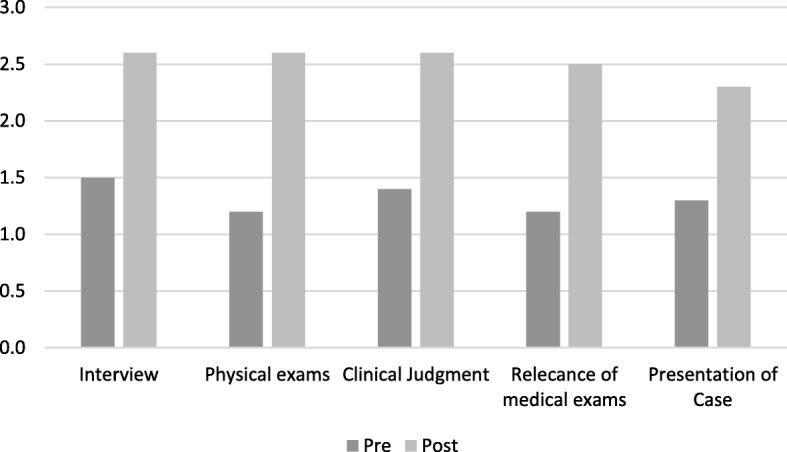
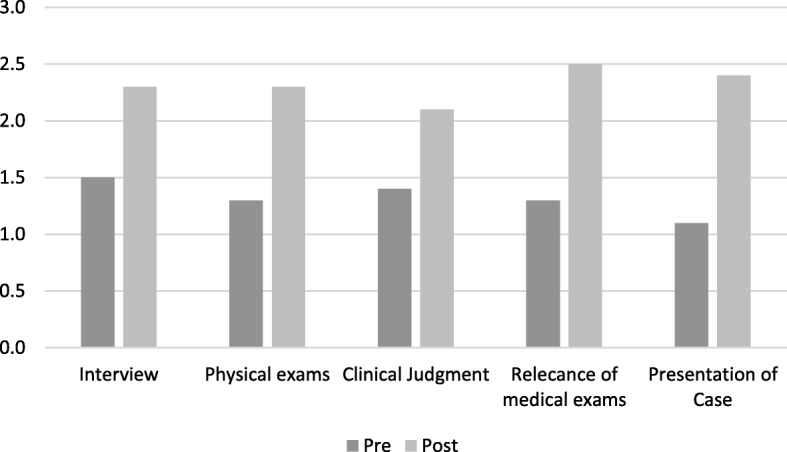
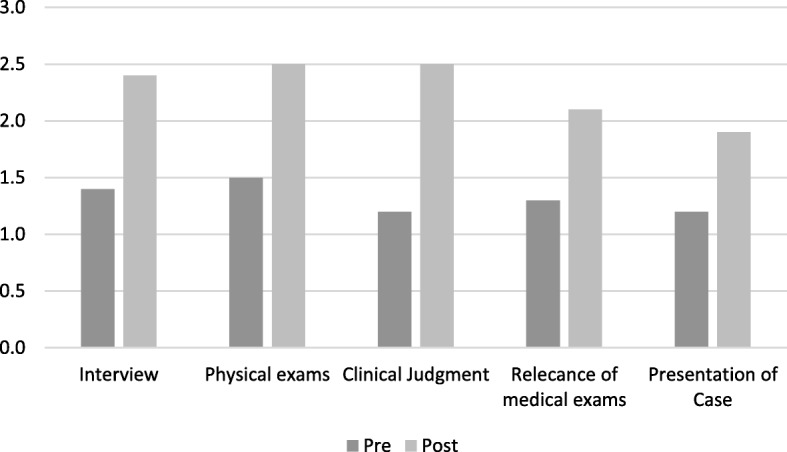
Verification
Claims the paper makes
31 Own result · 21 Not checked yet · 9 Own interpretation · 7 Own method · 1 No basis given
A result the paper reports from its own data — it cites no other source for it, so there is none to check. The quote shows it is in the paper.
In the paper
“It was found that the VP allowed students to learn to recognize the importance of each piece of information that may be provided by a patient, as well as the need for conducting a logical process that contributes to being more organized and methodical, and building structured mental schemes, which guide them towards possible diagnoses.”
§ The virtual patient as a learning tool: a mixed quantitative qualitative study > Results > Perceptions on learning
plaindirect- Asserted: passes — The authors put it forward as true.
- Checkable: passes — It can be checked against evidence.
- Load-bearing: passes — The paper’s conclusions depend on it.
- Based: passes — The paper gives a reason why it holds.
A result the paper reports from its own data — it cites no other source for it, so there is none to check. The quote shows it is in the paper.
In the paper
“VP allowed them to create logical and structured processes, to be wrong without consequences, and to review and reassess information available.”
- Also stated in: § Use of the tool · plain
“The VP enabled getting to know a patient, tackling a clinical case, broadening and feeding the curiosity over the unknown, asking questions again, re-examining, and going back to revisit and evaluate all the information.”
§ The virtual patient as a learning tool: a mixed quantitative qualitative study > Abstract > Results
plaindirect- Asserted: passes — The authors put it forward as true.
- Checkable: passes — It can be checked against evidence.
- Load-bearing: passes — The paper’s conclusions depend on it.
- Based: passes — The paper gives a reason why it holds.
- Also stated in: § Use of the tool · plain
A result the paper reports from its own data — it cites no other source for it, so there is none to check. The quote shows it is in the paper.
In the paper
“Throughout the implementation of the tool during the course, it was possible to observe more advantages than disadvantages.”
§ The virtual patient as a learning tool: a mixed quantitative qualitative study > Results > Use of the tool
hedged- Asserted: passes — The authors put it forward as true.
- Checkable: passes — It can be checked against evidence.
- Load-bearing: unclear — It is unclear whether the paper’s conclusions depend on it.
- Based: passes — The paper gives a reason why it holds.
A result the paper reports from its own data — it cites no other source for it, so there is none to check. The quote shows it is in the paper.
In the paper
“VP allowed them to create logical and structured processes, to be wrong without consequences, and to review and reassess information available.”
§ The virtual patient as a learning tool: a mixed quantitative qualitative study > Abstract > Results
plaindirect- Asserted: passes — The authors put it forward as true.
- Checkable: passes — It can be checked against evidence.
- Load-bearing: passes — The paper’s conclusions depend on it.
- Based: passes — The paper gives a reason why it holds.
A result the paper reports from its own data — it cites no other source for it, so there is none to check. The quote shows it is in the paper.
In the paper
“The VP enabled getting to know a patient, tackling a clinical case, broadening and feeding the curiosity over the unknown, asking questions again, re-examining, and going back to revisit and evaluate all the information.”
§ The virtual patient as a learning tool: a mixed quantitative qualitative study > Results > Use of the tool
plaindirect- Asserted: passes — The authors put it forward as true.
- Checkable: passes — It can be checked against evidence.
- Load-bearing: unclear — It is unclear whether the paper’s conclusions depend on it.
- Based: passes — The paper gives a reason why it holds.
A result the paper reports from its own data — it cites no other source for it, so there is none to check. The quote shows it is in the paper.
In the paper
“VP allowed them to create logical and structured processes, to be wrong without consequences, and to review and reassess information available.”
- Also stated in: § Use of the tool · plain
“participants perceived a motivating and easy-to-use tool, which allowed for making mistakes with no consequences over the integrity of a real patient.”
§ The virtual patient as a learning tool: a mixed quantitative qualitative study > Abstract > Results
plaindirect- Asserted: passes — The authors put it forward as true.
- Checkable: passes — It can be checked against evidence.
- Load-bearing: passes — The paper’s conclusions depend on it.
- Based: passes — The paper gives a reason why it holds.
- Also stated in: § Use of the tool · plain
A result the paper reports from its own data — it cites no other source for it, so there is none to check. The quote shows it is in the paper.
In the paper
“Furthermore, the analysis also revealed that the students understood the importance of exploring all possible information sources in relation to the patient’s problem, and that the logical, organized and methodical processing of data gathered helps them to propose the possible diverse diagnoses.”
§ The virtual patient as a learning tool: a mixed quantitative qualitative study > Discussion
plain- Asserted: passes — The authors put it forward as true.
- Checkable: passes — It can be checked against evidence.
- Load-bearing: passes — The paper’s conclusions depend on it.
- Based: passes — The paper gives a reason why it holds.
A result the paper reports from its own data — it cites no other source for it, so there is none to check. The quote shows it is in the paper.
In the paper
“For this specific course, the key to reaching a diagnosis of the various cases proposed by the VP lay in a different section of the clinical record: Personal data, current disease, review by systems, medical history or physical exam.”
§ The virtual patient as a learning tool: a mixed quantitative qualitative study > Discussion
plaindirect- Asserted: passes — The authors put it forward as true.
- Checkable: passes — It can be checked against evidence.
- Load-bearing: unclear — It is unclear whether the paper’s conclusions depend on it.
- Based: passes — The paper gives a reason why it holds.
In the paper
“With regard to the clinical reasoning skills, our results are similar to those previously reported in the literature by Cook and co [26].”
§ The virtual patient as a learning tool: a mixed quantitative qualitative study > Discussion
What the sources say
- Not checked yetcites [26] Cook DA, Erwin PJ, Triola MM. Computerized virtual patients in health professions education: a systematic review and meta-analysis. Acad Med. 2010;85:1589–602. source
plain- Asserted: passes — The authors put it forward as true.
- Checkable: passes — It can be checked against evidence.
- Load-bearing: unclear — It is unclear whether the paper’s conclusions depend on it.
- Based: passes — The paper gives a reason why it holds.
In the paper
“Nonetheless, one of the most important contributions of our study relies on the qualitative analysis where we observed that students applied different resources, appropriate for their learning level, to solve problems, as suggested by Norman [8].”
§ The virtual patient as a learning tool: a mixed quantitative qualitative study > Discussion
What the sources say
- Not checked yetcites [8] Norman G. Research in clinical reasoning: past history and current trends. Med Educ. 2005;39:418–27. source
plain- Asserted: passes — The authors put it forward as true.
- Checkable: passes — It can be checked against evidence.
- Load-bearing: passes — The paper’s conclusions depend on it.
- Based: passes — The paper gives a reason why it holds.
A result the paper reports from its own data — it cites no other source for it, so there is none to check. The quote shows it is in the paper.
In the paper
“Results attained show a remarkable contribution to the skill of students in conducting interviews and performing complete physical exams better aimed at understanding and producing a diagnosis of patient problems (p < 0.01).”
§ The virtual patient as a learning tool: a mixed quantitative qualitative study > Discussion
boosteddirect- Asserted: passes — The authors put it forward as true.
- Checkable: passes — It can be checked against evidence.
- Load-bearing: passes — The paper’s conclusions depend on it.
- Based: passes — The paper gives a reason why it holds.
A result the paper reports from its own data — it cites no other source for it, so there is none to check. The quote shows it is in the paper.
In the paper
“Furthermore, the analysis also revealed that the students understood the importance of exploring all possible information sources in relation to the patient’s problem, and that the logical, organized and methodical processing of data gathered helps them to propose the possible diverse diagnoses.”
§ The virtual patient as a learning tool: a mixed quantitative qualitative study > Discussion
plaindirect- Asserted: passes — The authors put it forward as true.
- Checkable: passes — It can be checked against evidence.
- Load-bearing: passes — The paper’s conclusions depend on it.
- Based: passes — The paper gives a reason why it holds.
A result the paper reports from its own data — it cites no other source for it, so there is none to check. The quote shows it is in the paper.
In the paper
“The remaining question whether VP is superior to other strategies could be secondary because the qualitative analysis allows establishing that the tool was unable to replace other teaching strategies completely.”
§ The virtual patient as a learning tool: a mixed quantitative qualitative study > Discussion
plain- Asserted: passes — The authors put it forward as true.
- Checkable: passes — It can be checked against evidence.
- Load-bearing: passes — The paper’s conclusions depend on it.
- Based: passes — The paper gives a reason why it holds.
A result the paper reports from its own data — it cites no other source for it, so there is none to check. The quote shows it is in the paper.
In the paper
“We conclude that the VP as a learning tool showed a significant contribution to improving history taking and clinical reasoning skills in students of medicine in a preclinical environment.”
§ The virtual patient as a learning tool: a mixed quantitative qualitative study > Conclusions
plaindirect- Asserted: passes — The authors put it forward as true.
- Checkable: passes — It can be checked against evidence.
- Load-bearing: passes — The paper’s conclusions depend on it.
- Based: passes — The paper gives a reason why it holds.
A conclusion the paper draws from its own results — it cites no other source for it, so there is none to check. The quote shows it is in the paper.
In the paper
“VP proved to be a valuable and useful tool for the development of clinical reasoning and history taking skills in medical students, as part of a constructivist learning course.”
§ The virtual patient as a learning tool: a mixed quantitative qualitative study > Abstract > Conclusions
plaindirect- Asserted: passes — The authors put it forward as true.
- Checkable: passes — It can be checked against evidence.
- Load-bearing: passes — The paper’s conclusions depend on it.
- Based: passes — The paper gives a reason why it holds.
- Rests on an assumption: The actor-patient clinical case exercise is the closest to authentic clinical performance of a physician.
- Rests on an assumption: The 20 undergraduate medical students from Universidad del Rosario are representative of medical students in general, so the study's conclusions can generalize to medical students.
None of the sources cited for this claim have been checked yet.
In the paper
“Evidence suggests that the most common medical error results from inadequate clinical reasoning [3, 9].”
§ The virtual patient as a learning tool: a mixed quantitative qualitative study > Background
What the sources say
hedgeddirect- Asserted: passes — The authors put it forward as true.
- Checkable: passes — It can be checked against evidence.
- Load-bearing: passes — The paper’s conclusions depend on it.
- Based: passes — The paper gives a reason why it holds.
A conclusion the paper draws from its own results — it cites no other source for it, so there is none to check. The quote shows it is in the paper.
In the paper
“Indeed, at the start of the professional career, it is useful for the student given that he/she acquires new experiences by interacting with a tool that enables the development of skills and attitudes, which are instrumental for his/her professional career.”
§ The virtual patient as a learning tool: a mixed quantitative qualitative study > Results > Building knowledge
plaindirect- Asserted: passes — The authors put it forward as true.
- Checkable: passes — It can be checked against evidence.
- Load-bearing: passes — The paper’s conclusions depend on it.
- Based: passes — The paper gives a reason why it holds.
A conclusion the paper draws from its own results — it cites no other source for it, so there is none to check. The quote shows it is in the paper.
In the paper
“One of the benefits of the VP is that it proves to be relevant for training first academic period students.”
§ The virtual patient as a learning tool: a mixed quantitative qualitative study > Results > Building knowledge
boosted- Asserted: passes — The authors put it forward as true.
- Checkable: passes — It can be checked against evidence.
- Load-bearing: passes — The paper’s conclusions depend on it.
- Based: passes — The paper gives a reason why it holds.
A conclusion the paper draws from its own results — it cites no other source for it, so there is none to check. The quote shows it is in the paper.
In the paper
“which allows them to make mistakes with no consequences over the integrity of real patients.”
§ The virtual patient as a learning tool: a mixed quantitative qualitative study > Discussion
plaindirect- Asserted: passes — The authors put it forward as true.
- Checkable: passes — It can be checked against evidence.
- Load-bearing: passes — The paper’s conclusions depend on it.
- Based: passes — The paper gives a reason why it holds.
What the paper did — it cites no source for this, so there is none to check. The quote shows it is in the paper.
In the paper
“Given that knowledge building and the acquisition of skills are complex processes, it may not be concluded that the progress made by the students therewith is the exclusive result of the VP as a teaching tool, since it happened within a comprehensive course and other learning sources cannot be ruled out during the study’s observation period.”
§ The virtual patient as a learning tool: a mixed quantitative qualitative study > Discussion
hedged- Asserted: passes — The authors put it forward as true.
- Checkable: passes — It can be checked against evidence.
- Load-bearing: passes — The paper’s conclusions depend on it.
- Based: passes — The paper gives a reason why it holds.
What the paper did — it cites no source for this, so there is none to check. The quote shows it is in the paper.
In the paper
“Another limitation of the study was that no comparison was made with other learning strategies.”
§ The virtual patient as a learning tool: a mixed quantitative qualitative study > Discussion
plain- Asserted: passes — The authors put it forward as true.
- Checkable: passes — It can be checked against evidence.
- Load-bearing: unclear — It is unclear whether the paper’s conclusions depend on it.
- Based: passes — The paper gives a reason why it holds.
- It may state two separate claims as one. 32
- The quote only partly states this claim. 1
- Probably not a substantial claim. 27
A result the paper reports from its own data — it cites no other source for it, so there is none to check. The quote shows it is in the paper.
In the paper
“It was found that the VP allowed students to learn to recognize the importance of each piece of information that may be provided by a patient, as well as the need for conducting a logical process that contributes to being more organized and methodical, and building structured mental schemes, which guide them towards possible diagnoses.”
§ The virtual patient as a learning tool: a mixed quantitative qualitative study > Results > Perceptions on learning
plaindirect- Asserted: passes — The authors put it forward as true.
- Checkable: passes — It can be checked against evidence.
- Load-bearing: passes — The paper’s conclusions depend on it.
- Based: passes — The paper gives a reason why it holds.
It may state two separate claims as one.
A result the paper reports from its own data — it cites no other source for it, so there is none to check. The quote shows it is in the paper.
In the paper
“By the same token, it was observed that they acquired new knowledge with the tool, they applied prior knowledge, and made connections without the pressure from the professor or from a real patient, which translated into being able to act “without fear of making a mistake.””
§ The virtual patient as a learning tool: a mixed quantitative qualitative study > Results > Perceptions on learning
plaindirect- Asserted: passes — The authors put it forward as true.
- Checkable: passes — It can be checked against evidence.
- Load-bearing: passes — The paper’s conclusions depend on it.
- Based: passes — The paper gives a reason why it holds.
It may state two separate claims as one.
A result the paper reports from its own data — it cites no other source for it, so there is none to check. The quote shows it is in the paper.
In the paper
“Students described the VP as an easy-to-use and motivating tool for learning without stress, especially at the beginning of their career.”
§ The virtual patient as a learning tool: a mixed quantitative qualitative study > Abstract > Results
plain- Asserted: passes — The authors put it forward as true.
- Checkable: passes — It can be checked against evidence.
- Load-bearing: passes — The paper’s conclusions depend on it.
- Based: passes — The paper gives a reason why it holds.
It may state two separate claims as one.
A result the paper reports from its own data — it cites no other source for it, so there is none to check. The quote shows it is in the paper.
In the paper
“The comparison of the students’ skills on the evaluation matrix before-and-after the course evidenced a statistically significant advance (p < 0.01) in all aspects (interview, physical exam, clinical judgment, relevance of medical exams, and presentation of case).”
- Also stated in: § Results · plain
“The student skills of history taking and clinical reasoning significantly improved after taking the course (Table 3).”
§ The virtual patient as a learning tool: a mixed quantitative qualitative study > Abstract > Results
plaindirect- Asserted: passes — The authors put it forward as true.
- Checkable: passes — It can be checked against evidence.
- Load-bearing: passes — The paper’s conclusions depend on it.
- Based: passes — The paper gives a reason why it holds.
It may state two separate claims as one. The quote only partly states this claim.
- Rests on an assumption: The actor-patient clinical case exercise is the closest to authentic clinical performance of a physician.
- Also stated in: § Results · plain
A result the paper reports from its own data — it cites no other source for it, so there is none to check. The quote shows it is in the paper.
In the paper
“As can be seen, the effect from both the tool and the course design proved to be favorable for learning to take place.”
§ The virtual patient as a learning tool: a mixed quantitative qualitative study > Results
plaindirect- Asserted: passes — The authors put it forward as true.
- Checkable: passes — It can be checked against evidence.
- Load-bearing: passes — The paper’s conclusions depend on it.
- Based: passes — The paper gives a reason why it holds.
It may state two separate claims as one.
A result the paper reports from its own data — it cites no other source for it, so there is none to check. The quote shows it is in the paper.
In the paper
“From the professor perspective, it allowed a better follow-up of the students’ learning process and favored reflections on the teaching-learning process.”
§ The virtual patient as a learning tool: a mixed quantitative qualitative study > Abstract > Results
plaindirect- Asserted: passes — The authors put it forward as true.
- Checkable: passes — It can be checked against evidence.
- Load-bearing: passes — The paper’s conclusions depend on it.
- Based: passes — The paper gives a reason why it holds.
It may state two separate claims as one.
A result the paper reports from its own data — it cites no other source for it, so there is none to check. The quote shows it is in the paper.
In the paper
“The VP enabled getting to know a patient, tackling a clinical case, broadening and feeding the curiosity over the unknown, asking questions again, re-examining, and going back to revisit and evaluate all the information.”
§ The virtual patient as a learning tool: a mixed quantitative qualitative study > Results > Use of the tool
plaindirect- Asserted: passes — The authors put it forward as true.
- Checkable: passes — It can be checked against evidence.
- Load-bearing: passes — The paper’s conclusions depend on it.
- Based: passes — The paper gives a reason why it holds.
It may state two separate claims as one.
A result the paper reports from its own data — it cites no other source for it, so there is none to check. The quote shows it is in the paper.
In the paper
“I have learned to organize my ideas and I understand that all my actions must have a specific end (verify-reject ideas).”
§ The virtual patient as a learning tool: a mixed quantitative qualitative study > Results > Building knowledge
plaindirectSingle case- Asserted: passes — The authors put it forward as true.
- Checkable: passes — It can be checked against evidence.
- Load-bearing: passes — The paper’s conclusions depend on it.
- Based: passes — The paper gives a reason why it holds.
Probably not a substantial claim. It may state two separate claims as one.
A result the paper reports from its own data — it cites no other source for it, so there is none to check. The quote shows it is in the paper.
In the paper
“Professor: Of course, as a professor you know what your student is intended to learn so activities that allow the student to build that knowledge, develop such skills, such attitudes are proposed… and few times I have been able to see that evidence of learning in the classroom as with this course…”
§ The virtual patient as a learning tool: a mixed quantitative qualitative study > Results > Building knowledge
plaincorrelationalSingle case- Asserted: passes — The authors put it forward as true.
- Checkable: passes — It can be checked against evidence.
- Load-bearing: fails — The paper’s conclusions may not depend on it.
- Based: passes — The paper gives a reason why it holds.
Probably not a substantial claim. The paper’s conclusions may not depend on it.
A result the paper reports from its own data — it cites no other source for it, so there is none to check. The quote shows it is in the paper.
In the paper
“The VP enables putting into practice and relating concepts learned, as well as strengthening concepts.”
§ The virtual patient as a learning tool: a mixed quantitative qualitative study > Results > Contributions to the teaching process
plaindirect- Asserted: passes — The authors put it forward as true.
- Checkable: passes — It can be checked against evidence.
- Load-bearing: passes — The paper’s conclusions depend on it.
- Based: passes — The paper gives a reason why it holds.
Probably not a substantial claim. It may state two separate claims as one.
A result the paper reports from its own data — it cites no other source for it, so there is none to check. The quote shows it is in the paper.
In the paper
“The use of the VP tool also allowed for a better follow-up of the students’ learning process and, in the case of the professor, for a reflection on the teaching-learning process:”
§ The virtual patient as a learning tool: a mixed quantitative qualitative study > Results > Contributions to the teaching process
plaindirect- Asserted: passes — The authors put it forward as true.
- Checkable: passes — It can be checked against evidence.
- Load-bearing: passes — The paper’s conclusions depend on it.
- Based: passes — The paper gives a reason why it holds.
It may state two separate claims as one.
A result the paper reports from its own data — it cites no other source for it, so there is none to check. The quote shows it is in the paper.
In the paper
“The Virtual Patient has allowed me to relate various concepts. Likewise, I feel that it has encouraged me to research those conditions that I do not understand and to improve my critical reasoning skills.”
§ The virtual patient as a learning tool: a mixed quantitative qualitative study > Results > Building knowledge
plaindirectSingle case- Asserted: passes — The authors put it forward as true.
- Checkable: passes — It can be checked against evidence.
- Load-bearing: passes — The paper’s conclusions depend on it.
- Based: passes — The paper gives a reason why it holds.
Probably not a substantial claim. It may state two separate claims as one.
A result the paper reports from its own data — it cites no other source for it, so there is none to check. The quote shows it is in the paper.
In the paper
“It should be noted that although the VP is a Web-based simulator that uses a chat-like interviewing methodology and a click-based physical examination, history taking skills significantly improved after the course.”
§ The virtual patient as a learning tool: a mixed quantitative qualitative study > Discussion
plaindirect- Asserted: passes — The authors put it forward as true.
- Checkable: passes — It can be checked against evidence.
- Load-bearing: passes — The paper’s conclusions depend on it.
- Based: passes — The paper gives a reason why it holds.
It may state two separate claims as one.
A result the paper reports from its own data — it cites no other source for it, so there is none to check. The quote shows it is in the paper.
In the paper
“that it is important to control “your own bias” and taking the easy way out when producing a diagnosis because it may lead to serious mistakes; they have reflected on the importance of taking the medical act with all due seriousness, also given the risks involved in taking it lightly;”
§ The virtual patient as a learning tool: a mixed quantitative qualitative study > Results > Building knowledge
plaindirect- Asserted: passes — The authors put it forward as true.
- Checkable: passes — It can be checked against evidence.
- Load-bearing: passes — The paper’s conclusions depend on it.
- Based: passes — The paper gives a reason why it holds.
Probably not a substantial claim. It may state two separate claims as one.
A result the paper reports from its own data — it cites no other source for it, so there is none to check. The quote shows it is in the paper.
In the paper
“For the same reason, a contribution was made regarding guidance and the relevance for requesting additional tests geared towards confirming the diagnosis, as well as the presentation of clinical cases, a set of skills considered in this research, as evidence for the abilities of students for clinical reasoning.”
§ The virtual patient as a learning tool: a mixed quantitative qualitative study > Discussion
plaindirect- Asserted: passes — The authors put it forward as true.
- Checkable: passes — It can be checked against evidence.
- Load-bearing: passes — The paper’s conclusions depend on it.
- Based: passes — The paper gives a reason why it holds.
It may state two separate claims as one.
The paper states this without a source or data behind it here, so there is nothing to check it against. The quote shows it is in the paper.
In the paper
“On another note, it is worth mentioning that the auto-filling feature of such questions is determined by the development level of the simulation model, which to a certain extent substitutes the student’s effort to consider the relevant questions within the clinical reasoning process.”
§ The virtual patient as a learning tool: a mixed quantitative qualitative study > Discussion
hedgeddirect- Asserted: passes — The authors put it forward as true.
- Checkable: passes — It can be checked against evidence.
- Load-bearing: fails — The paper’s conclusions may not depend on it.
- Based: fails — The paper may give no reason why it holds.
Probably not a substantial claim. The paper’s conclusions may not depend on it. The paper may give no reason why it holds. It may state two separate claims as one.
A result the paper reports from its own data — it cites no other source for it, so there is none to check. The quote shows it is in the paper.
In the paper
“I feel it is a good practice, where we can not only put into practice our knowledge, but also our practice at a consultation without compromising anyone’s life or health.”
§ The virtual patient as a learning tool: a mixed quantitative qualitative study > Results > Contributions to the teaching process
plainSingle case- Asserted: passes — The authors put it forward as true.
- Checkable: fails — It may be too vague to check against evidence.
- Load-bearing: passes — The paper’s conclusions depend on it.
- Based: passes — The paper gives a reason why it holds.
Probably not a substantial claim. It may be too vague to check against evidence.
A result the paper reports from its own data — it cites no other source for it, so there is none to check. The quote shows it is in the paper.
In the paper
“I also believe they have seen that they cannot afford to ask questions and pay attention indefinitely, but rather, that they must start to somehow focus the interview on the relevant aspects (without neglecting the rest).”
§ The virtual patient as a learning tool: a mixed quantitative qualitative study > Results > Building knowledge
hedgeddirect- Asserted: passes — The authors put it forward as true.
- Checkable: passes — It can be checked against evidence.
- Load-bearing: fails — The paper’s conclusions may not depend on it.
- Based: passes — The paper gives a reason why it holds.
Probably not a substantial claim. The paper’s conclusions may not depend on it. It may state two separate claims as one.
A result the paper reports from its own data — it cites no other source for it, so there is none to check. The quote shows it is in the paper.
In the paper
“From the Virtual Patient‘s structure, browsing the various tabs allowed the students to infer part of the clinical logic with which the doctor intervenes regarding the disease.”
§ The virtual patient as a learning tool: a mixed quantitative qualitative study > Results > Building knowledge
plaindirect- Asserted: passes — The authors put it forward as true.
- Checkable: passes — It can be checked against evidence.
- Load-bearing: passes — The paper’s conclusions depend on it.
- Based: passes — The paper gives a reason why it holds.
Probably not a substantial claim.
A result the paper reports from its own data — it cites no other source for it, so there is none to check. The quote shows it is in the paper.
In the paper
“From a cost perspective, the cost per hour of the VP was USD 12, which is noteworthy as it is low compared to high-fidelity simulators (between USD 160 and 800 per hour) and standardized patients (from USD 30 to 40 per hour).”
§ The virtual patient as a learning tool: a mixed quantitative qualitative study > Discussion
plain- Asserted: passes — The authors put it forward as true.
- Checkable: passes — It can be checked against evidence.
- Load-bearing: unclear — It is unclear whether the paper’s conclusions depend on it.
- Based: passes — The paper gives a reason why it holds.
It may state two separate claims as one.
In the paper
“The cost of the software and faculty time was similar to what was previously reported in the literature [30]: $49,000. USD.”
§ The virtual patient as a learning tool: a mixed quantitative qualitative study > Discussion
What the sources say
- Not checked yetcites [30] Schwid HA, Souter KJ. Resident perceptions and cost analysis of a virtual patient application for anesthesia-related critical incidents. J Educ Perioper Med. 2014;16:E077.
plain- Asserted: passes — The authors put it forward as true.
- Checkable: passes — It can be checked against evidence.
- Load-bearing: unclear — It is unclear whether the paper’s conclusions depend on it.
- Based: passes — The paper gives a reason why it holds.
It may state two separate claims as one.
None of the sources cited for this claim have been checked yet.
In the paper
“The results were measured through a mixed concurrent or triangulated study [19–21].”
§ The virtual patient as a learning tool: a mixed quantitative qualitative study > Methods
What the sources say
- Not checked yetcites [19] Greene JC, Caracelli VJ, Graham WF. Toward a conceptual framework for mixed-method evaluation designs. Educational Evaluation and Policy Analysis. 1989;11:255–74. source
- Not checked yetcites [20] Brewer J, Hunter A. Foundations of multimethod research. California: Thousand Oaks; 2018. https://doi.org/10.4135/9781412984294 . source
- Not checked yetcites [21] Greene JC. Mixed methods in social inquiry. 1st ed. San Francisco, CA: Jossey-Bass; 2007.
plain- Asserted: passes — The authors put it forward as true.
- Checkable: passes — It can be checked against evidence.
- Load-bearing: passes — The paper’s conclusions depend on it.
- Based: passes — The paper gives a reason why it holds.
Probably not a substantial claim.
What the paper did — it cites no source for this, so there is none to check. The quote shows it is in the paper.
In the paper
“Validation of the matrix was established by three evaluators using the agreement test through the Kappa coefficient, with a 95% reliability interval. Construct and content of the matrix were validated, as well as agreement amongst the observers (Table 1).”
§ The virtual patient as a learning tool: a mixed quantitative qualitative study > Methods
plain- Asserted: passes — The authors put it forward as true.
- Checkable: passes — It can be checked against evidence.
- Load-bearing: passes — The paper’s conclusions depend on it.
- Based: passes — The paper gives a reason why it holds.
It may state two separate claims as one.
In the paper
“This tool has been accepted by the Liaison Committee on Medical Education (LCME) as a resource to teach rare but necessary clinical situations [13].”
§ The virtual patient as a learning tool: a mixed quantitative qualitative study > Background
What the sources say
- Not checked yetcites [13] Cendan J, Lok B. The use of virtual patients in medical school curricula. Adv Physiol Educ. 2012;36:48–53. source
plain- Asserted: passes — The authors put it forward as true.
- Checkable: passes — It can be checked against evidence.
- Load-bearing: fails — The paper’s conclusions may not depend on it.
- Based: passes — The paper gives a reason why it holds.
Probably not a substantial claim. The paper’s conclusions may not depend on it.
None of the sources cited for this claim have been checked yet.
In the paper
“In addition, it is part of the United States Medical Licensing Examination (USMLE Step 3) since 1999 [13, 14].”
§ The virtual patient as a learning tool: a mixed quantitative qualitative study > Background
What the sources say
- Not checked yetcites [13] Cendan J, Lok B. The use of virtual patients in medical school curricula. Adv Physiol Educ. 2012;36:48–53. source
- Not checked yetcites [14] Mehta NP, Kramer DB. A critique of the USMLE clinical skills examination. Medscape Gen Med. 2005;7:76–6.
plain- Asserted: passes — The authors put it forward as true.
- Checkable: passes — It can be checked against evidence.
- Load-bearing: fails — The paper’s conclusions may not depend on it.
- Based: passes — The paper gives a reason why it holds.
Probably not a substantial claim. The paper’s conclusions may not depend on it.
What the paper did — it cites no source for this, so there is none to check. The quote shows it is in the paper.
In the paper
“Prior authorization from the University was requested, as well as an informed consent from all students involved.”
§ The virtual patient as a learning tool: a mixed quantitative qualitative study > Methods
plain- Asserted: passes — The authors put it forward as true.
- Checkable: passes — It can be checked against evidence.
- Load-bearing: fails — The paper’s conclusions may not depend on it.
- Based: passes — The paper gives a reason why it holds.
Probably not a substantial claim. The paper’s conclusions may not depend on it. It may state two separate claims as one.
A conclusion the paper draws from its own results — it cites no other source for it, so there is none to check. The quote shows it is in the paper.
In the paper
“This finding could be related to the simulator’s function of displaying patient question suggestions to the student.”
§ The virtual patient as a learning tool: a mixed quantitative qualitative study > Discussion
hedgedconditional- Asserted: passes — The authors put it forward as true.
- Checkable: passes — It can be checked against evidence.
- Load-bearing: fails — The paper’s conclusions may not depend on it.
- Based: passes — The paper gives a reason why it holds.
Probably not a substantial claim. The paper’s conclusions may not depend on it.
In the paper
“This process is known as clinical reasoning, an essential skill that must be applied in every moment of patient attendance [8].”
§ The virtual patient as a learning tool: a mixed quantitative qualitative study > Background
What the sources say
- Not checked yetcites [8] Norman G. Research in clinical reasoning: past history and current trends. Med Educ. 2005;39:418–27. source
plain- Asserted: passes — The authors put it forward as true.
- Checkable: fails — It may be too vague to check against evidence.
- Load-bearing: fails — The paper’s conclusions may not depend on it.
- Based: passes — The paper gives a reason why it holds.
Probably not a substantial claim. It may be too vague to check against evidence. The paper’s conclusions may not depend on it.
In the paper
“Hence, patient safety is recognized around the world as a priority, where “trial-error”-based learning cannot be an option in a real patient [4].”
§ The virtual patient as a learning tool: a mixed quantitative qualitative study > Background
What the sources say
- Not checked yetcites [4] Aggarwal R, Mytton OT, Derbrew M, Hananel D, Heydenburg M, Issenberg B, et al. Training and simulation for patient safety. Qual Saf Health Care. 2010;19 Suppl 2:i34. source
plain- Asserted: passes — The authors put it forward as true.
- Checkable: passes — It can be checked against evidence.
- Load-bearing: passes — The paper’s conclusions depend on it.
- Based: passes — The paper gives a reason why it holds.
It may state two separate claims as one.
None of the sources cited for this claim have been checked yet.
In the paper
“Current evidence suggests that medical error represents one of the leading causes of death [1–3].”
§ The virtual patient as a learning tool: a mixed quantitative qualitative study > Background
What the sources say
- Not checked yetcites [1] Weingart SN, McL Wilson R, Gibberd RW, Harrison B. Epidemiology of medical error. West J Med. 2000;172:390–3. source
- Not checked yetcites [2] Kohn LT, Corrigan JM, Donaldson MS, editors. To Err is Human: Building a Safer Health System. Washington (DC): National Academies Press (US); 2000.
- Not checked yetcites [3] Graber ML, Franklin N, Gordon R. Diagnostic error in internal medicine. Arch Intern Med. 2005;165:1493–9. source
hedged- Asserted: passes — The authors put it forward as true.
- Checkable: passes — It can be checked against evidence.
- Load-bearing: passes — The paper’s conclusions depend on it.
- Based: passes — The paper gives a reason why it holds.
Probably not a substantial claim.
In the paper
“Getting together the relevant information such as personal and psychosocial state, related personal and family medical background, the reason for consulting, plus the physical examination findings, should allow the physician to generate a diagnosis hypothesis.”
§ The virtual patient as a learning tool: a mixed quantitative qualitative study > Background
What the sources say
- Not checked yetcites [7] Keifenheim KE, Teufel M, Ip J, Speiser N, Leehr EJ, Zipfel S, et al. Teaching history taking to medical students: a systematic review. BMC Medical Education. 2015;15:159. source
plaindirect- Asserted: passes — The authors put it forward as true.
- Checkable: fails — It may be too vague to check against evidence.
- Load-bearing: fails — The paper’s conclusions may not depend on it.
- Based: passes — The paper gives a reason why it holds.
Probably not a substantial claim. It may be too vague to check against evidence. The paper’s conclusions may not depend on it.
In the paper
“Emergent strategies are based on constructivist concepts, which highlight the importance of the repeated interaction between the learner and the object of learning, and the importance of others in the process of knowledge construction [6].”
§ The virtual patient as a learning tool: a mixed quantitative qualitative study > Background
What the sources say
- Not checked yetcites [6] Phillips DC. The good, the bad, and the ugly: the many faces of constructivism. Educ Res. 1995;24:5–12. source
plain- Asserted: passes — The authors put it forward as true.
- Checkable: passes — It can be checked against evidence.
- Load-bearing: passes — The paper’s conclusions depend on it.
- Based: passes — The paper gives a reason why it holds.
Probably not a substantial claim. It may state two separate claims as one.
None of the sources cited for this claim have been checked yet.
In the paper
“This results in a valuable learning experience for the student, who at first has difficulties in asking questions, especially when it comes to sensitive issues or aspects relative to the patient’s private life [22–24].”
§ The virtual patient as a learning tool: a mixed quantitative qualitative study > Discussion
What the sources say
- Not checked yetcites [22] Edelbring S, Dastmalchi M, Hult H, Lundberg IE, Dahlgren LO. Experiencing virtual patients in clinical learning: a phenomenological study. Adv Health Sci Educ Theory Pract. 2011;16:331–45. source
- Not checked yetcites [23] Sandroni S. Enhancing clinical teaching with information technologies: what can we do right now? Academic medicine : journal of the Association of American Medical Colleges. 1997;72:770–4. source
- Not checked yetcites [24] Spencer J. Teaching about professionalism. Med Educ. 2003;37:288–9. source
plaindirect- Asserted: passes — The authors put it forward as true.
- Checkable: passes — It can be checked against evidence.
- Load-bearing: passes — The paper’s conclusions depend on it.
- Based: passes — The paper gives a reason why it holds.
It may state two separate claims as one.
None of the sources cited for this claim have been checked yet.
In the paper
“The aim of VP is to expose students to virtual scenarios that would otherwise be difficult to find or to deal with in real life [11, 12].”
§ The virtual patient as a learning tool: a mixed quantitative qualitative study > Background
What the sources say
- Not checked yetcites [11] Friedrich MJ. Practice makes perfect: risk-free medical training with patient simulators. JAMA. 2002;288(2808):2811–2.
- Not checked yetcites [12] Ellaway R, Masters K. AMEE guide 32: e-learning in medical education part 1: learning, teaching and assessment. Med Teach. 2008;30:455–73. source
plain- Asserted: passes — The authors put it forward as true.
- Checkable: passes — It can be checked against evidence.
- Load-bearing: passes — The paper’s conclusions depend on it.
- Based: passes — The paper gives a reason why it holds.
Probably not a substantial claim.
What the paper did — it cites no source for this, so there is none to check. The quote shows it is in the paper.
In the paper
“Nevertheless, the main limitation of the study is that the VP was immersed in a course that was designed following solid pedagogical principles to strengthen history taking and clinical reasoning skills. Hence, it is not possible to completely attribute the observed changes to the VP.”
§ The virtual patient as a learning tool: a mixed quantitative qualitative study > Discussion
plain- Asserted: passes — The authors put it forward as true.
- Checkable: passes — It can be checked against evidence.
- Load-bearing: passes — The paper’s conclusions depend on it.
- Based: passes — The paper gives a reason why it holds.
It may state two separate claims as one.
In the paper
“However, it has been accepted that simulation facilitates learning when it is used in the appropriate conditions that include providing feedback, repetition, curriculum integration, individualized learning and controlled environment [28].”
§ The virtual patient as a learning tool: a mixed quantitative qualitative study > Discussion
What the sources say
- Not checked yetcites [28] Issenberg SB, McGaghie WC, Petrusa ER, Lee Gordon D, Scalese RJ. Features and uses of high-fidelity medical simulations that lead to effective learning: a BEME systematic review. Med Teach. 2005;27:10–28. source
boosteddirect- Asserted: passes — The authors put it forward as true.
- Checkable: passes — It can be checked against evidence.
- Load-bearing: fails — The paper’s conclusions may not depend on it.
- Based: passes — The paper gives a reason why it holds.
Probably not a substantial claim. The paper’s conclusions may not depend on it.
A conclusion the paper draws from its own results — it cites no other source for it, so there is none to check. The quote shows it is in the paper.
In the paper
“In other terms, the VP proposes a logical order and familiarizes the student with the way of asking questions, previously introduced by medical instructors who apply them in their actual professional context.”
§ The virtual patient as a learning tool: a mixed quantitative qualitative study > Discussion
plaindirect- Asserted: passes — The authors put it forward as true.
- Checkable: passes — It can be checked against evidence.
- Load-bearing: passes — The paper’s conclusions depend on it.
- Based: passes — The paper gives a reason why it holds.
It may state two separate claims as one.
In the paper
“These circumstances make it necessary to introduce changes to medical education [5].”
§ The virtual patient as a learning tool: a mixed quantitative qualitative study > Background
What the sources say
- Not checked yetcites [5] Ypinazar VA, Margolis SA. Clinical simulators: applications and implications for rural medical education. Rural Remote Health. 2006;6:527.
boosteddirect- Asserted: passes — The authors put it forward as true.
- Checkable: fails — It may be too vague to check against evidence.
- Load-bearing: passes — The paper’s conclusions depend on it.
- Based: passes — The paper gives a reason why it holds.
Probably not a substantial claim. It may be too vague to check against evidence.
None of the sources cited for this claim have been checked yet.
In the paper
“Simulation emerges as a new medical educational strategy allowing students to repeat a given scenario as many times as needed, make mistakes, learn from errors, ponder, receive proper feedback, trace a learning curve, and finally, improve the clinical skills required in clinical practice without compromising patients’ safety, as well as to reduce the stress produced by direct interaction with real”
§ The virtual patient as a learning tool: a mixed quantitative qualitative study > Background
What the sources say
- Not checked yetcites [5] Ypinazar VA, Margolis SA. Clinical simulators: applications and implications for rural medical education. Rural Remote Health. 2006;6:527.
- Not checked yetcites [10] Aper L, Reniers J, Derese A, Veldhuijzen W. Managing the complexity of doing it all: an exploratory study on students’ experiences when trained stepwise in conducting consultations. BMC Med Educ. 2014;14:206. source
plaindirect- Asserted: passes — The authors put it forward as true.
- Checkable: passes — It can be checked against evidence.
- Load-bearing: passes — The paper’s conclusions depend on it.
- Based: passes — The paper gives a reason why it holds.
It may state two separate claims as one.
A conclusion the paper draws from its own results — it cites no other source for it, so there is none to check. The quote shows it is in the paper.
In the paper
“However, as it has been described above, VP challenges traditional preferences but not as a single tool, rather in a constructivist context.”
§ The virtual patient as a learning tool: a mixed quantitative qualitative study > Discussion
plaindirect- Asserted: passes — The authors put it forward as true.
- Checkable: passes — It can be checked against evidence.
- Load-bearing: passes — The paper’s conclusions depend on it.
- Based: passes — The paper gives a reason why it holds.
It may state two separate claims as one.
What the paper did — it cites no source for this, so there is none to check. The quote shows it is in the paper.
In the paper
“However, VP was used as the main tool of a course that was designed with solid pedagogical foundation, making it difficult to completely attribute the results to the single tool.”
§ The virtual patient as a learning tool: a mixed quantitative qualitative study > Conclusions
plain- Asserted: passes — The authors put it forward as true.
- Checkable: passes — It can be checked against evidence.
- Load-bearing: passes — The paper’s conclusions depend on it.
- Based: passes — The paper gives a reason why it holds.
It may state two separate claims as one.
In the paper
“Additionally, as has been suggested by Guraya et al., medical students prefer a more traditional approach to learning (reflectors and theorists) than a pragmatic or even an activist, and that instructional strategies should encourage students to self-directed learning [27].”
§ The virtual patient as a learning tool: a mixed quantitative qualitative study > Discussion
What the sources say
- Not checked yetcites [27] Guraya SS, Guraya SY, Habib FA, Khoshhal KI. Learning styles of medical students at Taibah University: trends and implications. J Res Med Sci. 2014;19:1155–62. source
hedged- Asserted: passes — The authors put it forward as true.
- Checkable: passes — It can be checked against evidence.
- Load-bearing: fails — The paper’s conclusions may not depend on it.
- Based: passes — The paper gives a reason why it holds.
Probably not a substantial claim. The paper’s conclusions may not depend on it. It may state two separate claims as one.
None of the sources cited for this claim have been checked yet.
In the paper
“Moreover, it is possible to find systematic reviews that include studies where VP has been compared with some of those strategies and where it showed positive results against traditional lectures and even standardized patients, but evidence is not [7] conclusive and heterogeneity of the data suggest that more research is needed [7, 26, 29].”
§ The virtual patient as a learning tool: a mixed quantitative qualitative study > Discussion
What the sources say
- Not checked yetcites [7] Keifenheim KE, Teufel M, Ip J, Speiser N, Leehr EJ, Zipfel S, et al. Teaching history taking to medical students: a systematic review. BMC Medical Education. 2015;15:159. source
- Not checked yetcites [26] Cook DA, Erwin PJ, Triola MM. Computerized virtual patients in health professions education: a systematic review and meta-analysis. Acad Med. 2010;85:1589–602. source
- Not checked yetcites [29] Cook DA, Triola MM. Virtual patients: a critical literature review and proposed next steps. Med Educ. 2009;43:303–11. source
hedgedconditional- Asserted: passes — The authors put it forward as true.
- Checkable: passes — It can be checked against evidence.
- Load-bearing: unclear — It is unclear whether the paper’s conclusions depend on it.
- Based: passes — The paper gives a reason why it holds.
It may state two separate claims as one.
A conclusion the paper draws from its own results — it cites no other source for it, so there is none to check. The quote shows it is in the paper.
In the paper
“Results suggest that a learning environment that promotes individual construction through peer interaction, meaningful learning, repetition of the same problem with different variations, learning by doing and a proper permanent feedback are essential to ensuring the efficacy of a Web-based virtual patient for developing clinical reasoning and history taking skills.”
§ The virtual patient as a learning tool: a mixed quantitative qualitative study > Conclusions
hedgeddirect- Asserted: passes — The authors put it forward as true.
- Checkable: passes — It can be checked against evidence.
- Load-bearing: passes — The paper’s conclusions depend on it.
- Based: passes — The paper gives a reason why it holds.
Probably not a substantial claim.
A conclusion the paper draws from its own results — it cites no other source for it, so there is none to check. The quote shows it is in the paper.
In the paper
“There was permanent collaborative work amongst small student groups, which must have influenced the outcome.”
§ The virtual patient as a learning tool: a mixed quantitative qualitative study > Discussion
plaindirect- Asserted: passes — The authors put it forward as true.
- Checkable: fails — It may be too vague to check against evidence.
- Load-bearing: fails — The paper’s conclusions may not depend on it.
- Based: fails — The paper may give no reason why it holds.
Probably not a substantial claim. It may be too vague to check against evidence. The paper’s conclusions may not depend on it. The paper may give no reason why it holds.
In the paper
“We agree with Aggarwal et al. [4] on the importance of bearing in mind that the VP and the simulation in general are merely tools for training purposes, and that success in their use does not depend so much on the accuracy of the simulation but rather on how it is used by the instructor and the student.”
§ The virtual patient as a learning tool: a mixed quantitative qualitative study > Discussion
What the sources say
- Not checked yetcites [4] Aggarwal R, Mytton OT, Derbrew M, Hananel D, Heydenburg M, Issenberg B, et al. Training and simulation for patient safety. Qual Saf Health Care. 2010;19 Suppl 2:i34. source
plaindirect- Asserted: passes — The authors put it forward as true.
- Checkable: passes — It can be checked against evidence.
- Load-bearing: fails — The paper’s conclusions may not depend on it.
- Based: passes — The paper gives a reason why it holds.
Probably not a substantial claim. The paper’s conclusions may not depend on it. It may state two separate claims as one.
What the paper did — it cites no source for this, so there is none to check. The quote shows it is in the paper.
In the paper
“Nonetheless, the scope of the study did not include a cost-effectiveness analysis and prospective studies are needed.”
§ The virtual patient as a learning tool: a mixed quantitative qualitative study > Discussion
plain- Asserted: passes — The authors put it forward as true.
- Checkable: passes — It can be checked against evidence.
- Load-bearing: fails — The paper’s conclusions may not depend on it.
- Based: passes — The paper gives a reason why it holds.
Probably not a substantial claim. The paper’s conclusions may not depend on it.
In the paper
“This suggests that instructional strategies, whether technology-based or not, must include some solid principles from pedagogical theory that were incorporated to the VP course and some of what Issenberg et al. described as key for simulation-based learning [28].”
§ The virtual patient as a learning tool: a mixed quantitative qualitative study > Discussion
What the sources say
- Not checked yetcites [28] Issenberg SB, McGaghie WC, Petrusa ER, Lee Gordon D, Scalese RJ. Features and uses of high-fidelity medical simulations that lead to effective learning: a BEME systematic review. Med Teach. 2005;27:10–28. source
hedged- Asserted: passes — The authors put it forward as true.
- Checkable: fails — It may be too vague to check against evidence.
- Load-bearing: fails — The paper’s conclusions may not depend on it.
- Based: passes — The paper gives a reason why it holds.
Probably not a substantial claim. It may be too vague to check against evidence. The paper’s conclusions may not depend on it. It may state two separate claims as one.
The paper relies on this without support.
The actor-patient clinical case exercise is the closest to authentic clinical performance of a physician.
“This exercise was considered as the closest to authentic clinical performance of a physician.”
The paper relies on this without support.
The 20 undergraduate medical students from Universidad del Rosario are representative of medical students in general, so the study's conclusions can generalize to medical students.
“The course involved 20 voluntary undergraduate medical students from first to fifth academic periods from Universidad del Rosario in the first half of 2012, who had not had a prior semiology course.”
The paper relies on this without support.
Less attention has been given to low-fidelity simulators than to high-fidelity simulators.
“There is significant evidence that supports the use of high-fidelity simulators (i.e. mannequins or dummies) to prepare students for clinical environments, less attention has been given to low-fidelity simulators.”
The paper relies on this without support.
The Virtual Patient is still under development and relatively unexplored from a pedagogic perspective.
“VP is still under development and relatively unexplored from a pedagogic perspective.”
The paper relies on this without support.
A greater number of worked cases results in better performance in real life.
“Evidence shows that a greater number of worked cases results in a better performance in real life.”
Claims other papers make about this one
Each is checked against this paper’s own text: does it say what the citing paper says it does?
In the citing paper
“In the included studies, 3 of the conversational agents were virtual patients, and users in all 3 studies reported liking that it provided a platform for risk-free learning because they were not practicing on real patients [15,41,50].”
From The Effectiveness of Artificial Intelligence Conversational Agents in Health Care: Systematic Review (2020) · cites this paper as [15]
Self-check
Percentages, sums and reported differences re-computed from the paper’s own numbers.
Each contradiction between two passages listed here was confirmed by an independent check.
Rated minor: it would not touch a result — a value no result rests on, a p-value that stays on the same side of the significance level, or a conflict that is clerical, resolved elsewhere in the paper, or outside its own findings.
In the paper
§ The virtual patient as a learning tool: a mixed quantitative qualitative study > Abstract > Results
“The comparison of the students’ skills on the evaluation matrix before-and-after the course evidenced a statistically significant advance (p < 0.01) in all aspects (interview, physical exam, clinical judgment, relevance of medical exams, and presentation of case).”
§ The virtual patient as a learning tool: a mixed quantitative qualitative study > Results
“| Clinical judgment | z = − 2.46 p = 0.01 | z = − 2.33 p = 0.02 | z = − 2.74 p < 0.01 |”
Citations
Cites
Wall, A. (2000) · British Journal of Healthcare Management · doi:10.12968/bjhc.2000.6.9.19311 · Cited by 5,912
Toward a Conceptual Framework for Mixed-Method Evaluation Designs
Greene, J. C., Caracelli, V. J., & Graham, W. F. (1989) · Educational Evaluation and Policy Analysis · doi:10.3102/01623737011003255 · Cited by 5,687
Educational Psychology: A Cognitive View
Ausubel, D. P., Novak, J. D., & Hanesian, H. (1968) · Medical Entomology and Zoology · Cited by 5,203
Barry Issenberg, S., Mcgaghie, W. C., Petrusa, E. R., Lee Gordon, D., & Scalese, R. J. (2005) · Medical Teacher · doi:10.1080/01421590500046924 · Cited by 3,966
To Err Is Human : Building A Safer Health System
Kohn, L. T., Corrigan, J. M., & Donaldson, M. S. (2000) · Cited by 2,830
Psychosomatic medicine in Germany: more timely than ever
Zipfel, S., Herzog, W., Kruse, J., & Henningsen, P. (2016) · Psychotherapy and Psychosomatics · doi:10.1159/000447701 · Cited by 2,323
Mixed Methods in Social Inquiry
Greene, J. C. (2007) · Cited by 1,960
Diagnostic error in internal medicine
Graber, M. L., Franklin, N., & Gordon, R. (2005) · Archives of Internal Medicine · doi:10.1001/archinte.165.13.1493 · Cited by 1,549
Conversational agents in healthcare: a systematic review
Laranjo, L., Dunn, A. G., Tong, H. L., Kocaballi, A. B., Chen, J., Bashir, R., Surian, D., Gallego, B., Magrabi, F., Lau, A. Y. S., et al. (2018) · Journal of the American Medical Informatics Association · doi:10.1093/jamia/ocy072 · Cited by 1,388
The Good, the Bad, and the Ugly: The Many Faces of Constructivism
Phillips, D. C. (1995) · Educational Researcher · doi:10.3102/0013189x024007005 · Cited by 1,330
Cited by
Sorted by citations
The Effectiveness of Artificial Intelligence Conversational Agents in Health Care: Systematic Review
Milne-Ives, M., de Cock, C., Lim, E., Shehadeh, M. H., de Pennington, N., Mole, G., Normando, E., & Meinert, E. (2020) · Journal of Medical Internet Research · doi:10.2196/20346 · Cited by 626
Wijnen-Meijer, M., Brandhuber, T., Schneider, A., & Berberat, P. O. (2022) · Journal of Medical Education and Curricular Development · doi:10.1177/23821205221091511 · Cited by 207
Plackett, R., Kassianos, A. P., Mylan, S., Kambouri, M. A., Raine, R., & Sheringham, J. (2022) · BMC Medical Education · doi:10.1186/s12909-022-03410-x · Cited by 157
Strategies Used to Teach Soft Skills in Undergraduate Nursing Education: A Scoping Review
Azzouzi, W., & Gantare, A. (2022) · Journal of Professional Nursing · doi:10.1016/j.profnurs.2022.07.010 · Cited by 95
Suárez, A., Velasco, A. A., García, V. D., Freire, Y., & Algar, J. (2022) · International Journal of Environmental Research and Public Health · doi:10.3390/ijerph19148735 · Cited by 97
Metadata
- Authors
- Isaza-Restrepo, A., Gómez, M. T., Cifuentes, G., & Argüello, A.
- Affiliations
- Universidad del Rosario (CO)
- Universidad de Los Andes (CO)
- Corresponding author
- Isaza-Restrepo, Andrés
- Venue
- BMC Medical Education
- Published
- 2018-12
- Volume
- 18
- Issue
- 1
- Pages
- 297-297
- ISSN
- 1472-6920 (ISSN-L)
- PMC
- PMC6282259
- OpenAlex
- W2902116953
- Semantic Scholar
- 3f86d9f962c6ca562369957d9a85f7c2a573ef0b
- Cited by
- 129
- References
- 32
- Citations by year
- 2026: 11 · 2025: 14 · 2024: 21 · 2023: 20 · 2022: 32 · 2021: 17 · 2020: 11 · 2019: 3
- FWCI
- 5.31
- Type
- journal article
- Language
- en
- Open access
- gold
- doi.org
- Licence
- Locations
- BMC Medical Education (publishedVersion, cc-by)
- Europe PMC (PubMed Central) (publishedVersion, other-oa)
- PubMed Central (publishedVersion, cc-by)
- PubMed (publishedVersion)
- LA Referencia (Red Federada de Repositorios Institucionales de Publicaciones Científicas) (submittedVersion, other-oa)
- DOAJ (DOAJ: Directory of Open Access Journals) (submittedVersion, cc-by-sa)
- Greater South Information System
- Funders
- Universidad de los Andes
- Universidad del Rosario
- Fundación Santa Fe de Bogotá
- Topics
- Social Sciences › Education › Simulation-Based Education in Healthcare
- Social Sciences › Education › Innovations in Medical Education
- Health Sciences › Medicine › Surgery › Surgical Simulation and Training
- Keywords
- virtual patients, low-fidelity simulation, simulation-based medical education, clinical reasoning, medical history, undergraduate medical students, constructivist learning
- MeSH terms
- Clinical Competence, Computer-Assisted Instruction, Education, Medical, Educational Measurement, Evaluation Studies as Topic, Humans, Health Knowledge, Attitudes, Practice, Learning, Manikins, Physical Examination, Students, Medical, User-Computer Interface, Patient Simulation, Problem-Based Learning, Qualitative Research
About these checks
Registry, retraction, Cites and statistics results are computed, not judged, with one exception: a printed reference that no index lists is read once by a model before it counts as a citation error. Claims are extracted by a model and kept only when their quote appears verbatim in the text; each cited source is then checked, with a model’s help, for whether it says what the claim relies on. Those verdicts can be wrong — read the claim’s quote and the cited source before relying on one.
A language model drew the claims from the paper on 2026-10-10, under version 3 of the claim definition (model deepseek-v4.1-flash, prompt extract-v3).
A second model labelled each claim on 2026-10-10 (model jev-1.13-20260917, definition revision gold-guideline-v0.2).
Statistics and arithmetic are recomputed, not judged.
Confidence bands are shown only for fields calibrated on our annotated test set. None is calibrated yet, so no band is shown.
What counts as a claim ›How we measure confidence ›How we check this ›
Are you an author, or do you see a problem with this page? Request a review
