

Acceptability of healthcare interventions: an overview of reviews and development of a theoretical framework
Open accessThe DOI matches its Crossref record; 76 of the 78 references it cites were found in a registry or an index.
Abstract
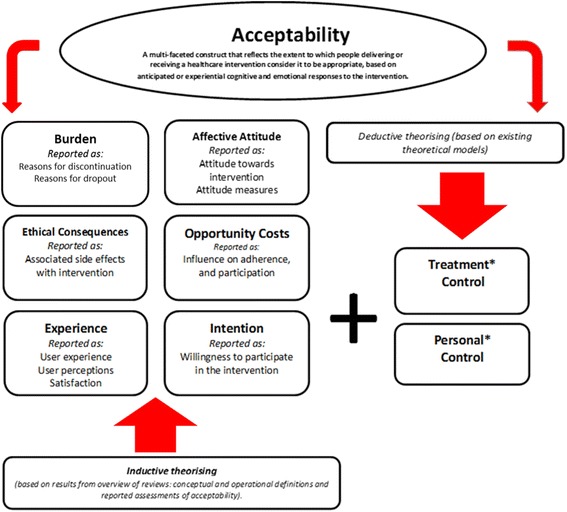
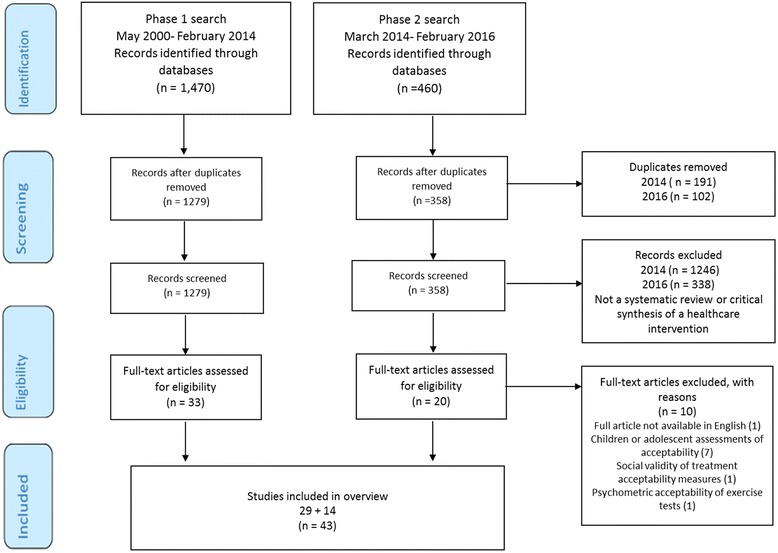
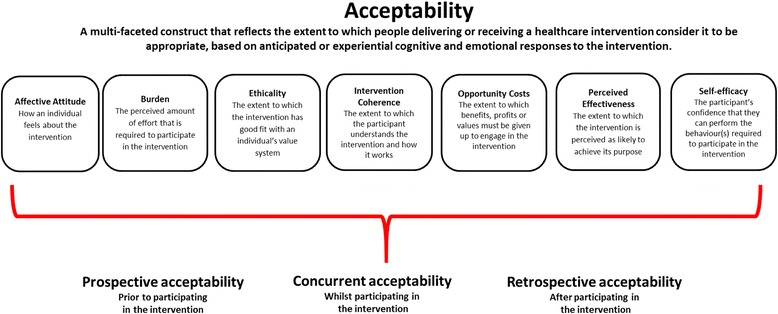
BACKGROUND: It is increasingly acknowledged that 'acceptability' should be considered when designing, evaluating and implementing healthcare interventions. However, the published literature offers little guidance on how to define or assess acceptability. The purpose of this study was to develop a multi-construct theoretical framework of acceptability of healthcare interventions that can be applied to assess prospective (i.e. anticipated) and retrospective (i.e. experienced) acceptability from the perspective of intervention delivers and recipients. METHODS: Two methods were used to select the component constructs of acceptability. 1) An overview of reviews was conducted to identify systematic reviews that claim to define, theorise or measure acceptability of healthcare interventions. 2) Principles of inductive and deductive reasoning were applied to theorise the concept of acceptability and develop a theoretical framework. Steps included (1) defining acceptability; (2) describing its properties and scope and (3) identifying component constructs and empirical indicators. RESULTS: From the 43 reviews included in the overview, none explicitly theorised or defined acceptability. Measures used to assess acceptability focused on behaviour (e.g. dropout rates) (23 reviews), affect (i.e. feelings) (5 reviews), cognition (i.e. perceptions) (7 reviews) or a combination of these (8 reviews). From the methods described above we propose a definition: Acceptability is a multi-faceted construct that reflects the extent to which people delivering or receiving a healthcare intervention consider it to be appropriate, based on anticipated or experienced cognitive and emotional responses to the intervention. The theoretical framework of acceptability (TFA) consists of seven component constructs: affective attitude, burden, perceived effectiveness, ethicality, intervention coherence, opportunity costs, and self-efficacy. CONCLUSION: Despite frequent claims that healthcare interventions have assessed acceptability, it is evident that acceptability research could be more robust. The proposed definition of acceptability and the TFA can inform assessment tools and evaluations of the acceptability of new or existing interventions.
Overview
The claims and statistics of this paper haven’t been checked yet.
Free: it reads the open-access text and checks the first 5 claims that cite a source we can check. Create a free account to check every claim.
Integrity signals
Registry
Cites
Statistics
Figures
Verification
Claims the paper makes
The claims and statistics of this paper haven’t been checked yet.
Free: it reads the open-access text and checks the first 5 claims that cite a source we can check. Create a free account to check every claim.
Claims other papers make about this one
Each is checked against this paper’s own text: does it say what the citing paper says it does?
The source backs part of the claim, not all of it — or backs it for a different population, condition or comparison.
In the citing paper
“Sekhon and colleagues [16] identified 7 component constructs of acceptability, but studies are generally designed to address only some of these components and vary by the components chosen.”
From Acceptability of Digital Mental Health Interventions for Depression and Anxiety: Systematic Review (2024) · cites this paper as [16]
Experimental — accuracy not yet measuredThe source backs part of the claim, not all of it — or backs it for a different population, condition or comparison.
In the citing paper
“Interviews followed a semi-structured schedule, taking into consideration elements of the TDF [24], and TFA [23]. Once drafted, interview schedules were reviewed by the EQUITy Lived Experience Advisory Panel (LEAP).”
From 'I didn't know what to expect': Exploring patient perspectives to identify targets for change to improve telephone-delivered psychological interventions (2020) · cites this paper as [23]
Experimental — accuracy not yet measuredThe source backs part of the claim, not all of it — or backs it for a different population, condition or comparison.
In the citing paper
“It has been increasingly acknowledged that consideration of patient acceptability using theories of behaviour change are key to effective evaluation, design and implementation of healthcare interventions [23–25] .”
From 'I didn't know what to expect': Exploring patient perspectives to identify targets for change to improve telephone-delivered psychological interventions (2020) · cites this paper as [23]
Experimental — accuracy not yet measuredThe cited source says what the claim attributes to it.
In the citing paper
“Overall, relating to the acceptability model by Sekhon et al. (2017), the main problems regarding acceptability centred around the dimensions burden, opportunity cost and self-efficacy, since participants found the intervention overly demanding when suffering from mental health symptoms and that they required more support to from a therapist to make use of the treatment material.”
From Investigating the potential of a novel internet-based cognitive behavioural intervention for Dari and Farsi speaking refugee youth: A feasibility study (2022) · cites this paper as Sekhon et al. (2017)
The cited source says what the claim attributes to it.
In the citing paper
“The TFA provided a structured theory around which to explore patient acceptability of specific elements of telephone-delivered treatment, without presuming acceptability based on patients’ behaviour [23].”
From 'I didn't know what to expect': Exploring patient perspectives to identify targets for change to improve telephone-delivered psychological interventions (2020) · cites this paper as [23]
2 more claims about this paper
Create a free account to see every claim other papers make about this one.
Self-check
Percentages, sums and reported differences re-computed from the paper’s own numbers.
The self-check needs the paper’s full text.
Citations
Cites
Using thematic analysis in psychology
Braun, V., & Clarke, V. (2006) · Qualitative Research in Psychology · doi:10.1191/1478088706qp063oa · Cited by 194,414 · cited 1×
“All extracted data were analysed by applying the thematic synthesis approach [30].”
MethodThe theory of planned behavior
Ajzen, I. (1991) · Organizational Behavior and Human Decision Processes · doi:10.1016/0749-5978(91)90020-t · Cited by 90,587
Preferred Reporting Items for Systematic Reviews and Meta-Analyses: the PRISMA statement
Moher, D., Liberati, A., Tetzlaff, J., Altman, D. G., & for the PRISMA Group (2009) · BMJ · doi:10.1136/bmj.b2535 · Cited by 83,823
Preferred reporting items for systematic reviews and meta-analyses: the PRISMA Statement.
(2009) · PubMed Central · Cited by 44,859
Self-efficacy: Toward a unifying theory of behavioral change
Bandura, A. (1977) · Psychological Review · doi:10.1037/0033-295x.84.2.191 · Cited by 43,925
Cochrane Handbook for Systematic Reviews of Interventions: Cochrane Book Series
(2008) · doi:10.1002/9780470712184 · Cited by 25,048 · cited 1×
“The Cochrane Tool of Quality Assessment was applied most frequently [39] (18 reviews: 62%).”
MethodAssessing the quality of reports of randomized clinical trials: Is blinding necessary?
Jadad, A. R., Moore, R. A., Carroll, D., Jenkinson, C., Reynolds, D. J. M., Gavaghan, D. J., & McQuay, H. J. (1996) · Controlled Clinical Trials · doi:10.1016/0197-2456(95)00134-4 · Cited by 17,582 · cited 2×
“Other assessments tools applied included the Jadad Scale [40] (three reviews: 10%), the”
MethodStructural Equations with Latent Variables.
Clogg, C. C., & Bollen, K. A. (1991) · Contemporary Sociology · doi:10.2307/2072165 · Cited by 17,442
Structural Equations with Latent Variables
Bollen, K. A. (1989) · Wiley series in probability and statistics · doi:10.1002/9781118619179 · Cited by 17,277 · cited 1×
“The inconsistency in defining concepts can impede the development of valid assessment instruments [20].”
BackgroundHealth Behavior and Health Education: Theory, Research, and Practice
(1992) · Annals of Internal Medicine · doi:10.7326/0003-4819-116-4-350_1 · Cited by 13,207
Zhang, Q., Wang, C., Zheng, M., Li, Y., Li, J., Zhang, L., Shang, X., & Yan, C. (2015) · Cerebrovascular Diseases · doi:10.1159/000369778 · Cited by 11,533
Developing and evaluating complex interventions: the new Medical Research Council guidance
Craig, P., Dieppe, P., Macintyre, S., Michie, S., Nazareth, I., & Petticrew, M. (2008) · BMJ · doi:10.1136/bmj.a1655 · Cited by 10,995
Self-efficacy: Toward a unifying theory of behavioral change
Bandura, A. (1978) · Advances in Behaviour Research and Therapy · doi:10.1016/0146-6402(78)90002-4 · Cited by 10,586
Process evaluation of complex interventions: Medical Research Council guidance
Moore, G. F., Audrey, S., Barker, M., Bond, L., Bonell, C., Hardeman, W., Moore, L., O'Cathain, A., Tinati, T., Wight, D., et al. (2015) · BMJ · doi:10.1136/bmj.h1258 · Cited by 6,204
Moher, D., Schulz, K. F., & Altman, D. G. (2001) · The Lancet · doi:10.1016/s0140-6736(00)04337-3 · Cited by 5,373
Dong, Y., Hao, L., Shi, Z., Wang, G., Zhang, Z., & Han, C. (2013) · Urologia Internationalis · doi:10.1159/000351405 · Cited by 4,540
Framework for design and evaluation of complex interventions to improve health
Campbell, M. (2000) · BMJ · doi:10.1136/bmj.321.7262.694 · Cited by 3,474
Making psychological theory useful for implementing evidence based practice: a consensus approach
Michie, S. (2005) · Quality and Safety in Health Care · doi:10.1136/qshc.2004.011155 · Cited by 3,440 · cited 5×
“We therefore considered a body of literature that groups control constructs together [38].”
BackgroundInfluentialThe revised illness perception questionnaire (IPQ-R)
Moss-Morris, R., Weinman, J., Petrie, K., Horne, R., Cameron, L., & Buick, D. (2002) · Psychology & Health · doi:10.1080/08870440290001494 · Cited by 2,949 · cited 1×
“On reviewing the control items within the Illness Perception Questionnaire –Revised (IPQ-R), we realised all items focus on an individual’s perceived control of the illness for example, “there is a lot I can do to control my symptoms” ([56], p.”
MethodMoher, D., Schulz, K. F., & Altman, D. G. (2001) · BMC Medical Research Methodology · doi:10.1186/1471-2288-1-2 · Cited by 2,755
Developing and Evaluating Complex Interventions: New Guidance
Craig, P., Dieppe, P. A., MacIntyre, S., Michie, S., Nazareth, I., & Petticrew, M. P. (2006) · UCL Discovery (University College London) · Cited by 1,978
Proctor, E. K., Landsverk, J., Aarons, G., Chambers, D., Glisson, C., & Mittman, B. (2009) · Administration and Policy in Mental Health and Mental Health Services Research · doi:10.1007/s10488-008-0197-4 · Cited by 1,894 · cited 1×
“overall effectiveness of the intervention [8, 9].”
Current methods of the U.S. Preventive Services Task Force
Harris, R. P., Helfand, M., Woolf, S. H., Lohr, K. N., Mulrow, C. D., Teutsch, S. M., & Atkins, D. (2001) · American Journal of Preventive Medicine · doi:10.1016/s0749-3797(01)00261-6 · Cited by 1,731
Cipriani, A., Furukawa, T. A., Salanti, G., Geddes, J. R., Higgins, J. P., Churchill, R., Watanabe, N., Nakagawa, A., Omori, I. M., McGuire, H., et al. (2009) · The Lancet · doi:10.1016/s0140-6736(09)60046-5 · Cited by 1,654
Armijo‐Olivo, S., Stiles, C. R., Hagen, N. A., Biondo, P. D., & Cummings, G. G. (2012) · Journal of Evaluation in Clinical Practice · doi:10.1111/j.1365-2753.2010.01516.x · Cited by 1,539 · cited 1×
“Effective Public Health Practice Project (EPHPP) quality assessment tool [43] (one review: 3%) and United States”
BackgroundTHEORY AT A GLANCE: A GUIDE FOR HEALTH PROMOTION PRACTICE
Croyle, R. T. (2005) · Cited by 1,396
Andrews, G., Cuijpers, P., Craske, M. G., McEvoy, P., & Titov, N. (2010) · PLoS ONE · doi:10.1371/journal.pone.0013196 · Cited by 1,311 · cited 1×
“These included two reviews measuring adherence and satisfaction [45, 46], three reviews focusing on dropout rates, take-up rates, reasons for discontinuation and a satisfaction measure [47–49] one review combining the time taken for wound healing alongside a measure of satisfaction and comfort [29], and two reviews us…”
BackgroundAtkins, D., Eccles, M., Flottorp, S., Guyatt, G. H., Henry, D., Hill, S., Liberati, A., O'Connell, D., Oxman, A. D., Phillips, B., et al. (2004) · BMC Health Services Research · doi:10.1186/1472-6963-4-38 · Cited by 1,235 · cited 1×
“(two reviews: 6%); Grade scale [42] (one review: 3%),”
Are interventions theory-based? Development of a theory coding scheme.
Michie, S., & Prestwich, A. (2010) · Health Psychology · doi:10.1037/a0016939 · Cited by 855
Borrelli, B., Sepinwall, D., Ernst, D., Bellg, A. J., Czajkowski, S., Breger, R., DeFrancesco, C., Levesque, C., Sharp, D. L., Ogedegbe, G., et al. (2005) · Journal of Consulting and Clinical Psychology · doi:10.1037/0022-006x.73.5.852 · Cited by 803 · cited 1×
“overall effectiveness of the intervention [8, 9].”
Demystifying theory and its use in improvement
Davidoff, F., Dixon-Woods, M., Leviton, L., & Michie, S. (2015) · BMJ Quality & Safety · doi:10.1136/bmjqs-2014-003627 · Cited by 714
Diepeveen, S., Ling, T., Suhrcke, M., Roland, M., & Marteau, T. M. (2013) · BMC Public Health · doi:10.1186/1471-2458-13-756 · Cited by 656 · cited 1×
“patients or healthcare professionals) [4, 5].”
Drop Your Tools: An Allegory for Organizational Studies
Weick, K. E. (1996) · Administrative Science Quarterly · doi:10.2307/2393722 · Cited by 578 · cited 1×
“The process of theorising is enhanced when inductive and deductive processes are combined [35, 36].”
BackgroundThe importance of patient preferences in treatment decisions-challenges for doctors
Say, R. E., & Thomson, R. (2003) · BMJ · doi:10.1136/bmj.327.7414.542 · Cited by 493
Attitudes and Acceptability on HIV Self-testing Among Key Populations: A Literature Review
Figueroa, C., Johnson, C., Verster, A., & Baggaley, R. (2015) · AIDS and Behavior · doi:10.1007/s10461-015-1097-8 · Cited by 451 · cited 1×
“Two of the reviews (5%) assessed acceptability pre-intervention, which involved participants agreeing to take part in screening for a brief alcohol intervention [52] and willingness to participate in HIV self–testing [53].”
BackgroundSanders, C., Rogers, A., Bowen, R., Bower, P., Hirani, S., Cartwright, M., Fitzpatrick, R., Knapp, M., Barlow, J., Hendy, J., et al. (2012) · BMC Health Services Research · doi:10.1186/1472-6963-12-220 · Cited by 450 · cited 1×
“filling out long follow–up questionnaires) and do not always reflect problems with acceptability of the intervention under investigation [61, 62].”
BackgroundSelf-citationSelf-efficacy beliefs: Comparison of five measures.
Lee, C., & Bobko, P. (1994) · Journal of Applied Psychology · doi:10.1037//0021-9010.79.3.364 · Cited by 429 · cited 1×
“Self-efficacy is often operationalised as an individual’s confidence in his or her capability of performing a behaviour [58, 59].”
BackgroundDesigning theoretically-informed implementation interventions
The Improved Clinical Effectiveness through Behavioural Research Group (ICEBeRG) (2006) · Implementation Science · doi:10.1186/1748-5908-1-4 · Cited by 380
Kaltenthaler, E., Sutcliffe, P., Parry, G., Beverley, C., Rees, A., & Ferriter, M. (2008) · Psychological Medicine · doi:10.1017/s0033291707002607 · Cited by 267
Assessment of preferences for treatment: Validation of a measure
Sidani, S., Epstein, D. R., Bootzin, R. R., Moritz, P., & Miranda, J. (2009) · Research in Nursing & Health · doi:10.1002/nur.20329 · Cited by 231 · cited 4×
“and effectiveness in managing the clinical problem” ([14],”
BackgroundInfluentialBotella, C., Serrano, B., baños, R., & García-Palacios, A. (2015) · Neuropsychiatric Disease and Treatment · doi:10.2147/ndt.s89542 · Cited by 223
O’Keeffe, L. M., Greene, R. A., & Kearney, P. M. (2014) · Systematic Reviews · doi:10.1186/2046-4053-3-1 · Cited by 192
Sandberg, M., Ahlström, G., Axmon, A., & Kristensson, J. (2016) · BMC Health Services Research · doi:10.1186/s12913-016-1880-x · Cited by 191
Integrating theoretical approaches to promote physical activity
Epstein, L. H. (1998) · American Journal of Preventive Medicine · doi:10.1016/s0749-3797(98)00083-x · Cited by 180
On Building an Administrative Science
Thompson, J. D. (1956) · Administrative Science Quarterly · doi:10.2307/2390842 · Cited by 164 · cited 1×
“The process of theorising is enhanced when inductive and deductive processes are combined [35, 36].”
BackgroundA guide and glossary on postpositivist theory building for population health
Carpiano, R. M., & Daley, D. M. (2006) · Journal of Epidemiology and Community Health · doi:10.1136/jech.2004.031534 · Cited by 149 · cited 2×
“The methods applied to develop theory are not always described systematically in the healthcare and psychology literature [31].”
MethodBerlim, M. T., McGirr, A., den Eynde, F. V., Fleck, M. P., & Giacobbe, P. (2014) · Journal of Affective Disorders · doi:10.1016/j.jad.2014.02.016 · Cited by 148
Cook, L., & Watkins, E. (2016) · Trials · doi:10.1186/s13063-015-1128-9 · Cited by 145
The acceptability and preference for the psychological treatment of PTSD
Tarrier, N., Liversidge, T., & Gregg, L. (2006) · Behaviour Research and Therapy · doi:10.1016/j.brat.2005.11.012 · Cited by 134
Becker, C. B., Darius, E., & Schaumberg, K. (2007) · Behaviour Research and Therapy · doi:10.1016/j.brat.2007.05.006 · Cited by 133
Telehealth behavioral treatment for medication nonadherence: a pilot and feasibility study
Hommel, K. A., Hente, E., Herzer, M., Ingerski, L. M., & Denson, L. A. (2013) · European Journal of Gastroenterology & Hepatology · doi:10.1097/meg.0b013e32835c2a1b · Cited by 133 · cited 1×
“recommendations and to benefit from improved clinical outcomes [6, 7].”
BackgroundAndrykowski, M. A., & Manne, S. L. (2006) · Annals of Behavioral Medicine · doi:10.1207/s15324796abm3202_3 · Cited by 122
Rixon, L., Baron, J., McGale, N., Lorencatto, F., Francis, J., & Davies, A. (2016) · BMC Health Services Research · doi:10.1186/s12913-016-1904-6 · Cited by 117 · cited 1×
“Findings may provide insights into reasons for low participant retention and implications for the fidelity of both delivery and receipt of the intervention [60].”
BackgroundSelf-citationThe self‐efficacy expectations and occupational preferences of females and males
CLEMENT, S. (1987) · Journal of Occupational Psychology · doi:10.1111/j.2044-8325.1987.tb00258.x · Cited by 111 · cited 1×
“Self-efficacy is often operationalised as an individual’s confidence in his or her capability of performing a behaviour [58, 59].”
BackgroundBrooke-Sumner, C., Petersen, I., Asher, L., Mall, S., Egbe, C. O., & Lund, C. (2015) · BMC Psychiatry · doi:10.1186/s12888-015-0400-6 · Cited by 108 · cited 1×
“Conceptual definitions included: “acceptability, or how the recipients of (or those delivering the intervention) perceive and react to it” ([49] p.”
BackgroundCampbell, M., Egan, M., Lorenc, T., Bond, L., Popham, F., Fenton, C., & Benzeval, M. (2014) · Systematic Reviews · doi:10.1186/2046-4053-3-114 · Cited by 103
Cox, W. M., Subramanian, L., Linden, D. E. J., Lührs, M., McNamara, R., Playle, R., Hood, K., Watson, G., Whittaker, J. R., Sakhuja, R., et al. (2016) · Trials · doi:10.1186/s13063-016-1607-7 · Cited by 91
A systematic review on the acceptability of perinatal depression screening
El‐Den, S., O’Reilly, C. L., & Chen, T. F. (2015) · Journal of Affective Disorders · doi:10.1016/j.jad.2015.06.015 · Cited by 88 · cited 1×
“These included two reviews measuring adherence and satisfaction [45, 46], three reviews focusing on dropout rates, take-up rates, reasons for discontinuation and a satisfaction measure [47–49] one review combining the time taken for wound healing alongside a measure of satisfaction and comfort [29], and two reviews us…”
BackgroundDiouf, A., Badiane, A., Manga, N. M., Dossou, N. I., Sow, P. S., & Wade, S. (2015) · BMC Public Health · doi:10.1186/s12889-015-2639-8 · Cited by 88
Stok, F. M., de Ridder, D. T. D., de Vet, E., Nureeva, L., Łuszczyńska, A., Wardle, J., Gaspar, T., & de Wit, J. B. F. (2015) · BMC Public Health · doi:10.1186/s12889-015-2665-6 · Cited by 86 · cited 1×
“patients or healthcare professionals) [4, 5].”
Fisher, P., McCarney, R., Hasford, C., & Vickers, A. J. (2006) · Homeopathy · doi:10.1016/j.homp.2006.07.006 · Cited by 78
Theory Building, Replication, and Behavioral Priming: Where Do We Need to Go From Here?
Locke, E. A. (2015) · Perspectives on Psychological Science · doi:10.1177/1745691614567231 · Cited by 78
Doll, R. E. (1974) · International Journal of Epidemiology · doi:10.1093/ije/3.4.305 · Cited by 72
Dillip, A., Alba, S., Mshana, C., Hetzel, M. W., Lengeler, C., Mayumana, I., Schulze, A., Mshinda, H., Weiss, M. G., & Obrist, B. (2012) · BMC Health Services Research · doi:10.1186/1472-6963-12-113 · Cited by 66
Giles, E. L., Sniehotta, F. F., McColl, E., & Adams, J. (2015) · BMC Public Health · doi:10.1186/s12889-015-1409-y · Cited by 61
Kedge, E. M. (2008) · Radiography · doi:10.1016/j.radi.2008.08.002 · Cited by 57 · cited 1×
“These included two reviews measuring adherence and satisfaction [45, 46], three reviews focusing on dropout rates, take-up rates, reasons for discontinuation and a satisfaction measure [47–49] one review combining the time taken for wound healing alongside a measure of satisfaction and comfort [29], and two reviews us…”
BackgroundA systematic review of self-help for disfigurement: Effectiveness, usability, and acceptability
Muftin, Z., & Thompson, A. R. (2013) · Body Image · doi:10.1016/j.bodyim.2013.07.005 · Cited by 49 · cited 1×
“These included two reviews measuring adherence and satisfaction [45, 46], three reviews focusing on dropout rates, take-up rates, reasons for discontinuation and a satisfaction measure [47–49] one review combining the time taken for wound healing alongside a measure of satisfaction and comfort [29], and two reviews us…”
BackgroundBlenkinsopp, A., & Hassey, A. (2005) · International Journal of Pharmacy Practice · doi:10.1211/ijpp.13.4.0001 · Cited by 48 · cited 1×
“These included two reviews measuring adherence and satisfaction [45, 46], three reviews focusing on dropout rates, take-up rates, reasons for discontinuation and a satisfaction measure [47–49] one review combining the time taken for wound healing alongside a measure of satisfaction and comfort [29], and two reviews us…”
BackgroundThe PRIME project: developing a patient evidence‐base
Staniszewska, S., Crowe, S., Badenoch, D., Edwards, C., Savage, J., & Norman, W. (2010) · Health Expectations · doi:10.1111/j.1369-7625.2010.00590.x · Cited by 45 · cited 1×
“Stainszewska and colleagues (2010) argue that social acceptability refers to “patients’ assessment of the acceptability, suitability, adequacy or effectiveness of care and treatment” ([18], p.”
BackgroundKulier, R., Helmerhorst, F. M., Maitra, N., & Gülmezoglu, A. M. (2004) · Reproductive Health · doi:10.1186/1742-4755-1-1 · Cited by 45
LITTLEJOHN, C. (2006) · Alcohol and Alcoholism · doi:10.1093/alcalc/agl053 · Cited by 39 · cited 1×
“Two of the reviews (5%) assessed acceptability pre-intervention, which involved participants agreeing to take part in screening for a brief alcohol intervention [52] and willingness to participate in HIV self–testing [53].”
BackgroundPafitis, N. (2015) · BMC Public Health · doi:10.1186/s12889-015-1368-3 · Cited by 34
Accrual and drop out in a primary prevention randomised controlled trial: qualitative study
Eborall, H., Stewart, M. C. W., Cunningham‐Burley, S., Price, J. F., & Fowkes, F. G. R. (2011) · Trials · doi:10.1186/1745-6215-12-7 · Cited by 32
Lawes-Wickwar, S., McBain, H. B., Newman, S. P., Hirani, S. P., Hurt, C. S., Dunlop, N., Flood, C., & Ezra, D. G. (2016) · Trials · doi:10.1186/s13063-016-1263-y · Cited by 27
Rodriguez, M. I., & Gordon‐Maclean, C. (2014) · Contraception · doi:10.1016/j.contraception.2014.01.008 · Cited by 18 · cited 1×
“2535) and “women were asked if they were well satisfied, unsatisfied or indifferent or had no response” with the intervention ([55] p.”
BackgroundEffective Health Care bulletins: are they efficient?
Torgerson, D. J., Ryan, M., & Donaldson, C. (1995) · BMJ Quality & Safety · doi:10.1136/qshc.4.1.48 · Cited by 14 · cited 1×
“Intervention developers are faced with the challenge of designing effective healthcare interventions to guarantee the best clinical outcomes achievable with the resources available [2, 3].”
Background
Research works printed but not linked: 1
- Hox JJ From theoretical concept to survey question. 1997): Survey Measurement and Process Quality 1997 New York ua Wiley 45 69
Cited by
Nadarzynski, T., Miles, O., Cowie, A., & Ridge, D. (2019) · DIGITAL HEALTH · doi:10.1177/2055207619871808 · Cited by 810
“The acceptability of a healthcare intervention is a multi-faceted construct based on a range of dimensions including burden, values, effectiveness, cognition, and emotional responses.(22) A study of 100 physicians in the US concluded that although the majority believed chatbots could assist with scheduling doctors’ ap…”
BackgroundSekhon, M., Cartwright, M., & Francis, J. J. (2022) · BMC Health Services Research · doi:10.1186/s12913-022-07577-3 · Cited by 541
“In a systematic overview of reviews, we found that 55% of included reviews used behavioural measures as indicators of acceptability [7], such as total trial dropout rate and reasons for discontinuation [8–10].”
BackgroundMethodSelf-citationPersonalized early detection and prevention of breast cancer: ENVISION consensus statement
Pashayan, N., Antoniou, A. C., Ivanus, U., Esserman, L. J., Easton, D. F., French, D., Sroczynski, G., Hall, P., Cuzick, J., Evans, D. G., et al. (2020) · Nature Reviews Clinical Oncology · doi:10.1038/s41571-020-0388-9 · Cited by 438
The Handbook of Behavior Change
(2020) · Cambridge University Press eBooks · doi:10.1017/9781108677318 · Cited by 407
Klaic, M., Kapp, S., Hudson, P., Chapman, W., Denehy, L., Story, D., & Francis, J. J. (2022) · Implementation Science · doi:10.1186/s13012-021-01171-7 · Cited by 394
“• Acceptability, fidelity and feasibility may influence scalability and sustainability of a healthcare intervention.”
MethodInfluentialSelf-citation
Metadata
- Authors
- Sekhon, M., Cartwright, M., & Francis, J. J.
- Affiliations
- City, University of London (GB)
- Corresponding author
- Sekhon, Mandeep
- Venue
- BMC Health Services Research
- Published
- 2017-01-26
- Volume
- 17
- Issue
- 1
- Pages
- 88-88
- ISSN
- 1472-6963 (ISSN-L)
- PMC
- PMC5267473
- OpenAlex
- W2582406074
- Cited by
- 3,938
- References
- 78
- Citations by year
- 2026: 620 · 2025: 701 · 2024: 683 · 2023: 518 · 2022: 535 · 2021: 349 · 2020: 349 · 2019: 118 · 2018: 56 · 2017: 6
- FWCI
- 234.94
- Type
- journal article
- Language
- en
- Open access
- gold
- doi.org
- Licence
- cc-by
- Locations
- BMC Health Services Research (publishedVersion, cc-by)
- Europe PMC (PubMed Central) (publishedVersion, cc-by)
- PubMed Central (publishedVersion, cc-by)
- PubMed (publishedVersion)
- Research Repository (Kingston University London) (acceptedVersion)
- City Research Online (City University London) (acceptedVersion)
- St George's Online Research Archive (St George's University of London) (acceptedVersion)
- Minerva Access (University of Melbourne) (submittedVersion, cc-by)
- Research Portal (King's College London) (submittedVersion, cc-by)
- Topics
- Health Sciences › Health Professions › General Health Professions › Health Policy Implementation Science
- Social Sciences › Economics, Econometrics and Finance › Economics and Econometrics › Health Systems, Economic Evaluations, Quality of Life
- Health Sciences › Nursing › Research and Theory › Health Education and Validation
- Keywords
- theoretical framework, affective attitudes, perceived burden, perceived effectiveness, ethicality, intervention coherence, opportunity cost, self-efficacy, dropout rates
- MeSH terms
- Humans, Models, Theoretical, Patient Acceptance of Health Care, Prospective Studies, Retrospective Studies, Review Literature as Topic, Consensus
About these checks
Registry, retraction, Cites and statistics results are computed, not judged, with one exception: a printed reference that no index lists is read once by a model before it counts as a citation error. Claims are extracted by a model and kept only when their quote appears verbatim in the text; each cited source is then checked, with a model’s help, for whether it says what the claim relies on. Those verdicts can be wrong — read the claim’s quote and the cited source before relying on one.
Statistics and arithmetic are recomputed, not judged.
Confidence bands are shown only for fields calibrated on our annotated test set. None is calibrated yet, so no band is shown.
What counts as a claim ›How we measure confidence ›How we check this ›
Are you an author, or do you see a problem with this page? Request a review
Data sources
Bibliographic data: Semantic Scholar, OpenAlex, Crossref.
Contains information from the Semantic Scholar Academic Graph Datasets, made available under the ODC Attribution License (ODC-BY 1.0).
Semantic Scholar’s data is described in: Kinney, R., et al. (2023). The Semantic Scholar Open Data Platform. arXiv:2301.10140.
