

The determinants and consequences of adult nursing staff turnover: a systematic review of systematic reviews
Open accessThe DOI matches its Crossref record; 64 of the 65 references it cites were found in a registry or an index.
Abstract
BACKGROUND: Nurses leaving their jobs and the profession are an issue of international concern, with supply-demand gaps for nurses reported to be widening. There is a large body of existing literature, much of which is already in review form. In order to advance the usefulness of the literature for nurse and human resource managers, we undertook an overview (review of systematic reviews). The aim of the overview was to identify high quality evidence of the determinants and consequences of turnover in adult nursing. METHODS: Reviews were identified which were published between 1990 and January 2015 in English using electronic databases (the Cochrane Database of Systematic Reviews, MEDLINE, EMBASE, Applied Social Sciences Index and Abstracts, CINAHL plus and SCOPUS) and forward searching. All stages of the review were conducted in parallel by two reviewers. Reviews were quality appraised using the Assessment of Multiple Systematic Reviews and their findings narratively synthesised. RESULTS: Nine reviews were included. We found that the current evidence is incomplete and has a number of important limitations. However, a body of moderate quality review evidence does exist giving a picture of multiple determinants of turnover in adult nursing, with - at the individual level - nurse stress and dissatisfaction being important factors and -at the organisational level - managerial style and supervisory support factors holding most weight. The consequences of turnover are only described in economic terms, but are considered significant. CONCLUSIONS: In making a quality assessment of the review as well as considering the quality of the included primary studies and specificity in the outcomes they measure, the overview found that the evidence is not as definitive as previously presented from individual reviews. Further research is required, of rigorous research design, whether quantitative or qualitative, particularly against the outcome of actual turnover as opposed to intention to leave. TRIAL REGISTRATION: PROSPERO Registration 17 March 2015: CRD42015017613 .
Overview
The claims and statistics of this paper haven’t been checked yet.
Free: it reads the open-access text and checks the first 5 claims that cite a source we can check. Create a free account to check every claim.
Integrity signals
Registry
Cites
Statistics
Figures
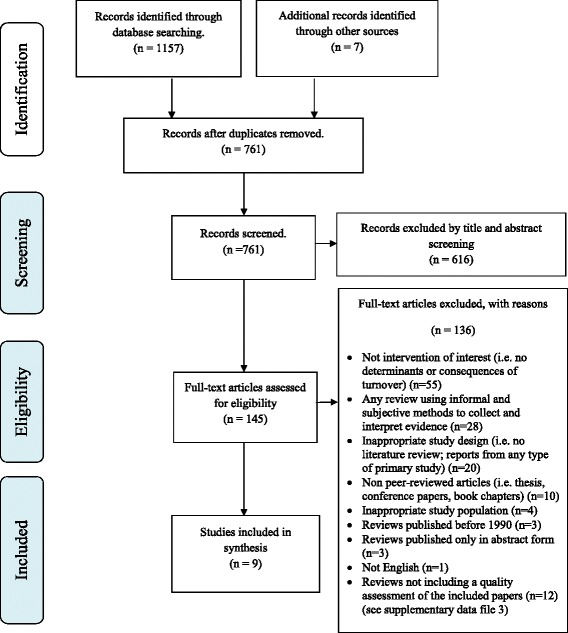
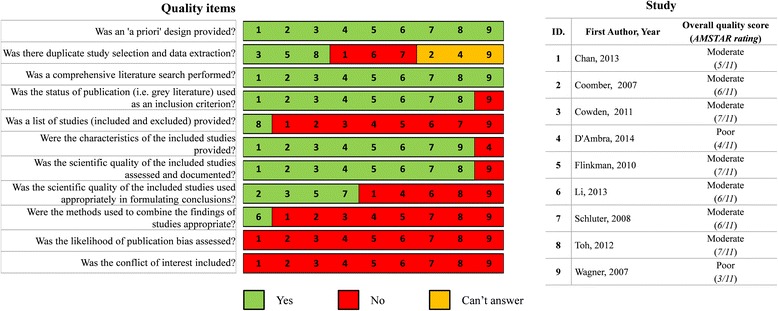
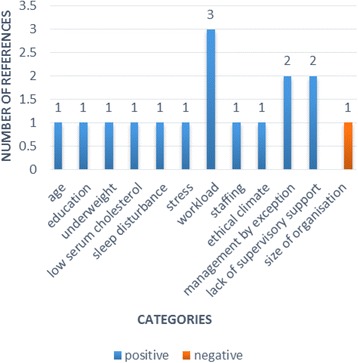
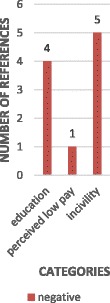
Verification
Claims the paper makes
The claims and statistics of this paper haven’t been checked yet.
Free: it reads the open-access text and checks the first 5 claims that cite a source we can check. Create a free account to check every claim.
Claims other papers make about this one
Each is checked against this paper’s own text: does it say what the citing paper says it does?
The cited source says what the claim attributes to it.
In the citing paper
“A search for systematic reviews published in the last 10 years examining turnover intention among HCWs on PubMed, PROSPERO and Google Scholar produced nine relevant systematic reviews [11–19]”
From A global overview of healthcare workers’ turnover intention amid COVID-19 pandemic: a systematic review with future directions (2022) · cites this paper as [13]
The cited source says what the claim attributes to it.
In the citing paper
“and many of which were known factors prior to the pandemic [11–19].”
From A global overview of healthcare workers’ turnover intention amid COVID-19 pandemic: a systematic review with future directions (2022) · cites this paper as [13]
Self-check
Percentages, sums and reported differences re-computed from the paper’s own numbers.
The self-check needs the paper’s full text.
Citations
Cites
PRISMA-P Group, Moher, D., Shamseer, L., Clarke, M., Ghersi, D., Liberati, A., Petticrew, M., Shekelle, P., & Stewart, L. A. (2015) · Systematic Reviews · doi:10.1186/2046-4053-4-1 · Cited by 26,223
Cochrane Handbook for Systematic Reviews of Interventions Version 5.0.1. The Cochrane Collaboration
Higgins, J. P. T., Green, S. R., & Higgins, J. P. T. (2008) · Cited by 7,259
Development of AMSTAR: A measurement tool to assess the methodological quality of systematic reviews
Shea, B. J., Grimshaw, J. M., Wells, G. A., Boers, M., Andersson, N., Hamel, C., Porter, A. C., Tugwell, P., Moher, D., & Bouter, L. M. (2007) · BMC Medical Research Methodology · doi:10.1186/1471-2288-7-10 · Cited by 4,374
Griffeth, R. W., Hom, P. W., & Gaertner, S. (2000) · Journal of Management · doi:10.1177/014920630002600305 · Cited by 4,001
Systematic reviews: CRD's guidance for undertaking reviews in health care
Tacconelli, E. (2010) · The Lancet Infectious Diseases · doi:10.1016/s1473-3099(10)70065-7 · Cited by 3,245
Greenhalgh, T., & Peacock, R. (2005) · BMJ · doi:10.1136/bmj.38636.593461.68 · Cited by 2,045 · cited 1×
“We identified additional studies by searching on PubMed by using the “related citations” algorithm and screening the reference lists of included studies for other reviews [36].”
MethodEvidence-based practice in nursing & healthcare : a guide to best practice
Melnyk, B. M., & Fineout‐Overholt, E. (2005) · Wolters Kluwer eBooks · Cited by 1,887
Synthesizing Research: A Guide for Literature Reviews
Cooper, H. (1998) · Cited by 1,704
Methodology in conducting a systematic review of systematic reviews of healthcare interventions
Smith, V., Devane, D., Begley, C. M., & Clarke, M. (2011) · BMC Medical Research Methodology · doi:10.1186/1471-2288-11-15 · Cited by 1,227 · cited 2×
“It is in recognition of the plethora of previous work in nursing that we conducted this overview of systematic reviews and, in doing so, highlight an important finding: while clarity has been achieved on where the strongest current evidence lies regarding the determinants and consequences of adult nursing turnover, no…”
BackgroundAppraising the Evidence: Reviewing Disparate Data Systematically
Hawker, S., Payne, S., Kerr, C., Hardey, M., & Powell, J. (2002) · Qualitative Health Research · doi:10.1177/1049732302238251 · Cited by 1,216
Seventy-five trials and eleven systematic reviews a day: how will we ever keep up?
Bastian, H., Glasziou, P., & Chalmers, I. (2010) · PLoS Medicine · doi:10.1371/journal.pmed.1000326 · Cited by 1,188 · cited 1×
“Using Medline alone at this stage we identified a large body of reviews relevant to the study’s objectives that indicated that nurse and human resource managers would be faced by a plethora of reviews [29, 30], many of which were not conducted according to reviews guidance [26].”
BackgroundBycio, P., Hackett, R. D., & Allen, J. S. (1995) · Journal of Applied Psychology · doi:10.1037//0021-9010.80.4.468 · Cited by 1,088
Holtom, B. C., Mitchell, T. R., Lee, T. W.-H., & Eberly, M. B. (2008) · Academy of Management Annals · doi:10.1080/19416520802211552 · Cited by 1,042
Coomber, B., & Louise Barriball, K. (2007) · International Journal of Nursing Studies · doi:10.1016/j.ijnurstu.2006.02.004 · Cited by 934
Epidemiology and reporting characteristics of systematic reviews.
Moher, D., Tetzlaff, J., Tricco, A. C., Sampson, M., & Altman, D. G. (2007) · PLoS Medicine · doi:10.1371/journal.pmed.0040078 · Cited by 891 · cited 1×
“Using Medline alone at this stage we identified a large body of reviews relevant to the study’s objectives that indicated that nurse and human resource managers would be faced by a plethora of reviews [29, 30], many of which were not conducted according to reviews guidance [26].”
BackgroundNurse turnover: A literature review – An update
Hayes, L. J., O’Brien-Pallas, L., Duffield, C., Shamian, J., Buchan, J., Hughes, F., Laschinger, H. K. S., & North, N. (2012) · International Journal of Nursing Studies · doi:10.1016/j.ijnurstu.2011.10.001 · Cited by 888
Nurse turnover: A literature review
Hayes, L. J., O’Brien-Pallas, L., Duffield, C., Shamian, J., Buchan, J., Hughes, F., Spence Laschinger, H. K., North, N., & Stone, P. W. (2006) · International Journal of Nursing Studies · doi:10.1016/j.ijnurstu.2005.02.007 · Cited by 873
The relationship between nursing leadership and patient outcomes: a systematic review update
Wong, C. A., Cummings, G. G., & Ducharme, L. (2013) · Journal of Nursing Management · doi:10.1111/jonm.12116 · Cited by 846
Integrating Research: A Guide for Literature Reviews
Kolbe, R. H., & Cooper, H. M. (1991) · Journal of Marketing Research · doi:10.2307/3172876 · Cited by 594
Predicting Registered Nurse Job Satisfaction and Intent to Leave
Larrabee, J. H., Janney, M. A., Ostrow, C. L., Withrow, M. L., Hobbs, & Burant, C. (2003) · JONA: The Journal of Nursing Administration · doi:10.1097/00005110-200305000-00003 · Cited by 525
The Effects of Postpartum Depression on Maternal-Infant Interaction: A Meta-Analysis
BECK, C. T. (1995) · Nursing Research · doi:10.1097/00006199-199509000-00007 · Cited by 467
Allen, D. G., Weeks, K. P., & Moffitt, K. R. (2005) · Journal of Applied Psychology · doi:10.1037/0021-9010.90.5.980 · Cited by 405
A comparative review of nurse turnover rates and costs across countries
Duffield, C. M., Roche, M. A., Homer, C., Buchan, J., & Dimitrelis, S. (2014) · Journal of Advanced Nursing · doi:10.1111/jan.12483 · Cited by 384
Defining the Review Question and Developing Criteria for Including Studies
O'Connor, D., Green, S., & Higgins, J. P. (2008) · Cochrane Handbook for Systematic Reviews of Interventions · doi:10.1002/9780470712184.ch5 · Cited by 374
The relationship between nursing leadership and patient outcomes: a systematic review
WONG, C. A., & CUMMINGS, G. G. (2007) · Journal of Nursing Management · doi:10.1111/j.1365-2834.2007.00723.x · Cited by 355
Nurse intention to remain employed: understanding and strengthening determinants
Tourangeau, A. E., & Cranley, L. A. (2006) · Journal of Advanced Nursing · doi:10.1111/j.1365-2648.2006.03934.x · Cited by 346
CHAN, Z. C. Y., TAM, W. S., LUNG, M. K. Y., WONG, W. Y., & CHAU, C. W. (2013) · Journal of Nursing Management · doi:10.1111/j.1365-2834.2012.01437.x · Cited by 342
Nurses' Moral Sensitivity and Hospital Ethical Climate: a Literature Review
Schluter, J., Winch, S., Holzhauser, K., & Henderson, A. (2008) · Nursing Ethics · doi:10.1177/0969733007088357 · Cited by 338
What Does Nurse Turnover Rate Mean and What Is the Rate?
Kovner, C. T., Brewer, C. S., Fatehi, F., & Jun, J. (2014) · Policy, Politics, & Nursing Practice · doi:10.1177/1527154414547953 · Cited by 333
Nurses’ intention to leave the profession: integrative review
Flinkman, M., Leino‐Kilpi, H., & Salanterä, S. (2010) · Journal of Advanced Nursing · doi:10.1111/j.1365-2648.2010.05322.x · Cited by 319
Nurses’ Job Satisfaction, Organizational Commitment, and Career Intent
Ingersoll, G. L., Olsan, T., Drew-Cates, J., DeVinney, B. C., & Davies, J. (2002) · JONA: The Journal of Nursing Administration · doi:10.1097/00005110-200205000-00005 · Cited by 318
The Effects of Nurses’ Job Satisfaction on Retention: An Australian Perspective
Cowin, L. (2002) · JONA: The Journal of Nursing Administration · doi:10.1097/00005110-200205000-00008 · Cited by 303
Leadership practices and staff nurses’ intent to stay: a systematic review
COWDEN, T., CUMMINGS, G., & PROFETTO-MCGRATH, J. (2011) · Journal of Nursing Management · doi:10.1111/j.1365-2834.2011.01209.x · Cited by 280
World Economic Outlook, October 2015
Dept., I. M. F. R. (2016) · World Economic Outlook · doi:10.5089/9781513519333.081 · Cited by 264
Toh, S. G., Ang, E., & Devi, M. K. (2012) · International Journal of Evidence-Based Healthcare · doi:10.1111/j.1744-1609.2012.00271.x · Cited by 261
Hospital Ethical Climates and Registered Nurses' Turnover Intentions
Hart, S. E. (2005) · Journal of Nursing Scholarship · doi:10.1111/j.1547-5069.2005.00030.x · Cited by 255
Flinkman, M., Laine, M., Leino-Kilpi, H., Hasselhorn, H.-M., & Salanterä, S. (2008) · International Journal of Nursing Studies · doi:10.1016/j.ijnurstu.2006.12.006 · Cited by 254
Estryn-Béhar, M., Van der Heijden, B. I. J. M., Ogińska, H., Camerino, D., Le Nézet, O., Conway, P. M., Fry, C., & Hasselhorn, H.-M. (2007) · Medical Care · doi:10.1097/mlr.0b013e31806728d8 · Cited by 253 · cited 1×
“Each of these content categories is divided by strength of evidence categories, within which we also account for the number and quality of the reviews’ included primary studies and the outcome Table 3 Articles most frequently included in the reviews assessed Articles Coomber Wagner Schluter Flinkman Cowden Toh Chan Li…”
BackgroundA literature review of nursing turnover costs: A Literature review of nursing turnover costs
LI, Y., & JONES, C. B. (2013) · Journal of Nursing Management · doi:10.1111/j.1365-2834.2012.01411.x · Cited by 250
Factors influencing job satisfaction of front line nurse managers: a systematic review
LEE, H., & CUMMINGS, G. G. (2008) · Journal of Nursing Management · doi:10.1111/j.1365-2834.2008.00879.x · Cited by 214
Evidence-Based Practice For Nurses: Appraisal And Application Of Research
Schmidt, N. A., & Brown, J. M. (2010) · Medical Entomology and Zoology · Cited by 199
Turnover factors revisited: A longitudinal study of Taiwan-based staff nurses
Chen, H.-C., Chu, C., Wang, Y.-H., & Lin, L.-C. (2006) · International Journal of Nursing Studies · doi:10.1016/j.ijnurstu.2006.08.010 · Cited by 180
Manager Leadership and Retention of Hospital Staff Nurses
Taunton, R. L., Boyle, D. K., Woods, C. Q., Hansen, H. E., & Bott, M. J. (1997) · Western Journal of Nursing Research · doi:10.1177/019394599701900206 · Cited by 179
Predictors of nurses’ intent to stay at work in a university health center
Sourdif, J. (2004) · Nursing and Health Sciences · doi:10.1111/j.1442-2018.2003.00174.x · Cited by 173
Lynn, M. R., & Redman, R. W. (2005) · JONA: The Journal of Nursing Administration · doi:10.1097/00005110-200505000-00010 · Cited by 172
Organizational commitment as a predictor variable in nursing turnover research: literature review
Wagner, C. M. (2007) · Journal of Advanced Nursing · doi:10.1111/j.1365-2648.2007.04421.x · Cited by 168
Dawson, A. J., Stasa, H., Roche, M. A., Homer, C. S. E., & Duffield, C. (2014) · BMC Nursing · doi:10.1186/1472-6955-13-11 · Cited by 145
Cummings, G., & Estabrooks, C. A. (2003) · International Journal of Sociology and Social Policy · doi:10.1108/01443330310790633 · Cited by 123
Incivility, retention and new graduate nurses: an integrated review of the literature
D'ambra, A. M., & Andrews, D. R. (2014) · Journal of Nursing Management · doi:10.1111/jonm.12060 · Cited by 117
A model of job satisfaction of nurses: a reflection of nurses’ working lives in Mainland China
Lu, H. S., While, A., & Barriball, K. L. (2007) · Journal of Advanced Nursing · doi:10.1111/j.1365-2648.2007.04233.x · Cited by 114
Vardaman, J. M., Taylor, S. G., Allen, D. G., Gondo, M. B., & Amis, J. (2015) · Organization Science · doi:10.1287/orsc.2015.0982 · Cited by 102
Staff Nurse Turnover Costs: Part I, A conceptual Model
Jones, C. B. (1990) · JONA The Journal of Nursing Administration · doi:10.1097/00005110-199004000-00005 · Cited by 91
Thirty Years of Nursing Turnover Research: Looking Back to Move Forward
Gilmartin, M. J. (2013) · Medical Care Research and Review · doi:10.1177/1077558712449056 · Cited by 85
Nursing education and regulation: international profiles and perspectives
Robinson, S., & Griffiths, P. (2007) · ePrints Soton (University of Southampton) · Cited by 69
Edwards, A., Mrcgp, G. E., Hood, K., & Rollnick, S. (2000) · Journal of Evaluation in Clinical Practice · doi:10.1046/j.1365-2753.2000.00212.x · Cited by 61
Hospital organizational climates and nurses’ intent to stay: Differences between units and wards
MRAYYAN, M. T. (2008) · Contemporary Nurse · doi:10.5172/conu.2008.27.2.223 · Cited by 60
Chang, C., Du, P., & Huang, I. (2006) · Journal of Advanced Nursing · doi:10.1111/j.1365-2648.2006.03796.x · Cited by 54
Popovich, I., Windsor, B., Jordan, V., Showell, M. G., Shea, B., & Farquhar, C. M. (2012) · PLoS ONE · doi:10.1371/journal.pone.0050403 · Cited by 46
Hospital organizational climates and nurses' intent to stay: differences between units and wards.
MRAYYAN, M. T. (2008) · PubMed · doi:10.5555/conu.2008.27.2.223 · Cited by 27
Predictors of hospitals' organizational climates and nurses' intent to stay in Jordanian hospitals
MRAYYAN, M. T. (2008) · Journal of research in nursing · doi:10.1177/1744987107081255 · Cited by 24
How to estimate employee turnover costs.
Hall, T. E. (1981) · PubMed · Cited by 23
Financial Management Series: Cost Per RN Hired
Hoffman, F. M. (1985) · JONA The Journal of Nursing Administration · doi:10.1097/00005110-198502000-00009 · Cited by 9
FINANCIAL MANAGEMENT FOR NURSE MANAGERS
Hoffman, F. M. (1984) · AJN American Journal of Nursing · doi:10.1097/00000446-198412000-00061 · Cited by 7
Fm, H. (1985) · PubMed · Cited by 6
Financial Management Series: Developing Capital Expenditure Proposals
Hoffman, F. M. (1985) · JONA The Journal of Nursing Administration · doi:10.1097/00005110-198509000-00006 · Cited by 2
Research works printed but not linked: 2
- Green S, Julian PT, Higgins JPT. Chapter 2: Preparing a Cochrane review. In Higgins JPT, Green S, editors. Cochrane Handbook for Systematic Reviews of Interventions Version 5.1.0. The Cochrane Collaboration; 2011. http://handbook-5-1.cochrane.org/. Accessed 21 Nov 2017.
- Miller J. Critical Review of Quantitative Research. Northern Health 2006. http://www.northernhealth.ca/Portals/0/Your_Health/Programs/Research_and_Evaluation/documents/Critical Review.pdf. Accessed 24 Feb 2011.
Cited by
Global nurse shortages—the facts, the impact and action for change
Drennan, V. M., & Ross, F. (2019) · British Medical Bulletin · doi:10.1093/bmb/ldz014 · Cited by 493
Self-citationImpact of nurse burnout on organizational and position turnover
Kelly, L. A., Gee, P. M., & Butler, R. J. (2021) · Nursing Outlook · doi:10.1016/j.outlook.2020.06.008 · Cited by 456
Poon, Y.-S. R., Lin, Y. P., Griffiths, P., Yong, K. K., Seah, B., & Liaw, S. Y. (2022) · Human Resources for Health · doi:10.1186/s12960-022-00764-7 · Cited by 394
de Vries, N., Boone, A., Godderis, L., Bouman, J., Szemik, S., Matranga, D., & de Winter, P. (2023) · INQUIRY: The Journal of Health Care Organization, Provision, and Financing · doi:10.1177/00469580231159318 · Cited by 285
The Key Job Demands and Resources of Nursing Staff: An Integrative Review of Reviews
Broetje, S., Jenny, G. J., & Bauer, G. F. (2020) · Frontiers in Psychology · doi:10.3389/fpsyg.2020.00084 · Cited by 257
Metadata
- Authors
- Halter, M., Boiko, O., Pelone, F., Beighton, C., Harris, R., Gale, J., Gourlay, S., & Drennan, V.
- Affiliations
- St George's, University of London (GB)
- Royal College of Obstetricians and Gynaecologists (GB)
- King's College London (GB)
- Kingston University London (GB)
- Corresponding author
- Halter, Mary
- ORCID
- Venue
- BMC Health Services Research
- Published
- 2017-12
- Volume
- 17
- Issue
- 1
- Pages
- 824-824
- ISSN
- 1472-6963 (ISSN-L)
- PMC
- PMC5732502
- OpenAlex
- W2766820689
- Cited by
- 366
- References
- 64
- Citations by year
- 2026: 29 · 2025: 68 · 2024: 71 · 2023: 52 · 2022: 52 · 2021: 37 · 2020: 35 · 2019: 12 · 2018: 7 · 2017: 1
- FWCI
- 3.63
- Type
- journal article
- Language
- en
- Open access
- gold
- doi.org
- Licence
- cc-by
- Locations
- BMC Health Services Research (publishedVersion, cc-by)
- Europe PMC (PubMed Central) (publishedVersion, cc-by)
- PubMed Central (publishedVersion, cc-by)
- PubMed (publishedVersion)
- Research Repository (Kingston University London) (acceptedVersion)
- St George's Online Research Archive (St George's University of London) (acceptedVersion)
- Research Portal (King's College London) (submittedVersion, cc-by)
- DOAJ (DOAJ: Directory of Open Access Journals) (submittedVersion, cc-by-sa)
- Funders
- Health Education South London (None)
- Topics
- Health Sciences › Nursing › Research and Theory › Nursing education and management
- Health Sciences › Nursing › Leadership and Management › Healthcare Education and Workforce Issues
- Health Sciences › Medicine › Public Health, Environmental and Occupational Health › Global Health Workforce Issues
- Keywords
- nurse turnover, adult nursing, nursing workforce, turnover determinants, nurse stress, job dissatisfaction, management style, supervisor support, turnover intention, nursing human resources
- MeSH terms
- Adult, Female, Humans, Interpersonal Relations, Job Satisfaction, Leadership, Male, Motivation, Nursing Staff, Personnel Turnover, Power, Psychological, Review Literature as Topic, Salaries and Fringe Benefits, Organizational Culture, Workload, Intention
About these checks
Registry, retraction, Cites and statistics results are computed, not judged, with one exception: a printed reference that no index lists is read once by a model before it counts as a citation error. Claims are extracted by a model and kept only when their quote appears verbatim in the text; each cited source is then checked, with a model’s help, for whether it says what the claim relies on. Those verdicts can be wrong — read the claim’s quote and the cited source before relying on one.
Statistics and arithmetic are recomputed, not judged.
Confidence bands are shown only for fields calibrated on our annotated test set. None is calibrated yet, so no band is shown.
What counts as a claim ›How we measure confidence ›How we check this ›
Are you an author, or do you see a problem with this page? Request a review
Data sources
Bibliographic data: Semantic Scholar, OpenAlex, Crossref.
Contains information from the Semantic Scholar Academic Graph Datasets, made available under the ODC Attribution License (ODC-BY 1.0).
Semantic Scholar’s data is described in: Kinney, R., et al. (2023). The Semantic Scholar Open Data Platform. arXiv:2301.10140.
