

Context matters in implementation science: a scoping review of determinant frameworks that describe contextual determinants for implementation outcomes
Open accessThe DOI matches its Crossref record; 110 of the 111 references it cites were found in a registry or an index.
Abstract
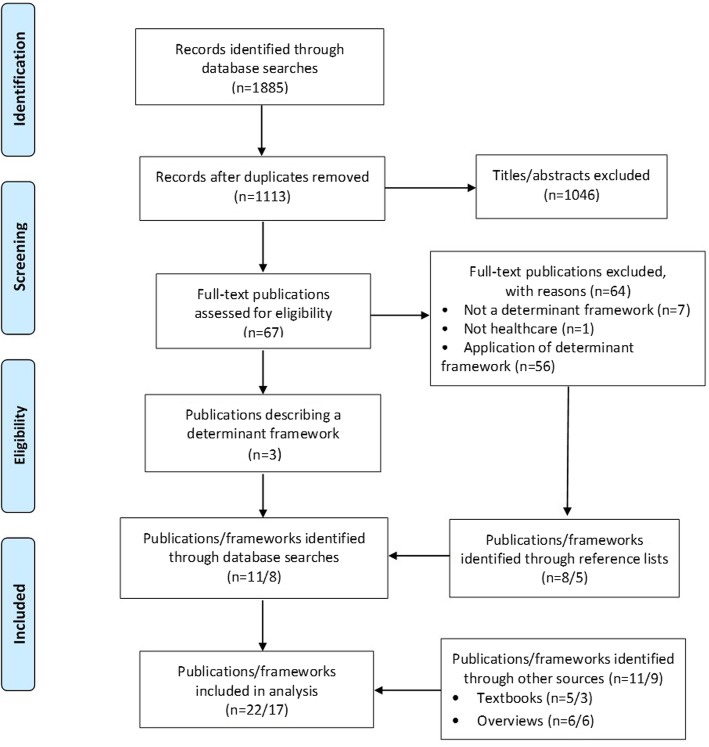
BACKGROUND: The relevance of context in implementation science is reflected in the numerous theories, frameworks, models and taxonomies that have been proposed to analyse determinants of implementation (in this paper referred to as determinant frameworks). This scoping review aimed to investigate and map how determinant frameworks used in implementation science were developed, what terms are used for contextual determinants for implementation, how the context is conceptualized, and which context dimensions that can be discerned. METHODS: A scoping review was conducted. MEDLINE and EMBASE were searched from inception to October 2017, and supplemented with implementation science text books and known published overviews. Publications in English that described a determinant framework (theory, model, taxonomy or checklist), of which context was one determinant, were eligible. Screening and inclusion were done in duplicate. Extracted data were analysed to address the study aims. A qualitative content analysis with an inductive approach was carried out concerning the development and core context dimensions of the frameworks. The review is reported according to the PRISMA guidelines. RESULTS: The database searches yielded a total of 1113 publications, of which 67 were considered potentially relevant based on the predetermined eligibility criteria, and retrieved in full text. Seventeen unique determinant frameworks were identified and included. Most were developed based on the literature and/or the developers' implementation experiences. Six of the frameworks explicitly referred to "context", but only four frameworks provided a specific definition of the concept. Instead, context was defined indirectly by description of various categories and sub-categories that together made up the context. Twelve context dimensions were identified, pertaining to different aggregation levels. The most widely addressed context dimensions were organizational support, financial resources, social relations and support, and leadership. CONCLUSIONS: The findings suggest variation with regard to how the frameworks were developed and considerable inconsistency in terms used for contextual determinants, how context is conceptualized, and which contextual determinants are accounted for in frameworks used in implementation science. Common context dimensions were identified, which can facilitate research that incorporates a theory of context, i.e. assumptions about how different dimensions may influence each other and affect implementation outcomes. A thoughtful application of the concept and a more consistent terminology would enhance transparency, simplify communication among researchers, and facilitate comparison across studies.
Overview
The claims and statistics of this paper haven’t been checked yet.
Free: it reads the open-access text and checks the first 5 claims that cite a source we can check. Create a free account to check every claim.
Integrity signals
Registry
Cites
Statistics
Figures
Verification
Claims the paper makes
The claims and statistics of this paper haven’t been checked yet.
Free: it reads the open-access text and checks the first 5 claims that cite a source we can check. Create a free account to check every claim.
Claims other papers make about this one
Each is checked against this paper’s own text: does it say what the citing paper says it does?
The source backs part of the claim, not all of it — or backs it for a different population, condition or comparison.
In the citing paper
“Understanding the end users, in this case, the students, is crucial and is known to facilitate successful implementation.23,24”
From Structured Development of Learning and Assessment Tasks to Prevent Generative AI Misuse and Enhance AI Literacy in the Faculty in Physiotherapy Education (2025) · cites this paper as [24]
Experimental — accuracy not yet measuredThe check wasn’t confident either way, so it gives no verdict — never disputed.
In the citing paper
“This call for hypothesis testing in implementation outcomes research has been echoed by a number of recent papers [21–24].”
From Ten years of implementation outcomes research: a scoping review (2023) · cites this paper as [23]
Experimental — accuracy not yet measured
Self-check
Percentages, sums and reported differences re-computed from the paper’s own numbers.
The self-check needs the paper’s full text.
Citations
Cites
Preferred Reporting Items for Systematic Reviews and Meta-Analyses: the PRISMA statement
Moher, D., Liberati, A., Tetzlaff, J., Altman, D. G., & for the PRISMA Group (2009) · BMJ · doi:10.1136/bmj.b2535 · Cited by 83,823
Preferred Reporting Items for Systematic Reviews and Meta-Analyses: The PRISMA Statement
Moher, D., Liberati, A., Tetzlaff, J., Altman, D. G., & The PRISMA Group (2009) · PLoS Medicine · doi:10.1371/journal.pmed.1000097 · Cited by 64,042 · cited 1×
“for Systematic Reviews and Meta-Analyses (PRISMA) guidelines [20].”
Preferred reporting items for systematic reviews and meta-analyses: the PRISMA Statement.
(2009) · PubMed Central · Cited by 44,859
Scoping studies: towards a methodological framework
Arksey, H., & O'Malley, L. (2005) · International Journal of Social Research Methodology · doi:10.1080/1364557032000119616 · Cited by 36,742
The Ecology of Human Development: Experiments by Nature and Design
Bronfenbrenner, U. (1979) · Harvard University Press eBooks · doi:10.4159/9780674028845 · Cited by 26,084
The qualitative content analysis process
Elo, S., & Kyngäs, H. (2008) · Journal of Advanced Nursing · doi:10.1111/j.1365-2648.2007.04569.x · Cited by 22,617
Wang, G., Ma, R., Qiao, G., Wada, K., Aizawa, Y., & Satoh, T. (2015) · Integrative Medicine International · doi:10.1159/000368408 · Cited by 18,657
Organizational culture and leadership
(1993) · Long Range Planning · doi:10.1016/0024-6301(93)90120-5 · Cited by 16,462
Damschroder, L. J., Aron, D. C., Keith, R. E., Kirsh, S. R., Alexander, J. A., & Lowery, J. C. (2009) · Implementation Science · doi:10.1186/1748-5908-4-50 · Cited by 14,496 · cited 11×
“, 2009 [15] Influences on implementation (outcomes) Based on analysis of the 19 theories, frameworks and models used in implementation science 5 categories (3 relate to contextual influences): • Intervention characteristics • Characteristics of individuals • Process • Inner setting • Outer setting Categories are refer…”
BackgroundMethodInfluentialThe ecology of human development : experiments by nature and design
Bronfenbrenner, U. (1979) · Cited by 12,580
Proctor, E., Silmere, H., Raghavan, R., Hovmand, P., Aarons, G., Bunger, A., Griffey, R., & Hensley, M. (2011) · Administration and Policy in Mental Health and Mental Health Services Research · doi:10.1007/s10488-010-0319-7 · Cited by 8,721
Diffusion of Innovations in Service Organizations: Systematic Review and Recommendations
GREENHALGH, T., ROBERT, G., MACFARLANE, F., BATE, P., & KYRIAKIDOU, O. (2004) · The Milbank Quarterly · doi:10.1111/j.0887-378x.2004.00325.x · Cited by 7,448
Why Don't Physicians Follow Clinical Practice Guidelines?: A Framework for Improvement
Cabana, M. D., Rand, C. S., Powe, N. R., Wu, A. W., Wilson, M. H., Abboud, P.-A. C., & Rubin, H. R. (1999) · JAMA · doi:10.1001/jama.282.15.1458 · Cited by 6,677
YUKL, G. A. (1981) · Cited by 5,266
Cane, J., O’Connor, D., & Michie, S. (2012) · Implementation Science · doi:10.1186/1748-5908-7-37 · Cited by 4,888
Making sense of implementation theories, models and frameworks
Nilsen, P. (2015) · Implementation Science · doi:10.1186/s13012-015-0242-0 · Cited by 4,447
(2005) · Cited by 3,748
The Essential Impact of Context on Organizational Behavior
Johns, G. (2006) · Academy of Management Review · doi:10.5465/amr.2006.20208687 · Cited by 3,532
Making psychological theory useful for implementing evidence based practice: a consensus approach
Michie, S. (2005) · Quality and Safety in Health Care · doi:10.1136/qshc.2004.011155 · Cited by 3,440 · cited 12×
“Determinant categories (underlined categories are associated with contextual determinants and/or are labelled “context”) Contextual determinants: categories and examples of sub-categories in the framework implementation of the innovation; extent to which colleagues implement the innovation (modelling) • Facilities nee…”
BackgroundMethodInfluentialMargulies, N., & Yukl, G. A. (1982) · The Academy of Management Review · doi:10.2307/257314 · Cited by 2,718 · cited 1×
“However, whereas leadership is concerned with setting a direction for change and developing a vision for the future, management consists of realizing those goals through planning, budgeting and coordinating [73, 74].”
BackgroundImplementation strategies: recommendations for specifying and reporting
Proctor, E. K., Powell, B. J., & McMillen, J. C. (2013) · Implementation Science · doi:10.1186/1748-5908-8-139 · Cited by 2,585
Enabling the implementation of evidence based practice: a conceptual framework.
Kitson, A., Harvey, G., & McCormack, B. (1998) · Quality in Health Care · doi:10.1136/qshc.7.3.149 · Cited by 1,985
Denison, D. R. (1996) · Academy of Management Review · doi:10.5465/amr.1996.9702100310 · Cited by 1,651 · cited 1×
“tudes concerning the observable, surface-level aspects of culture at a particular point in time [70].”
BackgroundThe contextual brain: implications for fear conditioning, extinction and psychopathology
Maren, S., Phan, K. L., & Liberzon, I. (2013) · Nature Reviews Neuroscience · doi:10.1038/nrn3492 · Cited by 1,547
Understanding Organizational Culture
Alvesson, M. (2002) · SAGE Publications Ltd eBooks · doi:10.4135/9781446280072 · Cited by 1,532
Interprofessional teamwork: Professional cultures as barriers
Hall, P. (2005) · Journal of Interprofessional Care · doi:10.1080/13561820500081745 · Cited by 1,392
Bridging Research and Practice
Tabak, R. G., Khoong, E. C., Chambers, D. A., & Brownson, R. C. (2012) · American Journal of Preventive Medicine · doi:10.1016/j.amepre.2012.05.024 · Cited by 1,386
What drives change? Barriers to and incentives for achieving evidence‐based practice
Grol, R., & Wensing, M. (2004) · Medical Journal of Australia · doi:10.5694/j.1326-5377.2004.tb05948.x · Cited by 1,378
Using evidenceHow research can inform public services
Nutley, S. M., Walter, I., & Davies, H. T. O. (2007) · Policy Press eBooks · doi:10.1332/policypress/9781861346650.001.0001 · Cited by 1,335
Using Evidence: How Research Can Inform Public Services
Nutley, S., Walter, I., & Davies, H. T. O. (2007) · Bristol University Press eBooks · doi:10.46692/9781847422323 · Cited by 1,299
Harvey, G., & Kitson, A. (2015) · Implementation Science · doi:10.1186/s13012-016-0398-2 · Cited by 1,271
Flottorp, S. A., Oxman, A. D., Krause, J., Musila, N. R., Wensing, M., Godycki-Cwirko, M., Baker, R., & Eccles, M. P. (2013) · Implementation Science · doi:10.1186/1748-5908-8-35 · Cited by 1,138
The Joanna Briggs Institute reviewers' manual 2015: methodology for JBI scoping reviews
Peters, M. D. J., Godfrey, C. M., McInerney, P. A., Soares, C. B., Khalil, H., & Parker, D. (2015) · Cited by 1,135
The Nonspread of Innovations: the Mediating Role of Professionals
Ferlie, E., Fitzgerald, L., Wood, M., & Hawkins, C. (2005) · Academy of Management Journal · doi:10.5465/amj.2005.15993150 · Cited by 1,106
The Quality Implementation Framework: A Synthesis of Critical Steps in the Implementation Process
Meyers, D. C., Durlak, J. A., & Wandersman, A. (2012) · American Journal of Community Psychology · doi:10.1007/s10464-012-9522-x · Cited by 1,102
Feldstein, A. C., & Glasgow, R. E. (2008) · The Joint Commission Journal on Quality and Patient Safety · doi:10.1016/s1553-7250(08)34030-6 · Cited by 987
Implementation, context and complexity
May, C. R., Johnson, M., & Finch, T. (2016) · Implementation Science · doi:10.1186/s13012-016-0506-3 · Cited by 978
Contemporary Theories of Learning
(2009) · Routledge eBooks · doi:10.4324/9780203870426 · Cited by 857
Using evidence: How research can inform public services
Nutley, S. M., Walter, I., & Davies, H. T. O. (2007) · doi:10.2307/j.ctt9qgwt1 · Cited by 808 · cited 6×
“Determinant categories (underlined categories are associated with contextual determinants and/or are labelled “context”) Contextual determinants: categories and examples of sub-categories in the framework and procedures; adopter training and support; plan for sustainability Both program/intervention and recipient cate…”
BackgroundMethodInfluentialPatient Participation: Current Knowledge and Applicability to Patient Safety
Longtin, Y., Sax, H., Leape, L. L., Sheridan, S. E., Donaldson, L., & Pittet, D. (2010) · Mayo Clinic Proceedings · doi:10.4065/mcp.2009.0248 · Cited by 805
Getting evidence into practice: the meaning of `context'
McCormack, B., Kitson, A., Harvey, G., Rycroft‐Malone, J., Titchen, A., & Seers, K. (2002) · Journal of Advanced Nursing · doi:10.1046/j.1365-2648.2002.02150.x · Cited by 765
The cross‐level effects of culture and climate in human service teams
Glisson, C., & James, L. R. (2002) · Journal of Organizational Behavior · doi:10.1002/job.162 · Cited by 758
Determinants of innovation within health care organizations: Literature review and Delphi study
Fleuren, M. (2004) · International Journal for Quality in Health Care · doi:10.1093/intqhc/mzh030 · Cited by 732
KAPLAN, H. C., BRADY, P. W., DRITZ, M. C., HOOPER, D. K., LINAM, W. M., FROEHLE, C. M., & MARGOLIS, P. (2010) · Milbank Quarterly · doi:10.1111/j.1468-0009.2010.00611.x · Cited by 714
Organizational Behavior: Linking Individuals and Groups to Organizational Contexts
Mowday, R. T., & Sutton, R. I. (1993) · Annual Review of Psychology · doi:10.1146/annurev.ps.44.020193.001211 · Cited by 577 · cited 1×
“a team, professional group, department or organization [91, 92].”
BackgroundImproving Patient Care: The Implementation of Change in Clinical Practice
Cosby, J. L. (2006) · Quality and Safety in Health Care · doi:10.1136/qshc.2005.016824 · Cited by 557
Ecological perspectives in health research
McLaren, L., & Hawe, P. (2005) · Journal of Epidemiology and Community Health · doi:10.1136/jech.2003.018044 · Cited by 551
Improving Patient Care: The Implementation of Change in Health Care
(2013) · doi:10.1002/9781118525975 · Cited by 506 · cited 1×
“[24], but the former provides some more details, which is why we chose the first publication.”
BackgroundGaps between knowing and doing: Understanding and assessing the barriers to optimal health care
Cochrane, L. J., Olson, C. A., Murray, S., Dupuis, M., Tooman, T., & Hayes, S. (2007) · Journal of Continuing Education in the Health Professions · doi:10.1002/chp.106 · Cited by 500
Knowledge Translation in Health Care
(2013) · Wiley eBooks · doi:10.1002/9781118413555 · Cited by 476
Birken, S. A., Powell, B. J., Shea, C. M., Haines, E. R., Alexis Kirk, M., Leeman, J., Rohweder, C., Damschroder, L., & Presseau, J. (2017) · Implementation Science · doi:10.1186/s13012-017-0656-y · Cited by 471
Diffusion of Innovations in Health Service Organisations: A Systematic Literature Review
Greenhalgh, T., Robert, G., Bate, P., Macfarlane, F., & Kyriakidou, O. (2007) · Cited by 453
Organizational Culture: Origins and Weaknesses
Meek, V. L. (1988) · Organization Studies · doi:10.1177/017084068800900401 · Cited by 452
Li, S.-A., Jeffs, L., Barwick, M., & Stevens, B. (2018) · Systematic Reviews · doi:10.1186/s13643-018-0734-5 · Cited by 433
Content Analysis: Process and Application
Cole, F. L. (1988) · Clinical Nurse Specialist · doi:10.1097/00002800-198800210-00025 · Cited by 418
Dissemination and Implementation Research in Health
(2017) · Oxford Scholarship Online · doi:10.1093/oso/9780190683214.001.0001 · Cited by 396
Blase, K. A., Van Dyke, M., Fixsen, D. L., & Bailey, F. W. (2012) · Handbook of Implementation Science for Psychology in Education · doi:10.1017/cbo9781139013949.004 · Cited by 395
The theory and practice of learning
(1999) · Choice Reviews Online · doi:10.5860/choice.36-4034 · Cited by 364
Models and Frameworks for Implementing Evidence-Based Practice: Linking Evidence to Action
Rycroft‐Malone, J., & Bucknall, T. K. (2010) · Cited by 358
Development and assessment of the Alberta Context Tool
Estabrooks, C. A., Squires, J. E., Cummings, G. G., Birdsell, J. M., & Norton, P. G. (2009) · BMC Health Services Research · doi:10.1186/1472-6963-9-234 · Cited by 317
Interprofessionality in health and social care: the Achilles' heel of partnership?
Hudson, B. (2002) · Journal of Interprofessional Care · doi:10.1080/13561820220104122 · Cited by 302
Knowledge Translation in Health Care: Moving from Evidence to Practice
(2009) · doi:10.1002/9781444311747 · Cited by 285
O’Brien, K. K., Colquhoun, H., Levac, D., Baxter, L., Tricco, A. C., Straus, S., Wickerson, L., Nayar, A., Moher, D., & O’Malley, L. (2016) · BMC Health Services Research · doi:10.1186/s12913-016-1579-z · Cited by 282
Understanding the role of opinion leaders in improving clinical effectiveness
Locock, L., Dopson, S., Chambers, D., & Gabbay, J. (2001) · Social Science & Medicine · doi:10.1016/s0277-9536(00)00387-7 · Cited by 279
Aarons, G. A., Sommerfeld, D. H., & Walrath-Greene, C. M. (2009) · Implementation Science · doi:10.1186/1748-5908-4-83 · Cited by 276
Theory and practice of leadership
Gill, R. C. (2006) · Cited by 262
(2004) · UCL Discovery (University College London) · Cited by 246
Dissemination and Implementation Research in Health: Translating Science to Practice
Chambers, D. (2023) · doi:10.1093/oso/9780197660690.001.0001 · Cited by 243
Tomoaia-Cotisel, A., Scammon, D. L., Waitzman, N. J., Cronholm, P. F., Halladay, J. R., Driscoll, D. L., Solberg, L. I., Hsu, C., Tai-Seale, M., Hiratsuka, V., et al. (2013) · The Annals of Family Medicine · doi:10.1370/afm.1549 · Cited by 240
Theory and Practice of Leadership: Book reviews
Peck, E. (2006) · Health & Social Care in the Community · doi:10.1111/j.1365-2524.2007.682_8.x · Cited by 232
Strifler, L., Cardoso, R., McGowan, J., Cogo, E., Nincic, V., Khan, P. A., Scott, A., Ghassemi, M., MacDonald, H., Lai, Y., et al. (2018) · Journal of Clinical Epidemiology · doi:10.1016/j.jclinepi.2018.04.008 · Cited by 227
Wakida, E. K., Talib, Z. M., Akena, D., Okello, E. S., Kinengyere, A., Mindra, A., & Obua, C. (2018) · Systematic Reviews · doi:10.1186/s13643-018-0882-7 · Cited by 219
Williams, B., Perillo, S., & Brown, T. (2015) · Nurse Education Today · doi:10.1016/j.nedt.2014.11.012 · Cited by 212
The Theory and Practice of Learning
(2003) · Routledge eBooks · doi:10.4324/9780203465653 · Cited by 208
Phillips, D. C., & Soltis, J. F. (2010) · Teachers College Press eBooks · doi:10.65528/9780807771204 · Cited by 201
Context and implementation: A concept analysis towards conceptual maturity
Pfadenhauer, L. M., Mozygemba, K., Gerhardus, A., Hofmann, B., Booth, A., Lysdahl, K. B., Tummers, M., Burns, J., & Rehfuess, E. A. (2015) · Zeitschrift für Evidenz, Fortbildung und Qualität im Gesundheitswesen · doi:10.1016/j.zefq.2015.01.004 · Cited by 189
Taylor, S. L., Dy, S., Foy, R., Hempel, S., McDonald, K. M., Øvretveit, J., Pronovost, P. J., Rubenstein, L. V., Wachter, R. M., & Shekelle, P. G. (2011) · BMJ Quality & Safety · doi:10.1136/bmjqs.2010.049379 · Cited by 178
Doherty, C., & Stavropoulou, C. (2012) · Social Science & Medicine · doi:10.1016/j.socscimed.2012.02.056 · Cited by 170
Langford, D., Hancock, M. R., Fellows, R., & Gale, A. W. (2014) · Routledge eBooks · doi:10.4324/9781315844695-9 · Cited by 167
A comprehensive understanding of human learning
Illeris, K. (2018) · Contemporary Theories of Learning · doi:10.4324/9781315147277-1 · Cited by 165
Gurses, A. P., Marsteller, J. A., Ozok, A. A., Xiao, Y., Owens, S., & Pronovost, P. J. (2010) · Critical Care Medicine · doi:10.1097/ccm.0b013e3181e69e02 · Cited by 145
How to Implement Evidence-Based Healthcare
Nguyen-Buckley, C., & Steadman, R. (2018) · Anesthesia & Analgesia · doi:10.1213/ane.0000000000002842 · Cited by 141
A thematic analysis of theoretical models for translational science in nursing: Mapping the field
Mitchell, S. A., Fisher, C. A., Hastings, C. E., Silverman, L. B., & Wallen, G. R. (2010) · Nursing Outlook · doi:10.1016/j.outlook.2010.07.001 · Cited by 138
Handbook of Implementation Science for Psychology in Education
(2012) · Cambridge University Press eBooks · doi:10.1017/cbo9781139013949 · Cited by 137
The Importance of Context in Implementation Research
Edwards, N., & Barker, P. M. (2014) · JAIDS Journal of Acquired Immune Deficiency Syndromes · doi:10.1097/qai.0000000000000322 · Cited by 137
Development and Testing of the Context Assessment Index (CAI)
McCormack, B., McCarthy, G., Wright, J., & Coffey, A. (2009) · Worldviews on Evidence-Based Nursing · doi:10.1111/j.1741-6787.2008.00130.x · Cited by 126
Subcultural dynamics in transformation: A multi-perspective study of healthcare professionals
Morgan, P. I., & Ogbonna, E. (2008) · Human Relations · doi:10.1177/0018726707085945 · Cited by 123 · cited 1×
“Although most frameworks specifically refer to organizational culture, it is important to recognize that health care organizations are inherently multi-cultural given the variety of professions, departments, and teams operating within them [59, 60].”
BackgroundLeadership in evidence-based practice: a systematic review
Reichenpfader, U., Carlfjord, S., & Nilsen, P. (2015) · Leadership in Health Services · doi:10.1108/lhs-08-2014-0061 · Cited by 122
Hartley, J. F., & Benington, J. (2010) · Policy Press eBooks · doi:10.1332/policypress/9781847424877.001.0001 · Cited by 115
Øvretveit, J. C., Shekelle, P. G., Dy, S. M., McDonald, K. M., Hempel, S., Pronovost, P., Rubenstein, L., Taylor, S. L., Foy, R., & Wachter, R. M. (2011) · BMJ Quality & Safety · doi:10.1136/bmjqs.2010.047035 · Cited by 112 · cited 1×
“Researchers in quality improvement have defined context as “everything else that is not the intervention” ([90], p.”
BackgroundENGAGING DOCTORS IN LEADERSHIP: REVIEW OF THE LITERATURE
Dickinson, H., & Ham, C. (2008) · Cited by 109
Wakida, E. K., Akena, D., Okello, E. S., Kinengyere, A., Kamoga, R., Mindra, A., Obua, C., & Talib, Z. M. (2017) · Systematic Reviews · doi:10.1186/s13643-017-0561-0 · Cited by 105
Identifying the domains of context important to implementation science: a study protocol
Squires, J. E., Graham, I. D., Hutchinson, A. M., Michie, S., Francis, J. J., Sales, A., Brehaut, J., Curran, J., Ivers, N., Lavis, J., et al. (2015) · Implementation Science · doi:10.1186/s13012-015-0325-y · Cited by 101
McMillan, K., & Perron, A. (2013) · Policy, Politics, & Nursing Practice · doi:10.1177/1527154413481811 · Cited by 98 · cited 1×
“continuous changes in the workplace [98].”
How to Implement Evidence-Based Healthcare
Greenhalgh, T. (2017) · Cited by 88
The Role of Organizational Processes in Dissemination and Implementation Research
Aarons, G. A., Moullin, J. C., & Ehrhart, M. G. (2017) · Oxford Scholarship Online · doi:10.1093/oso/9780190683214.003.0008 · Cited by 82
Managing The Physician: Rules Versus Incentives
Hillman, A. L. (1991) · Health Affairs · doi:10.1377/hlthaff.10.4.138 · Cited by 76
Hernan, A. L., Giles, S. J., Fuller, J. D., Johnson, J. K., Walker, C. F., & Dunbar, J. (2015) · BMJ Quality & Safety · doi:10.1136/bmjqs-2015-004049 · Cited by 76
An empirically based model for knowledge management in health care organizations
Sibbald, S. L., Wathen, C. N., & Kothari, A. R. (2015) · Health Care Management Review · doi:10.1097/hmr.0000000000000046 · Cited by 74
Implementation Science in Health Care
Mittman, B. S. (2012) · Dissemination and Implementation Research in HealthTranslating Science to Practice · doi:10.1093/acprof:oso/9780199751877.003.0019 · Cited by 73
Dopson, S., & Fitzgerald, L. (2005) · Knowledge to Action? · doi:10.1093/acprof:oso/9780199259014.003.0005 · Cited by 54
Changing Professional Practice
(2002) · Performance Management in Education: Improving Practice · doi:10.4135/9781446220931.n4 · Cited by 36
Improving patient care the implementation of change in health care
Grol, R. P. T. M., Wensing, M., Eccles, M., & Davis, D. (2013) · Cited by 31
The Physician's Role in Patient Safety: What's in It for Me?
Sutker, W. L. (2008) · Baylor University Medical Center Proceedings · doi:10.1080/08998280.2008.11928347 · Cited by 29
Involvement Drivers: A Study of Nurses and Physicians in Improvement Work
Eriksson, N., Müllern, T., Andersson, T., Gadolin, C., Tengblad, S., & Ujvari, S. (2016) · Quality Management in Health Care · doi:10.1097/qmh.0000000000000092 · Cited by 22
Wensing, M., Bosch, M., & Grol, R. P. T. M. (2013) · Wiley eBooks · doi:10.1002/9781118525975.ch8 · Cited by 21
Professional Boundaries and the Diffusion of Innovation
Fitzgerald, L., & Dopson, S. (2005) · Oxford University Press eBooks · doi:10.1093/acprof:oso/9780199259014.003.0006 · Cited by 20
Wensing, M., Bosch, M. B., Foy, R., van, D. W. T., Eccles, M., & Grol, R. (2005) · Newcastle University ePrints (Newcastle Univesity) · doi:10.25405/ncl.34585623.v1 · Cited by 20
Incorporating sustainability in small health-care facilities: an integrated model
Chu, K., & Cheung, L. (2018) · Leadership in health services · doi:10.1108/lhs-07-2017-0043 · Cited by 9 · cited 1×
“in those that are small and medium-sized [58].”
Background
Research works printed but not linked: 7
- Rycroft-Malone J Bucknall T Models and frameworks for implementing evidence-based practice: linking evidence to action 2010 Oxford Wiley-Blackwell
- Rainbird K Sanson-Fisher R Buchan H Identifying barriers to evidence uptake 2006 Melbourne National Institute of Clinical Studies
- World Health Organization (WHO) Identifying and addressing barriers to implementing policy options. In: SURE guides for preparing and using evidence-based policy briefs 2011
- Övretveit J The leaders’ role in quality and safety improvement: a review of the research and guidance 2005 Karolinska Institute Stockholm
- Weick KE The social psychology of organising 1969 Reading, MA Addison-Wesley
- Cappelli P Sherer PD The missing role of context in OB: the need for a meso-level approach Res Organ Behav 1991 13 55 110
- Jordan A Carlile O Stack A Approaches to learning – a guide for teachers 2008 New York Open University Press 1 251
Cited by
The updated consolidated framework for implementation research based on user feedback
Damschroder, L. J., Reardon, C. M., Widerquist, M. A. O., & Lowery, J. (2022) · Implementation Science · doi:10.1186/s13012-022-01245-0 · Cited by 4,452
“They concluded that the original CFIR only addressed 10 of 12 identified dimensions; the updated CFIR now addresses all 12 dimensions with the addition of the Characteristics: Opportunity construct in the Individuals Domain, to capture dedicated time, and the Structural Characteristics: Physical Infrastructure subcons…”
BackgroundImplementation science should give higher priority to health equity
Brownson, R. C., Kumanyika, S. K., Kreuter, M. W., & Haire-Joshu, D. (2021) · Implementation Science · doi:10.1186/s13012-021-01097-0 · Cited by 551
“Often context relates to characteristics of a priority population of focus or the setting within which an EBI is being delivered [50, 51].”
BackgroundPetersson, L., Larsson, I., Nygren, J. M., Nilsen, P., Neher, M., Reed, J. E., Tyskbo, D., & Svedberg, P. (2022) · BMC Health Services Research · doi:10.1186/s12913-022-08215-8 · Cited by 434
“Based on literature from other scientific fields, we know that the leaders’interest and commitment is widely recognized as an important factor for successful implementation of new innovations and interventions [28, 29].”
BackgroundTen years of implementation outcomes research: a scoping review
Proctor, E. K., Bunger, A. C., Lengnick-Hall, R., Gerke, D. R., Martin, J. K., Phillips, R. J., & Swanson, J. C. (2023) · Implementation Science · doi:10.1186/s13012-023-01286-z · Cited by 424
Clarity out of chaos: Use of theory in implementation research
Damschroder, L. J. (2020) · Psychiatry Research · doi:10.1016/j.psychres.2019.06.036 · Cited by 422
Metadata
- Authors
- Nilsen, P., & Bernhardsson, S.
- Affiliations
- Region Västra Götaland (SE)
- Corresponding author
- Bernhardsson, Susanne
- Venue
- BMC Health Services Research
- Published
- 2019-03-25
- Volume
- 19
- Issue
- 1
- Pages
- 189-189
- ISSN
- 1472-6963 (ISSN-L)
- PMC
- PMC6432749
- OpenAlex
- W2941268450
- Semantic Scholar
- 5761696aebadd7dde4d180778d844b700aefb54f
- Cited by
- 1,014
- References
- 111
- Citations by year
- 2026: 142 · 2025: 129 · 2024: 217 · 2023: 176 · 2022: 150 · 2021: 121 · 2020: 65 · 2019: 10
- FWCI
- 15.85
- Type
- journal article
- Language
- en
- Open access
- gold
- doi.org
- Licence
- cc-by
- creativecommons.org/licenses/by/4.0/ (tdm)
- Locations
- BMC Health Services Research (publishedVersion, cc-by)
- Europe PMC (PubMed Central) (publishedVersion, other-oa)
- PubMed Central (publishedVersion, cc-by)
- PubMed (publishedVersion)
- KTH Publication Database DiVA (KTH Royal Institute of Technology) (submittedVersion, other-oa)
- DOAJ (DOAJ: Directory of Open Access Journals) (submittedVersion, cc-by-sa)
- NORA - Norwegian Open Research Archives (submittedVersion, cc-by)
- Topics
- Health Sciences › Health Professions › General Health Professions › Health Policy Implementation Science
- Health Sciences › Health Professions › General Health Professions › Health Sciences Research and Education
- Health Sciences › Medicine › Public Health, Environmental and Occupational Health › Clinical practice guidelines implementation
- Keywords
- implementation context, contextual factors, implementation outcomes, organizational support, leadership, financial resources, interpersonal relationships, terminology consistency
- MeSH terms
- Implementation Science, Leadership, Evidence-Based Practice
About these checks
Registry, retraction, Cites and statistics results are computed, not judged, with one exception: a printed reference that no index lists is read once by a model before it counts as a citation error. Claims are extracted by a model and kept only when their quote appears verbatim in the text; each cited source is then checked, with a model’s help, for whether it says what the claim relies on. Those verdicts can be wrong — read the claim’s quote and the cited source before relying on one.
Statistics and arithmetic are recomputed, not judged.
Confidence bands are shown only for fields calibrated on our annotated test set. None is calibrated yet, so no band is shown.
What counts as a claim ›How we measure confidence ›How we check this ›
Are you an author, or do you see a problem with this page? Request a review
Data sources
Bibliographic data: Semantic Scholar, OpenAlex, Crossref.
Contains information from the Semantic Scholar Academic Graph Datasets, made available under the ODC Attribution License (ODC-BY 1.0).
Semantic Scholar’s data is described in: Kinney, R., et al. (2023). The Semantic Scholar Open Data Platform. arXiv:2301.10140.
