

Context matters in implementation science: a scoping review of determinant frameworks that describe contextual determinants for implementation outcomes
Open accessThe DOI matches its Crossref record; 110 of the 111 references it cites were found in a registry or an index.
Abstract
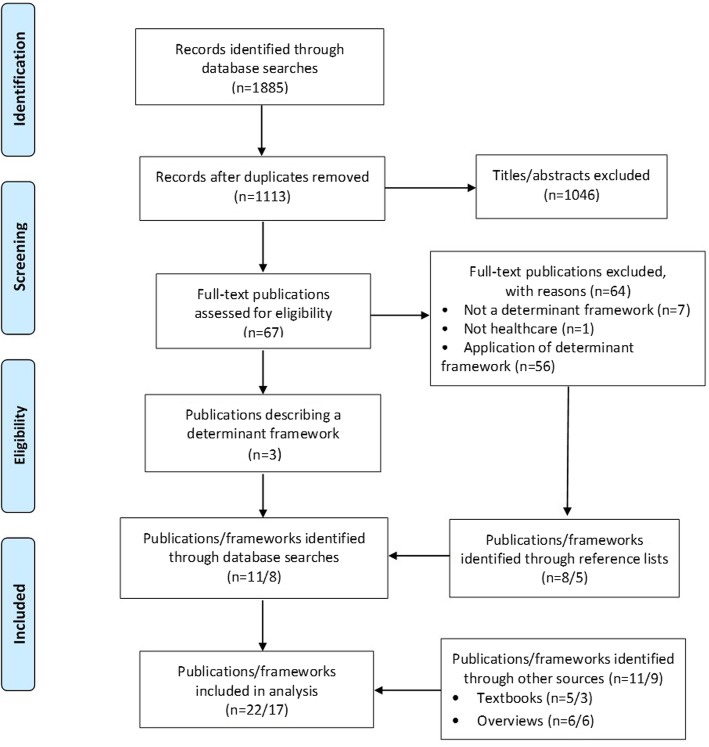
BACKGROUND: The relevance of context in implementation science is reflected in the numerous theories, frameworks, models and taxonomies that have been proposed to analyse determinants of implementation (in this paper referred to as determinant frameworks). This scoping review aimed to investigate and map how determinant frameworks used in implementation science were developed, what terms are used for contextual determinants for implementation, how the context is conceptualized, and which context dimensions that can be discerned. METHODS: A scoping review was conducted. MEDLINE and EMBASE were searched from inception to October 2017, and supplemented with implementation science text books and known published overviews. Publications in English that described a determinant framework (theory, model, taxonomy or checklist), of which context was one determinant, were eligible. Screening and inclusion were done in duplicate. Extracted data were analysed to address the study aims. A qualitative content analysis with an inductive approach was carried out concerning the development and core context dimensions of the frameworks. The review is reported according to the PRISMA guidelines. RESULTS: The database searches yielded a total of 1113 publications, of which 67 were considered potentially relevant based on the predetermined eligibility criteria, and retrieved in full text. Seventeen unique determinant frameworks were identified and included. Most were developed based on the literature and/or the developers' implementation experiences. Six of the frameworks explicitly referred to "context", but only four frameworks provided a specific definition of the concept. Instead, context was defined indirectly by description of various categories and sub-categories that together made up the context. Twelve context dimensions were identified, pertaining to different aggregation levels. The most widely addressed context dimensions were organizational support, financial resources, social relations and support, and leadership. CONCLUSIONS: The findings suggest variation with regard to how the frameworks were developed and considerable inconsistency in terms used for contextual determinants, how context is conceptualized, and which contextual determinants are accounted for in frameworks used in implementation science. Common context dimensions were identified, which can facilitate research that incorporates a theory of context, i.e. assumptions about how different dimensions may influence each other and affect implementation outcomes. A thoughtful application of the concept and a more consistent terminology would enhance transparency, simplify communication among researchers, and facilitate comparison across studies.
Overview
The claims and statistics of this paper haven’t been checked yet.
Free: it reads the open-access text and checks the first 5 claims that cite a source we can check. Create a free account to check every claim.
Integrity signals
Registry
Cites
Statistics
Figures
Verification
Claims the paper makes
The claims and statistics of this paper haven’t been checked yet.
Free: it reads the open-access text and checks the first 5 claims that cite a source we can check. Create a free account to check every claim.
Claims other papers make about this one
Each is checked against this paper’s own text: does it say what the citing paper says it does?
The source backs part of the claim, not all of it — or backs it for a different population, condition or comparison.
In the citing paper
“Understanding the end users, in this case, the students, is crucial and is known to facilitate successful implementation.23,24”
From Structured Development of Learning and Assessment Tasks to Prevent Generative AI Misuse and Enhance AI Literacy in the Faculty in Physiotherapy Education (2025) · cites this paper as [24]
Experimental — accuracy not yet measuredThe check wasn’t confident either way, so it gives no verdict — never disputed.
In the citing paper
“This call for hypothesis testing in implementation outcomes research has been echoed by a number of recent papers [21–24].”
From Ten years of implementation outcomes research: a scoping review (2023) · cites this paper as [23]
Experimental — accuracy not yet measured
Self-check
Percentages, sums and reported differences re-computed from the paper’s own numbers.
The self-check needs the paper’s full text.
Citations
Cites
Preferred Reporting Items for Systematic Reviews and Meta-Analyses: the PRISMA statement
Moher, D., Liberati, A., Tetzlaff, J., Altman, D. G., & for the PRISMA Group (2009) · BMJ · doi:10.1136/bmj.b2535 · Cited by 83,823
Preferred Reporting Items for Systematic Reviews and Meta-Analyses: The PRISMA Statement
Moher, D., Liberati, A., Tetzlaff, J., Altman, D. G., & The PRISMA Group (2009) · PLoS Medicine · doi:10.1371/journal.pmed.1000097 · Cited by 64,042 · cited 1×
“for Systematic Reviews and Meta-Analyses (PRISMA) guidelines [20].”
Preferred reporting items for systematic reviews and meta-analyses: the PRISMA Statement.
(2009) · PubMed Central · Cited by 44,859
Scoping studies: towards a methodological framework
Arksey, H., & O'Malley, L. (2005) · International Journal of Social Research Methodology · doi:10.1080/1364557032000119616 · Cited by 36,742
The Ecology of Human Development: Experiments by Nature and Design
Bronfenbrenner, U. (1979) · Harvard University Press eBooks · doi:10.4159/9780674028845 · Cited by 26,084
The qualitative content analysis process
Elo, S., & Kyngäs, H. (2008) · Journal of Advanced Nursing · doi:10.1111/j.1365-2648.2007.04569.x · Cited by 22,617
Wang, G., Ma, R., Qiao, G., Wada, K., Aizawa, Y., & Satoh, T. (2015) · Integrative Medicine International · doi:10.1159/000368408 · Cited by 18,657
Organizational culture and leadership
(1993) · Long Range Planning · doi:10.1016/0024-6301(93)90120-5 · Cited by 16,462
Damschroder, L. J., Aron, D. C., Keith, R. E., Kirsh, S. R., Alexander, J. A., & Lowery, J. C. (2009) · Implementation Science · doi:10.1186/1748-5908-4-50 · Cited by 14,496 · cited 11×
“, 2009 [15] Influences on implementation (outcomes) Based on analysis of the 19 theories, frameworks and models used in implementation science 5 categories (3 relate to contextual influences): • Intervention characteristics • Characteristics of individuals • Process • Inner setting • Outer setting Categories are refer…”
BackgroundMethodInfluentialThe ecology of human development : experiments by nature and design
Bronfenbrenner, U. (1979) · Cited by 12,580
Research works printed but not linked: 7
- Rycroft-Malone J Bucknall T Models and frameworks for implementing evidence-based practice: linking evidence to action 2010 Oxford Wiley-Blackwell
- Rainbird K Sanson-Fisher R Buchan H Identifying barriers to evidence uptake 2006 Melbourne National Institute of Clinical Studies
- World Health Organization (WHO) Identifying and addressing barriers to implementing policy options. In: SURE guides for preparing and using evidence-based policy briefs 2011
- Övretveit J The leaders’ role in quality and safety improvement: a review of the research and guidance 2005 Karolinska Institute Stockholm
- Weick KE The social psychology of organising 1969 Reading, MA Addison-Wesley
- Cappelli P Sherer PD The missing role of context in OB: the need for a meso-level approach Res Organ Behav 1991 13 55 110
- Jordan A Carlile O Stack A Approaches to learning – a guide for teachers 2008 New York Open University Press 1 251
Cited by
The updated consolidated framework for implementation research based on user feedback
Damschroder, L. J., Reardon, C. M., Widerquist, M. A. O., & Lowery, J. (2022) · Implementation Science · doi:10.1186/s13012-022-01245-0 · Cited by 4,452
“They concluded that the original CFIR only addressed 10 of 12 identified dimensions; the updated CFIR now addresses all 12 dimensions with the addition of the Characteristics: Opportunity construct in the Individuals Domain, to capture dedicated time, and the Structural Characteristics: Physical Infrastructure subcons…”
BackgroundImplementation science should give higher priority to health equity
Brownson, R. C., Kumanyika, S. K., Kreuter, M. W., & Haire-Joshu, D. (2021) · Implementation Science · doi:10.1186/s13012-021-01097-0 · Cited by 551
“Often context relates to characteristics of a priority population of focus or the setting within which an EBI is being delivered [50, 51].”
BackgroundPetersson, L., Larsson, I., Nygren, J. M., Nilsen, P., Neher, M., Reed, J. E., Tyskbo, D., & Svedberg, P. (2022) · BMC Health Services Research · doi:10.1186/s12913-022-08215-8 · Cited by 434
“Based on literature from other scientific fields, we know that the leaders’interest and commitment is widely recognized as an important factor for successful implementation of new innovations and interventions [28, 29].”
BackgroundTen years of implementation outcomes research: a scoping review
Proctor, E. K., Bunger, A. C., Lengnick-Hall, R., Gerke, D. R., Martin, J. K., Phillips, R. J., & Swanson, J. C. (2023) · Implementation Science · doi:10.1186/s13012-023-01286-z · Cited by 424
Clarity out of chaos: Use of theory in implementation research
Damschroder, L. J. (2020) · Psychiatry Research · doi:10.1016/j.psychres.2019.06.036 · Cited by 422
Movsisyan, A., Arnold, L., Evans, R., Hallingberg, B., Moore, G., O’Cathain, A., Pfadenhauer, L. M., Segrott, J., & Rehfuess, E. (2019) · Implementation Science · doi:10.1186/s13012-019-0956-5 · Cited by 331
Designing for Dissemination and Sustainability to Promote Equitable Impacts on Health
Kwan, B. M., Brownson, R. C., Glasgow, R. E., Morrato, E. H., & Luke, D. A. (2022) · Annual Review of Public Health · doi:10.1146/annurev-publhealth-052220-112457 · Cited by 234
Revisiting concepts of evidence in implementation science
Brownson, R. C., Shelton, R. C., Geng, E. H., & Glasgow, R. E. (2022) · Implementation Science · doi:10.1186/s13012-022-01201-y · Cited by 201
“When context is taken into account in research, the study findings are more likely to indicate the conditions under which evidence does or does not generalize to different populations, settings, and time periods [23]—yet too often context is inadequately described or not fully elucidated [81].”
BackgroundA scoping review of full-spectrum knowledge translation theories, models, and frameworks
Esmail, R., Hanson, H. M., Holroyd-Leduc, J., Brown, S., Strifler, L., Straus, S. E., Niven, D. J., & Clement, F. M. (2020) · Implementation Science · doi:10.1186/s13012-020-0964-5 · Cited by 166
Defining and assessing context in healthcare implementation studies: a systematic review
Rogers, L., De Brún, A., & McAuliffe, E. (2020) · BMC Health Services Research · doi:10.1186/s12913-020-05212-7 · Cited by 158
Dopp, A. R., Parisi, K. E., Munson, S. A., & Lyon, A. R. (2020) · Implementation Science Communications · doi:10.1186/s43058-020-00020-w · Cited by 169
“For example, UCD offers specific tools and methods that can help implementation experts achieve important aims such as identifying barriers and facilitators to change [38] (located in cluster 8, “understand systems and context”) and co-designing solutions with stakeholders (cluster 10) [39].”
MethodBergström, A., Ehrenberg, A., Eldh, A. C., Graham, I. D., Gustafsson, K., Harvey, G., Hunter, S. C., Kitson, A. A., Rycroft‐Malone, J., & Wallin, L. (2020) · Implementation Science · doi:10.1186/s13012-020-01003-0 · Cited by 192
Shelton, R. C., Adsul, P., Oh, A., Moise, N., & Griffith, D. M. (2021) · Implementation Research and Practice · doi:10.1177/26334895211049482 · Cited by 171
“…IS determinant frameworks (e.g., Consolidated Framework for Implementation Research, CFIR; Damschroder et al., 2009) emphasize multilevel context (Nilsen & Bernhardsson, 2019), yet implementation researchers often focus on organizational or “inner” context (e.g., implementation climate) without…”
BackgroundBerring, L. L., Holm, T., Hansen, J. P., Delcomyn, C. L., Søndergaard, R., & Hvidhjelm, J. (2024) · Healthcare · doi:10.3390/healthcare12090908 · Cited by 166
“In addition, TIC initiatives should be informed by implementation science, where the organizational context is taken into account [209].”
BackgroundShelton, R. C., Lee, M., Brotzman, L., Wolfenden, L., Nathan, N., & Wainberg, M. L. (2020) · International Journal of Behavioral Medicine · doi:10.1007/s12529-020-09848-x · Cited by 163
“, [33, 43]), theories/ frameworks have been categorized as (1) “process” theories/ frameworks that specify steps or phases to accomplish implementation goals (e.”
BackgroundEvidence-based practice models and frameworks in the healthcare setting: a scoping review
Dusin, J., Melanson, A., & Lawson, L. M. (2023) · BMJ Open · doi:10.1136/bmjopen-2022-071188 · Cited by 169
Malone, S., Prewitt, K., Hackett, R., Lin, J. C., McKay, V., Walsh-Bailey, C., & Luke, D. A. (2021) · Implementation Science Communications · doi:10.1186/s43058-021-00181-2 · Cited by 148
Sustainable by design: a systematic review of factors for health promotion program sustainability
Bodkin, A., & Hakimi, S. (2020) · BMC Public Health · doi:10.1186/s12889-020-09091-9 · Cited by 122
“Program planners should, within their local context, consider factors that are key to implementation and likely influence outcomes [47], and select a framework that best fits to use or adapt.”
BackgroundThe Lancet Psychiatry Commission: transforming mental health implementation research
McGinty, E. E., Alegria, M. M., Beidas, R. S., Braithwaite, J., Kola, L., LESLIE, D. L., Moise, N., Mueller, B., Pincus, H. A., Shidhaye, R. R., et al. (2024) · The Lancet Psychiatry · doi:10.1016/s2215-0366(24)00040-3 · Cited by 148
Etherington, C., Rodrigues, I. B., Giangregorio, L., Graham, I. D., Hoens, A. M., Kasperavicius, D., Kelly, C., Moore, J. E., Ponzano, M., Presseau, J., et al. (2020) · BMC Medical Research Methodology · doi:10.1186/s12874-020-01056-1 · Cited by 135
Rabin, B. A., Cakici, J. A., Golden, C. A., Estabrooks, P. A., Glasgow, R. E., & Gaglio, B. (2022) · Implementation Science · doi:10.1186/s13012-022-01234-3 · Cited by 129
“There is increasing interest [12, 13] but still limited understanding of which contextual factors [3, 14–17] have an impact on the initial uptake; equitable implementation, reach, effectiveness; and sustained use of complex health interventions [18] in a variety of clinical and community settings, which inhibits the t…”
BackgroundImplementation Science: Application of Evidence‐Based Practice Models to Improve Healthcare Quality
Tucker, S., McNett, M., Melnyk, B. M., Hanrahan, K., Hunter, S. C., Kim, B., Cullen, L., & Kitson, A. A. (2021) · Worldviews on Evidence-Based Nursing · doi:10.1111/wvn.12495 · Cited by 124
Advancing healthcare equity through dissemination and implementation science
Baumann, A. A., Shelton, R. C., Kumanyika, S., & Haire-Joshu, D. L. (2023) · Health Services Research · doi:10.1111/1475-6773.14175 · Cited by 116
“…variations within systems and across settings and how they shape both inequitable implementations in healthcare and differences in health across population sub-groups 37,48 by asking how and in what context does this intervention work or how can the system or the intervention be adapted to work?”
BackgroundInfluentialJolles, M. P., Fort, M. P., & Glasgow, R. E. (2024) · International Journal for Equity in Health · doi:10.1186/s12939-024-02130-6 · Cited by 103
“The IS emphasis on context is reflected in the use of frameworks and models to guide the identification of these key contextual domains [16].”
Schrader, J., Hasselhorn, M., Hetfleisch, P., & Goeze, A. (2020) · Zeitschrift für Erziehungswissenschaft · doi:10.1007/s11618-020-00927-z · Cited by 111
Al-Omary, H., Soltani, A., Stewart, D. C., & Nazar, Z. J. (2024) · BMC Medical Education · doi:10.1186/s12909-024-06016-7 · Cited by 109
“Further to this, the adoption of implementation theory has the potential to elicit greater insights into the full range of factors that act as influencers of the phenomenon being examined and thus providing rich data on specific aspects that may require further refinemenet [68, 69].”
BackgroundTransforming Mental Health And Addiction Services
Alegria, M. M., Frank, R. G., Hansen, H., Sharfstein, J. M., Shim, R. S., & Tierney, M. (2021) · Health Affairs · doi:10.1377/hlthaff.2020.01472 · Cited by 94
Bridging the Silos: A Comparative Analysis of Implementation Science and Improvement Science
Nilsen, P., Thor, J., Bender, M., Leeman, J., Andersson‐Gäre, B., & Sevdalis, N. (2022) · Frontiers in Health Services · doi:10.3389/frhs.2021.817750 · Cited by 95
Self-citationLanham, H. J., Papac, J., Olmos, D. I., Heydemann, E. L., Simonetti, N., Schmidt, S., & Potter, J. S. (2022) · JAMA Network Open · doi:10.1001/jamanetworkopen.2022.12419 · Cited by 87
It’s time to close the research to practice gap in autism: The need for implementation science
Boyd, B. A., Stahmer, A. C., Odom, S. L., Wallisch, A. M., & Matheis, M. (2021) · Autism · doi:10.1177/13623613211064422 · Cited by 88
Moon, S., Hogden, A., & Eljiz, K. (2022) · BMJ Open Quality · doi:10.1136/bmjoq-2022-002057 · Cited by 97
Movsisyan, A., Arnold, L., Copeland, L., Evans, R., Littlecott, H., Moore, G., O’Cathain, A., Pfadenhauer, L., Segrott, J., & Rehfuess, E. (2021) · Health Research Policy and Systems · doi:10.1186/s12961-020-00668-9 · Cited by 79
Strategies to adapt and implement health system guidelines and recommendations: a scoping review
Breneol, S., Curran, J., Marten, R., Minocha, K., Johnson, C., Wong, H., Langlois, É. V., Wozney, L., Vélez, C. M., Cassidy, C. E., et al. (2022) · Health Research Policy and Systems · doi:10.1186/s12961-022-00865-8 · Cited by 78
Leggat, F. J., Wadey, R., Day, M. C., Winter, S., & Sanders, P. (2021) · Qualitative Research in Sport Exercise and Health · doi:10.1080/2159676x.2021.1954074 · Cited by 82
“The KTA framework further emphasises context with dedicated phases to tailoring and adapting knowledge (Graham et al. 2006), while the use of additional theory to explore context has been recommended (Nilsen and Bernhardsson 2019).”
BackgroundGlasgow, R. E., Trinkley, K. E., Ford, B., & Rabin, B. A. (2024) · Global Implementation Research and Applications · doi:10.1007/s43477-024-00134-6 · Cited by 70
“…there is a need to adapt implementation strategies (and sometimes context and interventions) (Chambers & Norton, 2016; Moore et al., 2021; Nilsen & Bernhardsson, 2019); and (3) there are important processes and implementation outcomes that lead to multiple service and client/patient…”
Grounding implementation science in health equity for cancer prevention and control
Adsul, P., Chambers, D., Brandt, H. M., Fernández, M. E., Ramanadhan, S., Torres, E., Leeman, J., Baquero, B. I., Fleisher, L. G., Escoffery, C., et al. (2022) · Implementation Science Communications · doi:10.1186/s43058-022-00311-4 · Cited by 72
“, Consolidated Framework for Implementation Research [51], Theoretical Domain Framework [55], and the integrated Promoting Action on Research Implementation in Health Services framework [56]) provide a specific definition of context [57], but without an explicit consideration for social and structural determinants of…”
BackgroundImplementing Improvements: Opportunities to Integrate Quality Improvement and Implementation Science
Tyler, A. N., & Glasgow, R. E. (2021) · Hospital Pediatrics · doi:10.1542/hpeds.2020-002246 · Cited by 76
Haines, E. R., Dopp, A. R., Lyon, A. R., Witteman, H. O., Bender, M., Vaisson, G., Hitch, D., & Birken, S. A. (2021) · Implementation Science Communications · doi:10.1186/s43058-021-00147-4 · Cited by 71
“Methods for considering the dynamic interplay between EBP and context have not been well articulated [6, 11].”
BackgroundEmbleton, L., Logie, C. H., Ngure, K., Nelson, L. E., Kimbo, L., Ayuku, D., Turan, J. M., & Braitstein, P. K. A. (2022) · AIDS and Behavior · doi:10.1007/s10461-022-03793-4 · Cited by 71
“Context is an important implementation determinant and can be defined as the set of circumstances or unique factors that influence an implementation effort in a specific setting [47].”
BackgroundKnudsen, H. K., Drainoni, M., Gilbert, L., Huerta, T. R., Oser, C. B., Aldrich, A. M., Campbell, A. N. C., Crable, E. L., Garner, B. R., Glasgow, L., et al. (2020) · Drug and Alcohol Dependence · doi:10.1016/j.drugalcdep.2020.108330 · Cited by 65
Li, D. H., Benbow, N., Keiser, B., Mongrella, M. C., Ortiz, K. S., Villamar, J. A., Gallo, C. G., Deskins, J. S., Hall, C. D. X., Miller, C. H., et al. (2022) · JAIDS Journal of Acquired Immune Deficiency Syndromes · doi:10.1097/qai.0000000000002984 · Cited by 69
Harvey, G., Rycroft‐Malone, J., Seers, K., Wilson, P. M., Cassidy, C. E., Embrett, M. G., Hu, J., Pearson, M., Semenic, S. E., Zhao, J., et al. (2023) · Frontiers in Health Services · doi:10.3389/frhs.2023.1162762 · Cited by 70
“Contextual factors are represented to varying degrees in an array of implementation theories, frameworks, and models (21, 22),”
BackgroundTimm, L., Annerstedt, K. S., Ahlgren, J. Á., Absetz, P., Alvesson, H. M., Forsberg, B. C., & Daivadanam, M. (2022) · PLoS ONE · doi:10.1371/journal.pone.0275576 · Cited by 68
Guerin, R. J., Glasgow, R. E., Tyler, A. N., Rabin, B. A., & Huebschmann, A. G. (2022) · Safety Science · doi:10.1016/j.ssci.2022.105763 · Cited by 63
“An overview of some commonly used D & I TMFs is provided below.”
BackgroundInfluentialNeher, M., Petersson, L., Nygren, J. M., Svedberg, P., Larsson, I., & Nilsen, P. (2023) · Implementation Science Communications · doi:10.1186/s43058-023-00458-8 · Cited by 45
“Here it’s not about the resistance to these services or these technical solutions, it’s that we want to continue with the old” (14) “If the business hasn’t said that there is a need and you say that this will improve things, there’s not a lot of motivation and benefit there I think” ( “I think that…”
BackgroundStadin, M. R., Nordin, M., Fransson, E. I., & Broström, A. (2020) · BMC Medical Informatics and Decision Making · doi:10.1186/s12911-020-01261-4 · Cited by 70
“These aspects are in line with previous findings in implementation research in healthcare, that points out sufficient financial resources and time availability, combined with supportive leadership and social support from co-workers, as key components for successful implementation [36].”
ResultSarkies, M., Long, J. C., Pomare, C., Wu, W., Clay‐Williams, R., Nguyen, H. M., Francis‐Auton, E., Westbrook, J. I., Lévesque, J., Watson, D. E., et al. (2020) · Implementation Science · doi:10.1186/s13012-020-01049-0 · Cited by 68
“Applying a reductionist approach in implementation science neglects the possibility that multiple combinations of determinant factors may combine in ways that create unpredictable impacts or negligible effects [62, 72].”
BackgroundDevelopment of a qualitative data analysis codebook informed by the i-PARIHS framework
Ritchie, M. J., Drummond, K. L., Smith, B. N., Sullivan, J. L., & Landes, S. J. (2022) · Implementation Science Communications · doi:10.1186/s43058-022-00344-9 · Cited by 67
“Characteristics of three of these constructs, the Innovation (the practice or program being implemented), the Recipients (the individuals and teams that influence and are affected by innovation implementation), and the Context (the setting within which implementation occurs), were identified by framework developers ba…”
Diversifying Implementation Science: A Global Perspective
Bartels, S. M., Haider, S., Williams, C. R., Mazumder, Y., Ibisomi, L., Alonge, O., Theobald, S., Bärnighausen, T., Escallon, J. V., Vahedi, M., et al. (2022) · Global Health Science and Practice · doi:10.9745/ghsp-d-21-00757 · Cited by 70
Bridges and Mechanisms: Integrating Systems Science Thinking into Implementation Research
Luke, D. A., Powell, B. J., & Paniagua-Ávila, A. (2023) · Annual Review of Public Health · doi:10.1146/annurev-publhealth-060922-040205 · Cited by 61
Thomas, A., & Bussières, A. (2021) · Advances in Health Sciences Education · doi:10.1007/s10459-020-10021-y · Cited by 62
Advancing the use of organization theory in implementation science
Leeman, J., Baquero, B., Bender, M., Choy-Brown, M., Ko, L. K., Nilsen, P., Wangen, M., & Birken, S. A. (2019) · Preventive Medicine · doi:10.1016/j.ypmed.2019.105832 · Cited by 53
“A uthor M anuscript A uthor M anuscript A uthor M anuscript A uthor M anuscript have given less attention to outer setting determinants as compared to determinants at the other levels of the CFIR (Nilsen and Bernhardsson, 2019).”
BackgroundAntimicrobial stewardship in Latin America: Past, present, and future
Fabre, V., Cosgrove, S. E., Secaira, C., Torrez, J. C. T., Lessa, F. C., Patel, T. S., & Quiros, R. E. (2022) · Antimicrobial Stewardship & Healthcare Epidemiology · doi:10.1017/ash.2022.47 · Cited by 62
Mielke, J., Geest, S. D., Zúñiga, F., Brunkert, T., Zullig, L. L., Pfadenhauer, L. M., & Staudacher, S. (2022) · Frontiers in Health Services · doi:10.3389/frhs.2022.953731 · Cited by 56
Robinson, C. H., & Damschroder, L. J. (2023) · Implementation Science Communications · doi:10.1186/s43058-022-00380-5 · Cited by 53
Factors influencing patient experience in hospital wards: a systematic review
Guan, T., Chen, X., Junfei, L. I., & Zhang, Y. (2024) · BMC Nursing · doi:10.1186/s12912-024-02054-0 · Cited by 63
“Institutional factors can shape the nature of team members’ interaction and influence the intervention’s efficacy [169, 170].”
BackgroundMielke, J., Leppla, L., Valenta, S., Zullig, L. L., Zúñiga, F., Staudacher, S., Teynor, A., & Geest, S. D. (2022) · Implementation Science Communications · doi:10.1186/s43058-022-00354-7 · Cited by 56
“, the use of TMFs or methods to study context [3, 11, 31].”
BackgroundMethodEldh, A. C., Rycroft‐Malone, J., van der Zijpp, T. J., McMullan, C., & Hawkes, C. (2020) · Worldviews on Evidence-Based Nursing · doi:10.1111/wvn.12449 · Cited by 60
“Context has been defined as the setting or environment in which the proposed change is implemented (McCormack et al., 2002) and is included as a core element in several implementation models and frameworks (Damschroder et al., 2009; Nilsen & Bernhardsson, 2019).”
BackgroundDevelopment of an integrative coding framework for evaluating context within implementation science
Rogers, L., De Brún, A., & McAuliffe, E. (2020) · BMC Medical Research Methodology · doi:10.1186/s12874-020-01044-5 · Cited by 48
Squires, J. E., Graham, I. D., Santos, W. J., Hutchinson, A. M., The ICON Team, Backman, C., Bergström, A., Brehaut, J., Brouwers, M. C., Burton, C. R., et al. (2023) · Health Research Policy and Systems · doi:10.1186/s12961-023-01028-z · Cited by 50
“A recent scoping review [18] of determinant frameworks used in implementation science found that most ( n = 15 of 17, 88”
BackgroundFontaine, G., Mooney, M., Porat‐Dahlerbruch, J., Cahir, K., Ellen, M., Spinewine, A., Taylor, N., Laritz, R., Bourbeau-Allard, È., & Grimshaw, J. (2025) · Implementation Science · doi:10.1186/s13012-025-01436-5 · Cited by 56
“…the United States ( N = 10) [6, 13, 19, 24, 25, 35–39], Canada ( N = 10) [21, 30, 40–47], the United Kingdom ( N = 8) [22, 48–54], Australia ( N = 7) [2, 23, 55–59], New Zealand ( N = 2) [60, 61], Sweden ( N = 2) [1, 62], and one each from China [18], Ireland [63], Norway [64], and Poland [65].”
Ryan, A., Prieto, E., Miller, A. A., & Gore, J. M. (2024) · Educational Research Review · doi:10.1016/j.edurev.2024.100620 · Cited by 50
Mielke, J., Brunkert, T., Zúñiga, F., Simon, M., Zullig, L. L., & Geest, S. D. (2022) · BMC Medical Research Methodology · doi:10.1186/s12874-022-01772-w · Cited by 57
Vis, C., Schuurmans, J., Aouizerate, B., Craggs, M. A., Batterham, P. J., Bührmann, L., Calear, A. L., Pashoja, A. C., Christensen, H. M., Dozeman, E., et al. (2023) · Journal of Medical Internet Research · doi:10.2196/41532 · Cited by 53
Thürlimann, E., Verweij, L., & Naef, R. (2022) · Journal of Family Nursing · doi:10.1177/10748407221099655 · Cited by 49
“…and the bidirectional interaction of implementation strategy with contextual determinants has been previously stressed (Baker et al., 2015; Nilsen & Bernhardsson, 2019; Powell et al., 2019), suggesting that an adaptive, iterative process is necessary to ensure full integration of a new,…”
BackgroundScaling up public health interventions: engaging partners across multiple levels
Leeman, J., Boisson, A., & Go, V. (2022) · Annual Review of Public Health · doi:10.1146/annurev-publhealth-052020-113438 · Cited by 45
Stanton, M. C., Ali, S., & the SUSTAIN Center Team (2022) · Implementation Research and Practice · doi:10.1177/26334895211064250 · Cited by 50
“IS concepts and strategies are organized and presented through a plethora of frameworks and conceptual models (Birken et al., 2017; Nilsen, 2015; Nilsen & Bernhardsson, 2019; Tabak et al., 2012).”
Embedding implementation science in the research pipeline
Zullig, L. L., Drake, C., Check, D. K., Brunkert, T., Deschodt, M., Olson, M. S., & Geest, S. D. (2023) · Translational Behavioral Medicine · doi:10.1093/tbm/ibad050 · Cited by 47
Rutten, L. J. F., Ridgeway, J. L., & Griffin, J. M. (2024) · Mayo Clinic Proceedings · doi:10.1016/j.mayocp.2023.02.005 · Cited by 48
De-implementing low-value care in cancer care delivery: a systematic review
Tabriz, A. A., Turner, K. L., Clary, A., Hong, Y., Nguyen, O. T., Wei, G., Carlson, R., & Birken, S. A. (2022) · Implementation Science · doi:10.1186/s13012-022-01197-5 · Cited by 53
“, factors that influence outcomes [25]) of effective de-implementation efforts in cancer care is limited.”
BackgroundYip, O., Huber, E., Stenz, S., Zullig, L. L., Zeller, A., Geest, S. D., & Deschodt, M. (2021) · International Journal of Integrated Care · doi:10.5334/ijic.5607 · Cited by 48
“Context is a major focus in implementation science [21, 34, 35].”
van Tilburg, M. L., Spin, I., Pisters, M. F., Staal, J. B., Ostelo, R., van der Velde, M., Veenhof, C., & Kloek, C. J. J. (2024) · Journal of Medical Internet Research · doi:10.2196/49868 · Cited by 47
“…such as CFIR to structure the overview of barriers and facilitators allows stakeholders undertaking implementation activities to focus on barriers and facilitators that are of most interest to them more easily and design implementation strategies that are specific to their local context [19].”
InfluentialFridberg, H., Wallin, L., & Tistad, M. (2022) · BMC Health Services Research · doi:10.1186/s12913-022-08516-y · Cited by 40
“This observation reminds us how important it is to consider context in all studies directed towards operationalisation and implementation of complex innovations in the health care sector [55, 56].”
BackgroundMetz, A. J. R., Kainz, K., & Boaz, A. (2023) · Frontiers in Health Services · doi:10.3389/frhs.2022.959386 · Cited by 45
Preparing Nursing Contexts for Evidence‐Based Practice Implementation: Where Should We Go From Here?
Cassidy, C. E., Flynn, R., & Shuman, C. J. (2021) · Worldviews on Evidence-Based Nursing · doi:10.1111/wvn.12487 · Cited by 40
Geng, E., Mody, A., & Powell, B. J. (2023) · Annual Review of Public Health · doi:10.1146/annurev-publhealth-051920-124515 · Cited by 45
Engell, T., Stadnick, N. A., Aarons, G. A., & Barnett, M. L. (2023) · Global Implementation Research and Applications · doi:10.1007/s43477-023-00077-4 · Cited by 37
“…of implementation can include what implementation science theorizes as discrete implementation strategies (Powell et al., 2015), implementation determinants (Nilsen & Bernhardsson, 2019), implementation competencies (Metz et al., 2021), or any other relevant part of implementation processes.”
BackgroundCharette, C., Déry, J., Blanchette, A. K., Faure, C., Routhier, F., Bouyer, L. J., & Lamontagne, M. (2023) · Clinical Rehabilitation · doi:10.1177/02692155231164092 · Cited by 38
“In implementation research in general, outer setting tends to receive less attention compared to the others determinants.(85,86) A systematic review concluded that context has been an inconsistently defined and applied concept throughout studies, limiting its operationalization in research and practice.”
BackgroundGustafson, P. E., Lambert, M. V., Bartholomew, K., Ratima, M. M., Aziz, Y. H. A., Kremer, L. J., Fusheini, A., Carswell, P., BROWN, R. M. A., Priest, P. C., et al. (2024) · International Journal for Equity in Health · doi:10.1186/s12939-023-02087-y · Cited by 41
“…refers to the characteristics and circum-stances that are relevant to a particular implementation process, including the environmental setting, resource availability and the people involved (i.e. those involved in implementing the intervention and the recipients of the intervention) [52, 62].”
BackgroundGuerin, R. J., Harden, S. M., Rabin, B. A., Rohlman, D. S., Cunningham, T. R., TePoel, M. R. W., Parish, M., & Glasgow, R. E. (2021) · International Journal of Environmental Research and Public Health · doi:10.3390/ijerph182111050 · Cited by 41
“As mentioned above, context asks the question when, where, how, with whom, under what circumstances, and why does “the thing” work? [9,14,16,17].”
BackgroundHu, S., Liu, S., Xian-feng, L., Zhao, J., Chen, J., Chen, W., & Hu, J. (2024) · International Nursing Review · doi:10.1111/inr.13054 · Cited by 42
“…of evidence being implemented (Finch et al., 2020), the characteristics of the implementation context (e.g., systems, organizations, leadership) (Nilsen & Bernhardsson et al., 2019), clinical practitioners (e.g., nurses) (Bach-Mortensen et al., 2018), and clients (e.g., patients) (Juckett et…”
Kadesjö Banck, J., & Bernhardsson, S. (2020) · BMC Health Services Research · doi:10.1186/s12913-020-05596-6 · Cited by 35
“Hindering and facilitating factors at different levels, together termed “determinants”, influence implementation processes and outcomes [12, 13].”
BackgroundSelf-citationGeng, E., Powell, B. J., Goss, C. W., Lewis, C. C., Sales, A. E., & Kim, B. (2025) · Implementation Science · doi:10.1186/s13012-025-01427-6 · Cited by 38
“As a consequence, therefore, differences across implementing contexts [6] imply that implementation strategies will have different effects in many of these different contexts.”
Schmitt, M. E., Hawkins, M. M., & Florsheim, P. (2025) · Implementation Science Communications · doi:10.1186/s43058-025-00712-1 · Cited by 41
“Several frameworks have been developed to identify, organize, and define these determinants with the goal of understanding and guiding the implementation process [4–6].”
Hull, L., Boulton, R., Jones, F., Boaz, A., & Sevdalis, N. (2022) · Translational Behavioral Medicine · doi:10.1093/tbm/ibac064 · Cited by 38
“In the context of this review, we defined implementation outcomes “as the effects of deliberate and purposive actions to implement new treatments, practices, and services” [22] and implementation determinants as “factors believed or empirically shown to influence implementation outcomes” [23].”
BackgroundUnderstanding Gaps in the Hypertension and Diabetes Care Cascade: Systematic Scoping Review
Wang, J. M., Tan, F., Wang, Z., Yu, Y., Yang, J.-O., Wang, Y., Shao, R., & Yin, X. (2024) · JMIR Public Health and Surveillance · doi:10.2196/51802 · Cited by 40
Langley, J., Wassall, R. R., Geddis‐Regan, A., Watson, S., Verey, A., McKenna, G. J., Brocklehurst, P. R., & Tsakos, G. (2022) · Gerodontology · doi:10.1111/ger.12629 · Cited by 35
van der Westhuizen, C., Myers, B., Malan, M., Naledi, T., Roelofse, M., Stein, D. J., Lahri, S., & Sorsdahl, K. (2019) · PLOS ONE · doi:10.1371/journal.pone.0224951 · Cited by 32
“Second, there is uncertainty regarding how best to deliver and implement SBIRT, and about which contextual factors may affect SBIRT implementation, particularly given the inconsistent findings [7, 11, 30].”
BackgroundHarkko, J., Sipilä, N., Nordquist, H., Lallukka, T. M., Appelqvist‐Schmidlechner, K., Donnelly, M., & Kouvonen, A. M. (2023) · Implementation Science · doi:10.1186/s13012-023-01316-w · Cited by 35
“However, the concept ‘external context’, which largely overlaps in meaning with other concepts such as ‘outer setting’ or ‘external environment’, is defined ambiguously and inconsistently across various studies [9, 10].”
BackgroundResultInfluentialPhysical restraint practices in an adult intensive care unit: A prospective observational study
Alostaz, Z., Rose, L., Mehta, S., Johnston, L. J., & Dale, C. (2022) · Journal of Clinical Nursing · doi:10.1111/jocn.16264 · Cited by 33
Taylor, N. J., McKay, S., Long, J. C., Gaff, C., North, K. N., Braithwaite, J., Francis, J., & Best, S. (2023) · Implementation Science · doi:10.1186/s13012-023-01284-1 · Cited by 33
How can a behavioral economics lens contribute to implementation science?
Hodson, N., Powell, B. J., Nilsén, P., & Beidas, R. S. (2024) · Implementation Science · doi:10.1186/s13012-024-01362-y · Cited by 31
“…mapping out conscious and unconscious behavioral barriers and designing for those barriers) Approach to context Focus on multi-level contexts[60–62] Particular emphasis on how choice architecture impacts individual-level decision-making [55] Starting point Generally begins with comprehensive…”
BackgroundVarallyay, N. I., Langlois, É. V., Tran, N. T., Elias, V., & Revéiz, L. (2020) · Health Research Policy and Systems · doi:10.1186/s12961-020-00579-9 · Cited by 34
Building the Science to Guide Nursing Administration and Leadership Decision Making
Joseph, M. L., Nelson‐Brantley, H. V., Caramanica, L., Lyman, B., Frank, B., Hand, M. W., Parchment, J., Ward, D. M., Weatherford, B., & Chipps, E. M. (2021) · JONA The Journal of Nursing Administration · doi:10.1097/nna.0000000000001098 · Cited by 31
Łobczowska, K., Banik, A., Romaniuk, P., Forberger, S., Kubiak, T., Meshkovska, B., Neumann‐Podczaska, A., Kaczmarek, K., Scheidmeir, M., Wendt, J., et al. (2022) · International Journal of Behavioral Nutrition and Physical Activity · doi:10.1186/s12966-021-01242-4 · Cited by 34
“Thus, the results are in contrast to the assumption made by Nilsen [7, 11] suggesting that implementation frameworks belong to either of the three types.”
BackgroundMethodResultInfluentialA scoping review of implementation of health-focused interventions in vulnerable populations
Daniels, S. I., Cheng, H. L., Gray, C. P., Kim, B., Stave, C. D., & Midboe, A. M. (2022) · Translational Behavioral Medicine · doi:10.1093/tbm/ibac025 · Cited by 32
Houtven, C. H. V., Drake, C., Malo, T. L., Decosimo, K. P., Tucker, M., Sullivan, C., Dadolf, J., Hughes, J. M., Christensen, L., Grubber, J. M., et al. (2023) · Implementation Science Communications · doi:10.1186/s43058-023-00447-x · Cited by 37
“success could be a driver for adoption especially given that leadership is widely understood to be a key aspect of context related to implementation outcomes [25].”
BackgroundKerins, C., McHugh, S., McSharry, J., Reardon, C. M., Hayes, C., Perry, I. J., Geaney, F., Seery, S., & Kelly, C. (2020) · International Journal of Behavioral Nutrition and Physical Activity · doi:10.1186/s12966-020-00948-1 · Cited by 30
“individual, organisational and system-level factors) [48, 83].”
Wylie, G., Kroll, T., Witham, M. D., & Morris, J. H. (2022) · Disability and Rehabilitation · doi:10.1080/09638288.2022.2118869 · Cited by 31
Patient feedback for safety improvement in primary care: results from a feasibility study
Hernan, A. L., Giles, S. J., Beks, H., Namara, K. M., Kloot, K., Binder, M. J., & Versace, V. L. (2020) · BMJ Open · doi:10.1136/bmjopen-2020-037887 · Cited by 32
Metadata
- Authors
- Nilsen, P., & Bernhardsson, S.
- Affiliations
- Region Västra Götaland (SE)
- Corresponding author
- Bernhardsson, Susanne
- Venue
- BMC Health Services Research
- Published
- 2019-03-25
- Volume
- 19
- Issue
- 1
- Pages
- 189-189
- ISSN
- 1472-6963 (ISSN-L)
- PMC
- PMC6432749
- OpenAlex
- W2941268450
- Semantic Scholar
- 5761696aebadd7dde4d180778d844b700aefb54f
- Cited by
- 1,014
- References
- 111
- Citations by year
- 2026: 142 · 2025: 129 · 2024: 217 · 2023: 176 · 2022: 150 · 2021: 121 · 2020: 65 · 2019: 10
- FWCI
- 15.85
- Type
- journal article
- Language
- en
- Open access
- gold
- doi.org
- Licence
- cc-by
- creativecommons.org/licenses/by/4.0/ (tdm)
- Locations
- BMC Health Services Research (publishedVersion, cc-by)
- Europe PMC (PubMed Central) (publishedVersion, other-oa)
- PubMed Central (publishedVersion, cc-by)
- PubMed (publishedVersion)
- KTH Publication Database DiVA (KTH Royal Institute of Technology) (submittedVersion, other-oa)
- DOAJ (DOAJ: Directory of Open Access Journals) (submittedVersion, cc-by-sa)
- NORA - Norwegian Open Research Archives (submittedVersion, cc-by)
- Topics
- Health Sciences › Health Professions › General Health Professions › Health Policy Implementation Science
- Health Sciences › Health Professions › General Health Professions › Health Sciences Research and Education
- Health Sciences › Medicine › Public Health, Environmental and Occupational Health › Clinical practice guidelines implementation
- Keywords
- implementation context, contextual factors, implementation outcomes, organizational support, leadership, financial resources, interpersonal relationships, terminology consistency
- MeSH terms
- Implementation Science, Leadership, Evidence-Based Practice
About these checks
Registry, retraction, Cites and statistics results are computed, not judged, with one exception: a printed reference that no index lists is read once by a model before it counts as a citation error. Claims are extracted by a model and kept only when their quote appears verbatim in the text; each cited source is then checked, with a model’s help, for whether it says what the claim relies on. Those verdicts can be wrong — read the claim’s quote and the cited source before relying on one.
Statistics and arithmetic are recomputed, not judged.
Confidence bands are shown only for fields calibrated on our annotated test set. None is calibrated yet, so no band is shown.
What counts as a claim ›How we measure confidence ›How we check this ›
Are you an author, or do you see a problem with this page? Request a review
Data sources
Bibliographic data: Semantic Scholar, OpenAlex, Crossref.
Contains information from the Semantic Scholar Academic Graph Datasets, made available under the ODC Attribution License (ODC-BY 1.0).
Semantic Scholar’s data is described in: Kinney, R., et al. (2023). The Semantic Scholar Open Data Platform. arXiv:2301.10140.
