

Successful behavior change in obesity interventions in adults: a systematic review of self-regulation mediators
Open accessThe DOI matches its Crossref record; 125 of the 125 references it cites were found in a registry or an index; 7 of the 46 sources its claims cite were checked for support.
Abstract
BACKGROUND: Relapse is high in lifestyle obesity interventions involving behavior and weight change. Identifying mediators of successful outcomes in these interventions is critical to improve effectiveness and to guide approaches to obesity treatment, including resource allocation. This article reviews the most consistent self-regulation mediators of medium- and long-term weight control, physical activity, and dietary intake in clinical and community behavior change interventions targeting overweight/obese adults. METHODS: A comprehensive search of peer-reviewed articles, published since 2000, was conducted on electronic databases (for example, MEDLINE) and journal reference lists. Experimental studies were eligible if they reported intervention effects on hypothesized mediators (self-regulatory and psychological mechanisms) and the association between these and the outcomes of interest (weight change, physical activity, and dietary intake). Quality and content of selected studies were analyzed and findings summarized. Studies with formal mediation analyses were reported separately. RESULTS: Thirty-five studies were included testing 42 putative mediators. Ten studies used formal mediation analyses. Twenty-eight studies were randomized controlled trials, mainly aiming at weight loss or maintenance (n = 21). Targeted participants were obese (n = 26) or overweight individuals, aged between 25 to 44 years (n = 23), and 13 studies targeted women only. In terms of study quality, 13 trials were rated as "strong", 15 as "moderate", and 7 studies as "weak". In addition, methodological quality of formal mediation analyses was "medium". Identified mediators for medium-/long-term weight control were higher levels of autonomous motivation, self-efficacy/barriers, self-regulation skills (such as self-monitoring), flexible eating restraint, and positive body image. For physical activity, significant putative mediators were high autonomous motivation, self-efficacy, and use of self-regulation skills. For dietary intake, the evidence was much less clear, and no consistent mediators were identified. CONCLUSIONS: This is the first systematic review of mediational psychological mechanisms of successful outcomes in obesity-related lifestyle change interventions. Despite limited evidence, higher autonomous motivation, self-efficacy, and self-regulation skills emerged as the best predictors of beneficial weight and physical activity outcomes; for weight control, positive body image and flexible eating restraint may additionally improve outcomes. These variables represent possible targets for future lifestyle interventions in overweight/obese populations.
Overview
CoChat Summary
TL;DR
This systematic review of 35 lifestyle intervention studies found that autonomous motivation, self-efficacy, and self-regulation skills are the most consistent self-regulation mediators of weight control and physical activity in overweight/obese adults. For long-term weight control, positive body image and flexible eating restraint may also matter, while dietary intake had no consistent mediators.
Key findings
- Across 35 studies testing 42 putative mediators, 10 used formal mediation analyses; 28 were randomized controlled trials, mainly targeting weight loss or maintenance (n = 21). Study quality was rated strong for 13 trials, moderate for 15, and weak for 7; all 10 formal mediation analyses were rated medium quality.
- For medium/long-term weight control (≥12 months), formal mediation supported body image (significant in 100% of 3 tests), self-regulation skills (75% of 3 formal tests; 83% of 6 overall tests), and self-efficacy/barriers (67% of 3 formal tests; 68% of 28 overall tests). Autonomous motivation and flexible eating restraint were promising but derived from a single study each.
- For long-term physical activity, the main predictors were autonomous motivation (83% of formal mediation tests; 93% of overall tests) and self-efficacy (67% of formal tests; 75% of overall tests). Self-regulation skill use was less consistent and derived from low-quality studies.
- For dietary intake, no consistent mediators were identified. In the short term, self-efficacy/barriers and self-regulation skill use were each consistent with mediation in 75% of tests, but long-term self-efficacy was consistent with mediation in only 2 of 8 tests.
Methods
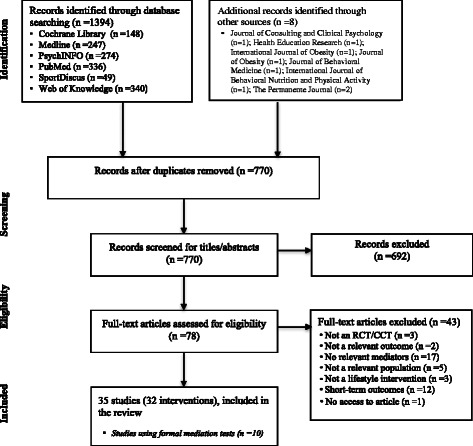
- Systematic review conducted per PRISMA. Six electronic databases were searched for peer-reviewed articles published January 2000–February 2014, plus manual cross-referencing; 1,394 records plus 8 manual additions yielded 1,404 potential articles, 770 abstracts screened, and 35 articles describing 32 unique lifestyle interventions included.
- Eligible studies were experimental lifestyle interventions in overweight/obese adults (≥18 years), reporting outcomes at least 6 months after intervention start and quantitative assessments of self-regulation mediators and weight/BMI, physical activity, or dietary intake. Results were separated into short-term (<12 months) and long-term (≥12 months) outcomes, and formal mediation studies were reported separately from predictor studies.
- Quality was assessed with an adapted Effective Public Health Practice Project tool and a mediation-specific checklist. Heterogeneity prevented meta-analysis, so findings were synthesized narratively with vote counting of significant mediation effects.
Limitations
- The paper states substantial heterogeneity in variables, study designs, measurement methods, populations, and intervention formats/lengths prevented deriving pooled mediation estimates or using meta-analytic techniques; narrative vote counting is less robust. It also notes many primary studies had poor methodological quality, none of the formal mediation studies were strong, outcome measures varied, coding relied on article descriptions, the year 2000 search cutoff was largely arbitrary, and non-controlled trials were included in some analyses.
- The paper states there were too few studies per mediator, dietary evidence was too sparse for meaningful conclusions, and external validity for self-regulation skills and autonomous motivation may be limited because findings came from few research groups using similar designs.
- Evident from the text: only 10 of 35 studies used formal mediation, and for short-term outcomes formal mediation was reported only for physical activity and only two mediators (body image/self-worth and self-efficacy/barriers), so much of the evidence is correlational or predictor-based rather than causal.
Model-written summary. Check it against the paper before relying on it.
Integrity signals
Registry
Cites
Statistics
Figures
Verification
Claims the paper makes
3 Valid · 1 Not valid · 26 Not checked · 77 Own results and interpretations
The cited sources support only part of this claim — read each source’s verdict below.
In the paper
“Second, if and when individuals are able to successfully self-regulate their behaviors, these effects tend to be sustainable, which is essential for having a lasting impact on health; moreover, this successful self-regulation may also “transfer” to, and help change, other health behaviors [18].”
§ Successful behavior change in obesity interventions in adults: a systematic review of self-regulation mediators > Background
What the sources say
- Partly supportedcites [18] Mata J Silva MN Vieira PN Carraça EV Andrade AM Coutinho SR Motivational “spill-over” during weight control: increased self-determination and exercise intrinsic motivation predict eating self-regulation Health Psychol. 2009 28 709 716 10.1037/a0016764 19916639 sourceExperimental — accuracy not yet measured
The Abstract reports that motivation predicted eating self-regulation over 12 months, and the Discussion (p. 18) reports possible spill-over from exercise motivation to eating regulation. These passages support the transfer part of the citing sentence, but they do not establish that successful self-regulation generally produces sustainable effects after the intervention. (LLM, conf=0.86)
hedgedstates an association- Asserted: passes — The authors put it forward as true.
- Checkable: passes — It can be checked against evidence.
- Load-bearing: passes — The paper’s conclusions depend on it.
- Based: passes — The paper gives a reason why it holds.
- Partly supported
Every source the paper cites for this claim was checked and supports it.
In the paper
“Second, if and when individuals are able to successfully self-regulate their behaviors, these effects tend to be sustainable, which is essential for having a lasting impact on health; moreover, this successful self-regulation may also “transfer” to, and help change, other health behaviors [18].”
§ Successful behavior change in obesity interventions in adults: a systematic review of self-regulation mediators > Background
What the sources say
- Supportedcites [18] Mata J Silva MN Vieira PN Carraça EV Andrade AM Coutinho SR Motivational “spill-over” during weight control: increased self-determination and exercise intrinsic motivation predict eating self-regulation Health Psychol. 2009 28 709 716 10.1037/a0016764 19916639 source
The Discussion (p. 18) concludes that spill-over may occur between exercise motivation and eating self-regulation during a weight-control intervention. This supports the cited possibility that self-regulation in one health behavior may help change another. (LLM, conf=0.90)
hedgedstates a possible cause- Asserted: passes — The authors put it forward as true.
- Checkable: passes — It can be checked against evidence.
- Load-bearing: passes — The paper’s conclusions depend on it.
- Based: passes — The paper gives a reason why it holds.
- Supported
Every source the paper cites for this claim was checked and supports it.
In the paper
“More broadly, psychological flexibility appears to predict health and psychological well-being [97], is thought to reflect more committed, values-based goal pursuit [98,99] and is considered a hallmark of self-determination [89], factors which may help explain successful health behavior self-regulation.”
§ Successful behavior change in obesity interventions in adults: a systematic review of self-regulation mediators > Discussion
What the sources say
- Supportedcites [97] Kashdan TB Rottenberg J Psychological flexibility as a fundamental aspect of health Clin Psychol Rev. 2010 30 865 878 10.1016/j.cpr.2010.03.001 21151705 PMC2998793 source
The introduction says psychological flexibility makes a major contribution to daily well-being and lasting psychological health. The ‘Balance among important life domains’ section adds that flexibility-related abilities account for incremental variance in social and psychological health. No page numbers are provided in our copy. (LLM, conf=0.91)
hedgedstates an association- Asserted: passes — The authors put it forward as true.
- Checkable: passes — It can be checked against evidence.
- Load-bearing: unclear — It is unclear whether the paper’s conclusions depend on it.
- Based: passes — The paper gives a reason why it holds.
- Supported
A result the paper reports from its own data — it cites no other source for it, so there is none to check. The quote shows it is in the paper.
In the paper
“Eating disinhibition, which appeared to be an additional predictor in the short-term, does not seem to be consistent in the long-term provided that it was significant only in 38% of the 16 times it was tested.”
§ Successful behavior change in obesity interventions in adults: a systematic review of self-regulation mediators > Results > Mediators/predictors of weight control
hedged- Asserted: passes — The authors put it forward as true.
- Checkable: passes — It can be checked against evidence.
- Load-bearing: passes — The paper’s conclusions depend on it.
- Based: passes — The paper gives a reason why it holds.
A result the paper reports from its own data — it cites no other source for it, so there is none to check. The quote shows it is in the paper.
In the paper
“For physical activity, significant putative mediators were high autonomous motivation, self-efficacy, and use of self-regulation skills.”
§ Successful behavior change in obesity interventions in adults: a systematic review of self-regulation mediators > Abstract > Results
hedgedstates a possible cause- Asserted: passes — The authors put it forward as true.
- Checkable: passes — It can be checked against evidence.
- Load-bearing: passes — The paper’s conclusions depend on it.
- Based: passes — The paper gives a reason why it holds.
36 more claims
Create a free account to see all 107 claims and to verify the 39 references still open.
- It may state two separate claims as one. 40
- Probably not a substantial claim. 41
- The quote only partly states this claim. 1
Claims other papers make about this one
Each is checked against this paper’s own text: does it say what the citing paper says it does?
The source backs part of the claim, not all of it — or backs it for a different population, condition or comparison.
In the citing paper
“This supports findings from a 2015 systematic review suggesting that psychological or self-regulatory skills and body image act as effective mediators of behavior change in lifestyle interventions [66].”
From Barriers and facilitators to diet, physical activity and lifestyle behavior intervention adherence: a qualitative systematic review of the literature (2023) · cites this paper as [66]
Experimental — accuracy not yet measuredThe source backs part of the claim, not all of it — or backs it for a different population, condition or comparison.
In the citing paper
“Improved body acceptance was associated with more stable maintenance of weight control behaviors, especially in individuals with low initial body image satisfaction [94].”
From Dietary and Behavioral Strategies for Weight Loss and Weight Loss Maintenance: A Narrative Review (2025) · cites this paper as [94]
Experimental — accuracy not yet measuredThe source backs part of the claim, not all of it — or backs it for a different population, condition or comparison.
In the citing paper
“This approach potentially enhances the effectiveness of pharmacological treatments through ongoing support and education using real-time microlearning approaches to promote individual self-care capability [18], as well as through supporting the adoption of health-seeking self-care behaviors using nudges and personalized insights delivered using an accessible digital platform [19,20].”
From Impact of Digital Engagement on Weight Loss Outcomes in Obesity Management Among Individuals Using GLP-1 and Dual GLP-1/GIP Receptor Agonist Therapy: Retrospective Cohort Service Evaluation Study (2025) · cites this paper as [20]
Experimental — accuracy not yet measuredIn the citing paper
“Improvements in body acceptance were associated with greater durability of behaviors supporting weight control, particularly among individuals with low baseline satisfaction with their appearance [94].”
From Dietary and Behavioral Strategies for Weight Loss and Weight Loss Maintenance: A Narrative Review (2025) · cites this paper as [94]
In the citing paper
“Findings on self regulatory strategies indicated that regular monitoring of behaviors, planning, and flexible adjustment of actions were more frequently observed among individuals achieving long term results [94].”
From Dietary and Behavioral Strategies for Weight Loss and Weight Loss Maintenance: A Narrative Review (2025) · cites this paper as [94]
1 more claim about this paper
Create a free account to see every claim other papers make about this one.
Self-check
Percentages, sums and reported differences re-computed from the paper’s own numbers.
Each contradiction between two passages listed here was confirmed by an independent check.
Rated minor: it would not touch a result — a value no result rests on, a p-value that stays on the same side of the significance level, or a conflict that is clerical, resolved elsewhere in the paper, or outside its own findings.
In the paper
§ Successful behavior change in obesity interventions in adults: a systematic review of self-regulation mediators > Results > Mediators/predictors of physical activity
“Fourteen variables, grouped in seven categories, were tested as mediators/predictors of short-term weight control (Table 4).”
§ Successful behavior change in obesity interventions in adults: a systematic review of self-regulation mediators > Methods > Data synthesis
“Table: Table 4 Mediators/predictors of short-term physical activity (<12 months)”
Rated minor: it would not touch a result — a value no result rests on, a p-value that stays on the same side of the significance level, or a conflict that is clerical, resolved elsewhere in the paper, or outside its own findings.
In the paper
§ Successful behavior change in obesity interventions in adults: a systematic review of self-regulation mediators > Results > Mediators/predictors of physical activity
“11 looked into short-term outcomes (less than 6 months beyond the start of the intervention)”
§ Successful behavior change in obesity interventions in adults: a systematic review of self-regulation mediators > Methods > Data synthesis
“Table: Table 4 Mediators/predictors of short-term physical activity (<12 months)”
Rated minor: it would not touch a result — a value no result rests on, a p-value that stays on the same side of the significance level, or a conflict that is clerical, resolved elsewhere in the paper, or outside its own findings.
In the paper
“| ↑ Self-regulation skill use | 3 | 3 | 75 | 6 | 6 | 83a |”
§ Successful behavior change in obesity interventions in adults: a systematic review of self-regulation mediators > Methods > Data synthesis
Reported 75 · recomputed 66.666667
Rated minor: it would not touch a result — a value no result rests on, a p-value that stays on the same side of the significance level, or a conflict that is clerical, resolved elsewhere in the paper, or outside its own findings.
In the paper
“| Study design (n = 35) | | Intervention (n = 35) | | | Trial | | Aim | | | NCT | 6 | Weight loss | 15 | | NRCT | 1 | Weight maintenance | 6 | | RCT | 28 | Exercise adherence | 3 | | Arms | | Health promotion | 8 | | 1 arm | 6 | Other | 2 |”
§ Successful behavior change in obesity interventions in adults: a systematic review of self-regulation mediators > Methods > Data synthesis
Reported 35 · recomputed 34
Citations
Cites
Baron, R. M., & Kenny, D. A. (1986) · Journal of Personality and Social Psychology · doi:10.1037/0022-3514.51.6.1173 · Cited by 91,532
Self-efficacy: The exercise of control
Bandura, A., Freeman, W. H., & Lightsey, R. (1999) · Journal of Cognitive Psychotherapy · doi:10.1891/0889-8391.13.2.158 · Cited by 46,835
(2013) · Cited by 44,563
The "what" and "why" of goal pursuits: Human needs and the self-determination of behavior
Deci, E. L., & Ryan, R. M. (2000) · Psychological Inquiry · doi:10.1207/s15327965pli1104_01 · Cited by 34,210 · cited 3×
“Additionally, because self-determined, well-internalized behaviors are associated with the satisfaction of the needs for autonomy, competence, and relatedness - and with the feelings of internal coherence and well-being that are thought to emerge from those experiences - this provides an explanation for the behavior t…”
BackgroundThe Cochrane Collaboration's tool for assessing risk of bias in randomised trials
Higgins, J. P. T., Altman, D. G., Gotzsche, P. C., Juni, P., Moher, D., Oxman, A. D., Savovic, J., Schulz, K. F., Weeks, L., Sterne, J. A. C., et al. (2011) · BMJ · doi:10.1136/bmj.d5928 · Cited by 33,817
Liberati, A., Altman, D. G., Tetzlaff, J., Mulrow, C., Gøtzsche, P. C., Ioannidis, J. P. A., Clarke, M., Devereaux, P. J., Kleijnen, J., & Moher, D. (2009) · PLoS Medicine · doi:10.1371/journal.pmed.1000100 · Cited by 28,164 · cited 3×
“A data extraction form was developed, informed by the PRISMA statement for reporting systematic reviews [21] and the Cochrane Collaboration’s tool for assessing risk of bias [27].”
MethodIntrinsic Motivation and Self-Determination in Human Behavior
Deci, E. L., & Ryan, R. M. (1985) · doi:10.1007/978-1-4899-2271-7 · Cited by 26,772 · cited 1×
“A wide variety of health behavior change theories has been employed to provide conceptual organization of these determinants, including social cognitive theories such as the theory of planned behavior [5], theories of motivation such as self-determination theory [6], theories distinguishing between motivational and po…”
BackgroundDermyshi, E., Wang, Y., Yan, C., Hong, W., Qiu, G., Gong, X., & Zhang, T. (2017) · Neonatology · doi:10.1159/000454668 · Cited by 24,451
Self-efficacy: the exercise of control
(1997) · Choice Reviews Online · doi:10.5860/choice.35-1826 · Cited by 24,281
From Intentions to Actions: A Theory of Planned Behavior
Ajzen, I. (1985) · Action Control · doi:10.1007/978-3-642-69746-3_2 · Cited by 19,057
Cited by
Items 101–200 of 798
Larsen, J. K., Hermans, R. C. J., Sleddens, E. F. C., Vink, J. M., Kremers, S., Ruiter, E. L. M., & Fisher, J. O. (2017) · Appetite · doi:10.1016/j.appet.2017.12.016 · Cited by 42
“Volitional regulation interventions mainly intervene on the automatic pathway, whereas self-efficacy interventions include a more reflective motivational mechanism that may operate along the entire continuum from adoption tomaintenance (Teixeira et al., 2015).”
Backgroundthe LIFEstyle study group, Karsten, M. D. A., van Oers, A. M., Groen, H., Mutsaerts, M. A. Q., van Poppel, M. N. M., Geelen, A., van de Beek, C., Painter, R. C., Mol, B. W., et al. (2018) · European Journal of Nutrition · doi:10.1007/s00394-018-1798-7 · Cited by 38
Social norms and obesity prevalence: From cohort to system dynamics models
Crielaard, L., Dutta, P., Quax, R., Nicolaou, M., Merabet, N., Stronks, K., & Sloot, P. M. A. (2020) · Obesity Reviews · doi:10.1111/obr.13044 · Cited by 36
“In fact, it has consistently been shown that weight loss resulting from interventions targeting individual weight-related behaviour is likely to not be maintained.(7) One possible explanation is that norms may counteract health awareness in shaping individual health-related behaviour.”
BackgroundMegías, Á., González‐Cutre, D., Beltrán‐Carrillo, V. J., Gomis-Díaz, J. M., Cervelló, E. M., & Bartholomew, K. J. (2018) · Stress and Health · doi:10.1002/smi.2811 · Cited by 41
Darwinian Hedonism and the Epidemic of Unhealthy Behavior
Williams, D. M. (2019) · Cambridge University Press eBooks · doi:10.1017/9781316275047 · Cited by 41
Yan, L. (2020) · Production and Operations Management · doi:10.1111/poms.13171 · Cited by 34
“Self-monitoring refers to the process by which individuals regulate and track their own behavior (Teixeira et al. 2015).”
Jiang, Y., Dou, Y., Chen, H., Zhang, Y., Chen, X., Yin, W., Rodrigues, M., & Yan, W. (2021) · Diabetology & Metabolic Syndrome · doi:10.1186/s13098-021-00688-7 · Cited by 37
“Therefore, identifying the high-risk groups with CMRs from an early age people with obesity could benefit in improving health awareness and behaviour of children and further promote their long-term adherence [5].”
BackgroundKoutoukidis, D. A., Beeken, R. J., Manchanda, R., Burnell, M., Ziauddeen, N., Michalopoulou, M., Knobf, M. T., & Lanceley, A. (2019) · International Journal of Gynecological Cancer · doi:10.1136/ijgc-2018-000039 · Cited by 33
Comșa, L. T., David, D., & David, D. O. (2020) · Behaviour Research and Therapy · doi:10.1016/j.brat.2020.103654 · Cited by 34
Unhealthy eating behaviors and weight gain: A prospective study in young and middle‐age adults
León-Muñoz, L. M., García‐Esquinas, E., Soler‐Vilá, H., Guallar‐Castillón, P., Banegas, J. R., & Rodríguez‐Artalejo, F. (2016) · Obesity · doi:10.1002/oby.21477 · Cited by 38
“sensible way to control energy intake; in fact, the effect of most weight-loss diets is mediated by deciding in advance what and how much to eat and by self-monitoring adherence to such plan (22).”
BackgroundRevisiting the Role of Football Spectators’ Behavioral Intentions and its Antecedents
Biscaia, R. (2016) · The Open Sports Sciences Journal · doi:10.2174/1875399x01609010003 · Cited by 36
“Additionally, while this study reviews the importance of spectators’ behavioral intentions within the football context, future studies could conduct a systematic review of the literature [15, 63] concerning behavioral intentions for spectator sports in general in order to strengthen our understanding of how to enhance…”
BackgroundFischer, M., Oberänder, N., & Weimann, A. (2020) · European Journal of Clinical Nutrition · doi:10.1038/s41430-020-0559-x · Cited by 36
Testing a Self-Determination Theory Model of Healthy Eating in a South African Township
Man, J. D., Wouters, E., Delobelle, P., Puoane, T. R., Daivadanam, M., Absetz, P., Remmen, R., & van Olmen, J. (2020) · Frontiers in Psychology · doi:10.3389/fpsyg.2020.02181 · Cited by 35
Bouhlal, S., McBride, C. M., Trivedi, N. S., Agurs‐Collins, T., & Persky, S. (2016) · Appetite · doi:10.1016/j.appet.2016.12.006 · Cited by 32
Pedersen, S., Sniehotta, F. F., Sainsbury, K., Evans, E. H., Marques, M. M., Stubbs, R. J., Heitmann, B. L., & Lähteenmäki, L. (2018) · Social Science & Medicine · doi:10.1016/j.socscimed.2018.05.016 · Cited by 36
Self-citationAnnesi, J. J. (2020) · The Permanente Journal · doi:10.7812/tpp/19.235 · Cited by 33
Unick, J. L., DUNSIGER, S. I., Bock, B. C., Sherman, S. A., Braun, T. D., & Wing, R. R. (2022) · PLoS ONE · doi:10.1371/journal.pone.0263405 · Cited by 31
Freshwater, M., Christensen, S. M., Oshman, L. D., & Bays, H. E. (2022) · Obesity Pillars · doi:10.1016/j.obpill.2022.100014 · Cited by 33
“Self-ef fi cacy is an important mediator of behavior change in obesity treatment [102].”
BackgroundAsbjørnsen, R. A., Hjelmesaeth, J. S., Smedsrød, M. L., Wentzel, J., Ollivier, M., Clark, M. M., van Gemert‐Pijnen, J. E. W. C., & Nes, L. S. (2022) · JMIR Human Factors · doi:10.2196/37372 · Cited by 36
“Health behaviors and self-regulation play central roles in weight loss and weight loss maintenance [24,25].”
BackgroundHussien, J., Brunet, J., Romain, A. J., Lemelin, L., & Baillot, A. (2020) · Disability and Rehabilitation · doi:10.1080/09638288.2020.1773944 · Cited by 33
“Considering that prolonged involvement in physical activity requires self-determined forms of motivation [12,13], interventions may benefit from promoting intrinsic motives (e.”
BackgroundMarques, M. M., Matos, M., Mattila, E., Encantado, J., Duarte, C., Teixeira, P. J., Stubbs, R. J., Sniehotta, F. F., Ermes, M., Harjumaa, M., et al. (2021) · Journal of Medical Internet Research · doi:10.2196/25305 · Cited by 31
“Available evidence from behavioral weight management interventions [17] showed some support for the effectiveness of interventions based on self-regulation theories [13,14,29] and self-determination theory [16].”
Self-citationAdherence to mobile‐app‐based dietary self‐monitoring—Impact on weight loss in adults
Payne, J. E., Turk, M. T., Kalarchian, M. A., & Pellegrini, C. A. (2021) · Obesity Science & Practice · doi:10.1002/osp4.566 · Cited by 61
“An established self‐regulation skill set, achieved through the process of self‐ monitoring, goal setting, feedback, self‐reward, and social support, is one of the best predictors of weight loss.(23,24) The accuracy and consistency of self‐monitoring are postulated as requirements to change health behavior.”
BackgroundNiu, Z., Bhurosy, T., & Heckman, C. J. (2022) · Preventive Medicine Reports · doi:10.1016/j.pmedr.2022.101709 · Cited by 29
Behavioral Interventions to Attenuate Driven Overeating and Weight Regain After Bariatric Surgery
Ames, G. E., Koball, A. M., & Clark, M. M. (2022) · Frontiers in Endocrinology · doi:10.3389/fendo.2022.934680 · Cited by 28
Mediators of physical activity adoption and maintenance among breast cancer survivors
Kindred, M. M., Pinto, B. M., & DUNSIGER, S. I. (2019) · Journal of Behavioral Medicine · doi:10.1007/s10865-019-00085-6 · Cited by 29
Iłowiecka, K., Glibowski, P., Skrzypek, M., & Styk, W. (2021) · Nutrients · doi:10.3390/nu13062020 · Cited by 35
“The current evidence is compatible with the notion that high motivation is one of the key predictors of successful weight loss and maintenance [18,19].”
ResultJohnson, H., Huang, D., Liu, V., Ammouri, M. A., Jacobs, C., & El-Osta, A. (2025) · Journal of Medical Internet Research · doi:10.2196/69466 · Cited by 27
“These techniques focused on fostering intrinsic motivation, goal setting, and problem-solving to promote sustainable lifestyle changes tailored to participants’ individual progress and challenges [20].”
Weimann, A., Fischer, M., Oberänder, N., Prodehl, G., Weber, N., Andrä, M. S., Krug, J., Wallstabe, I., Schiefke, I., & Bischoff, S. C. (2018) · Clinical Nutrition · doi:10.1016/j.clnu.2018.07.027 · Cited by 27
Ryan, K. D., Dockray, S., & Linehan, C. (2022) · CHI Conference on Human Factors in Computing Systems · doi:10.1145/3491102.3501864 · Cited by 30
“, tracking tools) to enhance self-regulation skills [40, 41].”
BackgroundChen, L., Huang, H., Jiang, S., Yao, H., Xu, L., Huang, Q., Xiao, M., & Zhao, Q. (2023) · International Journal of Nursing Sciences · doi:10.1016/j.ijnss.2023.12.007 · Cited by 32
“This is also supported by previous fi ndings [48,49], which showed that psychological state is an effective mediator of behavioral change in lifestyle interventions.”
ResultA Warm Welcome Matters! The Link Between Social Feedback and Weight Loss in /r/loseit
Cunha, T. O., Weber, I. G., & Pappa, G. L. (2017) · International World Wide Web Conference (WWW) · doi:10.1145/3041021.3055131 · Cited by 33
“In particular for long-term behavioral changes required for achieving and maintaining weight loss, user engagement is essential [38].”
Hansen, S., Huttunen‐Lenz, M., Sluik, D., Brand-Miller, J. C., Drummen, M., Fogelholm, M., Handjieva‐Darlenska, T., Macdonald, I. A., Martínez, J. A., Larsen, T. M., et al. (2018) · International Journal of Behavioral Medicine · doi:10.1007/s12529-018-9744-x · Cited by 34
Faghri, P. D., Simon, J., Huedo-Medina, T. B., & Gorin, A. A. (2017) · Journal of Occupational and Environmental Medicine · doi:10.1097/jom.0000000000000987 · Cited by 28
“Self-efficacy is a main predictor of physical activity maintenance and mediator of short-term weight control, dietary intake, and physical activity, and appears to be a potentially effective strategy for promoting weight loss.(17)”
BackgroundInfluentialStress and self-esteem in adolescence predict physical activity and sedentary behavior in adulthood
Carter, J. S. (2018) · Mental health and physical activity · doi:10.1016/j.mhpa.2018.02.005 · Cited by 26
Determinants of lifestyle behavior change to prevent type 2 diabetes in high-risk individuals
den Braver, N. R., de Vet, E., Duijzer, G., ter Beek, J., Jansen, S. C., Hiddink, G. J., Feskens, E. J. M., & Haveman‐Nies, A. (2017) · International Journal of Behavioral Nutrition and Physical Activity · doi:10.1186/s12966-017-0532-9 · Cited by 32
“One review investigated the mediation of behavioral determinants in the effectiveness of lifestyle interventions in changing behavior and body weight [7].”
BackgroundAn integrated model of fruit, vegetable, and water intake in young adolescents.
Smit, C. R., de Leeuw, R. N. H., Bevelander, K. E., Burk, W. J., Buijs, L., van Woudenberg, T. J., & Buijzen, M. (2018) · Health Psychology · doi:10.1037/hea0000691 · Cited by 27
Are young adults appreciating the health promotion messages on diet and exercise?
Berry, E., Aucott, L. S., & Poobalan, A. S. (2018) · Journal of Public Health · doi:10.1007/s10389-018-0905-9 · Cited by 28
“Autonomous motivation, self-efficacy, and self-monitoring have all been shown to increase an individual’s likelihood of undertaking health behaviours (Teixeria et al. 2015).”
BackgroundLara, M., & Amigo, H. (2018) · BMC Public Health · doi:10.1186/s12889-018-5185-3 · Cited by 25
Comportamento alimentar em obesos e sua correlação com o tratamento nutricional
Biagio, L. D., Moreira, P., & Amaral, C. K. (2020) · Jornal Brasileiro de Psiquiatria · doi:10.1590/0047-2085000000280 · Cited by 39
Jensen, C. D., Duraccio, K. M., Carbine, K. A., Barnett, K. A., & Kirwan, C. B. (2016) · Journal of Pediatric Psychology · doi:10.1093/jpepsy/jsw091 · Cited by 26
“Self-regulation failure is a prominent neurocognitive model for understanding weight-related behavior (Teixeira et al., 2015), and executive and inhibitory control are central to this theory (Heatherton & Wagner, 2011; Hofmann, Schmeichel, & Baddeley, 2012).”
BackgroundCalugi, S., Marchesini, G., Ghoch, M. E., Gavasso, I., & Grave, R. D. (2018) · Eating and Weight Disorders - Studies on Anorexia Bulimia and Obesity · doi:10.1007/s40519-018-0528-8 · Cited by 26
“Although discouraging, these results have prompted researchers to study the predictors of long-term maintenance of intentional weight loss, and to hypothesize that cognitive mechanisms, by interacting with specific changes in diet and adherence to physical activity, may play a pivotal role in weight loss maintenance […”
ResultL.-U., S., Ahola, A. J., Kupila, S. K. E., Korpela, R., & Pietiläinen, K. H. (2020) · Contemporary Clinical Trials Communications · doi:10.1016/j.conctc.2020.100638 · Cited by 25
Czepczor‐Bernat, K., Brytek‐Matera, A., & Staniszewska, A. (2020) · Archives of Women s Mental Health · doi:10.1007/s00737-020-01077-1 · Cited by 28
Fernandez-Lazaro, C. I., Toledo, E., Buil‐Cosiales, P., Salas‐Salvadó, J., Corella, D., Fitó, M., Martínez, J. A., Alonso‐Gómez, Á. M., Wärnberǵ, J., Vioqué, J., et al. (2021) · European Journal of Nutrition · doi:10.1007/s00394-021-02697-8 · Cited by 28
“1 3 Consistent with our findings, high self-efficacy has been a promising predictor in weight-loss interventions and physical activity among overweight/obese populations [45].”
BackgroundINDIVIDUO: Results from a patient-centered lifestyle intervention for obesity surgery candidates
Camolas, J., Santos, O., Moreira, P. A. M., & do Carmo, I. (2016) · Obesity Research & Clinical Practice · doi:10.1016/j.orcp.2016.08.003 · Cited by 27
Hsueh, P.-Y. S., Cheung, Y. K., Dey, S., Kim, K. K., Martin-Sanchez, F. J., Petersen, S. K., & Wetter, T. C. (2017) · Yearbook of Medical Informatics · doi:10.15265/iy-2017-009 · Cited by 26
“…include: (i) feeding information back into Medical Product development [20], (ii) use of data as trial outcome measures [21], (iii) identifying predictors of disease progression [22], and (iv) returning usefull information to the patient to assess self-efficacy and induce behavior changes [23,24].”
Samdal, G. B., Meland, E., Eide, G. E., Berntsen, S., Abildsnes, E., Stea, T. H., & Mildestvedt, T. (2018) · Scandinavian Journal of Public Health · doi:10.1177/1403494818756081 · Cited by 25
“Autonomous regulation, self-efficacy and the development of self-regulation skills are identified as psychological mechanisms and mediators of successful behaviour change [15].”
BackgroundGorin, A. A., LaRose, J. G., Espeland, M. A., Tate, D. F., Jelalian, E., Robichaud, E., Coward, P., Hatley, K. E., Garcia, K. R., Lang, W., et al. (2018) · Health Psychology · doi:10.1037/hea0000689 · Cited by 26
“Moderate levels of restraint and disinhibition were reported, consistent with other weight management trials (JaKa et al., 2015; Teixeira et al., 2015).”
Allison, K., Delany, C. M., Setchell, J., Egerton, T., Holden, M. A., Quicke, J. G., & Bennell, K. L. (2019) · Musculoskeletal Care · doi:10.1002/msc.1391 · Cited by 26
Berglind, D., Yacamán-Méndez, D., Lavebratt, C., & Forsell, Y. (2020) · JMIR mhealth and uhealth · doi:10.2196/14615 · Cited by 26
“…were based on a behavior change model with 4 core behavior change techniques (mobilizing social support for change, developing self-efficacy, goal setting, and self-monitoring), which are known to be effective in supporting individuals to improve healthy activity and dietary behaviors [22].”
Annesi, J. J., & Vaughn, L. L. (2017) · Journal of Nutrition Education and Behavior · doi:10.1016/j.jneb.2017.03.004 · Cited by 28
Annesi, J. J. (2020) · The Journal of Primary Prevention · doi:10.1007/s10935-020-00580-6 · Cited by 26
Diabetes and Cardiovascular Disease Risk Perception and Risk Indicators: a 5-Year Follow-up
Vornanen, M., Konttinen, H. M., Peltonen, M., & Haukkala, A. (2020) · International Journal of Behavioral Medicine · doi:10.1007/s12529-020-09924-2 · Cited by 28
Mackenbach, J. D., Lakerveld, J., van Lenthe, F. J., Teixeira, P. J., Compernolle, S., Bourdeaudhuij, I. D., Charreire, H., Oppert, J., Bárdos, H., Glonti, K., et al. (2016) · Obesity Reviews · doi:10.1111/obr.12374 · Cited by 28
“Individual determinants of obesity-related behaviours include psychosocial factors such as motivation, perceived opportunities and barriers, and behavioural norms, in addition to socio-demographic factors such as age, sex and socio-economic factors (4,5).”
BackgroundSelf-citationButtitta, M., Rousseau, A., & Guerrién, A. (2017) · Current Obesity Reports · doi:10.1007/s13679-017-0281-8 · Cited by 26
Mediators of Physical Activity Adherence: Results from an Action Control Intervention in Couples
Berli, C., Stadler, G., Shrout, P. E., Bolger, N., & Scholz, U. (2018) · Annals of Behavioral Medicine · doi:10.1007/s12160-017-9923-z · Cited by 22
Sandhu, M., Giabbanelli, P. J., & Mago, V. (2019) · Lecture notes in computer science · doi:10.1007/978-3-030-21902-4_31 · Cited by 22
Wang, X., Wu, Y., Fu, L., Fu, X., Pang, C., & Zang, S. (2023) · Appetite · doi:10.1016/j.appet.2023.107120 · Cited by 24
Replication and Extension of the Weight Loss For Life Community-Based Treatment Protocol
Annesi, J. J., Unruh, J. L., & Mareno, N. (2016) · Behavioral Medicine · doi:10.1080/08964289.2016.1232241 · Cited by 22
Jancey, J. M., Holt, A., Lee, A. H., Kerr, D. A., Robinson, S., Tang, L., Anderson, A. S., Hills, A. P., & Howat, P. A. (2017) · International Journal of Behavioral Nutrition and Physical Activity · doi:10.1186/s12966-017-0543-6 · Cited by 23
“Motivational interviewing by these ambassadors via telephone contact supported participant goal setting, adherence and program sustainability [28].”
BackgroundBatch, B. C., Goldstein, K. M., Yancy, W. S., Sanders, L. L., Danus, S. M., Grambow, S. C., & Bosworth, H. B. (2018) · Journal of Women s Health · doi:10.1089/jwh.2016.6212 · Cited by 22
“The current analysis included items from the psychosocial factor of the PCWC subscale as well as other self-reported characteristics (perceived social support, importance of losing weight, and self-efficacy) that have been shown to be associated with successful behavior change and weight loss.(19,20)”
MethodImpact of COVID-19 on health-related behaviours, well-being and weight management
Avery, A., Toon, J., Kent, J., Holloway, L., Lavin, J., & Bennett, S. (2021) · BMC Public Health · doi:10.1186/s12889-021-11143-7 · Cited by 22
Qin, Y., Wang, X., & Namkoong, K. (2021) · Mobile Media & Communication · doi:10.1177/20501579211054929 · Cited by 23
“For theories, only 6 out of the 24 included studies explicitly stated that the intervention relied on some sort of theory for its design, which was different from the results on traditional weight-loss interventions (Teixeira et al., 2015).”
ResultBaguley, B. J., Via, J. D., Fraser, S. F., Daly, R. M., & Kiss, N. K. (2022) · Nutrition Reviews · doi:10.1093/nutrit/nuac079 · Cited by 21
Mechanisms of change in diet and activity in the Make Better Choices 1 trial.
Schneider, K. L., Coons, M. J., McFadden, H. G., Pellegrini, C. A., DeMott, A., Siddique, J., Hedeker, D., Aylward, L., & Spring, B. J. (2016) · Health Psychology · doi:10.1037/hea0000333 · Cited by 21
Warschburger, P., Gmeiner, M. S., Morawietz, M., & Rinck, M. (2018) · European Eating Disorders Review · doi:10.1002/erv.2607 · Cited by 22
‘I've worked so hard, I deserve a snack in the worksite cafeteria’: A focus group study
Velema, E., Vyth, E. L., & Steenhuis, I. H. (2018) · Appetite · doi:10.1016/j.appet.2018.11.027 · Cited by 22
Castillo, K. Y. A. D., Dennis, C., Wamithi, S., Briollais, L., McGowan, P. O., Dol, J., & Lye, S. J. (2022) · Journal of Developmental Origins of Health and Disease · doi:10.1017/s2040174421000726 · Cited by 24
“Eligible studies were included if the following criteria were met: (1) longitudinal research studies that pertained to singleton pregnancies; (2) maternal BMI (exposure) and child BMI between the age of two and eighteen (outcome) were reported according to WHO16–18 or Centers for Disease Control and Prevention (CDC)19…”
BackgroundMethodPeddle‐McIntyre, C. J., Baker, M. K., Lee, G., Galvao, D. A., Cormie, P., Graham, V., & Newton, R. U. (2017) · European Journal of Cancer Care · doi:10.1111/ecc.12722 · Cited by 21
“Targeting these constructs has been shown to assist with initiating behaviour change in clinical populations (Teixeira et al., 2015).”
Backgroundde Vos, B. C., Runhaar, J., van Middelkoop, M., Krul, M., & Bierma‐Zeinstra, S. (2016) · American Journal of Clinical Nutrition · doi:10.3945/ajcn.116.133512 · Cited by 27
Factors Determining Consumers’ Purchase Intentions Towards Dried Fruits
Sun, Y., & Liang, C. (2020) · International Journal of Fruit Science · doi:10.1080/15538362.2020.1774477 · Cited by 22
Salemonsen, E., Førland, G., Hansen, B. S., & Holm, A. L. (2020) · Health Expectations · doi:10.1111/hex.13129 · Cited by 23
The impact of hope and hopelessness on evaluation: A meta‐cognitive approach
Requero, B., Briñol, P., & Petty, R. E. (2021) · European Journal of Social Psychology · doi:10.1002/ejsp.2726 · Cited by 21
“That is, many initiatives are designed to promote positive attitudes toward healthy diets (Cuschieri & Mamo, 2016; Hebden et al., 2012) while reducing the positive attitudes people hold toward unhealthy foods (Roberto & Kawachi, 2014; Teixeira et al., 2015).”
BackgroundNutrition in Physical Therapist Practice: Tools and Strategies to Act Now
Berner, P., Bezner, J. R., Morris, D. M., & Lein, D. H. (2021) · Physical Therapy · doi:10.1093/ptj/pzab061 · Cited by 21
Marentes-Castillo, M., Castillo, I., Tomás-Marco, I., Zamarripa, J., & Álvarez, O. (2021) · Public Health Nutrition · doi:10.1017/s1368980021004791 · Cited by 22
“Becoming autonomous is essential for achieving weight control, which involves understanding the reasons for initiating the behaviour and, thus, preventing abandonment, as well as redirecting the objective in overweight treatments towards process-focused treatment rather than outcome-focused treatment(15,16).”
Talebi, E., Mohaddesi, H., Vahabzadeh, D., & Rasuli, J. (2022) · BMC Women s Health · doi:10.1186/s12905-022-01725-x · Cited by 20
“Physical activity is an effective way to reduce unpleasant influences of pregnancy such as sleeplessness and feeling tired [7], excessive weight gains of a mother [8], back and pelvic pain [9], constipation [10], high blood pressure [11], depression and stress [12].”
BackgroundIncorporating Behavioral Techniques into a Serious Videogame for Children
Thompson, D. I. (2017) · Games for Health Journal · doi:10.1089/g4h.2016.0066 · Cited by 20
“adults.(22,26) It is likely they facilitate change by enhancing self-efficacy (e.”
Stubbs, R. J., Duarte, C., O’Driscoll, R., Turicchi, J., Kwaśnicka, D., Sniehotta, F. F., Marques, M. M., Horgan, G. W., Larsen, S. C., Palmeira, A. L., et al. (2021) · Obesity Facts · doi:10.1159/000513042 · Cited by 24
Self-citationMcMullan, I., Bunting, B. P., Blackburn, N. E., Wilson, J. J., Deidda, M., Caserotti, P., Smith, L., Dallmeier, D., Figuls, M. R. I., Weinmayr, G., et al. (2021) · Journal of Aging and Physical Activity · doi:10.1123/japa.2020-0322 · Cited by 23
Obesity, knee osteoarthritis, and polypathology: factors favoring weight loss in older people
Pera, P. I., Ferrer, M. C. O., Juárez, M. N., Juárez, E. N., Soler, L. M., Matheo, C. L., Cuadra, A. R., Pérez, M. H., & Marre, D. (2016) · Patient Preference and Adherence · doi:10.2147/ppa.s92183 · Cited by 41
Sweerts, S. J. (2016) · SOJ Psychology · doi:10.15226/2374-6874/3/1/00125 · Cited by 26
“In general, higher dispositional self-control could facilitate successful restrained eating [74, 75].”
BackgroundWilliams, L. T., Collins, C. E., Morgan, P. J., & Hollis, J. (2019) · Nutrients · doi:10.3390/nu11051100 · Cited by 23
“There is, therefore, a need for research that examines the long-term success of interventions and the characteristics of that success [10].”
BackgroundBennion, K. A., Tate, D., Muñoz‐Christian, K., & Phelan, S. (2020) · Obesity · doi:10.1002/oby.22921 · Cited by 18
“However, the effect of the intervention on targeted SCT constructs and weight-related psychosocial outcomes, including depressive symptoms and perceived stress (15), remained unknown.”
BackgroundDietary and Behavioral Strategies for Weight Loss and Weight Loss Maintenance: A Narrative Review
Żurawski, T., & Bartosiewicz, A. (2025) · Nutrients · doi:10.3390/nu18010012 · Cited by 18
“Findings on self regulatory strategies indicated that regular monitoring of behaviors, planning, and flexible adjustment of actions were more frequently observed among individuals achieving long term results [94].”
InfluentialManagement of obesity in menopause
Palacios, S., Chedraui, P. A., Sánchez‐Borrego, R., Coronado, P., Simoncini, T., Schauding, K., Hillard, T., & Nappi, R. E. (2024) · Climacteric · doi:10.1080/13697137.2024.2374760 · Cited by 19
Barriers to Weight Management Among Overweight and Obese Firefighters
Muegge, C. M., Zollinger, T. W., Song, Y., Wessel, J., Monahan, P. O., & Moffatt, S. M. (2019) · Journal of Occupational and Environmental Medicine · doi:10.1097/jom.0000000000001751 · Cited by 20
Annesi, J. J., & Walsh, S. (2021) · Scandinavian Journal of Psychology · doi:10.1111/sjop.12741 · Cited by 18
Aymes, E., Lisembard, G., Dallongeville, J., Rousseaux, J., Dumont, M., Amouyel, P., Romon, M., & Meirhaeghe, A. (2022) · Obesity Science & Practice · doi:10.1002/osp4.593 · Cited by 18
“Therefore, in this study, CR appeared to be associated with positive eating habits in individuals with obesity, maybe in order to prevent/limit further weight gain as described in a previous review.(22) AYMES ET AL.”
ResultLarsen, S. C., Horgan, G., Mikkelsen, M.-L. K., Palmeira, A. L., Scott, S., Duarte, C., Santos, I., Encantado, J., O'Driscoll, R., Turicchi, J., et al. (2020) · PLOS Medicine · doi:10.1371/journal.pmed.1003168 · Cited by 17
“individuals following a structured/consistent sleep schedule in general also have a higher degree of structure in other aspects of their lives, including factors directly or indirectly related to energy balance behaviour [33].”
BackgroundPlue, R. M., Jewett, L., & Widener, M. J. (2019) · Global perspectives on health geography · doi:10.1007/978-3-030-19573-1_6 · Cited by 19
Introduction of a smartphone based behavioral intervention for migraine in the emergency department
Minen, M. T., Friedman, B. W., Adhikari, S., Corner, S. E., Powers, S. W., Seng, E. K., Grudzen, C. R., & Lipton, R. B. (2021) · General Hospital Psychiatry · doi:10.1016/j.genhosppsych.2020.12.009 · Cited by 20
Colton, E., Connors, M., Mahlberg, J., & Verdejo‐García, A. (2024) · Obesity Reviews · doi:10.1111/obr.13801 · Cited by 21
Hamer, O., Kuroski, J. A., Bray, E. P., Harris, C., Blundell, A., Schneider, E., & Watkins, C. L. (2024) · BMJ Open · doi:10.1136/bmjopen-2023-082973 · Cited by 21
Stubbs, R. J., Duarte, C., O’Driscoll, R., Turicchi, J., & Michałowska, J. (2019) · Proceedings of The Nutrition Society · doi:10.1017/s0029665119001083 · Cited by 18
“13 The majority of systematic reviews of WLM interventio ns find considerable heterogeneity between 387 studies (86; 87; 98) .”
BackgroundMethodInfluentialKasila, K., Vainio, S., Punna, M., Lappalainen, P., Lappalainen, R. I., Kaipainen, K., & Kettunen, T. (2020) · Primary Health Care Research & Development · doi:10.1017/s146342362000016x · Cited by 22
“…and self-regulatory skills and techniques, such as goal setting, action planning, and self-monitoring, are associated with successful lifestyle changes, weight outcomes, and weight management (Greaves et al., 2011; 2017; Gupta et al., 2014; Teixeira et al., 2015; Burgess et al., 2017b).”
BackgroundInfluentialAnnesi, J. J. (2020) · Research Quarterly for Exercise and Sport · doi:10.1080/02701367.2020.1799917 · Cited by 17
“Consistent with previous research incorporating cognitive-behavioral treatment approaches (Mata et al., 2009; Teixeira et al., 2015), there were significant”
ResultGillon, A., & Pausé, C. (2021) · Fat Studies · doi:10.1080/21604851.2021.1906525 · Cited by 17
Evidence-Based Digital Tools for Weight Loss Maintenance: The NoHoW Project
Stubbs, R. J., Duarte, C., Palmeira, A. L., Sniehotta, F. F., Horgan, G. W., Larsen, S. C., Marques, M. M., Evans, E. H., Ermes, M., Harjumaa, M., et al. (2021) · Obesity Facts · doi:10.1159/000515663 · Cited by 20
Self-citationAnnesi, J. J., Mareno, N., & McEwen, K. L. (2016) · Scandinavian Journal of Psychology · doi:10.1111/sjop.12327 · Cited by 17
Annesi, J. J. (2018) · British Journal of Health Psychology · doi:10.1111/bjhp.12338 · Cited by 20
Metadata
- Authors
- Teixeira, P. J., Carraça, E. V., Marques, M. M., Rutter, H., Oppert, J.-M., De Bourdeaudhuij, I., Lakerveld, J., & Brug, J.
- Affiliations
- University of Lisbon (PT)
- London School of Hygiene & Tropical Medicine (GB)
- Inserm (FR)
- Amsterdam Public Health (NL)
- Corresponding author
- Teixeira, Pedro J
- ORCID
- Venue
- BMC Medicine
- Published
- 2015-04-16
- Volume
- 13
- Issue
- 1
- Pages
- 84-84
- ISSN
- 1741-7015 (ISSN-L)
- PMC
- PMC4408562
- OpenAlex
- W2092285599
- Semantic Scholar
- 99966d9cd971dd6a646ec628d2242042583d1635
- Cited by
- 711
- References
- 125
- Citations by year
- 2026: 50 · 2025: 57 · 2024: 55 · 2023: 50 · 2022: 64 · 2021: 86 · 2020: 76 · 2019: 107 · 2018: 65 · 2017: 49 · 2016: 43 · 2015: 7
- FWCI
- 7.59
- Type
- journal article
- Language
- en
- Open access
- gold
- doi.org
- Locations
- BMC Medicine (publishedVersion, cc-by)
- Europe PMC (PubMed Central) (publishedVersion, cc-by)
- PubMed Central (publishedVersion, cc-by)
- PubMed (publishedVersion)
- Pure Amsterdam UMC (publishedVersion, other-oa)
- Amsterdam UMC (VU Amsterdam) - Institutional Repository (publishedVersion)
- LSHTM Research Online (London School of Hygiene and Tropical Medicine) (acceptedVersion)
- Data Archiving and Networked Services (DANS) (acceptedVersion, other-oa)
- Ghent University Academic Bibliography (Ghent University) (submittedVersion, other-oa)
- HAL (submittedVersion, other-oa)
- UCL Discovery (University College London) (submittedVersion)
- Data Archiving and Networked Services (DANS) (submittedVersion)
- Funders
- European Commission (278186, FP7‐HEALTH‐2011)
- FP7 Health (278186)
- Topics
- Social Sciences › Psychology › Applied Psychology › Behavioral Health and Interventions
- Health Sciences › Medicine › Public Health, Environmental and Occupational Health › Obesity, Physical Activity, Diet
- Health Sciences › Medicine › Public Health, Environmental and Occupational Health › Obesity and Health Practices
- Keywords
- obesity intervention, behavior change, self-regulation, mediators, weight loss, weight maintenance, physical activity, dietary intake, autonomous motivation, self-efficacy, self-monitoring, dietary restraint, body image, relapse, lifestyle intervention, overweight adults
- MeSH terms
- Behavior Therapy, Diet, Humans, Life Style, Motor Activity, Obesity, Weight Loss, Overweight
About these checks
Registry, retraction, Cites and statistics results are computed, not judged, with one exception: a printed reference that no index lists is read once by a model before it counts as a citation error. Claims are extracted by a model and kept only when their quote appears verbatim in the text; each cited source is then checked, with a model’s help, for whether it says what the claim relies on. Those verdicts can be wrong — read the claim’s quote and the cited source before relying on one.
The claim verdicts this report counts are experimental: their accuracy is not yet measured.
A language model drew the claims from the paper on 2026-10-04, under version 3 of the claim definition (model deepseek-v4.1-flash, prompt extract-v3).
A second model labelled each claim on 2026-10-04 (model jev-1.13-20260917, definition revision gold-guideline-v0.2).
Cited sources are checked with a language model’s help (gpt-6-sol).
Statistics and arithmetic are recomputed, not judged.
Confidence bands are shown only for fields calibrated on our annotated test set. None is calibrated yet, so no band is shown.
What counts as a claim ›How we measure confidence ›How we check this ›
Are you an author, or do you see a problem with this page? Request a review
Data sources
Bibliographic data: Semantic Scholar, OpenAlex, Crossref.
Contains information from the Semantic Scholar Academic Graph Datasets, made available under the ODC Attribution License (ODC-BY 1.0).
Semantic Scholar’s data is described in: Kinney, R., et al. (2023). The Semantic Scholar Open Data Platform. arXiv:2301.10140.
