

Successful behavior change in obesity interventions in adults: a systematic review of self-regulation mediators
Open accessThe DOI matches its Crossref record; 125 of the 125 references it cites were found in a registry or an index; 7 of the 46 sources its claims cite were checked for support.
Abstract
BACKGROUND: Relapse is high in lifestyle obesity interventions involving behavior and weight change. Identifying mediators of successful outcomes in these interventions is critical to improve effectiveness and to guide approaches to obesity treatment, including resource allocation. This article reviews the most consistent self-regulation mediators of medium- and long-term weight control, physical activity, and dietary intake in clinical and community behavior change interventions targeting overweight/obese adults. METHODS: A comprehensive search of peer-reviewed articles, published since 2000, was conducted on electronic databases (for example, MEDLINE) and journal reference lists. Experimental studies were eligible if they reported intervention effects on hypothesized mediators (self-regulatory and psychological mechanisms) and the association between these and the outcomes of interest (weight change, physical activity, and dietary intake). Quality and content of selected studies were analyzed and findings summarized. Studies with formal mediation analyses were reported separately. RESULTS: Thirty-five studies were included testing 42 putative mediators. Ten studies used formal mediation analyses. Twenty-eight studies were randomized controlled trials, mainly aiming at weight loss or maintenance (n = 21). Targeted participants were obese (n = 26) or overweight individuals, aged between 25 to 44 years (n = 23), and 13 studies targeted women only. In terms of study quality, 13 trials were rated as "strong", 15 as "moderate", and 7 studies as "weak". In addition, methodological quality of formal mediation analyses was "medium". Identified mediators for medium-/long-term weight control were higher levels of autonomous motivation, self-efficacy/barriers, self-regulation skills (such as self-monitoring), flexible eating restraint, and positive body image. For physical activity, significant putative mediators were high autonomous motivation, self-efficacy, and use of self-regulation skills. For dietary intake, the evidence was much less clear, and no consistent mediators were identified. CONCLUSIONS: This is the first systematic review of mediational psychological mechanisms of successful outcomes in obesity-related lifestyle change interventions. Despite limited evidence, higher autonomous motivation, self-efficacy, and self-regulation skills emerged as the best predictors of beneficial weight and physical activity outcomes; for weight control, positive body image and flexible eating restraint may additionally improve outcomes. These variables represent possible targets for future lifestyle interventions in overweight/obese populations.
Overview
CoChat Summary
TL;DR
This systematic review of 35 lifestyle intervention studies found that autonomous motivation, self-efficacy, and self-regulation skills are the most consistent self-regulation mediators of weight control and physical activity in overweight/obese adults. For long-term weight control, positive body image and flexible eating restraint may also matter, while dietary intake had no consistent mediators.
Key findings
- Across 35 studies testing 42 putative mediators, 10 used formal mediation analyses; 28 were randomized controlled trials, mainly targeting weight loss or maintenance (n = 21). Study quality was rated strong for 13 trials, moderate for 15, and weak for 7; all 10 formal mediation analyses were rated medium quality.
- For medium/long-term weight control (≥12 months), formal mediation supported body image (significant in 100% of 3 tests), self-regulation skills (75% of 3 formal tests; 83% of 6 overall tests), and self-efficacy/barriers (67% of 3 formal tests; 68% of 28 overall tests). Autonomous motivation and flexible eating restraint were promising but derived from a single study each.
- For long-term physical activity, the main predictors were autonomous motivation (83% of formal mediation tests; 93% of overall tests) and self-efficacy (67% of formal tests; 75% of overall tests). Self-regulation skill use was less consistent and derived from low-quality studies.
- For dietary intake, no consistent mediators were identified. In the short term, self-efficacy/barriers and self-regulation skill use were each consistent with mediation in 75% of tests, but long-term self-efficacy was consistent with mediation in only 2 of 8 tests.
Methods
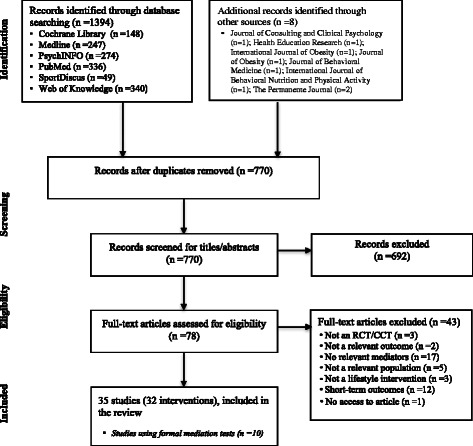
- Systematic review conducted per PRISMA. Six electronic databases were searched for peer-reviewed articles published January 2000–February 2014, plus manual cross-referencing; 1,394 records plus 8 manual additions yielded 1,404 potential articles, 770 abstracts screened, and 35 articles describing 32 unique lifestyle interventions included.
- Eligible studies were experimental lifestyle interventions in overweight/obese adults (≥18 years), reporting outcomes at least 6 months after intervention start and quantitative assessments of self-regulation mediators and weight/BMI, physical activity, or dietary intake. Results were separated into short-term (<12 months) and long-term (≥12 months) outcomes, and formal mediation studies were reported separately from predictor studies.
- Quality was assessed with an adapted Effective Public Health Practice Project tool and a mediation-specific checklist. Heterogeneity prevented meta-analysis, so findings were synthesized narratively with vote counting of significant mediation effects.
Limitations
- The paper states substantial heterogeneity in variables, study designs, measurement methods, populations, and intervention formats/lengths prevented deriving pooled mediation estimates or using meta-analytic techniques; narrative vote counting is less robust. It also notes many primary studies had poor methodological quality, none of the formal mediation studies were strong, outcome measures varied, coding relied on article descriptions, the year 2000 search cutoff was largely arbitrary, and non-controlled trials were included in some analyses.
- The paper states there were too few studies per mediator, dietary evidence was too sparse for meaningful conclusions, and external validity for self-regulation skills and autonomous motivation may be limited because findings came from few research groups using similar designs.
- Evident from the text: only 10 of 35 studies used formal mediation, and for short-term outcomes formal mediation was reported only for physical activity and only two mediators (body image/self-worth and self-efficacy/barriers), so much of the evidence is correlational or predictor-based rather than causal.
Model-written summary. Check it against the paper before relying on it.
Integrity signals
Registry
Cites
Statistics
Figures
Verification
Claims the paper makes
3 Valid · 1 Not valid · 26 Not checked · 77 Own results and interpretations
The cited sources support only part of this claim — read each source’s verdict below.
In the paper
“Second, if and when individuals are able to successfully self-regulate their behaviors, these effects tend to be sustainable, which is essential for having a lasting impact on health; moreover, this successful self-regulation may also “transfer” to, and help change, other health behaviors [18].”
§ Successful behavior change in obesity interventions in adults: a systematic review of self-regulation mediators > Background
What the sources say
- Partly supportedcites [18] Mata J Silva MN Vieira PN Carraça EV Andrade AM Coutinho SR Motivational “spill-over” during weight control: increased self-determination and exercise intrinsic motivation predict eating self-regulation Health Psychol. 2009 28 709 716 10.1037/a0016764 19916639 sourceExperimental — accuracy not yet measured
The Abstract reports that motivation predicted eating self-regulation over 12 months, and the Discussion (p. 18) reports possible spill-over from exercise motivation to eating regulation. These passages support the transfer part of the citing sentence, but they do not establish that successful self-regulation generally produces sustainable effects after the intervention. (LLM, conf=0.86)
hedgedstates an association- Asserted: passes — The authors put it forward as true.
- Checkable: passes — It can be checked against evidence.
- Load-bearing: passes — The paper’s conclusions depend on it.
- Based: passes — The paper gives a reason why it holds.
- Partly supported
Every source the paper cites for this claim was checked and supports it.
In the paper
“Second, if and when individuals are able to successfully self-regulate their behaviors, these effects tend to be sustainable, which is essential for having a lasting impact on health; moreover, this successful self-regulation may also “transfer” to, and help change, other health behaviors [18].”
§ Successful behavior change in obesity interventions in adults: a systematic review of self-regulation mediators > Background
What the sources say
- Supportedcites [18] Mata J Silva MN Vieira PN Carraça EV Andrade AM Coutinho SR Motivational “spill-over” during weight control: increased self-determination and exercise intrinsic motivation predict eating self-regulation Health Psychol. 2009 28 709 716 10.1037/a0016764 19916639 source
The Discussion (p. 18) concludes that spill-over may occur between exercise motivation and eating self-regulation during a weight-control intervention. This supports the cited possibility that self-regulation in one health behavior may help change another. (LLM, conf=0.90)
hedgedstates a possible cause- Asserted: passes — The authors put it forward as true.
- Checkable: passes — It can be checked against evidence.
- Load-bearing: passes — The paper’s conclusions depend on it.
- Based: passes — The paper gives a reason why it holds.
- Supported
Every source the paper cites for this claim was checked and supports it.
In the paper
“More broadly, psychological flexibility appears to predict health and psychological well-being [97], is thought to reflect more committed, values-based goal pursuit [98,99] and is considered a hallmark of self-determination [89], factors which may help explain successful health behavior self-regulation.”
§ Successful behavior change in obesity interventions in adults: a systematic review of self-regulation mediators > Discussion
What the sources say
- Supportedcites [97] Kashdan TB Rottenberg J Psychological flexibility as a fundamental aspect of health Clin Psychol Rev. 2010 30 865 878 10.1016/j.cpr.2010.03.001 21151705 PMC2998793 source
The introduction says psychological flexibility makes a major contribution to daily well-being and lasting psychological health. The ‘Balance among important life domains’ section adds that flexibility-related abilities account for incremental variance in social and psychological health. No page numbers are provided in our copy. (LLM, conf=0.91)
hedgedstates an association- Asserted: passes — The authors put it forward as true.
- Checkable: passes — It can be checked against evidence.
- Load-bearing: unclear — It is unclear whether the paper’s conclusions depend on it.
- Based: passes — The paper gives a reason why it holds.
- Supported
A result the paper reports from its own data — it cites no other source for it, so there is none to check. The quote shows it is in the paper.
In the paper
“Eating disinhibition, which appeared to be an additional predictor in the short-term, does not seem to be consistent in the long-term provided that it was significant only in 38% of the 16 times it was tested.”
§ Successful behavior change in obesity interventions in adults: a systematic review of self-regulation mediators > Results > Mediators/predictors of weight control
hedged- Asserted: passes — The authors put it forward as true.
- Checkable: passes — It can be checked against evidence.
- Load-bearing: passes — The paper’s conclusions depend on it.
- Based: passes — The paper gives a reason why it holds.
A result the paper reports from its own data — it cites no other source for it, so there is none to check. The quote shows it is in the paper.
In the paper
“For physical activity, significant putative mediators were high autonomous motivation, self-efficacy, and use of self-regulation skills.”
§ Successful behavior change in obesity interventions in adults: a systematic review of self-regulation mediators > Abstract > Results
hedgedstates a possible cause- Asserted: passes — The authors put it forward as true.
- Checkable: passes — It can be checked against evidence.
- Load-bearing: passes — The paper’s conclusions depend on it.
- Based: passes — The paper gives a reason why it holds.
36 more claims
Create a free account to see all 107 claims and to verify the 39 references still open.
- It may state two separate claims as one. 40
- Probably not a substantial claim. 41
- The quote only partly states this claim. 1
Claims other papers make about this one
Each is checked against this paper’s own text: does it say what the citing paper says it does?
The source backs part of the claim, not all of it — or backs it for a different population, condition or comparison.
In the citing paper
“This supports findings from a 2015 systematic review suggesting that psychological or self-regulatory skills and body image act as effective mediators of behavior change in lifestyle interventions [66].”
From Barriers and facilitators to diet, physical activity and lifestyle behavior intervention adherence: a qualitative systematic review of the literature (2023) · cites this paper as [66]
Experimental — accuracy not yet measuredThe source backs part of the claim, not all of it — or backs it for a different population, condition or comparison.
In the citing paper
“Improved body acceptance was associated with more stable maintenance of weight control behaviors, especially in individuals with low initial body image satisfaction [94].”
From Dietary and Behavioral Strategies for Weight Loss and Weight Loss Maintenance: A Narrative Review (2025) · cites this paper as [94]
Experimental — accuracy not yet measuredThe source backs part of the claim, not all of it — or backs it for a different population, condition or comparison.
In the citing paper
“This approach potentially enhances the effectiveness of pharmacological treatments through ongoing support and education using real-time microlearning approaches to promote individual self-care capability [18], as well as through supporting the adoption of health-seeking self-care behaviors using nudges and personalized insights delivered using an accessible digital platform [19,20].”
From Impact of Digital Engagement on Weight Loss Outcomes in Obesity Management Among Individuals Using GLP-1 and Dual GLP-1/GIP Receptor Agonist Therapy: Retrospective Cohort Service Evaluation Study (2025) · cites this paper as [20]
Experimental — accuracy not yet measuredIn the citing paper
“Improvements in body acceptance were associated with greater durability of behaviors supporting weight control, particularly among individuals with low baseline satisfaction with their appearance [94].”
From Dietary and Behavioral Strategies for Weight Loss and Weight Loss Maintenance: A Narrative Review (2025) · cites this paper as [94]
In the citing paper
“Findings on self regulatory strategies indicated that regular monitoring of behaviors, planning, and flexible adjustment of actions were more frequently observed among individuals achieving long term results [94].”
From Dietary and Behavioral Strategies for Weight Loss and Weight Loss Maintenance: A Narrative Review (2025) · cites this paper as [94]
1 more claim about this paper
Create a free account to see every claim other papers make about this one.
Self-check
Percentages, sums and reported differences re-computed from the paper’s own numbers.
Each contradiction between two passages listed here was confirmed by an independent check.
Rated minor: it would not touch a result — a value no result rests on, a p-value that stays on the same side of the significance level, or a conflict that is clerical, resolved elsewhere in the paper, or outside its own findings.
In the paper
§ Successful behavior change in obesity interventions in adults: a systematic review of self-regulation mediators > Results > Mediators/predictors of physical activity
“Fourteen variables, grouped in seven categories, were tested as mediators/predictors of short-term weight control (Table 4).”
§ Successful behavior change in obesity interventions in adults: a systematic review of self-regulation mediators > Methods > Data synthesis
“Table: Table 4 Mediators/predictors of short-term physical activity (<12 months)”
Rated minor: it would not touch a result — a value no result rests on, a p-value that stays on the same side of the significance level, or a conflict that is clerical, resolved elsewhere in the paper, or outside its own findings.
In the paper
§ Successful behavior change in obesity interventions in adults: a systematic review of self-regulation mediators > Results > Mediators/predictors of physical activity
“11 looked into short-term outcomes (less than 6 months beyond the start of the intervention)”
§ Successful behavior change in obesity interventions in adults: a systematic review of self-regulation mediators > Methods > Data synthesis
“Table: Table 4 Mediators/predictors of short-term physical activity (<12 months)”
Rated minor: it would not touch a result — a value no result rests on, a p-value that stays on the same side of the significance level, or a conflict that is clerical, resolved elsewhere in the paper, or outside its own findings.
In the paper
“| ↑ Self-regulation skill use | 3 | 3 | 75 | 6 | 6 | 83a |”
§ Successful behavior change in obesity interventions in adults: a systematic review of self-regulation mediators > Methods > Data synthesis
Reported 75 · recomputed 66.666667
Rated minor: it would not touch a result — a value no result rests on, a p-value that stays on the same side of the significance level, or a conflict that is clerical, resolved elsewhere in the paper, or outside its own findings.
In the paper
“| Study design (n = 35) | | Intervention (n = 35) | | | Trial | | Aim | | | NCT | 6 | Weight loss | 15 | | NRCT | 1 | Weight maintenance | 6 | | RCT | 28 | Exercise adherence | 3 | | Arms | | Health promotion | 8 | | 1 arm | 6 | Other | 2 |”
§ Successful behavior change in obesity interventions in adults: a systematic review of self-regulation mediators > Methods > Data synthesis
Reported 35 · recomputed 34
Citations
Cites
Baron, R. M., & Kenny, D. A. (1986) · Journal of Personality and Social Psychology · doi:10.1037/0022-3514.51.6.1173 · Cited by 91,532
Self-efficacy: The exercise of control
Bandura, A., Freeman, W. H., & Lightsey, R. (1999) · Journal of Cognitive Psychotherapy · doi:10.1891/0889-8391.13.2.158 · Cited by 46,835
(2013) · Cited by 44,563
The "what" and "why" of goal pursuits: Human needs and the self-determination of behavior
Deci, E. L., & Ryan, R. M. (2000) · Psychological Inquiry · doi:10.1207/s15327965pli1104_01 · Cited by 34,210 · cited 3×
“Additionally, because self-determined, well-internalized behaviors are associated with the satisfaction of the needs for autonomy, competence, and relatedness - and with the feelings of internal coherence and well-being that are thought to emerge from those experiences - this provides an explanation for the behavior t…”
BackgroundThe Cochrane Collaboration's tool for assessing risk of bias in randomised trials
Higgins, J. P. T., Altman, D. G., Gotzsche, P. C., Juni, P., Moher, D., Oxman, A. D., Savovic, J., Schulz, K. F., Weeks, L., Sterne, J. A. C., et al. (2011) · BMJ · doi:10.1136/bmj.d5928 · Cited by 33,817
Liberati, A., Altman, D. G., Tetzlaff, J., Mulrow, C., Gøtzsche, P. C., Ioannidis, J. P. A., Clarke, M., Devereaux, P. J., Kleijnen, J., & Moher, D. (2009) · PLoS Medicine · doi:10.1371/journal.pmed.1000100 · Cited by 28,164 · cited 3×
“A data extraction form was developed, informed by the PRISMA statement for reporting systematic reviews [21] and the Cochrane Collaboration’s tool for assessing risk of bias [27].”
MethodIntrinsic Motivation and Self-Determination in Human Behavior
Deci, E. L., & Ryan, R. M. (1985) · doi:10.1007/978-1-4899-2271-7 · Cited by 26,772 · cited 1×
“A wide variety of health behavior change theories has been employed to provide conceptual organization of these determinants, including social cognitive theories such as the theory of planned behavior [5], theories of motivation such as self-determination theory [6], theories distinguishing between motivational and po…”
BackgroundDermyshi, E., Wang, Y., Yan, C., Hong, W., Qiu, G., Gong, X., & Zhang, T. (2017) · Neonatology · doi:10.1159/000454668 · Cited by 24,451
Self-efficacy: the exercise of control
(1997) · Choice Reviews Online · doi:10.5860/choice.35-1826 · Cited by 24,281
From Intentions to Actions: A Theory of Planned Behavior
Ajzen, I. (1985) · Action Control · doi:10.1007/978-3-642-69746-3_2 · Cited by 19,057
Cited by
Items 201–300 of 798
Associations between hedonic hunger and BMI during a two-year behavioural weight loss trial
Mead, B. R., Boyland, E. J., Christiansen, P., Halford, J. C. G., Jebb, S. A., & Ahern, A. L. (2021) · PLoS ONE · doi:10.1371/journal.pone.0252110 · Cited by 19
“However, there is considerable, unexplained variability in treatment response such that these treatments appear to be effective for some people [4].”
Backgroundvan Maarschalkerweerd, P. E. A., Rademakers, J. J. D. J. M., & Rijken, M. (2017) · Psycho-Oncology · doi:10.1002/pon.4400 · Cited by 17
Guertin, C., Pelletier, L. G., Émond, C., & Lalande, G. (2017) · Motivation and Emotion · doi:10.1007/s11031-017-9608-8 · Cited by 19
Phelan, S., Roake, J., Alarcon, N., Ng, S. M., Glanz, H., Cardel, M. I., & Foster, G. D. (2022) · Obesity · doi:10.1002/oby.23372 · Cited by 16
“Psychological strategies include cognitive restraint (11) and frequent practice of healthy coping skills such as “thinking about past successes” and “remaining positive in the face of weight regain” (9).”
BackgroundThe ABCDs of Lifestyle Counseling
Lehr, A. L., Driver, S. L., & Stone, N. J. (2016) · JAMA Cardiology · doi:10.1001/jamacardio.2016.1419 · Cited by 16
Al-Hazmi, M. H., & Noorwali, E. A. (2022) · Chronobiology International · doi:10.1080/07420528.2022.2158846 · Cited by 16
“Several studies have shown that the ability to self-regulate eating behavior diminishes the intentionbehavior disparity and, therefore, helps to achieve desired dietary goals (Annesi et al. 2016; Greaves et al. 2017; Teixeira et al. 2015).”
BackgroundTouloudi, E., Hassandra, M., Galanis, E., Pinnas, G., Κrommidas, C., Γούδας, Μ., & Theodorakis, Y. (2025) · Frontiers in Sports and Active Living · doi:10.3389/fspor.2025.1520068 · Cited by 18
Annesi, J. J. (2018) · Psychological Reports · doi:10.1177/0033294118795883 · Cited by 17
“…(Wing & Hill, 2001), cognitive-behavioral treatment outcomes have also generally been inadequate (Greaves et al., 2011; Loveman et al., 2011; Teixeira et al., 2015), with regain of weight consistently beginning between six and nine months after treatment start (Jeffery et al., 2000; Mann…”
BackgroundAnnesi, J. J., & Johnson, P. H. (2020) · Scandinavian Journal of Psychology · doi:10.1111/sjop.12685 · Cited by 17
Jessen-Winge, C., Ilvig, P. M., Fritz, H., Brandt, C. J., Lee, K., & Christensen, J. R. (2021) · BMC Public Health · doi:10.1186/s12889-020-09850-8 · Cited by 16
Ku, C. W., Loo, R. S. X., Lim, C. J. E., Tan, J. J. X., Ho, J. E. W., Han, W. M., Ng, X. W., Chan, J. K. Y., Yap, F. K. P., & Loy, S. L. (2021) · Nutrients · doi:10.3390/nu13124553 · Cited by 16
“Intrinsic motivation can help promote sustainable change in health behavior [56].”
BackgroundSoltis, K. E., Acuff, S. F., Dennhardt, A. A., Borsari, B. E., Martens, M. P., & Murphy, J. G. (2018) · Experimental and Clinical Psychopharmacology · doi:10.1037/pha0000213 · Cited by 17
“Research in other health behavior domains, however, suggest that interventions that increase certain behaviors such as self-monitoring, planning, and selfevaluation may lead to enhanced global self-regulation (Baumeister, Gailliot, DeWall, & Oaten, 2006; Hofmann, Schmeichel, & Baddeley, 2012; Teixeira et al., 2015).”
DeJesus, R. S., Bauer, K. W., Bradley, D. P., Haller, I. V., Bradley, S. M., Schroeder, D. R., Sauver, J. L. S., Phelan, S. M., & Croghan, I. T. (2019) · Obesity Science & Practice · doi:10.1002/osp4.364 · Cited by 17
“The role of self-efficacy in driving behavioural changes and predicting success in weight loss interventions has been increasingly recognized in recent years.(33,34) Coaching and other strategies that improve self-efficacy have been shown to positively impact lifestyle behaviours that potentially contribute to sustain…”
BackgroundVarela, C., Montero, M., Serrano‐Ibáñez, E. R., Castelo, A. M. D. L. V., & Pulido, A. G. (2023) · Stress and Health · doi:10.1002/smi.3246 · Cited by 15
Hawkins, L. K., Burns, L., Swancutt, D. R., Moghadam, S., Pinkney, J. H., Tarrant, M., & The PROGROUP Programme Team (2024) · Obesity Reviews · doi:10.1111/obr.13798 · Cited by 19
“Intervention delivery comprised a mix of face-to-face (five reviews 33,36,46,47,51 ) and digital interventions (four reviews 32,34,37,40 ), including use of technology such as text/email, smartphone and web-based interventions, or a combination of these formats (six reviews 38,39,41,42,45,52 ).”
What to expect from an evolutionary hypothesis for a human disease: The case of type 2 diabetes
Watve, M., & Diwekar-Joshi, M. (2016) · HOMO · doi:10.1016/j.jchb.2016.07.001 · Cited by 15
Murphy, M. (2016) · Veterinary Clinics of North America Small Animal Practice · doi:10.1016/j.cvsm.2016.04.009 · Cited by 20
Lawlor, E. R., Hughes, C. A., Duschinsky, R., Pountain, G. D., Hill, A. J., Griffin, S. J., & Ahern, A. L. (2020) · Clinical Obesity · doi:10.1111/cob.12395 · Cited by 17
Lillis, J., DUNSIGER, S. I., Thomas, J. G., Ross, K. M., & Wing, R. R. (2021) · Journal of Behavioral Medicine · doi:10.1007/s10865-021-00215-z · Cited by 17
“This values-based motivation, sometimes referred to as a form of autonomous motivation, has been shown to mediate longterm weight loss (Teixeira et al., 2015) and has a strong influence on maintenance of behavior change (Deci & Ryan, 1985, 2008).”
BackgroundPolusny, M. A., Marquardt, C. A., Hubbling, M., Campbell, E. H., Arbisi, P. A., Davenport, N. D., Lim, K. O., Lissek, S. M., Schaefer, J. D., Sponheim, S. R., et al. (2023) · JMIR Research Protocols · doi:10.2196/51235 · Cited by 14
“For details outlining the collection of additional COVID-19–focused surveys through supplemental funding from the National Center for Complementary and Integrative Health, see the Multimedia Appendix 2 [1,31,38,44,45,48,84-127].”
BackgroundGiacobbi, P. R. (2016) · American Journal of Lifestyle Medicine · doi:10.1177/1559827616662435 · Cited by 14
Jauregibeitia, I., Portune, K. J., Gaztambide, S., Rica, I., Tueros, I., Velasco, O., Grau, G., Martin, A. A., Castaño, L. A., Larocca, A. V., et al. (2021) · Metabolites · doi:10.3390/metabo11010043 · Cited by 14
“However, obesity prevalence in both child and adult populations continues increasing worldwide, suggesting that, personalized intervention strategies could provide precise nutritional guidance and contribute to successful long-term interventions [7].”
BackgroundPalmeira, A. L., Sánchez‐Oliva, D., Encantado, J., Marques, M. M., Santos, I., Duarte, C., Matos, M., Larsen, S. C., Horgan, G. W., Teixeira, P. J., et al. (2022) · British Journal of Health Psychology · doi:10.1111/bjhp.12635 · Cited by 14
Self-citationSalmela, J., Konttinen, H. M., Lappalainen, R. I., Muotka, J. S., Antikainen, A., Lindström, J., Tuomilehto, J. O., Uusitupa, M. I. J., & Karhunen, L. J. (2023) · International Journal of Obesity · doi:10.1038/s41366-023-01300-w · Cited by 14
“A reduction in disinhibition [12, 21] and susceptibility to hunger [22] have also predicted weight loss, at least short-term.”
BackgroundElsborg, P., & Elbe, A. (2018) · Health Psychology · doi:10.1037/hea0000636 · Cited by 16
Kinsey, A. W., Segar, M., Barr‐Anderson, D. J., Whitt‐Glover, M. C., & Affuso, O. (2019) · Journal of Racial and Ethnic Health Disparities · doi:10.1007/s40615-018-00559-4 · Cited by 14
“rigid) is thought to be an important strategy for sustaining physical activity participation [42, 46] especially for women who juggle multiple roles and responsibilities.”
Martínez, M., Salazar-Collier, C. L., Pena, J., Wilkinson, A. V., Chavarria, E. A., & Reininger, B. M. (2022) · Frontiers in Public Health · doi:10.3389/fpubh.2022.652271 · Cited by 16
Brown, S. D., Kiernan, M., Ehrlich, S. F., Zhu, Y., Hedderson, M. M., Daredia, S., Feng, J., Millman, A. K., Quesenberry, C. P., & Ferrara, A. M. (2023) · Preventive Medicine Reports · doi:10.1016/j.pmedr.2023.102456 · Cited by 13
“…(e.g., to gain an extrinsic reward or avoid punishment or guilt) to autonomous (e.g., valuing the benefits of a behavior or genuine enjoyment, i.e., intrinsic motivation) (Teixeira et al., 2015; Deci and Ryan, 2004; Rhodes and Yao, 2015; Rhodes and Pfaeffli, 2010; Williams and Rhodes, 2016).”
BackgroundBiopsychosocial correlates of physical activity and sedentary time in adults with severe obesity
Baillot, A., Black, M., Brunet, J., & Romain, A. J. (2020) · Clinical Obesity · doi:10.1111/cob.12355 · Cited by 14
Preissner, C. E., Oenema, A., & de Vries, H. (2022) · BMC Psychology · doi:10.1186/s40359-022-00977-4 · Cited by 16
“Theoretical backdrop To date, a number of behavior change theories have been utilized to understand and promote different healthy eating behaviors [23], including the Theory of Planned Behavior [24], Social Cognitive Theory [25], and the Trans Theoretical Model [26].”
BackgroundAnnesi, J. J., & Powell, S. M. (2023) · International Journal of Behavioral Medicine · doi:10.1007/s12529-023-10164-3 · Cited by 13
“…of (1) the need to attend to phases of weight loss and weight-loss maintenance distinctly [1, 2], (2) the relevance of SE and learned self-regulatory skills in controlling weight-manage-ment behaviors [28, 29], and (3) the association of improved mood on self-regulatory skills utilization [8, 30].”
Joki, A., Mäkelä, J., & Fogelholm, M. (2017) · Appetite · doi:10.1016/j.appet.2017.04.031 · Cited by 18
Integrating Mindfulness Into Eating Behaviors
Sorensen, M., Arlinghaus, K. R., Ledoux, T. A., & Johnston, C. A. (2019) · American Journal of Lifestyle Medicine · doi:10.1177/1559827619867626 · Cited by 15
Jay, M. R., Orstad, S. L., Wali, S., Wylie‐Rosett, J., Tseng, C., Sweat, V., Wittleder, S., Shu, S. B., Goldstein, N. J., & Ladapo, J. A. (2019) · BMJ Open · doi:10.1136/bmjopen-2018-025278 · Cited by 13
Whitehall, J. M., Cook, E., Všetečková, J., Jones, K., Pappas, Y., Donald, L., & Chater, A. (2025) · International Journal of Obesity · doi:10.1038/s41366-025-01811-8 · Cited by 13
“Consequently, engagement in, adherence to and subsequent behaviour change long-term is important for weight-loss maintenance [12].”
DePietro, R., Bertarelli, I., Zink, C. M., Canfield, S. M., Smith, J., & McElroy, J. A. (2026) · Healthcare · doi:10.3390/healthcare14020186 · Cited by 13
“Overall, participants’ views on the benefits of weight loss aligned with public health evidence showing that modifiable risk factors, including poor diet, physical inactivity, and obesity, contribute to nearly 50% of premature deaths in the United States [68–70].”
Riley, W. T. (2017) · Health Psychology · doi:10.1037/hea0000464 · Cited by 12
“This research has contributed to our understanding of social and behavioral influences on health (Danaei et al., 2009) and the intervention mediators and strategies that change behaviors to improve health (e.g., Teixeira et al., 2015).”
BackgroundWenzel, M., Geelen, A., Wolters, M., Hebestreit, A., Laerhoven, K. V., Lakerveld, J., Andersen, L. F., Veer, P. V., & Kubiak, T. (2019) · Frontiers in Psychology · doi:10.3389/fpsyg.2019.01511 · Cited by 12
Self-citationBolt, L. J. J., Jacobs, M. L. Y. E., Sigterman, T. A., Krasznai, A. G., Sikkink, C. J. J. M., Schurink, G. W. H., & Bouwman, L. H. (2019) · Physiology & Behavior · doi:10.1016/j.physbeh.2019.112732 · Cited by 13
Promoting healthy eating by enhancing the correspondence between attitudes and behavioral intentions
Requero, B., Gandarillas, B., Paredes, B., Moreno, L., & Briñol, P. (2020) · Psicothema · doi:10.7334/psicothema2019.154 · Cited by 15
“In an attempt to combat this growing problem, researchers and practitioners have strongly advocated for the study and development of consumer programs that foster a more positive relationship with healthy foods and more negative evaluations of unhealthy food, and unhealthy food-industries and practices (e.g., Bayer, N…”
BackgroundHayes, J. F., Balantekin, K. N., Fitzsimmons‐Craft, E. E., Jackson, J. J., Ridolfi, D. R., Boeger, H. S., Welch, R. R., & Wilfley, D. E. (2020) · Annals of Behavioral Medicine · doi:10.1093/abm/kaaa021 · Cited by 14
“This fits with the goal of the current intervention, as well as BWL interventions, more generally [20, 21], which is to help participants develop sustainable habits that will continue following intervention completion and lead to improved health outcomes.”
BackgroundMechanisms of Action in a Behavioral Weight-Management Program: Latent Growth Curve Analysis
Bates, S. E., Norman, P. E., Breeze, P. R., Brennan, A., & Ahern, A. L. (2021) · Annals of Behavioral Medicine · doi:10.1093/abm/kaab019 · Cited by 12
“lysis [16], reporting that dietary restraint mediated the”
BackgroundSkarin, F., Wästlund, E., & Gustafsson, H. (2021) · Frontiers in Psychology · doi:10.3389/fpsyg.2021.688192 · Cited by 15
“behavior change include motivation, expectations, and goal achievement (Elfhag and Rössner, 2005; Teixeira et al., 2015).”
BackgroundSchembre, S. M., Jospe, M. R., Bedrick, E. J., Li, L., Brewster, A. M., Levy, E. J., Dirba, D. D., Campbell, M., Taylor, R. W., & Basen‐Engquist, K. (2022) · Cancer Prevention Research · doi:10.1158/1940-6207.capr-21-0298 · Cited by 12
Saarikko, J., Axelin, A., Huvinen, E., Rahmani, A. M., Azimi, I., Pasanen, M., & Niela‐Vilén, H. (2023) · PLoS ONE · doi:10.1371/journal.pone.0279696 · Cited by 12
“has been shown to be a strong predictor of health behaviors and weight control, including physical activity and dietary intake and therefore, body weight [15, 16].”
BackgroundCarraça, E. V., Rodrigues, B., Franco, S. F., Nobre, I., Jerónimo, F., Ilharco, V., Gabriel, F., Ribeiro, L., Palmeira, A. L., & Silva, M. N. (2023) · BMC Cancer · doi:10.1186/s12885-023-11137-1 · Cited by 15
Self-citationPatient factors associated with weight gain and weight loss after knee or hip arthroplasty
Naylor, J., Mills, K. A. G., Pocovi, N. C., Dennis, S. M., Hackett, D., Hassett, L. M., Brady, B., Lewin, A. M., Adie, S., & Xuan, W. (2019) · Obesity Research & Clinical Practice · doi:10.1016/j.orcp.2019.05.002 · Cited by 13
ACTIVITY TRACKING + MOTIVATION SCIENCE: Allies to Keep People Moving for a Lifetime
Segar, M. (2017) · ACSMʼs Health & Fitness Journal · doi:10.1249/fit.0000000000000309 · Cited by 17
“rigid strategies/plans when it comes to making changes related to physical activity and diets (50).”
Jenzer, T., Egerton, G. A., & Read, J. P. (2020) · Psychology of Addictive Behaviors · doi:10.1037/adb0000675 · Cited by 12
“According to Self-Efficacy Theory (Bandura, 1982), beliefs about one’s self-efficacy are central to human agency and are implicated in numerous human behaviors (Bandura, 1982; Honicke & Broadbent, 2016; Moritz, Feltz, Fahrbach, & Mack, 2000; Teixeira et al., 2015).”
BackgroundHayotte, M., Martinent, G., Nègre, V., Thérouanne, P., & d’Arripe-Longueville, F. (2021) · International Journal of Obesity · doi:10.1038/s41366-021-00813-6 · Cited by 13
“The SelfDetermination Theory is a macro-theory consisting of six mini-theories that provide valuable insight into exercise behavior [28], including in the field of obesity [29, 30].”
BackgroundEconomic Preferences and Obesity: Evidence from a Clinical Lab-in-Field Experiment
Pastore, C., Schurer, S., Tymula, A. A., Fuller, N. R., & Caterson, I. D. (2020) · Health Economics · doi:10.1002/hec.4721 · Cited by 14
Motor Coordination Training and Pedagogical Approach for Combating Childhood Obesity
Fu, A. C. L., Cobley, S. P., & Sanders, R. H. (2016) · Open Journal of Social Sciences · doi:10.4236/jss.2016.412001 · Cited by 15
“5 careful consideration must be accorded to the characteristics of MC programs and the pedagogical approach to ensure that “psycho-social conditions” are favourable and conducive to their long term success [39].”
BackgroundCapodaglio, P., UEMS-PRM EBPP Methodological Group, Ilieva, E., Oral, A., Kiekens, C., Négrini, S., Donoso, E., & Christodoulou, N. (2017) · European Journal of Physical and Rehabilitation Medicine · doi:10.23736/s1973-9087.17.04880-8 · Cited by 13
A loyalty scheme to encourage physical activity in office workers: a cluster RCT
Hunter, R. F., Gough, A., Murray, J., Tang, J., Brennan, S., Chrzanowski‐Smith, O. J., Carlin, A., Patterson, C. C., Longo, A., Hutchinson, G., et al. (2019) · Public Health Research · doi:10.3310/phr07150 · Cited by 13
36-Month Evaluation of a Weight Management Programme in Chinese Overweight and Obese Adults
Yang, X., Chattopadhyay, K., Hubbard, R., Li, J., Li, L., & Lin, Y. (2021) · Frontiers in Public Health · doi:10.3389/fpubh.2021.749302 · Cited by 13
“Recently, lifestyle intervention through strategies was suggested that higher autonomous motivation, self-efficacy, and self-regulation skills emerged might contribute to long-term weight control and weight loss maintenance (10).”
BackgroundRecommender systems use in weight management mHealth interventions: A scoping review
Castro, B. A., Levens, S. M., Sullivan, M., & Shaw, G. (2024) · Obesity Reviews · doi:10.1111/obr.13863 · Cited by 13
Ayoub, J. C., Haidar, S. A., Blaak, E. E., & de Vries, N. K. (2025) · Frontiers in Nutrition · doi:10.3389/fnut.2025.1523995 · Cited by 12
“…significant impact of self-efficacy on self-regulation techniques, which include goal setting, preparation for action, and subsequent behavior (68, 69), it could be beneficial to conduct additional high-quality research to identify potential barriers to MD adherence and promote self-efficacy in…”
Dobson, P., Burney, R. V., Hales, D. P., Vaughn, A., Tovar, A., Østbye, T., & Ward, D. S. (2021) · Journal of Nutrition Education and Behavior · doi:10.1016/j.jneb.2021.01.005 · Cited by 11
Carels, R. A., Miller, J. C., Shonrock, A. T., Byrd, R., & Haley, E. N. (2021) · Journal of Contextual Behavioral Science · doi:10.1016/j.jcbs.2021.07.005 · Cited by 13
“Disordered eating pathology and body image disturbances have been shown to be counterproductive to weight loss efforts and predict poorer outcomes in treatment-seeking individuals with obesity (Austin, Serier, Sarafin, & Smith, 2017; Carels et al., 2009; Dochat, Godfrey, Golshan, Cuneo, & Afari, 2019; Teixeira et al.,…”
BackgroundCheong, S. M., Nor, N. S. M., Ahmad, M. H., Manickam, M. A., Ambak, R., Shahrir, S. N., & Aris, T. (2018) · BMC Women s Health · doi:10.1186/s12905-018-0596-y · Cited by 13
Das, S. K., Bukhari, A. S., Taetzsch, A., Ernst, A. K., Rogers, G. T., Gilhooly, C. H., Hatch‐McChesney, A., Blanchard, C. M., Livingston, K. A., Silver, R. E., et al. (2021) · American Journal of Clinical Nutrition · doi:10.1093/ajcn/nqab259 · Cited by 16
Caruso, A., Grolnick, W. S., Rabner, J. C., & Lebel, A. (2019) · Journal of Health Psychology · doi:10.1177/1359105319884596 · Cited by 11
“Research from an SDT perspective has investigated autonomous regulation in chronic health problems such as obesity (e.g. Teixeira et al., 2015) and cardiovascular disease (e.g. Russell and Bray, 2010), with autonomous regulation related to positive physical health outcomes.”
BackgroundNagpal, T. S., Harry Prapavessis, A., Campbell, C. G., de Vrijer, B., Bgeginski, R., Hosein, K., Paplinskie, S. A., Manley, M., & Mottola, M. F. (2019) · International Journal of Behavioral Medicine · doi:10.1007/s12529-019-09840-0 · Cited by 11
“Researchers have identified lapses in selfregulation as a key mediator of lifestyle change interventions [20].”
BackgroundPlanning and preparing for later life
Preston, C., Burch, S., Forwood, S., Drydakis, N., & Ellen-Hughes, S. (2018) · doi:10.31077/ageing.better.2018.09a · Cited by 16
Curran, F., Brennan, C., Matthews, J. J., & O’Donoghue, G. (2023) · Obesity Science & Practice · doi:10.1002/osp4.721 · Cited by 11
YILMAZ, H. Ö., Arslan, S., Selçuk, K. T., & Yılmaz, S. (2026) · Nutrients · doi:10.3390/nu18020196 · Cited by 10
“Studies examining predictors of intuitive eating have reported similar or lower predictive values; Bruce and Ricciardelli [20] found that psychological and demographic variables explained 4–12% of intuitive eating variance across studies [20,52].”
Carl, J., Hartung, V., Tallner, A., & Pfeifer, K. (2021) · Behavioral Medicine · doi:10.1080/08964289.2021.1935437 · Cited by 10
Annesi, J. J. (2022) · Research Quarterly for Exercise and Sport · doi:10.1080/02701367.2022.2057904 · Cited by 11
Palmeira, A. L., Marques, M. M., Sánchez‐Oliva, D., Encantado, J., Santos, I., Duarte, C., Matos, M., Carneiro‐Barrera, A., Larsen, S. C., Horgan, G. W., et al. (2023) · International Journal of Behavioral Nutrition and Physical Activity · doi:10.1186/s12966-023-01529-8 · Cited by 11
Self-citationSaarikko, J., Axelin, A., Huvinen, E., Rahmani, A. M., Kolari, T. A., & Niela‐Vilén, H. (2024) · Midwifery · doi:10.1016/j.midw.2024.104235 · Cited by 11
Annesi, J. J., & Johnson, P. H. (2020) · Appetite · doi:10.1016/j.appet.2020.104818 · Cited by 11
Varela, C., Oda-Montecinos, C., Andrés, A., & Saldaña, C. (2021) · Journal of Eating Disorders · doi:10.1186/s40337-021-00432-6 · Cited by 10
“Therefore, the focus should be on improving web-based interventions where personalized feedback [11, 12, 23], social support [5, 19, 24, 25], and self-regulation skills [13] are included.”
BackgroundDispositional mindfulness and its relationship to exercise motivation and experience
Lynn, S., Satyal, M. K., Smith, A. J., Tasnim, N., Gyamfi, D., English, D. F., SUZUKI, W. A., & Basso, J. C. (2022) · Frontiers in Sports and Active Living · doi:10.3389/fspor.2022.934657 · Cited by 12
Carbonneau, É., Royer, M., Richard, C., Couture, P., Desroches, S., Lemieux, S., & Lamarche, B. (2017) · Nutrients · doi:10.3390/nu9030305 · Cited by 14
“The increase in cognitive restraint during the weight loss period was mostly related to an increase in participants’ rigid control, contrary to the results of a systematic review where flexible control, but not rigid control, was identified as a mediator of weight control [35].”
Wienert, J., Kuhlmann, T., Fink, S., Hambrecht, R., & Lippke, S. (2017) · International Journal of Behavioral Medicine · doi:10.1007/s12529-017-9649-0 · Cited by 11
An interpretable health behavioral intervention policy for mobile device users
Hu, X., Hsueh, P.-Y. S., Chen, C.-H., Diaz, K. M., Parsons, F., Ensari, I., Qian, M., & Cheung, Y. K. (2018) · IBM Journal of Research and Development · doi:10.1147/jrd.2017.2769320 · Cited by 10
“As another example, data collected from mobile devices can be used to personalize messages to patients [6] and support their self-care management of such concerns as obesity [7], chronic obstructive pulmonary disease [8], and post-traumatic stress disorder [9].”
BackgroundHolmgren, M., Sandberg, M., & Ahlström, G. (2018) · BMC Obesity · doi:10.1186/s40608-018-0212-6 · Cited by 11
Sevild, C. H., Dyrstad, S. M., & Bru, L. E. (2020) · Physical Activity and Health · doi:10.5334/paah.55 · Cited by 10
Development and feasibility of randomized trial to reduce urinary bisphenols in women with obesity
Hagobian, T. A., Delli-Bovi, Z., Mercado, A., Bird, A., Guy, M., & Phelan, S. (2021) · Pilot and Feasibility Studies · doi:10.1186/s40814-020-00744-5 · Cited by 10
“In an effort to increase awareness of BPAcontaining food packaging, our previous intervention encouraged self-monitoring of food and calorie intake with daily diaries [37], and this may have unintentionally led to weight changes between groups.”
BackgroundVenema, T. A. G., & van Gestel, L. C. (2021) · Routledge eBooks · doi:10.1201/9781003128830-19 · Cited by 15
Hayotte, M., Iannelli, A., Nègre, V., Pradier, C., Thérouanne, P., Fuch, A., Diagana, O., Garbarino, J.-M., Vuillemin, A., Colson, S. S., et al. (2021) · BMJ Open · doi:10.1136/bmjopen-2020-046184 · Cited by 10
A Warm Welcome Matters! The Link Between Social Feedback and Weight Loss in /r/loseitPreprint
Cunha, T. O., Weber, I. G., & Pappa, G. L. (2017) · arXiv (Cornell University) · doi:10.48550/arxiv.1701.05225 · Cited by 13
“In particular for long-term behavioral changes required for achieving and maintaining weight loss, user engagement is essential [38].”
Annesi, J. J. (2024) · Stress and Health · doi:10.1002/smi.3364 · Cited by 10
Bates, S. E., Bayley, T., Norman, P. E., Breeze, P. R., & Brennan, A. (2019) · Medical Decision Making · doi:10.1177/0272989x19889897 · Cited by 13
“monitoring of diet, exercise, weight and employing goal setting strategies) were predictive of weight loss.(17) A positive body image, flexible dietary restraint (restriction of dietary intake),(16,17) and habit (the extent to which healthy behaviors have become automatic) have also been associated with weight loss ma…”
McGill, B., O'Hara, B. J., Phongsavan, P., Bauman, A. E., Lawler, L., & Grunseit, A. C. (2020) · Healthcare · doi:10.3390/healthcare8010021 · Cited by 11
“In doing so, the program recognises the significance of self‐ regulation skills as an important predictor of behaviour change maintenance [38] as well as the value of providing multiple strategies for achieving a goal [39].”
BackgroundHawkins, M. A. W., Keirns, N. G., Baraldi, A. N., Layman, H. M., Stout, M. E., Smith, C. E., Gunstad, J., Hildebrand, D. A., Vohs, K. D., & Lovallo, W. R. (2021) · Obesity Science & Practice · doi:10.1002/osp4.537 · Cited by 10
“Finally, self‐regulation was assessed via widely used self‐report and behavioral indicators to ascertain whether cognitive performance would be associated with these theoretical constructs of goal‐directed behavior in the context of obesity treatment.(28,29) Together, these multifactorial constructs align with a propo…”
MethodBaur, J., Krohmer, K., Naumann, E., & Svaldi, J. (2022) · Behaviour Research and Therapy · doi:10.1016/j.brat.2022.104210 · Cited by 11
Amenyah, S., Waters, D., Tang, W. J., Fenge, L., & Murphy, J. L. (2022) · BMC Public Health · doi:10.1186/s12889-022-14518-6 · Cited by 10
Sainsbury, K., Cleland, C., Evans, E. H., Adamson, A., Batterham, A. M., Dombrowski, S. U., Gellert, P. R., Hill, M., Kwaśnicka, D., Scott, D., et al. (2016) · Health Psychology and Behavioral Medicine · doi:10.1080/21642850.2016.1269233 · Cited by 10
“Both the initial and the optimised version of the intervention draw on strategies from self-regulation theory (Kwasnicka et al., 2016; Teixeira et al., 2015) and relapse prevention theory (Latner et al., 2013; Marlatt & Gordon, 1985), and recognise the importance of self-efficacy (Bandura, 1977)…”
BackgroundMethodInfluentialHafez, D., Kullgren, J. T., Liestenfeltz, B., Richardson, C. R., & Heisler, M. (2018) · Pilot and Feasibility Studies · doi:10.1186/s40814-018-0246-z · Cited by 10
“Greater levels of autonomous motivation correlate positively with dietary adherence [29], weight loss [30, 31], physical activity [32, 33], and DPP participation [34].”
BackgroundBerg, A. C., Johnson, K. B., Straight, C. R., Reed, R. A., O’Connor, P. J., Evans, E. M., & Johnson, M. A. (2018) · Journal of Nutrition in Gerontology and Geriatrics · doi:10.1080/21551197.2018.1435433 · Cited by 10
“that both self-efficacy and flexible restraint may be part of several self-regulation behaviors that together may be associated with improved weight loss.(13) In light of these findings, health practitioners might consider focusing less on adherence to strict dietary recommendations for weight loss (rigid restraint) J…”
BackgroundResultInfluentialBerglind, D., Nyberg, G., Willmer, M., Persson, M., Wells, M. B., & Forsell, Y. (2018) · Trials · doi:10.1186/s13063-018-2646-z · Cited by 9
“To reduce the complexity of the meetings, a behavior-change model with four core behavior-change techniques (mobilizing social support for change, developing self-efficacy, goal setting and self-monitoring), that are known to be effective in supporting individuals to improve healthy activity and dietary behaviors [24]…”
MethodReal-Time Model Predictive Control of Human Bodyweight Based on Energy Intake
Fernández, A. P., Youssef, A., Heeren, C., Matthys, C., & Aerts, J. (2019) · Applied Sciences · doi:10.3390/app9132609 · Cited by 11
Bramante, C. T., Lee, G., Amsili, S. S., Linde, J. A., Phelan, S. M., Appel, L. J., Bennett, W. L., Clark, J. M., & Gudzune, K. A. (2020) · Clinical Obesity · doi:10.1111/cob.12363 · Cited by 9
Torbahn, G., Schoene, D., Schwingshackl, L., Rücker, G., Knüttel, H., KEMMLER, W. K., Sieber, C. C., Batsis, J. A., Villareal, D. T., Stroebele‐Benschop, N., et al. (2020) · BMJ Open · doi:10.1136/bmjopen-2020-038330 · Cited by 11
When behaviour meets biology: if obesity is a chronic medical disease what is obesity management?
Vallis, M., & Macklin, D. (2021) · Clinical Obesity · doi:10.1111/cob.12443 · Cited by 9
Development and cross-cultural validation of the Goal Content for Weight Maintenance Scale (GCWMS)
Encantado, J., Marques, M. M., Palmeira, A. L., Sebire, S. J., Teixeira, P. J., Stubbs, R. J., Heitmann, B. L., & Gouveia, M. J. (2021) · Eating and Weight Disorders - Studies on Anorexia Bulimia and Obesity · doi:10.1007/s40519-021-01148-x · Cited by 11
Self-citationAnnesi, J. J., & Eberly, A. A. (2022) · Family & Community Health · doi:10.1097/fch.0000000000000331 · Cited by 9
Čurović, I., & Grečić, D. (2025) · Frontiers in Sports and Active Living · doi:10.3389/fspor.2025.1549979 · Cited by 9
Hedin, L., Seiterö, A., Crawford, J., Bendtsen, M., & Löf, M. (2025) · BMC Public Health · doi:10.1186/s12889-025-22097-5 · Cited by 9
“Instead, factors closely related to know-how, such as skills training, are commonly included in interventions to improve dietary behaviors [44, 46, 55], but other behavioral factors, e.g., health routines, perceived behavioral control, and intention, are assessed as potential mediators for dietary…”
Metadata
- Authors
- Teixeira, P. J., Carraça, E. V., Marques, M. M., Rutter, H., Oppert, J.-M., De Bourdeaudhuij, I., Lakerveld, J., & Brug, J.
- Affiliations
- University of Lisbon (PT)
- London School of Hygiene & Tropical Medicine (GB)
- Inserm (FR)
- Amsterdam Public Health (NL)
- Corresponding author
- Teixeira, Pedro J
- ORCID
- Venue
- BMC Medicine
- Published
- 2015-04-16
- Volume
- 13
- Issue
- 1
- Pages
- 84-84
- ISSN
- 1741-7015 (ISSN-L)
- PMC
- PMC4408562
- OpenAlex
- W2092285599
- Semantic Scholar
- 99966d9cd971dd6a646ec628d2242042583d1635
- Cited by
- 711
- References
- 125
- Citations by year
- 2026: 50 · 2025: 57 · 2024: 55 · 2023: 50 · 2022: 64 · 2021: 86 · 2020: 76 · 2019: 107 · 2018: 65 · 2017: 49 · 2016: 43 · 2015: 7
- FWCI
- 7.59
- Type
- journal article
- Language
- en
- Open access
- gold
- doi.org
- Locations
- BMC Medicine (publishedVersion, cc-by)
- Europe PMC (PubMed Central) (publishedVersion, cc-by)
- PubMed Central (publishedVersion, cc-by)
- PubMed (publishedVersion)
- Pure Amsterdam UMC (publishedVersion, other-oa)
- Amsterdam UMC (VU Amsterdam) - Institutional Repository (publishedVersion)
- LSHTM Research Online (London School of Hygiene and Tropical Medicine) (acceptedVersion)
- Data Archiving and Networked Services (DANS) (acceptedVersion, other-oa)
- Ghent University Academic Bibliography (Ghent University) (submittedVersion, other-oa)
- HAL (submittedVersion, other-oa)
- UCL Discovery (University College London) (submittedVersion)
- Data Archiving and Networked Services (DANS) (submittedVersion)
- Funders
- European Commission (278186, FP7‐HEALTH‐2011)
- FP7 Health (278186)
- Topics
- Social Sciences › Psychology › Applied Psychology › Behavioral Health and Interventions
- Health Sciences › Medicine › Public Health, Environmental and Occupational Health › Obesity, Physical Activity, Diet
- Health Sciences › Medicine › Public Health, Environmental and Occupational Health › Obesity and Health Practices
- Keywords
- obesity intervention, behavior change, self-regulation, mediators, weight loss, weight maintenance, physical activity, dietary intake, autonomous motivation, self-efficacy, self-monitoring, dietary restraint, body image, relapse, lifestyle intervention, overweight adults
- MeSH terms
- Behavior Therapy, Diet, Humans, Life Style, Motor Activity, Obesity, Weight Loss, Overweight
About these checks
Registry, retraction, Cites and statistics results are computed, not judged, with one exception: a printed reference that no index lists is read once by a model before it counts as a citation error. Claims are extracted by a model and kept only when their quote appears verbatim in the text; each cited source is then checked, with a model’s help, for whether it says what the claim relies on. Those verdicts can be wrong — read the claim’s quote and the cited source before relying on one.
The claim verdicts this report counts are experimental: their accuracy is not yet measured.
A language model drew the claims from the paper on 2026-10-04, under version 3 of the claim definition (model deepseek-v4.1-flash, prompt extract-v3).
A second model labelled each claim on 2026-10-04 (model jev-1.13-20260917, definition revision gold-guideline-v0.2).
Cited sources are checked with a language model’s help (gpt-6-sol).
Statistics and arithmetic are recomputed, not judged.
Confidence bands are shown only for fields calibrated on our annotated test set. None is calibrated yet, so no band is shown.
What counts as a claim ›How we measure confidence ›How we check this ›
Are you an author, or do you see a problem with this page? Request a review
Data sources
Bibliographic data: Semantic Scholar, OpenAlex, Crossref.
Contains information from the Semantic Scholar Academic Graph Datasets, made available under the ODC Attribution License (ODC-BY 1.0).
Semantic Scholar’s data is described in: Kinney, R., et al. (2023). The Semantic Scholar Open Data Platform. arXiv:2301.10140.
