

Successful behavior change in obesity interventions in adults: a systematic review of self-regulation mediators
Open accessThe DOI matches its Crossref record; 125 of the 125 references it cites were found in a registry or an index; 7 of the 46 sources its claims cite were checked for support.
Abstract
BACKGROUND: Relapse is high in lifestyle obesity interventions involving behavior and weight change. Identifying mediators of successful outcomes in these interventions is critical to improve effectiveness and to guide approaches to obesity treatment, including resource allocation. This article reviews the most consistent self-regulation mediators of medium- and long-term weight control, physical activity, and dietary intake in clinical and community behavior change interventions targeting overweight/obese adults. METHODS: A comprehensive search of peer-reviewed articles, published since 2000, was conducted on electronic databases (for example, MEDLINE) and journal reference lists. Experimental studies were eligible if they reported intervention effects on hypothesized mediators (self-regulatory and psychological mechanisms) and the association between these and the outcomes of interest (weight change, physical activity, and dietary intake). Quality and content of selected studies were analyzed and findings summarized. Studies with formal mediation analyses were reported separately. RESULTS: Thirty-five studies were included testing 42 putative mediators. Ten studies used formal mediation analyses. Twenty-eight studies were randomized controlled trials, mainly aiming at weight loss or maintenance (n = 21). Targeted participants were obese (n = 26) or overweight individuals, aged between 25 to 44 years (n = 23), and 13 studies targeted women only. In terms of study quality, 13 trials were rated as "strong", 15 as "moderate", and 7 studies as "weak". In addition, methodological quality of formal mediation analyses was "medium". Identified mediators for medium-/long-term weight control were higher levels of autonomous motivation, self-efficacy/barriers, self-regulation skills (such as self-monitoring), flexible eating restraint, and positive body image. For physical activity, significant putative mediators were high autonomous motivation, self-efficacy, and use of self-regulation skills. For dietary intake, the evidence was much less clear, and no consistent mediators were identified. CONCLUSIONS: This is the first systematic review of mediational psychological mechanisms of successful outcomes in obesity-related lifestyle change interventions. Despite limited evidence, higher autonomous motivation, self-efficacy, and self-regulation skills emerged as the best predictors of beneficial weight and physical activity outcomes; for weight control, positive body image and flexible eating restraint may additionally improve outcomes. These variables represent possible targets for future lifestyle interventions in overweight/obese populations.
Overview
CoChat Summary
TL;DR
This systematic review of 35 lifestyle intervention studies found that autonomous motivation, self-efficacy, and self-regulation skills are the most consistent self-regulation mediators of weight control and physical activity in overweight/obese adults. For long-term weight control, positive body image and flexible eating restraint may also matter, while dietary intake had no consistent mediators.
Key findings
- Across 35 studies testing 42 putative mediators, 10 used formal mediation analyses; 28 were randomized controlled trials, mainly targeting weight loss or maintenance (n = 21). Study quality was rated strong for 13 trials, moderate for 15, and weak for 7; all 10 formal mediation analyses were rated medium quality.
- For medium/long-term weight control (≥12 months), formal mediation supported body image (significant in 100% of 3 tests), self-regulation skills (75% of 3 formal tests; 83% of 6 overall tests), and self-efficacy/barriers (67% of 3 formal tests; 68% of 28 overall tests). Autonomous motivation and flexible eating restraint were promising but derived from a single study each.
- For long-term physical activity, the main predictors were autonomous motivation (83% of formal mediation tests; 93% of overall tests) and self-efficacy (67% of formal tests; 75% of overall tests). Self-regulation skill use was less consistent and derived from low-quality studies.
- For dietary intake, no consistent mediators were identified. In the short term, self-efficacy/barriers and self-regulation skill use were each consistent with mediation in 75% of tests, but long-term self-efficacy was consistent with mediation in only 2 of 8 tests.
Methods
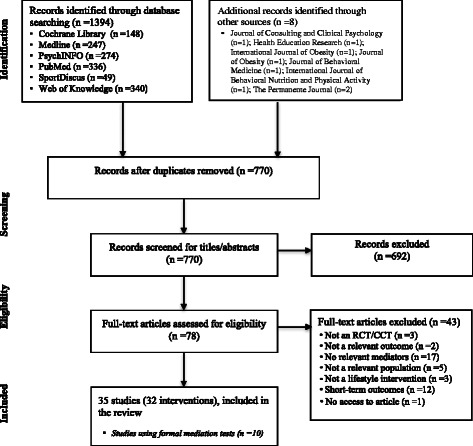
- Systematic review conducted per PRISMA. Six electronic databases were searched for peer-reviewed articles published January 2000–February 2014, plus manual cross-referencing; 1,394 records plus 8 manual additions yielded 1,404 potential articles, 770 abstracts screened, and 35 articles describing 32 unique lifestyle interventions included.
- Eligible studies were experimental lifestyle interventions in overweight/obese adults (≥18 years), reporting outcomes at least 6 months after intervention start and quantitative assessments of self-regulation mediators and weight/BMI, physical activity, or dietary intake. Results were separated into short-term (<12 months) and long-term (≥12 months) outcomes, and formal mediation studies were reported separately from predictor studies.
- Quality was assessed with an adapted Effective Public Health Practice Project tool and a mediation-specific checklist. Heterogeneity prevented meta-analysis, so findings were synthesized narratively with vote counting of significant mediation effects.
Limitations
- The paper states substantial heterogeneity in variables, study designs, measurement methods, populations, and intervention formats/lengths prevented deriving pooled mediation estimates or using meta-analytic techniques; narrative vote counting is less robust. It also notes many primary studies had poor methodological quality, none of the formal mediation studies were strong, outcome measures varied, coding relied on article descriptions, the year 2000 search cutoff was largely arbitrary, and non-controlled trials were included in some analyses.
- The paper states there were too few studies per mediator, dietary evidence was too sparse for meaningful conclusions, and external validity for self-regulation skills and autonomous motivation may be limited because findings came from few research groups using similar designs.
- Evident from the text: only 10 of 35 studies used formal mediation, and for short-term outcomes formal mediation was reported only for physical activity and only two mediators (body image/self-worth and self-efficacy/barriers), so much of the evidence is correlational or predictor-based rather than causal.
Model-written summary. Check it against the paper before relying on it.
Integrity signals
Registry
Cites
Statistics
Figures
Verification
Claims the paper makes
3 Valid · 1 Not valid · 26 Not checked · 77 Own results and interpretations
The cited sources support only part of this claim — read each source’s verdict below.
In the paper
“Second, if and when individuals are able to successfully self-regulate their behaviors, these effects tend to be sustainable, which is essential for having a lasting impact on health; moreover, this successful self-regulation may also “transfer” to, and help change, other health behaviors [18].”
§ Successful behavior change in obesity interventions in adults: a systematic review of self-regulation mediators > Background
What the sources say
- Partly supportedcites [18] Mata J Silva MN Vieira PN Carraça EV Andrade AM Coutinho SR Motivational “spill-over” during weight control: increased self-determination and exercise intrinsic motivation predict eating self-regulation Health Psychol. 2009 28 709 716 10.1037/a0016764 19916639 sourceExperimental — accuracy not yet measured
The Abstract reports that motivation predicted eating self-regulation over 12 months, and the Discussion (p. 18) reports possible spill-over from exercise motivation to eating regulation. These passages support the transfer part of the citing sentence, but they do not establish that successful self-regulation generally produces sustainable effects after the intervention. (LLM, conf=0.86)
hedgedstates an association- Asserted: passes — The authors put it forward as true.
- Checkable: passes — It can be checked against evidence.
- Load-bearing: passes — The paper’s conclusions depend on it.
- Based: passes — The paper gives a reason why it holds.
- Partly supported
Every source the paper cites for this claim was checked and supports it.
In the paper
“Second, if and when individuals are able to successfully self-regulate their behaviors, these effects tend to be sustainable, which is essential for having a lasting impact on health; moreover, this successful self-regulation may also “transfer” to, and help change, other health behaviors [18].”
§ Successful behavior change in obesity interventions in adults: a systematic review of self-regulation mediators > Background
What the sources say
- Supportedcites [18] Mata J Silva MN Vieira PN Carraça EV Andrade AM Coutinho SR Motivational “spill-over” during weight control: increased self-determination and exercise intrinsic motivation predict eating self-regulation Health Psychol. 2009 28 709 716 10.1037/a0016764 19916639 source
The Discussion (p. 18) concludes that spill-over may occur between exercise motivation and eating self-regulation during a weight-control intervention. This supports the cited possibility that self-regulation in one health behavior may help change another. (LLM, conf=0.90)
hedgedstates a possible cause- Asserted: passes — The authors put it forward as true.
- Checkable: passes — It can be checked against evidence.
- Load-bearing: passes — The paper’s conclusions depend on it.
- Based: passes — The paper gives a reason why it holds.
- Supported
Every source the paper cites for this claim was checked and supports it.
In the paper
“More broadly, psychological flexibility appears to predict health and psychological well-being [97], is thought to reflect more committed, values-based goal pursuit [98,99] and is considered a hallmark of self-determination [89], factors which may help explain successful health behavior self-regulation.”
§ Successful behavior change in obesity interventions in adults: a systematic review of self-regulation mediators > Discussion
What the sources say
- Supportedcites [97] Kashdan TB Rottenberg J Psychological flexibility as a fundamental aspect of health Clin Psychol Rev. 2010 30 865 878 10.1016/j.cpr.2010.03.001 21151705 PMC2998793 source
The introduction says psychological flexibility makes a major contribution to daily well-being and lasting psychological health. The ‘Balance among important life domains’ section adds that flexibility-related abilities account for incremental variance in social and psychological health. No page numbers are provided in our copy. (LLM, conf=0.91)
hedgedstates an association- Asserted: passes — The authors put it forward as true.
- Checkable: passes — It can be checked against evidence.
- Load-bearing: unclear — It is unclear whether the paper’s conclusions depend on it.
- Based: passes — The paper gives a reason why it holds.
- Supported
A result the paper reports from its own data — it cites no other source for it, so there is none to check. The quote shows it is in the paper.
In the paper
“Eating disinhibition, which appeared to be an additional predictor in the short-term, does not seem to be consistent in the long-term provided that it was significant only in 38% of the 16 times it was tested.”
§ Successful behavior change in obesity interventions in adults: a systematic review of self-regulation mediators > Results > Mediators/predictors of weight control
hedged- Asserted: passes — The authors put it forward as true.
- Checkable: passes — It can be checked against evidence.
- Load-bearing: passes — The paper’s conclusions depend on it.
- Based: passes — The paper gives a reason why it holds.
A result the paper reports from its own data — it cites no other source for it, so there is none to check. The quote shows it is in the paper.
In the paper
“For physical activity, significant putative mediators were high autonomous motivation, self-efficacy, and use of self-regulation skills.”
§ Successful behavior change in obesity interventions in adults: a systematic review of self-regulation mediators > Abstract > Results
hedgedstates a possible cause- Asserted: passes — The authors put it forward as true.
- Checkable: passes — It can be checked against evidence.
- Load-bearing: passes — The paper’s conclusions depend on it.
- Based: passes — The paper gives a reason why it holds.
36 more claims
Create a free account to see all 107 claims and to verify the 39 references still open.
- It may state two separate claims as one. 40
- Probably not a substantial claim. 41
- The quote only partly states this claim. 1
Claims other papers make about this one
Each is checked against this paper’s own text: does it say what the citing paper says it does?
The source backs part of the claim, not all of it — or backs it for a different population, condition or comparison.
In the citing paper
“This supports findings from a 2015 systematic review suggesting that psychological or self-regulatory skills and body image act as effective mediators of behavior change in lifestyle interventions [66].”
From Barriers and facilitators to diet, physical activity and lifestyle behavior intervention adherence: a qualitative systematic review of the literature (2023) · cites this paper as [66]
Experimental — accuracy not yet measuredThe source backs part of the claim, not all of it — or backs it for a different population, condition or comparison.
In the citing paper
“Improved body acceptance was associated with more stable maintenance of weight control behaviors, especially in individuals with low initial body image satisfaction [94].”
From Dietary and Behavioral Strategies for Weight Loss and Weight Loss Maintenance: A Narrative Review (2025) · cites this paper as [94]
Experimental — accuracy not yet measuredThe source backs part of the claim, not all of it — or backs it for a different population, condition or comparison.
In the citing paper
“This approach potentially enhances the effectiveness of pharmacological treatments through ongoing support and education using real-time microlearning approaches to promote individual self-care capability [18], as well as through supporting the adoption of health-seeking self-care behaviors using nudges and personalized insights delivered using an accessible digital platform [19,20].”
From Impact of Digital Engagement on Weight Loss Outcomes in Obesity Management Among Individuals Using GLP-1 and Dual GLP-1/GIP Receptor Agonist Therapy: Retrospective Cohort Service Evaluation Study (2025) · cites this paper as [20]
Experimental — accuracy not yet measuredIn the citing paper
“Improvements in body acceptance were associated with greater durability of behaviors supporting weight control, particularly among individuals with low baseline satisfaction with their appearance [94].”
From Dietary and Behavioral Strategies for Weight Loss and Weight Loss Maintenance: A Narrative Review (2025) · cites this paper as [94]
In the citing paper
“Findings on self regulatory strategies indicated that regular monitoring of behaviors, planning, and flexible adjustment of actions were more frequently observed among individuals achieving long term results [94].”
From Dietary and Behavioral Strategies for Weight Loss and Weight Loss Maintenance: A Narrative Review (2025) · cites this paper as [94]
1 more claim about this paper
Create a free account to see every claim other papers make about this one.
Self-check
Percentages, sums and reported differences re-computed from the paper’s own numbers.
Each contradiction between two passages listed here was confirmed by an independent check.
Rated minor: it would not touch a result — a value no result rests on, a p-value that stays on the same side of the significance level, or a conflict that is clerical, resolved elsewhere in the paper, or outside its own findings.
In the paper
§ Successful behavior change in obesity interventions in adults: a systematic review of self-regulation mediators > Results > Mediators/predictors of physical activity
“Fourteen variables, grouped in seven categories, were tested as mediators/predictors of short-term weight control (Table 4).”
§ Successful behavior change in obesity interventions in adults: a systematic review of self-regulation mediators > Methods > Data synthesis
“Table: Table 4 Mediators/predictors of short-term physical activity (<12 months)”
Rated minor: it would not touch a result — a value no result rests on, a p-value that stays on the same side of the significance level, or a conflict that is clerical, resolved elsewhere in the paper, or outside its own findings.
In the paper
§ Successful behavior change in obesity interventions in adults: a systematic review of self-regulation mediators > Results > Mediators/predictors of physical activity
“11 looked into short-term outcomes (less than 6 months beyond the start of the intervention)”
§ Successful behavior change in obesity interventions in adults: a systematic review of self-regulation mediators > Methods > Data synthesis
“Table: Table 4 Mediators/predictors of short-term physical activity (<12 months)”
Rated minor: it would not touch a result — a value no result rests on, a p-value that stays on the same side of the significance level, or a conflict that is clerical, resolved elsewhere in the paper, or outside its own findings.
In the paper
“| ↑ Self-regulation skill use | 3 | 3 | 75 | 6 | 6 | 83a |”
§ Successful behavior change in obesity interventions in adults: a systematic review of self-regulation mediators > Methods > Data synthesis
Reported 75 · recomputed 66.666667
Rated minor: it would not touch a result — a value no result rests on, a p-value that stays on the same side of the significance level, or a conflict that is clerical, resolved elsewhere in the paper, or outside its own findings.
In the paper
“| Study design (n = 35) | | Intervention (n = 35) | | | Trial | | Aim | | | NCT | 6 | Weight loss | 15 | | NRCT | 1 | Weight maintenance | 6 | | RCT | 28 | Exercise adherence | 3 | | Arms | | Health promotion | 8 | | 1 arm | 6 | Other | 2 |”
§ Successful behavior change in obesity interventions in adults: a systematic review of self-regulation mediators > Methods > Data synthesis
Reported 35 · recomputed 34
Citations
Cites
Baron, R. M., & Kenny, D. A. (1986) · Journal of Personality and Social Psychology · doi:10.1037/0022-3514.51.6.1173 · Cited by 91,532
Self-efficacy: The exercise of control
Bandura, A., Freeman, W. H., & Lightsey, R. (1999) · Journal of Cognitive Psychotherapy · doi:10.1891/0889-8391.13.2.158 · Cited by 46,835
(2013) · Cited by 44,563
The "what" and "why" of goal pursuits: Human needs and the self-determination of behavior
Deci, E. L., & Ryan, R. M. (2000) · Psychological Inquiry · doi:10.1207/s15327965pli1104_01 · Cited by 34,210 · cited 3×
“Additionally, because self-determined, well-internalized behaviors are associated with the satisfaction of the needs for autonomy, competence, and relatedness - and with the feelings of internal coherence and well-being that are thought to emerge from those experiences - this provides an explanation for the behavior t…”
BackgroundThe Cochrane Collaboration's tool for assessing risk of bias in randomised trials
Higgins, J. P. T., Altman, D. G., Gotzsche, P. C., Juni, P., Moher, D., Oxman, A. D., Savovic, J., Schulz, K. F., Weeks, L., Sterne, J. A. C., et al. (2011) · BMJ · doi:10.1136/bmj.d5928 · Cited by 33,817
Liberati, A., Altman, D. G., Tetzlaff, J., Mulrow, C., Gøtzsche, P. C., Ioannidis, J. P. A., Clarke, M., Devereaux, P. J., Kleijnen, J., & Moher, D. (2009) · PLoS Medicine · doi:10.1371/journal.pmed.1000100 · Cited by 28,164 · cited 3×
“A data extraction form was developed, informed by the PRISMA statement for reporting systematic reviews [21] and the Cochrane Collaboration’s tool for assessing risk of bias [27].”
MethodIntrinsic Motivation and Self-Determination in Human Behavior
Deci, E. L., & Ryan, R. M. (1985) · doi:10.1007/978-1-4899-2271-7 · Cited by 26,772 · cited 1×
“A wide variety of health behavior change theories has been employed to provide conceptual organization of these determinants, including social cognitive theories such as the theory of planned behavior [5], theories of motivation such as self-determination theory [6], theories distinguishing between motivational and po…”
BackgroundDermyshi, E., Wang, Y., Yan, C., Hong, W., Qiu, G., Gong, X., & Zhang, T. (2017) · Neonatology · doi:10.1159/000454668 · Cited by 24,451
Self-efficacy: the exercise of control
(1997) · Choice Reviews Online · doi:10.5860/choice.35-1826 · Cited by 24,281
From Intentions to Actions: A Theory of Planned Behavior
Ajzen, I. (1985) · Action Control · doi:10.1007/978-3-642-69746-3_2 · Cited by 19,057
Cited by
Items 301–400 of 798
Kravchuk, S., Bychkov, M. A., Kozyk, M., Strubchevska, O., & Kozyk, A. (2025) · Cureus · doi:10.7759/cureus.84803 · Cited by 21
“Combining these tools with personalized feedback from healthcare providers can further enhance long-term adherence and success in weight management [41].”
Bertoli, S., Capodaglio, P., Colosimo, S., Amicis, R. S. D., Gilardini, L., Bruno, A., Mambrini, S. P., Pietrabissi, G., Cavaggioni, L., Castelnuovo, G., et al. (2025) · Journal of Medical Internet Research · doi:10.2196/72054 · Cited by 13
Sevild, C. H., Niemiec, C. P., Dyrstad, S. M., & Bru, L. E. (2022) · International Journal of Environmental Research and Public Health · doi:10.3390/ijerph19095167 · Cited by 9
Annesi, J. J. (2018) · Journal of Physical Activity and Health · doi:10.1123/jpah.2018-0099 · Cited by 8
Beatty, J., Greene, G. W., Blissmer, B. J., Delmonico, M. J., & Melanson, K. J. (2019) · Journal of Human Nutrition and Dietetics · doi:10.1111/jhn.12704 · Cited by 9
Natvik, E., Råheim, M., Andersen, J. R., & Moltu, C. (2019) · Frontiers in Psychology · doi:10.3389/fpsyg.2019.02503 · Cited by 8
Vergeld, V., Wienert, J., Reinwand, D. A., Tan, S. L., & Lippke, S. (2020) · Applied Psychology Health and Well-Being · doi:10.1111/aphw.12218 · Cited by 8
“Numerous studies show that besides motivational factors (e.g. behavioral outcome expectations), volitional factors (e.g. action planning) play a key role in translating intentions into actual health behaviors (Inauen, Shrout, Bolger, Stadler, & Scholz, 2016; Teixeira et al., 2015).”
BackgroundHeaton, B., Wright, J. A., Bond, J. C., & Quintiliani, L. M. (2021) · BMC Public Health · doi:10.1186/s12889-020-10073-0 · Cited by 8
Balint, I. B., Császár, F., Orban, L., Radics, P., Farics, Á., Mánfai, G., Hari, V., & Jávor, R. (2021) · Langenbeck s Archives of Surgery · doi:10.1007/s00423-021-02276-9 · Cited by 8
Björkman, S., Wallengren, O., Laurenius, A., Eliasson, B., & Larsson, I. (2022) · Obesity Medicine · doi:10.1016/j.obmed.2022.100409 · Cited by 8
Brunet, J., Price, J., Srikanthan, A., Gillison, F., Standage, M., Taljaard, M., Beauchamp, M. R., Reed, J. L., & Wurz, A. J. (2022) · PLoS ONE · doi:10.1371/journal.pone.0273045 · Cited by 8
Norman, K., Burrows, L., Chepulis, L. M., & Lawrenson, R. A. (2023) · Australian Journal of Rural Health · doi:10.1111/ajr.13004 · Cited by 8
Annesi, J. J., & Powell, S. M. (2024) · Research Quarterly for Exercise and Sport · doi:10.1080/02701367.2024.2311652 · Cited by 10
“…effort based on their group process (Rosnow, 2002), and reliance on self-reports were present, this study contributed to the growing research literature on psychosocial predictors of weight loss (e.g., Annesi, 2022; Carraça et al., 2013; Hartmann-Boyce et al., 2021; Teixeira et al., 2015).”
Verberne, L. D. M., Hendriks, M. R., Rutten, G. M., Spronk, I., Savelberg, H. H. C. M., Veenhof, C., & Nielen, M. M. J. (2016) · Family Practice · doi:10.1093/fampra/cmw070 · Cited by 8
“Increased attention to lifestyle-related measurements in general practices might already have a positive effect on patients’ lifestyle behaviour, since self-regulation skills, such as monitoring of weight, are identified as predictor of successful outcomes on obesity-related behaviour changes (23).”
Koopman, A. D. M., Ven, M. V., Beulens, J. W. J., Welschen, L. M. C., Elders, P. J. M., Nijpels, G., & Rutters, F. (2018) · Journal of Diabetes Research · doi:10.1155/2018/9264204 · Cited by 9
Lara, M., Labrecque, J. A., van Lenthe, F. J., & Voortman, T. (2020) · Epidemiology · doi:10.1097/ede.0000000000001221 · Cited by 8
Validation of the Flexible and Rigid Cognitive Restraint Scales in a General French Population
Péneau, S., Bénard, M., Robert, M., Allès, B., Andreeva, V. A., Courtois, F., Touvier, M., Leys, C., & Bellisle, F. (2022) · International Journal of Environmental Research and Public Health · doi:10.3390/ijerph191912519 · Cited by 8
“Flexible restraint may be a self-regulation mediator of weight control, implying the monitoring if one’s food intake [63].”
BackgroundResultAnnesi, J. J. (2019) · Evaluation and Program Planning · doi:10.1016/j.evalprogplan.2019.04.002 · Cited by 9
How Does Obesity, Self-efficacy for Eating Control and Body Image in Women Affect Each Other?
Rabiepoor, S., Jabbari, S., Arezou, T., Ramona, R., & Yas, A. (2018) · Europe PMC (PubMed Central) · doi:10.26574/maedica.2018.13.3.223 · Cited by 9
Emerging Trends in Telehealth and AI-Driven Approaches for Obesity Management: A New Perspective
Koo, T. H., Leong, X. B., Jet Kwan, N. G., Tan, N., InnoDev Digital Enterprise, K. L., & MOHAMED, M. (2025) · Malaysian Journal of Medical Sciences · doi:10.21315/mjms-08-2024-614 · Cited by 10
“Periodic follow-ups further enhance long-term behavioural changes by strengthening the patient’s commitment and discussing problems (33, 34).”
Exploring successes, barriers, and enablers in the one-year digital Healthy Weight Coaching
Joki, A., Ahola, A. J., Suojanen, L.-U., & Pietiläinen, K. H. (2024) · BMC Health Services Research · doi:10.1186/s12913-024-11876-2 · Cited by 7
Weight Loss: How Does It Fit in With Liposuction?
Davis, W., & Lawrence, N. (2019) · Dermatologic Surgery · doi:10.1097/dss.0000000000002225 · Cited by 8
“Those with a positive body image exhibited a greater ability to maintain a diet, perhaps due to a lesser urgency and rigidity in their approach to dieting.(33) Conversely, environmental cues and high stress levels yield dietary failure through amplification of the reward system yielding greater desire for palatable fo…”
BackgroundThe Role of Self-Regulation in the Effect of Self-Tracking of Physical Activity and Weight on BMI
Kooiman, T. J. M., Dijkstra, A., Kooy, A., Dotinga, A., van der Schans, C. P., & de Groot, M. (2020) · Journal of Technology in Behavioral Science · doi:10.1007/s41347-020-00127-w · Cited by 8
“These BCTs have earlier been found to increase self-regulative health behavior (Lyons et al. 2014; Mercer et al. 2016; Samdal et al. 2017; Teixeira et al. 2015).”
BackgroundGillison, F., Killen, V., Grey, E., Standage, M., Watson, D., & Kremers, S. (2020) · Psychology Health & Medicine · doi:10.1080/13548506.2020.1829654 · Cited by 8
“In many health domains, including physical activity and diet (Teixeira et al., 2015), interventions that support autonomous motivation, by promoting psychological need satisfaction, have consistently been shown to promote behavioural persistence (Kwasnicka et al., 2016).”
BackgroundMarentes-Castillo, M., Castillo, I., Tomás-Marco, I., Zamarripa, J., & Álvarez, O. (2022) · Anales de Psicología · doi:10.6018/analesps.502421 · Cited by 8
“…predictores del mantenimiento del peso ideal, de la actividad física, del control de peso, de la regulación de la alimentación, y del uso de conductas saludables para el control de peso (Marentes-Castillo et al., 2022; Ntoumanis et al., 2021; Santos et al., 2016; Teixeira et al., 2006, 2015).”
BackgroundHeuchan, G. N., Lally, P. J., Beeken, R. J., Fisher, A., & Conway, R. E. (2023) · Journal of Cancer Survivorship · doi:10.1007/s11764-023-01333-0 · Cited by 7
“…for failing to employ evidence-based techniques based on behavior change theory, including goal setting, self-monitoring, and building self-efficacy [15], as well as failing to tackle the breadth of risk factors which can contribute to obesity, including health inequalities and genetics [16, 17].”
Dona, S. W. A., McKenna, K., Ho, T. Q. A., Mudiyanselage, S. B., Seymour, M., Le, H., & Gold, L. H. (2025) · Social Science & Medicine · doi:10.1016/j.socscimed.2025.118023 · Cited by 8
Annesi, J. J. (2020) · Applied Psychology Health and Well-Being · doi:10.1111/aphw.12203 · Cited by 8
Pirotta, S., Joham, A. E., Moran, L. J., Skouteris, H., & Lim, S. S. (2021) · Seminars in Reproductive Medicine · doi:10.1055/s-0041-1735456 · Cited by 8
Comșa, L. T., David, D., & David, D. O. (2022) · Journal of Rational-Emotive & Cognitive-Behavior Therapy · doi:10.1007/s10942-022-00455-1 · Cited by 7
“…found that self-efficacy and eating behaviors are important psychological factors in weight loss and weight maintenance (Elfhag & Rossner, 2005; Teixeira et al., 2010, 2015; Varkevisser et al., 2019; Byrne, 2002) also found that the Regainers have more dysfunctional thoughts in terms of…”
BackgroundResultInfluentialHilbert, A., Juarascio, A. S., Prettin, C., Petroff, D., Schlögl, H., & Hübner, C. (2023) · BMJ Open · doi:10.1136/bmjopen-2022-064394 · Cited by 8
Annesi, J. J., & Mareno, N. (2017) · Clinical Obesity · doi:10.1111/cob.12173 · Cited by 9
“Also, the analytic framework incorporated the strongly suggested evaluation of intervention effects through psychosocial mediators (24,73).”
BackgroundAnnesi, J. J. (2018) · Women & Health · doi:10.1080/03630242.2018.1544968 · Cited by 7
“Rather, it was proposed that exercise promotes long-term weight loss indirectly through its effects on psychosocial factors related to controlled eating (Annesi 2012; Baker and Brownell 2000; Teixeira et al. 2015).”
BackgroundResultJoki, A., Mäkelä, J., Konttinen, H. M., & Fogelholm, M. (2020) · BMC Public Health · doi:10.1186/s12889-019-8128-8 · Cited by 9
Geyer, C. (2021) · American Journal of Health Promotion · doi:10.1177/08901171211002328b · Cited by 8
Shrestha, S., Turrell, G., Dale, M. J., & Carroll, S. J. (2025) · Obesity Reviews · doi:10.1111/obr.13944 · Cited by 8
Munir, F., Chopra, H., Nasir, M. H., Simhachalam, L. V., Anis, Z. B., Bano, S., Islam, N., Baig, A. A., Heyat, M. B. B., Parveen, S., et al. (2025) · International Journal of Systems Assurance Engineering and Management · doi:10.1007/s13198-025-02801-9 · Cited by 6
“Despite the demonstrable and theoretical efficiency, a user’s inherent motive for these applications is essential to sustain and improve the outcome (Teixeira et al. 2015).”
Lee, M. M., Khoo, H. S., Krishnasamy, C., Loo, M. E., Wong, S., Cheng, S. C., Bei, Y. T. E., Tan, S. Y., Xie, P., Lee, E. S., et al. (2024) · BMJ Open · doi:10.1136/bmjopen-2023-079082 · Cited by 6
“35 The inter-relations among environmental, interpersonal and intra-personal factors highlight the need for a whole-system approach to achieve and sustain weight management in individuals with overweight/obesity and early type 2 diabetes, especially if aiming for diabetes remission.”
BackgroundAsbjørnsen, R. A., Børøsund, E., Hjelmesaeth, J. S., Smedsrød, M. L., Ollivier, M., Wentzel, J., Clark, M. M., van Gemert‐Pijnen, J. E. W. C., & Nes, L. S. (2024) · Behaviour and Information Technology · doi:10.1080/0144929x.2024.2399299 · Cited by 7
“…scores for autonomous motivation for diet and physical activity, which, according to self-determination theory, is essential for intrinsic motivation (e.g. enjoyment in exercise) and sustained health behaviours over time (Deci and Ryan 2008; Ostendorf et al. 2021; Teixeira et al. 2006, 2015).”
Grigoryeva, M. S. (2024) · Theory and Society · doi:10.1007/s11186-024-09578-z · Cited by 6
Brown, S. D., Kiernan, M., Hedderson, M. M., Quesenberry, C. P., Smith, B. P., Millman, A. K., Bandera, H. S., Daredia, S., Shan, J., & Ferrara, A. M. (2025) · Obesity · doi:10.1002/oby.24271 · Cited by 9
“Rooted in self-determination theory, intrinsic motivation is conceptualized as the most autonomous form of self-regulation and reflects engaging in a behavior for genuine enjoyment or alignment with personal values [12 – 16].”
Edwards, C. H., Vie, G. Å., & Kinge, J. M. (2022) · BMC Health Services Research · doi:10.1186/s12913-022-07597-z · Cited by 7
Supporting Physical Activity Lifestyle Change: The Application of Motivational Interviewing
Breckon, J. D. (2023) · ACSMʼs Health & Fitness Journal · doi:10.1249/fit.0000000000000901 · Cited by 7
Behaviour therapy for obesity in older adults
Koca, M., Dobbie, L. J., Ciudin, A., & Halil, M. G. (2024) · European Journal of Internal Medicine · doi:10.1016/j.ejim.2024.10.022 · Cited by 6
Annesi, J. J. (2021) · Behavioral Medicine · doi:10.1080/08964289.2021.1940821 · Cited by 6
Fritsch, J., Feil, K., Weyland, S., Schmidt, D., & Jekauc, D. (2021) · BMC Sports Science Medicine and Rehabilitation · doi:10.1186/s13102-021-00337-6 · Cited by 6
“To increase the effectiveness of obesity interventions it is further important to understand the psychological processes that are associated with behaviour change [20].”
BackgroundObesity: Etiology, Assessment and Treatment
Claes, L., Jeannin, R., & Braet, C. (2021) · Elsevier eBooks · doi:10.1016/b978-0-12-818697-8.00124-2 · Cited by 6
Pfammatter, A. F., Battalio, S. L., Olvera, C., Dezelar, M., Moore, D., Scanlan, L., Siddique, J., Spring, B. J., & Chang, S. (2022) · Contemporary Clinical Trials · doi:10.1016/j.cct.2022.106750 · Cited by 6
Latrille, C., Chapel, B., Héraud, N., Bughin, F., Hayot, M., & Boiché, J. (2023) · Digital Health · doi:10.1177/20552076221150744 · Cited by 9
Dwyer, L. A., Patel, M. R., Nebeling, L. C., & Oh, A. (2018) · Journal of Physical Activity and Health · doi:10.1123/jpah.2017-0202 · Cited by 7
Annesi, J. J. (2018) · The Permanente Journal · doi:10.7812/tpp/17-143 · Cited by 6
Mediators of two selective prevention interventions targeting both obesity and eating disorders
Rohde, P., Desjardins, C. D., Arigo, D., Shaw, H. E., & Stice, E. M. (2018) · Behaviour Research and Therapy · doi:10.1016/j.brat.2018.04.004 · Cited by 7
“…based obesity prevention or treatment programs, and have been shown to mediate the effects of obesity treatments (Norman, Kolodziejczyk, Adams, Patrick, & Marshall, 2013; Teixeira, 2015) and weight gain prevention programs (Partridge, McGeechan, Bauman, Phongsavan, & Allman-Farinelli, 2016).”
BackgroundInfluentialDevelopment and feasibility study of an app (Ladle) for weight loss and behaviour change
Ogden, J., Maxwell, H., & Wong, A. (2019) · PeerJ · doi:10.7717/peerj.6907 · Cited by 6
Annesi, J. J. (2019) · International Journal of Psychology · doi:10.1002/ijop.12593 · Cited by 6
Nakamura, Y., Ando, S., Yamasaki, S., Okada, N., Nishida, A., Kasai, K., Tanaka, S., Nakatani, H., & Koike, S. (2021) · Journal of Nutrition · doi:10.1093/jn/nxab068 · Cited by 6
Annesi, J. J. (2022) · International Journal of Behavioral Medicine · doi:10.1007/s12529-022-10106-5 · Cited by 5
“, slow progress, discomfort) and perceive a sense of mastery or ability to persevere toward a goal such as a healthy weight [9, 10].”
BackgroundYes I can! Exploring the impact of self-efficacy in a digital weight loss intervention
Cleare, A. E., Gardner, C. D., King, A. C., & Patel, M. L. (2024) · Annals of Behavioral Medicine · doi:10.1093/abm/kaae085 · Cited by 6
Nascimento, A. Q., Matte, D. L., Dantas, D. B., Farias, A. G. P., Abreu, K., & Andrade, A. (2025) · International Journal of Obesity · doi:10.1038/s41366-025-01830-5 · Cited by 5
Mind the Plateau: A Mathematical Modeling Analysis of Long-Term GLP-1 Receptor Agonist Treatment
Hubert, P. A., Coleman, C. D., Grosicki, G. J., Kiel, J., Shepherd, M., Lofton, H. F., Heymsfield, S. B., Thomas, J. G., Dhurandhar, N. V., & Jonnalagadda, S. S. (2026) · Journal of the Academy of Nutrition and Dietetics · doi:10.1016/j.jand.2026.156366 · Cited by 6
Self-regulation as a Mediator of Mindfulness and Physical Activity: A Narrative Review
Boyle, A., & Mosewich, A. D. (2021) · Spectrum · doi:10.29173/spectrum125 · Cited by 5
“One way to accomplish this is to pro- mote self-regulation skills since self-regulation is among the top predictors of PA participation (Teixeira et al., 2015).”
BackgroundA MULTİDİMENSİONAL APPROACH TO CHRONİC DİSEASE MANAGEMENT: PATİENT HEALTH ENGAGEMENT MODEL
Usta, D., & Korkmaz, F. (2021) · Cyprus Journal of Medical Sciences · doi:10.5152/cjms.2021.2162 · Cited by 7
Fatty Acid Profile of Red Blood Cells as Markers in Dietary Regimes and beyond
Ferreri, C., Sansone, A., Ferocino, A., Tueros, I., & Martinez, S. A. (2022) · Biomarkers in disease · doi:10.1007/978-3-030-81304-8_26-1 · Cited by 7
Annesi, J. J., & Stewart, F. A. (2024) · Journal of Behavioral Medicine · doi:10.1007/s10865-024-00494-2 · Cited by 5
“Because of their key role in both behavioral theory and preliminary research on psychosocial predictors of weight loss; self-regulation, self-efficacy, and mood have been evaluated as treatment targets (Annesi & Vaughn, 2017; Andrade et al., 2010; Kitsantas, 2000; Teixeira et al., 2015).”
Self-Regulation of Weight After Sleeve Gastrectomy
Madeira, T., do Carmo, I., Castelo, H. B., & Santos, O. (2017) · Behavior Modification · doi:10.1177/0145445517724540 · Cited by 5
“…less externally controlled and have been associated with healthier eating behaviors, greater physical activity levels in women with obesity, and greater weight loss and subsequent weight maintenance over time (Andrade et al., 2010; Crane, Ward, Lutes, Bowling, & Tate, 2016; Teixeira et al., 2015).”
BackgroundAnnesi, J. J. (2020) · Scandinavian Journal of Psychology · doi:10.1111/sjop.12619 · Cited by 5
Kokemustieto yhteiskehittämisessä: hyppy asiakaslähtöisyyteen terveyspalveluissa
Grahn, K., Jussila, L., Kaipainen, K., Kasila, K., Kettunen, T., Lappalainen, P., Lappalainen, R. I., Lumiaho, L., Lundgrén‐Laine, H., Nykänen, E., et al. (2021) · JYU Reports · doi:10.17011/jyureports/2021/1 · Cited by 14
Sooriyaarachchi, P., Jayawardena, R., Pavey, T., & King, N. A. (2023) · BMJ Open · doi:10.1136/bmjopen-2023-072012 · Cited by 6
Kaur, H., Pavela, G., Pekmezi, D., Rogers, L. Q., Cole, W., Parrish, K. B., Sayer, R. D., Wyatt, H. R., & Demark‐Wahnefried, W. (2023) · Nutrients · doi:10.3390/nu15234918 · Cited by 5
“These findings concur with the results of mediation analyses from many traditionally delivered lifestyle interventions [68].”
MethodResultLakerveld, J., Glonti, K., & Rutter, H. (2016) · Obesity Reviews · doi:10.1111/obr.12384 · Cited by 6
“individual-level obesity interventions (19), by reviewing”
Self-citationAnnesi, J. J. (2017) · European Journal of Integrative Medicine · doi:10.1016/j.eujim.2017.09.007 · Cited by 7
Annesi, J. J. (2018) · International Quarterly of Community Health Education · doi:10.1177/0272684x17749575 · Cited by 5
Eykelenboom, M., van Stralen, M. M., Poelman, M. P., & Steenhuis, I. H. (2018) · Nutrition & Dietetics · doi:10.1111/1747-0080.12489 · Cited by 6
Voi, S., & Sainsbury, K. (2019) · Psychology and Health · doi:10.1080/08870446.2019.1579912 · Cited by 6
“These processes were chosen as their importance for both GFD adherence in coeliac disease (Sainsbury, Halmos, Knowles, Mullan, & Tye-Din, 2018b) and weight loss in the general population (e.g. Hofmann, Adriaanse, Vohs, & Baumeister, 2014; Kwasnicka, Dombrowski, White, & Sniehotta, 2017; Teixeira et al., 2015) has been…”
BackgroundMethodAnnesi, J. J. (2019) · European Review of Applied Psychology · doi:10.1016/j.erap.2019.100472 · Cited by 6
Fischer, X., Donath, L., Zahner, L., Faude, O., & Gerber, M. (2019) · Journal of Behavioral Medicine · doi:10.1007/s10865-019-00112-6 · Cited by 7
Obesity as a chronic care challenge: new opportunities for social work practice
Sullivan, W. P., & Kincaid, Z. (2020) · Social Work in Health Care · doi:10.1080/00981389.2020.1790079 · Cited by 6
Samdal, G. B., Bezuijen, P., Mongstad, Ø. N., Eide, G. E., Abildsnes, E., Mildestvedt, T., & Meland, E. (2020) · Scandinavian Journal of Public Health · doi:10.1177/1403494820939027 · Cited by 5
“In line with our findings, controlled motivation is sometimes expected to motivate short-term behaviour, whereas autonomous motivation is needed in order to sustain change over time [32].”
BackgroundResultAnnesi, J. J. (2020) · Journal of Prevention and Health Promotion · doi:10.1177/2632077020975140 · Cited by 7
“Also, the authors of the review pointed to a need for stronger methodological quality in future related investigations, especially in the prediction of dietary change where confidence in findings was limited by few available studies (Teixeira et al., 2015).”
BackgroundResultInfluentialAnnesi, J. J. (2021) · Translational Behavioral Medicine · doi:10.1093/tbm/ibab074 · Cited by 5
Annesi, J. J. (2021) · International Journal of Behavioral Medicine · doi:10.1007/s12529-021-10025-x · Cited by 5
The lived experience of weight loss maintenance in young people
Sides, N., Pringle, A., & Newson, L. (2023) · Health Expectations · doi:10.1111/hex.13955 · Cited by 7
Long-term Weight Loss Maintenance
Lee, K. (2015) · The Korean Journal of Obesity · doi:10.7570/kjo.2015.24.4.179 · Cited by 6
“을 체계적으로 고찰한 연구에서도 일관성 있게 중장기간 체중조절에 관여된 요인은 높은 수준의 자율적 동기형성, 자기효능감/장애요소, 자기관찰 같은 조절기술, 융통성 있는 식사제한, 긍정적 자아이미지 였다.(13)”
Carl, E. M., Shevorykin, A., Liskiewicz, A., Alberico, R. A., Belal, A., Mahoney, M. C., Bouchard, E., Ray, A. D., & Sheffer, C. E. (2021) · International Journal of Environmental Research and Public Health · doi:10.3390/ijerph181910052 · Cited by 6
Effective psychological and behavioural interventions in obesity management
Bantjes, J. R., Arendse, C., Conradie-Smit, M., May, W., & Mawson, K. (2025) · South African Medical Journal · doi:10.7196/samj.2025.v115i9b.3698 · Cited by 4
Martins, F. L. P. D. S. P., Inete, M. B., Souza, Y. D. D. E. S., Costa, R. L. V., Gabbay, R. D., Moraes, T. M., Costa, V. V. L., Paracampo, C. C. P., de Albuquerque, L. C., & Gomes, D. L. (2024) · Nutrients · doi:10.3390/nu16081096 · Cited by 5
“Surgical treatment does not negate the need to adopt a healthy lifestyle, which should be maintained long-term post-surgery, as weight loss depends on changes in behavior and eating habits [8,9].”
BackgroundCarvalho, M., Morrissey, E. C., Dunne, P., Drury, A., Byrne, M., & McSharry, J. (2025) · Diabetic Medicine · doi:10.1111/dme.70032 · Cited by 4
“44 Similarly, a previous study highlighted the importance of the adoption of self-regulatory strategies in the transition from weight loss to weight maintenance in the context of an intervention for diabetes remission.”
Annesi, J. J., & Machek, S. B. (2025) · Nutrients · doi:10.3390/nu17152475 · Cited by 4
“In agreement with previous research reviews [17,56], findings indicated that changes in self-regulation in combination with self-efficacy changes were significant predictors of those weight losses over 3, 6, 12, and 24 months.”
Environmental Modification of Adult Weight Loss, Physical Activity, and Diet Intervention Effects
Zenk, S. N., Tarlov, E., & Kraft, A. N. (2019) · Energy balance and cancer · doi:10.1007/978-3-030-18408-7_11 · Cited by 5
Lawlor, E. R., Islam, N., Griffin, S. J., Hill, A. J., Hughes, C. A., & Ahern, A. L. (2018) · BMJ Open · doi:10.1136/bmjopen-2018-023425 · Cited by 5
Adipositas und psychische Komorbidität: therapeutische Implikationen
Hilbert, A. (2020) · Psychotherapeut · doi:10.1007/s00278-020-00480-4 · Cited by 4
Chang, C., Wong, J., Kamari, A. I., Cheah, S. C. H., Chan, M. A. W. K., & Zainuldin, R. (2021) · Proceedings of Singapore Healthcare · doi:10.1177/20101058211066418 · Cited by 4
Annesi, J. J. (2022) · The Permanente Journal · doi:10.7812/tpp/22.022 · Cited by 5
Body Image and Weight Loss Outcome After Bariatric Metabolic Surgery: a Mixed Model Analysis
Makarawung, D. J. S., Dijkhorst, P. J., de Vries, C. E. E., Monpellier, V. M., Wiezer, M. J., van Veen, R. N., Geenen, R., & van der Molen, A. B. M. (2023) · Obesity Surgery · doi:10.1007/s11695-023-06690-4 · Cited by 4
“Similar to nonsurgical weight loss populations [6, 7], a more positive body image may be associated with increased weight loss after bariatric metabolic surgery.”
BackgroundFrom Restriction to Intuition: Evaluating Intuitive Eating in a Sample of the General Population
Angeletti, L. L., Spinelli, M. C., Cassioli, E., Rossi, E., Castellini, G., Brogioni, G., Ricca, V., & Rotella, F. (2024) · Nutrients · doi:10.3390/nu16081240 · Cited by 3
“Additionally, the constant focus on weight regulation can lead to feelings of failure and frustration when desired outcomes are not met, further impacting their sense of self-efficacy and overall well-being [40].”
Backgroundvan de Riet, A., Otte, R. S., Jager‐Wittenaar, H., de van der Schueren, M. A. E., & Naumann, E. (2024) · Journal of Human Nutrition and Dietetics · doi:10.1111/jhn.13387 · Cited by 5
“36 In addition, low health literacy is associated with obesity and speci fi c nutrition skills such as estimation of portion size, 37 understanding nutrition labels, 38 searching for nutrition information and trust in information sources.”
Anthropometric Trajectories and Dietary Compliance During a Personalized Ketogenic Program
García-Gorrita, C., Soriano, J. M., Merino-Torres, J. F., & Onofre, N. S. (2025) · Nutrients · doi:10.3390/nu17091475 · Cited by 4
Intrinsische und extrinsische Motivation
Litt, J., Coutts, R., Sagner, M., & Egger, G. J. (2017) · Elsevier eBooks · doi:10.1016/b978-3-437-23274-9.00005-8 · Cited by 4
Weight Perceptions and Weight-Related Behaviors among Low Income Postpartum Women
Silfee, V., Haughton, C. F., Nisha, K., Lemon, S. C., & Rosal, M. C. (2018) · Journal of Obesity and Weight-loss Medication · doi:10.23937/2572-4010.1510022 · Cited by 4
Volition and motivations influence on weight maintenance
Elsborg, P., Nielsen, J. B., Pfister, G. U., Dümer, V., Jacobsen, A., & Elbe, A. (2019) · Health Education · doi:10.1108/he-04-2018-0023 · Cited by 5
How does MobileMums work? Mediators of a physical activity intervention
Fjeldsoe, B. S., Miller, Y. D., Prosser, S. J., & Marshall, A. L. (2019) · Psychology and Health · doi:10.1080/08870446.2019.1687698 · Cited by 4
“Two reviews in the past decade have summarised the evidence on mediators of physical activity behaviour change, one among non-clinical adults (Rhodes & Pfaeffli, 2010) and one in overweight or obese adults (Teixeira et al., 2015).”
Background
Metadata
- Authors
- Teixeira, P. J., Carraça, E. V., Marques, M. M., Rutter, H., Oppert, J.-M., De Bourdeaudhuij, I., Lakerveld, J., & Brug, J.
- Affiliations
- University of Lisbon (PT)
- London School of Hygiene & Tropical Medicine (GB)
- Inserm (FR)
- Amsterdam Public Health (NL)
- Corresponding author
- Teixeira, Pedro J
- ORCID
- Venue
- BMC Medicine
- Published
- 2015-04-16
- Volume
- 13
- Issue
- 1
- Pages
- 84-84
- ISSN
- 1741-7015 (ISSN-L)
- PMC
- PMC4408562
- OpenAlex
- W2092285599
- Semantic Scholar
- 99966d9cd971dd6a646ec628d2242042583d1635
- Cited by
- 711
- References
- 125
- Citations by year
- 2026: 50 · 2025: 57 · 2024: 55 · 2023: 50 · 2022: 64 · 2021: 86 · 2020: 76 · 2019: 107 · 2018: 65 · 2017: 49 · 2016: 43 · 2015: 7
- FWCI
- 7.59
- Type
- journal article
- Language
- en
- Open access
- gold
- doi.org
- Locations
- BMC Medicine (publishedVersion, cc-by)
- Europe PMC (PubMed Central) (publishedVersion, cc-by)
- PubMed Central (publishedVersion, cc-by)
- PubMed (publishedVersion)
- Pure Amsterdam UMC (publishedVersion, other-oa)
- Amsterdam UMC (VU Amsterdam) - Institutional Repository (publishedVersion)
- LSHTM Research Online (London School of Hygiene and Tropical Medicine) (acceptedVersion)
- Data Archiving and Networked Services (DANS) (acceptedVersion, other-oa)
- Ghent University Academic Bibliography (Ghent University) (submittedVersion, other-oa)
- HAL (submittedVersion, other-oa)
- UCL Discovery (University College London) (submittedVersion)
- Data Archiving and Networked Services (DANS) (submittedVersion)
- Funders
- European Commission (278186, FP7‐HEALTH‐2011)
- FP7 Health (278186)
- Topics
- Social Sciences › Psychology › Applied Psychology › Behavioral Health and Interventions
- Health Sciences › Medicine › Public Health, Environmental and Occupational Health › Obesity, Physical Activity, Diet
- Health Sciences › Medicine › Public Health, Environmental and Occupational Health › Obesity and Health Practices
- Keywords
- obesity intervention, behavior change, self-regulation, mediators, weight loss, weight maintenance, physical activity, dietary intake, autonomous motivation, self-efficacy, self-monitoring, dietary restraint, body image, relapse, lifestyle intervention, overweight adults
- MeSH terms
- Behavior Therapy, Diet, Humans, Life Style, Motor Activity, Obesity, Weight Loss, Overweight
About these checks
Registry, retraction, Cites and statistics results are computed, not judged, with one exception: a printed reference that no index lists is read once by a model before it counts as a citation error. Claims are extracted by a model and kept only when their quote appears verbatim in the text; each cited source is then checked, with a model’s help, for whether it says what the claim relies on. Those verdicts can be wrong — read the claim’s quote and the cited source before relying on one.
The claim verdicts this report counts are experimental: their accuracy is not yet measured.
A language model drew the claims from the paper on 2026-10-04, under version 3 of the claim definition (model deepseek-v4.1-flash, prompt extract-v3).
A second model labelled each claim on 2026-10-04 (model jev-1.13-20260917, definition revision gold-guideline-v0.2).
Cited sources are checked with a language model’s help (gpt-6-sol).
Statistics and arithmetic are recomputed, not judged.
Confidence bands are shown only for fields calibrated on our annotated test set. None is calibrated yet, so no band is shown.
What counts as a claim ›How we measure confidence ›How we check this ›
Are you an author, or do you see a problem with this page? Request a review
Data sources
Bibliographic data: Semantic Scholar, OpenAlex, Crossref.
Contains information from the Semantic Scholar Academic Graph Datasets, made available under the ODC Attribution License (ODC-BY 1.0).
Semantic Scholar’s data is described in: Kinney, R., et al. (2023). The Semantic Scholar Open Data Platform. arXiv:2301.10140.
