

Successful behavior change in obesity interventions in adults: a systematic review of self-regulation mediators
Open accessThe DOI matches its Crossref record; 125 of the 125 references it cites were found in a registry or an index; 7 of the 46 sources its claims cite were checked for support.
Abstract
BACKGROUND: Relapse is high in lifestyle obesity interventions involving behavior and weight change. Identifying mediators of successful outcomes in these interventions is critical to improve effectiveness and to guide approaches to obesity treatment, including resource allocation. This article reviews the most consistent self-regulation mediators of medium- and long-term weight control, physical activity, and dietary intake in clinical and community behavior change interventions targeting overweight/obese adults. METHODS: A comprehensive search of peer-reviewed articles, published since 2000, was conducted on electronic databases (for example, MEDLINE) and journal reference lists. Experimental studies were eligible if they reported intervention effects on hypothesized mediators (self-regulatory and psychological mechanisms) and the association between these and the outcomes of interest (weight change, physical activity, and dietary intake). Quality and content of selected studies were analyzed and findings summarized. Studies with formal mediation analyses were reported separately. RESULTS: Thirty-five studies were included testing 42 putative mediators. Ten studies used formal mediation analyses. Twenty-eight studies were randomized controlled trials, mainly aiming at weight loss or maintenance (n = 21). Targeted participants were obese (n = 26) or overweight individuals, aged between 25 to 44 years (n = 23), and 13 studies targeted women only. In terms of study quality, 13 trials were rated as "strong", 15 as "moderate", and 7 studies as "weak". In addition, methodological quality of formal mediation analyses was "medium". Identified mediators for medium-/long-term weight control were higher levels of autonomous motivation, self-efficacy/barriers, self-regulation skills (such as self-monitoring), flexible eating restraint, and positive body image. For physical activity, significant putative mediators were high autonomous motivation, self-efficacy, and use of self-regulation skills. For dietary intake, the evidence was much less clear, and no consistent mediators were identified. CONCLUSIONS: This is the first systematic review of mediational psychological mechanisms of successful outcomes in obesity-related lifestyle change interventions. Despite limited evidence, higher autonomous motivation, self-efficacy, and self-regulation skills emerged as the best predictors of beneficial weight and physical activity outcomes; for weight control, positive body image and flexible eating restraint may additionally improve outcomes. These variables represent possible targets for future lifestyle interventions in overweight/obese populations.
Overview
CoChat Summary
TL;DR
This systematic review of 35 lifestyle intervention studies found that autonomous motivation, self-efficacy, and self-regulation skills are the most consistent self-regulation mediators of weight control and physical activity in overweight/obese adults. For long-term weight control, positive body image and flexible eating restraint may also matter, while dietary intake had no consistent mediators.
Key findings
- Across 35 studies testing 42 putative mediators, 10 used formal mediation analyses; 28 were randomized controlled trials, mainly targeting weight loss or maintenance (n = 21). Study quality was rated strong for 13 trials, moderate for 15, and weak for 7; all 10 formal mediation analyses were rated medium quality.
- For medium/long-term weight control (≥12 months), formal mediation supported body image (significant in 100% of 3 tests), self-regulation skills (75% of 3 formal tests; 83% of 6 overall tests), and self-efficacy/barriers (67% of 3 formal tests; 68% of 28 overall tests). Autonomous motivation and flexible eating restraint were promising but derived from a single study each.
- For long-term physical activity, the main predictors were autonomous motivation (83% of formal mediation tests; 93% of overall tests) and self-efficacy (67% of formal tests; 75% of overall tests). Self-regulation skill use was less consistent and derived from low-quality studies.
- For dietary intake, no consistent mediators were identified. In the short term, self-efficacy/barriers and self-regulation skill use were each consistent with mediation in 75% of tests, but long-term self-efficacy was consistent with mediation in only 2 of 8 tests.
Methods
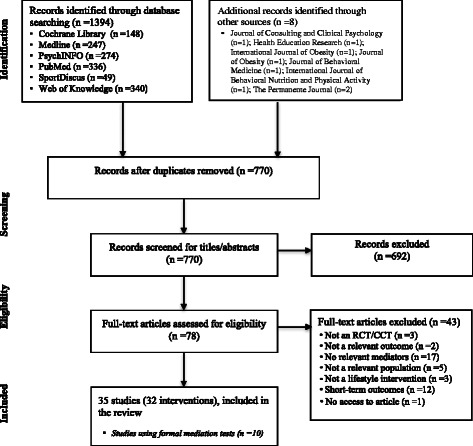
- Systematic review conducted per PRISMA. Six electronic databases were searched for peer-reviewed articles published January 2000–February 2014, plus manual cross-referencing; 1,394 records plus 8 manual additions yielded 1,404 potential articles, 770 abstracts screened, and 35 articles describing 32 unique lifestyle interventions included.
- Eligible studies were experimental lifestyle interventions in overweight/obese adults (≥18 years), reporting outcomes at least 6 months after intervention start and quantitative assessments of self-regulation mediators and weight/BMI, physical activity, or dietary intake. Results were separated into short-term (<12 months) and long-term (≥12 months) outcomes, and formal mediation studies were reported separately from predictor studies.
- Quality was assessed with an adapted Effective Public Health Practice Project tool and a mediation-specific checklist. Heterogeneity prevented meta-analysis, so findings were synthesized narratively with vote counting of significant mediation effects.
Limitations
- The paper states substantial heterogeneity in variables, study designs, measurement methods, populations, and intervention formats/lengths prevented deriving pooled mediation estimates or using meta-analytic techniques; narrative vote counting is less robust. It also notes many primary studies had poor methodological quality, none of the formal mediation studies were strong, outcome measures varied, coding relied on article descriptions, the year 2000 search cutoff was largely arbitrary, and non-controlled trials were included in some analyses.
- The paper states there were too few studies per mediator, dietary evidence was too sparse for meaningful conclusions, and external validity for self-regulation skills and autonomous motivation may be limited because findings came from few research groups using similar designs.
- Evident from the text: only 10 of 35 studies used formal mediation, and for short-term outcomes formal mediation was reported only for physical activity and only two mediators (body image/self-worth and self-efficacy/barriers), so much of the evidence is correlational or predictor-based rather than causal.
Model-written summary. Check it against the paper before relying on it.
Integrity signals
Registry
Cites
Statistics
Figures
Verification
Claims the paper makes
3 Valid · 1 Not valid · 26 Not checked · 77 Own results and interpretations
The cited sources support only part of this claim — read each source’s verdict below.
In the paper
“Second, if and when individuals are able to successfully self-regulate their behaviors, these effects tend to be sustainable, which is essential for having a lasting impact on health; moreover, this successful self-regulation may also “transfer” to, and help change, other health behaviors [18].”
§ Successful behavior change in obesity interventions in adults: a systematic review of self-regulation mediators > Background
What the sources say
- Partly supportedcites [18] Mata J Silva MN Vieira PN Carraça EV Andrade AM Coutinho SR Motivational “spill-over” during weight control: increased self-determination and exercise intrinsic motivation predict eating self-regulation Health Psychol. 2009 28 709 716 10.1037/a0016764 19916639 sourceExperimental — accuracy not yet measured
The Abstract reports that motivation predicted eating self-regulation over 12 months, and the Discussion (p. 18) reports possible spill-over from exercise motivation to eating regulation. These passages support the transfer part of the citing sentence, but they do not establish that successful self-regulation generally produces sustainable effects after the intervention. (LLM, conf=0.86)
hedgedstates an association- Asserted: passes — The authors put it forward as true.
- Checkable: passes — It can be checked against evidence.
- Load-bearing: passes — The paper’s conclusions depend on it.
- Based: passes — The paper gives a reason why it holds.
- Partly supported
Every source the paper cites for this claim was checked and supports it.
In the paper
“Second, if and when individuals are able to successfully self-regulate their behaviors, these effects tend to be sustainable, which is essential for having a lasting impact on health; moreover, this successful self-regulation may also “transfer” to, and help change, other health behaviors [18].”
§ Successful behavior change in obesity interventions in adults: a systematic review of self-regulation mediators > Background
What the sources say
- Supportedcites [18] Mata J Silva MN Vieira PN Carraça EV Andrade AM Coutinho SR Motivational “spill-over” during weight control: increased self-determination and exercise intrinsic motivation predict eating self-regulation Health Psychol. 2009 28 709 716 10.1037/a0016764 19916639 source
The Discussion (p. 18) concludes that spill-over may occur between exercise motivation and eating self-regulation during a weight-control intervention. This supports the cited possibility that self-regulation in one health behavior may help change another. (LLM, conf=0.90)
hedgedstates a possible cause- Asserted: passes — The authors put it forward as true.
- Checkable: passes — It can be checked against evidence.
- Load-bearing: passes — The paper’s conclusions depend on it.
- Based: passes — The paper gives a reason why it holds.
- Supported
Every source the paper cites for this claim was checked and supports it.
In the paper
“More broadly, psychological flexibility appears to predict health and psychological well-being [97], is thought to reflect more committed, values-based goal pursuit [98,99] and is considered a hallmark of self-determination [89], factors which may help explain successful health behavior self-regulation.”
§ Successful behavior change in obesity interventions in adults: a systematic review of self-regulation mediators > Discussion
What the sources say
- Supportedcites [97] Kashdan TB Rottenberg J Psychological flexibility as a fundamental aspect of health Clin Psychol Rev. 2010 30 865 878 10.1016/j.cpr.2010.03.001 21151705 PMC2998793 source
The introduction says psychological flexibility makes a major contribution to daily well-being and lasting psychological health. The ‘Balance among important life domains’ section adds that flexibility-related abilities account for incremental variance in social and psychological health. No page numbers are provided in our copy. (LLM, conf=0.91)
hedgedstates an association- Asserted: passes — The authors put it forward as true.
- Checkable: passes — It can be checked against evidence.
- Load-bearing: unclear — It is unclear whether the paper’s conclusions depend on it.
- Based: passes — The paper gives a reason why it holds.
- Supported
A result the paper reports from its own data — it cites no other source for it, so there is none to check. The quote shows it is in the paper.
In the paper
“Eating disinhibition, which appeared to be an additional predictor in the short-term, does not seem to be consistent in the long-term provided that it was significant only in 38% of the 16 times it was tested.”
§ Successful behavior change in obesity interventions in adults: a systematic review of self-regulation mediators > Results > Mediators/predictors of weight control
hedged- Asserted: passes — The authors put it forward as true.
- Checkable: passes — It can be checked against evidence.
- Load-bearing: passes — The paper’s conclusions depend on it.
- Based: passes — The paper gives a reason why it holds.
A result the paper reports from its own data — it cites no other source for it, so there is none to check. The quote shows it is in the paper.
In the paper
“For physical activity, significant putative mediators were high autonomous motivation, self-efficacy, and use of self-regulation skills.”
§ Successful behavior change in obesity interventions in adults: a systematic review of self-regulation mediators > Abstract > Results
hedgedstates a possible cause- Asserted: passes — The authors put it forward as true.
- Checkable: passes — It can be checked against evidence.
- Load-bearing: passes — The paper’s conclusions depend on it.
- Based: passes — The paper gives a reason why it holds.
36 more claims
Create a free account to see all 107 claims and to verify the 39 references still open.
- It may state two separate claims as one. 40
- Probably not a substantial claim. 41
- The quote only partly states this claim. 1
Claims other papers make about this one
Each is checked against this paper’s own text: does it say what the citing paper says it does?
The source backs part of the claim, not all of it — or backs it for a different population, condition or comparison.
In the citing paper
“This supports findings from a 2015 systematic review suggesting that psychological or self-regulatory skills and body image act as effective mediators of behavior change in lifestyle interventions [66].”
From Barriers and facilitators to diet, physical activity and lifestyle behavior intervention adherence: a qualitative systematic review of the literature (2023) · cites this paper as [66]
Experimental — accuracy not yet measuredThe source backs part of the claim, not all of it — or backs it for a different population, condition or comparison.
In the citing paper
“Improved body acceptance was associated with more stable maintenance of weight control behaviors, especially in individuals with low initial body image satisfaction [94].”
From Dietary and Behavioral Strategies for Weight Loss and Weight Loss Maintenance: A Narrative Review (2025) · cites this paper as [94]
Experimental — accuracy not yet measuredThe source backs part of the claim, not all of it — or backs it for a different population, condition or comparison.
In the citing paper
“This approach potentially enhances the effectiveness of pharmacological treatments through ongoing support and education using real-time microlearning approaches to promote individual self-care capability [18], as well as through supporting the adoption of health-seeking self-care behaviors using nudges and personalized insights delivered using an accessible digital platform [19,20].”
From Impact of Digital Engagement on Weight Loss Outcomes in Obesity Management Among Individuals Using GLP-1 and Dual GLP-1/GIP Receptor Agonist Therapy: Retrospective Cohort Service Evaluation Study (2025) · cites this paper as [20]
Experimental — accuracy not yet measuredIn the citing paper
“Improvements in body acceptance were associated with greater durability of behaviors supporting weight control, particularly among individuals with low baseline satisfaction with their appearance [94].”
From Dietary and Behavioral Strategies for Weight Loss and Weight Loss Maintenance: A Narrative Review (2025) · cites this paper as [94]
In the citing paper
“Findings on self regulatory strategies indicated that regular monitoring of behaviors, planning, and flexible adjustment of actions were more frequently observed among individuals achieving long term results [94].”
From Dietary and Behavioral Strategies for Weight Loss and Weight Loss Maintenance: A Narrative Review (2025) · cites this paper as [94]
1 more claim about this paper
Create a free account to see every claim other papers make about this one.
Self-check
Percentages, sums and reported differences re-computed from the paper’s own numbers.
Each contradiction between two passages listed here was confirmed by an independent check.
Rated minor: it would not touch a result — a value no result rests on, a p-value that stays on the same side of the significance level, or a conflict that is clerical, resolved elsewhere in the paper, or outside its own findings.
In the paper
§ Successful behavior change in obesity interventions in adults: a systematic review of self-regulation mediators > Results > Mediators/predictors of physical activity
“Fourteen variables, grouped in seven categories, were tested as mediators/predictors of short-term weight control (Table 4).”
§ Successful behavior change in obesity interventions in adults: a systematic review of self-regulation mediators > Methods > Data synthesis
“Table: Table 4 Mediators/predictors of short-term physical activity (<12 months)”
Rated minor: it would not touch a result — a value no result rests on, a p-value that stays on the same side of the significance level, or a conflict that is clerical, resolved elsewhere in the paper, or outside its own findings.
In the paper
§ Successful behavior change in obesity interventions in adults: a systematic review of self-regulation mediators > Results > Mediators/predictors of physical activity
“11 looked into short-term outcomes (less than 6 months beyond the start of the intervention)”
§ Successful behavior change in obesity interventions in adults: a systematic review of self-regulation mediators > Methods > Data synthesis
“Table: Table 4 Mediators/predictors of short-term physical activity (<12 months)”
Rated minor: it would not touch a result — a value no result rests on, a p-value that stays on the same side of the significance level, or a conflict that is clerical, resolved elsewhere in the paper, or outside its own findings.
In the paper
“| ↑ Self-regulation skill use | 3 | 3 | 75 | 6 | 6 | 83a |”
§ Successful behavior change in obesity interventions in adults: a systematic review of self-regulation mediators > Methods > Data synthesis
Reported 75 · recomputed 66.666667
Rated minor: it would not touch a result — a value no result rests on, a p-value that stays on the same side of the significance level, or a conflict that is clerical, resolved elsewhere in the paper, or outside its own findings.
In the paper
“| Study design (n = 35) | | Intervention (n = 35) | | | Trial | | Aim | | | NCT | 6 | Weight loss | 15 | | NRCT | 1 | Weight maintenance | 6 | | RCT | 28 | Exercise adherence | 3 | | Arms | | Health promotion | 8 | | 1 arm | 6 | Other | 2 |”
§ Successful behavior change in obesity interventions in adults: a systematic review of self-regulation mediators > Methods > Data synthesis
Reported 35 · recomputed 34
Citations
Cites
Baron, R. M., & Kenny, D. A. (1986) · Journal of Personality and Social Psychology · doi:10.1037/0022-3514.51.6.1173 · Cited by 91,532
Self-efficacy: The exercise of control
Bandura, A., Freeman, W. H., & Lightsey, R. (1999) · Journal of Cognitive Psychotherapy · doi:10.1891/0889-8391.13.2.158 · Cited by 46,835
(2013) · Cited by 44,563
The "what" and "why" of goal pursuits: Human needs and the self-determination of behavior
Deci, E. L., & Ryan, R. M. (2000) · Psychological Inquiry · doi:10.1207/s15327965pli1104_01 · Cited by 34,210 · cited 3×
“Additionally, because self-determined, well-internalized behaviors are associated with the satisfaction of the needs for autonomy, competence, and relatedness - and with the feelings of internal coherence and well-being that are thought to emerge from those experiences - this provides an explanation for the behavior t…”
BackgroundThe Cochrane Collaboration's tool for assessing risk of bias in randomised trials
Higgins, J. P. T., Altman, D. G., Gotzsche, P. C., Juni, P., Moher, D., Oxman, A. D., Savovic, J., Schulz, K. F., Weeks, L., Sterne, J. A. C., et al. (2011) · BMJ · doi:10.1136/bmj.d5928 · Cited by 33,817
Liberati, A., Altman, D. G., Tetzlaff, J., Mulrow, C., Gøtzsche, P. C., Ioannidis, J. P. A., Clarke, M., Devereaux, P. J., Kleijnen, J., & Moher, D. (2009) · PLoS Medicine · doi:10.1371/journal.pmed.1000100 · Cited by 28,164 · cited 3×
“A data extraction form was developed, informed by the PRISMA statement for reporting systematic reviews [21] and the Cochrane Collaboration’s tool for assessing risk of bias [27].”
MethodIntrinsic Motivation and Self-Determination in Human Behavior
Deci, E. L., & Ryan, R. M. (1985) · doi:10.1007/978-1-4899-2271-7 · Cited by 26,772 · cited 1×
“A wide variety of health behavior change theories has been employed to provide conceptual organization of these determinants, including social cognitive theories such as the theory of planned behavior [5], theories of motivation such as self-determination theory [6], theories distinguishing between motivational and po…”
BackgroundDermyshi, E., Wang, Y., Yan, C., Hong, W., Qiu, G., Gong, X., & Zhang, T. (2017) · Neonatology · doi:10.1159/000454668 · Cited by 24,451
Self-efficacy: the exercise of control
(1997) · Choice Reviews Online · doi:10.5860/choice.35-1826 · Cited by 24,281
From Intentions to Actions: A Theory of Planned Behavior
Ajzen, I. (1985) · Action Control · doi:10.1007/978-3-642-69746-3_2 · Cited by 19,057
Intrinsic Motivation and Self-Determination in Human Behavior
Miller, K. A., Deci, E. L., & Ryan, R. M. (1988) · Contemporary Sociology · doi:10.2307/2070638 · Cited by 15,312
‘Small Changes' to Diet and Physical Activity Behaviors for Weight Management
Hills, A. P., Byrne, N. M., Lindstrom, R., & Hill, J. O. (2013) · Obesity Facts · doi:10.1159/000345030 · Cited by 9,493
Michie, S., Richardson, M., Johnston, M., Abraham, C., Francis, J., Hardeman, W., Eccles, M. P., Cane, J., & Wood, C. E. (2013) · Annals of Behavioral Medicine · doi:10.1007/s12160-013-9486-6 · Cited by 7,629 · cited 1×
“In practical terms, this could mean that strategies or “behavior change techniques” [107] identified as the most effective to specifically change these variables (for example, self-efficacy [108] or autonomous motivation [109]) would be integrated into future interventions in a widespread fashion, and that health prof…”
BackgroundAcceptance and commitment therapy: model, processes and outcomes
Hayes, S. C., Luoma, J. B., Bond, F. W., Masuda, A., & Lillis, J. (2006) · Behaviour Research and Therapy · doi:10.1016/j.brat.2005.06.006 · Cited by 6,587 · cited 1×
“More broadly, psychological flexibility appears to predict health and psychological well-being [97], is thought to reflect more committed, values-based goal pursuit [98,99] and is considered a hallmark of self-determination [89], factors which may help explain successful health behavior self-regulation.”
BackgroundMacKinnon, D. P., Fairchild, A. J., & Fritz, M. S. (2007) · Annual Review of Psychology · doi:10.1146/annurev.psych.58.110405.085542 · Cited by 5,688 · cited 1×
“Regarding mediation and specifically in studies with formal mediation tests, researchers could use Baron and Kenny’s approach [28] and check whether the main effects were reduced in the presence of the mediator, or employ more sophisticated techniques to directly test the significance of the indirect effect through th…”
MethodMoher, D., Cook, D. J., Eastwood, S., Olkin, I., Rennie, D., & Stroup, D. F. (1999) · The Lancet · doi:10.1016/s0140-6736(99)04149-5 · Cited by 4,826
Motivational Interviewing: Helping People Change
Tober, G. (2013) · Alcohol and Alcoholism · doi:10.1093/alcalc/agt010 · Cited by 4,268 · cited 1×
“In the area of motivation enhancement, the techniques and instruments used in motivational interviewing [111,112] are a good example of such potential application in medicine and health care.”
MethodOn the Self-Regulation of Behavior
Carver, C. S., & Scheier, M. F. (1998) · Cambridge University Press eBooks · doi:10.1017/cbo9781139174794 · Cited by 4,110
2013 AHA/ACC/TOS Guideline for the Management of Overweight and Obesity in Adults
Jensen, M. D., Ryan, D. H., Apovian, C. M., Ard, J. D., Comuzzie, A. G., Donato, K. A., Hu, F. B., Hubbard, V. S., Jakicic, J. M., Kushner, R. F., et al. (2014) · Journal of the American College of Cardiology · doi:10.1016/j.jacc.2013.11.004 · Cited by 4,058 · cited 2×
“Behavior modification in general, and “ comprehensive lifestyle interventions ” in particular [10] are currently the first recommended step in obesity management.”
BackgroundOn the Self-Regulation of Behavior
Wright, B. R. E., Carver, C. S., & Scheier, M. F. (2000) · Contemporary Sociology · doi:10.2307/2654424 · Cited by 3,327
Psychological flexibility as a fundamental aspect of health
Kashdan, T. B., & Rottenberg, J. (2010) · Clinical Psychology Review · doi:10.1016/j.cpr.2010.03.001 · Cited by 3,054 · cited 2×
“More broadly, psychological flexibility appears to predict health and psychological well-being [97], is thought to reflect more committed, values-based goal pursuit [98,99] and is considered a hallmark of self-determination [89], factors which may help explain successful health behavior self-regulation.”
BackgroundResultExercise, physical activity, and self-determination theory: A systematic review
Teixeira, P. J., Carraça, E. V., Markland, D., Silva, M. N., & Ryan, R. M. (2012) · International Journal of Behavioral Nutrition and Physical Activity · doi:10.1186/1479-5868-9-78 · Cited by 2,963 · cited 2×
“A recent meta-analysis [90] and other reviews provide empirical support for both the SDT motivation model and the association of autonomous motivation with health behavior change in different areas [91].”
ResultSelf-citationEvaluating non-randomised intervention studies
Deeks, J., Dinnes, J., D'Amico, R., Sowden, A., Sakarovitch, C., Song, F., Petticrew, M., & Altman, D. (2003) · Health Technology Assessment · doi:10.3310/hta7270 · Cited by 2,907 · cited 1×
“The current adaptation was based on recommendations from several authors [31,32], and has been used in a previous systematic review conducted as part of the SPOTLIGHT project [33].”
MethodJensen, M. D., Ryan, D. H., Apovian, C. M., Ard, J. D., Comuzzie, A. G., Donato, K. A., Hu, F. B., Hubbard, V. S., Jakicic, J. M., Kushner, R. F., et al. (2014) · Circulation · doi:10.1161/01.cir.0000437739.71477.ee · Cited by 2,735
Schwarzer, R. (2008) · Applied Psychology · doi:10.1111/j.1464-0597.2007.00325.x · Cited by 2,569 · cited 1×
“…the theory of planned behavior [5], theories of motivation such as self-determination theory [6], theories distinguishing between motivational and post-motivational or volitional phases [7] such as the health action process approach (HAPA) [8], and self-regulation models such as control theory [9].”
BackgroundMediators and Moderators of Treatment Effects in Randomized Clinical Trials
Kraemer, H. C., Wilson, G. T., Fairburn, C. G., & Agras, W. S. (2002) · Archives of General Psychiatry · doi:10.1001/archpsyc.59.10.877 · Cited by 2,562 · cited 2×
“Testing of mediation, using appropriate methods, is a critical step in this field; it provides the strongest possible inference for the identification of elements in interventions which are causally “responsible” for achieving desired outcomes [20].”
BackgroundMethod(2013) · Cited by 2,393
Effective techniques in healthy eating and physical activity interventions: A meta-regression.
Michie, S., Abraham, C., Whittington, C., McAteer, J., & Gupta, S. (2009) · Health Psychology · doi:10.1037/a0016136 · Cited by 2,229 · cited 1×
“[100]) these variables are more skill-based (in some cases, they are discrete behaviors in themselves) and somewhat different than the previous set of predictors, more intrapsy-”
BackgroundThomas, B. H., Ciliska, D., Dobbins, M., & Micucci, S. (2004) · Worldviews on Evidence-Based Nursing · doi:10.1111/j.1524-475x.2004.04006.x · Cited by 2,118 · cited 1×
“The quality of included studies was assessed using an adapted version of the Quality Assessment Tool for Quantitative Studies, developed by the Effective Public Health Practice Project [30], and recommended for use by the Cochrane Public Health Review Group [27].”
MethodSelf-Determination Theory Applied to Health Contexts: A Meta-Analysis
Ng, J. Y. Y., Ntoumanis, N., Thøgersen-Ntoumani, C., Deci, E. L., Ryan, R. M., Duda, J. L., & Williams, G. C. (2012) · Perspectives on Psychological Science · doi:10.1177/1745691612447309 · Cited by 1,959 · cited 2×
“A recent meta-analysis [90] and other reviews provide empirical support for both the SDT motivation model and the association of autonomous motivation with health behavior change in different areas [91].”
ResultBody image: a handbook of theory, research, and clinical practice
(2003) · Choice Reviews Online · doi:10.5860/choice.40-3703 · Cited by 1,830
Michie, S., Ashford, S., Sniehotta, F. F., Dombrowski, S. U., Bishop, A., & French, D. P. (2011) · Psychology & Health · doi:10.1080/08870446.2010.540664 · Cited by 1,756 · cited 1×
“Moreover, because it is unlikely that any single factor (self-regulatory or otherwise) by itself will explain a large share of variance of change in complex behaviors such as physical activity and diet (as a result of an intervention), the identification of groups of significant predictors, which can be then discussed…”
BackgroundRyan, R. M., & Deci, E. L. (2006) · Journal of Personality · doi:10.1111/j.1467-6494.2006.00420.x · Cited by 1,642 · cited 1×
“Autonomous motivation, a concept derived from selfdetermination theory (SDT, [88]), generally indicates the degree to which individuals self-endorse, feel that they have a choice about, and attribute deeply reflected value to a certain behavior.”
BackgroundFranz, M. J., VanWormer, J. J., Crain, A. L., Boucher, J. L., Histon, T., Caplan, W., Bowman, J. D., & Pronk, N. P. (2007) · Journal of the American Dietetic Association · doi:10.1016/j.jada.2007.07.017 · Cited by 1,559 · cited 1×
“Other sources included manual cross-referencing of bibliographies cited in previous reviews [2,22,24-26] and included studies, as well as manual searches of the content of key scientific journals (Obesity Reviews; International Journal of Obesity; Obesity (Silver Spring); International Journal of Behavioral Nutrition…”
MethodS UCCESSFUL W EIGHT L OSS M AINTENANCE
Wing, R. R., & Hill, J. O. (2001) · Annual Review of Nutrition · doi:10.1146/annurev.nutr.21.1.323 · Cited by 1,382 · cited 1×
“In addition, the evidence shows that relatively little if any weight loss accomplished in treatment programs is maintained over the long term [16].”
BackgroundSniehotta, F. F., Scholz, U., & Schwarzer, R. (2005) · Psychology & Health · doi:10.1080/08870440512331317670 · Cited by 1,350 · cited 2×
“Background Lifestyle treatment interventions for obesity typically target changes in diet and physical activity through strategies like setting adequate goals and enhancing patients’ motivation, changing their beliefs and expectations, and providing guidance in the use of a variety of self-regulation skills (such as s…”
BackgroundElfhag, K., & Rössner, S. (2005) · Obesity Reviews · doi:10.1111/j.1467-789x.2005.00170.x · Cited by 1,343 · cited 3×
“Other sources included manual cross-referencing of bibliographies cited in previous reviews [2,22,24-26] and included studies, as well as manual searches of the content of key scientific journals (Obesity Reviews; International Journal of Obesity; Obesity (Silver Spring); International Journal of Behavioral Nutrition…”
BackgroundMethodThought contents and cognitive functioning in motivational versus volitional states of mind
Heckhausen, H., & Gollwitzer, P. M. (1987) · Motivation and Emotion · doi:10.1007/bf00992338 · Cited by 1,295 · cited 2×
“on the “intention-behavior gap” (see, for example, [7,101,102]) make the distinction between motivational and implementation phases (sometimes referred to as “volitional” or “post-motivational”), with self-regulation skills reviewed in the present study falling in the latter phase [103].”
BackgroundBLAIR, S. N., HASKELL, W. L., HO, P., PAFFENBARGER, R. S., VRANIZAN, K. M., FARQUHAR, J. W., & WOOD, P. D. (1985) · American Journal of Epidemiology · doi:10.1093/oxfordjournals.aje.a114163 · Cited by 1,104 · cited 1×
“Regarding physical activity, objective measures were employed in 4 studies (for example, accelerometry, pedometry) and self-reported instruments in 17 studies; of these, 6 used the Seven-Day Physical Activity Recall [71] and 6 studies used the Godin Leisure-Time Exercise Questionnaire [72].”
MethodThe Body Appreciation Scale: Development and psychometric evaluation
Avalos, L., Tylka, T. L., & Wood-Barcalow, N. (2005) · Body Image · doi:10.1016/j.bodyim.2005.06.002 · Cited by 1,094 · cited 1×
“Body image is a multidimensional concept [76] that depicts attitudes, perceptions, and in some cases behaviors associated with mental representations of one’s body (or some of its parts) [77,78].”
BackgroundA Meta-analysis of the Effectiveness of Intervention Programs Designed to Support Autonomy
Su, Y.-L., & Reeve, J. (2011) · Educational Psychology Review · doi:10.1007/s10648-010-9142-7 · Cited by 924 · cited 1×
“In practical terms, this could mean that strategies or “behavior change techniques” [107] identified as the most effective to specifically change these variables (for example, self-efficacy [108] or autonomous motivation [109]) would be integrated into future interventions in a widespread fashion, and that health prof…”
BackgroundPsychological correlates of obesity: Moving to the next research generation.
Friedman, M. A., & Brownell, K. D. (1995) · Psychological Bulletin · doi:10.1037/0033-2909.117.1.3 · Cited by 863 · cited 2×
“For instance, in 1995, Friedman and Brownell [23] alerted for the need of a “ third generation ” of obesity treatment studies analyzing causal mechanisms be-tween psychosocial variables and weight change.”
BackgroundSocial cognition models and health behaviour: A structured review
Armitage, C. J., & Conner, M. (2000) · Psychology & Health · doi:10.1080/08870440008400299 · Cited by 797 · cited 1×
“Self-efficacy and perceived barriers are common variables in several theoretical frameworks concerned with health behaviors [92,93].”
BackgroundAssessing competence in the use of motivational interviewing
Moyers, T. B., Martin, T., Manuel, J. K., Hendrickson, S. M. L., & Miller, W. R. (2005) · Journal of Substance Abuse Treatment · doi:10.1016/j.jsat.2004.11.001 · Cited by 738 · cited 1×
“In the area of motivation enhancement, the techniques and instruments used in motivational interviewing [111,112] are a good example of such potential application in medicine and health care.”
MethodLong-term weight loss after diet and exercise: a systematic review
Curioni, C. C., & Lourenço, P. M. (2005) · International Journal of Obesity · doi:10.1038/sj.ijo.0803015 · Cited by 695 · cited 1×
“Other sources included manual cross-referencing of bibliographies cited in previous reviews [2,22,24-26] and included studies, as well as manual searches of the content of key scientific journals (Obesity Reviews; International Journal of Obesity; Obesity (Silver Spring); International Journal of Behavioral Nutrition…”
MethodThe Primacy of Self‐Regulation in Health Promotion
Bandura, A. (2005) · Applied Psychology · doi:10.1111/j.1464-0597.2005.00208.x · Cited by 693 · cited 1×
“Background Lifestyle treatment interventions for obesity typically target changes in diet and physical activity through strategies like setting adequate goals and enhancing patients’ motivation, changing their beliefs and expectations, and providing guidance in the use of a variety of self-regulation skills (such as s…”
BackgroundWilliams, S. L., & French, D. P. (2011) · Health Education Research · doi:10.1093/her/cyr005 · Cited by 690 · cited 1×
“Self-efficacy and perceived barriers are common variables in several theoretical frameworks concerned with health behaviors [92,93].”
BackgroundCognitive-Behavioral Perspectives on Body Image
Cash, T. F. (2012) · Encyclopedia of Body Image and Human Appearance · doi:10.1016/b978-0-12-384925-0.00054-7 · Cited by 680
Schwartz, M. B., & Brownell, K. D. (2004) · Body Image · doi:10.1016/s1740-1445(03)00007-x · Cited by 637
Translating the Diabetes Prevention Program into the Community
Ackermann, R. T., Finch, E. A., Brizendine, E., Zhou, H., & Marrero, D. G. (2008) · American Journal of Preventive Medicine · doi:10.1016/j.amepre.2008.06.035 · Cited by 622 · cited 1×
“However, so far, randomized controlled trials evaluating the effectiveness of programs that target lifestyle behavior have shown mixed effects and, if effective, they have generally resulted in only small changes in target behaviors [11-15].”
BackgroundOlander, E. K., Fletcher, H., Williams, S., Atkinson, L., Turner, A., & French, D. P. (2013) · International Journal of Behavioral Nutrition and Physical Activity · doi:10.1186/1479-5868-10-29 · Cited by 590
Hagger, M. S., & Luszczynska, A. (2014) · Applied Psychology: Health and Well-Being · doi:10.1111/aphw.12017 · Cited by 581 · cited 1×
“on the “intention-behavior gap” (see, for example, [7,101,102]) make the distinction between motivational and implementation phases (sometimes referred to as “volitional” or “post-motivational”), with self-regulation skills reviewed in the present study falling in the latter phase [103].”
BackgroundThe assessment of body image investment: An extensive revision of the appearance schemas inventory
Cash, T. F., Melnyk, S. E., & Hrabosky, J. I. (2004) · International Journal of Eating Disorders · doi:10.1002/eat.10264 · Cited by 577 · cited 1×
“Poor body image often reflects a high level of concern with body weight or shape, what is known as dysfunctional investment in body image, when body esteem occupies an excessive role as a determinant of overall self-esteem [79].”
BackgroundGodin Leisure-Time Exercise Questionnaire
&NA; (1997) · Medicine& Science in Sports & Exercise · doi:10.1097/00005768-199706001-00009 · Cited by 478
A review of psychosocial pre‐treatment predictors of weight control
Teixeira, P. J., Going, S. B., Sardinha, L. B., & Lohman, T. G. (2005) · Obesity Reviews · doi:10.1111/j.1467-789x.2005.00166.x · Cited by 449 · cited 6×
“Despite this, one decade later, it has been observed that very few studies had investigated such mechanisms, and even fewer looked into long-term changes [2].”
BackgroundMethodResultInfluentialSelf-citationTowards a theory of intentional behaviour change: Plans, planning, and self‐regulation
Sniehotta, F. F. (2009) · British Journal of Health Psychology · doi:10.1348/135910708x389042 · Cited by 437 · cited 1×
“on the “intention-behavior gap” (see, for example, [7,101,102]) make the distinction between motivational and implementation phases (sometimes referred to as “volitional” or “post-motivational”), with self-regulation skills reviewed in the present study falling in the latter phase [103].”
BackgroundQUOROM Group, Moher, D., Cook, D. J., Eastwood, S., Olkin, I., Rennie, D., & Stroup, D. F. (2000) · Journal of British Surgery · doi:10.1046/j.1365-2168.2000.01610.x · Cited by 416
Mediators of Weight Loss and Weight Loss Maintenance in Middle‐aged Women
Teixeira, P. J., Silva, M. N., Coutinho, S. R., Palmeira, A. L., Mata, J., Vieira, P. N., Carraça, E. V., Santos, T. C., & Sardinha, L. B. (2010) · Obesity · doi:10.1038/oby.2009.281 · Cited by 404 · cited 4×
“Seventeen studies investigated potential mediators/predictors of long-term (≥12 months) weight outcomes, the main focus of the review [36,39,40,43-45,55,56,58,59,63-66].”
BackgroundResultInfluentialSelf-citationPelletier, L. G., Dion, S. C., Slovinec-D'Angelo, M., & Reid, R. (2004) · Motivation and Emotion · doi:10.1023/b:moem.0000040154.40922.14 · Cited by 390 · cited 2×
“Potential reasons for this association range from excessive psychological pressure leading to more rigid and inconsistent eating regulation [80-82] - poor body image being associated with a history of failed attempts and thus being a marker for other physiological, psychological, or socio-environmental risk factors fo…”
BackgroundMata, J., Silva, M. N., Vieira, P. N., Carraça, E. V., Andrade, A. M., Coutinho, S. R., Sardinha, L. B., & Teixeira, P. J. (2009) · Health Psychology · doi:10.1037/a0016764 · Cited by 390 · cited 2×
“Second, if and when individuals are able to successfully self-regulate their behaviors, these effects tend to be sustainable, which is essential for having a lasting impact on health; moreover, this successful self-regulation may also “transfer” to, and help change, other health behaviors [18].”
BackgroundSelf-citationSelf‐Regulation Assessment and Intervention in Physical Health and Illness: A Review
Maes, S., & Karoly, P. (2005) · Applied Psychology · doi:10.1111/j.1464-0597.2005.00210.x · Cited by 389 · cited 1×
“Background Lifestyle treatment interventions for obesity typically target changes in diet and physical activity through strategies like setting adequate goals and enhancing patients’ motivation, changing their beliefs and expectations, and providing guidance in the use of a variety of self-regulation skills (such as s…”
BackgroundLubans, D. R., Foster, C., & Biddle, S. J. H. (2008) · Preventive Medicine · doi:10.1016/j.ypmed.2008.07.011 · Cited by 388 · cited 1×
“For studies employing formal tests of mediation, assessment of methodological quality was complemented with a checklist tool developed specifically for mediation analysis by Lubans, Foster, and Biddle [34], and subsequently adapted by Rhodes and Pfaeffli [35].”
MethodMackenbach, J. D., Rutter, H., Compernolle, S., Glonti, K., Oppert, J.-M., Charreire, H., De Bourdeaudhuij, I., Brug, J., Nijpels, G., & Lakerveld, J. (2014) · BMC Public Health · doi:10.1186/1471-2458-14-233 · Cited by 381 · cited 1×
“The current adaptation was based on recommendations from several authors [31,32], and has been used in a previous systematic review conducted as part of the SPOTLIGHT project [33].”
MethodSelf-citationAn Integrated Behavior Change Model for Physical Activity
Hagger, M. S., & Chatzisarantis, N. L. D. (2014) · Exercise and Sport Sciences Reviews · doi:10.1249/jes.0000000000000008 · Cited by 370 · cited 1×
“on the “intention-behavior gap” (see, for example, [7,101,102]) make the distinction between motivational and implementation phases (sometimes referred to as “volitional” or “post-motivational”), with self-regulation skills reviewed in the present study falling in the latter phase [103].”
BackgroundDisinhibition: its effects on appetite and weight regulation
Bryant, E. J., King, N. A., & Blundell, J. E. (2008) · Obesity Reviews · doi:10.1111/j.1467-789x.2007.00426.x · Cited by 352 · cited 1×
“It stands in opposition to rigid restraint [96].”
BackgroundBarte, J. C. M., Ter Bogt, N. C. W., Bogers, R. P., Teixeira, P. J., Blissmer, B., Mori, T. A., & Bemelmans, W. J. E. (2010) · Obesity Reviews · doi:10.1111/j.1467-789x.2010.00740.x · Cited by 319 · cited 1×
“Other sources included manual cross-referencing of bibliographies cited in previous reviews [2,22,24-26] and included studies, as well as manual searches of the content of key scientific journals (Obesity Reviews; International Journal of Obesity; Obesity (Silver Spring); International Journal of Behavioral Nutrition…”
MethodSelf-citationLinde, J. A., Rothman, A. J., Baldwin, A. S., & Jeffery, R. W. (2006) · Health Psychology · doi:10.1037/0278-6133.25.3.282 · Cited by 307 · cited 2×
“Thirty-five articles describing 32 unique lifestyle interventions met the eligibility criteria and were therefore included [36-70].”
BackgroundExercise Autonomous Motivation Predicts 3-yr Weight Loss in Women
SILVA, M. N., MARKLAND, D., CARRAÇA, E. V., VIEIRA, P. N., COUTINHO, S. R., MINDERICO, C. S., MATOS, M. G., SARDINHA, L. B., & TEIXEIRA, P. J. (2011) · Medicine & Science in Sports & Exercise · doi:10.1249/mss.0b013e3181f3818f · Cited by 296
Self-citationWeight loss by mobile phone: a 1-year effectiveness study
Haapala, I., Barengo, N. C., Biggs, S., Surakka, L., & Manninen, P. (2009) · Public Health Nutrition · doi:10.1017/s1368980009005230 · Cited by 280 · cited 2×
“Seventeen studies investigated potential mediators/predictors of long-term (≥12 months) weight outcomes, the main focus of the review [36,39,40,43-45,55,56,58,59,63-66].”
BackgroundRhodes, R. E., & Pfaeffli, L. A. (2010) · International Journal of Behavioral Nutrition and Physical Activity · doi:10.1186/1479-5868-7-37 · Cited by 277 · cited 1×
“For studies employing formal tests of mediation, assessment of methodological quality was complemented with a checklist tool developed specifically for mediation analysis by Lubans, Foster, and Biddle [34], and subsequently adapted by Rhodes and Pfaeffli [35].”
MethodDietary restraint and disinhibition: Is restraint a homogeneous construct?
Westenhoefer, J. (1991) · Appetite · doi:10.1016/0195-6663(91)90110-e · Cited by 274 · cited 1×
“Flexible eating restraint involves regulating one ’ s food intake so that no particular behavior is forbidden and thus subject to rigid control and scrutiny [95].”
BackgroundPerri, M. G., Limacher, M. C., Durning, P. E., Janicke, D. M., Lutes, L. D., Bobroff, L. B., Dale, M. S., Daniels, M. J., Radcliff, T. A., & Martin, A. D. (2008) · Archives of Internal Medicine · doi:10.1001/archinte.168.21.2347 · Cited by 266 · cited 3×
“Seventeen studies investigated potential mediators/predictors of long-term (≥12 months) weight outcomes, the main focus of the review [36,39,40,43-45,55,56,58,59,63-66].”
BackgroundLeisure Time Exercise Questionnaire
Godin, G., & Shephard, R. J. (2015) · PsycTESTS Dataset · doi:10.1037/t31334-000 · Cited by 256
Exercise Motivation, Eating, and Body Image Variables as Predictors of Weight Control
TEIXEIRA, P. J., GOING, S. B., HOUTKOOPER, L. B., CUSSLER, E. C., METCALFE, L. L., BLEW, R. M., SARDINHA, L. B., & LOHMAN, T. G. (2006) · Medicine & Science in Sports & Exercise · doi:10.1249/01.mss.0000180906.10445.8d · Cited by 200 · cited 3×
“Thirty-five articles describing 32 unique lifestyle interventions met the eligibility criteria and were therefore included [36-70].”
BackgroundSelf-citationKinmonth, A.-L., Wareham, N. J., Hardeman, W., Sutton, S., Prevost, A. T., Fanshawe, T., Williams, K. M., Ekelund, U., Spiegelhalter, D., & Griffin, S. J. (2008) · The Lancet · doi:10.1016/s0140-6736(08)60070-7 · Cited by 200
Motivational dynamics of eating regulation: a self-determination theory perspective
Verstuyf, J., Patrick, H., Vansteenkiste, M., & Teixeira, P. J. (2012) · International Journal of Behavioral Nutrition and Physical Activity · doi:10.1186/1479-5868-9-21 · Cited by 195 · cited 3×
“In this respect, an attempt was recently made to provide an integrative view of eating regulation and weight maintenance, which also includes an explanation for the etiology and role of body image concerns and disordered eating, while considering motivational and self-regulatory aspects [80].”
BackgroundSelf-citationChanges in self-efficacy and dietary adherence: the impact on weight loss in the PREFER study
Warziski, M. T., Sereika, S. M., Styn, M. A., Music, E., & Burke, L. E. (2008) · Journal of Behavioral Medicine · doi:10.1007/s10865-007-9135-2 · Cited by 188 · cited 2×
“Seventeen studies investigated potential mediators/predictors of long-term (≥12 months) weight outcomes, the main focus of the review [36,39,40,43-45,55,56,58,59,63-66].”
BackgroundTheoretical integration in health psychology: Unifying ideas and complementary explanations
Hagger, M. S. (2009) · British Journal of Health Psychology · doi:10.1348/135910708x397034 · Cited by 179 · cited 1×
“Moreover, because it is unlikely that any single factor (self-regulatory or otherwise) by itself will explain a large share of variance of change in complex behaviors such as physical activity and diet (as a result of an intervention), the identification of groups of significant predictors, which can be then discussed…”
BackgroundStage-based lifestyle interventions in primary care
van Sluijs, E. M. F., van Poppel, M. N. M., & van Mechelen, W. (2004) · American Journal of Preventive Medicine · doi:10.1016/j.amepre.2003.12.010 · Cited by 176 · cited 1×
“However, so far, randomized controlled trials evaluating the effectiveness of programs that target lifestyle behavior have shown mixed effects and, if effective, they have generally resulted in only small changes in target behaviors [11-15].”
BackgroundSilva, M. N., Markland, D. A., Vieira, P. N., Coutinho, S. R., Carraça, E. V., Palmeira, A. L., Minderico, C. S., de Matos, M. G., Sardinha, L. B., & Teixeira, P. J. (2010) · Psychology of sport and exercise · doi:10.1016/j.psychsport.2010.06.011 · Cited by 174 · cited 2×
“Thirty-five articles describing 32 unique lifestyle interventions met the eligibility criteria and were therefore included [36-70].”
BackgroundSelf-citationSlovinec D'Angelo, M. E., Pelletier, L. G., Reid, R. D., & Huta, V. (2014) · Health Psychology · doi:10.1037/hea0000094 · Cited by 173
McCracken, L. M. (2013) · The Journal of Pain · doi:10.1016/j.jpain.2013.02.009 · Cited by 172 · cited 1×
“More broadly, psychological flexibility appears to predict health and psychological well-being [97], is thought to reflect more committed, values-based goal pursuit [98,99] and is considered a hallmark of self-determination [89], factors which may help explain successful health behavior self-regulation.”
BackgroundMaintaining large weight losses: The role of behavioral and psychological factors.
Wing, R. R., Papandonatos, G., Fava, J. L., Gorin, A. A., Phelan, S., McCaffery, J., & Tate, D. F. (2008) · Journal of Consulting and Clinical Psychology · doi:10.1037/a0014159 · Cited by 166 · cited 2×
“Seventeen studies investigated potential mediators/predictors of long-term (≥12 months) weight outcomes, the main focus of the review [36,39,40,43-45,55,56,58,59,63-66].”
BackgroundPelletier, L. G., & Dion, S. C. (2007) · Journal of Social and Clinical Psychology · doi:10.1521/jscp.2007.26.3.303 · Cited by 153 · cited 1×
“Potential reasons for this association range from excessive psychological pressure leading to more rigid and inconsistent eating regulation [80-82] - poor body image being associated with a history of failed attempts and thus being a marker for other physiological, psychological, or socio-environmental risk factors fo…”
BackgroundPath analysis of exercise treatment-induced changes in psychological factors leading to weight loss
Annesi, J. J., & Marti, C. N. (2011) · Psychology & Health · doi:10.1080/08870446.2010.534167 · Cited by 131 · cited 3×
“Thirty-five articles describing 32 unique lifestyle interventions met the eligibility criteria and were therefore included [36-70].”
BackgroundTh⊘gersen-Ntoumani, C., Ntoumanis, N., & Nikitaras, N. (2010) · Psychology & Health · doi:10.1080/08870440902783628 · Cited by 127
Eriksson, M. K., Franks, P. W., & Eliasson, M. (2009) · PLoS ONE · doi:10.1371/journal.pone.0005195 · Cited by 123 · cited 1×
“However, so far, randomized controlled trials evaluating the effectiveness of programs that target lifestyle behavior have shown mixed effects and, if effective, they have generally resulted in only small changes in target behaviors [11-15].”
BackgroundLong-term maintenance of exercise and healthy eating behaviors in overweight adults
RIEBE, D., BLISSMER, B., GREENE, G., CALDWELL, M., RUGGIERO, L., STILLWELL, K., & NIGG, C. (2005) · Preventive Medicine · doi:10.1016/j.ypmed.2004.09.023 · Cited by 117 · cited 3×
“Thirty-five articles describing 32 unique lifestyle interventions met the eligibility criteria and were therefore included [36-70].”
BackgroundAnnesi, J. J., Unruh, J. L., Marti, N. C., Gorjala, S., & Tennant, G. (2011) · Research Quarterly for Exercise and Sport · doi:10.1080/02701367.2011.10599726 · Cited by 106 · cited 3×
“Thirty-five articles describing 32 unique lifestyle interventions met the eligibility criteria and were therefore included [36-70].”
BackgroundPalmeira, A. L., Markland, D. A., Silva, M. N., Branco, T. L., Martins, S. C., Minderico, C. S., Vieira, P. N., Barata, J. T., Serpa, S. O., Sardinha, L. B., et al. (2009) · International Journal of Behavioral Nutrition and Physical Activity · doi:10.1186/1479-5868-6-9 · Cited by 106
Self-citationJanssen, V. R., Gucht, V. D., van Exel, H. J., & Maes, S. (2013) · Journal of Behavioral Medicine · doi:10.1007/s10865-012-9489-y · Cited by 105 · cited 1×
“It could also mean that bedside instruments (such as brief questionnaires or interview items) would be made available for professionals to quickly assess their patients for these variables (for example, to assess their body image or level of self-regulation skill use [1,110]) and tailor interventions to the most relev…”
BackgroundMcGuire, M., Jeffery, R. W., French, S. A., & HANNAN, P. J. (2001) · International Journal of Obesity · doi:10.1038/sj.ijo.0801579 · Cited by 105 · cited 4×
“Seventeen studies investigated potential mediators/predictors of long-term (≥12 months) weight outcomes, the main focus of the review [36,39,40,43-45,55,56,58,59,63-66].”
BackgroundInfluentialAnnesi, J. J. (2012) · The Permanente Journal · doi:10.7812/11-136 · Cited by 103
Palmeira, A. L., Branco, T. L., Martins, S. C., Minderico, C. S., Silva, M. N., Vieira, P. N., Barata, J. T., Serpa, S. O., Sardinha, L. B., & Teixeira, P. J. (2010) · Body Image · doi:10.1016/j.bodyim.2010.03.002 · Cited by 101 · cited 3×
“Seventeen studies investigated potential mediators/predictors of long-term (≥12 months) weight outcomes, the main focus of the review [36,39,40,43-45,55,56,58,59,63-66].”
BackgroundSelf-citationBody image change and improved eating self-regulation in a weight management intervention in women
Carraça, E. V., Silva, M. N., Markland, D. A., Vieira, P. N., Minderico, C. S., Sardinha, L. B., & Teixeira, P. J. (2011) · International Journal of Behavioral Nutrition and Physical Activity · doi:10.1186/1479-5868-8-75 · Cited by 95 · cited 1×
“In this exercise, we are informed by our own research, for instance, linking improved eating regulation, including flexible eating, with improved body image [105] and with exercise autonomous motivation [18] and also by other studies.”
Self-citationPsychosocial Factors Related to Physical Activity and Weight Loss in Overweight Women
GALLAGHER, K. I., JAKICIC, J. M., NAPOLITANO, M. A., & MARCUS, B. H. (2006) · Medicine & Science in Sports & Exercise · doi:10.1249/01.mss.0000218137.25970.c6 · Cited by 94 · cited 3×
“Thirty-five articles describing 32 unique lifestyle interventions met the eligibility criteria and were therefore included [36-70].”
BackgroundLakerveld, J., Bot, S. D., Chinapaw, M. J., van Tulder, M. W., Kostense, P. J., Dekker, J. M., & Nijpels, G. (2013) · International Journal of Behavioral Nutrition and Physical Activity · doi:10.1186/1479-5868-10-47 · Cited by 84 · cited 1×
“However, so far, randomized controlled trials evaluating the effectiveness of programs that target lifestyle behavior have shown mixed effects and, if effective, they have generally resulted in only small changes in target behaviors [11-15].”
BackgroundSelf-citationLakerveld, J., Brug, J., Bot, S., Teixeira, P. J., Rutter, H., Woodward, E., Samdal, O., Stockley, L., De Bourdeaudhuij, I., van Assema, P., et al. (2012) · BMC Public Health · doi:10.1186/1471-2458-12-793 · Cited by 80 · cited 1×
“Third, although some interventions targeting individuals may be ineffective on their own, they might be able to contribute to the effectiveness of strategies that integrate multiple levels (that is, strategies that include individuallevel and environmental-level approaches) [19].”
BackgroundSelf-citationToward an Organismic Integration Theory
Deci, E. L., & Ryan, R. M. (1985) · Springer eBooks · doi:10.1007/978-1-4899-2271-7_5 · Cited by 76
Boone, L., Soenens, B., & Braet, C. (2011) · Journal of Social and Clinical Psychology · doi:10.1521/jscp.2011.30.10.1043 · Cited by 75
Burke, V., Beilin, L. J., Cutt, H. E., Mansour, J., & Mori, T. A. (2007) · Health Education Research · doi:10.1093/her/cym047 · Cited by 64 · cited 4×
“Thirty-five articles describing 32 unique lifestyle interventions met the eligibility criteria and were therefore included [36-70].”
BackgroundInfluentialVerstuyf, J., Vansteenkiste, M., & Soenens, B. (2011) · Body Image · doi:10.1016/j.bodyim.2011.09.003 · Cited by 63 · cited 1×
“…factors for weight gain/regain [83,84] - to motivational factors in which external pressures and goals predominate but tend not to produce behavior change in consistent or healthy ways (for example, wanting to be thin for reasons related to social comparison and perceived desirability) [85-87].”
BackgroundAnnesi, J. J. (2011) · Behavioral Medicine · doi:10.1080/08964289.2011.579643 · Cited by 62 · cited 3×
“Thirty-five articles describing 32 unique lifestyle interventions met the eligibility criteria and were therefore included [36-70].”
BackgroundLeong, S. L., Madden, C., Gray, A., & Horwath, C. (2012) · Journal of the Academy of Nutrition and Dietetics · doi:10.1016/j.jand.2012.04.018 · Cited by 59 · cited 1×
“For example, recently, in a large dataset of women in New Zealand, autonomous motivation for eating was associated with less binge eating and slower speed of eating (and a much healthier diet), indicative of improved eating selfregulation [106].”
BackgroundAnderson-Bill, E. S., Winett, R. A., Wojcik, J. R., & Williams, D. M. (2011) · Journal of Aging Research · doi:10.4061/2011/505928 · Cited by 55 · cited 4×
“Seventeen studies investigated potential mediators/predictors of long-term (≥12 months) weight outcomes, the main focus of the review [36,39,40,43-45,55,56,58,59,63-66].”
BackgroundInfluentialPsychological Functioning of Obese Individuals
Fabricatore, A. N., & Wadden, T. A. (2003) · Diabetes Spectrum · doi:10.2337/diaspect.16.4.245 · Cited by 53 · cited 1×
“Potential reasons for this association range from excessive psychological pressure leading to more rigid and inconsistent eating regulation [80-82] - poor body image being associated with a history of failed attempts and thus being a marker for other physiological, psychological, or socio-environmental risk factors fo…”
BackgroundMata, J., Silva, M. N., Vieira, P. N., Carraça, E. V., Andrade, A. M., Coutinho, S. R., Sardinha, L. B., & Teixeira, P. J. (2011) · Sport Exercise and Performance Psychology · doi:10.1037/2157-3905.1.s.49 · Cited by 52
Self-citationKarhunen, L. J., Lyly, M., Lapveteläinen, A. T., Kolehmainen, M., Laaksonen, D. E., Lähteenmäki, L., & Poutanen, K. S. (2012) · Journal of Obesity · doi:10.1155/2012/274068 · Cited by 51
Mediating Effects of Group Cohesion on Physical Activity and Diet in Women of Color: Health is Power
Lee, R. E., O'Connor, D. P., Smith-Ray, R., Mama, S. K., Medina, A. V., Reese-Smith, J. Y., Banda, J. A., Layne, C. S., Brosnan, M., Cubbin, C., et al. (2012) · American Journal of Health Promotion · doi:10.4278/ajhp.101215-quan-400 · Cited by 50 · cited 3×
“Thirty-five articles describing 32 unique lifestyle interventions met the eligibility criteria and were therefore included [36-70].”
BackgroundLong‐term weight loss and weight‐loss maintenance strategies
Rössner, S., Hammarstrand, M., Hemmingsson, E., Neovius, M., & Johansson, K. (2008) · Obesity Reviews · doi:10.1111/j.1467-789x.2008.00516.x · Cited by 41 · cited 1×
“Clearly, there is a need for research that identifies causal predictors of long-term weight control, including successful weight loss and maintenance [17].”
BackgroundAnnesi, J. J. (2011) · The Permanente Journal · doi:10.7812/tpp/10-153 · Cited by 39 · cited 2×
“Thirty-five articles describing 32 unique lifestyle interventions met the eligibility criteria and were therefore included [36-70].”
BackgroundAnnesi, J. J., & Vaughn, L. L. (2011) · Advances in Preventive Medicine · doi:10.4061/2011/514271 · Cited by 34 · cited 2×
“Thirty-five articles describing 32 unique lifestyle interventions met the eligibility criteria and were therefore included [36-70].”
BackgroundFitzpatrick, S. L., Bandeen‐Roche, K., Stevens, V. J., Coughlin, J. W., Rubin, R. R., Brantley, P. J., Funk, K., Svetkey, L. P., Jerome, G. J., Dalcin, A., et al. (2013) · Obesity · doi:10.1002/oby.20636 · Cited by 29 · cited 4×
“Thirty-five articles describing 32 unique lifestyle interventions met the eligibility criteria and were therefore included [36-70].”
BackgroundInfluentialWeight Loss and Psychologic Gain in Obese Women—Participants in a Supported Exercise Intervention
Annesi, J. J., & Whitaker, A. C. (2008) · The Permanente Journal · doi:10.7812/tpp/07-134 · Cited by 29 · cited 2×
“Thirty-five articles describing 32 unique lifestyle interventions met the eligibility criteria and were therefore included [36-70].”
BackgroundBehavioral Mediators of Treatment Effects in the Weight Loss Maintenance Trial
Coughlin, J. W., Gullion, C. M., Brantley, P. J., Stevens, V. J., Bauck, A., Champagne, C. M., Dalcin, A. T., Funk, K. L., Hollis, J. F., Jerome, G. J., et al. (2013) · Annals of Behavioral Medicine · doi:10.1007/s12160-013-9517-3 · Cited by 27 · cited 3×
“Seventeen studies investigated potential mediators/predictors of long-term (≥12 months) weight outcomes, the main focus of the review [36,39,40,43-45,55,56,58,59,63-66].”
BackgroundIntervention-mediated effects for adult physical activity: A latent growth curve analysis
Roesch, S. C., Norman, G. J., Villodas, F. M., Sallis, J. F., & Patrick, K. (2010) · Social Science & Medicine · doi:10.1016/j.socscimed.2010.04.032 · Cited by 26 · cited 2×
“Thirty-five articles describing 32 unique lifestyle interventions met the eligibility criteria and were therefore included [36-70].”
BackgroundAnnesi, J. J., & Porter, K. J. (2013) · International Journal of Behavioral Nutrition and Physical Activity · doi:10.1186/1479-5868-10-133 · Cited by 22 · cited 3×
“Thirty-five articles describing 32 unique lifestyle interventions met the eligibility criteria and were therefore included [36-70].”
BackgroundAnnesi, J. J. (2013) · Journal of Physical Activity and Health · doi:10.1123/jpah.10.7.1024 · Cited by 21 · cited 3×
“Thirty-five articles describing 32 unique lifestyle interventions met the eligibility criteria and were therefore included [36-70].”
BackgroundAnnesi, J. J., & Gorjala, S. (2010) · Southern Medical Journal · doi:10.1097/smj.0b013e3181f6d3d4 · Cited by 19 · cited 2×
“Thirty-five articles describing 32 unique lifestyle interventions met the eligibility criteria and were therefore included [36-70].”
BackgroundBurke, V., Mansour, J., Mori, T. A., Beilin, L. J., Cutt, H. E., & Wilson, A. (2007) · Health Education Research · doi:10.1093/her/cym017 · Cited by 17 · cited 4×
“Seventeen studies investigated potential mediators/predictors of long-term (≥12 months) weight outcomes, the main focus of the review [36,39,40,43-45,55,56,58,59,63-66].”
BackgroundInfluentialAnnesi, J. J., & Mareno, N. (2014) · Journal of Community Health · doi:10.1007/s10900-014-9828-8 · Cited by 14 · cited 3×
“Thirty-five articles describing 32 unique lifestyle interventions met the eligibility criteria and were therefore included [36-70].”
BackgroundAnnesi, J. J. (2007) · Social Behavior and Personality An International Journal · doi:10.2224/sbp.2007.35.10.1295 · Cited by 13 · cited 2×
“Thirty-five articles describing 32 unique lifestyle interventions met the eligibility criteria and were therefore included [36-70].”
BackgroundZhou, F., & Wang, D. (2007) · Social Behavior and Personality An International Journal · doi:10.2224/sbp.2007.35.3.295 · Cited by 13
Outcome expectations and realizations as predictors of weight regain among dieters
Moore, S. D., King, A. C., Kiernan, M., & Gardner, C. D. (2011) · Eating Behaviors · doi:10.1016/j.eatbeh.2010.08.007 · Cited by 8 · cited 2×
“Seventeen studies investigated potential mediators/predictors of long-term (≥12 months) weight outcomes, the main focus of the review [36,39,40,43-45,55,56,58,59,63-66].”
BackgroundIlion besieged: A tenth year report
Gedo, J. E. (1991) · Psychoanalytic Inquiry · doi:10.1080/07351699109533853 · Cited by 7
Cited by
Garvey, W. T., Mechanick, J. I., Brett, E. M., Garber, A. J., Hurley, D. L., Jastreboff, A. M., Nadolsky, K., Pessah-Pollack, R., & Plodkowski, R. (2016) · Endocrine Practice · doi:10.4158/ep161365.gl · Cited by 1,914
Clinical application of intermittent fasting for weight loss: progress and future directions
Varady, K. A., Cienfuegos, S., Ezpeleta, M., & Gabel, K. (2022) · Nature Reviews Endocrinology · doi:10.1038/s41574-022-00638-x · Cited by 357
Long-term weight loss maintenance for obesity: a multidisciplinary approach
Marchesini, G., Montesi, L., El Ghoch, M., Brodosi, L., Calugi, S., & Dalle Grave, R. (2016) · Diabetes, Metabolic Syndrome and Obesity: Targets and Therapy · doi:10.2147/dmso.s89836 · Cited by 320
“62 It is, however, unknown whether and how long this strategy may be maintained.”
BackgroundPrevalence of personal weight control attempts in adults: a systematic review and meta‐analysis
Santos, I., Sniehotta, F. F., Marques, M. M., Carraça, E. V., & Teixeira, P. J. (2017) · Obesity Reviews · doi:10.1111/obr.12466 · Cited by 274
Self-citationDeterminants of weight loss maintenance: a systematic review
Varkevisser, R. D. M., van Stralen, M. M., Kroeze, W., Ket, J. C. F., & Steenhuis, I. H. M. (2019) · Obesity Reviews · doi:10.1111/obr.12772 · Cited by 295
“A review by Teixeira and colleagues found similar trends in social/cognitive determinants considered to be important for weight loss maintenance (84).”
Background
Metadata
- Authors
- Teixeira, P. J., Carraça, E. V., Marques, M. M., Rutter, H., Oppert, J.-M., De Bourdeaudhuij, I., Lakerveld, J., & Brug, J.
- Affiliations
- University of Lisbon (PT)
- London School of Hygiene & Tropical Medicine (GB)
- Inserm (FR)
- Amsterdam Public Health (NL)
- Corresponding author
- Teixeira, Pedro J
- ORCID
- Venue
- BMC Medicine
- Published
- 2015-04-16
- Volume
- 13
- Issue
- 1
- Pages
- 84-84
- ISSN
- 1741-7015 (ISSN-L)
- PMC
- PMC4408562
- OpenAlex
- W2092285599
- Cited by
- 711
- References
- 125
- Citations by year
- 2026: 50 · 2025: 57 · 2024: 55 · 2023: 50 · 2022: 64 · 2021: 86 · 2020: 76 · 2019: 107 · 2018: 65 · 2017: 49 · 2016: 43 · 2015: 7
- FWCI
- 7.59
- Type
- journal article
- Language
- en
- Open access
- gold
- doi.org
- Locations
- BMC Medicine (publishedVersion, cc-by)
- Europe PMC (PubMed Central) (publishedVersion, cc-by)
- PubMed Central (publishedVersion, cc-by)
- PubMed (publishedVersion)
- Pure Amsterdam UMC (publishedVersion, other-oa)
- Amsterdam UMC (VU Amsterdam) - Institutional Repository (publishedVersion)
- LSHTM Research Online (London School of Hygiene and Tropical Medicine) (acceptedVersion)
- Data Archiving and Networked Services (DANS) (acceptedVersion, other-oa)
- Ghent University Academic Bibliography (Ghent University) (submittedVersion, other-oa)
- HAL (submittedVersion, other-oa)
- UCL Discovery (University College London) (submittedVersion)
- Data Archiving and Networked Services (DANS) (submittedVersion)
- Funders
- European Commission (278186, FP7‐HEALTH‐2011)
- FP7 Health (278186)
- Topics
- Social Sciences › Psychology › Applied Psychology › Behavioral Health and Interventions
- Health Sciences › Medicine › Public Health, Environmental and Occupational Health › Obesity, Physical Activity, Diet
- Health Sciences › Medicine › Public Health, Environmental and Occupational Health › Obesity and Health Practices
- Keywords
- obesity intervention, behavior change, self-regulation, mediators, weight loss, weight maintenance, physical activity, dietary intake, autonomous motivation, self-efficacy, self-monitoring, dietary restraint, body image, relapse, lifestyle intervention, overweight adults
- MeSH terms
- Behavior Therapy, Diet, Humans, Life Style, Motor Activity, Obesity, Weight Loss, Overweight
About these checks
Registry, retraction, Cites and statistics results are computed, not judged, with one exception: a printed reference that no index lists is read once by a model before it counts as a citation error. Claims are extracted by a model and kept only when their quote appears verbatim in the text; each cited source is then checked, with a model’s help, for whether it says what the claim relies on. Those verdicts can be wrong — read the claim’s quote and the cited source before relying on one.
The claim verdicts this report counts are experimental: their accuracy is not yet measured.
A language model drew the claims from the paper on 2026-10-04, under version 3 of the claim definition (model deepseek-v4.1-flash, prompt extract-v3).
A second model labelled each claim on 2026-10-04 (model jev-1.13-20260917, definition revision gold-guideline-v0.2).
Cited sources are checked with a language model’s help (gpt-6-sol).
Statistics and arithmetic are recomputed, not judged.
Confidence bands are shown only for fields calibrated on our annotated test set. None is calibrated yet, so no band is shown.
What counts as a claim ›How we measure confidence ›How we check this ›
Are you an author, or do you see a problem with this page? Request a review
Data sources
Bibliographic data: Semantic Scholar, OpenAlex, Crossref.
Contains information from the Semantic Scholar Academic Graph Datasets, made available under the ODC Attribution License (ODC-BY 1.0).
Semantic Scholar’s data is described in: Kinney, R., et al. (2023). The Semantic Scholar Open Data Platform. arXiv:2301.10140.
