

Successful behavior change in obesity interventions in adults: a systematic review of self-regulation mediators
Open accessThe DOI matches its Crossref record; 125 of the 125 references it cites were found in a registry or an index; 7 of the 46 sources its claims cite were checked for support.
Abstract
BACKGROUND: Relapse is high in lifestyle obesity interventions involving behavior and weight change. Identifying mediators of successful outcomes in these interventions is critical to improve effectiveness and to guide approaches to obesity treatment, including resource allocation. This article reviews the most consistent self-regulation mediators of medium- and long-term weight control, physical activity, and dietary intake in clinical and community behavior change interventions targeting overweight/obese adults. METHODS: A comprehensive search of peer-reviewed articles, published since 2000, was conducted on electronic databases (for example, MEDLINE) and journal reference lists. Experimental studies were eligible if they reported intervention effects on hypothesized mediators (self-regulatory and psychological mechanisms) and the association between these and the outcomes of interest (weight change, physical activity, and dietary intake). Quality and content of selected studies were analyzed and findings summarized. Studies with formal mediation analyses were reported separately. RESULTS: Thirty-five studies were included testing 42 putative mediators. Ten studies used formal mediation analyses. Twenty-eight studies were randomized controlled trials, mainly aiming at weight loss or maintenance (n = 21). Targeted participants were obese (n = 26) or overweight individuals, aged between 25 to 44 years (n = 23), and 13 studies targeted women only. In terms of study quality, 13 trials were rated as "strong", 15 as "moderate", and 7 studies as "weak". In addition, methodological quality of formal mediation analyses was "medium". Identified mediators for medium-/long-term weight control were higher levels of autonomous motivation, self-efficacy/barriers, self-regulation skills (such as self-monitoring), flexible eating restraint, and positive body image. For physical activity, significant putative mediators were high autonomous motivation, self-efficacy, and use of self-regulation skills. For dietary intake, the evidence was much less clear, and no consistent mediators were identified. CONCLUSIONS: This is the first systematic review of mediational psychological mechanisms of successful outcomes in obesity-related lifestyle change interventions. Despite limited evidence, higher autonomous motivation, self-efficacy, and self-regulation skills emerged as the best predictors of beneficial weight and physical activity outcomes; for weight control, positive body image and flexible eating restraint may additionally improve outcomes. These variables represent possible targets for future lifestyle interventions in overweight/obese populations.
Overview
CoChat Summary
TL;DR
This systematic review of 35 lifestyle intervention studies found that autonomous motivation, self-efficacy, and self-regulation skills are the most consistent self-regulation mediators of weight control and physical activity in overweight/obese adults. For long-term weight control, positive body image and flexible eating restraint may also matter, while dietary intake had no consistent mediators.
Key findings
- Across 35 studies testing 42 putative mediators, 10 used formal mediation analyses; 28 were randomized controlled trials, mainly targeting weight loss or maintenance (n = 21). Study quality was rated strong for 13 trials, moderate for 15, and weak for 7; all 10 formal mediation analyses were rated medium quality.
- For medium/long-term weight control (≥12 months), formal mediation supported body image (significant in 100% of 3 tests), self-regulation skills (75% of 3 formal tests; 83% of 6 overall tests), and self-efficacy/barriers (67% of 3 formal tests; 68% of 28 overall tests). Autonomous motivation and flexible eating restraint were promising but derived from a single study each.
- For long-term physical activity, the main predictors were autonomous motivation (83% of formal mediation tests; 93% of overall tests) and self-efficacy (67% of formal tests; 75% of overall tests). Self-regulation skill use was less consistent and derived from low-quality studies.
- For dietary intake, no consistent mediators were identified. In the short term, self-efficacy/barriers and self-regulation skill use were each consistent with mediation in 75% of tests, but long-term self-efficacy was consistent with mediation in only 2 of 8 tests.
Methods
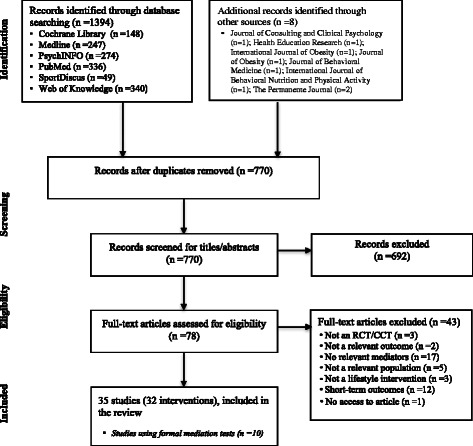
- Systematic review conducted per PRISMA. Six electronic databases were searched for peer-reviewed articles published January 2000–February 2014, plus manual cross-referencing; 1,394 records plus 8 manual additions yielded 1,404 potential articles, 770 abstracts screened, and 35 articles describing 32 unique lifestyle interventions included.
- Eligible studies were experimental lifestyle interventions in overweight/obese adults (≥18 years), reporting outcomes at least 6 months after intervention start and quantitative assessments of self-regulation mediators and weight/BMI, physical activity, or dietary intake. Results were separated into short-term (<12 months) and long-term (≥12 months) outcomes, and formal mediation studies were reported separately from predictor studies.
- Quality was assessed with an adapted Effective Public Health Practice Project tool and a mediation-specific checklist. Heterogeneity prevented meta-analysis, so findings were synthesized narratively with vote counting of significant mediation effects.
Limitations
- The paper states substantial heterogeneity in variables, study designs, measurement methods, populations, and intervention formats/lengths prevented deriving pooled mediation estimates or using meta-analytic techniques; narrative vote counting is less robust. It also notes many primary studies had poor methodological quality, none of the formal mediation studies were strong, outcome measures varied, coding relied on article descriptions, the year 2000 search cutoff was largely arbitrary, and non-controlled trials were included in some analyses.
- The paper states there were too few studies per mediator, dietary evidence was too sparse for meaningful conclusions, and external validity for self-regulation skills and autonomous motivation may be limited because findings came from few research groups using similar designs.
- Evident from the text: only 10 of 35 studies used formal mediation, and for short-term outcomes formal mediation was reported only for physical activity and only two mediators (body image/self-worth and self-efficacy/barriers), so much of the evidence is correlational or predictor-based rather than causal.
Model-written summary. Check it against the paper before relying on it.
Integrity signals
Registry
Cites
Statistics
Figures
Verification
Claims the paper makes
3 Valid · 1 Not valid · 26 Not checked · 77 Own results and interpretations
The cited sources support only part of this claim — read each source’s verdict below.
In the paper
“Second, if and when individuals are able to successfully self-regulate their behaviors, these effects tend to be sustainable, which is essential for having a lasting impact on health; moreover, this successful self-regulation may also “transfer” to, and help change, other health behaviors [18].”
§ Successful behavior change in obesity interventions in adults: a systematic review of self-regulation mediators > Background
What the sources say
- Partly supportedcites [18] Mata J Silva MN Vieira PN Carraça EV Andrade AM Coutinho SR Motivational “spill-over” during weight control: increased self-determination and exercise intrinsic motivation predict eating self-regulation Health Psychol. 2009 28 709 716 10.1037/a0016764 19916639 sourceExperimental — accuracy not yet measured
The Abstract reports that motivation predicted eating self-regulation over 12 months, and the Discussion (p. 18) reports possible spill-over from exercise motivation to eating regulation. These passages support the transfer part of the citing sentence, but they do not establish that successful self-regulation generally produces sustainable effects after the intervention. (LLM, conf=0.86)
hedgedstates an association- Asserted: passes — The authors put it forward as true.
- Checkable: passes — It can be checked against evidence.
- Load-bearing: passes — The paper’s conclusions depend on it.
- Based: passes — The paper gives a reason why it holds.
- Partly supported
Every source the paper cites for this claim was checked and supports it.
In the paper
“Second, if and when individuals are able to successfully self-regulate their behaviors, these effects tend to be sustainable, which is essential for having a lasting impact on health; moreover, this successful self-regulation may also “transfer” to, and help change, other health behaviors [18].”
§ Successful behavior change in obesity interventions in adults: a systematic review of self-regulation mediators > Background
What the sources say
- Supportedcites [18] Mata J Silva MN Vieira PN Carraça EV Andrade AM Coutinho SR Motivational “spill-over” during weight control: increased self-determination and exercise intrinsic motivation predict eating self-regulation Health Psychol. 2009 28 709 716 10.1037/a0016764 19916639 source
The Discussion (p. 18) concludes that spill-over may occur between exercise motivation and eating self-regulation during a weight-control intervention. This supports the cited possibility that self-regulation in one health behavior may help change another. (LLM, conf=0.90)
hedgedstates a possible cause- Asserted: passes — The authors put it forward as true.
- Checkable: passes — It can be checked against evidence.
- Load-bearing: passes — The paper’s conclusions depend on it.
- Based: passes — The paper gives a reason why it holds.
- Supported
Every source the paper cites for this claim was checked and supports it.
In the paper
“More broadly, psychological flexibility appears to predict health and psychological well-being [97], is thought to reflect more committed, values-based goal pursuit [98,99] and is considered a hallmark of self-determination [89], factors which may help explain successful health behavior self-regulation.”
§ Successful behavior change in obesity interventions in adults: a systematic review of self-regulation mediators > Discussion
What the sources say
- Supportedcites [97] Kashdan TB Rottenberg J Psychological flexibility as a fundamental aspect of health Clin Psychol Rev. 2010 30 865 878 10.1016/j.cpr.2010.03.001 21151705 PMC2998793 source
The introduction says psychological flexibility makes a major contribution to daily well-being and lasting psychological health. The ‘Balance among important life domains’ section adds that flexibility-related abilities account for incremental variance in social and psychological health. No page numbers are provided in our copy. (LLM, conf=0.91)
hedgedstates an association- Asserted: passes — The authors put it forward as true.
- Checkable: passes — It can be checked against evidence.
- Load-bearing: unclear — It is unclear whether the paper’s conclusions depend on it.
- Based: passes — The paper gives a reason why it holds.
- Supported
A result the paper reports from its own data — it cites no other source for it, so there is none to check. The quote shows it is in the paper.
In the paper
“Eating disinhibition, which appeared to be an additional predictor in the short-term, does not seem to be consistent in the long-term provided that it was significant only in 38% of the 16 times it was tested.”
§ Successful behavior change in obesity interventions in adults: a systematic review of self-regulation mediators > Results > Mediators/predictors of weight control
hedged- Asserted: passes — The authors put it forward as true.
- Checkable: passes — It can be checked against evidence.
- Load-bearing: passes — The paper’s conclusions depend on it.
- Based: passes — The paper gives a reason why it holds.
A result the paper reports from its own data — it cites no other source for it, so there is none to check. The quote shows it is in the paper.
In the paper
“For physical activity, significant putative mediators were high autonomous motivation, self-efficacy, and use of self-regulation skills.”
§ Successful behavior change in obesity interventions in adults: a systematic review of self-regulation mediators > Abstract > Results
hedgedstates a possible cause- Asserted: passes — The authors put it forward as true.
- Checkable: passes — It can be checked against evidence.
- Load-bearing: passes — The paper’s conclusions depend on it.
- Based: passes — The paper gives a reason why it holds.
36 more claims
Create a free account to see all 107 claims and to verify the 39 references still open.
- It may state two separate claims as one. 40
- Probably not a substantial claim. 41
- The quote only partly states this claim. 1
Claims other papers make about this one
Each is checked against this paper’s own text: does it say what the citing paper says it does?
The source backs part of the claim, not all of it — or backs it for a different population, condition or comparison.
In the citing paper
“This supports findings from a 2015 systematic review suggesting that psychological or self-regulatory skills and body image act as effective mediators of behavior change in lifestyle interventions [66].”
From Barriers and facilitators to diet, physical activity and lifestyle behavior intervention adherence: a qualitative systematic review of the literature (2023) · cites this paper as [66]
Experimental — accuracy not yet measuredThe source backs part of the claim, not all of it — or backs it for a different population, condition or comparison.
In the citing paper
“Improved body acceptance was associated with more stable maintenance of weight control behaviors, especially in individuals with low initial body image satisfaction [94].”
From Dietary and Behavioral Strategies for Weight Loss and Weight Loss Maintenance: A Narrative Review (2025) · cites this paper as [94]
Experimental — accuracy not yet measuredThe source backs part of the claim, not all of it — or backs it for a different population, condition or comparison.
In the citing paper
“This approach potentially enhances the effectiveness of pharmacological treatments through ongoing support and education using real-time microlearning approaches to promote individual self-care capability [18], as well as through supporting the adoption of health-seeking self-care behaviors using nudges and personalized insights delivered using an accessible digital platform [19,20].”
From Impact of Digital Engagement on Weight Loss Outcomes in Obesity Management Among Individuals Using GLP-1 and Dual GLP-1/GIP Receptor Agonist Therapy: Retrospective Cohort Service Evaluation Study (2025) · cites this paper as [20]
Experimental — accuracy not yet measuredIn the citing paper
“Improvements in body acceptance were associated with greater durability of behaviors supporting weight control, particularly among individuals with low baseline satisfaction with their appearance [94].”
From Dietary and Behavioral Strategies for Weight Loss and Weight Loss Maintenance: A Narrative Review (2025) · cites this paper as [94]
In the citing paper
“Findings on self regulatory strategies indicated that regular monitoring of behaviors, planning, and flexible adjustment of actions were more frequently observed among individuals achieving long term results [94].”
From Dietary and Behavioral Strategies for Weight Loss and Weight Loss Maintenance: A Narrative Review (2025) · cites this paper as [94]
1 more claim about this paper
Create a free account to see every claim other papers make about this one.
Self-check
Percentages, sums and reported differences re-computed from the paper’s own numbers.
Each contradiction between two passages listed here was confirmed by an independent check.
Rated minor: it would not touch a result — a value no result rests on, a p-value that stays on the same side of the significance level, or a conflict that is clerical, resolved elsewhere in the paper, or outside its own findings.
In the paper
§ Successful behavior change in obesity interventions in adults: a systematic review of self-regulation mediators > Results > Mediators/predictors of physical activity
“Fourteen variables, grouped in seven categories, were tested as mediators/predictors of short-term weight control (Table 4).”
§ Successful behavior change in obesity interventions in adults: a systematic review of self-regulation mediators > Methods > Data synthesis
“Table: Table 4 Mediators/predictors of short-term physical activity (<12 months)”
Rated minor: it would not touch a result — a value no result rests on, a p-value that stays on the same side of the significance level, or a conflict that is clerical, resolved elsewhere in the paper, or outside its own findings.
In the paper
§ Successful behavior change in obesity interventions in adults: a systematic review of self-regulation mediators > Results > Mediators/predictors of physical activity
“11 looked into short-term outcomes (less than 6 months beyond the start of the intervention)”
§ Successful behavior change in obesity interventions in adults: a systematic review of self-regulation mediators > Methods > Data synthesis
“Table: Table 4 Mediators/predictors of short-term physical activity (<12 months)”
Rated minor: it would not touch a result — a value no result rests on, a p-value that stays on the same side of the significance level, or a conflict that is clerical, resolved elsewhere in the paper, or outside its own findings.
In the paper
“| ↑ Self-regulation skill use | 3 | 3 | 75 | 6 | 6 | 83a |”
§ Successful behavior change in obesity interventions in adults: a systematic review of self-regulation mediators > Methods > Data synthesis
Reported 75 · recomputed 66.666667
Rated minor: it would not touch a result — a value no result rests on, a p-value that stays on the same side of the significance level, or a conflict that is clerical, resolved elsewhere in the paper, or outside its own findings.
In the paper
“| Study design (n = 35) | | Intervention (n = 35) | | | Trial | | Aim | | | NCT | 6 | Weight loss | 15 | | NRCT | 1 | Weight maintenance | 6 | | RCT | 28 | Exercise adherence | 3 | | Arms | | Health promotion | 8 | | 1 arm | 6 | Other | 2 |”
§ Successful behavior change in obesity interventions in adults: a systematic review of self-regulation mediators > Methods > Data synthesis
Reported 35 · recomputed 34
Citations
Cites
Baron, R. M., & Kenny, D. A. (1986) · Journal of Personality and Social Psychology · doi:10.1037/0022-3514.51.6.1173 · Cited by 91,532
Self-efficacy: The exercise of control
Bandura, A., Freeman, W. H., & Lightsey, R. (1999) · Journal of Cognitive Psychotherapy · doi:10.1891/0889-8391.13.2.158 · Cited by 46,835
(2013) · Cited by 44,563
The "what" and "why" of goal pursuits: Human needs and the self-determination of behavior
Deci, E. L., & Ryan, R. M. (2000) · Psychological Inquiry · doi:10.1207/s15327965pli1104_01 · Cited by 34,210 · cited 3×
“Additionally, because self-determined, well-internalized behaviors are associated with the satisfaction of the needs for autonomy, competence, and relatedness - and with the feelings of internal coherence and well-being that are thought to emerge from those experiences - this provides an explanation for the behavior t…”
BackgroundThe Cochrane Collaboration's tool for assessing risk of bias in randomised trials
Higgins, J. P. T., Altman, D. G., Gotzsche, P. C., Juni, P., Moher, D., Oxman, A. D., Savovic, J., Schulz, K. F., Weeks, L., Sterne, J. A. C., et al. (2011) · BMJ · doi:10.1136/bmj.d5928 · Cited by 33,817
Liberati, A., Altman, D. G., Tetzlaff, J., Mulrow, C., Gøtzsche, P. C., Ioannidis, J. P. A., Clarke, M., Devereaux, P. J., Kleijnen, J., & Moher, D. (2009) · PLoS Medicine · doi:10.1371/journal.pmed.1000100 · Cited by 28,164 · cited 3×
“A data extraction form was developed, informed by the PRISMA statement for reporting systematic reviews [21] and the Cochrane Collaboration’s tool for assessing risk of bias [27].”
MethodIntrinsic Motivation and Self-Determination in Human Behavior
Deci, E. L., & Ryan, R. M. (1985) · doi:10.1007/978-1-4899-2271-7 · Cited by 26,772 · cited 1×
“A wide variety of health behavior change theories has been employed to provide conceptual organization of these determinants, including social cognitive theories such as the theory of planned behavior [5], theories of motivation such as self-determination theory [6], theories distinguishing between motivational and po…”
BackgroundDermyshi, E., Wang, Y., Yan, C., Hong, W., Qiu, G., Gong, X., & Zhang, T. (2017) · Neonatology · doi:10.1159/000454668 · Cited by 24,451
Self-efficacy: the exercise of control
(1997) · Choice Reviews Online · doi:10.5860/choice.35-1826 · Cited by 24,281
From Intentions to Actions: A Theory of Planned Behavior
Ajzen, I. (1985) · Action Control · doi:10.1007/978-3-642-69746-3_2 · Cited by 19,057
Cited by
Garvey, W. T., Mechanick, J. I., Brett, E. M., Garber, A. J., Hurley, D. L., Jastreboff, A. M., Nadolsky, K., Pessah-Pollack, R., & Plodkowski, R. (2016) · Endocrine Practice · doi:10.4158/ep161365.gl · Cited by 1,914
Clinical application of intermittent fasting for weight loss: progress and future directions
Varady, K. A., Cienfuegos, S., Ezpeleta, M., & Gabel, K. (2022) · Nature Reviews Endocrinology · doi:10.1038/s41574-022-00638-x · Cited by 357
Long-term weight loss maintenance for obesity: a multidisciplinary approach
Marchesini, G., Montesi, L., El Ghoch, M., Brodosi, L., Calugi, S., & Dalle Grave, R. (2016) · Diabetes, Metabolic Syndrome and Obesity: Targets and Therapy · doi:10.2147/dmso.s89836 · Cited by 320
“62 It is, however, unknown whether and how long this strategy may be maintained.”
BackgroundPrevalence of personal weight control attempts in adults: a systematic review and meta‐analysis
Santos, I., Sniehotta, F. F., Marques, M. M., Carraça, E. V., & Teixeira, P. J. (2017) · Obesity Reviews · doi:10.1111/obr.12466 · Cited by 274
Self-citationDeterminants of weight loss maintenance: a systematic review
Varkevisser, R. D. M., van Stralen, M. M., Kroeze, W., Ket, J. C. F., & Steenhuis, I. H. M. (2019) · Obesity Reviews · doi:10.1111/obr.12772 · Cited by 295
“A review by Teixeira and colleagues found similar trends in social/cognitive determinants considered to be important for weight loss maintenance (84).”
BackgroundDietary interventions for obesity: clinical and mechanistic findings.
Chao, A. M., Quigley, K. M., & Wadden, T. A. (2021) · Journal of Clinical Investigation · doi:10.1172/jci140065 · Cited by 257
Built environmental characteristics and diabetes: a systematic review and meta-analysis
den Braver, N. R., Lakerveld, J., Rutters, F., Schoonmade, L. J., Brug, J., & Beulens, J. W. J. (2018) · BMC Medicine · doi:10.1186/s12916-017-0997-z · Cited by 236
“Real-life T2D prevention programmes aimed at changing people’s lifestyle behaviours have often been ineffective on the long term (3).”
BackgroundSelf-citationDeslippe, A. L., Soanes, A., Bouchaud, C. C., Beckenstein, H., Slim, M., Plourde, H., & Cohen, T. R. (2023) · International Journal of Behavioral Nutrition and Physical Activity · doi:10.1186/s12966-023-01424-2 · Cited by 241
“This supports findings from a 2015 systematic review suggesting that psychological or self-regulatory skills and body image act as effective mediators of behavior change in lifestyle interventions [66].”
Huang, G., & Ren, Y. (2020) · Computers in Human Behavior · doi:10.1016/j.chb.2019.09.013 · Cited by 203
Towards a multidisciplinary approach to understand and manage obesity and related diseases
Bischoff, S. C., Boirie, Y., Cederholm, T., Chourdakis, M., Cuerda, C., Delzenne, N. M., Deutz, N. E., Fouque, D., Genton, L., Gil, C., et al. (2017) · Clinical Nutrition · doi:10.1016/j.clnu.2016.11.007 · Cited by 206
“motivational and emotional condition, as well as the social environment can determine successful behavior change [75].”
BackgroundObesity II: Establishing causal links between chemical exposures and obesity
Heindel, J. J., Howard, S., Agay-Shay, K., Arrebola, J. P., Audouze, K., Babin, P. J., Barouki, R., Bansal, A., Blanc, E., Cave, M. C., et al. (2022) · Biochemical Pharmacology · doi:10.1016/j.bcp.2022.115015 · Cited by 195
Greaves, C., Poltawski, L., Garside, R., & Briscoe, S. (2017) · Health Psychology Review · doi:10.1080/17437199.2017.1299583 · Cited by 181
“A systematic review of quantitative studies testing mediators of weight loss and maintenance (Teixeira et al., 2015) found that intrinsic motivation, positive body image and self-management skills such as self-monitoring and flexible eating restraint mediated long-term weight control.”
BackgroundInfluentialUsing Health and Well-Being Apps for Behavior Change: A Systematic Search and Rating of Apps
McKay, F. H., Wright, A., Shill, J., Stephens, H., & Uccellini, M. (2019) · JMIR mHealth and uHealth · doi:10.2196/11926 · Cited by 182
“Given that we know that sustaining long-term behavior change is difficult, that even those programs that are effective have been shown to result in small changes [41], and that apps are typically used only on a few occasions before they are deleted [24,42], this is an area that needs more research attention as we stri…”
BackgroundRhodes, R. E., Boudreau, P., Josefsson, K. W., & Ivarsson, A. (2021) · Health Psychology Review · doi:10.1080/17437199.2019.1706614 · Cited by 172
“This finding provides some contrast to prior narrative reviews on the mediators of PA where mainly self-regulation behaviours (plans, self-monitoring) were reliable explanations for how interventions bestow behaviour change (Murray et al., 2018; Rhodes & Pfaeffli, 2010; Teixeira et al., 2015).”
BackgroundResultJarmul, S., Dangour, A. D., Green, R., Liew, Z., Haines, A., & Scheelbeek, P. (2020) · Environmental Research Letters · doi:10.1088/1748-9326/abc2f7 · Cited by 188
“A strong policy framework that that supports dietary choices improves health and the environment would facilitate behaviour change at scale [49].”
Borek, A. J., Abraham, C., Greaves, C. J., & Tarrant, M. (2018) · Applied Psychology: Health and Well-Being · doi:10.1111/aphw.12121 · Cited by 154
Successful weight loss maintenance: A systematic review of weight control registries
Paixão, C., Dias, C. M., Jorge, R., Carraça, E. V., Yannakoulia, M., de Zwaan, M., Soini, S., Hill, J. O., Teixeira, P. J., & Santos, I. (2020) · Obesity Reviews · doi:10.1111/obr.13003 · Cited by 158
Self-citationMacLean, P. S., Rothman, A. J., Nicastro, H. L., Czajkowski, S. M., Agurs‐Collins, T., Rice, E. L., Courcoulas, A. P., Ryan, D. H., Bessesen, D. H., & Loria, C. M. (2018) · Obesity · doi:10.1002/oby.22154 · Cited by 150
“Some explanatory factors have emerged as potential predictors of treatment response and are summarized elsewhere (14,16-27), but few have been replicated across trials (15,28).”
BackgroundSchippers, M., Adam, P. C. G., Smolenski, D. J., Wong, H. T. H., & de Wit, J. B. F. (2017) · Obesity Reviews · doi:10.1111/obr.12492 · Cited by 150
“Other, less frequently used theories include the transtheoretical model (14% of interventions) and self-determination theory (9% of interventions) (10).”
The obesity epidemic – Nature via nurture: A narrative review of high-income countries
Jackson, S. E., Llewellyn, C. H., & Smith, L. (2020) · SAGE Open Medicine · doi:10.1177/2050312120918265 · Cited by 164
Patel, M. L., Hopkins, C. M., Brooks, T. L., & Bennett, G. G. (2019) · JMIR mHealth and uHealth · doi:10.2196/12209 · Cited by 129
“Fostering self-regulatory skills may provide an opportunity for mastery and, in turn, strengthen self-efficacy [9], which has been linked to greater weight reduction [10].”
Nam, G. E., Kim, Y., Han, K., Jung, J., Rhee, E., Lee, S., Kim, D. J., Lee, K. W., Lee, W., & the Korean Society for the Study of Obesity (2020) · Journal of Obesity & Metabolic Syndrome · doi:10.7570/jomes20058 · Cited by 142
Effects of fitspiration content on body image: a systematic review
Jerónimo, F., & Carraça, E. V. (2022) · Eating and Weight Disorders - Studies on Anorexia Bulimia and Obesity · doi:10.1007/s40519-022-01505-4 · Cited by 154
“[33]), used in previous systematic reviews (e.”
Self-citationMobile Apps for Weight Management: A Review of the Latest Evidence to Inform Practice
Ghelani, D. P., Moran, L. J., Johnson, C., Mousa, A., & Naderpoor, N. (2020) · Frontiers in Endocrinology · doi:10.3389/fendo.2020.00412 · Cited by 128
The role of mindfulness in physical activity: a systematic review
Schneider, J., Malinowski, P., Watson, P. M., & Lattimore, P. (2019) · Obesity Reviews · doi:10.1111/obr.12795 · Cited by 106
“Several psychological factors may contribute to greater PA adherence and maintenance, such as autonomous motivation, self-efficacy and the use of self-regulation skills (21).”
BackgroundMindfulness and craving: effects and mechanisms
Tapper, K. (2018) · Clinical Psychology Review · doi:10.1016/j.cpr.2017.11.003 · Cited by 127
Skoglund, G., Nilsson, B. B., Olsen, C. F., Bergland, A., & Hilde, G. (2022) · BMC Public Health · doi:10.1186/s12889-022-12885-8 · Cited by 135
“A systematic review of obesity-related lifestyle change interventions, has shown that health behaviours that are initiated and regulated via autonomous motivation are more likely to be maintained over time through autonomous motivation, self-efficacy, and self-regulation skills [14].”
BackgroundBarrett, S., Begg, S. J., O’Halloran, P., & Kingsley, M. (2018) · BMC Public Health · doi:10.1186/s12889-018-6062-9 · Cited by 128
Lifestyle and Behavioral Management of Polycystic Ovary Syndrome
Brennan, L., Teede, H., Skouteris, H., Linardon, J., Hill, B., & Moran, L. (2017) · Journal of Women's Health · doi:10.1089/jwh.2016.5792 · Cited by 112
“Inconsistent mediators include higher body image, cognitive restraint, and lower eating disinhibition and perceived hunger in the short term and higher self-regulation, body image, self-efficacy, flexible cognitive restraint, and outcome expectancies in the long term.(43) Similar variables are also associated with att…”
Pathways of Association from Stress to Obesity in Early Childhood
Miller, A. L., & Lumeng, J. C. (2018) · Obesity · doi:10.1002/oby.22155 · Cited by 99
“Child self-regulation Self-regulation is central to adult weight management (65) but is much less understood in children in relation to the risk for obesity.”
BackgroundMicanti, F., Iasevoli, F., Cucciniello, C., Costabile, R., Loiarro, G., Pecoraro, G., Pasanisi, F., Rossetti, G., & Galletta, D. (2017) · Eating and Weight Disorders - Studies on Anorexia, Bulimia and Obesity · doi:10.1007/s40519-016-0275-7 · Cited by 107
Emerging pharmacotherapies for obesity: A systematic review
Kokkorakis, M., Chakhtoura, M., Rhayem, C., Al Rifai, J., Ghezzawi, M., Valenzuela-Vallejo, L., & Mantzoros, C. S. (2025) · Pharmacological Reviews · doi:10.1124/pharmrev.123.001045 · Cited by 102
Semper, H. M., Povey, R., & Clark‐Carter, D. (2016) · Obesity Reviews · doi:10.1111/obr.12428 · Cited by 96
“Up until fairly recently, this was typically carried out using a pen and paper and a calorie counter book for monitoring dietary intake, and has had modest successes (16).”
BackgroundWilson, T. E., Hennessy, E. A., Falzon, L., Boyd, R., Kronish, I. M., & Birk, J. L. (2020) · Health Psychology Review · doi:10.1080/17437199.2019.1706615 · Cited by 107
“…of tactics, including goal setting, action planning, identification of barriers and problem solving to overcome barriers, self-monitoring, attentional control, the ability to inhibit habitual responses, delay of gratification, and emotional regulation (Maes & Karoly, 2005; Teixeira et al., 2015).”
BackgroundHealth Behavior Change for Obesity Management
Teixeira, P. J., & Marques, M. M. (2017) · Obesity Facts · doi:10.1159/000484933 · Cited by 97
Self-citationWilfley, D. E., Hayes, J. F., Balantekin, K. N., Buren, D. J. V., & Epstein, L. H. (2018) · American Psychologist · doi:10.1037/amp0000293 · Cited by 93
“Goal-setting and self-regulatory skills have been shown to both predict and mediate weight outcomes in pediatric and adult populations (Teixeira et al., 2015; Wilfley, Saelens, et al., 2017).”
Nutrition therapy within and beyond gestational diabetes
Hernandez, T. L., Mande, A., & Barbour, L. A. (2018) · Diabetes Research and Clinical Practice · doi:10.1016/j.diabres.2018.04.004 · Cited by 86
Asbjørnsen, R. A., Wentzel, J., Smedsrød, M. L., Hjelmesæth, J., Clark, M. M., Solberg Nes, L., & Van Gemert-Pijnen, J. E. W. C. (2020) · Journal of Medical Internet Research · doi:10.2196/22598 · Cited by 84
“…body image, self-selected rewards, and health and well-being (eg, not only weight) could also contribute to long-term weight control and improve the cost-benefit ratio that many people experience while trying to balance behaviors to prevent weight regain [23,103,104,111,125,131,134,137,138].”
BackgroundObesity in Women: Insights for the Clinician
Tauqeer, Z., Gómez, G., & Stanford, F. C. (2017) · Journal of Women s Health · doi:10.1089/jwh.2016.6196 · Cited by 93
“Higher autonomous motivation, self-efficacy, and self-regulation skills have emerged through research as the best predictors of beneficial weight and physical activity outcomes.(84) In this respect, pregnancy, perhaps unlike any other time in a woman’s life, presents a period of increased contact with healthcare provi…”
BackgroundŁuszczyńska, A., Hagger, M. S., Banik, A., Horodyska, K., Knoll, N., & Scholz, U. (2016) · PLoS ONE · doi:10.1371/journal.pone.0159125 · Cited by 82
“The difference between intervention and control groups is substantial and similar to 1% of body fat changes found in other PA and nutrition interventions delivered to overweight individuals [19].”
BackgroundCurran, F., Davis, M. E., Murphy, K., Tersigni, N., King, A., Ngo, N., & O’Donoghue, G. (2023) · Obesity Reviews · doi:10.1111/obr.13615 · Cited by 85
“25,26,87 In addition, both exercise enjoyment and intrinsic motivation were positively associated with higher PA levels, 25,78 and previous literature indicates that adults with overweight and obesity who self-selected their PA type and intensity engaged in a higher volume of PA over time.”
Nutrition Education and Dietary Behavior Change Games: A Scoping Review
Baranowski, T., Ryan, C., Hoyos-Cespedes, A., & Lu, A. S. (2018) · Games for Health Journal · doi:10.1089/g4h.2018.0070 · Cited by 92
“Dietary behavior change programs have been shown to change diet, but the mediating variables are not clear.(2,3) Nutrition knowledge change programs (usually called nutrition education) by themselves have been shown to be inadequate to change behavior,(4) but some knowledge is a likely precondition of effective behavi…”
Aschbrenner, K. A., Naslund, J. A., Shevenell, M., Mueser, K. T., & Bartels, S. J. (2016) · Psychiatric Quarterly · doi:10.1007/s11126-015-9395-x · Cited by 72
“While self-monitoring dietary intake is an evidence-based strategy for successful weight loss in people without mental illness [41], prior studies of healthy lifestyle interventions for people with SMI have demonstrated successful weight loss by focusing on other self-regulatory strategies to…”
Family lifestyle dynamics and childhood obesity: evidence from the millennium cohort study
Gray, L. A., Alava, M. H., Kelly, M. P., & Campbell, M. J. (2018) · BMC Public Health · doi:10.1186/s12889-018-5398-5 · Cited by 91
“Similarly, interventions have been successful in reducing weight gain during pregnancy [41] and in reducing obesity in adults [42].”
BackgroundHaigh, L., Bremner, S., Houghton, D., Henderson, E., Avery, L., Hardy, T., Hallsworth, K., McPherson, S., & Anstee, Q. M. (2019) · Clinical Gastroenterology and Hepatology · doi:10.1016/j.cgh.2018.10.044 · Cited by 73
“Self-regulation and higher autonomous motivation have been found to be positive predictors of 331 diet adherence in obesity interventions, which is in line with our findings (29).”
ResultGettens, K. M., & Gorin, A. A. (2017) · Journal of Behavioral Medicine · doi:10.1007/s10865-017-9831-5 · Cited by 86
“…and inhibition (Miyake et al., 2000), and subsequently consider the specific health behaviors, or mediators, uniquely associated with WLM (Byrne, 2002; Elfhag & Rössner, 2005; Svetkey et al., 2008; Teixeira et al., 2010, 2015; Thomas et al., 2014; Williams et al., 1996; Wing & Phelan, 2005).”
BackgroundSoliman, G. A. (2022) · Frontiers in Public Health · doi:10.3389/fpubh.2022.1017254 · Cited by 83
Silva-Tinoco, R., Cuatecontzi-Xochitiotzi, T., de la Torre-Saldaña, V., León-García, E., Serna-Alvarado, J., Orea‐Tejeda, A., Castillo‐Martínez, L., Gay, J. G., de León, D. F. C., & Prada, D. (2020) · BMC Endocrine Disorders · doi:10.1186/s12902-020-00604-6 · Cited by 90
Market characteristics and zoonotic disease risk perception in Cameroon bushmeat markets
Saylors, K. E., Mouiche, M. M. M., Lucas, A., McIver, D. J., Matsida, A., Clary, C., Maptue, V. T., Euren, J., LeBreton, M., & Tamoufé, U. (2020) · Social Science & Medicine · doi:10.1016/j.socscimed.2020.113358 · Cited by 76
Donnachie, C., Wyke, S., Mutrie, N., & Hunt, K. (2017) · International Journal of Behavioral Nutrition and Physical Activity · doi:10.1186/s12966-017-0505-z · Cited by 78
“Accumulating evidence indicates that greater autonomous motivation is associated with longterm increases in PA/exercise behaviour [35] and successful weight control [36].”
BackgroundSegar, M., Taber, J. M., Patrick, H., Thai, C. L., & Oh, A. (2017) · BMC Public Health · doi:10.1186/s12889-017-4361-1 · Cited by 79
“This new messaging strategy suggestion also supports autonomy because it gives women permission to engage in PA in flexible ways [18] that works for them at any given moment .”
InfluentialEvidenced-Based Nutrition for Gestational Diabetes Mellitus
Mahajan, A., Donovan, L. E., Vallee, R., & Yamamoto, J. M. (2019) · Current Diabetes Reports · doi:10.1007/s11892-019-1208-4 · Cited by 68
Mental Health and Obesity During the COVID-19 Pandemic
Melamed, O. C., Selby, P. L., & Taylor, V. H. (2022) · Current Obesity Reports · doi:10.1007/s13679-021-00466-6 · Cited by 76
Murray, J., Brennan, S., French, D., Patterson, C., Kee, F., & Hunter, R. F. (2018) · Annals of Behavioral Medicine · doi:10.1093/abm/kay012 · Cited by 72
A model bridging team brand experience and sponsorship brand experience
Biscaia, R., Trail, G. T., Ross, S., & Yoshida, M. (2017) · International Journal of Sports Marketing and Sponsorship · doi:10.1108/ijsms-07-2016-0038 · Cited by 73
“Other sources for identifying studies included manual cross-referencing of bibliographies cited in these articles (Teixeira et al., 2015).”
BackgroundPredictors of weight regain after sleeve gastrectomy: an integrative review
Yu, Y. H., Klem, M. L., Kalarchian, M. A., Ji, M., & Burke, L. E. (2019) · Surgery for Obesity and Related Diseases · doi:10.1016/j.soard.2019.02.009 · Cited by 75
Elliston, K. G., Ferguson, S. G., & Schüz, B. (2017) · British Journal of Health Psychology · doi:10.1111/bjhp.12259 · Cited by 69
Batrakoulis, A., Loules, G., Georgakouli, K., Tsimeas, P. D., Draganidis, D., Chatzinikolaou, A., Παπανικολάου, Κ., Deli, C. K., Syrou, N. F., Comoutos, N., et al. (2019) · European Journal of Sport Science · doi:10.1080/17461391.2019.1663270 · Cited by 69
“Previous studies suggest that subjective vitality is related to maintenance of weight loss and psychological well-being whereas behavior change skills are the best predictors of beneficial weight control and adherence to PA (Ryan, & Frederick, 1997; Teixeira et al., 2015).”
BackgroundOutcomes from a Whole-Systems Ayurvedic Medicine and Yoga Therapy Treatment for Obesity Pilot Study
Rioux, J., & Howerter, A. (2019) · The Journal of Alternative and Complementary Medicine · doi:10.1089/acm.2018.0448 · Cited by 67
“Ayurveda-consistent self-monitoring and data collection procedures were consistent with noted psychological mediators of successful outcomes in obesity-related lifestyle-change interventions.(50) Self-report instruments were designed to capture data in five lifestyle-related areas identified by Ayurvedic medicine as p…”
MethodCoupe, N., Peters, S., Rhodes, S., & Cotterill, S. (2019) · BMC Public Health · doi:10.1186/s12889-019-7185-3 · Cited by 65
Annesi, J. J., Johnson, P. H., Tennant, G. A., Porter, K. J., & McEwen, K. L. (2016) · The Permanente Journal · doi:10.7812/tpp/15-146 · Cited by 56
Targeting self-regulation to promote health behaviors in children
Miller, A. L., Gearhardt, A. N., Fredericks, E. M., Katz, B., Shapiro, L. F., Holden, K., Kaciroti, N., Gonzalez, R., Hunter, C. M., & Lumeng, J. C. (2017) · Behaviour Research and Therapy · doi:10.1016/j.brat.2017.09.008 · Cited by 64
“Furthermore, although few studies have examined stability of obesogenic eating behaviors from childhood into adulthood, these ating behaviors in adults have been associated with poorer self-regulation (Forman & Butryn, 2015; Martin, Davidson, & McCrory, 2017) and obesity (Teixeira et al., 2015).”
Berthoud, H., Morrison, C. D., & Münzberg, H. (2020) · Physiology & Behavior · doi:10.1016/j.physbeh.2020.112959 · Cited by 67
Ketogenic diets as treatment of obesity and type 2 diabetes mellitus
Casanueva, F. F., Castellana, M., Bellido, D., Trimboli, P., Castro, A. I., Sajoux, I., Rodríguez-Carnero, G., Gómez-Arbeláez, D., Crujeiras, A. B., & Olmos, M. Á. M. (2020) · Reviews in Endocrine and Metabolic Disorders · doi:10.1007/s11154-020-09580-7 · Cited by 61
Griauzde, D., Kullgren, J. T., Liestenfeltz, B., Ansari, T., Johnson, E. H., Fedewa, A., Saslow, L. R., Richardson, C., & Heisler, M. (2019) · JMIR mHealth and uHealth · doi:10.2196/11267 · Cited by 58
“Greater levels of autonomous motivation correlate positively with dietary adherence [13], weight loss [14,15], physical activity [16,17], DPP participation [10], and maintenance of healthy behaviors over time [18,19].”
Spreckley, M., Seidell, J., & Halberstadt, J. (2021) · International Journal of Qualitative Studies on Health and Well-being · doi:10.1080/17482631.2020.1862481 · Cited by 56
“…of continuous selfmonitoring supported by strong motivation and peer feedback, physical activity goals and clear relapse protocols are consistently mentioned throughout WLM research (Elfhag & Rossner, 2005; Garip & Yardley, 2011; Simpson et al., 2011; Teixeira et al., 2015; Wing & Phelan, 2005).”
BackgroundWeight History in Clinical Practice: The State of the Science and Future Directions
Kushner, R. F., Batsis, J. A., Butsch, W. S., Davis, N., Golden, A., Halperin, F., Kidambi, S., Machineni, S., Novick, M., Port, A., et al. (2020) · Obesity · doi:10.1002/oby.22642 · Cited by 55
“Table 1 includes cognitive, psychological, and behavioral variables from the literature that have been associated with weight change (34-42).”
BackgroundMethodBehavioral weight loss and maintenance: a 25-Year research program informing innovative programming
Annesi, J. J. (2022) · The Permanente Journal · doi:10.7812/tpp/21.212 · Cited by 54
Gisch, U. A., & Warschburger, P. (2019) · Eating Behaviors · doi:10.1016/j.eatbeh.2019.02.004 · Cited by 61
Lartey, S. T., Magnussen, C. G., Si, L., Boateng, G. O., de Graaff, B., Biritwum, R. B., Minicuci, N., Kowal, P. R., Blizzard, L., & Palmer, A. J. (2019) · PLoS ONE · doi:10.1371/journal.pone.0215045 · Cited by 56
Chew, H. S. J., Lau, S. T., & Lau, Y. (2022) · European Eating Disorders Review · doi:10.1002/erv.2906 · Cited by 52
“This is supported by a systematic review where weight management was found to be mediated by intrinsic motivation, confidence, self‐regulation skills and flexible cognitive restraint (Teixeira et al., 2015).”
BackgroundSevild, C. H., Niemiec, C. P., Bru, L. E., Dyrstad, S. M., & Husebø, A. M. L. (2020) · BMC Public Health · doi:10.1186/s12889-020-09111-8 · Cited by 62
Health-related knowledge, beliefs and self-efficacy in women with polycystic ovary syndrome
Lin, A. W., Dollahite, J. S., Sobal, J., & Lujan, M. E. (2018) · Human Reproduction · doi:10.1093/humrep/dex351 · Cited by 50
“This assumption is supported by several studies involving women without PCOS wherein knowledge, beliefs and self-efficacy (psychosocial constructs) were shown to influence adoption of behavioral modifications (Bunting and Boivin, 2007; Lo et al., 2015; Stacey et al., 2015; Teixeira et al., 2015).”
ResultKwaśnicka, D., Ntoumanis, N., Hunt, K., Gray, C. M., Newton, R. U., Gucciardi, D. F., Thøgersen‐Ntoumani, C., Olson, J. L., McVeigh, J. A., Kerr, D. A., et al. (2020) · PLoS Medicine · doi:10.1371/journal.pmed.1003136 · Cited by 55
Annesi, J. J., Mareno, N., & McEwen, K. L. (2015) · Eating and Weight Disorders - Studies on Anorexia Bulimia and Obesity · doi:10.1007/s40519-015-0209-9 · Cited by 48
“On a favorable note, this is one of the few investigations of disordered eating and weight-management processes that not only evaluated theory- and evidence-based treatments for their effects, but also decomposed those effects to determine behavioral predictors both at baseline and over time [25].”
BackgroundSmith, K. E., Mason, T. B., Crosby, R. D., Engel, S. G., Crow, S. J., Wonderlich, S. A., & Peterson, C. B. (2017) · Appetite · doi:10.1016/j.appet.2017.09.020 · Cited by 52
Rodrigues, B., Encantado, J., Franco, S. F., Silva, M. N., & Carraça, E. V. (2024) · Journal of Cancer Survivorship · doi:10.1007/s11764-024-01559-6 · Cited by 50
“Autonomous motivations have been shown to result in more favorable psychological outcomes and lasting adherence to PA [42, 46, 47].”
Self-citationPhysical activity preferences of individuals diagnosed with schizophrenia or bipolar disorder
Subramaniapillai, M., Arbour‐Nicitopoulos, K. P., Duncan, M. J., McIntyre, R. S., Mansur, R. B., Remington, G. J., & Faulkner, G. (2016) · BMC Research Notes · doi:10.1186/s13104-016-2151-y · Cited by 52
“A walking program may also be an effective way to build confidence and self-efficacy to consider other forms of PA in the future [74].”
BackgroundMoayed, M. S., Ebadi, A., Khodaveisi, M., Toosi, M. N., Soltanian, A. R., & Khatiban, M. (2018) · Patient Preference and Adherence · doi:10.2147/ppa.s180341 · Cited by 49
Chow, E. J., Doody, D. R., Di, C., Armenian, S. H., Baker, K. S., Bricker, J. B., Gopal, A. K., Hagen, A. M., Ketterl, T. G., Lee, S. J., et al. (2021) · Journal of Cancer Survivorship · doi:10.1007/s11764-020-00949-w · Cited by 45
“Selfdetermination theory has been a well-accepted model supporting physical activity and dietary intervention [8, 9].”
BackgroundLifestyle interventions for cardiometabolic health
Rutters, F., den Braver, N. R., Lakerveld, J., Mackenbach, J. D., van der Ploeg, H. P., Griffin, S. J., Elders, P. J. M., & Beulens, J. W. J. (2024) · Nature Medicine · doi:10.1038/s41591-024-03373-0 · Cited by 50
“A systematic review of 35 studies indeed showed a focus on positive changes in body image, autonomous motivation to adhere to healthy lifestyle behaviors, self-efficacy, lowering perceived barriers and using self-regulation skills (such as self-monitoring) are effective components of CLIs 61 .”
Self-citationRodrigues, B., Carraça, E. V., Francisco, B. B., Nobre, I., Cortez‐Pinto, H., & Santos, I. (2023) · Journal of Cancer Survivorship · doi:10.1007/s11764-023-01390-5 · Cited by 43
“The current adaptation was based on recommendations from several authors [39–41] and has been previously used [39, 42].”
MethodSelf-citationThe Management of Obesity in People with Severe Mental Illness: An Unresolved Conundrum
Holt, R. I. G. (2019) · Psychotherapy and Psychosomatics · doi:10.1159/000503835 · Cited by 42
Romeo, A., Edney, S. M., Plotnikoff, R. C., Olds, T., Vandelanotte, C., Ryan, J. C., Curtis, R., & Maher, C. A. (2021) · BMC Public Health · doi:10.1186/s12889-020-10100-0 · Cited by 48
“Similarly, results on the effectiveness of these constructs mediating physical activity as a secondary outcome are varied [30].”
ResultCalugi, S., Marchesini, G., Ghoch, M. E., Gavasso, I., & Grave, R. D. (2016) · Journal of the Academy of Nutrition and Dietetics · doi:10.1016/j.jand.2016.09.001 · Cited by 45
Scott, S., Duarte, C., Encantado, J., Evans, E. H., Harjumaa, M., Heitmann, B. L., Horgan, G. W., Larsen, S. C., Marques, M. M., Mattila, E., et al. (2019) · BMJ Open · doi:10.1136/bmjopen-2019-029425 · Cited by 45
“17 A recent systematic review exploring psychological mediators of sustained effects in diet and lifestyle obesity interventions found that higher levels of autonomous motivation, self-efficacy, self-regulation skills, flexible eating restraint and positive body image were mediators of medium-term to long-term weight…”
BackgroundSelf-citationIntuitive eating and dietary intake
Jackson, A., Sano, Y., Parker, L. A., Cox, A. E., & Lanigan, J. D. (2022) · Eating Behaviors · doi:10.1016/j.eatbeh.2022.101606 · Cited by 45
Segar, M., Marques, M. M., Palmeira, A. L., & Okely, A. D. (2020) · International Journal of Behavioral Nutrition and Physical Activity · doi:10.1186/s12966-020-01048-w · Cited by 45
Self-citationPenzavecchia, C., Todisco, P., Muzzioli, L., Poli, A., Marangoni, F., Poggiogalle, E., Giusti, A. M., Lenzi, A., Pinto, A., & Donini, L. M. (2022) · Eating and Weight Disorders - Studies on Anorexia Bulimia and Obesity · doi:10.1007/s40519-022-01507-2 · Cited by 63
“Nutrition education, however, seems to be more effective if it is combined with psychological and educational support to help make the behavior lasting and sustainable over time [53, 54].”
BackgroundChevance, G., Caudroit, J., Henry, T., Guerin, P., Boiché, J. C. S., & Héraud, N. (2017) · Journal of Behavioral Medicine · doi:10.1007/s10865-017-9881-8 · Cited by 43
Turicchi, J., O'Driscoll, R., Finlayson, G., Beaulieu, K., Deighton, K., & Stubbs, R. J. (2019) · Obesity Reviews · doi:10.1111/obr.12849 · Cited by 37
“Indeed, participation in an active WLM intervention, including guidance or behaviour change techniques (eg, prescription of commercially available physical activity trackers which are increasingly available in research environments(105)), is likely to produce better weight outcomes.(106) We were not able to investigat…”
BackgroundBransby, L., Rosenich, E., Maruff, P. T., & Lim, Y. Y. (2023) · The Journal of Prevention of Alzheimer s Disease · doi:10.14283/jpad.2023.119 · Cited by 41
“For example, higher autonomous motivation was a key mediator of successful outcomes across a range of obesity-related lifestyle interventions (122).”
BackgroundRandomized Intervention Trial to Decrease Bisphenol A Urine Concentrations in Women: Pilot Study
Hagobian, T. A., Smouse, A., Streeter, M., Wurst, C., Schaffner, A. A., & Phelan, S. (2016) · Journal of Women s Health · doi:10.1089/jwh.2016.5746 · Cited by 37
“A recent review showed that self-monitoring was a strong predictor of both shortand long-term weight control.(22) Future research is needed with detailed measures of diet and designs that account for the potential influence of self-monitoring on caloric intake.”
Wills, J., & Kelly, M. (2016) · Nurse Education Today · doi:10.1016/j.nedt.2016.10.011 · Cited by 37
Mobile-Based Interventions for Dietary Behavior Change and Health Outcomes: Scoping Review
Kankanhalli, A., Shin, J., & Oh, H. (2019) · JMIR mhealth and uhealth · doi:10.2196/11312 · Cited by 40
“This could be partly because of the erstwhile difficulties of measuring a person’s dietary behavior and then improving on it [15-17].”
BackgroundCashin, A. G., Lee, H., Lamb, S. E., Hopewell, S., Mansell, G., Williams, C. M., Kamper, S. J., Henschke, N., & McAuley, J. H. (2019) · Journal of Clinical Epidemiology · doi:10.1016/j.jclinepi.2019.03.005 · Cited by 36
Morning self-efficacy predicts physical activity throughout the day in knee osteoarthritis.
Zhaoyang, R., Martire, L. M., & Sliwinski, M. J. (2017) · Health Psychology · doi:10.1037/hea0000479 · Cited by 36
“, 2011), people with chronic health conditions such as obesity, diabetes or cancer (Basen-Engquist et al., 2013; Teixeira et al., 2015), as well as people with mental health conditions (Vancampfort et al.”
Brief report: Meaning in life is mediated by self-efficacy in the prediction of physical activity
Rush, C. L., Hooker, S. A., Ross, K. M., Frers, A., Peters, J. C., & Masters, K. S. (2019) · Journal of Health Psychology · doi:10.1177/1359105319828172 · Cited by 38
“Indeed, greater self-efficacy is linked to greater PA levels (Bauman et al., 2012; Blanchard et al., 2007; Darker et al., 2010; Teixeira et al., 2015).”
Santos, I., Mata, J., Silva, M. N., Sardinha, L. B., & Teixeira, P. J. (2015) · Obesity · doi:10.1002/oby.21082 · Cited by 42
Self-citationLarsen, J. K., Hermans, R. C. J., Sleddens, E. F. C., Vink, J. M., Kremers, S., Ruiter, E. L. M., & Fisher, J. O. (2017) · Appetite · doi:10.1016/j.appet.2017.12.016 · Cited by 42
“Volitional regulation interventions mainly intervene on the automatic pathway, whereas self-efficacy interventions include a more reflective motivational mechanism that may operate along the entire continuum from adoption tomaintenance (Teixeira et al., 2015).”
Background
Metadata
- Authors
- Teixeira, P. J., Carraça, E. V., Marques, M. M., Rutter, H., Oppert, J.-M., De Bourdeaudhuij, I., Lakerveld, J., & Brug, J.
- Affiliations
- University of Lisbon (PT)
- London School of Hygiene & Tropical Medicine (GB)
- Inserm (FR)
- Amsterdam Public Health (NL)
- Corresponding author
- Teixeira, Pedro J
- ORCID
- Venue
- BMC Medicine
- Published
- 2015-04-16
- Volume
- 13
- Issue
- 1
- Pages
- 84-84
- ISSN
- 1741-7015 (ISSN-L)
- PMC
- PMC4408562
- OpenAlex
- W2092285599
- Cited by
- 711
- References
- 125
- Citations by year
- 2026: 50 · 2025: 57 · 2024: 55 · 2023: 50 · 2022: 64 · 2021: 86 · 2020: 76 · 2019: 107 · 2018: 65 · 2017: 49 · 2016: 43 · 2015: 7
- FWCI
- 7.59
- Type
- journal article
- Language
- en
- Open access
- gold
- doi.org
- Locations
- BMC Medicine (publishedVersion, cc-by)
- Europe PMC (PubMed Central) (publishedVersion, cc-by)
- PubMed Central (publishedVersion, cc-by)
- PubMed (publishedVersion)
- Pure Amsterdam UMC (publishedVersion, other-oa)
- Amsterdam UMC (VU Amsterdam) - Institutional Repository (publishedVersion)
- LSHTM Research Online (London School of Hygiene and Tropical Medicine) (acceptedVersion)
- Data Archiving and Networked Services (DANS) (acceptedVersion, other-oa)
- Ghent University Academic Bibliography (Ghent University) (submittedVersion, other-oa)
- HAL (submittedVersion, other-oa)
- UCL Discovery (University College London) (submittedVersion)
- Data Archiving and Networked Services (DANS) (submittedVersion)
- Funders
- European Commission (278186, FP7‐HEALTH‐2011)
- FP7 Health (278186)
- Topics
- Social Sciences › Psychology › Applied Psychology › Behavioral Health and Interventions
- Health Sciences › Medicine › Public Health, Environmental and Occupational Health › Obesity, Physical Activity, Diet
- Health Sciences › Medicine › Public Health, Environmental and Occupational Health › Obesity and Health Practices
- Keywords
- obesity intervention, behavior change, self-regulation, mediators, weight loss, weight maintenance, physical activity, dietary intake, autonomous motivation, self-efficacy, self-monitoring, dietary restraint, body image, relapse, lifestyle intervention, overweight adults
- MeSH terms
- Behavior Therapy, Diet, Humans, Life Style, Motor Activity, Obesity, Weight Loss, Overweight
About these checks
Registry, retraction, Cites and statistics results are computed, not judged, with one exception: a printed reference that no index lists is read once by a model before it counts as a citation error. Claims are extracted by a model and kept only when their quote appears verbatim in the text; each cited source is then checked, with a model’s help, for whether it says what the claim relies on. Those verdicts can be wrong — read the claim’s quote and the cited source before relying on one.
The claim verdicts this report counts are experimental: their accuracy is not yet measured.
A language model drew the claims from the paper on 2026-10-04, under version 3 of the claim definition (model deepseek-v4.1-flash, prompt extract-v3).
A second model labelled each claim on 2026-10-04 (model jev-1.13-20260917, definition revision gold-guideline-v0.2).
Cited sources are checked with a language model’s help (gpt-6-sol).
Statistics and arithmetic are recomputed, not judged.
Confidence bands are shown only for fields calibrated on our annotated test set. None is calibrated yet, so no band is shown.
What counts as a claim ›How we measure confidence ›How we check this ›
Are you an author, or do you see a problem with this page? Request a review
Data sources
Bibliographic data: Semantic Scholar, OpenAlex, Crossref.
Contains information from the Semantic Scholar Academic Graph Datasets, made available under the ODC Attribution License (ODC-BY 1.0).
Semantic Scholar’s data is described in: Kinney, R., et al. (2023). The Semantic Scholar Open Data Platform. arXiv:2301.10140.
