

Successful behavior change in obesity interventions in adults: a systematic review of self-regulation mediators
Open accessThe DOI matches its Crossref record; 125 of the 125 references it cites were found in a registry or an index; 7 of the 46 sources its claims cite were checked for support.
Abstract
BACKGROUND: Relapse is high in lifestyle obesity interventions involving behavior and weight change. Identifying mediators of successful outcomes in these interventions is critical to improve effectiveness and to guide approaches to obesity treatment, including resource allocation. This article reviews the most consistent self-regulation mediators of medium- and long-term weight control, physical activity, and dietary intake in clinical and community behavior change interventions targeting overweight/obese adults. METHODS: A comprehensive search of peer-reviewed articles, published since 2000, was conducted on electronic databases (for example, MEDLINE) and journal reference lists. Experimental studies were eligible if they reported intervention effects on hypothesized mediators (self-regulatory and psychological mechanisms) and the association between these and the outcomes of interest (weight change, physical activity, and dietary intake). Quality and content of selected studies were analyzed and findings summarized. Studies with formal mediation analyses were reported separately. RESULTS: Thirty-five studies were included testing 42 putative mediators. Ten studies used formal mediation analyses. Twenty-eight studies were randomized controlled trials, mainly aiming at weight loss or maintenance (n = 21). Targeted participants were obese (n = 26) or overweight individuals, aged between 25 to 44 years (n = 23), and 13 studies targeted women only. In terms of study quality, 13 trials were rated as "strong", 15 as "moderate", and 7 studies as "weak". In addition, methodological quality of formal mediation analyses was "medium". Identified mediators for medium-/long-term weight control were higher levels of autonomous motivation, self-efficacy/barriers, self-regulation skills (such as self-monitoring), flexible eating restraint, and positive body image. For physical activity, significant putative mediators were high autonomous motivation, self-efficacy, and use of self-regulation skills. For dietary intake, the evidence was much less clear, and no consistent mediators were identified. CONCLUSIONS: This is the first systematic review of mediational psychological mechanisms of successful outcomes in obesity-related lifestyle change interventions. Despite limited evidence, higher autonomous motivation, self-efficacy, and self-regulation skills emerged as the best predictors of beneficial weight and physical activity outcomes; for weight control, positive body image and flexible eating restraint may additionally improve outcomes. These variables represent possible targets for future lifestyle interventions in overweight/obese populations.
Overview
CoChat Summary
TL;DR
This systematic review of 35 lifestyle intervention studies found that autonomous motivation, self-efficacy, and self-regulation skills are the most consistent self-regulation mediators of weight control and physical activity in overweight/obese adults. For long-term weight control, positive body image and flexible eating restraint may also matter, while dietary intake had no consistent mediators.
Key findings
- Across 35 studies testing 42 putative mediators, 10 used formal mediation analyses; 28 were randomized controlled trials, mainly targeting weight loss or maintenance (n = 21). Study quality was rated strong for 13 trials, moderate for 15, and weak for 7; all 10 formal mediation analyses were rated medium quality.
- For medium/long-term weight control (≥12 months), formal mediation supported body image (significant in 100% of 3 tests), self-regulation skills (75% of 3 formal tests; 83% of 6 overall tests), and self-efficacy/barriers (67% of 3 formal tests; 68% of 28 overall tests). Autonomous motivation and flexible eating restraint were promising but derived from a single study each.
- For long-term physical activity, the main predictors were autonomous motivation (83% of formal mediation tests; 93% of overall tests) and self-efficacy (67% of formal tests; 75% of overall tests). Self-regulation skill use was less consistent and derived from low-quality studies.
- For dietary intake, no consistent mediators were identified. In the short term, self-efficacy/barriers and self-regulation skill use were each consistent with mediation in 75% of tests, but long-term self-efficacy was consistent with mediation in only 2 of 8 tests.
Methods
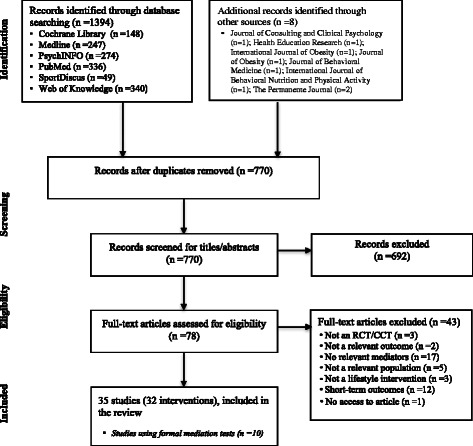
- Systematic review conducted per PRISMA. Six electronic databases were searched for peer-reviewed articles published January 2000–February 2014, plus manual cross-referencing; 1,394 records plus 8 manual additions yielded 1,404 potential articles, 770 abstracts screened, and 35 articles describing 32 unique lifestyle interventions included.
- Eligible studies were experimental lifestyle interventions in overweight/obese adults (≥18 years), reporting outcomes at least 6 months after intervention start and quantitative assessments of self-regulation mediators and weight/BMI, physical activity, or dietary intake. Results were separated into short-term (<12 months) and long-term (≥12 months) outcomes, and formal mediation studies were reported separately from predictor studies.
- Quality was assessed with an adapted Effective Public Health Practice Project tool and a mediation-specific checklist. Heterogeneity prevented meta-analysis, so findings were synthesized narratively with vote counting of significant mediation effects.
Limitations
- The paper states substantial heterogeneity in variables, study designs, measurement methods, populations, and intervention formats/lengths prevented deriving pooled mediation estimates or using meta-analytic techniques; narrative vote counting is less robust. It also notes many primary studies had poor methodological quality, none of the formal mediation studies were strong, outcome measures varied, coding relied on article descriptions, the year 2000 search cutoff was largely arbitrary, and non-controlled trials were included in some analyses.
- The paper states there were too few studies per mediator, dietary evidence was too sparse for meaningful conclusions, and external validity for self-regulation skills and autonomous motivation may be limited because findings came from few research groups using similar designs.
- Evident from the text: only 10 of 35 studies used formal mediation, and for short-term outcomes formal mediation was reported only for physical activity and only two mediators (body image/self-worth and self-efficacy/barriers), so much of the evidence is correlational or predictor-based rather than causal.
Model-written summary. Check it against the paper before relying on it.
Integrity signals
Registry
Cites
Statistics
Figures
Verification
Claims the paper makes
3 Valid · 1 Not valid · 26 Not checked · 77 Own results and interpretations
The cited sources support only part of this claim — read each source’s verdict below.
In the paper
“Second, if and when individuals are able to successfully self-regulate their behaviors, these effects tend to be sustainable, which is essential for having a lasting impact on health; moreover, this successful self-regulation may also “transfer” to, and help change, other health behaviors [18].”
§ Successful behavior change in obesity interventions in adults: a systematic review of self-regulation mediators > Background
What the sources say
- Partly supportedcites [18] Mata J Silva MN Vieira PN Carraça EV Andrade AM Coutinho SR Motivational “spill-over” during weight control: increased self-determination and exercise intrinsic motivation predict eating self-regulation Health Psychol. 2009 28 709 716 10.1037/a0016764 19916639 sourceExperimental — accuracy not yet measured
The Abstract reports that motivation predicted eating self-regulation over 12 months, and the Discussion (p. 18) reports possible spill-over from exercise motivation to eating regulation. These passages support the transfer part of the citing sentence, but they do not establish that successful self-regulation generally produces sustainable effects after the intervention. (LLM, conf=0.86)
hedgedstates an association- Asserted: passes — The authors put it forward as true.
- Checkable: passes — It can be checked against evidence.
- Load-bearing: passes — The paper’s conclusions depend on it.
- Based: passes — The paper gives a reason why it holds.
- Partly supported
Every source the paper cites for this claim was checked and supports it.
In the paper
“Second, if and when individuals are able to successfully self-regulate their behaviors, these effects tend to be sustainable, which is essential for having a lasting impact on health; moreover, this successful self-regulation may also “transfer” to, and help change, other health behaviors [18].”
§ Successful behavior change in obesity interventions in adults: a systematic review of self-regulation mediators > Background
What the sources say
- Supportedcites [18] Mata J Silva MN Vieira PN Carraça EV Andrade AM Coutinho SR Motivational “spill-over” during weight control: increased self-determination and exercise intrinsic motivation predict eating self-regulation Health Psychol. 2009 28 709 716 10.1037/a0016764 19916639 source
The Discussion (p. 18) concludes that spill-over may occur between exercise motivation and eating self-regulation during a weight-control intervention. This supports the cited possibility that self-regulation in one health behavior may help change another. (LLM, conf=0.90)
hedgedstates a possible cause- Asserted: passes — The authors put it forward as true.
- Checkable: passes — It can be checked against evidence.
- Load-bearing: passes — The paper’s conclusions depend on it.
- Based: passes — The paper gives a reason why it holds.
- Supported
Every source the paper cites for this claim was checked and supports it.
In the paper
“More broadly, psychological flexibility appears to predict health and psychological well-being [97], is thought to reflect more committed, values-based goal pursuit [98,99] and is considered a hallmark of self-determination [89], factors which may help explain successful health behavior self-regulation.”
§ Successful behavior change in obesity interventions in adults: a systematic review of self-regulation mediators > Discussion
What the sources say
- Supportedcites [97] Kashdan TB Rottenberg J Psychological flexibility as a fundamental aspect of health Clin Psychol Rev. 2010 30 865 878 10.1016/j.cpr.2010.03.001 21151705 PMC2998793 source
The introduction says psychological flexibility makes a major contribution to daily well-being and lasting psychological health. The ‘Balance among important life domains’ section adds that flexibility-related abilities account for incremental variance in social and psychological health. No page numbers are provided in our copy. (LLM, conf=0.91)
hedgedstates an association- Asserted: passes — The authors put it forward as true.
- Checkable: passes — It can be checked against evidence.
- Load-bearing: unclear — It is unclear whether the paper’s conclusions depend on it.
- Based: passes — The paper gives a reason why it holds.
- Supported
A result the paper reports from its own data — it cites no other source for it, so there is none to check. The quote shows it is in the paper.
In the paper
“Eating disinhibition, which appeared to be an additional predictor in the short-term, does not seem to be consistent in the long-term provided that it was significant only in 38% of the 16 times it was tested.”
§ Successful behavior change in obesity interventions in adults: a systematic review of self-regulation mediators > Results > Mediators/predictors of weight control
hedged- Asserted: passes — The authors put it forward as true.
- Checkable: passes — It can be checked against evidence.
- Load-bearing: passes — The paper’s conclusions depend on it.
- Based: passes — The paper gives a reason why it holds.
A result the paper reports from its own data — it cites no other source for it, so there is none to check. The quote shows it is in the paper.
In the paper
“For physical activity, significant putative mediators were high autonomous motivation, self-efficacy, and use of self-regulation skills.”
§ Successful behavior change in obesity interventions in adults: a systematic review of self-regulation mediators > Abstract > Results
hedgedstates a possible cause- Asserted: passes — The authors put it forward as true.
- Checkable: passes — It can be checked against evidence.
- Load-bearing: passes — The paper’s conclusions depend on it.
- Based: passes — The paper gives a reason why it holds.
36 more claims
Create a free account to see all 107 claims and to verify the 39 references still open.
- It may state two separate claims as one. 40
- Probably not a substantial claim. 41
- The quote only partly states this claim. 1
Claims other papers make about this one
Each is checked against this paper’s own text: does it say what the citing paper says it does?
The source backs part of the claim, not all of it — or backs it for a different population, condition or comparison.
In the citing paper
“This supports findings from a 2015 systematic review suggesting that psychological or self-regulatory skills and body image act as effective mediators of behavior change in lifestyle interventions [66].”
From Barriers and facilitators to diet, physical activity and lifestyle behavior intervention adherence: a qualitative systematic review of the literature (2023) · cites this paper as [66]
Experimental — accuracy not yet measuredThe source backs part of the claim, not all of it — or backs it for a different population, condition or comparison.
In the citing paper
“Improved body acceptance was associated with more stable maintenance of weight control behaviors, especially in individuals with low initial body image satisfaction [94].”
From Dietary and Behavioral Strategies for Weight Loss and Weight Loss Maintenance: A Narrative Review (2025) · cites this paper as [94]
Experimental — accuracy not yet measuredThe source backs part of the claim, not all of it — or backs it for a different population, condition or comparison.
In the citing paper
“This approach potentially enhances the effectiveness of pharmacological treatments through ongoing support and education using real-time microlearning approaches to promote individual self-care capability [18], as well as through supporting the adoption of health-seeking self-care behaviors using nudges and personalized insights delivered using an accessible digital platform [19,20].”
From Impact of Digital Engagement on Weight Loss Outcomes in Obesity Management Among Individuals Using GLP-1 and Dual GLP-1/GIP Receptor Agonist Therapy: Retrospective Cohort Service Evaluation Study (2025) · cites this paper as [20]
Experimental — accuracy not yet measuredIn the citing paper
“Improvements in body acceptance were associated with greater durability of behaviors supporting weight control, particularly among individuals with low baseline satisfaction with their appearance [94].”
From Dietary and Behavioral Strategies for Weight Loss and Weight Loss Maintenance: A Narrative Review (2025) · cites this paper as [94]
In the citing paper
“Findings on self regulatory strategies indicated that regular monitoring of behaviors, planning, and flexible adjustment of actions were more frequently observed among individuals achieving long term results [94].”
From Dietary and Behavioral Strategies for Weight Loss and Weight Loss Maintenance: A Narrative Review (2025) · cites this paper as [94]
1 more claim about this paper
Create a free account to see every claim other papers make about this one.
Self-check
Percentages, sums and reported differences re-computed from the paper’s own numbers.
Each contradiction between two passages listed here was confirmed by an independent check.
Rated minor: it would not touch a result — a value no result rests on, a p-value that stays on the same side of the significance level, or a conflict that is clerical, resolved elsewhere in the paper, or outside its own findings.
In the paper
§ Successful behavior change in obesity interventions in adults: a systematic review of self-regulation mediators > Results > Mediators/predictors of physical activity
“Fourteen variables, grouped in seven categories, were tested as mediators/predictors of short-term weight control (Table 4).”
§ Successful behavior change in obesity interventions in adults: a systematic review of self-regulation mediators > Methods > Data synthesis
“Table: Table 4 Mediators/predictors of short-term physical activity (<12 months)”
Rated minor: it would not touch a result — a value no result rests on, a p-value that stays on the same side of the significance level, or a conflict that is clerical, resolved elsewhere in the paper, or outside its own findings.
In the paper
§ Successful behavior change in obesity interventions in adults: a systematic review of self-regulation mediators > Results > Mediators/predictors of physical activity
“11 looked into short-term outcomes (less than 6 months beyond the start of the intervention)”
§ Successful behavior change in obesity interventions in adults: a systematic review of self-regulation mediators > Methods > Data synthesis
“Table: Table 4 Mediators/predictors of short-term physical activity (<12 months)”
Rated minor: it would not touch a result — a value no result rests on, a p-value that stays on the same side of the significance level, or a conflict that is clerical, resolved elsewhere in the paper, or outside its own findings.
In the paper
“| ↑ Self-regulation skill use | 3 | 3 | 75 | 6 | 6 | 83a |”
§ Successful behavior change in obesity interventions in adults: a systematic review of self-regulation mediators > Methods > Data synthesis
Reported 75 · recomputed 66.666667
Rated minor: it would not touch a result — a value no result rests on, a p-value that stays on the same side of the significance level, or a conflict that is clerical, resolved elsewhere in the paper, or outside its own findings.
In the paper
“| Study design (n = 35) | | Intervention (n = 35) | | | Trial | | Aim | | | NCT | 6 | Weight loss | 15 | | NRCT | 1 | Weight maintenance | 6 | | RCT | 28 | Exercise adherence | 3 | | Arms | | Health promotion | 8 | | 1 arm | 6 | Other | 2 |”
§ Successful behavior change in obesity interventions in adults: a systematic review of self-regulation mediators > Methods > Data synthesis
Reported 35 · recomputed 34
Citations
Cites
Baron, R. M., & Kenny, D. A. (1986) · Journal of Personality and Social Psychology · doi:10.1037/0022-3514.51.6.1173 · Cited by 91,532
Self-efficacy: The exercise of control
Bandura, A., Freeman, W. H., & Lightsey, R. (1999) · Journal of Cognitive Psychotherapy · doi:10.1891/0889-8391.13.2.158 · Cited by 46,835
(2013) · Cited by 44,563
The "what" and "why" of goal pursuits: Human needs and the self-determination of behavior
Deci, E. L., & Ryan, R. M. (2000) · Psychological Inquiry · doi:10.1207/s15327965pli1104_01 · Cited by 34,210 · cited 3×
“Additionally, because self-determined, well-internalized behaviors are associated with the satisfaction of the needs for autonomy, competence, and relatedness - and with the feelings of internal coherence and well-being that are thought to emerge from those experiences - this provides an explanation for the behavior t…”
BackgroundThe Cochrane Collaboration's tool for assessing risk of bias in randomised trials
Higgins, J. P. T., Altman, D. G., Gotzsche, P. C., Juni, P., Moher, D., Oxman, A. D., Savovic, J., Schulz, K. F., Weeks, L., Sterne, J. A. C., et al. (2011) · BMJ · doi:10.1136/bmj.d5928 · Cited by 33,817
Liberati, A., Altman, D. G., Tetzlaff, J., Mulrow, C., Gøtzsche, P. C., Ioannidis, J. P. A., Clarke, M., Devereaux, P. J., Kleijnen, J., & Moher, D. (2009) · PLoS Medicine · doi:10.1371/journal.pmed.1000100 · Cited by 28,164 · cited 3×
“A data extraction form was developed, informed by the PRISMA statement for reporting systematic reviews [21] and the Cochrane Collaboration’s tool for assessing risk of bias [27].”
MethodIntrinsic Motivation and Self-Determination in Human Behavior
Deci, E. L., & Ryan, R. M. (1985) · doi:10.1007/978-1-4899-2271-7 · Cited by 26,772 · cited 1×
“A wide variety of health behavior change theories has been employed to provide conceptual organization of these determinants, including social cognitive theories such as the theory of planned behavior [5], theories of motivation such as self-determination theory [6], theories distinguishing between motivational and po…”
BackgroundDermyshi, E., Wang, Y., Yan, C., Hong, W., Qiu, G., Gong, X., & Zhang, T. (2017) · Neonatology · doi:10.1159/000454668 · Cited by 24,451
Self-efficacy: the exercise of control
(1997) · Choice Reviews Online · doi:10.5860/choice.35-1826 · Cited by 24,281
From Intentions to Actions: A Theory of Planned Behavior
Ajzen, I. (1985) · Action Control · doi:10.1007/978-3-642-69746-3_2 · Cited by 19,057
Cited by
Items 601–700 of 798
Bentley, J. R., Yu, X., Karmarkar, A. M., Downer, B. G., Prochaska, J. D., & Lyons, E. (2021) · Research Square · doi:10.21203/rs.3.rs-435122/v1
Knowing Well, Being Well: well-being born of understanding: The Homo Sapiens Superpower
Katz, D. L., Geyer, C., Sanchez, H., & Buettner, D. (2021) · American Journal of Health Promotion · doi:10.1177/08901171211002328
Hedonic Motivation versus Reflective Motivation
Williams, D. M. (2019) · Cambridge University Press eBooks · doi:10.1017/9781316275047.015
Pleasure, Displeasure, and Affective Valence
Williams, D. M. (2019) · Cambridge University Press eBooks · doi:10.1017/9781316275047.010
Painoneutraali lähestymistapa lihavuuden hoidossa - vaikutus intuitiiviseen syömiseen ja painoon
Pöntinen, J. (2021) · UEF eRepo (University of Eastern Finland)
Yazarloo, S., Sarbakhash, P., Shokrvash, B., Ebahimi-Mamghani, M., Hariri-Akbari, M., & Shahedifar, N. (2021) · Research Square · doi:10.21203/rs.3.rs-513245/v1
Psychological Hedonism and Its Problems
Williams, D. M. (2019) · Cambridge University Press eBooks · doi:10.1017/9781316275047.008
Financial incentives for decreasing and preventing obesity in workers
Keikha, M., Jahanfar, S., Christie, J., Abedi, P., Danowski, M., Yoneoka, D., & Ebrahimi, M. H. (2021) · Cochrane Database of Systematic Reviews · doi:10.1002/14651858.cd014576
Williams, D. M. (2019) · Cambridge University Press eBooks · doi:10.1017/9781316275047.027
Reward, Incentive Salience, and Hedonic Motivation
Williams, D. M. (2019) · Cambridge University Press eBooks · doi:10.1017/9781316275047.013
Reformulating Psychological Hedonism
Williams, D. M. (2019) · Cambridge University Press eBooks · doi:10.1017/9781316275047.009
Understanding the Causes of Behavior
Williams, D. M. (2019) · Cambridge University Press eBooks · doi:10.1017/9781316275047.004
Williams, D. M. (2019) · Cambridge University Press eBooks · doi:10.1017/9781316275047.012
Richardson, J. (2020) · Worcester Research and Publications (University of Worcester) · Cited by 1
Desarrollo de un dispositivo para la determinación de la aptitud del hormigón para el bombeo
López, M. R. (2011) · RECERCAT (Consorci de Serveis Universitaris de Catalunya)
The Phylogenetic Development of Psychological Hedonism
Williams, D. M. (2019) · Cambridge University Press eBooks · doi:10.1017/9781316275047.021
Williams, D. M. (2019) · Cambridge University Press eBooks · doi:10.1017/9781316275047.018
From Hedonic Motivation to Unhealthy Behavior
Williams, D. M. (2019) · Cambridge University Press eBooks · doi:10.1017/9781316275047.016
Williams, D. M. (2019) · Cambridge University Press eBooks · doi:10.1017/9781316275047.022
Darwinian Hedonism and Political Will
Williams, D. M. (2019) · Cambridge University Press eBooks · doi:10.1017/9781316275047.029
Darwinian Hedonism and Hedonic Desire for Calorie-Dense Foods
Williams, D. M. (2019) · Cambridge University Press eBooks · doi:10.1017/9781316275047.024
Williams, D. M. (2019) · Cambridge University Press eBooks · doi:10.1017/9781316275047.001
Conclusions and Future Directions
Williams, D. M. (2019) · Cambridge University Press eBooks · doi:10.1017/9781316275047.030
Williams, D. M. (2019) · Cambridge University Press eBooks · doi:10.1017/9781316275047.002
Williams, D. M. (2019) · Cambridge University Press eBooks · doi:10.1017/9781316275047.033
The Epidemic of Unhealthy Behavior
Williams, D. M. (2019) · Cambridge University Press eBooks · doi:10.1017/9781316275047.003
Darwinian Hedonism and Hedonic Desire for Smoking, Drinking, and Drug Use
Williams, D. M. (2019) · Cambridge University Press eBooks · doi:10.1017/9781316275047.026
Anticipating Criticisms of Darwinian Hedonism
Williams, D. M. (2019) · Cambridge University Press eBooks · doi:10.1017/9781316275047.032
Darwinian Hedonism and Health-Behavior Policy
Williams, D. M. (2019) · Cambridge University Press eBooks · doi:10.1017/9781316275047.028
Williams, D. M. (2019) · Cambridge University Press eBooks · doi:10.1017/9781316275047.019
Williams, D. M. (2019) · Cambridge University Press eBooks · doi:10.1017/9781316275047.006
Incentive Conditioning: From Hedonic Response to Hedonic Motivation
Williams, D. M. (2019) · Cambridge University Press eBooks · doi:10.1017/9781316275047.014
Darwinian Hedonism and Unhealthy Behavior
Williams, D. M. (2019) · Cambridge University Press eBooks · doi:10.1017/9781316275047.023
Williams, D. M. (2019) · Cambridge University Press eBooks · doi:10.1017/9781316275047.011
Williams, D. M. (2019) · Cambridge University Press eBooks · doi:10.1017/9781316275047.005
Understanding vocational students' motivation for dietary and physical activity behavioursPreprint
Kuipers, A., Kloek, G. C., & de Vries, S. I. (2020) · Research Square · doi:10.21203/rs.2.20913/v1
“Consumption of unhealthy choices (portions/week) 24 (21) 18 (8-33) Breakfast consumption (days/week) 4.”
BackgroundManagement of Obese Pediatric Patients in the Digital Era
Vlachopapadopoulou, E. A., Georga, E. I., & Fotiadis, D. I. (2022) · IGI Global eBooks · doi:10.4018/978-1-6684-5360-5.ch026
Understanding vocational students' motivation for dietary and physical activity behavioursPreprint
Kuipers, A., Kloek, G. C., & de Vries, S. I. (2020) · doi:10.21203/rs.2.20913/v2
Arigo, D., & Pasko, K. (2020) · Springer eBooks · doi:10.1007/978-3-030-39903-0_102008
Weight management: Weight maintenance
Griffiths, L. A., Jackson, A. M., Steeves, E. A., & Raynor, H. A. (2022) · Elsevier eBooks · doi:10.1016/b978-0-12-821848-8.00056-1
Bolt, L. J. J. (2022) · Research Publications (Maastricht University) · doi:10.26481/dis.20220331lb
Computational modelling of the biological and social factors of type 2 diabetes
Dutta, P. (2021) · DR-NTU (Nanyang Technological University) · doi:10.32657/10356/155229
Warschburger, P. (2020) · Springer eBooks · doi:10.1007/978-3-662-61170-8_19
Williams, D. M. (2019) · Cambridge University Press eBooks · doi:10.1017/9781316275047.034
Messerli‐Bürgy, N., & Munsch, S. (2018) · Springer eBooks · doi:10.1007/978-3-662-54909-4_16
Nutritional therapy for gestational diabetes mellitus: what does the evidence say?
Kaminarskaya, Y. A. (2022) · Clinical nutrition and metabolism · doi:10.17816/clinutr105653
“Отсутствие строгих ограничений и более разнообразный выбор продуктов делает этот вид диетотерапии более доступным и вызывает меньше тревоги у беременных, что улучшает приверженность к лечению [23, 25, 68].”
van Zutphen, E. M., Kok, A. A. L., Rhebergen, D., van Schoor, N. M., Huisman, M. A., & Beekman, A. T. F. (2022) · Journal of Psychosomatic Research · doi:10.1016/j.jpsychores.2022.111015
Gillespie, C. (2022) · Wiley eBooks · doi:10.1002/9781119521686.ch11
Mechanisms of change in cognitive-behavioral therapy for weight loss
Comșa, L. T., & David, D. (2023) · Elsevier eBooks · doi:10.1016/b978-0-323-85726-0.00044-2
Annesi, J. J., & Stewart, F. A. (2023) · Health Behavior Research · doi:10.4148/2572-1836.1180
Walc, A. M., Latimer‐Cheung, A. E., Day, A. G., Brennan, A. M., Hill, J. O., & Ross, R. (2023) · Clinical Obesity · doi:10.1111/cob.12587
“Self-monitoring for the behaviour change is consistent with self-regulation theory,(26) and according to systematic reviews, autonomous motivation, self-efficacy and self-regulation skills are highly predictive of beneficial weight and physical activity outcomes in trials including participants with obesity.(27) Our f…”
Obesity Intervention in Sub-Saharan Africa: A systematic review protocolPreprint
Agyemang, K., & Anokye, N. (2023) · medRxiv · doi:10.1101/2023.07.18.23292826
Brunet, J., Sharma, S., Price, J., & Black, M. (2023) · JMIR Formative Research · doi:10.2196/48301
Genes, D., Sirois, F. M., & Buckland, N. J. (2023) · Health Psychology Open · doi:10.1177/20551029231214058
“According to self-regulation theory, various individual characteristics can help people face adversity and continue their self-regulation attempts (Teixeira et al., 2015).”
BackgroundLedoux, T. A., Gamal, B., Duque, A., & Berens, P. (2024) · Midwifery · doi:10.1016/j.midw.2024.103939
Felisatti, F. (2023) · theses.fr (ABES) · doi:10.70675/957c3e86z0eabz4d4bza536z8ed0d286cd98 · Cited by 3
Effects of fitness apps on body image and mental health: a systematic review (Preprint)Preprint
Lu, Y.-X., Tong, X., Hua, C., & Wan, D.-L. (2024) · doi:10.2196/preprints.58348
DiFilippo, K. N., & Chapman‐Novakofski, K. (2024) · Topics in Clinical Nutrition · doi:10.1097/tin.0000000000000352 · Cited by 1
“9,10 Mobile applications (apps) have been shown to utilize strategies, which support dietary adherence for the management of HTN, such as self-monitoring.”
BackgroundAlsairi, R. (2024) · Queensland University of Technology · doi:10.5204/thesis.eprints.248232
Streb, A. R., Vieira, C. G., Leonel, L. D. S., Bertuol, C., Tozetto, W. R., Benedet, J., & Duca, G. F. D. (2024) · Clinical Rehabilitation · doi:10.1177/02692155241249670
“24,30 Thus, physical inactivity and other negative outcomes, such as eating disorders related to this behavior, can approach current image disorders, while exercise improves the conception of the ideal image.”
BackgroundBenton, D. (2024) · Springer eBooks · doi:10.1007/978-3-031-48197-0_23
Annesi, J. J., & Powell, S. M. (2024) · International Journal of Behavioral Medicine · doi:10.1007/s12529-024-10294-2
“For example, in a review of 35 studies of durations of at least 6 months, changes in self-regulation and self-efficacy were associated with weight loss in adults with overweight and obesity [17], and with class 2 and 3 obesity [18].”
Dumayas, G. R. (2023) · International Journal of Science and Research (IJSR) · doi:10.21275/sr23816031614
Annesi, J. J., & Stewart, F. A. (2024) · Psychological Reports · doi:10.1177/00332941241255037
“…cognitive theory ’ s (Bandura, 1986) assertion that individuals can develop abilities to overcome their environmental challenges such as with improving their dietary behaviors and increasing exercise, self-regulation has been a key research focus (Annesi & Walsh, 2021; Teixeira et al., 2015).”
InfluentialAnnesi, J. J., & Jennings, J. K. (2024) · Health Care For Women International · doi:10.1080/07399332.2024.2359555
“Recent iterations of psychological skills-based interventions proposed by researchers (Annesi & Johnson, 2017; Jacob et al., 2018; Teixeira et al., 2015) are often grounded in tenets of social cognitive theory (Bandura, 1986, Bandura, 2005), self-efficacy theory (Bandura, 1997), and/or…”
Dramatic tension, social support & weight loss narrative persuasion
Mayer, A. M., & Lee, H. (2024) · iDEA - Drexel University Institutional Repository · doi:10.17918/00010426 · Cited by 1
Carregosa, E. S., Medreiros, L. S., Lima, K. D. A., do Nascimento, M. V. S., Rodrigues, M. A. S., dos Santos, B. L. A., Franco, F. S., Souza, K. D. B. S., Vieira, J. D. F., Barreto, V. L. F., et al. (2024) · Revista Sociedade Científica · doi:10.61411/rsc202450717 · Cited by 1
Relation Between Energy Intake and Obesity or Overweight in Childbearing Age Woman: A Scoping Review
Siswati, T., Ainiyyah, A. Z. N., Afifah, H., & Sitasari, A. (2024) · National Journal of Community Medicine · doi:10.55489/njcm.150920244158 · Cited by 1
“37,40”
BackgroundPinto, M., & Santos, I. (2024) · Revista Brasileira de Atividade Física & Saúde · doi:10.12820/rbafs.29e0352
Vainikainen, M.-P., Nikunen, M., Tuomisto, M. T., Siljamäki-Ojansuu, U., & Koivula, S.-S. (2025) · Psykologia · doi:10.62443/psykologia.v55i1.69743
Annesi, J. J., Adams, K. J., & Bakhshi, M. (2025) · Journal of Prevention · doi:10.1007/s10935-025-00842-1
“It has also been previously incorporated into behavioral obesity treatments with a strong emphasis on self-regulating through challenges and barriers (Teixeira et al., 2015).”
Dunton, G. F., Hatzinger, L. A., Crosley‐Lyons, R., Hewus, M., Wang, W., Dyck, D. V., & Huh, J. (2025) · Contemporary Clinical Trials · doi:10.1016/j.cct.2025.107945
Annesi, J. J. (2025) · Nutrition and Health · doi:10.1177/02601060251350428 · Cited by 1
“The fi ndings extend previous treatment-related research on psycho-social factors related to weight loss in adults (Clark et al., 1991; Marcus et al., 1992; Michie et al., 2011; Teixeira et al., 2015), in this case women with obesity (see Figures 1 and 2).”
InfluentialPimenta, F., Garcia, I. Q., Damião, C., Rosas, R., & Leal, I. M. P. (2025) · Journal of Health Psychology · doi:10.1177/13591053251348301
“They can also shape intrapsychic experiences (e.g. attribution of meaning, reshaping beliefs, valuing results, emotional experiences, among others), and such consequences become a driving force for motivation, thereby as a crucial mechanism of action (Palmeira et al., 2023; Teixeira et al., 2015).”
Yang, X., Qu, G., Luk, L., Mo, P. K. H., Yip, B. H. K., Wong, S. Y. S., & Wong, C. K. M. (2025) · BMC Family Practice · doi:10.1186/s12875-025-02957-0
“The significant role of emotions in unhealthy lifestyles and lifestyle changes has been highlighted in previous surveys [33–35].”
Zeng, Y., Long, Q., Jiang, Y., Li, J., Rao, Z., Zhong, J., & Guo, J. (2025) · Nutrients · doi:10.3390/nu17152478
“Numerous SCT-based lifestyle interventions have been designed to modify the aforementioned unhealthy lifestyles among obese adults [13].”
Røynesdal, Ø. B., Smith, O. R. F., Sørensen, M., van Nassau, F., Jelsma, J. G. M., Wyke, S., Gray, C. M., Pereira, H. V., Andersen, E., Silva, M. N., et al. (2025) · International Journal of Sport and Exercise Psychology · doi:10.1080/1612197x.2025.2547364
“…recent meta-analyses that emphasise how SDT-based interventions can foster health behaviour change (Rhodes et al., 2021; Sheeran et al., 2020, 2021; Teixeira et al., 2015), but also meta-analyses demonstrating indirect effects of autonomous motivation on PA outcomes (Ng et al., 2012; Rhodes et…”
Annesi, J. J. (2025) · Nutrients · doi:10.3390/nu17193048
“Consistent with the theory background [26–28] and other related research findings [18,29,31,34,35], S-Reg and S-Eff were confirmed as important intervention targets.”
Fu, D., He, Q., Wu, T., Wang, X., Xiao, M., Yuan, J., & Yan, X. (2025) · Cognitive Neurodynamics · doi:10.1007/s11571-025-10350-x
“As an important subcomponent of executive function (Baddeley 2012), working memory (WM) plays a central role in self-regulation, which is closely associated with eating behaviors and body weight management (Houben et al. 2016; Teixeira et al. 2015).”
Rasquinha, R. D., Pelletier, A. J., Klein, L., Sommer, S., Roche, A. T., Solanky, P., Wang, S., Gregoire, A., Hopkins, S., Katz, E., et al. (2025) · Research Square · doi:10.21203/rs.3.rs-6181028/v1
Kushitor, M. K., Yacobi, H., Okoibhole, L. O., Kushitor, S. B., Antwi, P., Kretchy, I. A., Sanuade, O. A., Amon, S., Baatiema, L., Asah-Ayeh, V., et al. (2025) · BMC Public Health · doi:10.1186/s12889-025-24106-z
“Some scientists have suggested that any intervention proposed for the built environment should be based on the perspectives of the local community [27].”
Masagca, R. C. (2025) · Physical Education of Students · doi:10.15561/20755279.2025.0508
“In men, appearance-related goals may contribute to dysregulated eating through pressure to meet social standards of strength and control [62].”
Brunet, J., Price, J., Gillison, F., Standage, M., Taljaard, M., Beauchamp, M. R., Reed, J. L., & Srikanthan, A. (2025) · Pilot and Feasibility Studies · doi:10.1186/s40814-025-01701-w
“As a whole, the intervention seeks to promote young adults’ autonomous motivation for PA—a key driver of behavior change [46, 53, 54]—by fostering their psychological needs for competence, autonomy, and relatedness via motivational interviewing and (motivational) behavior change techniques.”
Psychosocial Functionality and Predictors in Bariatric Surgery Candidates
Gök, R., Şişman, E., Tatlıdil, E., & Polat, A. (2025) · ALPHA PSYCHIATRY · doi:10.31083/ap47647
Annesi, J. J., & Machek, S. B. (2025) · Obesities · doi:10.3390/obesities5040083
“…through behavioral means, theories such as social cognitive theory [22] and self-regulation theory [23], as well as previous research [9,11,24,25], suggest advantages of a focus on increasing one’s ability to self-regulate through common challenges/barriers such as negative emotional states,…”
Petinatti, L. R. D. A. L. (2025) · Revista Acadêmica Online · doi:10.36238/2359-5787.2025.v11n60.1750
Chen, W., Zheng, Z., Zhang, S., Ismail, R., Geldsetzer, P., Bärnighausen, T., Wang, C., Chen, S., & Su, T. T. (2025) · JMIR Public Health and Surveillance · doi:10.2196/80381
“Screening alone may be insufficient to drive significant weight loss if participants lack the resources, motivation, or sustained support to act on the feedback [22].”
Imagem corporal positiva, regulação e estado emocional em candidatos a cirurgia bariátrica
Nora, M. B. (2022) · Portuguese National Funding Agency for Science, Research and Technology (RCAAP Project by FCT) · doi:10.34626/v13n-2q39
Romeo, A., Edney, S. M., Plotnikoff, R. C., Olds, T., Vandelanotte, C., Ryan, J., Curtis, R., & Maher, C. A. (2021) · Figshare · doi:10.6084/m9.figshare.13544392
Varela, C., Oda-Montecinos, C., Andrés, A., & Saldaña, C. (2021) · Figshare · doi:10.6084/m9.figshare.14853308
Jiang, Y., Dou, Y., Chen, H. Y., Zhang, Y., Chen, X., Wang, Y., Rodrigues, M., & Yan, W. (2021) · Figshare · doi:10.6084/m9.figshare.14782800
Jiang, Y., Dou, Y., Chen, H. Y., Zhang, Y., Chen, X., Wang, Y., Rodrigues, M., & Yan, W. (2021) · Figshare · doi:10.6084/m9.figshare.14782809
Jiang, Y., Dou, Y., Chen, H. Y., Zhang, Y., Chen, X., Wang, Y., Rodrigues, M., & Yan, W. (2021) · Figshare · doi:10.6084/m9.figshare.14782815
Metadata
- Authors
- Teixeira, P. J., Carraça, E. V., Marques, M. M., Rutter, H., Oppert, J.-M., De Bourdeaudhuij, I., Lakerveld, J., & Brug, J.
- Affiliations
- University of Lisbon (PT)
- London School of Hygiene & Tropical Medicine (GB)
- Inserm (FR)
- Amsterdam Public Health (NL)
- Corresponding author
- Teixeira, Pedro J
- ORCID
- Venue
- BMC Medicine
- Published
- 2015-04-16
- Volume
- 13
- Issue
- 1
- Pages
- 84-84
- ISSN
- 1741-7015 (ISSN-L)
- PMC
- PMC4408562
- OpenAlex
- W2092285599
- Semantic Scholar
- 99966d9cd971dd6a646ec628d2242042583d1635
- Cited by
- 711
- References
- 125
- Citations by year
- 2026: 50 · 2025: 57 · 2024: 55 · 2023: 50 · 2022: 64 · 2021: 86 · 2020: 76 · 2019: 107 · 2018: 65 · 2017: 49 · 2016: 43 · 2015: 7
- FWCI
- 7.59
- Type
- journal article
- Language
- en
- Open access
- gold
- doi.org
- Locations
- BMC Medicine (publishedVersion, cc-by)
- Europe PMC (PubMed Central) (publishedVersion, cc-by)
- PubMed Central (publishedVersion, cc-by)
- PubMed (publishedVersion)
- Pure Amsterdam UMC (publishedVersion, other-oa)
- Amsterdam UMC (VU Amsterdam) - Institutional Repository (publishedVersion)
- LSHTM Research Online (London School of Hygiene and Tropical Medicine) (acceptedVersion)
- Data Archiving and Networked Services (DANS) (acceptedVersion, other-oa)
- Ghent University Academic Bibliography (Ghent University) (submittedVersion, other-oa)
- HAL (submittedVersion, other-oa)
- UCL Discovery (University College London) (submittedVersion)
- Data Archiving and Networked Services (DANS) (submittedVersion)
- Funders
- European Commission (278186, FP7‐HEALTH‐2011)
- FP7 Health (278186)
- Topics
- Social Sciences › Psychology › Applied Psychology › Behavioral Health and Interventions
- Health Sciences › Medicine › Public Health, Environmental and Occupational Health › Obesity, Physical Activity, Diet
- Health Sciences › Medicine › Public Health, Environmental and Occupational Health › Obesity and Health Practices
- Keywords
- obesity intervention, behavior change, self-regulation, mediators, weight loss, weight maintenance, physical activity, dietary intake, autonomous motivation, self-efficacy, self-monitoring, dietary restraint, body image, relapse, lifestyle intervention, overweight adults
- MeSH terms
- Behavior Therapy, Diet, Humans, Life Style, Motor Activity, Obesity, Weight Loss, Overweight
About these checks
Registry, retraction, Cites and statistics results are computed, not judged, with one exception: a printed reference that no index lists is read once by a model before it counts as a citation error. Claims are extracted by a model and kept only when their quote appears verbatim in the text; each cited source is then checked, with a model’s help, for whether it says what the claim relies on. Those verdicts can be wrong — read the claim’s quote and the cited source before relying on one.
The claim verdicts this report counts are experimental: their accuracy is not yet measured.
A language model drew the claims from the paper on 2026-10-04, under version 3 of the claim definition (model deepseek-v4.1-flash, prompt extract-v3).
A second model labelled each claim on 2026-10-04 (model jev-1.13-20260917, definition revision gold-guideline-v0.2).
Cited sources are checked with a language model’s help (gpt-6-sol).
Statistics and arithmetic are recomputed, not judged.
Confidence bands are shown only for fields calibrated on our annotated test set. None is calibrated yet, so no band is shown.
What counts as a claim ›How we measure confidence ›How we check this ›
Are you an author, or do you see a problem with this page? Request a review
Data sources
Bibliographic data: Semantic Scholar, OpenAlex, Crossref.
Contains information from the Semantic Scholar Academic Graph Datasets, made available under the ODC Attribution License (ODC-BY 1.0).
Semantic Scholar’s data is described in: Kinney, R., et al. (2023). The Semantic Scholar Open Data Platform. arXiv:2301.10140.
