

Successful behavior change in obesity interventions in adults: a systematic review of self-regulation mediators
Open accessThe DOI matches its Crossref record; 125 of the 125 references it cites were found in a registry or an index; 7 of the 46 sources its claims cite were checked for support.
Abstract
BACKGROUND: Relapse is high in lifestyle obesity interventions involving behavior and weight change. Identifying mediators of successful outcomes in these interventions is critical to improve effectiveness and to guide approaches to obesity treatment, including resource allocation. This article reviews the most consistent self-regulation mediators of medium- and long-term weight control, physical activity, and dietary intake in clinical and community behavior change interventions targeting overweight/obese adults. METHODS: A comprehensive search of peer-reviewed articles, published since 2000, was conducted on electronic databases (for example, MEDLINE) and journal reference lists. Experimental studies were eligible if they reported intervention effects on hypothesized mediators (self-regulatory and psychological mechanisms) and the association between these and the outcomes of interest (weight change, physical activity, and dietary intake). Quality and content of selected studies were analyzed and findings summarized. Studies with formal mediation analyses were reported separately. RESULTS: Thirty-five studies were included testing 42 putative mediators. Ten studies used formal mediation analyses. Twenty-eight studies were randomized controlled trials, mainly aiming at weight loss or maintenance (n = 21). Targeted participants were obese (n = 26) or overweight individuals, aged between 25 to 44 years (n = 23), and 13 studies targeted women only. In terms of study quality, 13 trials were rated as "strong", 15 as "moderate", and 7 studies as "weak". In addition, methodological quality of formal mediation analyses was "medium". Identified mediators for medium-/long-term weight control were higher levels of autonomous motivation, self-efficacy/barriers, self-regulation skills (such as self-monitoring), flexible eating restraint, and positive body image. For physical activity, significant putative mediators were high autonomous motivation, self-efficacy, and use of self-regulation skills. For dietary intake, the evidence was much less clear, and no consistent mediators were identified. CONCLUSIONS: This is the first systematic review of mediational psychological mechanisms of successful outcomes in obesity-related lifestyle change interventions. Despite limited evidence, higher autonomous motivation, self-efficacy, and self-regulation skills emerged as the best predictors of beneficial weight and physical activity outcomes; for weight control, positive body image and flexible eating restraint may additionally improve outcomes. These variables represent possible targets for future lifestyle interventions in overweight/obese populations.
Overview
CoChat Summary
TL;DR
This systematic review of 35 lifestyle intervention studies found that autonomous motivation, self-efficacy, and self-regulation skills are the most consistent self-regulation mediators of weight control and physical activity in overweight/obese adults. For long-term weight control, positive body image and flexible eating restraint may also matter, while dietary intake had no consistent mediators.
Key findings
- Across 35 studies testing 42 putative mediators, 10 used formal mediation analyses; 28 were randomized controlled trials, mainly targeting weight loss or maintenance (n = 21). Study quality was rated strong for 13 trials, moderate for 15, and weak for 7; all 10 formal mediation analyses were rated medium quality.
- For medium/long-term weight control (≥12 months), formal mediation supported body image (significant in 100% of 3 tests), self-regulation skills (75% of 3 formal tests; 83% of 6 overall tests), and self-efficacy/barriers (67% of 3 formal tests; 68% of 28 overall tests). Autonomous motivation and flexible eating restraint were promising but derived from a single study each.
- For long-term physical activity, the main predictors were autonomous motivation (83% of formal mediation tests; 93% of overall tests) and self-efficacy (67% of formal tests; 75% of overall tests). Self-regulation skill use was less consistent and derived from low-quality studies.
- For dietary intake, no consistent mediators were identified. In the short term, self-efficacy/barriers and self-regulation skill use were each consistent with mediation in 75% of tests, but long-term self-efficacy was consistent with mediation in only 2 of 8 tests.
Methods
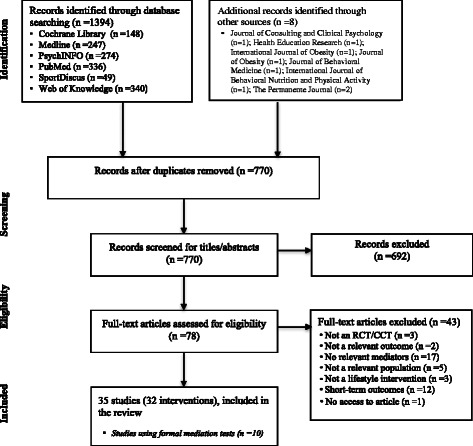
- Systematic review conducted per PRISMA. Six electronic databases were searched for peer-reviewed articles published January 2000–February 2014, plus manual cross-referencing; 1,394 records plus 8 manual additions yielded 1,404 potential articles, 770 abstracts screened, and 35 articles describing 32 unique lifestyle interventions included.
- Eligible studies were experimental lifestyle interventions in overweight/obese adults (≥18 years), reporting outcomes at least 6 months after intervention start and quantitative assessments of self-regulation mediators and weight/BMI, physical activity, or dietary intake. Results were separated into short-term (<12 months) and long-term (≥12 months) outcomes, and formal mediation studies were reported separately from predictor studies.
- Quality was assessed with an adapted Effective Public Health Practice Project tool and a mediation-specific checklist. Heterogeneity prevented meta-analysis, so findings were synthesized narratively with vote counting of significant mediation effects.
Limitations
- The paper states substantial heterogeneity in variables, study designs, measurement methods, populations, and intervention formats/lengths prevented deriving pooled mediation estimates or using meta-analytic techniques; narrative vote counting is less robust. It also notes many primary studies had poor methodological quality, none of the formal mediation studies were strong, outcome measures varied, coding relied on article descriptions, the year 2000 search cutoff was largely arbitrary, and non-controlled trials were included in some analyses.
- The paper states there were too few studies per mediator, dietary evidence was too sparse for meaningful conclusions, and external validity for self-regulation skills and autonomous motivation may be limited because findings came from few research groups using similar designs.
- Evident from the text: only 10 of 35 studies used formal mediation, and for short-term outcomes formal mediation was reported only for physical activity and only two mediators (body image/self-worth and self-efficacy/barriers), so much of the evidence is correlational or predictor-based rather than causal.
Model-written summary. Check it against the paper before relying on it.
Integrity signals
Registry
Cites
Statistics
Figures
Verification
Claims the paper makes
3 Valid · 1 Not valid · 26 Not checked · 77 Own results and interpretations
The cited sources support only part of this claim — read each source’s verdict below.
In the paper
“Second, if and when individuals are able to successfully self-regulate their behaviors, these effects tend to be sustainable, which is essential for having a lasting impact on health; moreover, this successful self-regulation may also “transfer” to, and help change, other health behaviors [18].”
§ Successful behavior change in obesity interventions in adults: a systematic review of self-regulation mediators > Background
What the sources say
- Partly supportedcites [18] Mata J Silva MN Vieira PN Carraça EV Andrade AM Coutinho SR Motivational “spill-over” during weight control: increased self-determination and exercise intrinsic motivation predict eating self-regulation Health Psychol. 2009 28 709 716 10.1037/a0016764 19916639 sourceExperimental — accuracy not yet measured
The Abstract reports that motivation predicted eating self-regulation over 12 months, and the Discussion (p. 18) reports possible spill-over from exercise motivation to eating regulation. These passages support the transfer part of the citing sentence, but they do not establish that successful self-regulation generally produces sustainable effects after the intervention. (LLM, conf=0.86)
hedgedstates an association- Asserted: passes — The authors put it forward as true.
- Checkable: passes — It can be checked against evidence.
- Load-bearing: passes — The paper’s conclusions depend on it.
- Based: passes — The paper gives a reason why it holds.
- Partly supported
Every source the paper cites for this claim was checked and supports it.
In the paper
“Second, if and when individuals are able to successfully self-regulate their behaviors, these effects tend to be sustainable, which is essential for having a lasting impact on health; moreover, this successful self-regulation may also “transfer” to, and help change, other health behaviors [18].”
§ Successful behavior change in obesity interventions in adults: a systematic review of self-regulation mediators > Background
What the sources say
- Supportedcites [18] Mata J Silva MN Vieira PN Carraça EV Andrade AM Coutinho SR Motivational “spill-over” during weight control: increased self-determination and exercise intrinsic motivation predict eating self-regulation Health Psychol. 2009 28 709 716 10.1037/a0016764 19916639 source
The Discussion (p. 18) concludes that spill-over may occur between exercise motivation and eating self-regulation during a weight-control intervention. This supports the cited possibility that self-regulation in one health behavior may help change another. (LLM, conf=0.90)
hedgedstates a possible cause- Asserted: passes — The authors put it forward as true.
- Checkable: passes — It can be checked against evidence.
- Load-bearing: passes — The paper’s conclusions depend on it.
- Based: passes — The paper gives a reason why it holds.
- Supported
Every source the paper cites for this claim was checked and supports it.
In the paper
“More broadly, psychological flexibility appears to predict health and psychological well-being [97], is thought to reflect more committed, values-based goal pursuit [98,99] and is considered a hallmark of self-determination [89], factors which may help explain successful health behavior self-regulation.”
§ Successful behavior change in obesity interventions in adults: a systematic review of self-regulation mediators > Discussion
What the sources say
- Supportedcites [97] Kashdan TB Rottenberg J Psychological flexibility as a fundamental aspect of health Clin Psychol Rev. 2010 30 865 878 10.1016/j.cpr.2010.03.001 21151705 PMC2998793 source
The introduction says psychological flexibility makes a major contribution to daily well-being and lasting psychological health. The ‘Balance among important life domains’ section adds that flexibility-related abilities account for incremental variance in social and psychological health. No page numbers are provided in our copy. (LLM, conf=0.91)
hedgedstates an association- Asserted: passes — The authors put it forward as true.
- Checkable: passes — It can be checked against evidence.
- Load-bearing: unclear — It is unclear whether the paper’s conclusions depend on it.
- Based: passes — The paper gives a reason why it holds.
- Supported
A result the paper reports from its own data — it cites no other source for it, so there is none to check. The quote shows it is in the paper.
In the paper
“Eating disinhibition, which appeared to be an additional predictor in the short-term, does not seem to be consistent in the long-term provided that it was significant only in 38% of the 16 times it was tested.”
§ Successful behavior change in obesity interventions in adults: a systematic review of self-regulation mediators > Results > Mediators/predictors of weight control
hedged- Asserted: passes — The authors put it forward as true.
- Checkable: passes — It can be checked against evidence.
- Load-bearing: passes — The paper’s conclusions depend on it.
- Based: passes — The paper gives a reason why it holds.
A result the paper reports from its own data — it cites no other source for it, so there is none to check. The quote shows it is in the paper.
In the paper
“For physical activity, significant putative mediators were high autonomous motivation, self-efficacy, and use of self-regulation skills.”
§ Successful behavior change in obesity interventions in adults: a systematic review of self-regulation mediators > Abstract > Results
hedgedstates a possible cause- Asserted: passes — The authors put it forward as true.
- Checkable: passes — It can be checked against evidence.
- Load-bearing: passes — The paper’s conclusions depend on it.
- Based: passes — The paper gives a reason why it holds.
36 more claims
Create a free account to see all 107 claims and to verify the 39 references still open.
- It may state two separate claims as one. 40
- Probably not a substantial claim. 41
- The quote only partly states this claim. 1
Claims other papers make about this one
Each is checked against this paper’s own text: does it say what the citing paper says it does?
The source backs part of the claim, not all of it — or backs it for a different population, condition or comparison.
In the citing paper
“This supports findings from a 2015 systematic review suggesting that psychological or self-regulatory skills and body image act as effective mediators of behavior change in lifestyle interventions [66].”
From Barriers and facilitators to diet, physical activity and lifestyle behavior intervention adherence: a qualitative systematic review of the literature (2023) · cites this paper as [66]
Experimental — accuracy not yet measuredThe source backs part of the claim, not all of it — or backs it for a different population, condition or comparison.
In the citing paper
“Improved body acceptance was associated with more stable maintenance of weight control behaviors, especially in individuals with low initial body image satisfaction [94].”
From Dietary and Behavioral Strategies for Weight Loss and Weight Loss Maintenance: A Narrative Review (2025) · cites this paper as [94]
Experimental — accuracy not yet measuredThe source backs part of the claim, not all of it — or backs it for a different population, condition or comparison.
In the citing paper
“This approach potentially enhances the effectiveness of pharmacological treatments through ongoing support and education using real-time microlearning approaches to promote individual self-care capability [18], as well as through supporting the adoption of health-seeking self-care behaviors using nudges and personalized insights delivered using an accessible digital platform [19,20].”
From Impact of Digital Engagement on Weight Loss Outcomes in Obesity Management Among Individuals Using GLP-1 and Dual GLP-1/GIP Receptor Agonist Therapy: Retrospective Cohort Service Evaluation Study (2025) · cites this paper as [20]
Experimental — accuracy not yet measuredIn the citing paper
“Improvements in body acceptance were associated with greater durability of behaviors supporting weight control, particularly among individuals with low baseline satisfaction with their appearance [94].”
From Dietary and Behavioral Strategies for Weight Loss and Weight Loss Maintenance: A Narrative Review (2025) · cites this paper as [94]
In the citing paper
“Findings on self regulatory strategies indicated that regular monitoring of behaviors, planning, and flexible adjustment of actions were more frequently observed among individuals achieving long term results [94].”
From Dietary and Behavioral Strategies for Weight Loss and Weight Loss Maintenance: A Narrative Review (2025) · cites this paper as [94]
1 more claim about this paper
Create a free account to see every claim other papers make about this one.
Self-check
Percentages, sums and reported differences re-computed from the paper’s own numbers.
Each contradiction between two passages listed here was confirmed by an independent check.
Rated minor: it would not touch a result — a value no result rests on, a p-value that stays on the same side of the significance level, or a conflict that is clerical, resolved elsewhere in the paper, or outside its own findings.
In the paper
§ Successful behavior change in obesity interventions in adults: a systematic review of self-regulation mediators > Results > Mediators/predictors of physical activity
“Fourteen variables, grouped in seven categories, were tested as mediators/predictors of short-term weight control (Table 4).”
§ Successful behavior change in obesity interventions in adults: a systematic review of self-regulation mediators > Methods > Data synthesis
“Table: Table 4 Mediators/predictors of short-term physical activity (<12 months)”
Rated minor: it would not touch a result — a value no result rests on, a p-value that stays on the same side of the significance level, or a conflict that is clerical, resolved elsewhere in the paper, or outside its own findings.
In the paper
§ Successful behavior change in obesity interventions in adults: a systematic review of self-regulation mediators > Results > Mediators/predictors of physical activity
“11 looked into short-term outcomes (less than 6 months beyond the start of the intervention)”
§ Successful behavior change in obesity interventions in adults: a systematic review of self-regulation mediators > Methods > Data synthesis
“Table: Table 4 Mediators/predictors of short-term physical activity (<12 months)”
Rated minor: it would not touch a result — a value no result rests on, a p-value that stays on the same side of the significance level, or a conflict that is clerical, resolved elsewhere in the paper, or outside its own findings.
In the paper
“| ↑ Self-regulation skill use | 3 | 3 | 75 | 6 | 6 | 83a |”
§ Successful behavior change in obesity interventions in adults: a systematic review of self-regulation mediators > Methods > Data synthesis
Reported 75 · recomputed 66.666667
Rated minor: it would not touch a result — a value no result rests on, a p-value that stays on the same side of the significance level, or a conflict that is clerical, resolved elsewhere in the paper, or outside its own findings.
In the paper
“| Study design (n = 35) | | Intervention (n = 35) | | | Trial | | Aim | | | NCT | 6 | Weight loss | 15 | | NRCT | 1 | Weight maintenance | 6 | | RCT | 28 | Exercise adherence | 3 | | Arms | | Health promotion | 8 | | 1 arm | 6 | Other | 2 |”
§ Successful behavior change in obesity interventions in adults: a systematic review of self-regulation mediators > Methods > Data synthesis
Reported 35 · recomputed 34
Citations
Cites
Baron, R. M., & Kenny, D. A. (1986) · Journal of Personality and Social Psychology · doi:10.1037/0022-3514.51.6.1173 · Cited by 91,532
Self-efficacy: The exercise of control
Bandura, A., Freeman, W. H., & Lightsey, R. (1999) · Journal of Cognitive Psychotherapy · doi:10.1891/0889-8391.13.2.158 · Cited by 46,835
(2013) · Cited by 44,563
The "what" and "why" of goal pursuits: Human needs and the self-determination of behavior
Deci, E. L., & Ryan, R. M. (2000) · Psychological Inquiry · doi:10.1207/s15327965pli1104_01 · Cited by 34,210 · cited 3×
“Additionally, because self-determined, well-internalized behaviors are associated with the satisfaction of the needs for autonomy, competence, and relatedness - and with the feelings of internal coherence and well-being that are thought to emerge from those experiences - this provides an explanation for the behavior t…”
BackgroundThe Cochrane Collaboration's tool for assessing risk of bias in randomised trials
Higgins, J. P. T., Altman, D. G., Gotzsche, P. C., Juni, P., Moher, D., Oxman, A. D., Savovic, J., Schulz, K. F., Weeks, L., Sterne, J. A. C., et al. (2011) · BMJ · doi:10.1136/bmj.d5928 · Cited by 33,817
Liberati, A., Altman, D. G., Tetzlaff, J., Mulrow, C., Gøtzsche, P. C., Ioannidis, J. P. A., Clarke, M., Devereaux, P. J., Kleijnen, J., & Moher, D. (2009) · PLoS Medicine · doi:10.1371/journal.pmed.1000100 · Cited by 28,164 · cited 3×
“A data extraction form was developed, informed by the PRISMA statement for reporting systematic reviews [21] and the Cochrane Collaboration’s tool for assessing risk of bias [27].”
MethodIntrinsic Motivation and Self-Determination in Human Behavior
Deci, E. L., & Ryan, R. M. (1985) · doi:10.1007/978-1-4899-2271-7 · Cited by 26,772 · cited 1×
“A wide variety of health behavior change theories has been employed to provide conceptual organization of these determinants, including social cognitive theories such as the theory of planned behavior [5], theories of motivation such as self-determination theory [6], theories distinguishing between motivational and po…”
BackgroundDermyshi, E., Wang, Y., Yan, C., Hong, W., Qiu, G., Gong, X., & Zhang, T. (2017) · Neonatology · doi:10.1159/000454668 · Cited by 24,451
Self-efficacy: the exercise of control
(1997) · Choice Reviews Online · doi:10.5860/choice.35-1826 · Cited by 24,281
From Intentions to Actions: A Theory of Planned Behavior
Ajzen, I. (1985) · Action Control · doi:10.1007/978-3-642-69746-3_2 · Cited by 19,057
Cited by
Items 701–798 of 798
Heaton, B., Wright, J. A., Bond, J. C., & Quintiliani, L. M. (2021) · Figshare · doi:10.6084/m9.figshare.13544618
Jiang, Y., Dou, Y., Chen, H. Y., Zhang, Y., Chen, X., Wang, Y., Rodrigues, M., & Yan, W. (2021) · Figshare · doi:10.6084/m9.figshare.14782812
Martinez, C. (2024) · Carolina Digital Repository (University of North Carolina at Chapel Hill) · doi:10.17615/qyk4-9277 · Cited by 1
Jiang, Y., Dou, Y., Chen, H. Y., Zhang, Y., Chen, X., Wang, Y., Rodrigues, M., & Yan, W. (2021) · Figshare · doi:10.6084/m9.figshare.14782806
Jiang, Y., Dou, Y., Chen, H. Y., Zhang, Y., Chen, X., Wang, Y., Rodrigues, M., & Yan, W. (2021) · Figshare · doi:10.6084/m9.figshare.14782797
Lee, S., Lahoda, K., Myers, N. D., Horowitz, A., Chiu, K., Begdache, L., & Einav, E. (2024) · Figshare · doi:10.6084/m9.figshare.26685438
Palmeira, A. L., Marques, M. M., Sánchez-Oliva, D., Encantado, J., Santos, I., Duarte, C., Matos, M., Carneiro‐Barrera, A., Larsen, S. C., Horgan, G., et al. (2023) · Figshare · doi:10.6084/m9.figshare.24452435
Self-citation(2022) · UpSpace Institutional Repository (University of Pretoria) · doi:10.25403/upresearchdata.23653434 · Cited by 1
Edwards, C. H., Vie, G. Å., & Kinge, J. M. (2022) · Figshare · doi:10.6084/m9.figshare.19425066
Jiang, Y., Dou, Y., Chen, H. Y., Zhang, Y., Chen, X., Wang, Y., Rodrigues, M., & Yan, W. (2021) · Figshare · doi:10.6084/m9.figshare.14782803
Carraça, E. V., Rodrigues, B., Franco, S. F., Nobre, I., Jerónimo, F., Ilharco, V., Gabriel, F., Ribeiro, L., Palmeira, A. L., & Silva, M. N. (2023) · Figshare · doi:10.6084/m9.figshare.23632548
Self-citationJiang, Y., Dou, Y., Chen, H. Y., Zhang, Y., Chen, X., Wang, Y., Rodrigues, M., & Yan, W. (2021) · Figshare · doi:10.6084/m9.figshare.14782818
Associação entre os motivos, regulações comportamentais e a corrida recreativa
Lança, S. V. (2021) · Portuguese National Funding Agency for Science, Research and Technology (RCAAP Project by FCT)
Åkerberg, C., & Sundberg, F. (2023) · Diva portal (Dalarna University Library)
Saarikko, J. (2024) · UTUPub (University of Turku) · Cited by 1
Pinto, H. M. B. (2022) · Portuguese National Funding Agency for Science, Research and Technology (RCAAP Project by FCT) · Cited by 2
Batista, R. M. (2022) · Lusophone University Repository
Itsesäätelytaidot elämäntapamuutoksessa
Vainio, S. (2017) · Jyväskylä University Digital Archive (University of Jyväskylä)
Freitag, A. C. (2023) · Lume (Universidade Federal do Rio Grande do Sul)
Translating a pediatric weight management intervention into medically underserved areas
Golden, C. A. (2023) · DigitalCommons@UNMC
da Silva, H. B. G. (2022) · Portuguese National Funding Agency for Science, Research and Technology (RCAAP Project by FCT)
McClendon, S. (2023) · ScholarWorks (Walden University) · Cited by 1
Elämäntapamuutos verkkopohjaisen, hyväksymis- ja omistautumisperustaisen intervention aikana
Petäjäaho, P. (2018) · Jyväskylä University Digital Archive (University of Jyväskylä) · Cited by 2
Tock, W. L. (2024) · eScholarship@McGill (McGill) · doi:10.82308/27140 · Cited by 2
Factors associated with weight loss difficulties in adults
Mikk, R. (2025) · DSpace repository (University of Tartu)
Boulanger, B. (2023) · Corpus Université Laval (Université Laval)
Pinto, M. D. J. P. (2022) · Portuguese National Funding Agency for Science, Research and Technology (RCAAP Project by FCT)
Saif, Z. (2023) · DiVA (Mälardalen University College)
Fuentes, N. S. (2023) · ePrints Soton (University of Southampton) · Cited by 1
Myers, S. (2025) · cIRcle (University of British Columbia) · doi:10.14288/1.0449860
Leão, M. G. (2024) · Portuguese National Funding Agency for Science, Research and Technology (RCAAP Project by FCT)
Annesi, J. J., & Bakhshi, M. (2026) · Women · doi:10.3390/women6010003
Nogueira, P. M. (2026) · Brazilian Journal of Health Aromatherapy and Essential Oil · doi:10.62435/2965-7253.bjhae.2026.bjhae01
Stubbs, R. J., Duarte, C., Dakin, C. A., Palmeira, A. L., Sniehotta, F. F., Horgan, G. W., Larsen, S. C., Marques, M. M., Encantado, J., Evans, E. H., et al. (2026) · Journal of Medical Internet Research · doi:10.2196/69634
Self-citationAnnesi, J. J., Bakhshi, M., & Sevene-Adams, P. G. (2026) · Women s Health · doi:10.1177/17455057251414932
“24,25”
Mechanisms of Strong Hearts, Healthy Communities-2.0 Effects on Weight: A Mediation Analysis
Rethorst, C. D., Demment, M. M., Graham, M. L., Ha, S., Uribe, A. L. M., Lo, B. K., Szeszulski, J., Githinji, P., Strogatz, D. S., Folta, S. C., et al. (2026) · Journal of Nutrition Education and Behavior · doi:10.1016/j.jneb.2025.12.008
Jól (l)enni: adaptív evési magatartások és mérési lehetőségeik
Román, N. (2024) · Eötvös Loránd Tudományegyetem · doi:10.15476/elte.2023.244
Wilhelm, L. O., Knoll, N., Łuszczyńska, A., Bar‐Kalifa, E., Elbelt, U., & Heuse, S. (2026) · British Journal of Health Psychology · doi:10.1111/bjhp.70061
Pellegrini, C. A., Wilcox, S., Kennerley, C., Lee, J. J., Turner‐McGrievy, G. M., Regan, E., Wessinger, P., Chen, B., Davis, H. T., Jamieson, S. T., et al. (2026) · Osteoarthritis and Cartilage Open · doi:10.1016/j.ocarto.2026.100760 · Cited by 1
“All constructs included in our model have been previously associated with, or shown to mediate, weight loss outcomes in similar programs [32 – 35].”
Propuesta de intervención grupal para adultos con obesidad
Téllez, Á. M. (2024) · e_Buah
Annesi, J. J. (2026) · Psychology International · doi:10.3390/psycholint8010016
“…better effects on those targeted psychosocial variables and negative mood, as well as on exercise and dietary behaviors, when contrasted with a more typical treatment of weight loss education, is consistent with previous research (Annesi et al., 2016; Jacob et al., 2018; Teixeira et al., 2015).”
Xie, X., Mao, Y., Sun, M., Zou, X., Yang, Y., Gao, Y., Xu, W., Zhang, L., Kawano-Dourado, L. B., Agarwal, A., et al. (2026) · Obesity Reviews · doi:10.1111/obr.70118 · Cited by 2
“This cognitive modification is complemented by the enhancement of self-regulation skills, such as self-monitoring and goal-setting, which empower individuals to take control of their eating behaviors and physical activity levels [56].”
Mercer, L. C., Al‐Masri, M., Rocha, D., König, L. M., & Western, M. J. (2026) · Obesity Reviews · doi:10.1111/obr.70121
Mendelson, M., Coudurier, M., Doutreleau, S., Guinot, M., Flore, P., Bailly, S., Baillieul, S., Destors, M., Tamisier, R., Pépin, J., et al. (2026) · BMC Public Health · doi:10.1186/s12889-026-26959-4
“To this end, drawing upon robust theoretical frameworks [18, 19] is essential to guide intervention content, enhance adherence, and maximize the likelihood of sustainable health improvements.”
Assunção, J. F. D. S., Martins, J., Nicolau, C. S., Souza, C. M., & de Oliveira, A. S. (2026) · Musculoskeletal Science and Practice · doi:10.1016/j.msksp.2026.103550
Anjum, N., Naz, S., Aleem, S., Kiaani, S., & Saqulain, G. (2026) · Pakistan Journal of Psychological Research · doi:10.33824/pjpr.2026.41.1.04
Chevance, G. (2017) · theses.fr (ABES) · doi:10.70675/2c7c7ecez28cdz43d4z98e6z52795f65f28b · Cited by 2
“Comparativement, dans d’autres contextes, comme l’obésité (Teixeira et al., 2015) et le cancer (Stacey et al., 2016), des mécanismes impliqués dans le changement des comportements liés à l’activité physique des patients ont d’ores et déjà été identifiés.”
Sweerts, S. J. (2019) · theses.fr (ABES) · doi:10.70675/4eff0dfdzb1c6z4668zbe45zcc1657991369 · Cited by 1
Weight Stigma’s Relationship to the Practice and Maintenance of Physical Activity
Rojas-Sánchez, A. (2019) · theses.fr (ABES) · doi:10.70675/152715c2z4dbfz40bez916dz999325dee07b
Baruth, M., Wilcox, S., Liu, J., & Schlaff, R. A. (2026) · BMC Pregnancy and Childbirth · doi:10.1186/s12884-025-07780-0
“Similar to other studies [32, 33], our findings support the role of and importance of self-regulation in changing dietary outcomes in various populations.”
Yeral, Ş. A., & Miroğlu, F. S. Ö. (2026) · Çukurova Üniversitesi Sosyal Bilimler Enstitüsü Dergisi · doi:10.35379/cusosbil.1627134
Moyon, L. (2024) · theses.fr (ABES) · doi:10.70675/dda3f186z5dddz49eaz8ec6z4d6a828f2f8b
Keleş, İ., Aras, E., & Yılmaz, R. C. (2026) · Sağlık Bilimleri Dergisi · doi:10.34108/eujhs.1769403
Social Support and Weight Management Behaviors Lived Experiences of Overweight Native Hawaiian Women
Gruenstein, S. (2026) · ScholarWorks (Walden University)
Motivating Patients to Engage in Evidence-Based Strategies to Prevent Diabetes: An RCT
Kullgren, J. T., STOLL, S. C., Carter, E. W., Vadari, H. S., Resnicow, K., Herman, W. H., Kim, H. M., McEwen, L. N., Volpp, K. G. M., & Heisler, M. (2026) · American Journal of Preventive Medicine · doi:10.1016/j.amepre.2026.108407
Palacios, A. M., Cardel, M. I., Watts, C. Q., Henschel, B., Parker, C., Dickinson, S., Kersey, J. X., Anderson, G., Allison, D. B., Foster, G. D., et al. (2026) · Annals of Behavioral Medicine · doi:10.1093/abm/kaag022 · Cited by 1
Yang, Z., Sun, M., Wang, W. W., Zhang, X., Lu, B., Qi, Y., Zhang, S., Pan, L., Zhou, Z., Yang, N., et al. (2026) · Journal of Medical Internet Research · doi:10.2196/preprints.101766
Rennyson, K., Kenjale, A. A., Chiswell, K., Li, Y., Uchehara, B., Armstrong, S., Goldstein, B. A., Kelsey, M. D., Hurdle, M., McGarrah, R., et al. (2026) · Contemporary Clinical Trials · doi:10.1016/j.cct.2026.108369
Diez-Hernández, M., Zerón-Rugerio, M. F., Parilli‐Moser, I., & Izquierdo-Pulido, M. (2026) · Nutrients · doi:10.3390/nu18111809
“Such changes may reflect greater self-regulation and improved adherence to dietary goals, which have been identified as predictors of successful weight management [50].”
Dietary patterns and weight loss: why adherence matters more than diet type
Mello, L. A. A. (2026) · Brazilian Journal of Health Review · doi:10.34119/bjhrv9n3-074
Preez, A. D., Marshall, D., Kelly, L., Swift, K., Evans, Z., Clinton, M., Doshi, R., Fitzhugh, C., Gardner, B., Gibson, R., et al. (2026) · Journal of Nutritional Science · doi:10.1017/jns.2026.10104
“(46,56,57) The sleep component focused on sleep hygiene, encouraging modifiable environmental and behavioural practices that promote healthy sleep through self-regulatory techniques such as prompts and cues, and habit formation approaches.”
Майданевич, В. О. (2026) · Borys Grinchenko Kyiv University Institutional repository (Borys Grinchenko Kyiv University)
Novák, A., Téglás, T., & Lantos, Z. T. (2026) · Medycyna Pracy · doi:10.13075/mp.5893.01743
“2026 ;77(3) substantially to the development of obesity and related metabolic disturbances in military populations [6–8].”
Brindal, E., Brooker, P. G., & Hendrie, G. A. (2026) · BMC Public Health · doi:10.1186/s12889-026-28368-z
“A subsequent systematic review of self-regulation mediators in obesity interventions identified autonomous motivation, alongside self-efficacy and self-regulation skills, most consistently linked to beneficial weight and physical activity outcomes [14].”
Pernot, S., Jean, A., Rouillon, P., Leblond, E., & Gagnayre, R. (2026) · Education thérapeutique du patient - Therapeutic patient education · doi:10.1051/tpe/2026007
Psychological Determinants of the Weight Cycle: A Review of Perceived Stress and Self-Efficacy
Yıldırım, E. D., & Yıldırım, İ. G. (2026) · Current Obesity Reports · doi:10.1007/s13679-026-00739-y
“In behavioural weight loss interventions, increases in self-efficacy have been shown to be associated with greater weight loss in most studies [ 52 , 124 –128 ]; however, this finding is not consistent across all studies, and conflicting results have also been reported in the literature [ 129– 132].”
Nenadić, D. B., Radić, J., Kolak, E., Selak, M., & Radić, M. (2026) · Nutrients · doi:10.3390/nu18152482
HARJUNEN, M. A. (2026) · Jyväskylä University Digital Archive (University of Jyväskylä)
Annesi, J. J., & Powell, S. M. (2026) · Performance Enhancement & Health · doi:10.1016/j.peh.2026.100452
Wickman, B. E., Smith, B. P., Kiernan, M., Hedderson, M. M., Ehrlich, S. F., Quesenberry, C. P., Millman, A. K., Bandera, H. S., Arons, A., Ferrara, A. M., et al. (2026) · medRxiv · doi:10.64898/2026.08.13.26360418
Ahern, A. L., Mueller, J., Breeze, P. R., Sharp, S. J., Whittle, F., Brennan, A., Hill, A. J., Duschinsky, R., Hughes, C. A., Fusco, F., et al. (2026) · Programme Grants for Applied Research · doi:10.3310/dhyt8854
Iqbal, M. A. (2026) · UWE Research Repository (UWE Bristol)
Draia, D., Putnoky, S., Olariu, I. C., & Șerban, C. L. (2026) · Frontiers in Nutrition · doi:10.3389/fnut.2026.1911825
Annesi, J. J., & Bakhshi, M. (2026) · Health & Social Work · doi:10.1093/hsw/hlag036
Gamage, G. P., Hettiarachchi, P., Amarasekara, T. D., Jayawardena, R., & Wasalathanthri, S. (2026) · BMJ Open · doi:10.1136/bmjopen-2025-116126
Rementería, A. A. N. (2026) · MLS Health & Nutrition Research · doi:10.60134/mlshn.v5n1.4594
Kaur, H., Pekmezi, D., Pisu, M., Rogers, L. Q., Kenzik, K. M., Crane, T. E., Pavela, G., Sayer, R. D., Wyatt, H. R., & Demark‐Wahnefried, W. (2026) · Journal of the Academy of Nutrition and Dietetics · doi:10.1016/j.jand.2026.156875
Vázquez, C., Cárdenas‐Salas, J., de Arrieta, F., Sánchez, A., Alcarria, M., Melchor, A., Luca, B. L., Yela, C., Fernández, Y., Prieto, A., et al. (2026) · Nutrients · doi:10.3390/nu18182985
“Lifestyle modification remains a cornerstone of treatment even in the era of effective anti-obesity pharmacotherapy, and its long-term effectiveness depends less on a single optimal dietary pattern than on the patient’s ability to understand, adapt, and maintain the prescription [4–7].”
Taherkhani, T., Hariri, R., Karimi, K., Kordi, R., Moghadam, N., & Memari, A. H. (2026) · Archives of Neuroscience · doi:10.5812/ans-170128
Hughes, C., Rimal, R. N., Feder, K. A., & Underwood, C. (2026) · Obesity Science & Practice · doi:10.1002/osp4.70198
“A substantial body of literature has examined cognitive, affective, and motivational correlates of weight management success [17, 23, 24].”
Lee, A., Zhang, H., & Rhodes, R. E. (2026) · Health Psychology Review · doi:10.1080/17437199.2026.2735273
Bohîlțea, R. E., & Durdu, C.-E. (2026) · Romanian Journal of Preventive Medicine · doi:10.3390/rjpm4030010
“In this context, successful interventions were described as those that begin with understanding patient motivations, identifying perceived benefits, and establishing a therapeutic alliance before dietary recommendations are introduced [89].”
Zheng, R., Hu, X. X., Sun, J. Y., Qi, L., Han, Y., Cao, Y., & Huang, J. H. (2026) · Journal of Medical Internet Research · doi:10.2196/91273
Associação da atividade física, qualidade de vida e burnout em professores: Uma revisão sistemática
Brito, S., Silva, M. N., & Carraça, E. V. (2026) · Cuadernos de Psicología del Deporte · doi:10.6018/cpd.691631
Self-citationVerkko-ohjelma elintapoihin vaikuttamisessa: verkkopuntari-ohjelman arviointitutkimus
Puska, A. (2023) · UEF eRepo (University of Eastern Finland) · Cited by 1
Halali, F. (2022) · UEF eRepo (University of Eastern Finland)
Sawetprasart, P. (2019) · The Journal of Prapokklao Hospital Clinical Medical Education Center
Boonprasit, K. (2026) · Buddhasothorn Hospital Journal
Boniecka, K., & Liberska, H. (2026) · Journal of Clinical Medicine · doi:10.3390/jcm15197690
Zeraattalab-Motlagh, S., & Ledoux, T. A. (2026) · Nutrition Research · doi:10.1016/j.nutres.2026.10.005
Dakin, C. A., Beaumont, J. D., & O’Hara, B. (2026) · Obesity Reviews · doi:10.1111/obr.70245
Mediation and Moderation Effects in a Blended Physical Activity Intervention for Office Employees
Sun, Y., Gao, Y., Wang, X., Ou, A. Y. T., Tao, D., Xie, Y. J., Zhang, D., & Baker, J. S. (2026) · Health Education & Behavior · doi:10.1177/10901981261490514
Rantala, E., Valtanen, M., Kaasalainen, K. S., Saarelainen, E., Aittola, K., Färm, M., Grénman, J., Hekkala, A., Martikainen, J. A., Pusa, T., et al. (2026) · JMIR Research Protocols · doi:10.2196/98070
Flight and Flourish: A Health Psychology Blueprint for Aviator Care
Keizer, B. M., Kalpinski, R. J., & Jones, J. R. (2026) · Military Behavioral Health Series. · doi:10.1007/978-3-032-25816-8_5
Masagca, R. C. (2026) · Journal of Physical Education and Sport · doi:10.7752/jpes.2026.03042
The relationship between lying and self-regulation: a scoping review
Bonner, D. (2025) · Boloka Institutional Repository (North-west University)
Metadata
- Authors
- Teixeira, P. J., Carraça, E. V., Marques, M. M., Rutter, H., Oppert, J.-M., De Bourdeaudhuij, I., Lakerveld, J., & Brug, J.
- Affiliations
- University of Lisbon (PT)
- London School of Hygiene & Tropical Medicine (GB)
- Inserm (FR)
- Amsterdam Public Health (NL)
- Corresponding author
- Teixeira, Pedro J
- ORCID
- Venue
- BMC Medicine
- Published
- 2015-04-16
- Volume
- 13
- Issue
- 1
- Pages
- 84-84
- ISSN
- 1741-7015 (ISSN-L)
- PMC
- PMC4408562
- OpenAlex
- W2092285599
- Semantic Scholar
- 99966d9cd971dd6a646ec628d2242042583d1635
- Cited by
- 711
- References
- 125
- Citations by year
- 2026: 50 · 2025: 57 · 2024: 55 · 2023: 50 · 2022: 64 · 2021: 86 · 2020: 76 · 2019: 107 · 2018: 65 · 2017: 49 · 2016: 43 · 2015: 7
- FWCI
- 7.59
- Type
- journal article
- Language
- en
- Open access
- gold
- doi.org
- Locations
- BMC Medicine (publishedVersion, cc-by)
- Europe PMC (PubMed Central) (publishedVersion, cc-by)
- PubMed Central (publishedVersion, cc-by)
- PubMed (publishedVersion)
- Pure Amsterdam UMC (publishedVersion, other-oa)
- Amsterdam UMC (VU Amsterdam) - Institutional Repository (publishedVersion)
- LSHTM Research Online (London School of Hygiene and Tropical Medicine) (acceptedVersion)
- Data Archiving and Networked Services (DANS) (acceptedVersion, other-oa)
- Ghent University Academic Bibliography (Ghent University) (submittedVersion, other-oa)
- HAL (submittedVersion, other-oa)
- UCL Discovery (University College London) (submittedVersion)
- Data Archiving and Networked Services (DANS) (submittedVersion)
- Funders
- European Commission (278186, FP7‐HEALTH‐2011)
- FP7 Health (278186)
- Topics
- Social Sciences › Psychology › Applied Psychology › Behavioral Health and Interventions
- Health Sciences › Medicine › Public Health, Environmental and Occupational Health › Obesity, Physical Activity, Diet
- Health Sciences › Medicine › Public Health, Environmental and Occupational Health › Obesity and Health Practices
- Keywords
- obesity intervention, behavior change, self-regulation, mediators, weight loss, weight maintenance, physical activity, dietary intake, autonomous motivation, self-efficacy, self-monitoring, dietary restraint, body image, relapse, lifestyle intervention, overweight adults
- MeSH terms
- Behavior Therapy, Diet, Humans, Life Style, Motor Activity, Obesity, Weight Loss, Overweight
About these checks
Registry, retraction, Cites and statistics results are computed, not judged, with one exception: a printed reference that no index lists is read once by a model before it counts as a citation error. Claims are extracted by a model and kept only when their quote appears verbatim in the text; each cited source is then checked, with a model’s help, for whether it says what the claim relies on. Those verdicts can be wrong — read the claim’s quote and the cited source before relying on one.
The claim verdicts this report counts are experimental: their accuracy is not yet measured.
A language model drew the claims from the paper on 2026-10-04, under version 3 of the claim definition (model deepseek-v4.1-flash, prompt extract-v3).
A second model labelled each claim on 2026-10-04 (model jev-1.13-20260917, definition revision gold-guideline-v0.2).
Cited sources are checked with a language model’s help (gpt-6-sol).
Statistics and arithmetic are recomputed, not judged.
Confidence bands are shown only for fields calibrated on our annotated test set. None is calibrated yet, so no band is shown.
What counts as a claim ›How we measure confidence ›How we check this ›
Are you an author, or do you see a problem with this page? Request a review
Data sources
Bibliographic data: Semantic Scholar, OpenAlex, Crossref.
Contains information from the Semantic Scholar Academic Graph Datasets, made available under the ODC Attribution License (ODC-BY 1.0).
Semantic Scholar’s data is described in: Kinney, R., et al. (2023). The Semantic Scholar Open Data Platform. arXiv:2301.10140.
